Pareto
Optimum
Allocations in
the
Economy
wiffi Clubs
Shin-Ichi
T&ekuma
$\mathrm{G}\mathrm{r}\mathrm{a}\mathrm{d}\mathrm{u}\mathrm{a}\not\in$
School
ofEconomics,
Hitotsubashi Universiq,
Kunitachi,
$\mathrm{T}\mathrm{o}v\mathrm{o}$,
186-8601,
$\mathrm{J}\mathrm{a}\mu \mathrm{n}$
Absract
Some
$\mathrm{n}\mathrm{a}\mathrm{e}\mathrm{e}\mathrm{S}\mathrm{S}\mathrm{a}_{U^{\mathrm{C}\mathrm{o}\mathrm{n}\mathrm{d}\mathrm{i}\dot{\mathrm{b}}\mathrm{o}\mathrm{n}\mathrm{s}}}$for
the Paoeto
$\mathrm{o}\mathrm{p}\mathrm{t}\mathrm{i}\mathrm{m}\mathrm{a}\mathrm{l}\mathrm{i}\eta$of
ffie
$\mathrm{a}\mathrm{l}\mathrm{l}\mathrm{o}\mathrm{c}\mathrm{a}\dot{\mathrm{b}}\mathrm{o}\mathrm{n}\mathrm{s}$
in
an
economy
with
clubs
are
derived
Also,
the
$\mathrm{p}$r
$\mathrm{i}\mathrm{o}\mathrm{e}- \mathrm{s}\mathrm{u}\mathrm{p}w\mathrm{r}\mathrm{t}\mathrm{e}\mathrm{d}$
allocabons
are
deffied and
they
are
shown
to
$\mathrm{k}$
Pareto
$\mathrm{o}\mathrm{p}\dot{\mathrm{h}}\mathrm{m}\mathrm{u}\mathrm{m}$
.
The
usual definibon of
$\mathrm{c}\mathrm{o}\mathrm{m}\infty \mathrm{b}\mathrm{t}\mathrm{i}\mathrm{v}\mathrm{e}\Re \mathrm{M}\mathrm{b}\mathrm{r}\mathrm{i}\mathrm{u}\mathrm{m}$for
economies
only wiffi private goods
is extended for
an
economy
with
clubs,
and
it
is proved ffiat any allocation under
the
$\mathrm{c}\mathrm{o}\mathrm{m}ffi\dot{\mathrm{b}}\mathrm{v}\mathrm{e}$$\Re \mathrm{f}\mathrm{f}\mathrm{i}\mathrm{i}\mathrm{b}\mathrm{r}\mathrm{i}\iota \mathrm{m}$
for
the
economy is
Pareto
opbmum
1. Inffoduction
Some conmodibes
are
$\mathrm{s}\mathrm{M}\mathrm{e}\mathrm{d}$and
jointly
consmned
by
pple. Groups of
pople
who
are
sharing
$\mathrm{g}\infty \mathrm{d}\mathrm{s}\mathrm{a}\mathrm{I}\mathrm{e}$cffied
”
$\mathrm{c}\mathrm{l}\mathrm{u}\mathrm{b}\mathrm{s}^{\uparrow \mathrm{f}}$,
or
consumpbon
$\mathrm{o}\mathrm{w}\mathrm{n}\mathrm{e}\mathrm{r}\mathrm{s}\mathrm{h}\mathrm{i}\triangleright \mathrm{m}\mathrm{e}\mathrm{m}\mathrm{k}\mathrm{M}\mathrm{p}$anangements.
Commodities consumed separately
by
a
single
$\varphi \mathrm{r}\mathrm{s}\mathrm{o}\mathrm{n}$are purely private
$\mathrm{g}\infty \mathrm{d}\mathrm{s}$
,
whereas
commodibes consumd
by
all
the people in the
economy
are
$\mathrm{p}\mathrm{u}\iota \mathrm{e}\mathrm{l}\mathrm{y}$public
goods.
$\cdot$Thus,
$\mathrm{c}\mathrm{o}\mathrm{m}\mathrm{m}\alpha \mathrm{l}\mathrm{i}\dot{\mathrm{b}}\mathrm{e}\mathrm{s}$consumed
by
clubs
are
$\mathrm{i}\mathrm{n}\mathrm{t}\mathrm{e}\iota \mathrm{m}\mathrm{e}\mathrm{d}\mathrm{i}\mathrm{a}\mathrm{t}\mathrm{e}\mathrm{g}\infty \mathrm{d}\mathrm{s}$ktween the
purely private
$\mathrm{g}\infty \mathrm{d}$and ffie
purely
public
good
In
ffiis
paper,
we
consider
an
economy
with clubs and
derive
$\mathrm{n}\mathrm{e}\mathrm{o}\mathrm{e}\mathrm{s}\mathrm{s}\mathrm{a}\iota \mathrm{y}$condibons
for Pareto
$\mathrm{o}\mathrm{p}\dot{\mathrm{u}}\mathrm{m}\mathrm{u}\mathrm{m}\mathrm{a}\mathrm{l}\mathrm{l}\mathrm{o}\mathrm{c}\mathrm{a}\dot{\mathrm{b}}\mathrm{o}\mathrm{n}\mathrm{s}$in
the
economy.
Also,
we
define price-supprted allocations
and
show ffiat
they
are
Pare.to
$\mathrm{o}\mathrm{p}\dot{\mathfrak{U}}\mathrm{m}\mathrm{u}\mathrm{m}$and
$\mathrm{s}\mathrm{a}\mathrm{b}\mathrm{s}\Phi$tk Paoeto
$\mathrm{o}\mathrm{p}^{\dot{\mathfrak{g}}}\mathrm{m}\mathrm{a}\mathrm{l}\mathrm{i}\mathfrak{h}^{r}$conditions.
$\mathrm{M}\mathrm{o}\mathrm{r}\infty \mathrm{v}\mathrm{e}\mathrm{r},$$\mathrm{w}$
define
a
$\mathrm{c}\mathrm{o}\mathrm{m}\infty\dot{\mathrm{n}}\mathrm{v}\mathrm{e}$
equihbrium and
prove
that
any
$\mathrm{a}\mathrm{l}\mathrm{l}\mathrm{o}\mathrm{c}\mathrm{a}\iota \mathrm{i}\mathrm{o}\mathrm{n}$
under ffie
comffibve
$\mathrm{e}\dot{\varphi}\mathrm{h}\mathrm{b}\mathrm{r}\mathrm{i}\mathrm{u}\mathrm{m}$for the
economy
is
Pareto
opbmum.
Our
definition
is a
sffaight
extension
of
the
usffi
comffibbve
$\Re\dot{\mathrm{m}}\mathrm{h}\mathrm{b}\iota \mathrm{i}\mathrm{u}\mathrm{m}$for
economies
only wiffi
private
goods.
In his
famous
fflffl J.
$\mathrm{M}$Buchanan
(1965)
obtain4 as
Pareto
$\mathrm{o}\mathrm{p}\dot{\mathrm{u}}\mathrm{m}\mathrm{a}\mathrm{h}\mathfrak{h}^{r}$condibons,
the
$\Re \mathrm{u}\mathrm{i}\mathrm{h}\mathrm{b}\mathrm{r}\mathrm{i}\mathrm{u}\mathrm{m}$
condibons for
an
individtffi.
Y-K. Ng
(1973)
derived
a more
$\mathrm{p}\mathrm{r}\mathrm{o}ffi\mathrm{r}$
opumahty
condition directly fiom
ffie
definibon of Pareto
$\mathrm{o}\mathrm{p}\mathrm{u}\mathrm{m}\mathrm{a}\mathrm{h}\Psi$.
E.
Berglas
(1976)
derivd
a
condibon
for
social
$\mathrm{o}\mathrm{p}\mathrm{f}\dot{\mathrm{i}}\mathrm{m}\mathrm{a}\mathrm{l}\mathrm{i}\eta$. E.
Helrlan
and A L.
$\mathrm{H}4$
]
$\mathrm{m}\mathrm{a}\mathrm{n}$
(1977)
$\mu \mathrm{i}\mathrm{n}\mathrm{t}e\mathrm{d}$out
$\mathrm{c}\mathrm{o}\sigma\ovalbox{\tt\small REJECT} \mathrm{y}$a
$\mathrm{d}\mathrm{i}\mathrm{s}\mathrm{f}\mathrm{i}\mathrm{n}\mathrm{c}\dot{0}\mathrm{o}\mathrm{n}$ktwaen
$\mathrm{B}\mathrm{u}\mathrm{c}\mathrm{h}\mathrm{a}\mathrm{n}\mathrm{a}\mathrm{n}^{1}\mathrm{s}$and
$\mathrm{N}\mathrm{g}\mathrm{s}$
andyses,
and
showed
an
$\mathrm{o}\mathrm{P}\mathrm{n}\mathrm{m}\mathrm{a}\mathrm{l}\mathrm{i}\mathfrak{h}^{r}$
condibon for club
size.
Also, A
$\mathrm{c}\mathrm{o}\mathrm{m}ffi\dot{\theta}\dot{\mathrm{b}}\mathrm{v}\mathrm{e}\Re \mathrm{u}\mathrm{i}\mathrm{h}\mathrm{b}\dot{\mathrm{n}}\iota \mathrm{m}$was
defined
by
D. Foley
(1967)
and D.
$\mathrm{K}$Richter
(1974)
for
oeonomies
wiffi public
$\mathrm{g}\mathrm{o}\mathrm{M}\mathrm{s}_{\vee}$,
and
by
S. Scotchmer
and
$\mathrm{M}\mathrm{B}$
Wooders
(1987)
for
economies
wiffi
clubs.
2.
Model
We
consider
a
simple mdel ofan
economy
in which there
are
two
$\mathrm{b}$
ds
ofcommodibea One
of
them
is
a
private
good
and
$\mathrm{c}\mathrm{o}\mathrm{n}\mathrm{s}\iota \mathrm{n}\mathrm{n}\mathrm{d}$by each
$\mathrm{s}\mathrm{i}\mathrm{n}\mathrm{g}_{\mathrm{e}}$ffirson
${\rm Re}$
other
is
a
good
$\mathrm{s}\mathrm{h}\mathrm{a}\iota \mathrm{e}\mathrm{d}$and
consumd
in
a
club.
The
club
is
a
goup
of
$\pi \mathrm{o}\mathrm{p}\mathrm{l}\mathrm{e}$who share
ffie
$\mathrm{g}\mathrm{o}\mathrm{M}$in
consumpbon.
We
assume
ffiat
ffiere
is
only
one
club
in ffie
economy.
Let
us
denote
a
quanby
of
ffie good used
for the club
by
’
$||x’,$
wfrich
may
$\mathrm{k}$interpreted
as
the
$\mathrm{f}\mathrm{a}\mathrm{c}\mathrm{i}\mathrm{h}\dot{\mathrm{b}}\mathrm{e}\mathrm{s}$
of
the club. The numkr of
the
memkrs,
$p\mathrm{o}\mathrm{p}\mathrm{l}\mathrm{e}_{\Psi}\mathrm{b}\mathrm{c}\mathrm{i}\mu \mathrm{b}\mathrm{n}\mathrm{g}$in
the
club,
is denotd
by
$t1\mathrm{I}n’$.
We
assume
ffiat pple
do
not
caoe
about who
are
members
of ffie
club,
but only
akut
ffie
number
of
its
memkrs.
Therefore,
the club
is
specified by
$f\dot{fl\mathrm{r}}(x,n)$
.
We
assume
that
$\mathrm{i}\mathrm{n}\mathrm{d}\mathrm{i}\mathrm{v}\mathrm{i}\mathrm{d}\iota \mathrm{f}\mathrm{f}\mathrm{i}\mathrm{s}\mathrm{a}r\mathrm{e}’\uparrow \mathrm{d}\mathrm{i}\mathrm{v}\mathrm{i}\mathrm{s}\mathrm{i}\mathrm{b}\mathrm{l}\mathrm{e}^{\mathrm{t}}$’
and
denooe the
set
ofall
ffie
persons in
ffie
economy
by
$A=[0,1]$
.
The
ffiity
$\mathrm{f}\mathrm{f}\mathrm{i}\mathrm{n}\mathrm{c}\dot{\mathrm{b}}\mathrm{o}\mathrm{n}$of each
ffirson
$a\in A$
,
when he
(or she)
is
a
memkr
ofclub
$(x, n)$
,
is
denooed by
$\mathrm{z}\ulcorner U^{a}((x,n),y)$
,
where
$y$
is
an
amount
offfie
private
good
ne
folowing assumption
means
that
$\mathrm{f}\mathrm{f}^{\mathrm{O}}\mathrm{p}\mathrm{l}\mathrm{e}$prefer
a
larger and less crowded
club.
If
a
club
has
no
facihboe,
$\Psi \mathrm{p}\mathrm{l}\mathrm{e}$can
get
nothin
$\mathrm{g}$ffom
$\mathrm{k}\mathrm{l}\mathrm{o}\mathrm{n}\dot{\mathrm{g}}\mathrm{n}\mathrm{g}$to
ffie
club.
Therefore,
fflople
who
do
not
klong
to
club
$(x, n)$
can
$\mathrm{k}$regarded
as
members of club
$(0, n)$
.
Thus,
by abusing
notabon,
we
denote
the
$\mathrm{u}\dot{\mathrm{u}}\mathrm{h}y\mathrm{o}\mathrm{f}ffl\mathrm{r}\mathrm{s}\mathrm{o}\mathrm{n}a\in A$who
is
not
a
member
ofthe
club by
Fig.
1:
Infflerece Cunres in
ckb
$(\mathrm{x}, n)$
quantity
of
$\mathrm{p}\dot{\alpha}\mathrm{v}\mathrm{a}\mathrm{t}\epsilon$good
$\mathrm{r}\mathrm{a}\mathrm{c}\mathrm{A}\mathrm{h}\mathrm{e}\mathrm{s}$
of club
$\mathrm{F}\dot{\mathrm{g}}3:\mathrm{P}\mathrm{r}\mathrm{o}\mathrm{d}\mathrm{u}\mathrm{c}\dot{\mathfrak{g}}\mathrm{o}\mathrm{n}\mathrm{P}\mathrm{o}s\mathrm{s}\mathrm{i}\mathrm{b}\mathrm{i}\mathrm{l}\mathrm{i}_{\Psi}\mathrm{F}\mathrm{r}\mathrm{o}\mathrm{n}\dot{\mathrm{t}}\mathrm{e}\mathrm{r}$$\mathrm{F}\dot{\mathrm{m}}\lrcorner \mathrm{a}\mathrm{l}\mathrm{y}$
,
we assume
ffie
$\mathrm{m}\mathrm{e}\mathrm{a}\mathrm{s}\mathrm{u}\iota \mathrm{a}\mathrm{b}\mathrm{i}\mathrm{h}y$
offfie
$\mathrm{t}\mathrm{m}\mathrm{h}\eta$map and
ffie conbnuity ofthe
$\mathrm{u}\dot{\mathrm{h}}\mathrm{h}\mathrm{t}\mathrm{y}$fimcbon
of
each
$\mathrm{N}^{\mathrm{r}\mathrm{s}\mathrm{o}\mathrm{n}}$.
(1)
Map,
$(a, (x,n),y)arrow U^{a}((x,n),y)$
,
is
$\mathrm{m}\mathrm{e}\mathrm{a}\mathrm{s}\mathrm{u}\iota \mathrm{a}\mathrm{b}\mathrm{l}\mathrm{e}$.
(2)
For each
$a\in A,$
$U^{a}((x,n),y)$
is
$\infty \mathrm{n}\mathrm{b}\mathrm{n}\mathrm{u}\mathrm{o}\mathrm{u}\mathrm{s}$in
$((x,n),y)$
.
The producbon set
$\mathrm{o}\mathrm{f}\mathrm{c}\mathrm{o}\mathrm{m}\mathrm{m}\mathrm{M}\mathrm{i}\dot{\mathrm{b}}\mathrm{e}\mathrm{s}$is
denoted by
a
set
$\mathrm{Y}$,
which
is descrikd
by
a
fimction
$F$
,
i.e.,
$\mathrm{Y}=\{(x,y)|x\geqq 0,y\geqq 0,F(x,y)\leqq 0\}$
,
$\mathrm{w}\mathrm{h}\mathrm{e}\mathrm{I}\mathrm{e}x$
is
a
quanbty
usd
for the club and
$y$
is a
$\mathrm{q}\mathrm{u}\mathrm{a}\mathrm{n}\dot{\mathrm{b}}\Psi$of
the
private
good ffle prduction
$\mathrm{p}\mathrm{o}\mathrm{e}\mathrm{s}\mathrm{l}\mathrm{b}\mathrm{i}\mathrm{h}\mathfrak{h}^{r}$ffonber
of
$\mathrm{Y}$is
the set
ofall
the points
$(x,y)$
ffiat satisq
3.
$\mathrm{P}\pi \mathrm{e}\mathrm{t}\mathrm{o}$Optimrm Allocations
To descnb
an
alloeahon
in the
economy,
we
have to
spiq
ffie facihboe
offfie
club,
its
memkrs,
and ffie
diffilbuuon offfie private good among
people. Let
us
denote
the
facihties ofthe club
by
a
number
$k$
and its memkrs
by
a
measurable subaet
$M\mathrm{o}\mathrm{f}A$
.
Then,
the
club is denoted
by
$(k, M)$
.
Let
2
$(M)\mathrm{k}$
the
Leksgue
$\mathrm{m}\mathrm{a}\mathrm{e}\mathrm{s}\iota\pi \mathrm{e}$of
set
$M$
.
We
$\mathrm{a}\mathrm{s}\mathrm{s}\iota \mathrm{m}\mathrm{e}$,
without loss
of
$\mathrm{g}\mathrm{e}\mathrm{n}\mathrm{e}\iota \mathrm{a}\mathrm{h}\mathrm{t}\mathrm{y}$,
that
2
(
$w$
is
ffie nunnkr ofthe memkrs ofthe club.
To denote ffie disfflbuuon of
the
private
$\mathrm{g}\mathrm{o}\infty$we use
a
rffi-valud measurable fimction
$f$
on
$A$
,
whereXa)
is
an
$\mathrm{q}\mathrm{u}\mathrm{a}\mathrm{n}\mathrm{u}\mathfrak{h}^{r}$of
ffie
privaoe
good
allocatd
to
$\varphi \mathrm{r}\mathrm{s}\mathrm{o}\mathrm{n}a\in A$.
Thus,
an
allocarion
in
the
$\mathrm{e}\mathrm{c}\mathrm{o}\mathrm{n}\mathrm{o}\mathrm{m}\mathrm{y}\mathrm{i}\mathrm{s}\mathrm{i}\mathrm{n}\mathrm{d}\mathrm{i}\mathrm{c}\mathrm{a}\iota \mathrm{e}\mathrm{d}\mathrm{b}\mathrm{y}\mathrm{t}\mathrm{h}\mathrm{e}s\mathrm{e}\mathrm{t}\mathrm{h}\mathrm{I}\mathrm{a}\mathrm{e}\mathrm{e}\mathrm{l}\mathrm{e}\mathrm{m}\mathrm{e}\mathrm{n}\mathrm{t}s,$
$\{(k,M),f\}$
.
$\mathrm{A}\mathrm{n}\mathrm{a}\mathrm{l}\mathrm{l}\mathrm{o}\mathrm{c}\mathrm{a}\dot{\mathrm{b}}\mathrm{o}\mathrm{n}\{(k,M),f\}\mathrm{i}\mathrm{n}\mathrm{f}\mathrm{f}\mathrm{i}\mathrm{e}\mathrm{e}\omega \mathrm{n}\mathrm{o}\mathrm{m}\mathrm{y}$
is said
to
$\mathrm{k}\ovalbox{\tt\small REJECT}$
if
$(k, \int_{A}fda)\in \mathrm{Y}$
In
$\mathrm{a}\mathrm{l}\mathrm{l}\infty \mathrm{a}\dot{\mathfrak{a}}\mathrm{o}\mathrm{n}\{(k,M),f\}$,
the
ffiity
ofmemkr
$a\in M$
is
$U^{a}((k, \lambda(M)),f(a))$
,
whereas the
$\mathrm{u}\dot{\mathrm{u}}\mathrm{h}_{\Psi}$of
non-memkr
$a\in A\backslash M$
is
$U^{a}((0, \lambda(M)),f(a))$
. Let
$\chi_{M}\mathrm{k}$
the
indicator
$\mathrm{f}\mathrm{i}\mathrm{m}\mathrm{c}\dot{0}\mathrm{o}\mathrm{n}$of
set
$M$
,
thal
is,
$\chi_{M}$
is
a
fimcbon such
that
$\chi_{M}(a)=1$
for
$a\in M$
and
$\chi_{M}(a)4$
for
$a\in A\backslash M$
.
Then,
the uhhty
$\mathrm{o}\mathrm{f}ffi\iota \mathrm{s}\mathrm{o}\mathrm{n}a\in A$
is
denotd
by
$U^{a}((k\chi_{M}(a), \lambda(M)),f(a))$
.
feaslble
allocation
$\{(k’,M),f\}$
such that
$U^{a}((k\chi_{M}(a), \lambda(M)),f(a))\leqq U^{a}((k’\chi_{M’}(a), \lambda(M’)),f’(a))$
for
all
$a\in A$
and ffie snict
inequahty
in
the
above hol&for
some
$a\in A$
.
In
what
follows,
we
conffie ourselves
to
the
case
in
$\mathrm{w}l\dot{\mathrm{u}}\mathrm{c}\mathrm{h}$allocabons
are
in
ffie
”
$\mathrm{i}\mathrm{n}\mathrm{t}\mathrm{e}\dot{\mathrm{n}}\mathrm{o}\mathrm{r}^{1\uparrow}$.
Namely,
for any
allocabon
$\{(k, \mathrm{M},f\}$
,
we
assume
$\mathrm{t}\mathrm{h}\mathrm{a}\iota k>0,$
$i(w>0, \mathrm{a}\mathrm{n}\mathrm{d}\lambda a)>0$
for all
$a\in A$
.
Also,
we
assrnne
that ffinction
$F$
and
the
$\iota \mathrm{N}\mathrm{l}\mathrm{i}\mathfrak{h}^{r}$fimctions of pple
are
all
differenhable in
the
interior
oftheir domains.
The addihon of
$\mathrm{m}\mathrm{e}\mathrm{m}\dot{\mathrm{k}}$rs
to
the club
affects
the value of
ffie club
to
any
one
memkr. The
$\mathrm{p}\mathrm{I}\mathrm{i}\mathrm{v}\mathrm{a}\mathrm{t}\mathrm{e}\mathrm{g}\infty \mathrm{d}$
may
$\mathrm{k}$desigatd
a
numeIaire
$\mathrm{g}\infty \mathrm{A}$and
can
$\mathrm{k}$simply
$\mathrm{t}\mathrm{h}\mathrm{o}\mathrm{u}\not\in \mathrm{l}\mathrm{t}$of
as
money.
The
value ffiat each memkr
$a\in M$
offfie club loses
ffom adding
a
memkr
is
$\mathrm{d}\mathrm{e}\mathrm{n}\mathrm{o}8\mathrm{e}\mathrm{d}$by
$\mathrm{A}fflS_{yn}^{a}.\cdot=-\frac{\partial U^{a}}{\partial n}\div\frac{\partial U^{a}}{\partial y}$
.
Thus,
the total value
that
ffie
memkrs
of
the
club lose for
adding
an
addibond
memkr
is
$\int_{M}\mathrm{A}fflS_{yn}^{a}da$
,
which
is
$\mathrm{f}\dot{\mathrm{f}\mathrm{i}}\mathrm{e}$
The
$\mathrm{f}\mathrm{o}\mathbb{I}\mathrm{o}\mathrm{w}\mathrm{i}\mathrm{n}\mathrm{g}$theorem
$\mathrm{c}\mathrm{o}\mathrm{n}\mathrm{e}\mathrm{s}\Re \mathrm{n}\mathrm{d}\mathrm{s}$to
one
of ffie Paoeto
$\mathrm{o}\mathrm{p}\dot{\mathrm{n}}\mathrm{m}\mathrm{a}\mathrm{h}\eta$condibons
assertd by Y.-K
Ng
(1973)
in
an economy
with clubs.
Then ffie
fouowing
holds:
$U^{a}((0,\lambda(M)),f(a)+q)\leqq U^{a}((k,\lambda(M)),f(a))$
for all
$a\in M$
and
$U^{a}((k,\lambda(M)),f(a)-q)\leqq U^{a}((0,\lambda(M)),f(a))$
for
all
$a\in A\backslash M$
.
$\mathrm{E}\mathrm{m}\Phi \mathrm{S}\mathrm{u}\mathrm{p}\varphi \mathrm{s}\mathrm{e}$
that
$U^{a}((0,\lambda(M)),f(a)+q)>U^{a}((k,\lambda(M)),f(a))$
for
some
$a\in M$
.
$\mathrm{T}\mathrm{h}\mathrm{m}$there
exist
$\xi>0$
and
$E\subset M$
wiffi
$\lambda(E)>0$
such
that
$U^{a}((0, \lambda(M)-\lambda(E)),f(a)+q-\int_{E}\mathrm{A}aS_{yn}^{a}da-\epsilon)>U^{a}((k,\lambda(M)),f(a))$
for all
$a\in E$
.
oefine
$g.Aarrow R_{+}$
by
$g(a)=$
$\mathrm{f}\mathrm{o}\mathrm{r}a\in A\backslash M\mathrm{f}\mathrm{o}\mathrm{r}a\in E\mathrm{f}\mathrm{o}\mathrm{r}a\in M\backslash E$Ken,
clearly,
$\int_{M}gda=\int_{M}fda$
.
Also,
ifwe
$\mathrm{c}\mathrm{h}\infty \mathrm{s}\mathrm{e}E$so
ffiat
$\lambda(E)$
is
sufficiently
small,
ffien
we
have
$U^{a}((k,\lambda(M)-\lambda(E)),g(a))>U^{a}((k,\lambda(M)-\lambda(E)),f(a)-\mathrm{A}aS_{yn}^{a}\lambda(E))$
$=U^{a}((k,\lambda(M)),f(a))$
for all
$a\in M\backslash E$
.
$\mathrm{B}\dot{\mathrm{u}}s$
shows ffiat
$\mathrm{a}\mathrm{l}\mathrm{l}\mathrm{o}\mathrm{c}\mathrm{a}\dot{\mathrm{b}}\mathrm{o}\mathrm{n}\{(k, M\backslash E), g\}$
improves
$\mathrm{a}\mathrm{l}\mathrm{l}\mathrm{o}\mathrm{c}\mathrm{a}\mathrm{b}\mathrm{o}\mathrm{n}\{(k, M),J\}$,
whch
conffa&cts
ffie
Pareto
$\mathrm{o}\mathrm{p}\mathrm{t}\mathrm{i}\mathrm{m}\mathrm{a}\mathrm{h}\eta$of
$\{(k,M),f\}$
.
On
ffie offier
hand,
$\sup\mu s\mathrm{e}\mathrm{f}\mathrm{f}\mathrm{i}\mathrm{a}\iota U^{a}((k,\lambda(M)),f(a)-q)>U^{a}((0,\lambda(M)),f(a))$
for
some
$a\in$
$A\backslash M$
.
Then,
there
exist
$\xi>0$
and
$E\subset A\backslash M$
wiffi
$\lambda(E)>0$
such
that
$U^{a}((k,\lambda(M)+\lambda(E)),f(a)-q-\epsilon)>U^{a}((0,\lambda(M)),f(a))$
for
all
$a\in E$
.
$g(a\succ^{-}$
for
$a\in M$
for
$a\in E$
for
$a\in A\backslash (M\cup E)$
Then,
clearly,
$\int_{4}gda=\int_{A}fda$
.
Ako,
if
we
$\mathrm{c}\mathrm{h}\infty s\mathrm{e}E$so
ffial
$\lambda(E)$
is
sufficienfly
$\mathrm{s}\mathrm{m}\mathrm{a}\mathrm{U}$,
ffien
we
have
$U^{a}((k,\lambda(M)+\lambda(E)),g(a))>U^{a}((k,\lambda(M)+\lambda(E)),f(a)+\mathrm{A}fflS_{J^{n}}^{a}\lambda(E))$
$\neg-U^{a}((k,\lambda(M)),f(a))$
for all
$a\in M$
.
This shows ffiat allocahon
$\{(k, M\cup E), g\}$
improves
$\mathrm{a}\mathrm{L}’ \mathrm{o}\mathrm{c}\mathrm{a}\dot{\mathrm{b}}\mathrm{o}\mathrm{n}\{(k, M),f\}$,
whch
conha&cts
ffie
$\mathrm{P}\mathrm{a}r\mathrm{e}\mathrm{t}\mathrm{o}\mathrm{o}\mathrm{p}\dot{\mathbb{R}}\mathrm{a}\mathrm{l}\mathrm{i}\mathfrak{h}^{r}\mathrm{o}\mathrm{f}\{(k,M),j\}$.
$\blacksquare$The
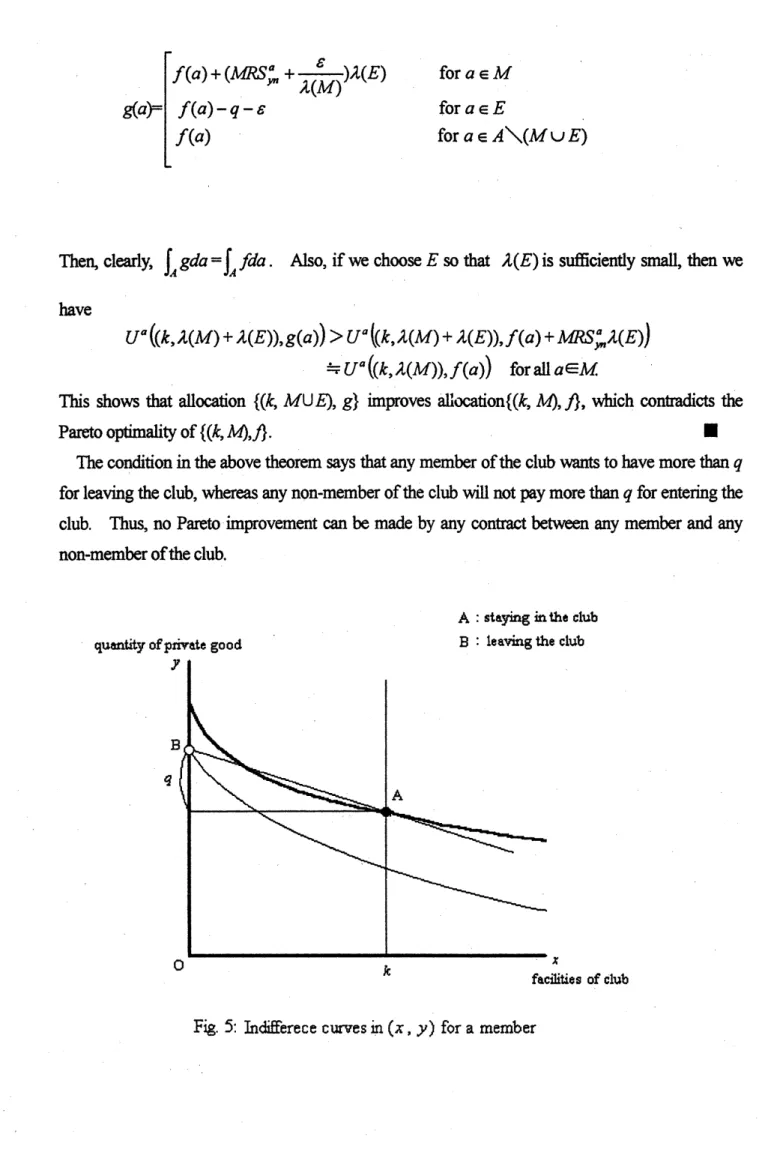
condition
in
the
above theorem
says
that
any memkr ofthe club
wants to
have
more
than
$q$
for leaving the
club,
whereas
any
non-member offfie club
w41
not
py
more
than
$q$
for entering the
club.
Thoe,
no
Paoeto
improvement
can
$\mathrm{k}$made by
any
conbact
between
any
$\mathrm{m}\alpha \mathrm{n}\mathrm{k}\mathrm{r}$and
any
non-memkr offfie club.
A
:
staving
in
the
club
A
:
$\epsilon i\mathrm{a}\dot{\mathrm{m}}\epsilon$out of
$\mathrm{f}\mathrm{f}\mathrm{i}\epsilon$rlub
Fig.
6:
hdiffcrencc
cuuves
$(x. y)$
for
a
non-mcmber
The
value
that each mmber
$a\in M$
of
the club gains fiom increasing
ffie
$\mathrm{f}\mathrm{a}\mathrm{c}\mathrm{i}\mathrm{h}\dot{\mathrm{b}}\mathrm{o}\mathrm{e}$of
ffie
club by
one
unit is denoted
by
$\mathrm{A}fflS_{yx}^{a}:=\frac{\partial U^{a}}{\partial x}\div\frac{\partial U^{a}}{\partial y}$
.
The
$\mathrm{m}\mathrm{a}\mathrm{r}\dot{\mathrm{g}}\mathrm{n}\mathrm{d}$cost
to
increase
the
$\Re \mathrm{i}\mathrm{h}\mathrm{b}\mathrm{e}\mathrm{s}$offfie
club
is denotd
by
$MT_{yx}.
\cdot=\frac{\partial F}{\partial x}-\cdot$
.
$\frac{\partial F}{\partial y}$.
ne
$\mathrm{f}\mathrm{o}\mathrm{U}\mathrm{o}\mathrm{w}\mathrm{i}\mathrm{n}\mathrm{g}$theorem
is
one
of
ffie Pareto ophmality
conditions derived
by
J.
$\mathrm{M}$Buchanan
(1965)
and
Y.-K.
Ng
(1973),
which
is
a
generahzabon
of the
$\mathrm{P}\mathrm{a}\iota \mathrm{e}\mathrm{t}\mathrm{o}$opbmality
$\infty \mathrm{n}\mathrm{d}\mathrm{i}\mathrm{b}o\mathrm{n}$for
allocabons
ofpurely public goods provd by
$\mathrm{P}$A.
Samuelson
(1954).
Then,
we
have
$\int_{M}M\mathfrak{B}_{\mu}^{a}da=MT_{y\mathrm{r}}$
$\underline{\mathrm{p}}_{\Phi}\mathrm{g}$
.
Suppose
$\int_{M}MS_{y\mathrm{r}}^{a}da<\mathrm{A}\mathcal{O}\mathfrak{i}T_{yx}$
.
Then,
there
exists
$\xi>0$
such
that
$\mathrm{A}_{i}RT_{J^{\alpha}}$
,
and
for all
sufficiently
$\mathrm{s}\mathrm{m}\mathrm{a}\mathrm{U}\delta>0$
,
$(k- \delta, \int_{A}fda+(\int_{M}MS_{\mu}^{a}da+s)\delta)\in \mathrm{Y}$
Define
$g\cdot.44arrow R_{+}$
by
$g(a\succ^{-}$
$fora\in A\backslash Mfora\in M$
Then,
clearly,
$\int_{A}gda=\int_{A}fda+(\int_{M}\mathrm{A}fflS_{y\alpha}^{a}da+s)d$
,
and
ffieoefore
$(k- \delta, \int_{A}gda)\in \mathrm{Y}$
,
which
implies that
$\mathrm{a}\mathrm{l}\mathrm{l}\propto \mathrm{a}\dot{\mathrm{n}}\mathrm{o}\mathrm{n}\{(k-\delta,M),g\}$
is feasible.
Also,
ifwe choose
a
small
$\delta$,
ffien
$U^{a}((k-\delta,\lambda(M)),g(a))>U^{a}((k-\delta,\lambda(M)),f(a)+hfflS_{yn}^{a}\delta)$
$\equiv U^{a}((k,\lambda(M)),f(a))$
for
all
$a\in M$
.
This shows that allocabon
$\{(k-d, M), g\}$
improves
allocabon
$\{(k, M),f\}$
,
which conbadicts
the
Pareto ophmahy
of
$\{(k,M),f\}$
.
In
case
of
$\int_{M}\mathrm{A}fflS_{\mu}^{a}da>\mathrm{A}\mathcal{O}\mathfrak{i}T_{yx},$
$\mathrm{c}\mathrm{h}\infty s\mathrm{e}\mathcal{E}<0$
and
$d<0$
such that
$\int_{M}\mathbb{R}S_{\mu}^{a}da+s>$
$\mathrm{A}RT_{j\propto}$
and
$(k-d, \int_{A}fda+(\int_{M}\mathbb{R}S_{y\alpha}^{a}da+\xi)d)\in \mathrm{Y}$
Then,
we
can
have
the
same
conbadiction
$\blacksquare$4. Supporting Prices
The
$\mathrm{c}\mathrm{o}\mathrm{n}\mathrm{d}\mathrm{i}\dot{\mathrm{b}}\mathrm{o}\mathrm{n}\mathrm{s}$in
Theorems
3.1
and
3.2
are
$\mathrm{n}\mathrm{o}\mathrm{e}\mathrm{e}\mathrm{s}\mathrm{s}\mathrm{a}\iota \mathrm{y}$
conditions for
Pareto
optimality,
but not
sufficient
$\mathrm{c}\mathrm{o}\mathrm{n}\mathrm{d}\mathrm{i}\dot{\mathrm{b}}\mathrm{o}\mathrm{n}\mathrm{s}$.
$\mathrm{h}$what
folows,
we w41
show
a
sufficient condition
for Pareto
optimahty.
We
assume
that the
prioe ofthe private
good
is
unity. Let
us
denote the
price
of the
$\infty \mathrm{m}\mathrm{m}\mathrm{M}\mathrm{t}\mathrm{y}$ $\mathrm{u}s\mathrm{d}$for
the club by
$p$
.
condibons
are
$\mathrm{s}\mathrm{a}\dot{\mathrm{b}}\mathrm{s}\mathrm{f}\mathrm{i}\mathrm{d}$:
(1)
If
$\{(k’,M?,f\}$
is
an
$\mathrm{a}\mathrm{l}\mathrm{l}\mathrm{o}\mathrm{c}\mathrm{a}\dot{\mathrm{b}}\mathrm{o}\mathrm{n}$such that
$U^{a}((k\chi_{\mathrm{A}t}(a), \lambda(M)),f(a))\leqq U^{a}((k’\chi_{M},(a),$
$\lambda(M’)),f’(a))$
for
all
$a\in E$
,
$\frac{pk}{\lambda(M)}\lambda(M\cap E)+\int_{E}fda\leqq\frac{pk’}{\lambda(M’)}\lambda(M\cap E)+\int_{E}fda$
.
(2)
$pk+ \int_{A}fda\geqq px+_{y}$
for
all
$(x,y)\in \mathrm{Y}$
The
above
deffiibon
means
$\mathrm{U}\mathfrak{N}$if
a
feasible alocahon
is
$S\mathrm{u}\mathrm{D}\mathrm{m}\mathfrak{n}\mathrm{d}$by
a
prioe,
people
are
The
$\mathrm{f}\mathrm{o}\mathrm{u}\mathrm{o}\mathrm{w}\check{\mathrm{l}}\mathrm{n}\mathrm{g}$theorem
shows
$\mathrm{f}\mathrm{f}\mathrm{i}\mathrm{a}\iota$
king supportd by
a
prioe
is
a
sufficient condibon for feasible
allocabons
to
$\mathrm{k}$Pareto
$\mathrm{o}\mathrm{p}^{\dot{\mathfrak{g}}}\mathrm{m}\iota \mathrm{m}$
.
Emof
Suppse that
a
feasible allocabon
$\{(k, M),f\}$
supprted by
a
prioe
$p\mathrm{w}\mathrm{e}\iota \mathrm{e}$not
Pareto
ophmum.
$\mathrm{R}\mathrm{e}\mathrm{n}$there
is
a
feasible alocahon
$\{(k’,M),f\}$
such
$\mathrm{t}\mathrm{h}\mathrm{a}\iota$$U^{a}((k\chi_{M}(a), \lambda(M)),f(a))\leqq U^{a}((k’\chi_{M’}(a), \lambda(M’)),f’(a))$
for all
$a\in A$
and ffie
$\ovalbox{\tt\small REJECT} \mathrm{i}\mathrm{c}\mathrm{t}$ineqffiity holds for
some
$a\in A$
.
Rerefore,
by
(1)
ofDefinibon
4.1,
we
can
show
bt
$pk+ \int_{A}fda<pk’+\int_{A}fda$
,
which
$\infty \mathrm{n}\mathrm{b}\mathrm{a}\ \mathrm{c}\mathrm{t}s(2)\mathrm{o}\mathrm{f}\mathrm{D}\mathrm{e}\mathrm{f}\mathrm{i}\dot{\mathrm{m}}\mathrm{t}\mathrm{i}\mathrm{o}\mathrm{n}4.1$.
$\blacksquare$$\int_{M}MS_{yn}^{a}da=\frac{pk}{\lambda(M)}$
and
$\Lambda RT_{yx}=p$
.
$\mathrm{E}\Omega \mathrm{L}\mathrm{f}$
Let
$E\subset M$
and
$X(E)>0$
.
$\mathrm{I}\mathrm{f},f(E)$
is sufficiently
small,
ffien for each
$a\in M$
ffiere
exists
$e$
$(a)>0$
such
ffiat
$U^{a}((k,\lambda(M)-\lambda(E)),f(a)-(\mathbb{R}S_{yn}^{a}-\epsilon(a))\lambda(E))>U^{a}((k,\lambda(M)),f(a))$
.
Now,
let
$\{(k’,M),f\}\mathrm{k}$
an
$\mathrm{a}\mathrm{l}\mathrm{l}\mathrm{o}\mathrm{c}\mathrm{a}\dot{\mathrm{b}}\mathrm{o}\mathrm{n}$such ffiat
$k’=k,M=M\backslash _{E}$
,
and
$f(a)=$
Then,
$U^{a}((k,\lambda(M’)),f(a))>U^{a}((k,\lambda(M)),f(a))$
for
each
$a\in M$
.
Therefooe,
by
(1)
of
$\frac{pk}{\lambda(M)}\lambda(M)+\int_{\mathrm{A}\Gamma}fda\leqq pk+\int_{M’}fda$
$\gamma k+\int_{M},fda+X(E\mathrm{x}-\int_{M}\mathrm{A}aS_{yn}^{a}da+\int_{\mathrm{A}t}\epsilon(a)\ )$
,
i.e.,
$\int_{\mathrm{A}l}\mathrm{A}fflS_{J^{n}}^{a}da\leqq\frac{pk}{\lambda(M)}+\int_{M}.\epsilon(a)da$
.
For each
$a\in M$
,
when2
(
$E$
goes
$\hslash 0,$
$\epsilon(a)$
also
goes
to
$0$
.
$\mathrm{R}\mathrm{u}s$,
the
akve
$\mathrm{i}\mathrm{n}\eta \mathrm{u}\mathrm{a}\mathrm{h}\eta$implioe ffiat
$\int_{M}\lambda RS_{yn}^{a}da\leqq\frac{pk}{\lambda\langle M)}$
.
$\mathrm{h}$
order
to
$\ovalbox{\tt\small REJECT}$ffie
opposioe
inequahty,
let
$E\subset A$
Wand
,
$I(E)>0$
.
If
2
$(E)$
is
sufficiently
small,
then
for each
$a\in M\mathrm{t}\mathrm{h}\alpha \mathrm{e}\mathrm{e}\mathrm{x}\mathrm{i}\Phi s(a)>0$
such ffiat
$U^{a}((k,\lambda(M)+\lambda(E)),f(a)+(\mathrm{A}aeS_{yn}^{a}+\epsilon(a))\lambda(E))>U^{a}((k_{*}\lambda(M)),f(a))$
.
Now,
let
{
$(k’,M),f?\mathrm{k}$
an
allocabon such ffiat
$k’=k,M=M\cup E$
,
and
$f(a)=$
$\mathrm{R}\mathrm{e}\mathrm{n},$
$U^{a}((k,\lambda(M^{t}))),f(a))>U^{a}((k,\lambda(M)),f(a))$
for
each
$a\in M$
.
Tkrefooe,
by
(1)
of
$\mathrm{D}\mathrm{e}\mathrm{f}\mathrm{i}\mathrm{n}\mathrm{i}\dot{\mathrm{b}}\mathrm{o}\mathrm{n}4.1$
,
we
have
$pk+ \int_{M}fda\leqq\frac{pk}{\lambda(M^{\mathrm{t}})}\lambda(M)+\int_{M}fda$
$\frac{-pk}{\lambda(M^{\mathrm{t}})}\lambda(M)+\int_{M}fda+2(E\chi\int_{M}\mathrm{A}fflS_{yn}^{a}da+\int_{M}\epsilon(a)da)$
,
i.e.,
$\frac{pk}{\lambda(M)}\leqq\int_{M}\mathrm{A}\mathfrak{M}S_{yn}^{a}da+\int_{\mathrm{A}\Gamma}\epsilon(a)da$
.
For each
$a\in M$
,
when
,
$l(E)$
goes
to
$0,$
$s(a)$
also
goes
to
$0$
.
Thus,
ffie
above
inequahty implioe
ffit
$\frac{pk}{\lambda(M)}\leqq\int_{M}\mathrm{A}aS_{yn}^{a}da$
.
Findly, by
(2)
ofoefinibon
4.1,
we
can
easily show ffiat
$MRT_{r^{--}}p$
.
$\blacksquare$Now
we
can
show ffiat the
$\mathrm{m}\mathrm{e}\mathrm{m}\mathrm{k}\iota \mathrm{s}\mathrm{h}\mathrm{i}\mathrm{p}$fee of
the
club
is
$\frac{pk}{\lambda(M)}$
and the
demand prioe
for the
Ken,
we
have ffie
$l\mathrm{o}\mathrm{u}\mathrm{o}\backslash \mathrm{V}\mathrm{l}\mathrm{n}\mathrm{g}.\cdot$
(1)
$U^{a}((0, \lambda(M)),f(a)+\frac{pk}{\lambda(M)})\leqq U^{a}((k,\lambda(M)),f(a))$
for al
$a\in M$
and
$U^{a}((k, \lambda(M)),f(a)-\frac{pk}{\lambda(M)})\leqq U^{a}((0,\lambda(M)),f(a))$
for all
$a\in A\backslash M$
.
(2)
$\int_{M}\mathrm{A}fflS_{y\propto}^{a}da=p$
$\Xi \mathfrak{W}\mathrm{f}$
By
$\mathrm{R}\infty \mathrm{r}\mathrm{e}\mathrm{m}4.1$
,
any
$\mathrm{f}\mathrm{a}\mathrm{e}\mathrm{s}\iota \mathrm{b}\mathrm{l}\mathrm{e}$allocation
$\sup\mu\iota \mathrm{t}\mathrm{e}\mathrm{d}$
by
a
prioe
is
Pareto
ophmum,
and
ffierefore ffiis theorem
$\mathrm{i}\mathrm{m}\mathrm{m}\mathrm{e}\mathrm{d}\mathrm{i}\mathrm{a}\iota \mathrm{e}\mathrm{l}\mathrm{y}$follows ffom
Lemma 4.1, Theorems
3.1
and
3.2.
$\blacksquare$We
do
not
know under
$\mathrm{w}\mathrm{h}\mathrm{a}\iota$assumptions the
converse
of Theorem
4.1
holds,
ffiat is,
if
an
allocabon
is Pareto
$\mathrm{o}\mathrm{p}\dot{0}\mathrm{m}\iota \mathrm{m}\mathrm{L}$then it
is
supprted by
a
prioe.
The
$\mathrm{c}\mathrm{h}\mathrm{a}\iota \mathrm{a}\mathrm{c}\mathrm{t}\mathrm{e}\dot{\mathrm{n}}\mathrm{z}\mathrm{a}\dot{\mathrm{b}}\mathrm{o}\mathrm{n}$,
by
using prioes,
ofPareto
$\mathrm{o}\mathrm{p}^{\mathfrak{g}}\mathrm{m}\mathrm{u}\mathrm{m}$allocabons in
the
economy
with clubs is
an
$0\mathrm{f}\mathrm{f}^{\mathrm{n}}$
problem.
5.
Compebtive
$\mathrm{E}\mathrm{q}\mathrm{M}\mathrm{b}\mathrm{r}\mathrm{i}\mathrm{u}\mathrm{m}$Let
us
denote
ffie
prioe
ofthe good usd
for
the
club by
$p$
and the
prioe
$\mathrm{o}\mathrm{f}\mathrm{m}\mathrm{e}\mathrm{m}\mathrm{b}\mathrm{e}\iota \mathrm{s}\mathrm{h}\mathrm{i}\mathrm{p}$ofthe
club
by
$q$
.
such
$\mathrm{t}\mathrm{h}\mathrm{a}\iota$the
$\mathrm{f}\mathrm{o}\mathbb{I}\mathrm{o}\mathrm{w}\mathrm{i}\mathrm{n}\mathrm{g}$
conditions
are
satisfied:
(1)
$U^{a}((0,\lambda(M)),f(a)+q)\leqq U^{a}((k,\lambda(M)),f(a))$
for
all
$a\in M$
and
$U^{a}((k,\lambda(M)),f(a)-q)\leqq U^{a}((0,\lambda(M)),f(a))$
for all
$a\in A\backslash M$
.
(2)
$\mathrm{I}\mathrm{f}\{(k’,M),f\}\mathrm{i}s\mathrm{a}\mathrm{n}\mathrm{a}11\mathrm{o}\mathrm{c}\mathrm{a}\mathrm{b}\mathrm{o}\mathrm{n}\mathrm{s}\mathrm{u}\mathrm{c}\mathrm{h}\mathrm{b}\mathrm{a}\mathrm{t}$$U^{a}((k\chi_{M}(a), \lambda(M)),f(a))\leqq U^{a}((k^{\mathfrak{l}}, \lambda(M’)),f’(a))$
for
all
$a\in M$
,
then
$q \lambda(M\cap M’)+\int_{M},fda\leqq pk’+\int_{\mathrm{t}f}fda$
.
(4)
$pk+ \int_{A}fda\geqq px+y$
for all
$(*y)\in Y$
.
$\mathrm{h}$
ffie
akve
$\mathrm{d}\mathrm{e}\mathrm{f}\mathrm{i}\dot{\mathrm{m}}\dot{\mathrm{b}}0\iota \mathrm{c}\mathrm{o}\mathrm{n}\mathrm{d}\mathrm{i}\dot{\mathrm{b}}\mathrm{o}\mathrm{n}(1)$moens
that each
$\mathrm{f}\mathrm{f}^{\mathrm{r}\mathrm{s}\mathrm{o}\mathrm{n}}$is
$\mathrm{m}\mathrm{a}.\mathrm{i}\ovalbox{\tt\small REJECT} \mathrm{g}\mathrm{u}\mathrm{h}\mathrm{l}\mathrm{i}\Psi \mathrm{l}\mathrm{m}\mathrm{d}\mathrm{e}\mathrm{r}$
abudget
consffaint
$\mathrm{C}\mathrm{o}\mathrm{n}\mathrm{d}\mathrm{i}\dot{\mathrm{b}}\mathrm{o}\mathrm{n}(2)$moens
that the club
cant
change
its
memkrs by mahng
koer offers
to
new
memkrs
at
the
same
cost
Therefore,
condibons
(1)
and
(2)
imply ffiat
ffie market of
$\mathrm{m}\mathrm{e}\mathrm{m}\mathrm{k}\iota \mathrm{s}\mathrm{h}\mathrm{i}\mathrm{p}$
is in
$\mathrm{e}\mathrm{q}\mathrm{u}\mathrm{i}\mathrm{h}\mathrm{b}\dot{\mathrm{n}}\iota \mathrm{n}\mathrm{n}$.
Condihon
(3)
moens
ffiat the market
of
membersiuip
is
$\mathrm{c}\mathrm{o}\mathrm{m}f\dot{fl}\dot{\mathrm{b}}\mathrm{v}\mathrm{e}$
and ffie club
ffls
no
profits in
$\mathrm{e}\mathrm{q}\mathrm{u}\mathrm{i}\mathrm{h}\mathrm{b}\dot{\mathrm{n}}\iota \mathrm{m}$.
$\mathrm{C}\mathrm{o}\mathrm{n}\mathrm{d}\mathrm{i}\dot{\mathrm{b}}\mathrm{o}\mathrm{n}(4)$means
the
producers
$\mathrm{o}\mathrm{f}\infty \mathrm{m}\mathrm{m}\mathrm{o}\mathrm{d}\mathrm{i}\dot{\mathrm{b}}\mathrm{e}\mathrm{s}$
are
In
(1)
of
the
above
$\mathrm{d}\mathrm{e}\mathrm{f}\mathrm{i}\dot{\mathrm{m}}\mathrm{b}\mathrm{o}_{l}$it is
$\mathrm{a}s\mathrm{s}\iota \mathrm{m}\mathrm{d}$ffiat each
prson
decide wheffier he
(or she)
should
join ffie
exishng
club,
or
not
Therefore,
our
$\mathrm{d}\mathrm{e}\mathrm{f}\mathrm{i}\mathrm{n}\mathrm{i}\dot{\mathrm{b}}\mathrm{o}\mathrm{n}$of
comfflibve
$\mathrm{e}\mathrm{q}\mathrm{u}\mathrm{i}\mathrm{h}\mathrm{b}\mathrm{r}\mathrm{i}\iota \mathrm{m}\mathrm{l}$is
different ffom
that
of
S.
Scotchmer,
S. and M. X
WMers
(1987),
in
$\mathrm{w}l\dot{\mathrm{u}}\mathrm{c}\mathrm{h}\varphi \mathrm{o}\mathrm{p}\mathrm{l}\mathrm{e}\mathrm{c}\mathrm{h}\infty \mathrm{s}\mathrm{e}$one
club
to
join
among
many ptenbally exisong clubs.
Now
we
can prove
ffie
basic
ffieorem
ofwelfare
economics
for
economies
with
clubs.
$\mathrm{R}\mathrm{f}$
Suppose
ffiat
a
$\infty \mathrm{m}\infty \mathrm{t}\mathrm{i}\mathrm{v}\mathrm{e}$allooehon
$\{(k,M),f\}$
were
not
Pareto
ophmum.
$\Pi \mathrm{e}\mathrm{n}$there
is
a
feaslble
$\mathrm{a}\mathrm{l}\mathrm{l}\propto \mathrm{a}\iota \mathrm{i}\mathrm{o}\mathrm{n}\{(k’,M),f\}$such that
$U^{a}((k\chi_{M}(a), \lambda(M)),f(a))\leqq U^{a}((k’\chi_{M},(a),$
$\lambda(M’)),f’(a))$
for all
$a\in A$
,
where
ffie
$\mathfrak{W}\mathrm{c}\mathrm{t}\mathrm{i}\mathrm{n}\Re \mathrm{u}\mathrm{a}\mathrm{h}\mathfrak{h}^{r}$holds for
some
$a\in A$
.
For each
$a\in M$
,
we
have
$U^{a}((k\chi_{M}(a), \lambda(M)),f(a))\leqq U^{a}((k’, \lambda(M’)),f(a))$
.
Rerefore,
by
(2)
$\mathrm{o}\mathrm{f}\mathrm{R}\mathrm{f}\mathrm{i}\dot{\mathrm{m}}\dot{\mathrm{b}}\mathrm{o}\mathrm{n}5.1$,
we
have
$q \lambda(M\cap M’)+\int_{M}.fda\leqq pk’+\int_{M},fda$
.
For
each
$a\in M\backslash \mathrm{A}l$
,
we
have
$U^{a}((k, \lambda(M)),f(a))\leqq U^{a}((0, \lambda(M’)),f(a))=U^{a}((0, \lambda(M)),f(a))$
,
which implies,
by
(1)
$\mathrm{o}\mathrm{f}\mathrm{D}\mathrm{e}\mathrm{f}\mathrm{f}\mathrm{i}\iota \mathrm{i}\mathrm{b}\mathrm{o}\mathrm{n}5.1$,
thatf
$(a)+q\leqq f(a)$
.
$\Pi \mathrm{u}\mathrm{s}$,
we
have
$q \lambda(\mathrm{m})+\int_{\lambda\kappa 1l}fda\leqq \mathrm{j}_{\mathrm{A}KM}.fda$
.
For each
$a\in A\backslash (M\cup M)$
,
we
have
$\mathrm{w}\mathrm{h}\mathrm{i}\mathrm{c}\mathrm{h}\mathrm{i}\mathrm{m}\mathrm{p}\mathrm{l}\mathrm{i}\mathrm{e}s\mathrm{t}\mathrm{h}\mathrm{a}\iota fla)\leqq f(a)$
.
$\mathrm{T}\mathrm{h}\mathrm{u}s,$ $\mathrm{w}\mathrm{e}\mathrm{h}\mathrm{a}\mathrm{v}\mathrm{e}$$\int_{A\backslash (\mathrm{A}\mathrm{O}M)}.fda\leqq\int_{A\backslash (\mathrm{A}DM)}fda$
.
In
one
ofthe
$\mathrm{a}\mathrm{U}\mathrm{v}\mathrm{e}$ffiroe
inequahties, the
strict
$\mathrm{i}\mathrm{n}\Re \mathrm{u}\mathrm{a}\mathrm{h}\eta$
holds.
Therefore,
by adding them
up,
we
have
$q \lambda(M)+\int_{A}fda<pk’+\int_{A}fda$
,
whch,
by
(3)
$\mathrm{o}\mathrm{f}\mathrm{D}\mathrm{e}\mathrm{f}\mathrm{i}\dot{\mathrm{m}}\mathrm{b}\mathrm{o}\mathrm{n}5.1,$ $\infty \mathrm{n}\mathrm{u}\mathrm{a}\ \mathrm{c}\mathrm{t}\mathrm{s}(4)\mathrm{o}\mathrm{f}\mathrm{D}\mathrm{e}\mathrm{f}\mathrm{i}\dot{\mathrm{m}}\dot{\mathrm{b}}\mathrm{o}\mathrm{n}5.1$.
$\blacksquare$Referenoes
Berglas,
$\mathrm{E}.(1976)$
,
On the
$\mathrm{t}\mathrm{h}\mathrm{e}\mathrm{o}\iota \mathrm{y}$ofclubs,
American Economic Review 66,
pp. 116-121.
$\mathrm{B}\mathrm{u}\mathrm{c}\mathrm{h}\mathrm{a}\mathrm{n}\mathrm{a}\iota_{\mathrm{L}}$J.
$\mathrm{M}.(1965)$
,
An
economic
$\mathrm{t}\mathrm{h}\infty \mathrm{r}\mathrm{y}$
ofclubs,
Economica
32,
$\mathfrak{M}^{1- 14}.$
.
Foley,
$\mathrm{D}.(1967)$
,
Resouroe
allocarion and
the public
$s\mathrm{e}\alpha \mathrm{o}\mathrm{r}$,
Yale
Economic
$Ess\varphi s$
7,
pp.43-98.
HelPmU
E. and A.
H41man
(1977),
Two remarks
on
opbmal club size,
Economica 44, pp.293-96.
Ng,
Y-K(1973),
The
economic
theory
of clubs: Pareto
$\mathrm{o}\mathrm{p}\mathrm{h}\mathrm{m}\mathrm{a}\mathrm{h}\Psi$condibons,
Economica
40,
pp.291-298.
.
(1974),
The
oeonomic
theory
ofclubs:
Opbmal
$\mathrm{b}\mathrm{x}/\mathrm{s}\mathrm{u}\mathrm{b}\mathrm{s}\mathrm{i}\mathrm{d}\mathrm{y}$,
Economica
41,
pp.308-321.
.
(1978),
$\mathrm{O}\mathrm{p}\dot{\mathrm{h}}\mathrm{m}\mathrm{a}\mathrm{l}$club
size:
A
reply,
Economica
45, pp.407A10.
Richter,
D.
$\mathrm{K}.(1974)$
,
The
core
of
a
public
goods
economy,
Intemational
Economic
Review 15,
pp.
131-142.
Samuelson,
P
$\mathrm{A}.(1954)$
,
The
pure
ffieory ofpublic
$\mathrm{e}\varphi \mathrm{n}\mathrm{d}\mathrm{i}\mathrm{t}\mathrm{u}\mathrm{r}\mathrm{e}$,
Review
ofEconomics
md
Statistics
36,
pp.387-89.
Sandler,
T.
and J. T.
Tschirhart
(1980),
The
economic
$\mathrm{t}\mathrm{h}\infty \mathrm{I}\mathrm{y}$ofclubs:
An evaluabve
survey,
Jmnal
ofEconomic
Literature 18,
pp. 1481-1521.
Scotchmer,
$\mathrm{S}.(1985)$
,
Profit
$\mathrm{m}\ovalbox{\tt\small REJECT} \mathrm{g}$
clubs,
Joumal
ofPublic
Economics
27, pp.25A5.
Scotchmer,
S.
and
M. H.
$\mathrm{W}\infty \mathrm{d}\mathrm{e}\mathrm{r}\mathrm{s}$(1987),
$\mathrm{C}\mathrm{o}\mathrm{m}\dot{\infty}\dot{\mathrm{u}}\mathrm{v}\mathrm{e}$