Large-time
behaviors
of
solutions to
an
inflow
problem
in
the
half
space
for
a
one-dimensional
system
of
compressible viscous
gas
早大政経 西原 健二
(Kenji
Nishihara
阪大理 松村 昭孝
(Akitaka
Matsumura)
1
Introduction
We consider the initial-boundary value problem
on
$\mathrm{R}_{+}=(0, \infty)$ for asystem ofone-dimensional
barotropic viscous flow in the Eulerian coordinate:$\{$
$\tilde{\rho}_{t}+(\tilde{\rho}\tilde{u})_{\overline{x}}=0$, $(\tilde{x}, t)\in \mathrm{R}_{+}\cross \mathrm{R}_{+}$ $(\tilde{\rho}\tilde{u})_{t}+(\tilde{\rho}\tilde{u}^{2}+\tilde{p})_{\overline{x}}=\mu\tilde{u}_{\tilde{x}\tilde{x}}$
$(\tilde{\rho},\tilde{u})|_{t=0}=(\tilde{\rho}_{0},\tilde{u}_{0})(\tilde{x})arrow(\rho_{+}, u_{+})$
as
$\tilde{x}arrow+\infty$$(\tilde{\rho},\tilde{u})|_{\overline{x}=0}=(\rho_{-}, u_{-})$,
(1.1)
where the conditions
$\beta\pm>0,\tilde{\rho}_{0}(\tilde{x})>0$ and $u_{-}>0$
andthe compatibility conditions areassumed. Here$\tilde{\rho}$is the density,
$\tilde{u}$is the velocity,
and the pressure$\tilde{p}$ is given by $\tilde{p}=\tilde{\rho}^{\gamma}(\gamma\geq 1)$. Since $u_{-}>0$, the flow with
$(\rho_{-}, u_{-})$
goes into the region under consideration through the boundary $\tilde{x}=0$, and hence
the problem (1) is called the
inflow
problem. In thecase
of $u_{-}=0$ the condition$\tilde{\rho}|_{\overline{x}=0}=\rho_{-}$ is not imposed. The asymptotic behaviors in the
case
$u_{-}=0$are
investigated
in $[3,7]$. The present problem is treated in Matsumura and Nishihara[8].
We first rewrite (1.1) in the Lagrangiancoordinate. The
mass
of thegasinflowed for $(0, t)$ is $\mathrm{p}-\mathrm{U}-\mathrm{t}=\frac{u-}{v-}t$, $v_{-}:=1/\rho_{-}$. Hence, the problem (1.1) is transformed intothat with the moving boundary $x=\mathrm{s}_{-}\mathrm{t}$, $s_{-}=-u_{-}/v_{-}(<0)$ in the Lagrangean
coordinate:
$\{$
$v_{t}-u_{x}=0$, $(x, t)\in\{(x, t);x>s_{-}t, t>0\}$
$u_{t}+p(v)_{x}=\mu(_{v}^{\underline{u}_{\mathrm{a}}})_{x}$, $p=p(v)=v^{-\gamma}$
$(v, u)|_{t=0}=(v_{0}, u_{0})(x)arrow(v_{+}, u_{+}):=(1/\rho_{+}, u_{+})$ as $xarrow+\infty$ $(v, u)|_{x=0}=(v_{-}, u_{-})=(1/\rho_{-}, u_{-})$,
(1.1)
where $(v, u)(x, t)=(1/\tilde{\rho},\tilde{u})(\tilde{x}, t)$
.
Our aim is to investigate theasymptotic behaviors of the solution $(v, u)$ to (1.2),
equivalent to (1. 1).
The characteristic speeds for the corresponding hyperbolic system are $\lambda_{:}(v)=$
$(-1)^{i}\sqrt{-p’(v)}$, $i=1,2$ . Comparing the speed $s_{-}$ of moving boundary with the
数理解析研究所講究録 1225 巻 2001 年 99-113
characteristic speed $\lambda_{1}(v)$, we devide the quarter space into three resions $\Omega_{*ub}$ $=$ $\{(v, u);0<u<c(v), v>0, u>0\}$
.
$\Gamma_{tra’ 1\iota}$ $=$ $\{(v,u);u=c(v), v>0, u>0\}$ (1.3)
$\Omega_{\iota \mathrm{u}\mu r}$ $=$ $\{(v,u);u>c(v), v>0, u>0\}$,
where $c(v)=v\sqrt{-ff(v)}=\sqrt{\gamma}v^{-*^{1}}(=\sqrt{p^{\sim}(\tilde{\rho})})$ is the soundspeed. So, we call them
the subsonic, transonic and supersonic regions, respectively.
See
Figure 1.1.$u$ ’ 1 $\Omega_{u\mathrm{p}\mathrm{e}r}$
.
$\Gamma_{\iota r\mathrm{n}\iota},.-c(v)$ $\Omega_{\epsilon ub}$ $v$ Figure1.1.
$=1$)If$(v_{-},u_{-})\in\Omega_{\epsilon ub}$, them $\lambda_{1}(v_{-})<s_{-}(<0)$, and hence the existence ofatraveling
wave
solution $(V, U)(x-s_{-}t)$ with $(V, U)(0)=(v_{-},u-)$, $(V, \mathrm{U})(0)=(v_{+},u_{+})$ isexpected. Substitute this into $(1.2)_{1,2}$ (this
means
the first and second equations in(1.3)$)$ tohave
$\{$
$-s_{-}V’-U’=0$, $’=d/d\xi$, $\xi=x-s_{-}t>0$
$-s_{-}U’+p(V)’= \mu(\frac{U’}{V})’$
$(V, U)(0)=(v_{-}, u-)$, $(V, U)(+\infty)=(v_{+}, u_{+})$.
(1.4)
When the solution $(V, U)$ to (1.4) exists, it is called the boundary layer solution,
or
$\mathrm{B}\mathrm{L}$-solution simply. Seek for the condition for the existence. When $(V, U)$ exists,
the integration of (1.4)
over
$(0, \infty)$ and $(\xi, \infty)$ yields$\{$ $-s_{-}(v_{+}-v_{-})-(u_{+}-u_{-})=0$ $-s_{-}(u_{+}-u_{-})+p(v_{+})-p(v_{-})=- \mu\frac{U’(0)}{v_{-}}$ (1.5) and $\{$ $-s_{-}(V-v_{+})-(U-u_{+})=0$ $-s_{-}(U-u_{+})+p(V)-p(v_{+})= \mu\frac{U’}{V}$. (1.6) From $(1.5)_{1}$ and $(1.6)_{1}$ $s_{-}=- \frac{U(\xi)}{V(\xi)}=-\frac{u_{-}}{v_{-}}=-\frac{u_{+}}{v_{+}}$ , (1.7)
100
and hence
we
define $BL$-line through $(v_{-}, u_{-})\in\Omega_{sub}$ by$\mathrm{B}\mathrm{L}\{\mathrm{V}-,$$u_{-})= \{(v, u)\in\Omega_{svb}\cup\Gamma_{trans};\frac{u}{v}=\frac{u_{-}}{v_{-}}=-s_{-}\}$.
Especially, denote $\Gamma_{trans}\cap BL(v_{-}, u-)=\{(v_{*}, u_{*})\}$. By (1.6) we have the ordinary
differential equation of $V$:
$\{$
$\mu\frac{dV}{d\xi}=\frac{V}{s_{-}}\{-s_{-}^{2}(V-v_{+})-(p(V)-p(v_{+}))\}=:\frac{V}{s_{-}}h(V)$
$V(0)=v_{-}$, $V(+\infty)=v_{+}$.
(1.8)
Conversely
we can
show the existence of the solution $V$ to (1.8) and hence $U$ for$(v_{+}, u_{+})\in BL(v_{-}, u_{-})$. At $(v_{*}, u_{*})$, $-s_{-}^{2}=-(u_{*}/v_{*})^{2}=-(c(v_{*})/v_{*})^{2}=-\gamma v_{*}^{-\gamma-1}=$
$p’(v_{*})$
.
That is, $-s_{-}^{2}$ is the slope of the tangential line of$p(V)$ at $(v_{*},p(v_{*}))$. Hencewe find that $h(v_{+})=0$, $h(v)>0$ and $\frac{dV}{d\xi}<0$ for $v_{+}<v<v_{-}$ if $v_{+}<v_{-}$, and
$h(v)<0$ and $\frac{dV}{d\xi}>0$ for $v_{-}<v_{+}(\leq v_{*})$ if $v_{-}<v_{+}$. Thus, we have the following
lemma.
Lemma 1. 1(Boundary Layer Solution) Let $(v_{-}, u_{-})\in\Omega_{sub}$ and $(v_{+}, u_{+})\in$ $BL(v_{-}, u_{-})$. Then, there eists a unique solution $(V, U)(\xi)$ to $(1.\mathit{8})_{f}$ which
satisfies
$|(V(\xi)-v_{+}, U(\xi)-u_{+})|\leq C\delta\exp(-c|\xi|)$
if
$v_{+}<v_{*}$ $|(V(\xi)-v_{+}, U(\xi)-u_{+})|\leq C\delta|\xi|^{-1}$if
$v_{+}=v_{*}$,there $\delta=|(v_{+}-v_{-}, u+-u_{-})|$.
On the other hand, since $0>\lambda_{1}(v)>s_{-}$ in $\Omega_{\sup er}$, the 1-characteristic field is away from the moving boundary. Since $\lambda_{2}(v)>0>s_{-}$, the waves along the
2-characteristic field, of course, go away from the boundary. Hence, in these
cases
the behaviors of solutions
are
expected to besame as
those for the Cauchy problem(See Matsumura and Nishihara [4,5,6]).
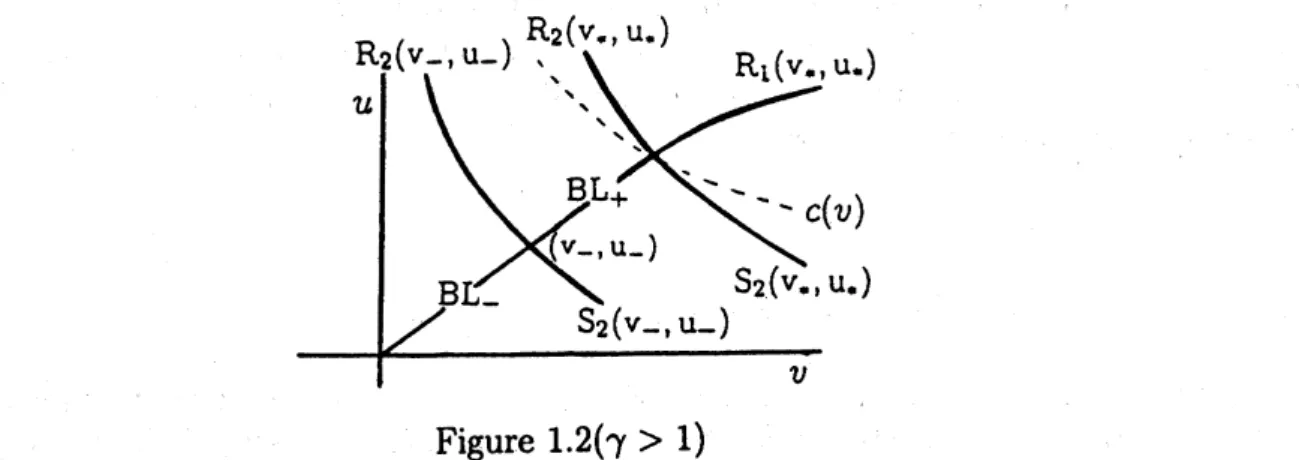
Hence, the large time behaviors to be expected devide the $(v, u)$-space as the
following figure, Figure 1.2.
Figure
1.2.
$>1$)Here,
$BL_{+}(v_{-}, u_{-})=\{(v, u)\in BL(v_{-}, u_{-});v_{-}<v\leq v_{*}\}$
$BL_{-}(v_{-}, u_{-})=\{(v, u)\in BL(v_{-}, u_{-});0<v<v_{-\}}$ $R_{1}(v_{*}, u_{*})=$
{
$(v,$$u);u=u_{*}- \int_{v_{*}}^{v}$Xi$(s)ds$, $v>v_{*}$}
$R_{2}(v_{-}, u_{-})= \{(v, u);u=\mathrm{v}\mathrm{z}_{-}-\int_{v-}^{v}\lambda_{2}(s)ds, v<v_{*}\}$$R_{2}(v*’ u*)=$
{
$(v,$$u);u=u_{*}- \int_{v_{*}}^{v}$X2(s)ds, $v<v_{*}$}
$S_{2}(v_{-}, u_{-})=\{(v, u);u=\mathrm{t}\mathrm{z}_{-}-s_{2}(v-v_{-}), v>v_{-}\}$ $S_{2}(v_{*}, u_{*})=\{(v, u);u=u_{*}-s_{*}(v-v_{*}), v>v_{*}\}$,
(I) If $(v+’ u_{+})\in BL_{+}(v_{-}, u-)$, then the $\mathrm{B}\mathrm{L}$-solution
is stable.
(II) If $(v_{+}, u_{+})\in BL_{-}(v_{-}, u_{-})$ , then the $\mathrm{B}\mathrm{L}$-solution is stable provided that
$|(v_{+}-v_{-}, u_{+}-u_{-})|$ is small. That is, the $\mathrm{B}\mathrm{L}$-solution
is
necessary
to be weak.(III) If $(v_{+}, u_{+})\in BL_{+}R_{2}(v_{-}, u-)$, then there exists $(\mathrm{v},\mathrm{u})\overline{u})\in BL_{+}(v_{-}, u_{-})$
such that $(v_{+}, u_{+})\in R_{2}(\overline{v},\overline{u})$, and the superposition of the $\mathrm{B}\mathrm{L}$-solution connect-$\mathrm{i}\mathrm{n}\mathrm{g}$ $(v_{-}, u_{-})$ with $(\overline{v},\overline{u})$ and the 2-rarefaction
wave
connecting$(\overline{v},\overline{u})$ with $(v_{+}, u_{+})$
is stableprovided that $|(v_{+}-\overline{v}, u_{+}-\overline{u})|$ is small, where
$BL_{+}R_{2}(v_{-}, u_{-})=$
{
$(v,$$u);u>-s_{-}v$, $u>u_{-}- \int_{v-}^{v}\lambda_{2}(s)ds$, $u \leq u_{*}-\int_{v}^{v}$.X2
$(s)ds$}.
That is, the rarefaction
wave
is weak, but the $\mathrm{B}\mathrm{L}$-solution is notnecessarily weak.
(IV) If $(v+’ u_{+})\in BL_{-}R_{2}(v_{-}, u-)$, then the superposition of the $\mathrm{B}\mathrm{L}$-solution and
the 2-rarefaction wave is stable provided that $|(v_{+}-v_{-}, u_{+}-u_{-})|$ is small, where
$BL_{-}R_{2}(v_{-}, u_{-})=$
{
(v, u);u $>-\mathrm{s}_{-}\mathrm{v}$, u $<u_{-}- \int_{v-}^{v}$X2$(s)ds$}.
In this case, both the $\mathrm{B}\mathrm{L}$-solution and the rarefaction
wave are weak.
(V) If $(v_{*}, u_{*})\in BL_{+}(v_{-}, u-)$, $(v_{+}, u_{+})\in R_{1}R_{2}(v_{*}, u_{*})$ and $|(v_{+}-v_{*},$ $u_{+}-$
$u_{*})|$ is small, then the superposition of the $\mathrm{B}\mathrm{L}$-solution, 1-rarefaction
wave
and2-rarefaction
wave
is stable. Here,$R_{1}R_{2}(v_{*}, u_{*})=$
{
(v,u);u $>u_{*}- \int_{v}^{v}$.
Xi(s)ds, i $=1,$2}.
Similar to (III), the $\mathrm{B}\mathrm{L}$-solution is not necessarily weak.
In the proofs of the above assertions, the sign of $U_{\xi}=V_{t}$ is important, similar
to those of the Cauchy problem. So, to show (/) and (II) are essential. The case
(III), $(\mathrm{I}/^{\ovalbox{\tt\small REJECT}})$ are the applications to (/), and (IV) is to (//). In the next section we
mainly state the stability thorems of the boundary layer solutions.
The other cases are still open. For example, when
$(v_{+}, u_{+})\in BL_{-}S_{2}(v_{-}, u_{-})=\{(v, u);u<-s_{-}v, u<u_{-}-s_{2}(v-v_{-})\}$,
theasmptoticstateis conjectured to be $(V, U)(x-s_{-}t)+(V_{2}^{S}, U_{2}^{S})(x-s_{2}t+\alpha)-(\overline{v},\overline{u})$
together with asuitable shift $\alpha$, where $(\overline{v},\overline{u})\in BL_{-}(v_{-}, u_{-})$ such that $(v_{+}, u_{+})\in$ $\mathrm{s}2\{\mathrm{v}\overline{u}$), and $(V, U)$ is the $\mathrm{B}\mathrm{L}$-solution connecting $(v_{-}, u_{-})$ with $(\overline{v},\overline{u})$ and $(V_{2}^{S}, U_{2}^{S})$
is 2-viscous shock
wave
connecting $(\overline{v},\overline{u})$ with $(v_{+}, u_{+})$. Even though the shift $\alpha$ isconjectured by the
same
wayas
in Matsumura and Mei [3], thiscase
is not solvedyet.
2Stability of the boundary layer
solution
2.1
The
case
$(v_{+}, u_{+})\in BL_{+}(v_{-}, u_{-})$Assume that
$(\mathrm{V}, u_{-})\in\Omega_{sub}$ and $(v_{+}, u_{+})\in BL+(v_{-}, u_{-})$, (2.1)
then aboundarylayersolution $(V, U)(\xi)$, $\xi=x-s_{-}t\geq 0$, $s_{-}=-u_{-}/v_{-}$ connecting
$(v_{-}, u_{-})$ with $(v_{+}, u_{+})$ is uniquely determined in Lemma 1.1. Note that
$U_{\xi}=-s_{-}V_{\xi}>0$, (2.2)
which plays an important role in theapriori estimate. The perturbation $(\phi, \psi)(\xi, t)$
defined by
$(v, u)(x, t)=(V, U)(\xi)+(\phi, \psi)(\xi, t)$, (2.3)
satisfies
$\{$
$\phi_{t}-s_{-}\phi_{\xi}-\psi_{\xi}=0$, $\xi>0$, $t>0$
$\psi_{t}-s_{-}\psi_{\xi}+(p(V+\phi)-p(V))_{\xi}=\mu(\frac{U_{\xi}+\psi_{\xi}}{V+\phi}-\frac{U_{\xi}}{V})_{\xi}$
$(\phi, \psi)|_{\xi=0}=(0,0)$
$(\phi, \psi)|_{t=0}=(\phi_{0}, \psi_{0})(\xi):=(v_{0}-V, u_{0}-U)(\xi)$,
(2.4)
from (1.2) and (1.6).
To solve (2.4)
we
apply the $L^{2}$-energy method. The solution space is defined by$X_{m,\Lambda f}(0, T)=\{(\phi, \psi)\in C([0, T];H_{0}^{1})|\phi_{x}\in L^{2}(0, T;L^{2})$, $\psi_{x}\in L^{2}(0, T;H^{1})$
with $\sup_{[0,T]}||(\phi, \psi)(t)||_{1}\leq M$, $\inf_{\mathrm{R}_{+}\cross[0,T]}(V+\phi)(\xi, t)\geq m\}$,
for positive constants $m$, $M$. Here, we denote $||f||_{k}=( \sum_{j=1}^{k}.||\partial_{x}^{j}f||^{2})^{1/2}$ and $||f||=$
$( \int_{0}^{\infty}|f(x)|^{2}dx)^{1/2}$. To obtain atime-globalsolution, we combine the time-local
exis-tence of the solution with the apriori estimates, which are given as follows
Proposition 2. 1(Local existence) Let ($o,$\ovalbox{\tt\small REJECT}\# 0$) be in $\mathrm{f}\mathrm{f}|3$(R.). $If|| 0$,
$\mathrm{e}_{0}||_{\mathrm{t}}\ovalbox{\tt\small REJECT}$
M and $\inf 4\mathrm{x}(0,T)(\mathrm{I}’+(4\rangle t)\ovalbox{\tt\small REJECT}_{\ovalbox{\tt\small REJECT}}m$, then there $e\ovalbox{\tt\small REJECT} ts$ $t_{0}\ovalbox{\tt\small REJECT}$ $t_{0}$(m,
A#)
$>0$ such that (24) has a unique solution ($, e) E $X_{4^{\ovalbox{\tt\small REJECT}\cdot,27\mathrm{H}}}(0, t_{0})$.Proposition 2. 2(A priori estimates) Let $(\phi, \psi)$ be asolutionto (2.4) in $X_{\frac{1}{2}m,\epsilon}$
$(0, T)$. Then,
for
a suitably small$\epsilon$ $>0$, there exists a constant $C_{0}>0$such that
$||( \phi, \psi)(t)||_{1}^{2}+\int_{0}^{t}(\psi_{\xi}(0, \tau)^{2}+||\sqrt{V_{\xi}}\phi(\tau)||^{2}+||\phi_{\xi}(\tau)||^{2}+||\psi_{\xi}(\tau)||_{1}^{2})d\tau\leq C_{0}||\phi_{0}$ ,$\psi_{0}||_{1}^{2}$.
Remark 2.1 If $\epsilon$ is suitably small, then
$\inf_{\mathrm{R}_{+}\mathrm{x}[0,T]}(V+\phi)(\xi, t)\geq m/4$ is
aut0-matically satisfies by the Sobolev inequality. Hence
we
denote $X_{m,\epsilon}(0, T)$ simply by$X_{\frac{1}{2}\vee \mathrm{P}}(0, T)$.
The stability theorem is derived from these two Propositions in astandard way. Theorem 2. 1(Stability of$\mathrm{B}\mathrm{L}$ solution
$If||v_{0}-V$,$u_{0}-U||_{1}$ is suitably small
togetherwith the compatibility condition$(v_{0}-V, u_{0}-U)(0)=(0,0)$, then there eists
a unique solution $(v, u)$ to (1.2), which satisfy $(v-V, u-U)\in C([0, \infty);H_{0}^{1})$ and
$\sup_{\epsilon\geq 0}|(\phi, \psi)(\xi, t)|=\sup_{x\geq s_{-}t}|(v, u)(x, t)-(V, U)(x-s_{-}t)|arrow 0$ as $tarrow\infty$.
We first sketch the proof of the local existence theorem, Propositions 2.1.
By $(2.4)_{1}$, $\phi$ has the explicit form
$\phi(\xi, t)=\{$
$\int_{t+_{\epsilon_{-}}}^{t}[perp]\psi_{\xi}(\xi+s_{-}(t-\tau), \tau)d\tau$, $0\leq\xi\leq-s_{-}t$
$\phi_{0}(\xi+s_{-}t)+\int_{0}^{t}\psi_{\xi}(\xi+s_{-}(t-\tau), \tau)d\tau$, $\xi\geq-s_{-}t$.
(2.5)
$\mathrm{E}\mathrm{q}.(2.4)_{2}$ is written
as an
initial-boundary value problem for the linear parabolic equatioin of$\psi$:$\{$
$\psi_{t}-\mu(\frac{\psi_{\xi}}{V+\phi})_{\xi}=g:=g(\psi_{\xi}, \phi, \phi_{\xi})$
$\psi(0, t)=0$
$\psi(\xi, 0)=\psi_{0}(\xi)$,
(2.6)
where
$g( \psi_{\xi}, \phi, \phi_{\xi})=s_{-}\psi_{\xi}-(p(V+\phi)-p(V))_{\xi}+\mu(\frac{U_{\xi}}{V+\phi}-\frac{U_{\xi}}{V})_{\xi}$ .
To
use
the iteration method,we
approximate $(\phi_{0}, \psi_{0})\in H_{0}^{1}$ by $(\phi_{0k}, \psi_{0k})\in$ $H^{2}\cap H_{0}^{1}$ such that(0,$\psi_{0k})arrow(\phi_{0}, \psi_{0})$ strongly in $H^{1}$
as $karrow\infty$. We may
assume
$||\phi_{0k}$,$\psi_{0k}||_{1}\leq\frac{3}{2}M$, $\inf_{\mathrm{R}_{+}}(V+\phi_{0k})\geq\frac{2}{3}m$
for any $k\geq 1$. Define the sequence $\{(\phi^{(n)}, \psi^{(n)})\}:=\{(\phi_{k}^{(n)}., \psi_{k}^{(n)}.)\}$for each $k$ so that
$(\phi^{(0)}, \psi^{(0)})(\xi, t)=(\phi_{0k}, \psi_{0k})(\xi)$ ,
and, for agiven $(\phi^{(n-1)}, \psi^{(n-1)})(\xi, t)$, $\psi^{(n)}$ is asolution to
$\{$
$\psi_{t}^{(n)}-\mu(\frac{\psi_{\xi}^{(n)}}{V+\phi^{(n-1)}})_{\xi}=g^{(n-1)}:=g(\psi(n-1)_{\xi}, \phi^{(n-1)}, \phi_{\xi}^{(n-1)})$
$\psi^{(n)}(0, t)=0$ $\psi^{(n)}(\xi, 0)=\psi_{0k}(\xi)$, $(2.6)’$ and $\phi^{(n)}(\xi, t)=$ .
$\int_{t\dagger_{s_{-}}^{\Delta_{-}^{\zeta}}}^{t}\psi_{\xi}^{(n)}(\xi+s_{-}(t-\tau), \tau)d\tau$, $0\leq\xi\leq-s_{-}t$
(2.5)’
$\backslash \phi_{0k}(\xi+s_{-}t)+\int_{0}^{t}\psi_{\xi}^{(n)}(\xi+s_{-}(t-\tau), \tau)d\tau$, $\xi\geq-s_{-}t$.
From the linear theory, if $g\in C^{0}([0, T];L^{2})$, $\psi_{0}\in H^{2}\cap H_{0}^{1}$, then there exists a
unique solution $\psi$ to (2.6) satisfying
$\psi$ $\in C([0, T];H^{2}\cap H_{0}^{1})\cap C^{1}([0, T];L^{2})\cap L^{2}(0, T;H^{3})$. Using this, if $(\phi^{(n-1)}, \psi^{(n-1)})\in X_{\frac{1}{2}m,2M}$ , then we have
$||( \phi^{(7l)}, \psi^{(7\iota)})(t)||^{2}\leq((\frac{3}{2}M)^{2}+C(m, M)t_{0})\exp(C_{/}(m, M)t_{0})$ (2.7) $\leq(2M)^{2}$ if $0<t_{0}:=t_{0}(n\iota, M)<<1$
and also
$\int_{0}^{t_{\mathrm{O}}}||\psi_{\xi}^{(n)}(\tau)||_{1}^{2}d\tau\leq C(m, M)M^{2}$ .
Hence, direct estimates on (2.5)’ give
$|| \int_{t+_{\overline{s}_{-}}^{e}}^{t}=\psi_{\xi}^{(n)}(\xi+s_{-}(t-\tau), \tau)d\tau||_{1}\leq C\sqrt{t_{0}}M$
and
$|| \int_{0}^{t}\psi_{\xi}^{(n)}(\xi+s_{-}(t-\tau), \tau)d\tau||_{1}\leq C\sqrt{t_{0}}M$.
Hence, for asuitable small $t_{0}$
we
have$\sup_{0\leq t\leq t_{\mathrm{O}}}||\phi^{(n)}(t)||_{1}\leq 2M$ and $\inf_{\mathrm{R}_{+}\mathrm{x}[0,t_{\mathrm{O}}]}(V+\phi)(\xi, t)\geq\frac{1}{2}m$. (2.8)
By (2.7)-(2.8), $(\phi^{(n)}, \psi^{(n)})\in X_{\frac{1}{2}m,2M}(0, t_{0})$. By a standard way,
$(\phi^{(n)}, \psi^{(n)})$
can
be shown to be the Cauchy sequence in $C([0, t_{0}];H^{1})$. Thus we have asolution
$(\phi_{k}, \psi_{k})\in X_{\frac{1}{2}m,2\mathrm{A}\mathrm{f}}(0, t_{0})$ to(2.5) and (2.6) by
$\lim_{narrow\infty}(\phi^{(n)}, \psi^{(n)})=\lim_{narrow\infty}(\phi_{k}^{(n)}, \psi_{k}^{(n)}.)$.
Here,
we
note that$\phi_{k}\in C([0, t_{0}];H^{2}\cap H_{0}^{1})$ and
$\psi_{k}\in C([0, t_{0}];H^{2}\cap H_{0}^{1})\cap C^{1}$($[0$,to]; $L^{2}$)
$\cap L^{2}(0, t_{0};H^{3})$,
since $g((\psi_{k})_{\xi}, \phi_{k}, (\phi_{k})_{\xi})\in C([0, t_{0}];L^{2})$ and
$(\phi_{0k}, \psi_{0k}.)\in H^{2}\cap H_{0}^{1}$. Again,
show-ing that $(\phi_{k}, \psi_{k})$ is aCauchy sequence in
$C_{/}([0, t_{0}];H^{1})$ (taking $t_{0}$ smaller than the previous
one
if necessary),we
obtain the desired unique-local solution $(\phi, \psi)\in$$X_{\frac{1}{2}m,2M}(0, t_{0})$.
Next, we show the apriori estimate.
Let $($$,$\psi)$ be asolution in
$X_{\frac{1}{2}m,\epsilon}(0, T)=X_{\epsilon}(0, T)$. First, Multiply $(2.4)_{1}$ and
$(2.4)_{2}$ by $\psi$ and $-(p(V+\phi)-p(V))$,
respectively, and add these two equations to
have adivergence form
$\{\frac{1}{2}\psi^{2}+\Phi(v, V)\}_{t}$ $+ \{s_{-}\Phi(v, V)-\frac{s_{-}}{2}\psi^{2}+(p(v)-p(V))\phi-\mu(\frac{\psi_{\xi}^{2}}{v}-\frac{U_{\xi}}{V})\psi\}_{\xi}$ (2.9) $+ \{\mu\frac{\psi_{\xi}^{2}}{v}-\mu s_{-}\frac{V_{\xi}\phi\psi_{\xi}}{vV}-s_{-}V_{\xi}(p(V+\phi)-p(V)-p’(V)\phi)\}=0$ , where $\Phi(v, V)=p(V)\phi-\int_{V}^{V+\phi}p(\eta)dr_{l}$. (2.10)
Here and after
we
will oftenuse
the notation $(v, u)=(V+\phi, U+\phi)$, though theunknown functions are $\phi$ and $\psi$. Since$\mathrm{p}(\mathrm{V})>0$, put
$p(V+\phi)-p(V)-p’(V)\phi=f(v, V)\phi^{2}$, (2.11)
then $f(v, V)\geq 0$. Hence (2.2) is effective, and the last three terms in (2.9) are
regarded as the quadratic equation:
$Q:= \mu\frac{\psi_{\xi}}{v}-\mu s_{-}\frac{V_{\xi}\phi\psi_{\xi}}{vV}-s_{-}V_{\xi}f(v, V)\phi^{2}$
$=( \sqrt{\mu}\frac{\psi_{\xi}}{\sqrt{v}})^{2}-\frac{\sqrt{-\mu s_{-}V_{\xi}}}{V\sqrt{vf(v,V)}}\cdot\sqrt{\mu}\frac{\psi_{\xi}}{\sqrt{v}}\cdot\sqrt{-s_{-}V_{\xi}f(v,V)}\phi+(\sqrt{-s_{-}V_{\xi}f(v,V)}\phi)^{2}$.
The discriminant of $Q$ is $D= \frac{-\mu s_{-}V_{\xi}}{V^{2}vf(v,V)}-4=\frac{-h(V)}{Vvf(v,V)}-4$. (2.12) Since $v_{+}>v_{-}$, $-h(V)=s_{-}^{2}(V-v_{+})+p(V)-p(v_{+})<p(V)=V^{-\gamma}$. (2.13) Moreover, by putting $X=V/v$, $Vvf(v, V)= \frac{Vv(v^{-\gamma}-V^{-\gamma}+\gamma V^{-\gamma-1}(v-V))}{(v-V)^{2}}$ (2.14)
$=V^{-\gamma} \cdot\frac{X^{\gamma+1}-(\gamma+1)X+\gamma}{(X-1)^{2}}\geq\gamma V^{-\gamma}$,
because $X^{\gamma+1}-(\gamma+1)X+\gamma\geq\gamma(X-1)^{2}$ for $X\geq 0$. By (2.12)-(2.14),
$D \leq\frac{V^{-\gamma}}{\gamma V^{-\gamma}}-4=\frac{1}{\gamma}-4\leq 3$. (2.15)
Thus, integrating (2.9)
over
$(0, \infty)$ $\cross(0, t)$, we have the following basic estimate.Lemma 2. 1(Basic estimate) Forthe solution $(\phi, \psi)\in X_{\epsilon}(0, T)$, it holds that
$\frac{1}{2}||\psi(t)||^{2}+\int_{0}^{\infty}\Phi(v, V)(\xi, t)d\xi$
$+C_{/}^{-1} \int_{0}^{t}\int_{0}^{\infty}\{\frac{\psi_{\xi}^{2}}{v}+|\frac{V_{\xi}\phi\psi_{\xi}}{vV}|+(p(V+\phi)-p(V)-p’(V)\phi)V_{\xi}\}d\xi d\tau$
$\leq\frac{1}{2}||\psi_{0}||^{2}+\int_{0}^{\infty}\Phi(v_{0}, V)(\xi)d\xi\leq C||\phi_{0}$,$\psi_{0}||^{2}$.
Next, following [7], change $\phi$ to $\tilde{v}:=v/V$. Since
$p(V+\phi)-p(V)-p’(V)\phi=V^{-\gamma}(\tilde{v}^{-\gamma}-1+\gamma(\tilde{v}-1))$ and $\Phi(v, V)=V^{-\gamma+1}\tilde{\Phi}(\tilde{v})$, where $\tilde{\Phi}(\tilde{v})=\{$ $\tilde{v}-1-\ln\tilde{v}$ $(\gamma=1)$ $\tilde{v}-1+\frac{1}{\gamma-1}(\tilde{v}^{-\gamma+1}-1)$ $(\gamma>1)$,
Lemma 2.1 is rewritten as follows
Lemma 2. 2It
follows
that$\frac{1}{2}||\psi(t)||^{2}+\int_{0}^{\infty}V^{-\gamma+1}\tilde{\Phi}(\tilde{v}(\xi, t))d\xi$
$+C^{-1} \int_{0}^{t}\int_{0}^{\infty}\{\frac{\psi_{\xi}^{2}}{v}+|\frac{V_{\xi}\phi\psi_{\xi}}{vV}|+\frac{V_{\xi}}{V^{\gamma}}(\tilde{v}^{-\gamma}-1+\gamma(\tilde{v}-1))\}d\xi d\tau$
$\leq C||\phi_{0}$,$\psi_{0}||^{2}$. Eq. $(2.4)_{2}$ is also written
as
$( \mu\frac{\tilde{v}_{\xi}}{\tilde{v}}-\psi)_{t}-s_{-}(\mu\frac{\tilde{v}_{\xi}}{\tilde{v}}-\psi)_{\xi}+\frac{\gamma\tilde{v}_{\xi}}{V^{\gamma}\tilde{v}^{\gamma+1}}+\frac{\gamma V_{\xi}}{V^{\gamma+1}}(\tilde{v}^{-\gamma}-1)=0$
. (2.16)
Multiplying (2.16) by $\tilde{v}_{\xi}/\tilde{v}$,
we
have adivergence form$\{\frac{\mu}{2}(\frac{\tilde{v}_{\xi}}{\tilde{v}})^{2}-\psi(\frac{\tilde{v}_{\xi}}{\tilde{v}})\}_{t}$
$+ \{\psi\frac{v_{t}}{v}-\frac{\gamma h(V)}{s_{-}\mu V^{\gamma}}(\frac{\tilde{v}^{-\gamma}-1}{\gamma}+\ln\tilde{v})-\frac{\mu s_{-}}{2}(\frac{\tilde{v}_{\xi}}{\tilde{v}})^{2}\}_{\xi}+\frac{\gamma\tilde{v}_{\xi}^{2}}{V^{\gamma}\tilde{v}^{\gamma+2}}$
(2.17)
$= \frac{\psi_{\xi}^{2}}{v}+\frac{s_{-}\phi\psi_{\xi}V_{\xi}}{vV}-\frac{\gamma V_{\xi}}{s_{-}\mu}\frac{h’(V)V^{\gamma}-h(V)\gamma V^{\gamma-1}}{V^{2\gamma}}\{\frac{\tilde{v}^{-\gamma}-1}{\gamma}+\ln\tilde{v}\}$ .
By (2.2)
$|\mathrm{t}\mathrm{h}\mathrm{e}$ final term of $(2.14)| \leq C\frac{V_{\xi}}{V^{\gamma}}(\tilde{v}^{-\gamma}-1+\gamma(\tilde{v}-1))$
.
Hence, the right hand side of$(2.!4)$ is controllable by Lemma 2.2. Thus integrating
(2.14)
over
$(0, \infty)$ $\cross(0, t)$ yields the following lemma.Lemma 2. 3It holds that
$|| \frac{\tilde{v}_{\xi}}{\tilde{v}}(t)||^{2}+\int_{0}^{t}\int_{0}^{\infty}.\frac{\tilde{v}_{\xi}^{2}}{\tilde{v}^{\gamma+2}}d\xi d\tau$
(2.18)
$\leq C(||\phi_{0}||_{1}^{2}+||\psi_{0}||^{2})+C\int_{0}^{t}(\frac{\tilde{v}_{\xi}}{\tilde{v}})^{2}(0, \tau)d\tau$.
We note that the estimates until
now
have been obtained without smallnesscondition. Hence we wish to control the final term of (2.18), $C \int_{0}^{t\overline{v}}(_{\overline{v}}^{4})^{2}(0, \tau)d\tau$,
without smallness condition, in asimilar fashion to $[6,7]$. But, we could not do it. However, we can control it provided that the initial data is small. Since
$( \frac{\tilde{v}_{\xi}}{\tilde{v}})^{2}(0, \tau)=\frac{1}{v_{-}^{2}}\phi_{\xi}^{2}(0, \tau)=\frac{1}{u_{-}^{2}}\psi_{\xi}^{2}(0, \tau)\leq C||\psi_{\xi}(\tau)||||\psi_{\xi\xi}(\tau)||$, (2.19)
it is necessary to estimate $I\ovalbox{\tt\small REJECT}\ovalbox{\tt\small REJECT}_{\ovalbox{\tt\small REJECT}}^{\ovalbox{\tt\small REJECT}_{\ovalbox{\tt\small REJECT}}}\ovalbox{\tt\small REJECT} l<)_{q_{t};}\ovalbox{\tt\small REJECT} r$) $|^{\ovalbox{\tt\small REJECT}}|^{2}dr$, which is controllable for small the initial
data.
We now
assume
that$N(T):= \sup_{0\leq t\leq T}||(\phi, \psi)(t)||_{1}\leq\in$ $<<1$.
Multiplying $(2.4)_{2}\mathrm{b}\mathrm{y}-\psi_{\xi\xi}$,
we
have$( \frac{1}{2}\psi_{\xi}^{2})_{t}+(-\psi_{t}\psi_{\xi}+\frac{s_{-}}{2}\psi_{\xi}^{2})_{\xi}+\mu\frac{\psi_{\xi\xi}^{2}}{v}$
$= \{-\mu\frac{\psi_{\xi}(V_{\xi}+\phi_{\xi})}{(V+\phi)^{2}}+\mu(\frac{U_{\xi}}{V+\phi}-\frac{U_{\xi}}{V})_{\xi}-(p(V+\phi)-p(V))_{\xi}\}(-\psi_{\xi\xi})$
and, after integrating the resultant equation
over
$(0, \infty)$ $\cross(0, t)$,$|| \psi_{\xi}(t)||^{2}+\int_{0}^{t}(\psi_{\xi}(0, \tau)^{2}+||\psi_{\xi\xi}(\tau)||^{2})d\tau$
(2.20) $\leq C||\psi_{0\xi}||^{2}+C\int_{0}^{t}\int_{0}^{\infty}(\phi_{\xi}^{2}+V_{\xi}\phi^{2}+\psi_{\xi}^{2})d\xi d\tau$.
Here, we have estimated the amount $(\phi\xi\psi\xi)^{2}$ as
$\int_{0}^{t}\int_{0}^{\infty}(\phi_{\xi}\psi_{\xi})^{2}d\xi d\tau\leq\int_{0}^{t}||\psi_{\xi}||||\psi_{\xi\xi}||||\phi_{\xi}||^{2}d\tau$
$\leq lJ$ $\int_{0}^{t}||\psi_{\xi\xi}||^{2}d\tau+C_{\nu}N(T)^{2}\int_{0}^{t}||\phi_{\xi}(\tau)||^{2}d\tau$
for asmall constant $|J$ $>0$. By Lemma 2.1, (2.20) is reduced to
$|| \psi_{\xi}(t)||^{2}+\int_{0}^{t}(\psi_{\xi}(0, \tau)^{2}+||\psi_{\xi\xi}(\tau)||^{2})d\tau$
(2.21)
$\leq C(||\phi_{0}||^{2}+||\psi_{0}||_{1}^{2})+C\int_{0}^{t}||\phi_{\xi}(\tau)||^{2}d\tau$.
For asmall constant $\lambda>0$, (2.18)+(2.21) $\cdot\lambda$ together with (2.19) yield
$|| \frac{\tilde{v}_{\xi}}{\tilde{v}}(t)||^{2}+\lambda||\psi_{\xi}(t)||^{2}+\int_{0}^{t}(||\tilde{v}_{\xi}(\tau)||^{2}+\lambda\psi_{\xi}(0, \tau)^{2}+\lambda||\psi_{\xi\xi}(\tau)||^{2})d\tau$
$\leq C||\phi_{0}$,$\psi_{0}||_{1}^{2}+C\int_{0}^{t}((\frac{\tilde{v}_{\xi}}{\tilde{v}})^{2}(0, \tau)+\lambda||\phi_{\xi}(\tau)||^{2})d\tau$
$\leq C||\phi_{0}$,$\psi_{0}||^{2}+\int_{0}^{t}(_{\mathfrak{l}\prime}||\psi_{\xi\xi}(\tau)||^{2}+C_{\mathfrak{l}/}/||\psi_{\xi}(\tau)||^{2}+C\lambda||\phi_{\xi}(\tau)||^{2})d\tau$ .
$|| \tilde{v}_{\xi}(t)||^{2}=\int_{0}^{\infty}(\frac{\phi_{\xi}}{V}-\frac{V_{\xi}\phi}{V^{2}})^{2}d\xi$
$\geq\int_{0}^{\infty}(\frac{\phi_{\xi}^{2}}{2V^{2}}-\frac{(V_{\xi}\phi)^{2}}{V^{4}})d\xi\geq c_{0}||\phi_{\xi}(t)||^{2}-C||\phi(t)||^{2}$
and
$\int_{0}^{t}||\tilde{v}_{\xi}(\tau)||^{2}d\tau\geq \mathrm{q}_{1}\int_{0}^{t}||\phi_{\xi}(\tau)||^{2}d\tau-C\int_{0}^{t}\int_{0}^{\infty}V_{\xi}\phi^{2}d\xi d\tau$ ,
we fix Asuch that $C\lambda\leq \mathrm{q}_{1}/2$ and $l/$ such that $|/\leq\lambda/2$. Then, the following lemma
holds.
Lemma 2.
4If
$N(T)= \sup_{0\leq t\leq T}||(\phi, \psi)(t)||_{1}$ is suitably small, then$||( \phi_{\xi}, \psi_{\xi})(t)||^{2}+\int_{0}^{t}(\psi_{\xi}(0, \tau)^{2}+||(\phi_{\xi}, \psi_{\xi\xi})(\tau)||^{2})d_{\mathcal{T}}\leq C||\phi_{0}$,$\psi_{0}||_{1}^{2}$.
Combining Lemmas 2.1-2.4 completes the proofof Proposition 2.2.
We briefly mention thecase $(v_{+}, u_{+})\in BL_{+}R_{2}(v_{-}, \mathrm{u}_{-})$, $R_{1}(v_{*}, u_{*})$ or$R_{1}R_{2}(v_{*}, u_{*})$.
For example, for $(v_{+}, u_{+})\in BL_{+}R_{2}(v_{-}, u-)$, there is aunique $(\mathrm{v},\mathrm{u})\overline{u})\in BL_{+}$ such
that $(v_{+}, u_{+})\in R_{2}(\overline{v},\overline{u})$, and there exist
a
$\mathrm{B}\mathrm{L}$ solution$(V_{0}, U_{0})(x-s_{-}t)$ connecting
$(v_{-}, u_{-})$ with $(\overline{v},\overline{u})$ and a2-rarefaction
wave
$(v_{2}^{R}, u_{2}^{R})(x/t)$ connecting $(\overline{v},\overline{u})$ with$(v_{+}, u_{+})$. The behavior of solution $(v, u)$ to (1.2) is expected to be
$(v, u)(x, t)\sim(\mathrm{V}\mathrm{o}’-\mathrm{S}-\mathrm{t})+v_{2}^{R}(x/t)-\overline{v},$$U_{0}(x-\mathrm{S}-\mathrm{t})+u_{2}^{R}(x/t)-\overline{u})$ (2.22)
as
$tarrow\infty$. To show (2.22)we
first construct asmoothapproximate rarefaction wave$(V_{2}, U_{2})(x, t)$ satisfying
$\{$
$V_{2t}-U_{2x}=0$
$U_{2t}+p(V_{2})_{x}=0$
with $U_{2x}=V_{2t}>0$ and $\lim_{tarrow\infty}\sup|(V_{2}, U_{2})(x, t)-(v_{2}^{R}, u_{2}^{R})(x/t)|=0(\mathrm{S}\mathrm{e}\mathrm{e}[5,6,7])$.
Then, the perturbation $(\phi, \psi)(\xi, t)=(v-(V_{0}+V_{1}-\mathrm{u}_{-}), u-(U_{0}+U_{1}-\mathrm{u}))=$:
$(v-V, u-U)$ satisfies
$\{$
$\phi_{t}-s_{-}\phi_{\zeta}-\psi_{\xi}=0$
$\psi_{t}-s_{-}\psi_{\xi}+(p(V+\phi)-p(V))_{\xi}=\mu(\frac{U_{0\xi}+\psi_{\xi}}{V_{0}+\phi}-\frac{U_{0\xi}}{V_{0}})_{\xi}$
$-(p(V)-p(V_{0})-p(V_{1})+p(\overline{v}))_{\xi}$
$(\phi, \psi)|_{\xi=0}=(V_{1}-\overline{v}, U_{1}-\overline{u})|_{\xi=0}=:(\mathrm{v}, b_{U})(t)$
$(\phi, \psi)|_{t=0}=(v_{0}-V|_{t=0}, u_{0}-U|_{t=0})=:(\phi_{0},\psi_{0})(\xi)$.
(2.23)
Since the last term of $(2.23)_{2}$ and the boundary value $(b_{V}, b_{U})(t)$ are small as
$tarrow\infty$ if $|(v_{+}-\overline{v}, u_{+}-\overline{u})|<<1$, we can treat (2.23) as essentially same as (2.4).
In particular, since $U_{\xi}=U_{0\xi}+U_{1\xi}>0$, the basic estimate similar to Lemma 2.1 is
obtained, and hence the stability theorem for $(V, U)=(V_{0}+V_{1}-\overline{v}, U_{0}+U_{1}-\overline{u})$
holds provided that $|(v_{+}-\overline{v}, u_{+}-\overline{u})|<<1$. Weomit the details
2.2
The
case
$(v_{+}, u_{+})\in BL_{-}(v_{-}, u_{-})$In this subsection we assume that
$(v_{-}, u_{-})\in\Omega_{sub}$ and $(v_{+}, u_{+})\in BL_{-}(v_{-}, u_{-})$.
The situations
are
allsame as
thecase
$(v_{+}, u_{+})\in BL_{+}(v_{-}, u_{-})$ except for $\mu V_{\xi}=$ $\frac{V}{s-}l\iota(V)<0$. Hence, the perturbation $(\phi, \psi)$ satisfies (2.4), but the proofof Lemma2.1 is not available. In this case, we have, from (2.9),
$\frac{d}{dt}\int_{0}^{\infty}(\frac{1}{2}\psi^{2}+\Phi(v, V))d\xi+\int_{0}^{\infty}\mu\frac{\psi_{\xi}^{2}}{v}d\xi$
$\leq C\int_{0}^{\infty}|V_{\xi}|\phi^{2}d\xi+lJ$$\int_{0}^{\infty}\psi_{\xi}^{2}d\xi+C_{\nu}\int_{0}^{\infty}|V_{\xi}|^{2}\phi^{2}d\xi$
for asmall constant $\mathfrak{l}J>0$. If$\delta=|(v_{+}-v_{-}, u_{+}-u_{-})|<<1$ and $||(\phi, \psi)(t)||_{1}\leq\in$$<<1$, then
$||( \phi, \psi)(t)||^{2}+\int_{0}^{t}||\psi_{\xi}(\tau)||^{2}d\tau\leq C||\phi_{0}$,$\psi_{0}||^{2}+C\int_{0}^{t}\int_{0}^{\infty}|V_{\xi}|\phi(\xi, \tau)^{2}d\xi d\tau$. (2.24)
The estimate of the last term is akey point. Applying the idea by Kawashima and
Nikkuni [1], we have
$\phi(\xi, t)=\phi(0, t)+\int_{0}^{\xi}\phi_{\xi}(\eta, t)d\eta\leq\xi^{1/2}||\phi_{\xi}(t)||$ ,
and
$C \int_{0}^{t}\int_{0}^{\infty}|V_{\xi}|\phi(\xi, \tau)^{2}d\xi d\tau\leq C\int_{0}^{t}||\phi_{\xi}(\tau)||^{2}\int_{0}^{\infty}\xi(-V_{\xi}(\xi))d\xi d\tau\leq C\delta\int_{0}^{t}||\phi_{\xi}(\tau)||^{2}d\tau$.
Thus we have
$||( \phi, \psi)(t)||^{2}+\int_{0}^{t}||\psi_{\xi}(\tau)||^{2}d\tau\leq C(||\phi_{0}, \psi_{0}||^{2}+\delta\int_{0}^{t}||\phi_{\xi}(\tau)||^{2}d\tau)$. (2.25)
Moreover we seek for the estimates of higher order derivatives.
Similar to the proof of Lemma 2.3, we can show
$|| \phi_{\xi}(t)||^{2}+\int_{0}^{t}||\phi_{\xi}(\tau)||^{2}d\tau\leq C(||\phi_{0}, \psi_{0}||_{1}^{2}+\int_{0}^{t}\phi_{\xi}(0, t)^{2}d\tau+\int_{0}^{t}\int_{0}^{\infty}|V_{\xi}|\phi^{2}d\xi d\tau)$ . (2.26)
Since
$C \int_{0}^{t}\phi_{\xi}(0, \tau)^{2}d\tau=\frac{c_{/}}{s_{-}^{2}}J_{0}^{t}.\psi_{\xi}(0, \tau)^{2}\leq \mathfrak{l}J\int_{0}^{t}||\psi_{\xi\xi}(\tau)||^{2}d\tau+C_{\nu}\int_{0}^{t}||\psi_{\xi}(\tau)||^{2}d\tau$,
(2.26) yields
$|| \phi_{\xi}(t)||^{2}+\int_{0}^{t}||\phi_{\xi}(\tau)||^{2}d\tau$
(2.27)
$\leq(||\phi_{0}, \psi_{0}||_{1}^{2})+\int_{0}^{t}\{|/||\psi_{\xi\xi}(\tau)||^{2}+C\delta||\phi_{\xi}(\tau)||^{2}+C_{/}’/||\psi_{\xi}(\tau)||^{2}\}d\tau$.
Further
we
have, by multiplying $(2.4)_{1}\mathrm{b}\mathrm{y}-\psi_{\xi\xi}$,$|| \psi_{\xi}(t)||^{2}+\int_{0}^{t}(\psi_{\xi}(0, \tau)^{2}+||\psi_{\xi\xi}(\tau)||^{2})d\tau$
$\leq C||\phi_{0}$,$\psi_{0}||_{1}^{2}+C\int_{0}^{t}(||\phi_{\xi}(\tau)||^{2}+||\psi_{\xi}(\tau)||^{2})d\tau$.
(2.28)
Add (2.27) to A-(2.28) for afixed number $\lambda>0$ such
as
$1-C\lambda\geq 1/2$ and$\nu=\lambda/2$, then
$||( \phi_{\xi}, \psi_{\xi})(t)||^{2}+\int_{0}^{t}(\psi_{\xi}(0, \tau)^{2}+||\phi_{\xi}(\tau)||^{2}+||\psi_{\xi\xi}(\tau)||^{2})d\tau$
$\leq C(||\phi_{0}, \psi_{0}||_{1}^{2}+\int_{0}^{t}||\psi_{\xi}(\tau)||^{2}d\tau)$.
(2.29)
Again, add (2.29)$\cdot\lambda(\lambda>0)$ to (2.25), then $||(\phi, \psi)(t)||^{2}+\lambda||(\phi_{\xi}, \psi_{\xi})(t)||^{2}$
$+ \int_{0}^{t}\{(1-C\lambda)||\psi_{\xi}(\tau)||^{2}+\lambda(\psi_{\xi}(0, \tau)^{2}+||\phi_{\xi}(\tau)||^{2}+||\psi_{\xi\xi}(\tau)||^{2}\}d\tau$
$\leq C||\phi_{0}$,$\psi_{0}||_{1}^{2}+C\delta\int_{0}^{t}||\phi_{\xi}(\tau)||^{2}d\tau$
.
Taking Aas $1-C\lambda\geq 1/2$ and restrict $\delta$
as
$\lambda-C\delta\geq\lambda/2$,
we
obtain the desired apriori estimate.
Thus
we
reach thefollowing theorem.Theorem 2.
2If
$|v_{+}-v_{-}$,$u_{+}-u_{-}|+||v_{0}-V$,$u_{0}-U||_{1}$ is suitably small withthe compatibility condition $(v_{0}-V, u_{0}-U)(0)=(0,0)$, then there eists a unique
solution $(v, u)$ to (1.2), which
satisfies
$(v-V, u-U)\in C([0, \infty);H_{0}^{1})$ and $\sup_{x\geq s_{-}t}|(v, u)(x, t)-(V, U)(x-s_{-}t)|arrow \mathrm{O}$as
$tarrow\infty$.References
[1] S. Kawashima and Y. Nikkuni, Stability of stationary solutions to the half-space problem for the discrete Boltzmann equation with multiple collisions, Kyushu
J. Math., to appear.
[2] A. Matsumura, Inflow and outflow problems in the half space for
aone-dimensional isentropic model system ofcompressible viscous gas, Proceedings
ofIMS Conference onDifferential Equationsfrom Mechnics, Hong Kong, 1999.,
to appear.
[3] A. Matsumura and M. Mei, Convergence to traveling fronts of solutions ofthe psystem with viscosity in the presence of aboundary, Arch. Rat. Mech. Anal.
146(1999), 1-22
[4] A. Matsumura and K. Nishihara, On the stability oftraveling wavesolutions of
aone-dimensional model system for compressible viscous gas, Japan J. Appl.
Math. $2(1985)$, 17-25.
[5] –, Asymptotics toward the rarefaction waves of the solutions of
aone-dimensional model system for compressible viscous gas, Jpn. J. Appl. Math.
$3(1986)$, 1-13.
[6] –, Global stability ofthe rarefaction
wave
ofaone-dimensional
model systemfor compressible viscous gas, Commun. Math. Phys. 144(1992),
325-335.
[7] –, Global asymptotics toward the rarefaction
wave
for solutions of viscouspsystem with boundary effect, Q. Appl. Math. 58(2000),
69-83.
[8] –, Large-time behaviors of solutions to
an
inflow problem in the half spacefor