J. Operations Research Soc. of Japan Vol. 16, No. 3, September 1973
THE ORDER OF
n ITEMS PROCESSED ON
m
MACHINES [Ill]
ICHIRO NABESHIMA
University of Electra·Communications (Received Septem ber 18. 1972)
Abstract
Sufficient conditions are presented for determining the definite order of adjacent two jobs (items) for min-makespan problem in flow shop where no passing is allowed, by using dynamic programming formulation. In relation to them, their applicabilities to the algorithms for obtaining the optimal sequence are mentioned.
Finally algorithms for obtaining the approximate sequence are presented together with numerical example. It is obtained satisfying approximate sequence.
1. Introduction
Recently many branch-and-bound type algorithms [1]-[5] for obtaining the optimal schedule for min-makespan problem in job shop have been presented. On the other hand, there exist special types of algorithms (6]-(12] for this problem in flow shop for each case according to whether passing is allowed or not, based on the struc-ture of the flow shop. Especially the problem for three machines case in flow shop can be assumed that no passing is allowed which
163
164 Ichiro Nabeshima
makes the analysis easier.
This paper presents certain analytic devices which may be ef-ficient to use together with those algorithms in such flow shop.
That is the set of sufficient conditions for determining the definite order of adjacent two jobs regardless of their position in optimal sequence, which is derived by dynamic programming formulation. First sufficient conditions for three machines case are presented and its generalizations to m machines case follow. Finally efficient algo-rithms for obtaining the approximate sequence for the problem are presented~together with numerical example.
Let W=iJi2 ... in--dn be any sequence of n jobs and TIc(iq) be the
elapsed time of job iq counted from the completion time of this job on first machine Ml to that of this job on kth machine Mic (q=l-n, k=2-m), that is, TIc(iq ) is the time committed ahead on Mic to Ml by the processing of job i q. Then total elapsed time (makespan) TE(w) is expressed by
n
(2.1) TE(w) = ~ piq,l+ Tm(in)
q=l
where Pi,j means the processing time of job
i
on machine Mj.Since the first term of (2.1) is constant for any sequence w, hence, in order to obtain the optimal sequence, it is sufficient to seek for the sequence which has minimum TmCin) among all sequences.
On the other hand, next recurrence relations hold for Tk(iq):
(2.2) TIG(iq)=Piq,lG+max[TIG(iq-I)-Piq,I, THCiq)] (q=l-n, k=2-m)
where TIc(io) =.0, Tl(iq) =.0, by the reason that the starting time of the processing of job iq on MIG is not sooner than both completion time of job iq-Ion Mic and completion time of job iq on Mk- 1 under taking the origin of time scale as the completion time of job
i
q on M1•The Order of n Items Processed on m Machines [Ill] 165
From these recurrence relations, we see that each TIc(iq) is an increasing function of TIc(iq-l) and Tk.-l(iq) (q=l-n, k=2-m).
Also, by using these relations successively, we can compute total elapsed time (makespan) of any sequence.
3. Order of Adjacent Two Jobs in Optimal Sequence
When optimal scheduling procedure is employed and after the processing of certain definite subsequence S with last job
t,
let two jobs i, j be processed after S.If two jobs i, j are processed in this order after S, then next recurrence relations on n(i) and Tk(ij)
=
Tk(j) hold from (2.2) where notation T,,(ij) will be used to show the order of i, j and in generalTIc(S) means T,c(!) of last job t of the sequence S:
(3.1) TIc(i)=pi,,,+max [TIc(l)-j'i,l, TIc-l(i)] , (3.2) TIc(ij)=Pi,k+max [TIc(i)-PJ,I, TIc-l(ij)]
(k=2-m)
where Tl(i)=O, Tl(ij)=O and TIc(l)=O when i is a first job.
If we interchange the order of i and j, then recurrence relations which can be easily obtained by exchanging i and j in (3.1) and (3.2) hold.
Then, since T,,(i) , T,,(ij) say is an increasing function of TIc(I) and
T"-l(i), TIc(i) and Tlc-l(ij) respectively (k=2-m) and optimal sequence has minimum Tm(in) among all sequences with last job in, if (m-I) in-equalities TIc(ij)~T,,(ji) (k=2-m) hold, next theorem obviously holds: (cf. Theorem 1 in [17])
Theorem 1. When optimal scheduling procedure is employed and after the processing of definite subsequence S with last job
t,
let two jobs i, j be processed after S. Then if (m-I) inequalities(3.3) TIc(ij)~ TIc(ji) (k=2- m)
hold, we can regard that job i precedes job j after S in order to construct the optimal sequence.
166 Ichiro Nabeshima
4. Constant Order of Definite Adjacent Two Jobs for Three Machines Case
In the following sections 4 and 5, they will be shown sufficient conditions followed from theorem 1 to decide the constant order of any two definite adjacent jobs regardless of their position in order to construct the optimal sequel1ce for m machines (m~2) where they coincide with Johnson's criterion for two machines case (m=2) [15].
In order to make clear the content and process of the demon-stration of these sufficient conditions, first we shall treat three machines case (m=3) in this section.
4.1 Proposed Sufficient Conditions
By using'the recurrence relations (3.1), (3.2) for k=2, 3 and putt-ing T2(i) into T2(ij) and T3(i), we have
(4.1) T2(ij)=PJ,2+Pi,2-Pi,1-P),1
+max [T2(l), Pt,l, Pi,l +P),1-pi,2] (4.2) =pi,S-Pt,l-P),l +max [T2(l)+Pi,2+PJ,2-Pi,3, Pi,l
+pi,2+PJ,2-Pt,3, Pi,l +PJ,l +PJ,2-pi,S] ,
(4.3) T3(i)=Pi,S-pi,1+max [Ts(l), T2(l)+Pi,2, Pi,2+Pt.d . Then, by putting (4.2) and (4.3) into Ts(ij), we have (4.4) T3(ij)=PJ,S+Pi,3-Pi,1-PJ,1+max [Ts(l), T2(l)+Pi,2,
T2(l)+Pi,2+PJ,2-Pi,3, Pi,2+Pi,1,
Pi,l +Pi,2+PJ,2-Pi,3, Pi,l +PJ,l +PJ,2-Pi,3] . By the same way we have
(4.5) T2(ji)=Pi,2+PJ,2-P),1-Pi,1
+max[T2(1), PJ,l, PJ,l+Pi,l-PJ,2],
(4.6) Ts(ji)=Pi,3+PJ,S-PJ,1-Pi,1
Hence, if inequality
+max [Ta(l), T 2(l)+p),2, T2(l)+PJ,2+Pi,2-PJ,3, P),2+P),1, P),l +PJ,2+Pi,2-P),3,
The Order of n Items Processed on m Machines [Ill] 167
(4.7) max [Pi,! Pi,! +Pj,!-Pi,~]~;;;max [p),!, Pj,! + Pi,!-Pj,2] holds, inequality T2(ij)~ T2(ji) follows.
Inequality (4.7) is equivalent to
(4.8) min [pi,!, P),2]~ min [p),!, pt,2] . Next, it follows from Ts(ij)~ Ts(ji)
(4.9) max [Ts(l), max {T2(lHlJi,2, T2(lHPi,2+P),2-Pi,S}, max {Pi,2+Pi,!, pi,! +Pi,2+pj,2-pi,S, pi,! +Pj,! +pj,2-pi,S}] ~ max [Ts(l), max {T2(lHP),2, T2(lHPj,2+Pi,2-PJ,S},
max{p),2+P),!, Pj,!+PJ,2+Pi,2-P),S PJ,!+Pi,!+Pi,2-pj,S}] • So if both inequalities
(4.10) max[T2(lHPt,2, T2(lHPi,2+PJ,2-pt,S] ~max [T2(lHPJ,2, T2(lHP),2+pi,2-PJ,S] and
(4.11) max [Pi,2+Pi,!, pi,! +Pi,2+Pj,2-Pi,S, pi,! +Pj,! +pj,2-pi,S] ~max [P),2+pj,!, Pj,! +Pj,2+Pi,2-Pj,3, pj,!+Pi,! +Pi,2-Pj,S] hold, then (4.9), that is, T3(ij)~ Ts(ij) follows.
Here, (4.10) follows from inequality
max[pt,2, Pi,2+Pj,2-pi,s1~max[p),2, Pj,2+Pi,2-Pj,S] which is equivalent to
(4.12) min [Pi,2, PJ,s]~min [P),2, Pi,a] .
And, by subtracting the quantity Pi,l +Pj,! +Pi,2+Pj,2 from both sides of (4.11), we have altimately
(4.13) min [Pi,! +pi,2, pi,! +PJ,a, PJ,2+PJ,3] ~min[pj,!+pj,2, Pj,!+Pi,3, Pi,2+Pi,3]. Hence next theorem holds from theorem 1: Theorem 2. If three inequalities
(4.8) min [pi,!, p),2]~min [pj, I, Pi,2] ,
(4.12) min [Pi,2, p),s]~min [Pj,2, Pi,S] ,
(4.13) min [Pi,! +pi,2, pi,! +Pj,S, pj,~+pj,s] ~min [Pj,! +pj,2, Pj,! +Pi,3, Pi,2+Pi,S]
168 Ichiro Nabeshima
regardless of their position in order to construct the optimal sequence. In these three inequalities, transitive property does not hold for (4.13). The theorem with three inequalities as sufficient conditions, each of them has transitive property, is obtained by using next lemma which will be also applied to similar theorem for general m machines case in section 5.1.
Lemma. If three inequalities
(4.14) min [A!' A2]~min [Aa, Aj] , (4.15) min [BI, B2]~min [Ba, B j] ,
(4.16) min[AI+BI, A2+B2]~min[Aa+Ba, AI+Bj]
hold, then inequality
(4.17) min[AI+BI, AI+B2, A2+B2]
~min[Aa+Ba, Aa+B4, A1+B4]
follows except the case (P) where four inequalities
A2<AI, Aa<min[AI, Ad, BI<B2, B4<min[B2, Bd
hold.
Proof. Let ::!=min [AI, A2], A=min [Aa, AI], §=min [BI, B2], B=min [Ba, BI] . In case where ::!=Acl, §=BI; or ::!=AI, §=B2; or ~=A2, l1.=B2, A I + BI or AI+B2 or A2+B2 is a smallest term among six terms in (4.17) and then (4.17) holds. In each case, inequality (4.16) can be omitted from conditions.
Then we devide the remained case where ::!=A2<AI, §=BI<B2 into subsequent cases. If Aa~AI or BI~B2' then it holds Aa+BI~ AI+BI~AI+BI or A3+Bj~A3+B2~A2+B2 respectively which shows that (4.16) coincides with (4.17). In case where A=Aa, B=Ba, they hold A2+B2<AI +B2, /la+Ba~Aa+Bj and then (4.16) coincides with (4.17). In case where A=AI, B=Ba, they hold A2+B2<AI +B2, A I +
BI~Aa+BI and then (4.16) coincides with (4.17). In case where A=
The Order of n Items Processed on m ~fachines [Ill] 169
(4.16) coincides with (4.17).
So that, remaining case is the case (P) which does not always
derive (4.17). Q.E.D.
ExamPle of case (P) not leading to (4.17)
min [6, 2]<min [3,5.1 )
min[2, 6]<min[7, 4] ~min[6+2, 6+6, 2+6] min [6+2, 2+6]<min [3+7, 5+4] <!: min [3+7, 3+4, 5+4]. By this lemma, we obtain next theorem from theorem 2:
Theorem 3. If three inequalities
(4.8)
(4.12)
(4.18)
min [Pi,l, PJ,d~min [PJ,I, Pi,2] ,
min [Pi,2, PJ,s]~min [PJ,2, pi,S] ,
min [Pi,l +pi,2, PJ,2+PJ,3]~min [PJ,1 +PJ,2, Pi,2+Pi,S]
hold, then the same conclusion as that in theorem 2 follows.
When there is equality in each of these inequalities, either order-ing is optimal. This workorder-ing rule is called as general working rule. (cf. 4.2)
Proof In lemma they hold A2=Bs and A4=B!. If the case (P) holds, then they hold A2~As<A4 from (4.14) and BI~B4<Bs from (4.15). The latter inequality becomes A4~B4<A2 by A2=B3, A4=B! which contradicts with the former. Then the case (P) does not occur.
Q.E.D. 4.2 Remarks on Johnson Working Rule
( 1) Johnson has stated, in his first paper about optimal sequenc-ing on two and three machines [15], that a sequence which is simul-taneously optimal both for first two machines MI, M2 and for last two machines M2, Ma in three machines case becomes optimal for three machines MI, M2, Ms. This fact is true under his working rule [15] for deciding only one definite optimal sequence for two machines in case tie. That is, next theorem 4 holds which can be proved easily by showing that (4.13) holds for each case where A and B
170 Ichiro Nabe8hima
take possible values. (cf. proof of theorem 5 in next section).
Theorem 4. If job i simultaneously precedes jobs j both on M!, M2 and on M2, Ma under Johnson working rule for deciding one definite optimal sequence for two machines by using
(4.8) min [pi,!, PJ,d~min [PJ,!, Pi,2] , (4.12)
respectively, then job i must precede job j under transitive property in order to construct the optimal sequence for three machines M!, M2,Ma.
( 2) There exist the cases where only one of the above two theorems 3, 4 can derive the optimal sequence.
Then general theorem with detailed sufficient conditions, which includes both theorem 3 and theorem 4 as special cases will be shown in next section.
4.3 General Theorem
Theorem 5. I. In case where PJ,2~Pi,! or Pi,2~PJ,a holds, if two in-equalities
(4.8) (4.12)
min [pi,!, PJ,d~min [PJ,!, Pi,2] , min [Pi,2, PJ,8]~min [PJ,2, Pi,a]
hold, then job i must precede job j under transitive property in order to construct the optimal sequence for three machines. When all equalities hold, either ordering is optimal.
n.
In case where both PJ,2<Pi,! and Pi,2<PJ,3 hold, if three lll-equalities (4.8), (4.12) (they yield Pi,2=PJ,2) and(4.18) min [pi,! +pi,2, PJ,2+PJ,a]~min [PJ,! +PJ,2, Pi,2+Pi,a] hold, then the same conclusions as that in case I hold.
Proof. By theorem 3, it is necessary only to prove the case I. In case I, they hold !J.=Pi,l and !}=Pi,2, or 4=Pi,l and !!=PJ,3, or A= PJ,2 and !!=PJ,3. Hence (4.13) in theorem 2 follows. Q.E.D.
The Order of n Items Processed on m Machines [Ill] 171
Pi. I Pi.2:;;; Pi. 3
~II ~
j Pi.1 ~ P,.2 Pi. 3 Fig. 1. Case
n.
Conditions in case 11 is schematically shown in Fig. 1. Under the conditions in theorem 4 where Johnson working rule is applied, the case 11 in theorem 5 does not occur because equalities hold in (4.8) and (4.12) and job j precedes job i for MI, M2 when
i
is smaller thanj and job j precedes job
i
for M2, Ma when j is smaller than i. Hence theorem 5 includes theorem 4. And obviously theorem 5 includes theorem 3. Theorem 5 is used as a criterion in algorithm for determining the optimal sequence for three machines.5. Constant Order of Definite Adjacent Two Jobs for General m Machines Case
In this section, generalization of each theorem at former section 4 to m machines case (m~2) will be presented.
5.1. Generalization of Theorem 3
By using mathematical induction and lemma at section 4.1, we can generalize theorem 3 which shows sufficient conditions with transitive property for deciding constant order of adjacent two jobs i, j for three machines, to m machines case (m~2) in order to con-struct the optimal sequence. The generalized theorem is stated as below:
Theorem 6. If m(m-1)j2 inequalities
(5.1) min [Pi,k, pj,1<+J]~min [P1.k, Pi,k+J] ,
172 Ichiro ~abe8hi~a
(5.2) min
[k~ Pi,~, k~+1
P),k ]~
min[k~
pj,k,k:~t Pi,~
](1~u<v~m-1)
hold, then T~(ij)~ Tk(ji) (k=2-m) hold regardless of the value of T/r,(l) (k=2-m) and so always job i must precede job j for adjacent two jobs i, j regardless of their position in order to construct the optimal sequence. When there exist equalities in all inequalities, either ordering is optimal.
Proof
1. SUfficient conditions to lead T~(ij)~ Tk(ji), (k=2-m).
When optimal scheduling procedure is employed and after the processing of certain definite subsequence S with last job I, let two jobs i and j be processed after S.
In case where these two jobs are processed by the order ij, they hold recurrence relations (3.1), (3.2). By successively putting Tq-l(i) into Tq(i) and putting Tq(i), Tq-l(ij) into Tq(ij) (q=2-k), finally it holds
(5.3) T1o(ij )=max [ T1o(l),
r!!J~;"2
{ T1o-l-r(l)+q=~:_li,q,
T1o-l-rCl)10-'
+Pi,~-l+Pj,k-l-Pi,1o+ ~ pi,q, Tk-l-rC/)
q=k-l-T
10-1 10-3
+Pi,/r,-2+ ~ P),q-pi,1o+ ~ pi,q, T~-l-r(l) q=k-2 q=k-!-r
10-1 10-4
+Pi,k-3+ ~ P),q-pi,k+ ~ pi,q, "', Tk-l-r(l)
q=k-3 q=k-l-r
10-1
+pi,~-r+ ~ Pj,q-Pi,~+Pi,~-l-r, T~-l-r(l) q=1o-r
+pi,k-l-r
+
q=~:_rPJ,q-Pi'~}
]The Order of n Items Processed on m Machines [Ill] 173
v
k-l k - / - 2 ]
+ q=~t-l PJ,q-pi,k+ q=~r_li,P)
== max [ Tk(l),
r~~i~2
A(ij, t, r,k)]
(k=2-m)
where TI(I)=O,
::E
=0 (u>v).q=u
By the same way it holds for the order ji
(5.4) Tk(ji)
=
max [ Tk(l),r~-~~2 /~~:}Tk-r-I(lHPJ,k-t-1
Hence if inequality
+
q=~:_/i,q-PJ'~+ q:~~~l
PJ,q)]==max[ Tk(l),
r~~~2
A(ji, t, r,k)] .
(k=2-~m)
(5.5) max A(ij,
t,
r, k)~ max A(ji,t,
r, k)r=O-k-2 r=O-k-2
holds, then it becomes
(5.6)
(k=2'~m).Also in order to show the existence of (5.5), it is sufficient to show that next (k-l) inequalities hold for all r (r=0-k-2):
(5.7) A(ij, t, r, k)~A(ji, t, r, k) . Since
k-l
A(ij, t, r, k) = Tk-r-I(l)+ max (Pi,k-t-I
+
::E
PJ,q-Pi,~/ = - I - r q=k-/-l
k-/-2
+
::E
Pi,q)== Tk-r-l(lHB(ij, t, r, k)q=k-r-l
say, if they hold
B(ij, t, r, k)~B(ji, t, r, /z); that is, if they hold
174 Ichiro ~abe8hinla
(5.8)
k-t-2)
k - l ]-Pi,k+
.:8
Pi,q ,pi,k-r-I+
2J
pj,q-pi,k
q=k-r-l q=k-r-l
[
k - l ( k - l
~max
2J
PJ,q,
maxPj,k-t-I
+
2J
Pi,q
q=k-r-l
t=O-r-lq=k-t-l
for all r (r=O-k-2), then (5.7) hold.
k-l k-l
By subtracting the quantity
2J
Pi,q+
2J
PJ,q
from both sidesq=k-r-l
q=k-r-l
of (5.8), we have next inequalities by using the relation
max[·-A, -B, -C]=-min[A, B, Cl:
(5.9) min
[I=~r_li,q, t=rp!~-l C~~:~l
Pi,q+ qi;:_li,q) ,
q~-lj,qJ
~min [1=~r_lJ,q, t=~i~_l C:~~lPj,q+
qi;:_li,q) ,
q~li,q]
.
(r=O-k-2, k=2-m)
So that, if (5.9) hold for all r (r=O-k-2) and k (k=2-m), then (5.6) hold and job i precedes job j.
11. Mathematical induction to prove the existence of (5.9) for all m (m~2).
For m=2, it becomes r=O and both conditions (5.1), (5.2) and (5.9) reduce to the same inequality:
min
[Pi,l, pj,2];:2;min
[PJ,I,Pi,2]
which shows that (5.9) holds for m=2. Also it holds for m=3 by theorem 3.
Next we assume that (5.9) hold for all k (k=2- K) under condi-tions (5.1), (5.2) for m=K:
(5.10)
(5.11)
The Order of n Items Processed on m Machines [Ill] 175
min
[pi,k, P),k+d
~ min[P),k, Pi,k+d ,
(k=1-K--1)min
[±
pi,k,
~
P),k]
~~;min
[±
P),k,
k=u k=U+l k=u
(1~u<v~~K-1)
Then we must show that (5.9) hold for m=K+1 under conditions (5.1), (5.2) for m=K+1; that is, under conditions (5.10), (5.11) and K
additional conditions
(5.12) min
[
~K
pi,k,
K+l]
~j'),k
~ min[K
~PJ,k,
K+1]
~pi,.
k=K-r k=K-r+l k=K-r k=K-r+l (r=0-K-1)
Also they hold, by assumption, next inequalities for k=K under conditions (5.10), (5.11):
(5.13) min
L=~:_ti'.' t~i~_l C~~~~1
pi,.+
q~-f),q), q~-lj,·]·
~min [q=~:_lPi,q t=~!~-1 C:1d~lPi,q+
q!;_pi,q) ,
q=~_li,q]
.
(r=0-K-2)On the other hand, inequalities ,:5.9) for k=K+1 are (5.14)
[
K
(X-t-1
K+l
) K+1
]
~min ~
Pi,q,
min ~Pi,q+
~Pi,q,
~Pi,q .
q=K-r
t=0-r-1 q=K-r
q=K-t+1
q=K-r+1
(r=0-K-1)
These hold for all r (r=0-K-2) since (5.14) for all r (r=0-K-2)
can be derived by taking K+1 for Kin (5.10), (5.11) and (5.13) for r (r=0-K-2) under conditions (5.12).
Hence it is remained to prove the existence of (5.14) for r=K-1;
176 Ichiro Nabe8hima
min
[~li,q, t=~!~_2C%t-lpi,q+ q=~:+lpj,q), ~>j,qJ
~min [~lj,q, t=~!~-2
C%t-
1p},q+
q=~:+lPi,q), ~21pi,qJ
which is expressed as next form:(5.15) min
[Pi,l
+min(~Pi,q,
min(K~-lpi,q
lq=2
t=O-K-3 q=2
By putting leach term, min{ }, in left and right side of (5.15) as A, B respectively, (5.15) is expressed as
(5.16)
So, in order to prove (5.15), first it is shown that inequality (5.17) min
[Pi,l+A,
~21pJ,qJ~min
[PJ,l+B,
~2lpi,qJ
holds under conditions (5.10), (5.11) and (5.12) because existing in-equality for r=K-2 in (5.14) is
(5.18)
and then we can have (5.17) under conditions (5.10), (5.11), (5.12) by
2 3 2 3
substituting ~
Pi,q,
~p},q;
~Pl,q,
~Pi,q
forPt,2, p},S; P},2,
pi,S inq=l
q=2
q=l
q=2
(5.18) respectively_
Next, inequality (5.16) is proved by using lemma at section 4.1 under conditions (5.17), (5.18) and
The Order of n Items Processed on m Machines [Ill] 177
(5.19) as below:
The case (P) where all next inequalities: (5.20) (5.21) (5.22)
P),2<pi,! ,
P},!<Pi,2,
K+l K+lPi,! <pi,!, A
<::8
p),q,
::8
Pi,q<B,
q=3 q=:l
K+l K+l
::8
pi,q
<::8
PJ,q ,
q=3 q=3
hold does not occur because if all these inequalities hold, they become
P),2<pi,2
from (5.19), (5.20), (5.21) and then P),8~Pi,8 from conditionK+l K+l
(5.10) which lead to
::8
p},q~::8
pi,q
by successively applying (5.11) andq=3 q=3
(5.12), with
P},2<pi,2,
which is a contradiction to (5.22). Hence (5.14) hold for all r (r=0-K-1) and then (5.9) hold for all k (k=2-K+1)and theorem holds for all m (m~2).
Q.E.D.
For m=2, this theorem coincides with well known Johnson's theorem for two machines [15] and in case where m=3 in this theorem we obtain theorem 3.
Theorem 6 is efficiently applied to the reduction of the number of sequences in branch-and-bound algorithms and other algorithms for obtaining the optimal sequence for m machines (m~3) in flow shop where no passing is allowed. cf. [11].
Also this theorem gives some ways of obtaining the approximate sequence similar as Johnson approximation [14] for any m machines (m~3) in such flow shop. (cf. section 6.3)
5.2 Generalization of General Theorem 5
Next theorem 7 is a generalization of theorem 5 to m machines (m~2), which includes the theorem 6 and generalization of theorem
178 Ichiro Nabeshima
4 presented in next section 5.3 as its special cases. Theorem 7. Let job i and j be adjacent two jobs.
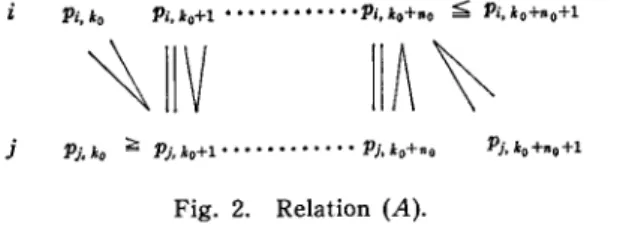
I. In case where relation (A): P},kO+!<pi,kO' pi,ko+""o<p},ko+no+!; does not hold for any ko (ko=1-m-2) and for any no (no=l-m-ko-l) for each ko, if next (m-I) inequalities:
(5.23) min [pi,k, PJ,Tc+d~min [P},k, pi,k+d (k=l-m-l) hold, then job i must precedes job j under transitive property in order to construct the optimal sequence for m machines (m~2).
When equalities hold for all inequalities, either ordering is optimal. 11. In case where above relation (A) holds for a certain ko (ko= l-m-2) and a certain no (no=l-m-ko-l) for this ko, if additional inequalities to (5.23):
min
[±
Pi,q,~
P},q]~min
[±
PJ,q,~
Pi,q]q=u q=u+l q=u q=u+l
(5.24)
(l~u<v~m-l) hold, then the same conclusions as that in I hold.
Proof By theorem 6 it is sufficient to show that (5.9) hold for case I.
Case I. (1) In case Pi,k~P},k+! for each k (k=l-m-l), it becomes
k-J
Pi,k~Pi,k+! from (5.23) and so ~ pi,q is a smallest term in (5.9) for
q=k~r-l
all rand k. Hence (5.9) hold.
(2) In case Pi,k~P},Tc+l (k=l-kl-l), P},kl+!<Pi,kp it becomes P},Tc+l~Pi,k, P},k for each k (kl<k~m-l) by assumption and then
k - l k 1-l k k
~ pi,q or ~ pi,q+ ~ p},q, ~ p},q is a smallest term in (5.9).
q=k-r-l q=k-r·-l q=k1 +1 q=k-r
(3) In case P},2<Pi,1, it holds always P},k+l~Pi,k, P},k for each
k
k (2~k~m-l) by assumption and ~ p},q is a smallest term in (5.9).
q=k-r
Q.E.D.
Relation (A) is schematically shown in Fig. 2. Theorem 7 can be used as a criterion in algorithm for determining the optimal sequence
The Order of n Items Processed on m Machines [111] 179
Pi,ko Pi,ko+l •••••••••• ··1'i,ko+.o ~ Pi,ko+rao+l
'\IIV
IIA~
j Pj, ho ;<: Pj, ho+l •••••••••••• Pj, ko+'o
Fig. 2. Relation (A).
for m machines (m;;:;;3) in flow shop under consideration. 5.3 Generalization of Theorem 4 under Johnson Working Rule
It will be shown that generalization of theorem 4 (m=3) which is the case where Johnson working rule for two machines case is used, is a special case of general theorem 7.
Generalization of theorem 4 to m machines case (m;;:;;2) is stated as below:
Corollary. If job i directly precedes job j on each adjacent two machines Mic, Mic+! under Johnson working rule by using
(5.23) min [Pi,lc, Pj,k+d:;;;min [ilj,k, Pi,Tc+l]
for each k (k=l-m-I), then job i directly precedes job j on m
machines case, that is, if an optimal sequence on each adjacent two machines Mic, MIc+l (k=l-m-l) coincides with each other, then this
sequence becomes an optimal sequence on m machines, when Johnson working rule is employed in flow shop where no passing is allowed. Proof. It is sufficient to show that case 11 in theorem 7 does not occur. If (m-I) inequalities (5.23) hold in case II and Johnson work-ing rule is used for two jobs i, j where i is smaller than j (j is smaller than i), then, as known from Fig. 2 and (5.23), job j precedes job
i
on two machines Mk, MTc+l; k=ko, or ko+l, ... , ko+no-I (k=ko+no, or ko+no-I, ... , ko+l) which contradicts to the assumption.180 Ichiro ~abe8hi~ 6. Approximate Algorithms
The problem is to decide the approximate sequence which has sufficiently small makespan on m machines in flow shop where no passing is allowed.
The methods of approximation are classified into following three types, that is,
1) Determination of the position of nk jobs at stage k to constract the approximate sequence of n jobs. Usually the case where nA:=l is considered.
2) Systematic reformation of the order of some adjacent jobs in the suitably determined initial sequence of n jobs.
3) Separation of the set of n jobs into r subsets followed by suitable connection of the optimal or approximate subsequence of each subset.
Next, some approximate algorithms related to these types will be presented by using the inequalities in theorem 6.
6.1 Approximate Algorithms 1
Let n jobs be named along 1,2, ... , n as usual.
Step 1. Each of the optimal sequences obtained by each inequality of (5.1) and (5.2) is determined by general working rule as the same way for two machines case, under transitive property of the order of jobs determined by each inequality.
Step 2. For each pair (i, j) among n jobs, frequency of the order ij
and frequency of the order ji in all optimal sequences determined at step 1 are counted respectively. Then the order among two orders
ij, ji which has larger number of frequency is determined. If the number of frequency is equal to each other, then both orders ij, ji
are taken.
Example (m=3, n=6). For three machines case, inequalities become (4.8), (4.12) and (4.18) in theorem 3, a special case of theorem 6.
The Order of n Items Processed on m Machines [1111 181 1 2 3 4 5 6 Pi,1 6 12 4 3 6 2 Pi,2 7 2 6 11 8 14 Pi,S 3 3 8 7 10 12 Processing Time
Then optimal sequences by
(4.8), (4.12)
and(4.18)
become as below respectively (Step 1):(1) f643152}
(2) 235641
(643512
(3)
f:~5612}(:354612
And the order of two jobs of each pair (i, j) is determined as below. (Step
2):
(1, 2)
12
(2, 4)
42
(3, 5)
35
(3, 6)
36
(1, 3)
31
(3, 4)
34
(4, 5)
45, 54 (4, 6)
64
(2, 2)
32
(1, 5)
51
(1, 6)
61
(5, 6)
56
(1, 4)
41
(2, 5)
52
(2, 6)
62
Step 3. Each job i which is increasing from i=2 to i=n is classified into one of two subsets NI, N2 defined as follows. Subset NI is com-posed of the job
i
which has the unique order for all job j«i).
Subset Ns is composed of the job
i
which has two orders ij, ji for certain job j«i).
Job 1 belongs to NI only when unique order among the pair (1, 2) is determined.Under the above preparations, the procedures in next step 4 con-struct the approximate sequence successively.
Step 4. First the order of the jobs in NI along the increasing number of job is determined by following each unique order of two jobs (i, j).
Next the position of each job in N2 is determined along the increasing number of job by following each unique or twofold order of two jobs (i, j) such that already determined order of jobs is not changed. Lastly sequence of n jobs can be obtained.
182 Ichiro Nabeshima
ways, then the possible sequences that satisfy almost all unique or twofold orders are taken. Then the sequence having minimum make-span among them is the approximate sequence.
Example. (Continued)
NI={l, 2, 3, 4, 6} , NF{5}. (Step 3).
Construction of the approximate sequence is made as below (Step 4): Stage. 1 NI: 12 2 312 3 4 3412 36412
N2: (Stage 5). Order 45 contradicts to the unique orders 56, 64 and then the order 54 determines one approximate sequence 356412 with makespan 57 which is just an optimal sequence in this example. 6.2 Remarks
1) Product·latine method [16] of the matrix for Hamiltonian path can be used after step 2 in the above algorithm 1 by taking both order ij, ji as the element corresponding to twofold order of (i, j).
2) Mean approximate ratio for 15 examples of three machines and six jobs was 98.45% where
. . (Optimal time)
(ApproxImate ratlO)= CA . . ) x 100%. pproxlmate hme
3) Additional steps to make the makespan of the sequence of n jobs obtained in step 4 more smaller by exchanging suitable jobs of this sequence may be considered.
6.3 Other Related Algorithms .
1) In the above algorithm 1, only some of the inequalities (5.1), (5.2) can be taken instead of all inequalities (5.1), (5.2) and then ap· proximate sequence will be obtained by following the same steps.
For example, Johnson approximation for three machines [14] is obtained by using only the inequality (4.18) in the above example and general formula of this type for m machines case is next inequality
The Order of n Items Processed on m Machines [Ill] 183
where u=l and v=m-1 in (5.2):
(6.1) min
[~~YPi'k' ~lj'kJ ~min[~:pj'k' ~Pi'kJ
k=2
.
But two additional inequalities:(6.2) min
[~12pi'k' ~21pj'k
]
~min [~12pj'k'
?dIPi,kJ '
(6.3) min[~21pi'k' ~lj'k
]
~min [~21pj'k' ~/i'k
]
for instance may yield better approximate sequence.2) If, in any above algorithm, we use only step 1 and then decide the approximate sequence as the sequence with least makespan among all optimal sequences for each inequality corresponding to (5.1) and/or (5.2), or similar inequalities, we obtain another algorithm. Algorithm in [13] can be considered as this type.
3) An algorithm to decide one job of the approximate sequence successively from the first job is formulated by using the relations
(6.4) Tk(ij)~ Tk(ji) for all k (k=2-m) that are the same as (3.3) and (5.6), or one relation
(6.5) Tm(ij)~ Tm(ji)
where each Tk(ij), Tk(ji) can be calculated by recurrence relations (3.1), (3.2) and so on successively.
This algorithm is stated as below:
At each stage k (k=1-n-1) there has been already decided the presubsequence il ... ik-l with (k-l) jobs, then for each pair (i, j) of two jobs among remained (n-k+1) jobs, the order ij is determined by relations (6.4) where both orders ij, ji are taken when inequalities with reverse direction hold for the pair (i, j), or by relation (6.5).
Next one job ik which precedes all other jobs j becomes k th job of the approximate sequence. If such job does not exist, the jobs ik that have a large number of jobs preceded by ik are considered as
184 Ichiro Nabeshima
Then the approximate sequence with least makespan among all sequences of n jobs obtained at stage n is determined.
References
[1] Balas, E., "Machine Sequencing via Disjunctive Graphs: An Implicit Enumeration Algorithms," Opns. Res., 17, 6 (1969), 941-957.
[2] Balas, E., "Machine Sequencing: Disjunctive Graphs and Degree·Con-strained Subgraphs," Nav. Res. Log. Quart., 17, 1 (1970), 1-10.
[3] Charlton, J. M. and C. C. Death, "A Generalized Machine·Scheduling Al-gorithm," OPnal. Res. Quart., 21, 1 (1970), 127-134.
[4] Chariton, J. M. and C. C. Death, "A Method of Solution for General Machine·Scheduling Problems," Opns. Res., 18, 4 (1970), 689-707.
[5] Nabeshima, I., "General Scheduling Algorithms with Applications to Parallel Scheduling and Multiprogramming Scheduling," J. Opns. Res. Soc. Japan,
14, 2 (1971), 72-99.
[6] Brown, A. P. G. and Z. A. Lomnicki, "Some Applications of the Branch-and·Bound Algorithm to the Machine Scheduling Problem," OPnal. Res. Quart., 17, 2 (1966), 173-186.
[7] Gupta, J. N. D., "A General Algorithm for the n x M Flowshop Scheduling Problem," Int. J. Prod. Res., 7, 3 (1969), 241-247.
[8] Ignall, E. and L. Schrage, "Application of the Branch and Bound Tech-nique to Some Flow Shop Scheduling Problems," Opns. Res., 13, 3 (1965), 400-412.
[9] Lomnicki, Z. A., "A Branch·and·Bound Algorithm for the Exact Solution of the Three Machine Scheduling Problem," OPnal. Res. Quart., 16, 1 (1965), 89-100.
[10] McMahon, G. B. and P. G. Burton, "Flow·Shop Scheduling with the Branch-and·Bound Method," Opns. Res., 15, 3 (1967), 473-481.
[11] Nabeshima, I., "On the Bound of Makespans and Its Application in m Machine Scheduling Problem," J. OPns. Res. Soc. Japan, 9, 3 & 4 (1967), 98-135.
[12] Smith, R. R. and R. A. Dudek, "A General Algorithm for Solution of the n·Jobs, M·Machine Scheduling Problem," OPns. Res., 15, 1 (1967), 71-81. [13] Campbell, H. G., R. A. Dudek and M. L. Smith, "A Heuristic Algorithm
for the n Job, m Machine Sequencing Problem," Manag. Sci., 16, 10 (1970), B·630-637.
[14] Giglio, R. J. and H. M. Wagner, "Approximate Solutions to the Three-Machine Scheduling Problem," OPns. Res., 12, 2 (1964), 305-324.
[15] Johnson, S. M., "Optimal Two and Three Stage Production Schedules with Set·Up Time Included," Nav. Res. Log. Quart., 1, 1 (1954), 61-68, and Muth,
The Order of n Items Processed on m Machines [III] 185
J. F. and G. L. Thompson edt., Industrial Scheduling, Prentice-Hall, 1963, Chap. 2.
[16] Kaufman, A., Metlwdes et Modeles de la Recherche Operationelle, Dunod, 1962, Tome 2, p. 307.
[17] Nabeshima, 1., "The Order of n Items Processed on m Machines [Il]," J.