D05
Initiation and Movement of a Coseismic Loess Flowslide Induced by the 2013 Minxian (Mw 6.6)
Earthquake, China
○ Fanyu ZHANG (Department of Geological Engineering, Lanzhou University, China) Gonghui WANG (Disaster Prevention Research Institute, Kyoto University, Japan)
1 Introduction
Coseismic fluidized landslides (even in small scale) normally result in a great number of casualties due to their high mobility and long run-out distances. A small fluidized loess landslide induced by 2013 Minxian (Mw 6.6) earthquake in Gansu, China, traveled about 2 km, killing 12 people.
It has been widely understood that liquefaction phenomenon occurring on saturated soil layer of these landslide played a key role in their high mobility. Nevertheless, the existence of unsaturated soil layer and the changes in physicochemical properties induced by pore water chemistry may modify the initiation and movement of coseismic loess landslide.
To better understand the initiation and movement mechanism of the coseismic fluidized landslides, this study aims at examining: (1) initial state and nature of the soil layers, (2) the effect of pore water chemistry on shear strength of saturated loess, and (3) internal structure of the landslide bodies.
2 Materials and Methods
To examine the initiation and movement mecha-nisms of the landslide, we sampled the loess from dif-ferent soil layers around the landslide, and performed basic index properties tests and undrained static shear tests in a saturated state with different salt concentra-tions. The electrical resistivity imaging was use to survey the internal structure of the landslide bodies. In addition, we monitored the ground motion of the landslide area during aftershocks, and examined the chemical composition of water in landslide body and well near the landslide.
3 Results
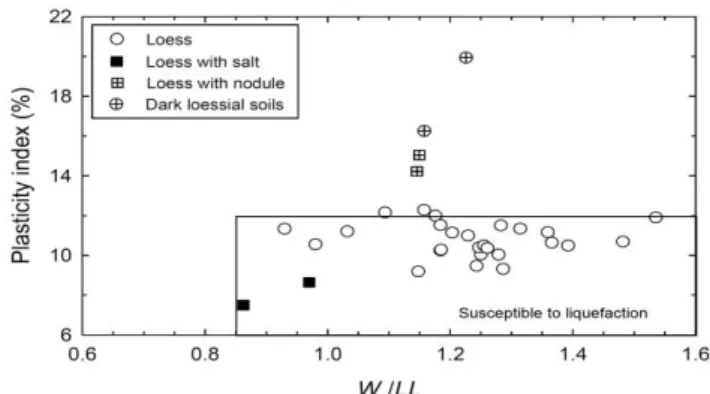
We found that the physical natures of the loess lay-ers influence their liquefaction susceptibility during shock (Fig. 1). The ring shear results further proved that loess with salt have much greater shear strength
compared loess without salt (Fig. 2). The electrical resistivity imaging profiles showed that initial groundwater condition and porous structure of soil layer may affect the generation and dissipation of pore water pressure, and then result in the differences in the mobility of displaced landslide materials (Fig. 3).
Acknowledgements
We acknowledge the support provided by DPRI through a long-term research visit grant. Prof. Toshitaka Kamai is greatly thanked for his great sup-port and encourage to the first author.
Fig. 1: Graphical representation of the proposed liq-uefaction susceptibility criteria for all samples
Fig. 2: Steady-state strength at different salt content
Fig. 3: ERT profiles of the landslide body
40 45 50 55 60 0 4 6 Sh ear res is tan ce (k Pa) Salt content (%)