featur
e ar
ticle
Integrated IT Platform for Highly Effi cient
Operation in Virtual Server Environment
server virtualization is expected to accelerate, leading to a doubling in the ratio of VMs to standalone servers by 2013. Coupled to the trend toward adoption of hypervisor technology, this means that both x86 platforms and integrated storage are becoming even more critical to data centers.
Ongoing advances in server virtualization technology have also highlighted the growing interdependency between server and storage. One example is how VMware*¹ uses SCSI (small computer system interface) commands to offl oad specifi c processes from the server to the storage. Th is implies that vendors like Hitachi with a deep understanding of server and storage architectures are well positioned to deliver robust high-performance infrastructure that will enable users to achieve their goal of reinvesting OPEX back into the business.
Key market trends identifi ed by IDC demonstrate that use of virtual infrastructure continues to accelerate: (1) More than half of all workloads (51%) will be virtualized by the end of 2010
(2) Two-thirds (69%) by 2013
(3) Only 12.8% of all physical servers were virtualized in 2009
(4) VM densities continue to rise predictably
(5) Th e average number of VMs per physical server rose from 6.0 in 2009 to 8.5 in 2013
Th e potential for extraordinary VM densities has been boosted both by improvements to the x86 platform
*1 VMware and VMware ESX are trademarks or registered trademarks of VMware, Inc. in the U.S. and/or other jurisdictions.
Big Data
により新たな価値を創出する次世代
IT
プラットフォームfeature article
OVERVIEW: Like never before server and storage markets are coming closer together. Technologies like server virtualization (e.g. hypervisor technologies) and aggregated platforms (e.g. Hitachi Unifi ed Compute Platform) are revealing new synergies between these traditionally separate markets and are making a truism out of the statement: “The rack is the new server; the data center is the new rack.” This paper describes the market and technology conditions generating these synergies, and discusses how Hitachi is participating now and in the future.
INTRODUCTION
Th e combined size of the server and storage markets has reached $83 billion in annual revenues. Meanwhile, the fast-paced development of x86 platforms is increasing both potential and actual synergies between these markets. Th ese synergies have led to the rise of virtual platforms (e.g. hypervisor technologies) and aggregated platforms (e.g. Hitachi Unifi ed Compute Platform), making a truism out of the statement: “Th e rack is the new server; the data center is the new rack.”
When considered alongside the growth in OPEX (operational expenditure), customers see the advances in x86 platforms as opening up the potential for the use of virtual infrastructure and aggregated platforms to redirect money away from OPEX and toward reinvestment in the business. For instance, fi gures collected by International Data Corporation (IDC) indicate that the number of VMs (virtual machines) surpassed the number of standalone physical servers in 2009 (7.0 million VMs vs. 6.1 million standalone). Th is widespread adoption of
designed specifi cally for that purpose [e.g. Intel*² -VT (Virtualization Technology) and AMD-V*³ (Virtualization)] and by other more general-purpose improvements (e.g. multi-core chips and dense high-performance on-chip caches). While this increased VM-to-physical server density brings the promise of further data center consolidation, there is also a need to balance processing between the server and storage layers. Th is results in a virtuous circle in which innovations in the server layer allow further innovations in the storage layer, both of which support increased VM densities leading to yet more improvements in the x86 platform, and so on.
Industry analysts at IDC also believe in this virtuous circle, citing two main ways the storage layer can help increase VM densities:
(1) Enable fl exible and effi cient storage allocation and utilization technologies (e.g. Hitachi Dynamic Provisioning with Zero Page Reclaim)
(2) Provide features that help overcome performance degradation in environments with a high degree of random I/O (input/output) traffi c and server memory over-commitment (e.g. Hitachi Virtual Storage Platform and Hitachi Adaptable Modular Storage support of VMware’s VAAI)
CUSTOMER PAIN AND CHALLENGES
As server virtualization matures, customers are encountering painful system management challenges that are the direct result of the fast and easy server deployment made possible by server virtualization. Having been delighted by the ease with which their virtual servers can be spun-up, users come away with the unrealistic impression that maintaining these virtual servers will be just as easy. In a world of fl uid server migrations, opaque hardware architectures, and uncertain dependencies, operational management of virtual servers is tricky. Here are some of the challenges commonly faced by Hitachi’s customers:
(1) Disparate storage architectures: Many data stores on diff erent RAID (redundant array of independent disks) groups, NAS (network attached storage) shares, and/or arrays.
*2 Intel is a registered trademark of Intel Corporation in the U.S. and/or other countries.
*3 AMD-V is a trademark of Advanced Micro Devices, Inc.
(2) Varied hardware platforms: A variety of architectures, platforms, and confi gurations for server and storage layers.
(3) Data protection: A mix of fat VMs (application plus internalized data) and thin VMs (application plus externalized data) mean existing protection processes may be outdated, leaving data unprotected.
(4) Reliability and availability: Improper deployments may result in higher risks as consolidation leads to more VMs per physical server and data storage. Th ese deployments also add to compliance challenges because of their role in downtime due to unknown single points of failure.
(5) Fluid architectures: Easy non-disruptive movement of VMs between systems requires an infrastructure that can support this workload activity. Th e demand is for VMs to be fl uid and available, but this is made more diffi cult as they continue to become larger and run on diff erent hardware platforms.
As they come to understand these factors, customers are demanding complete enterprise-grade infrastructures for virtual machine platforms like Microsoft*4 Hyper-V*4, VMware ESX*¹, and Citrix*5 XEN. Th ey are questioning long-held beliefs such as the view that NFS (network fi le system) is the only storage access model for virtual machine deployments. Th ey are also exercising their right to leverage integrated IT platforms like Hitachi’s Unifi ed Compute Platform (UCP) to improve operational effi ciencies and reduce costs.
HITACHI’S UNIFIED COMPUTE PLATFORM
Hitachi’s UCP simplifi es deployment and management of enterprise data centers and cloud deployments. It is a dynamic integrated solution comprising storage, servers, networking, and software with orchestrated management. Unlike other off erings, UCP is designed for use with multiple types of hypervisors, servers, storage, and systems. It aims to enable users to achieve the following objectives:
(1) Certifi cation with interoperability and compatibility for all hardware and software components in an integrated
*4 Microsoft, Microsoft Hyper-V, Microsoft Exchange, SQL Server, Windows, and Windows Server are registered trademarks of Microsoft Corporation in the U.S. and/or other countries.
*5 Citrix and Citrix XEN are trademarks or registered trademarks of Citrix Systems, Inc. and/or one or more of its subsidiaries.
featur e ar ticle Architect IT administrator Unified portal Local
Second Scale Unit
Remote Scale Unit Cloud Scale Unit ・ ・ Workflow coordination ・ ・ Centralized management ・ ・ Templates ・ ・ Deployment Compute Storage Scale unit Network ・
・ Service level aware ・
・ Chargeback usage reporting ・
・ Provisioning and administration ・
・ Multitenant control Orchestration
Manage and monitor
Business user
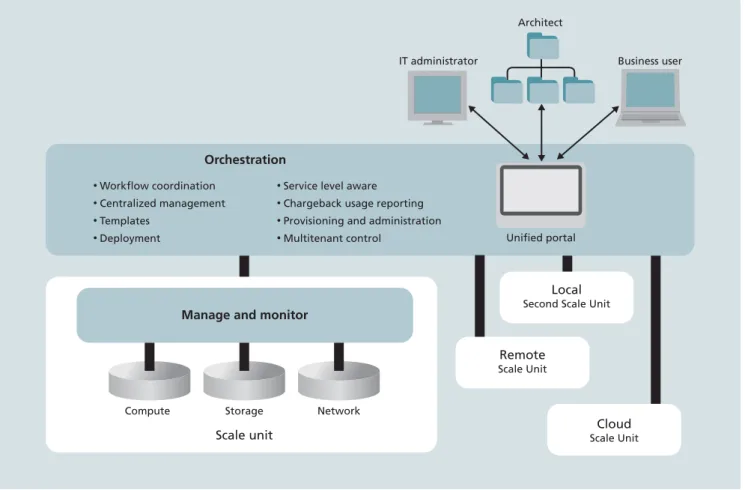
Fig. 2│Unified Compute Platform overview
The infrastructure controlled by UCP Management Rack can be configured or grown as needed.
(4) Increase operational effi ciency and resource utilization by aligning business processes to IT execution so that compliance is not an afterthought.
(5) Simplify and improve service availability and business continuity with the deployment of local clusters that can be quickly expanded to multiple data centers.
As you can see in Fig. 1 and Fig. 2, Hitachi’s UCP combines hardware Scale Units with software orchestration. Th is results in coordinated management of server, storage, and networking as an integrated package. Best-in-class technologies and deep technology integration make UCP ideal for consolidating and virtualizing enterprise applications on the customer’s hypervisor of choice. Th ese include Microsoft Exchange*4 and SQL Server*4, Oracle*6, and SAP*7. It can also provide the foundation for a private cloud solution.
Orchestration
As an option for use in Microsoft Hyper-V
*6 Oracle is a registered trademark of Oracle and/or its affi liates.
*7 SAP is a registered trademark of SAP AG in Germany and in several other countries.
stack.
(2) Improve their competitive advantage by allowing rapid deployment of new applications and services in response to changing business needs.
(3) Reduce complexity and management cost with coordinated and automated end-to-end provisioning.
Fig. 1│Unified Compute Platform Management Rack
The UCP management rack is used to integrate and orchestrate VM templates and deployments.
environments, UCP’s innovative orchestration software coordinates management workfl ows for operating systems running on Hyper-V, servers, networks, and storage from a single role-based access point with roles tailored for the business user, IT administrator, and IT architect. In early releases, the tight coupling and management of a diverse set of resources as a single whole is achieved by linking and integrating the Microsoft and Hitachi system management solutions. UCP’s management software is key to making the platform a fully integrated solution and to simplifying the acquisition, integration and ongoing end-to-end management of large computing environments. Future plans for UCP Orchestration include supporting other hypervisors.
Server
Unlike other platforms, UCP off ers the choice and fl exibility of an open platform. Th e stated goal is to support multiple servers and hypervisors. Th e fi rst server product to be qualifi ed is Hitachi BladeSymphony which off ers a true enterprise-class Intel Architecture blade server system. UCP will initially support Microsoft Windows*4 Server*4 2008 R2 with Microsoft Hyper-V, while other hypervisor technologies will be aggressively pursued as a fi rst step towards this goal of server and multi-hypervisor support. Multiple server and multi-hypervisor support with an open architecture is key to proving a fl exible platform for changing business needs.
Network
Best-of-breed network switches are integrated into the Scale Units providing channels for both block and TCP/IP (transmission control protocol/internet protocol) traffi c. Th e networking layer allows Scale Units to communicate both internally between components and externally with data center SANs (storage area networks), LANs (local area networks), WANs (wide area networks) and MANs (metropolitan area networks).
Storage
Th e fi rst qualifi ed storage systems are Hitachi Virtual Storage Platform, Hitachi Universal Storage Platform V, Hitachi Universal Storage Platform VM, and the Hitachi Adaptable Modular Storage 2000 family systems. All provide Hitachi’s renowned enterprise quality and
leadership, including features like storage virtualization, cloning, dynamic tiering, and dynamic provisioning. UCP Summary
UCP provides an integrated, qualifi ed, and tested platform with orchestrated management for hypervisor, server, network and storage. Th is aff ords users access to a supply of “vendor-manufactured” IT systems, removing many implementation burdens and yielding OPEX savings. Organizations can access best-of-breed IT without having to procure diff erent components from a variety of suppliers. Acquisition of UCP can also improve IT platform scalability, security, availability, and elasticity. Orchestrated management with a unifi ed view of resources allows IT execution to be better aligned with business processes for end-to-end visibility and quality of service. Hitachi UCP reduces the complexity and maintenance challenges associated with disjointed and ineffi cient management of data center resources. Key features of UCP include:
(1) Support for chargeback to business unit or organization (2) SLAs (service level agreements) defi ned per business unit or organization
(3) Simplifi ed confi guration and integration targeted at specifi c user types
(4) Holistic management with orchestration software (5) Secure partitioning through multi-tenancy
(6) Elastic scaling when and where needed with on-demand storage allocation and processing
UCP provides a modular and fl exible approach that can achieve real savings by giving organizations the ability to deploy vendor-manufactured IT systems at lower cost and with reduced risk but at their own pace, and without disrupting an existing environment.
FUTURE
Today’s Transitory State
Hitachi’s UCP is evidence of Hitachi’s timely participation in the emerging industry trend of vertically integrated stacks. Th is trend is about IT organizations making a transition from focusing on CAPEX (capital expenditure) and their own DIY (do it yourself ) internal manufacturing processes to relying on one or more IT suppliers for vertically integrated packages to reduce OPEX costs. Customers’ expectation for the future is
featur
e ar
ticle
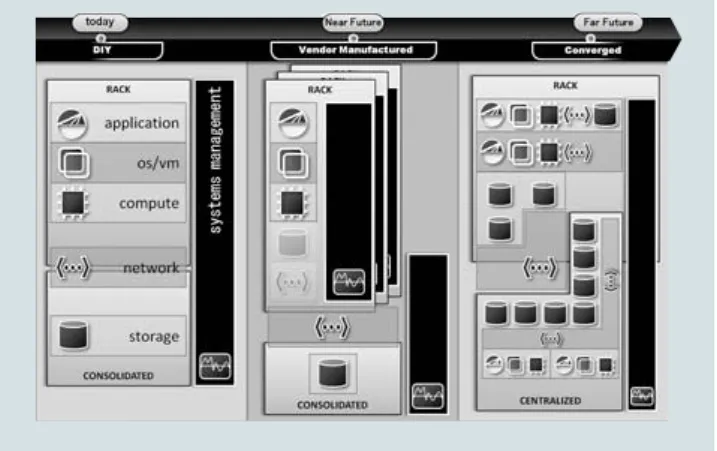
that it will be the vendors and not users who perform component-level integration, testing, and qualifi cation. In a very real sense, this near-future transition is best illustrated by the statement: “Th e rack is the new server; the data center is the new rack.” So, what is next? Fig. 3 shows a roadmap for the near future (looking forward over the next several years) and far future (looking fi ve or more years ahead). In this coming era, the above statement will need to be revised as follows: “Th e rack is the new data center; the data center is the region.” Th is next transition will occur through the miniaturization of various IT components and the growing adoption of the SoC (system-on-chip) approach in enterprise IT systems. Next Leap in IT Architecture
Th e path to the future is already being mapped out by companies like Intel (with its Jasper Forest and Romley architectures) and Advanced Micro Devices (AMD) (with its Fusion architecture). In the case of Intel, they are working to give their processors some advantages by including high-bandwidth external interconnection technologies like PCIe (peripheral component interconnect express) and by off ering offl oading functions for common storage capabilities. Meanwhile, AMD is previewing what might be the processor of the future with multiple types of cores (scalar and vector) on the same die. Hitachi’s intention is to take advantage of these fundamental commodity technologies by taking the trend of vendor manufacturing established in the near future to its logical conclusion: a fully converged platform in the far future.
Given SoC’s ability to aggregate diff erent types of
Michael Hay
Joined Hitachi Data Systems Corporation in 2001, and now works at Product Planning, GSSD, HDS (as Vice President) and the Disk Array Systems Division, Hitachi, Ltd (as Chief Engineer). He is currently engaged in planning the future of Hitachi’s expanding global IT portfolio.
Araki Masanori
Joined Hitachi, Ltd in 1992, and now works at Products Planning Department, Disk Array Systems Division. He is currently engaged in the NFL project in Disk Array Systems Division.
Michael Heff ernan
Joined Hitachi Data Systems Corporation (HDS) in 2006, and now works at Solutions Product Management, Global Solutions, Strategy and Development (GSSD), HDS. He is currently engaged in the fi eld of server virtualization as a global product manager at HDS.
ABOUT THE AUTHORS
technology on the same chip, one can imagine the next leap in IT infrastructure as being a machine capable of supplying most if not all of the hardware functionality of a single Hitachi UCP Scale Unit (server, network, and storage) in a smaller-than-rack form factor. Such a system would take advantage of emerging technologies like PCIe and the storage offl oad function provided by the Intel architecture as well as commodity vector processing to realize the vision of the rack becoming the new data center. In short, Hitachi is carefully looking at the emerging trends within the fundamental domains of processing, networking, and storage to guide our users and customers toward the day when they can cut their OPEX spending by half or more and deliver a single 19-inch rack capable of handling much of the computing done in an entire data center of today.
CONCLUSIONS
In Summary, Hitachi is focused on building robust servers and storage as well as integration with all hypervisors. Th e market and future are ripe for integrated platforms and customers require certifi ed confi gurations with guarantees that what they are consuming will combine maximum availability with cost savings. As VMs become more dense, so too do the server and storage infrastructure and the dependency between all these components is critical for the future of the data center transformation.
Fig. 3│Future of vertical stack
The near and far future for integrated stacks. This trend involves refocusing cost reduction on OPEX instead of CAPEX.
(1) HDS web site, http//www.hds.com/go/ucp