• 検索結果がありません。

Influence of somatosensory changes in tongue to somatosensory function and perceptual distortion of tongue in healthy participants

N/A
N/A
Protected

Academic year: 2021

シェア "Influence of somatosensory changes in tongue to somatosensory function and perceptual distortion of tongue in healthy participants"

Copied!
38
0
0

読み込み中.... (全文を見る)

全文

(1)

Influence of somatosensory changes in tongue to somatosensory function and perceptual distortion of tongue in healthy participants

(舌の体性感覚の変化が舌の感覚機能および知覚の歪みに及ぼす影響)

Mika Honda

Nihon University Graduate School of Dentistry at Matsudo Oral Function and Rehabilitation

(Director: Prof. Misao Kawara)

日本大学大学院松戸歯学研究科 顎口腔機能治療学専攻 本田 実加

(指導:川良 美佐雄 教授)
(2)

1

. Abstract

. Introduction

. Materials and Methods

Research1Somatosensory profile changes on the tongue evoked by topical capsaicin application in healthy participants

Research2Perceptual distortion of the tongue by lingual nerve block and topical application of capsaicin in healthy participants

. Result

Research1Somatosensory profile changes on the tongue evoked by topical capsaicin application in healthy participants

1. Intensity of pain during topical application of capsaicin 2. Somatosensory sensitivity

3. Z-score analysis

Research2Perceptual distortion of the tongue by lingual nerve block and topical application of capsaicin in healthy participants

1. Mechanical and electrical detection threshold

2. Perceptual distortion by the template matching procedure 3. Perceptual distortion by the numerical rating scale (NRS)

. Discussion

Research1Somatosensory profile changes on the tongue evoked by topical capsaicin application in healthy participants

Research2Perceptual distortion of the tongue by lingual nerve block and topical application of capsaicin in healthy participants

. Conclusion

(3)

2

. References

. Tables and Figures

(4)

3

. Abstract [Objective]

Although burning mouth syndrome (BMS) is considered to be a chronic pain disorder with significant impact on the quality of life, the pathophysiology of BMS remains unknown. The aims of the present study were twofold: first, to assess the effect of topical application of capsaicin as a surrogate model of BMS on somatosensory sensitivity at the tongue using a standardized battery of quantitative sensory testing (QST) in healthy participants, and second to investigate perceptual distortion evoked by transient deafferentation and burning pain as models of aspects of BMS.

[Materials and methods]

Research 1: This study was comprised of two experimental sessions (capsaicin and control session) with QST in 16 healthy women. The examiner applied capsaicin or vaseline on the tongue tip for 5 min. The participants were asked to keep their tongue tip in contact with the capsaicin/vaseline at the bottom of a disposable cup for 5 min, during which the participant rated the perceived intensity of the tongue pain every 30 s on an electronic 0-10 visual analogue scale (VAS). QST was performed on the tongue tip before and immediately after application in each session.

Research 2: Sixteen healthy women took part in three experimental sessions that

included exposure to lingual nerve block, capsaicin, and control substance. In each

session, reported perceptual distortion and mechanical detection threshold (MDT) were

assessed at four areas (tongue, lower front teeth, lower lip, and right thumb) before and

at 5, 15, 30 min and 1 and 3 h after the injection or application. A numerical rating scale

(NRS) and a template matching procedure were used to quantify the perceptual

distortions.

(5)

4 [Result]

Research 1: The mean VAS pain scores during capsaicin and control session were 8.2

± 0.5 and 1.9 ± 0.2 respectively. The peak of the perceived pain in the capsaicin session was significantly higher than in the control session (P < 0.001). In the capsaicin session, heat pain threshold (HPT) at post-application was significantly higher than at pre-application, and cold detection threshold (CDT) and mechanical pain threshold (MPT) at post-application ware significantly lower than at pre-application (P < 0.001).

The average Z-scores showed a significant somatosensory loss for CDT. In the control session, there were no differences between pre and post application.

Research 2: There was a significantly higher MDT on the tongue during the lingual nerve block session at 5 min up until 1 h, with the perceived tongue size significantly increased at 5, 15, and 30 min and at 1 h compared to baseline (P < 0.05). Although the perceived size determined by the NRS scores during the capsaicin session was significantly larger for the lower lip at 5 min compared to baseline (P < 0.001), there were no significant effects on the MDT or the perceived sizes for the tongue, lower front teeth, or right thumb at any of the time points.

[Conclusion]

These results suggests that topical application of capsaicin on the tongue tip change the

somatosensory sensitivity, and perceptual distortions on the tongue are influenced by

somatosensory impairment using lingual nerve block rather than nociceptive activity

from experimentally induced pain in healthy participants.

(6)

5

. Introduction

Burning mouth syndrome (BMS) is a chronic burning sensation confined to the oral mucosa and represents a great burden and suffering for the patient and a great diagnostic and therapeutic challenge for the clinician. The International Association for the Study of Pain (IASP) additionally identified BMS as a “distinctive nosological entity”

characterized by “unremitting oral burning or similar pain in the absence of detectable oral mucosa changes” [1]. In functional magnetic imaging studies, BMS patients show less activation throughout the entire brain compared to normal individuals [2] . Furthermore Lauria et al. showed that tongue mucosal biopsies of BMS have significantly lower density of epithelial and subepithelial nerve fibers than those of normal participants [3]. Although BMS is considered to be a chronic pain disorder with significant impact on the quality of life [4], the pathophysiology of BMS remains unknown. So far, there is no conclusive evidence for the involved pain mechanisms or recommendations for most effective therapies in BMS.

Quantitative sensory testing (QST) is a useful tool for investigating

somatosensory function and may aid in the study of pain mechanisms [5-17]. Past

studies have found good reliability for the QST on the face and on the upper and lower

limbs [11] and also in the orofacial region [9, 12]. These studies also reported that the

somatosensory sensitivity to thermal stimulation of the tongue was generally higher

than for other intraoral sites but less for that of the facial skin. Although some studies

already investigated the changes of somatosensory and neuropathic in BMS patients,

they did not apply a full QST to the patients [13]. In order to examine possible

mechanisms underlying BMS, investigations of the somatosensory sensitivity of the

tongue using a standardized comprehensive QST battery is considered to be essential

(7)

6

[9, 10, 12]. Pain models that use an intraoral application of capsaicin on the tongue mucosa and gingiva have been demonstrated to show good reliability with regard to induction of somatosensory changes [8, 14, 15]. However, a complete battery of standardized intraoral QST has yet to be used to assess somatosensory changes after the application of capsaicin on the tongue.

On the other hand, several studies have reported a relationship between perceptual distortion and pain [18-22]. Türker et al. examined the orofacial area and compared the perceived size of the upper lip and upper front teeth before and after anesthesia [19]. Their findings demonstrated that the anesthesia produced perceptual distortion of both the upper lip and the upper front teeth [19]. Skyt et al. compared the perceived size of the face before and after nociceptive stimulation in healthy volunteers [21]. After the participants received injections of hypertonic saline and a local anesthetic in the infraorbital and mental nerve region, the authors found that both nociceptive stimulation and transient blocking of nerve transduction led to perceptual distortion of the face. Dagsdóttir et al. examined orofacial pain in a clinical setting and demonstrated that 55% of the chronic oral facial pain patients (painful post-traumatic trigeminal neuropathy, painful temporomandibular disorder, and persistent idiopathic facial pain) experienced perceptual distortions [22]. Thus, patients with BMS may also have perceptual distortion of the tongue. A recent study suggests that perceptual distortion is an important phenomenon to consider in orofacial pain conditions [20]. However, there have yet to be any studies that have investigated perceptual distortion on the tongue.

The aims of the present study were twofold: first, to assess the effect of topical

application of capsaicin as a surrogate model of BMS on somatosensory sensitivity at

the tongue using a standardized battery of QST in healthy participants, and second to

(8)

7

investigate perceptual distortion evoked by transient deafferentation and burning pain as models of aspects of BMS.

. Materials and methods

Research 1: Somatosensory profile changes on the tongue evoked by topical capsaicin application in healthy participants

The study was carried out in 16 healthy women without any trauma, damage or pain in the tongue (mean ± standard deviation (SD) age 25.5 ± 6.8 years). Informed consent was obtained from all participants before the experiment. This protocol was approved by the Local Ethics Committee in Central Denmark Region Denmark, based on the guidelines set forth in the Declaration of Helsinki II. Participants were excluded if they were pregnant or if they had medical or psychological problems, allergy to capsaicin, or had taken analgesic, antidepressant, or hypnotic medications within 48 h of the study . This study consisted of two experimental sessions (with capsaicin as the test substance and Vaseline as the control) that were conducted on separate days in randomized order. QST was performed on the tongue tip before and after application of test substances. The examiner applied capsaicin or Vaseline on the tongue tip for 5 min.

The duration between the first and second experimental day was set to 3-5 days to avoid any possible carry-over effects. The same female researcher examined all participants in a quiet room.

In this study, the method and time-period of the application was based on the

results of previous studies [8]. Syringes were used to apply 0.2 mL of 0.1% capsaicin

and 0.2 mL of Vaseline into small disposable cups (23×32 mm, DMD01, Medenstar,

Shanghai, China). The participants were asked to keep their tongue tip in contact with

(9)

8

the capsaicin/Vaseline at the bottom of the cup for 5 min. The participants rated the perceived intensity of tongue pain every 30 s during the 5 min application period. An electronic visual analogue scale (VAS) (Foresee-IMS Scale, INTERACTING MINDS CENTER, Denmark) was used to rate the pain on a scale that ranged from 0 = no pain to 10 = most intense pain imaginable. The participants indicated their current pain by clicking the appropriate pain level number shown on the computer.

The standardized battery of QST on the tongue tip involved 13 thermal and

mechanical tests [12, 23, 24, 25]. These tests included cold detection threshold (CDT),

warmth detection threshold (WDT), thermal sensory limen (TSL), paradoxical heat

sensation (PHS), cold pain threshold (CPT), heat pain threshold (HPT), mechanical

detection threshold (MDT), mechanical pain threshold (MPT), mechanical pain

sensitivity (MPS), dynamic mechanical allodynia (DMA), windup ratio (WUR), vibration

detection threshold (VDT), and pressure pain threshold (PPT). A thermal sensory

testing device (Pathway; Medoc Inc., Ramat Yishai, Israel) was used to perform the

thermal tests [9] A probe with a 6 mm diameter surface area was used for all of the tests

[9, 10, 12]. At first, the CDT and WDT were measured using cold and warm stimuli,

followed by the TSL. In the TSL, when the ramped stimulus reached a point where the

participant first perceived the temperature as being warm, the participant pressed a

button. Subsequently, the direction of the temperature ramp was reversed and the

thermode cooled down until the participant perceived a temperature change and again

pressed the button [9, 24]. During this procedure, the number of PHSs was recorded,

after which the CPT and HPT were determined [24]. For the thermal testing, ramped

stimuli of 1°C/s were used with the procedure ending when the participant pressed a

button [9, 24] and participants was not able to look at the computer screen during these

(10)

9

measurements. The starting temperature on the tongue tip was 37°C. The cut-off temperatures were set at 0 and 50°C [9, 24]. The interstimulus interval between each thermal measurement on the tongue tip was 4–6 s. All thresholds of CDT, WDT, CPT, and HPT on the tongue tip were calculated as the mean of three measurements. Each registration was repeated, if the thermode slipped and provoked a mechanically induced pain sensation on the tongue tips [9, 24]. The MDT was measured using a standardized set of modified von Frey filaments (OptiHair2, Marstock Nervtest Ltd., Marburg, Germany) [9, 10, 12, 25]. The OptiHair2 set contains 12 monofilaments that exert different forces upon bending. Each monofilament increases the force by a factor of 2, ranging from 0.25 to 512 mN [9, 24]. All monofilaments were applied perpendicular to the examination site, with contact times ranging from 1–2 s. The five threshold measurements were made by application of a series of ascending and descending stimulus intensities. The threshold value was calculated using the geometric mean of these five measurements [9, 24]. In the MPT measurements on the tongue tip, a custom-made set of seven weighted pinprick stimulators (The Pin Prick; Aarhus University, Aarhus, Denmark) were used [9, 10, 12, 25]. The pinprick stimulators had a flat contact surface with a 0.2 mm diameter. The range of forces of pinprick stimulators was from 8 mN to 512 mN and contact times on the tongue tip was approximately 2 s.

All pinprick tests were made with the stimulators in a vertical position and perpendicular

to the tongue tip. The “method of limits”, similar to the one used to determine the MDT,

was also used to determine the MPT [9, 12]. Similar to the MPT evaluation, the seven

weighted pinprick stimulators were used for the MPS determinations. The DMA was

estimated using three tactile stimulators including a cotton wisp, a cotton wool tip (Q-tip)

attached to a flexible handle and a disposable toothbrush (Top Dent®, Meda AB, Solna,

(11)

10

Sweden). For the DMA measurement, the three tactile stimulators were applied in a single stroke over an 1–2 cm distance of the tongue tip. The MPS and DMA measurements consisted of five stimulations with each of the 10 stimulators (seven weighted pinprick stimulators and three tactile stimulators) in randomized order according to the German Research Network on Neuropathic Pain (DFNS) protocol [12, 24]. In each of the total of 50 stimuli, the participants rated the pain on a 0 to 100 numerical rating scale with the endpoints ‘0’ indicating “no pain” and ‘100’ indicating

“most intense pain imaginable”. The MPS was calculated as the geometric mean of all

the numerical ratings using the seven weighted pinprick stimulators [9, 24]. The DMA

value was calculated as the geometric mean of all the numerical ratings using the three

tactile stimulators [9, 24]. To measure the WUR a train of 10 pinprick stimuli were

repeated at a rate of 1 Hz and the perceived magnitude on the 0–100 numerical rating

scale for pain was determined. The 10 pinprick stimuli were kept constant through the

use of a metronome (MA-30 Digital metronome, KORG®, Tokyo, Japan) and the score

from the 10 repeated stimuli was divided by the score from a single pinprick stimulus

with the same force [9, 10, 12, 24, 25]. In the WUR assessment, the same

custom-made pinprick stimulators as used in the MPT determinations were used. An

pinprick stimulator that delivered a force, which the participant perceived as “slightly

painful” was selected and the 128-mN stimulator was tried first. If the response from

participants using the 128 mN pinprick stimulus was 0 (not painful), the WUR

assessment was performed using a greater force. If the participant perceived the

stimulus as intolerable, less force was used [9, 24]. If a participant did not perceive the

512 mN stimulator to be painful, the WUR assessment was abandoned. The WUR was

calculated as the mean of three trials in the WUR assessment. The VDT was assessed

(12)

11

using a Rydel–Seiffer graded tuning fork (64 Hz, 8/8 scale) [9, 10, 12, 24, 25]. In the VDT assessment, the participants were asked to raise their hands to indicate, when the vibration could no longer be sensed. A 9-point scale (0–8) was used to measure the intensity of vibration, with all values recorded to an accuracy of 0.5 units. The VDT assessment consisted of three trials and the means of the VDTs from three repetitions were calculated from all participants. The PPT was measured using a digital pressure algometer (Somedic Algometer, Somedic Sales, Sweden) with a pinch handle and a probe with a surface area of 0.18 cm

2

. During the PPT assessment, a rate of increase in pressure of 50 kPa/s was used. The participants pressed a button to interrupt the stimulation when they felt the first painful sensation. The PPT assessment consisted of three trials and the mean of PPT from the three trials was used for analysis.

The QST data were analyzed using a two-way analysis of variance (ANOVA) with the different test substance sessions (capsaicin and Vaseline as control) and time (pre- and post- application) as the repeated measurement factors. Post-hoc tests were performed using the Tukey honestly significant difference test (HSD) test with correction multiple comparisons. P values less than 0.05 were considered statistically significant.

With the exception of the PHS and DMA, all the data were log-transformed before the analyses and converted into Z-scores, with the means and SDs of the pre-application test data used as the reference [9, 12, 24]. The sign of the Z-scores was adjusted in such a way that Z > 1.96 was regarded as a gain in somatosensory function while Z <

-1.96 was regarded as a loss of somatosensory function [8, 9, 24]. The area under the

curve (AUC) and mean VAS pain scores during applications of capsaicin and Vaseline

were calculated. The means of the VAS pain scores were compared between

substances (capsaicin and control) and time-points using a two-way ANOVA with Tukey

(13)

12 tests for post-hoc analysis [15].

Research 2: Perceptual distortion of the tongue by lingual nerve block and topical application of capsaicin in healthy participants

This study was carried out in 16 healthy women who were 25.5 ± 1.2 years old (mean ± SEM). The sample size was based on earlier studies using intraoral QST and experimental modulations of intraoral somatosensory sensitivity. All participants were recruited by posting an advertisement on the information boards in Aarhus University.

Informed consent was obtained from all participants before the experiments. This protocol was approved by the Local Ethics Committee at Central Denmark Region, Denmark. The protocol followed the guidelines set forth in the Declaration of Helsinki ll.

Exclusion criteria were pregnancy, any mental disorders, allergy to capsaicin/lidocaine, being scheduled for dental treatment during the time of the study, and the intake of medication (analgesics, antidepressants, or hypnotics) within 48 h of the investigation [8, 20].

The three experimental sessions (lingual nerve block session, application of

capsaicin session, and application of Vaseline as a control session) were performed on

separate days in a randomized order. All measurement performed at experimental room

during daytime. To avoid any carry-over effects, an interval of 3-5 days was set between

each of the sessions. All participants were examined by the same female examiner in a

quiet room. In all of the sessions, the procedure and the time periods of the application

were chosen based on the results of other studies [8, 14]. For the lingual nerve block

session, participants were given doses of 0.2 mL of the local anesthetic Mepivacain

(AstraZeneca/Denmark) 1.8 ml using a 27-gauge needle in order to achieve lingual

(14)

13

nerve block on both sides. For the capsaicin session, 0.2 ml of 0.1% capsaicin (Capzasin-HP. Chattem, Inc, USA) was first put into small cups (DMD01, Medenstar, Shanghai, China). Participants were then asked to keep their tongue tip in contact with the capsaicin at the bottom of the cup for 5 min. For the control session, Vaseline (Apotekets Vaseline, Apoteket (The pharmacy), Denmark) was first put into small cups.

Participants were then asked to keep their tongue tip in contact with the Vaseline at the bottom of the cup for 5 min. During application of capsaicin and Vaseline on their tongue tip using small cups, participants held their head in a slightly forward position and kept a tray under the chin to catch their saliva.

Mechanical detection threshold (MDT) of the tongue, lower lip, and right thumb

were measured using a standardized set of modified von Frey filaments (OptiHair2,

Marstock Nervtest Ltd., Marburg, Germany) [9-12]. The modified von Frey filaments

contain 12 monofilaments that exert different forces upon bending. Each monofilament

increases the force by a factor of 2, ranging from 0.25 to 512 mN [9, 17]. These von

Frey filaments were applied perpendicularly to the tongue, lower lip, and right thumb

within 1-2 s. The ‘method of limits’ technique was used to measure MDT according to

past studies [9, 12, 17]. The five MDT measurements were obtained through the

application of a series of 5 ascending and 5 descending stimulus intensities. The

threshold value was calculated using the geometric mean of these five measurements

[9, 17]. An electronic pulp-tester (Model 2001, Analytic Technology, USA) was used to

test the electrical detection threshold (EDT) on the lower front teeth. The EDT of the

lower front teeth was determined as the mean of three recordings. The MDT of the

tongue, lower lip, and right thumb and the EDT of the lower front teeth were measured

before and at 5, 15, and 30 min, and 1 h after injection or application. During the MDT

(15)

14

measurement on the tongue tip in the capsaicin session, the target of measurement was within the area directly in contact with capsaicin.

During each of the sessions, the perceived sizes of the four investigated areas (tongue, lower front teeth, lower lip, and right thumb) were measured using a template matching procedure and a numerical rating scale (NRS) before and at 5, 15, and 30 min and 1 and 3 h after each injection or application. During the template matching procedure, participants examined 15 differently sized templates and chose the one that best matched the perceived size of the tongue, lower front teeth, lower lip, and right thumb (Fig. 3). The template that approximated the real size of each area was arbitrarily designated as 100% [19] (Fig. 3). Fifteen different sizes from 20% to 300% of the real size were depicted in this study. [19] (Fig. 3). Participants were asked to ‘select the picture that best matches the perceived size’ [18, 19]. Participants were given no information concerning the absolute size or about any of their prior choices. As another measure of perceptual distortion, the participants were asked to indicate the level of distortion on NRS, at 5, 15, and 30 min and 1 and 3 h after the injection or application;

the participants were asked to choose a rating for each of the four areas using scales that ranged from -100 to +100 (-100: half size of normal, 0 = no change, 100 = double size of normal) [20, 21].

All data are presented as the mean ± SEM. The MDT of the tongue, lower lip,

and right thumb and the EDT of the lower front teeth were analyzed using a two-way

repeated measurements ANOVA with session (lingual nerve block, capsaicin, and

control) and time (pre, 5, 15, and 30 min and 1 h) used as analytical factors. NRS and

template matching of the perceived size of the four areas were analyzed using a

two-way repeated measurements ANOVA with session (lingual nerve block, capsaicin,

(16)

15

and control) and time (pre, 5, 15, and 30 min and 1 and 3 h) used as the analytical factors. When appropriate, the ANOVAs were followed by post-hoc Tukey tests to compensate for multiple comparisons. P values less than 0.05 were considered statistically significant.

. Results

Research 1: Somatosensory profile changes on the tongue evoked by topical capsaicin application in healthy participants

1. Intensity of pain during topical application of capsaicin

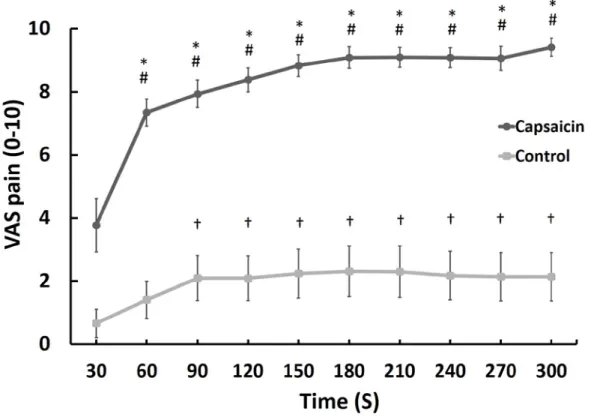
No participants withdrew during this experiment. Figure 1 shows the mean of participant-reported VAS pain scores that were calculated every 30 s for 5 min during the topical application of the capsaicin and Vaseline on the tongue tip. The VAS pain scores during the application of capsaicin were significantly higher than those observed in the control condition (P < 0.001). The mean ± SEM of peak of pain that occurred during the capsaicin application was 9.4 ± 0.3. The mean ± SEM of the AUC of VAS pain score in the capsaicin session (2545.1 ± 90.2) was significantly greater than in the control session (474.3 ± 171.6; P < .001) (Fig. 1). The overall mean ± SEM of the VAS pain scores for the 5 min capsaicin application was 8.2 ± 0.5, while it was 1.9 ± 0.3 for the control session (P < 0.001) (Fig. 1). Five participants reported VAS pain scores (0.8 - 7.1) during the control session. The capsaicin-evoked VAS pain score from 60 s to 300 s were significantly higher than the VAS pain scores in the control session (P < 0.05) (Fig.

1). Interestingly, for the control condition, the VAS pain scores from 90 s to 300 s were

significantly higher than that reported at baseline (P < 0.05) (Fig. 1).

(17)

16 2. Somatosensory sensitivity

The ANOVA of the CDT showed that there was a significant effect of the type of substance (P < 0.001, F = 17.481), time (P < .001, F = 20.394), and interaction between session and time (P < 0.006, F = 10.451). Post-hoc analyses showed that the CDT after the application of capsaicin was lower (decreased sensitivity) than that after the application in the control condition (P < 0.001) (Table 1). Moreover, the HPT after the application of capsaicin was lower (increased sensitivity) than that observed prior to the application (P < 0.001) (Table 1). The MPT after the application of capsaicin was also significantly higher (decreased sensitivity) than that observed prior to the application (P

< 0.05) (Table 1). There were no significant differences observed for the WDT, TSL, CPT, MDT, MPS, WUR, VDT and PPT between the pre- and post- application in either session. PHS and DMA were not encountered in any of the sessions.

3. Z-score analysis

Figure 2 shows the Z-scores after application of capsaicin and for the control condition when using the means and SDs of the pre-application data as the reference values. The individual Z-scores for 16 participants from the capsaicin session indicated a somatosensory loss regarding the CDT (in 8/16 participants), CPT (4/16) and MPT (4/16). On average, the Z-score of 16 participants after capsaicin also showed a loss of function for CDT (Fig 2). With the exception of CDT, all the other QST measures were within the range between -1.96 and 1.96.

Research 2: Perceptual distortion of the tongue by lingual nerve block and topical

application of capsaicin in healthy participants

(18)

17

1. Mechanical and electrical detection threshold

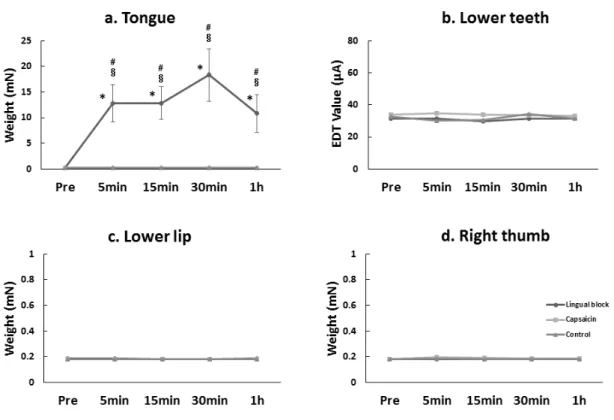
Figure 4 shows comparisons of the MDT of the tongue, lower lip, and right thumb and the EDT of the lower front teeth before and at 5, 15, and 30 min and at 1 h after the injection or application. The ANOVA analysis of the MDT of the tongue demonstrated significance for the effect of sessions (F = 4.258, P = 0.077), time (F = 2.749, P < 0.05), and for the interaction between sessions and time (F = 2.747, P <

0.05). Post hoc analysis indicated that the MDTs of the tongue during the lingual nerve block session at 5, 15, and 30 min and at 1 h were significantly higher than that observed prior to the lingual nerve block (P < 0.001). The MDTs of the tongue during the lingual nerve block session at 5, 15 and 30 min and at 1 h were also significantly higher than that observed at the same times during the capsaicin and control sessions (P <

0.001). However, during the capsaicin and control sessions, there were no changes observed for the MDT on the tongue over the 1 h observation period. There were also no differences observed between the sessions and time-points for the MDT of the lower lip and finger and the EDT of the lower front teeth.

2Perceptual distortion by the template matching procedure

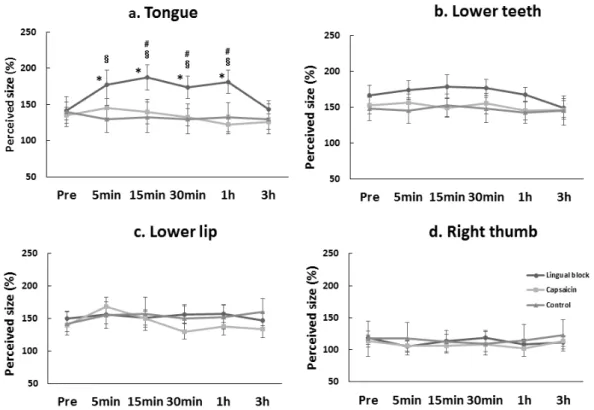
Figure 5 shows the comparisons of the perceived sizes of the four areas when

using the template matching procedure before and at 5, 15 and 30 min and at 1 and 3 h

after the injection or application. The ANOVA analysis of the template matching

procedure for the tongue demonstrated there was a significant effect of session (F =

21.391, P < 0.001), time (F = 3.671, P < 0.05), and the interaction between sessions

and time (F = 4.076, P < 0.05). For the lingual nerve block session, the perceived

tongue sizes based on the template matching procedure after the lingual nerve block at

(19)

18

5 (P < 0.05), 15 (P < 0.001), and 30 min (P < 0.05) and at 1 h (P < 0.05) were significantly larger than that observed before the lingual nerve block. When compared to the controls at the same time-points, there was a significantly larger perceived tongue size found by the template matching procedure at 5 (P < 0.05), 15 (P < 0.001), and 30 min (P < 0.05) and at 1 h (P < 0.05) after the lingual nerve block. When compared to the capsaicin session at the same time-points, there was also a significantly larger perceived tongue size found by the template matching procedure at 15 (P < 0.001) and 30 min (P < 0.05) and at 1 h (P < 0.001) after the lingual nerve block. No significant changes were found by the template matching procedure for the perceived sizes of the lower front teeth, lower lip, and right thumb during the 3 h period after the lingual nerve block, capsaicin, and control sessions.

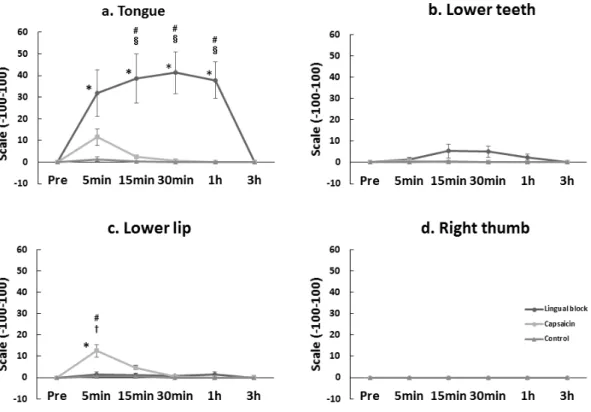
3Perceptual distortion by NRS

Figure 6 shows comparison of the perceived sizes of the tongue, lower front teeth, lower lip, and right thumb determined by the NRS before and at the 5, 15, and 30 min and at 1 h and 3 h after the injection or application. The ANOVA analysis of the NRS for the tongue showed there was a significant effect of session (F = 11.173, P < 0.05), time (F = 10.481, P < 0.001), and the interaction between the session and time (F = 7.899, P < 0.001). After the lingual nerve block, the perceived tongue size determined by the NRS was significantly larger at 5 (P < 0.05), 15 (P < 0.001), and 30 min (P <

0.001) and at 1 h (P < 0.001) as compared to that observed prior to the lingual nerve

block. When compared to the values obtained prior to the application, the NRS results

showed there was a significantly larger perceived size of the lower lip at the 5 min

observation point in the capsaicin session (P < 0.001) (Fig. 6). This perceived size of the

(20)

19

lower lip at 5 min was significantly larger than the sizes found for the lingual nerve block and control sessions at 5 min (P < 0.001). The perceived size from NRS of the tongue at 5 min showed a trend to be larger than the size of the control sessions at 5 min (Fig. 6).

No significant changes were observed for the NRS-determined perceived sizes of the lower front teeth and right thumb during the 3 h observation periods for the lingual nerve, capsaicin, and control sessions.

. Discussion

Research 1: Somatosensory profile changes on the tongue evoked by topical capsaicin application in healthy participants

Past studies have demonstrated that topical application of capsaicin on the tongue mucosa and gingiva are effective surrogate models of intraoral pain conditions [8, 14, 15]. In our current study, topical application of capsaicin on the tongue tip also caused pain in all participants. The pain intensity for capsaicin was higher than that observed during the control conditions. These results indicate that the use of capsaicin on the tongue tip is a safe and effective way to create pain and therefore may be a valuable surrogate human model to mimic some of the clinical characteristics of BMS.

[26, 27]. However, it should be noted that five participants unexpectedly felt mild pain

during the application of Vaseline. This can perhaps be explained by the fact that the

whole QST battery had been applied before the Vaseline application and that this may

have caused minor irritation of the oral mucosa leading to low pain scores in some of

the participants. Moreover, the capsaicin-evoked pain on the tongue tip continued for

about one hour. Since the duration of the QST for each session was 30 min, this

ensured that there was enough time to document any changes in the somatosensory

(21)

20

sensitivity that might have occurred. Thermal tests in previous studies have demonstrated hypoalgesia to cold stimuli on the skin of the forearm after topical application of capsaicin [28]. In contrast, Lu et al. showed that there were no changes to cold stimuli after the application of capsaicin on the gingiva [8]. However, the present study indicated that the CDT after an application of capsaicin on the tongue tip decreased which pointed to a (relative) loss in somatosensory function related to cold stimuli Differences in findings related to cold sensitivity between gingiva and the tongue may likely be explained by differences in afferent fiber populations between the tissues.

Thermal tests have been reported to reflect the C- and A-delta fiber function [1, 4].

Microneurographic investigations in humans have also shown that the mechano-heat-sensitive part of these fibers is sensitive to capsaicin [29]. The aim of the measurement of CDT on the tongue tip was to evaluate A-delta fiber function. The observed cold hypoesthesia suggests a desensitization of these A-delta fibers.

Interestingly, cold hypoesthesia has also been demonstrated in BMS patients [13]

indicating that application of capsaicin on the tongue tip is, indeed a useful experimental surrogate model of BMS.

A previous study has reported gain in somatosensory functions related to WDT

and HPT after an application of capsaicin on the gingiva [14]. In the present study, a

gain in somatosensory function to painful heat stimuli on the tongue after the application

of capsaicin was also found (Table 1). Although another study suggested that

sensitization of the C-fibers of the gingiva can influence the HPT [8] the present study

found that there were no significant differences in the WDT between before and after the

application of capsaicin. The present results therefore suggest that

sensitization/desensitization to non-painful warm stimuli did not occur on tongue tip after

(22)

21

application of capsaicin. Since Mo et al. showed that HPT and WDT of Chinese BMS patients were significantly higher (sensory loss) than in normal participants [13], the present model did not succeed in modelling this particular clinical aspect of BMS.

Boudreau et al. showed that both the blood flow and the temperature of the tongue increased after a local application of capsaicin [27]. Further studies are needed to investigate the blood flow and the temperature of the tongue in BMS patients.

Previous studies on mechanical sensitivity have shown that cutaneous or intradermal applications of capsaicin normally result in mechanical allodynia and hyperalgesia [16, 30-32]. However, Lu et al. applied mechanical test stimuli to the intraoral area, and found that mechanical sensitivity decreased (MPT increased and MPS decreased) after topical application of capsaicin on the gingiva [8]. The present study also showed that mechanical sensitivity decreased (MPT increased) after topical application of capsaicin on the tongue tip. These findings suggest that the change of mechanical sensitivity from application of capsaicin for the intraoral area was different from the hairy skin of the hand or foot [16, 30]. On the other hand, Mo et al. showed that there were no significant differences in MDT and MPT between Chinese BMS patients and normal participants [13].

Recent investigations have demonstrated that after the application of capsaicin

to the gingiva, the mean Z-score reflect somatosensory gain of heat sensitivity on the

gingiva [8]. The mean Z-score for capsaicin in all 16 participants in the current study

showed somatosensory loss related to cold detection stimuli (Fig. 2). Although there

were significant differences for the HPT and MPT between the pre- and post-application

of capsaicin on the tongue tip, the mean Z-score indicated the HPT and MPT were

within the normal range based on the pre application data (grey area, Fig. 2). Hence,

(23)

22

the Z-score analysis may be considered more conservative than simple comparisons of mean values [8].

Research 2: Perceptual distortion of the tongue by lingual nerve block and topical application of capsaicin in healthy participants

Türker et al. reported that perceptual distortion was dependent on the removal of the peripheral input by the anesthesia and that there was a temporal relationship between the perceptual distortion and the recovery from anesthesia in the upper lip and upper teeth [19]. In the present study, the results showed that lingual nerve block evoked sensory loss regarding MDT on the tongue from 5 min to 1 h after the injection.

Thus, these findings demonstrate that perceptual distortion on the tongue also occurs during lingual nerve block. Our findings further suggested that the perceptual distortion on the tongue was induced by the administration of local anesthesia on the tongue.

In contrast, Skyt et al. demonstrated that both transient blocking of nerve

transduction and nociceptive stimulation in the infraorbital and mental nerve region

could lead to perceptual distortion of the face [21]. Dagsdóttir et al. further investigated

experimental orofacial pain and the effect of an injection of hypertonic saline close to the

lingual nerve. These authors reported that after these injections, although in the present

study, there was no change in the perception of the tongue size, they found that the

subjects did report a feeling of swelling in the injected area [20]. All of these past studies

utilized the near-nerve injection method when investigating experimental orofacial pain

in healthy participants [20, 21]. However, the present study used topical applications of

capsaicin on the tongue tip as a way of creating experimental pain in the healthy

participants. Present results indicated that lingual nerve block, but not capsaicin, was

(24)

23

able to induce perceptual distortion on the tongue. McNulty et al. reported finding increases in the somatosensory cortical cell firing after amputation or nerve section [33].

Türker et al. suggested that thin myelinated A-delta and unmyelinated C-fibers might be involved in the perceptual distortion that follows regional anesthesia, as the perceptual distortion coincides with the impairment of the mechanical detection sensation [19]. In addition, other previous results have demonstrated that capsaicin mediates its effects through the transient receptor potential vanilloid type 1 (TRPV1) receptor, which is found on non-myelinated C-fibers and small diameter myelinated A-delta fibers [34, 35].

In contrast, present findings suggested that the perceptual distortion on the tongue was not associated with the A-delta and C-fibers on the tongue. However, it should be noted that the current study only examined a single experimental condition for capsaicin during the session in which capsaicin was applied to the tongue. Therefore, further studies that investigate the relationship between different concentrations of capsaicin applied to the tongue and the perceptual distortion will need to be undertaken. Moreover, in this study all measurements were taken by a non-blinded examiner. Although this design may be associated with bias it could be argued that the main findings related to perceptual distortion are all based solely on subject-based measures (self-reports).

Further studies on perceptual distortion could consider to apply a double-blinded design to completely rule out bias.

Although no perceptual distortions of the tongue, lower front teeth, and right

thumb were found during the 3 h measurement period, it is interesting that during the

capsaicin session, the perceived size of the lower lip at 5 min was significantly larger

than that observed at baseline. Türker et al. demonstrated that perceptual distortion

occurred on the upper lip after using local anesthesia to block the upper lip [19]. While it

(25)

24

is possible that the capsaicin cream used in the present study could have been transferred to the lower lip during its application on the tongue, which is an experimental limitation of this study, present results do suggest that the application of capsaicin on the lower lip can evoke the perceived distortion of the lower lip. Additional studies that compare the effect of capsaicin with the perceived distortion between the lower lip and tongue in the same individual will need to be undertaken in the future. Moreover Fig. 4 shows that the perceived size of the tongue using the NRS at 5 min after capsaicin application tended to be larger than the size of the control session at 5 min (Fig. 4).

Further studies are needed to investigate perceptual distortions of the tongue using different concentration of capsaicin.

. Conclusion

These results suggests that topical application of capsaicin on the tongue tip

change the somatosensory sensitivity, and perceptual distortions on the tongue are

influenced by somatosensory impairment using lingual nerve block rather than

nociceptive activity from experimentally induced pain in healthy participants.

(26)

25

. References

1. Merskey H, Bogduk N. Classification of chronic pain: descriptions of chronic pain syndromes and definitions of pain terms. IASP Press, Seattle, 1994; 209-214

2. Albuquerque RJ, de Leeuw R, Carlson CR, Okeson JP, Miller CS, Andersen AH.

Cerebral activation during thermal stimulation of patients who have burning mouth disorder: an fMRI study. Pain. 2006; 122:23-34.

3. Lauria G, Majorana A, Borgna M, Lombardi R, Penza P, Padovani A, Sapelli P.

Trigeminal small-fiber sensory neuropathy causes burning mouth syndrome. Pain.

2005; 115:332-337.

4. López-Jornet P, Camacho-Alonso F, Andujar-Mateos P, Sánchez-Siles M, Gómez-Garcia F. Burning mouth syndrome: an update. Med Oral Patol Oral Cir Bucal. 2010; 15:562-8.

5. Jääskeläinen SK, Clinical neurophysiology and quantitative sensory testing in the investigation of orofacial pain and sensory function. 2004; 18:85-107

6. Komiyama O, De Laat A. Tactile and pain thresholds in the intra- and extra-oral regions of symptom-free subjects. Pain. 2005; 115:308-15.

7. Komiyama O, Kawara M, De Laat A. Ethnic differences regarding tactile and pain thresholds in the trigeminal region. J Pain. 2007; 8:363-369.

8. Lu S, Baad-Hansen L, List T, Zhang Z, Svensson P. Somatosensory profiling in healthy subjects modified by intra-oral capsaicin and menthol. Eur J Oral Sci 2013;

121:29–35.

9. Baad-Hansen L, Pigg M, Ivanovic SE, Faris H, List T, Drangsholt M, Svensson P.

Intraoral somatosensory abnormalities in patients with atypical odontalgia--a

controlled multicenter quantitative sensory testing study. Pain. 2013;

(27)

26 154:1287-1294.

10. Svensson P, Baad-Hansen L, Pigg M, List T, Eliav E, Ettlin D, Michelotti A, Tsukiyama Y, Matsuka Y, Jääskeläinen SK, Essick G, Greenspan JD, Drangsholt M.

Guidelines and recommendations for assessment of somatosensory function in oro-facial pain conditions - a taskforce report. J Oral Rehabil. 2011; 38:366-394.

11. Geber C, Klein T, Azad S, Birklein F, Gierthmuhlen J, Huge V, Lauchart M, Nitzsche D, Stengel M, Valet M, Baron R, Maier C, Tolle T, Treede RD. Test-retest and interobserver reliability of quantitative sensory testing according to the protocol of the German Research Network on Neuropathic Pain (DFNS): a multi-centre study.

Pain 2011; 152:548–556.

12. Pigg M, Baad-Hansen L, Svensson P, Drangsholt M, List T. Reliability of intraoral quantitative sensory testing (QST). Pain 2010; 148:220–226.

13. Mo X, Zhang J, Fan Y, Svensson P, Wang K. Thermal and mechanical quantitative sensory testing in Chinese patients with burning mouth syndrome--a probable neuropathic pain condition? J Headache Pain. 2015; 16:84.

14. Baad-Hansen L, Jensen TS, Svensson P. A human model of intraoral pain and heat hyperalgesia. J Orofac Pain. 2003; 17:333-340.

15. Naganawa T, Baad-Hansen L, Ando T, Svensson P. Influence of topical application of capsaicin, menthol and local anesthetics on intraoral and aspects. Exp Brain Res.

2015; 233:1189-1199

16. Magerl W, Fuchs PN, Meyer RA, Treede RD. Roles of capsaicin-insensitive nociceptors in cutaneous pain and secondary hyperalgesia. Brain. 2001;

124:1754-1764.

17. Rolke R, Magerl W, Campbell KA, Schalber C, Caspari S, Birklein F, Treede RD.

(28)

27

Quantitative sensory testing: a comprehensive protocol for clinical trials. Eur J Pain.

2006; 10:77–88.

18. Gandevia SC, Phegan CM. Perceptual distortions of the human body image produced by local anaesthesia, pain and cutaneous stimulation. J Physiol 1999;

15:609-616

19. Türker KS, Yeo PL, Gandevia SC. Perceptual distortion of face deletion by local anaesthesia of the human lips and teeth. Exp Brain Res 2005; 165:37-43

20. Dagsdóttir LK, Skyt I, Vase L, Baad-Hansen L, Castrillon E, Svensson P.

Experimental orofacial pain and sensory deprivation lead to perceptual distortion of the face in healthy volunteers. Exp Brain Res 2015; 233:2597-2606

21. Skyt I, Dagsdóttir L, Vase L, Baad-Hansen L, Castrillon E, Roepstorff A, Jensen TS, Svensson P. Painful stimulation and transient blocking of nerve transduction due to local anesthesia evoke perceptual distortions of the face in healthy volunteers. J Pain 2015; 16:335-345

22. Dagsdóttir LK, Skyt I, Vase L, Baad-Hansen L, Castrillon E, Svensson P. Reports of perceptual distortion of the face are common in patients with different types of chronic oro-facial pain. J Oral Rehabil 2016; 43:409-416

23. Krumova EK, Westermann A, Maier C. Quantitative sensory testing: a diagnostic tool for painful neuropathy. Future Neurol. 2010; 5:721–733

24. Maier C, Baron R, Tolle TR, Binder A, Birbaumer N, Birklein F, Gierthmuhlen J, Flor

H, Geber C, Huge V, Krumova EK, Landwehrmeyer GB, Magerl W, Maihofner C,

Richter H, Rolke R, Scherens A, Schwarz A, Sommer C, Tronnier V, Uceyler N, Valet

M, Wasner G, Treede RD. Quantitative sensory testing in the German Research

Network on Neuropathic Pain (DFNS): somatosensory abnormalities in 1236

(29)

28

patients with different neuropathic pain syndromes. Pain. 2010; 150:439–450.

25. Baumgärtner U, Magerl W, Klein T, Hopf HC, Treede RD. Neurogenic hyperalgesia versus painful hypoalgesia: two distinct mechanisms of neuropathic pain. Pain.

2002; 96:141-151.

26. Ngom PI, Dubray C, Woda A, Dallel R. A human oral capsaicin pain model to assess topical anesthetic-analgesic drugs. Neurosci Lett. 2001; 316:149-152.

27. Boudreau SA, Wang K, Svensson P, Sessle BJ, Arendt-Nielsen L. Vascular and psychophysical effects of topical capsaicin application to orofacial tissues. J Orofac Pain. 2009; 23:253-264.

28. Callsen MG, Moller AT, Sorensen K, Jensen TS, Finnerup NB. Cold hyposensitivity after topical application of capsaicin in humans. Exp Brain Res. 2008; 191:447-452.

29. Schmidt R, Schmelz M, Forster C, Ringkamp M, Torebjörk E, Handwerker H. Novel classes of responsive and unresponsive C nociceptors in human skin. J Neurosci.

1995; 15:333-41.

30. Liu M, Max MB, Robinovitz E, Gracely RH, Bennett GJ. The human capsaicin model of allodynia and hyperalgesia: sources of variability and methods for reduction. J Pain Symptom Manage. 1998; 16:10-20.

31. Fuchs PN, Campbell JN, Meyer RA. Secondary hyperalgesia persists in capsaicin desensitized skin. Pain. 2000; 84:141-149.

32. Chen J, Chen HS. Pivotal role of capsaicin-sensitive primary afferents in development of both heat and mechanical hyperalgesia induced by intraplantar bee venom injection. Pain. 2001; 91:367-376.

33. McNulty PA, Macefield VG, Taylor JL, Hallett M. Cortically evoked neural volleys to

the human hand are increased during ischaemic block of the forearm. J Physiol

(30)

29 2002; 1:279-288

34. Nagy JI, Iversen LL, Goedert M, Chapman D, Hunt SP. Dose-dependent effects of capsaicin on primary sensory neurons in the neonatal rat. J Neurosci 1983;

3:399-406

35. Szolcsányi J. A pharmacological approach to elucidation of the role of different nerve fibres and receptor endings in mediation of pain. J Physiol (Paris) 1977;

73:251-259

(31)

30

ϯ

ϯ7DEOHDQG)LJXUHV

7DEOH &RPSDULVRQRITXDQWLWDWLYHVHQVRU\WHVWLQJ467UHVXOWEHWZHHQSUHDQGSRVW DSSOLFDWLRQVLQFDSVDLFLQDQGFRQWUROVHVVLRQV

&'7FROGGHWHFWLRQWKUHVKROGƒ&:'7ZDUPWKGHWHFWLRQWKUHVKROGƒ&76/WKHUPDO VHQVRU\OLPHQƒ&3+6SDUDGR[LFDOKHDWVHQVDWLRQ&37FROGSDLQWKUHVKROGƒ&

+37KHDWSDLQWKUHVKROGƒ&037PHFKDQLFDOSDLQWKUHVKROGP1036PHFKDQLFDO

SDLQVHQVLWLYLW\PHDQSDLQUDWLQJ±'0$G\QDPLFPHFKDQLFDODOORG\QLD156

:85 ZLQGXS UDWLR 0'7 PHFKDQLFDO GHWHFWLRQ WKUHVKROG P1 9'7 YLEUDWLRQ

GHWHFWLRQWKUHVKROG337SUHVVXUHSDLQWKUHVKROGN3D

(32)

31

Fig. 1 Participant-reported visual analogue scale (VAS) pain scores that were calculated

every 30 s for 5 min during the topical application of the capsaicin and Vaseline on the

tongue tip. Error bars indicate the standard of the mean (SEM). * indicates significant

differences between capsaicin and control (P < 0.05). # denotes significant differences

from baseline in capsaicin session (P < 0.05). † indicates significant differences from

baseline in control session (P < 0.05).

(33)

32

Fig. 2 Individual Z-score profiles after application of capsaicin and Vaseline (control) with the use of means and standard deviations of pre application data as the reference.

Individual Z-score profiles based QST data from the tongue tip at post application of Capsaicin (A) and Vaseline (Control) (B). C shows the averaged Z-score (n=16). Error bars indicate the standard of the mean (SEM). CDT: cold detection threshold, WDT:

warmth detection threshold, TSL: thermal sensory limen, CPT: cold pain threshold, HPT:

heat pain threshold, MPT: mechanical pain threshold, MPS: mechanical pain sensitivity,

WUR: wind-up ratio, MDT: mechanical detection threshold, VDT: vibration detection

threshold, PPT: pressure pain threshold. The grey zone (Z score between −1.96 and

1.96) represents the 95 % confidence interval of baseline values.

(34)

33

Fig. 3 Sample set of tongue templates, which varied in size. Participants chose the

drawing that best matched the perceived size of their tongue. Similar methods were

used to assess the perceived size of the lower front teeth, lower lip, and right thumb.

(35)

34

Fig. 4 Comparisons of the MDT of the tongue, lower lip, and right thumb, and the EDT of the lower front teeth before and at 5, 15, and 30 min and at 1 h after the injection or application. (a) The mean (± SEM) MDT of the tongue. (b) The mean (± SEM) EDT of the lower front teeth. (c) The mean (± SEM) MDT of the lower lip. (d) The mean (± SEM) MDT of the right thumb. * indicates significant differences compared to baseline (P <

0.05). # indicates significant differences between the lingual nerve block and capsaicin

sessions (P < 0.05). § indicates significant differences between the lingual nerve block

and control sessions (P < 0.05).

(36)

35

Fig. 5 Comparisons of the perceived size of the tongue, lower front teeth, lower lip, and

right thumb found by the template matching procedure before and at 5, 15, and 30 min

and at 1 and 3 h after the injection or application. (a) The mean (± SEM) perceived sizes

of the tongue. (b) The mean (± SEM) perceived sizes of the lower front teeth. (c) The

mean (± SEM) perceived sizes of the lower lip. (d) The mean (± SEM) perceived sizes

of the right thumb. * indicates significant differences compared to baseline (P < 0.05). #

indicates significant differences between the lingual nerve block and capsaicin sessions

(P < 0.05). § indicates significant differences between the lingual nerve block and

control sessions (P < 0.05).

(37)

36

Fig. 6 Comparisons of the perceived size of the tongue, lower front teeth, lower lip, and right thumb found by NRS before and at 5, 15, and 30 min and at 1 and 3 h after the injection or application. (a) The mean (± SEM) perceived sizes of the tongue. (b) The mean (± SEM) perceived sizes of the lower front teeth. (c) The mean (± SEM) perceived sizes of the lower lip. (d) The mean (± SEM) perceived sizes of the right thumb. * indicates significant differences compared to baseline (P < 0.05). # indicates significant differences between the lingual nerve block and capsaicin sessions (P < 0.05). § indicates significant differences between the lingual nerve block and control sessions (P

< 0.05). † indicates significant differences between the capsaicin and control sessions

(P < 0.05)

(38)

Fig. 1 Participant-reported visual analogue scale (VAS) pain scores that were calculated  every 30 s for 5 min during the topical application of the capsaicin and Vaseline on the  tongue tip
Fig.  3  Sample  set  of  tongue  templates,  which  varied  in  size.  Participants  chose  the  drawing  that  best  matched  the  perceived  size  of  their  tongue
Fig. 4 Comparisons of the MDT of the tongue, lower lip, and right thumb, and the EDT of  the lower front teeth before and at 5, 15, and 30 min and at 1 h after the injection or  application
Fig. 5 Comparisons of the perceived size of the tongue, lower front teeth, lower lip, and  right thumb found by the template matching procedure before and at 5, 15, and 30 min  and at 1 and 3 h after the injection or application
+2

参照

関連したドキュメント