40. What is the trajectory in platform diving?
We have so far looked into situations in which the center of gravity does not move in the first place. But the center of gravity does not always· remain stationary; a "movement in the center-of-gravity system" may occur when the center of gravity of the entire body moves.
Figure 1 shows how a dolphin jumps. After jumping out of the water, it moves in a parabolic orbit like a ball thrown diagonally in the air since air resistance is negligible.
By actually examining the movement of the dolphin's center of gravity, we find out that it moves in a beautiful parabola.
Although the dolphin twists its body, the movements do not affect the outside at all; the center of gravity therefore does not deviate from the parabola. The forces related to outside objects are sometimes called the "external forces".
A similar movement can be observed in the case of platform diving (Figure 2) and a somersault performed on a trampoline or in gymnastics (Figure 3), etc.
Twisting and turning during on-going sports movements are performed by the action and reaction between hands, legs, and torso. Since these forces work only inside, they are sometimes called the "internal forces".
These movements, when performed in the air and when unaffected by the air (wind), can be regarded as perfect examples of the "
movements in the center-of-gravity system". And various sports movements can· be explained from this point of view.
Figure 2: Platform diving (In this case,' Figure 1: Loop-jumping by a dolphin too, the center of gravity remains on (The center of gravity remains on the the parabola.) parabola no matter how much the body
twists and turns.)
51
Figure 3: A gymnastics vault, "Kasamatsu" (Jumping with a half
turn, a 3/4 twist, and a tucked back somersault)
41.
of
What is the an artistic
secret jump?
We have found out that the location of a center of gravi ty remains constant despite the t wisting and turning motions in the air. But we do not t wi st or turn ou r body without reason.
Even a dolphin skillfu l ly twists its body so that it can go through the ring withou t touch i ng it and land in the wa te r smooth ly.
To seek examples in othe r sports, we should look to simil ar jumping events in athleti cs.
Fi gure 1 indicates a long jump, which requires rapid dashing, st rong take- off, an d effective aerial movement to ensure an adequate l anding.I n other wo rds , bending arms and legs forward by the effect of action and reaction, a jumpe r t ries to push the legs ahead of the center of gravity, land as far as possible, and thereby attain the best possible mark.
The same thing happens in the high jump; particularly i n the ae ri al movement a imed at c learing the bar (Figure 2) , which can be considered to be even artistic.
A jumper sometimes cl ear s the bar by bending the body effec tively at the highest point with the center of gravity remaining outside the body and even directly below the bar.
In other words, a strange thing may occur : the jumper, without sufficient energy to jump over the bar in the f irst place, can clear the b ar . Thi s is a lso caused by »movement in the center- of- gravity system» .
B es ides the high jump , another good example of the center of gravity ex i sting outside the body is found in a balancing toy
(Figure 3) .
52
Figure 1 : Aerial mot ions in the long jump (The center of grav i ty is on the parabola. )
Figure 2 : The center of gravity,
»G,» is beneath the bar w hen a jumper is going over it in a :\: hi gh jump.
Figure 3: The center of gravity, "G , »
exists at som e point in t he air.
42. A heavy bat swings you!
When you shake your head w hil e stand ing upr ight, your body will sway a little.This cannot be prevented even if you firmly brace your legs on the ground. Moreover, you may feel this swaying unmistakably when you swing a heavy bat or a long go lf c l ub.
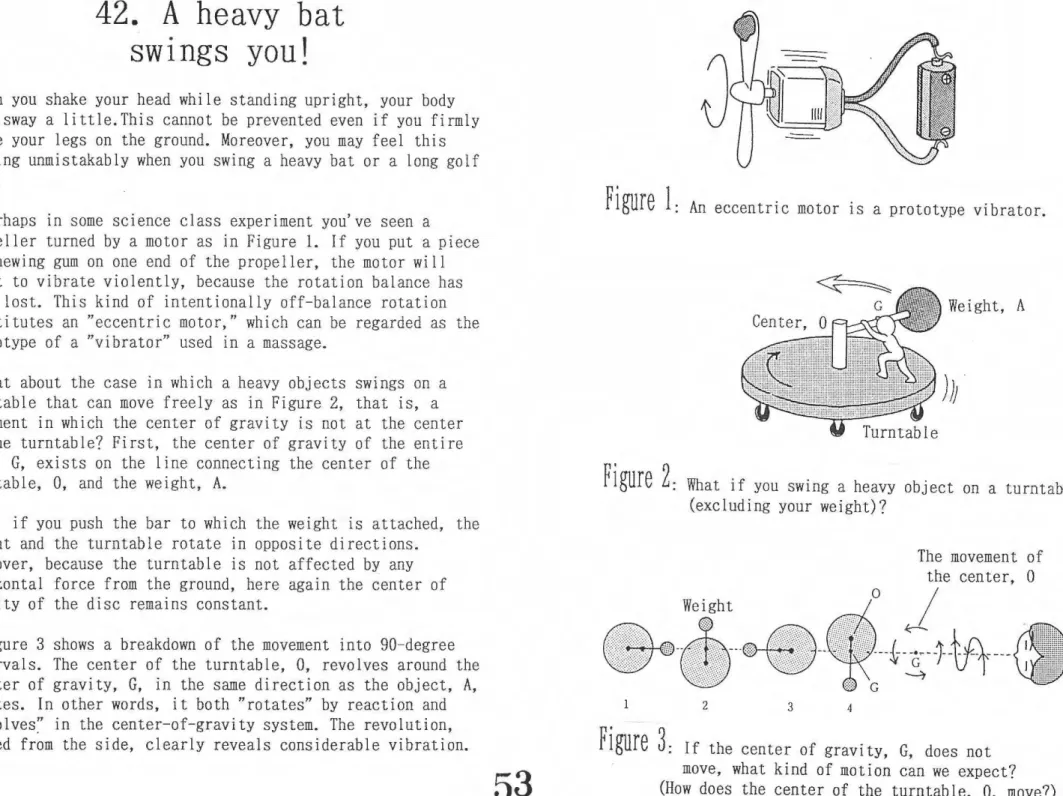
Perhaps in some science class exper iment you've seen a propeller turned by a motor as in Figure l . If you put a pi ece of chewing gum on one end of the prope l ler, the motor will start to vi brate violently , because the rotation balance has been lost. Thi s kind of intentionally off-balance rotat i on constitutes an »eccentric motor,» which can be regarded as the prototype of a »vibrator» used in a massage.
What about the case in which a heavy objects swings on a turntabl e that can move freely as in Figure 2, that is, a movement in which the center of gravity is not at the center of the turntable? First, the center of gravity of the entire disc, G, exists on the line connecting the center of the turntable, 0, and the weight, A.
Now, if you push the bar to which the weight is attached, the weight and the tu rntabl e rotate in opposite directions.
Moreover, because the turntable is not affected by any horizontal force from the ground, here again the center of gravity of the disc r emains constant.
Figure 3 shows a breakdown of the movement into 90-degree intervals. The center of the turntable, 0, revolves around the
center of gravity, G, in the same direction as the object, A, rotates. In other words, it both nrotatesn by reaction and
»revolves:· in the center-of-gravity sys tem. The revo l ution, viewed from the s i de, clearly reveals considerable vibration .
53
Figure 1:
Aneccentric motor is a prototype vibrator.
Figure 2
=W eight, A
What if you swing a heavy object on a turntable (excluding your weight)?
Weight
The movement of the center, 0
··~- ·· OJ
-{ -~ --}- -Vt - - -
2 3
Figure 3: If the center of gravity, G , does not move, what kind of mot ion can we expect?
(How does the cente r of the turntable, 0, move?)
43. This is why your head moves in a golf swing f
When you sw ing a heavy bat, you may feel as if you were being
"swung by the bat." Even if you brace your legs firmly on the ground, when you move your upper body, particularly making a big motion aro u nd the shoulders, you may feel the backbone and torso swaying substantially. This may be felt more clearly if the head, wh ich can be m oved freely above the shou lders, is moved around .
The upper part of t he body, particularly the head, seems to move to an extent comparable to a middle between when the lowe r part is firmly fixed to the ground and when standi ng on a slippery s urface like ice.
Now, let's conf irm this supposition through the fo l lowing mental experiment.
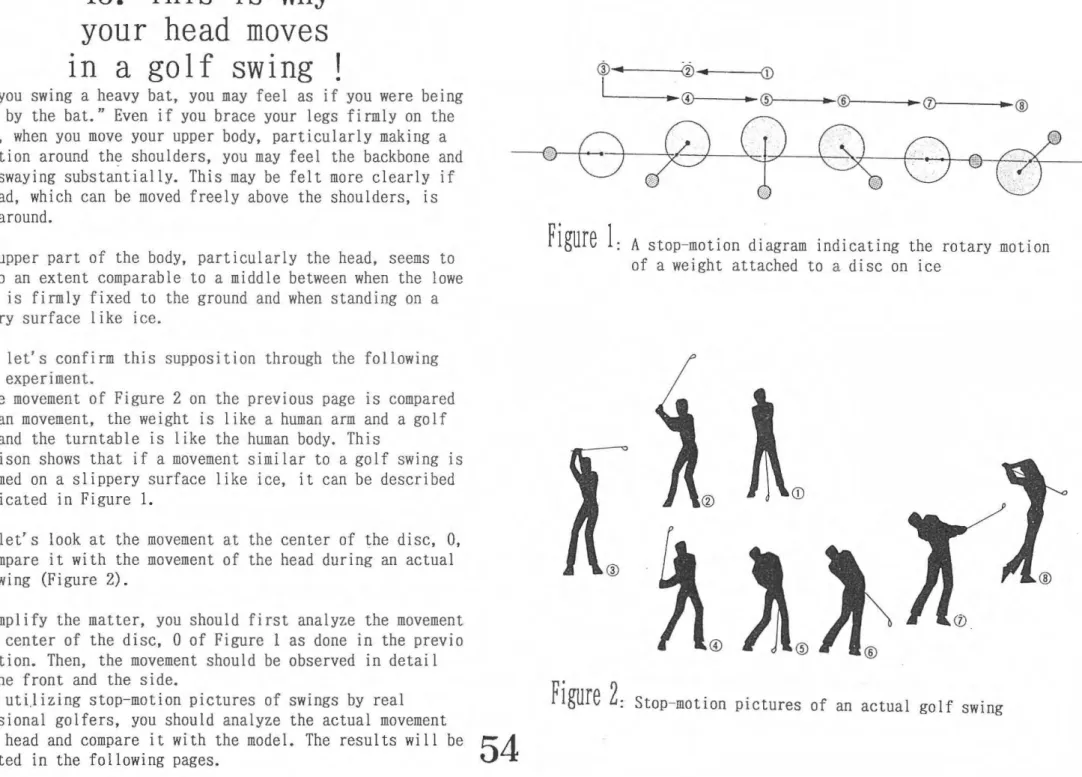
If the movement of Figure 2 on the previous page is compared to human movement, the weight is like a human arm and a golf c lub ; and the turntab l e is l ike the human body. T his
compar ison shows that if a movement s imil ar to a golf swing is performed on a slippery s urface like ice , it can be described as i nd icated in Figure 1.
Now, let's look at t he movement at the center of the disc, 0, and compare it wit h the movement of the head during an actual golf swing (Figure 2).
To simpl ify the matter, you should first analyze the movement of the cente r of the disc, 0 of Figure 1 as done in the previa us section. Then, the movement should be observed in detail from the front and the s ide.
Then, uti . li z ing stop- motion pictures of swings by real professional golfers, you should analyze the actual movement of the head and compare i t with the mode l . The results will be
presented in t he fol lowing pages . 54
®--.
(i) .. (j). _ I - - - - -. . . . - ®---< ...
- ® ....
®~---~.. -
(J)i - - - t .... - @Figure 1: A stop-motion di ag ram indi cat ing the rotary motion of a weight at tached to a disc on ice
(j)
®
Figure 2: Stop- motion pi ctures of an actual golf swing
heads 44. Professional golfers'
also move during the swing
'
Figure
1i s an analytical representation of Figure
1of the previous page for comparison with actua l swings. In order to analyze actual swings (Figure 2), two of the world's top players Ayako Okamoto and Severiano Ballesteros, were asked to appear here so that the movements of their heads could be exam ined. The f indings were quite interesting.
First of all, the movement of the center of the disc, 0, 1s quite similar to the movements of the players' heads
immediately before and after impact . Secondly, the imp act points (indicated by »X's» in the Figure) always come in the middle of the way in which .the heads move from the left to the
right.
Of course, real swi ngs are not exact ly like the disc model, but judging from those similarities immediately found before and after impact, I am confident that both are closely related to the movements in the center-of-mass system related to ction and reaction, that is, kinetic factors common to all the
movements that tend to stabilize the location of the center of gravity.
This contention can be clearly understood by int erpreting professional instructors' advice, »Don't move your head," as»
Don't move the location of the center of gravity.»
Conversely, if you try not to move your head, you end up moving the center of gravity of the entire body, which will
lead to an unnecessary swaying of the body or loss of energy.
Of course, the head should not be moved unnecessarily, but if you try to move your body naturally, you cannot help moving your head.
»Do~t
move your head in a golf swing»: this superst1t1on or misllilderstanding seems to have caused even professional
golfers (not to mention amateur golfers) to find a substantial roundabout way, and spend unnecessary money or ene rgy.
55
From the left side
(Not only right-and-le f t movements but also front- and-rear movements can be observed.)
From the front
Figure 1: What does the movement of the center of a disc, 0 (y our head), look like, when viewed f rom the front and the side?
(Right Left) Left)
,c----7
t l
(' ;- -~
- - - o___ _ __ __ __J
r=;;---~
l _
'---o_____j
About 16 centimeters About 22 centimeters
< The case of Ayako Okamoto> . <The case ~f Sever i ano Ballesteros>
Figure 2: Patterns of actual right~a~d--left movements of
professional golfers' heads viewed from the front (Not only
the right-and-left movements as indicated here, but also front
- and-rea r, or even up-and-down movements can be observed.)
45. The center of gravi t y moves
when arms mo ve !
D o you know the clackers (Picture 1), which makes that strange ticking sound? You may have seen it at a fair. Its movement has a lot in common with our bodily movements.
The explanations up to the previous chapter do not take into consideration the fact that the center of gravity of the torso moves because of the effect of the movement of arms. In other words, those arguments can be sustained only when t he firmly fixed torso works as a pivot for the movement of arms. However,
in rea lity, the torso moves considerably in acco rdance with the arms' movements.
As in Figure 1, hold the dumb bells in front of you and open your arms, You will notice that your body feels like i t is being pushed forw ard. Then, if you return your arms back to the front, your body w i ll be pushed backward.
If you observed these movements from two different angles, you will notice something quite interesting. First, as in Figure
1 a, let's look at it from the front. In this case , the two dumbbel l s look as if they are repelled from each other. On the other hand, if you look at the movement from the side, as in Figure 1b, the body and the dumbbells look as if they are attracted to each other. In either case, it is apparen t that the effects of action and reaction are involved.
Figure 2 is a schematic description of the movements. I t shows the relative re l ationship of the body and the arms when they are opened quick l y, which invo lves the effect of action and reaction, like a butterf ly's fluttering.
However, ·these movements ar e so complicated that, if you find them a littl e difficult to understand, you should actually move your body and feel the effects for yourself.
Picture 1: The clackers (Ho ld the grip and move it up and down quickly;
the two bal ls hit each other and make clear ticking sound.)
fr~~ ~~~k~~~nt ~
<Repulsion>
b. Look ing from t he side
<Attraction>
Figure 1: What if you hold dumbbells and open you r arms quick l y ?
56 Figure 2: Schematic descriptions of Figure 1 (Side views;
"X" i ndicates the location of the center of gravity. )
46. Lean back and get an ace serve!
In m any spo rts, we hit or throw a ball by using the effects of lean ing backward. In this case, we apply the principle show n in Figure 2 in the prev ious section to the body and arms .
While the previous examples are hori zontal movements, those on the nex t page are performed by athl etes standi ng vertica l ly
(that is, movement on a vert i cal plane). Characteristica l ly, these movements also utilize the r eaction resulting fr om using one's l egs to p ush off the gro und.
Figure 1 shows the principle that applies to all these movem ents . The upper part of the body turns around the hips , wh ich act as a pivot, with the flex ing that moves the arm forward and t hen sw ings i t down. The lower part of t he body , on the other hand, turns aro und the hips, which act as a pivo t, with the reaction result i ng from pushing off the ground with one's legs.
As a result, thes e m oveme nts in t he upper and l ower parts of t he body create the fo rce to draw back the hi ps, which is of course affected by the princip l e of action an d reaction.
T he movem ent of pulling back the hips is thus affected by t he movements of the upper and the lower parts of t he body,
allowi ng t ennis or badminton p l aye rs to hit a ball or shuttle back and fo rth qu i ckly and powerfully as in Figure 2. Thi s is what permits them to serve aces. Also, in the case of a throw-
in in soccer, this permits a player to throw a ball further (Figure 3).
In thi s. way , without pu lli ng back part of the body, arms cannot be moved forward qu i ck l y. In other words, the action and r eaction that applies t o li near moti ons also applies in
these cases. 57
~ ~l __._ Pushing by the physi cal power Pu ll ing back
the hips ~
Pushed by
~ JJi• ~
the ground .
Figure 1 : The princ i pl~~~ f exerting force b y l eaning backward
/
0
Figure 2: A tenn i s serve (Get an ace by leaning backward!)
\
\
Figu re 3: A throw- in in soccer (Power
appli ed without leaning backward.)
47. Great jumping power produced by
"action-reaction"!
Aerial motions such as a "jump kick" of karate cannot utili ze action and reaction by pushing off the ground.
In this sect ion , we will look into act ions such as spiking in vol l eyball (Figure 1) , jump smashes in badminton (Figure 2), and headers in soccer (Figure 3).
These motions all have in common two motions -- leaning the body back and bending the knees.Moreover, the backward leaning of the body in t he air is the same as leaning back when one's feet ar e planted on the ground.
However, in the air, the reaction resulting from pushing off the ground cannot be utili zed. Instead, the reaction r esulting from straightening bent l egs is utilized.
With this kicking motion, you can push the leaned -back upper body forward both quickly and powerfully. The important point here is to effectively bend the knees.
You may also notice that there are two ways to use the arms.
One way is to swing the pulled-back arm high and forward . The other is to pull the· arm, which has been pushed forward, down below the hips. Both movements are effective for pul ling back
the hips.
The Butterfly stroke in swimming also makes a good use of the backward leaning of the body and the bending of the knees in the water. This motion is comparable to jumps in the air (see the next ·page).
58
Figure 2: A jump smash in badminton
Figure 3: A header
Figure 1
=In soccer
A spike in
volleyball
48. What are the principles the butterfly stroke and breast stroke?
of
In the butter fly, both arms and legs are moved simultaneously.
This stroke does not use body twists like the crawl does, but rather utilizes "backward l eaning" of the body . The movement is , as indicated in _ Figure
1,a kind of rotary motion of the upper and lower parts of the body, with the hips acting as a pivot.
Fi gure 2 is a schematic description of the movement. In Figure 2a, the hips are moved upward by the reaction of the simultaneous downward rotations of the upper and lower parts of the body, which is followed by b, c, returning to a again.
In other w ords , without the effect of action and reaction, no power can be produced.
And repeating these movements, you can move forward by effectively stroking and kicking the water with both arms and
legs.
It is often said that the up- and-down motion of the hips is the driving force in the butterfly . This principle can be cl early understood by looking at Figure 2.
In the breaststroke, the repetitive motion of folding and extending the arms and legs underneath the body creates the driving force (Figure 3). In short, what is conspicuous here
is the effec tive use of action and react ion resulting from strok i ng and kicki ng in the w ater eff i ciently.
H owever, due to the strong water resistance, sw immi ng motions are not as simple as aerial motions which can be almost ful ly ana lyzed . bY looking at the relationsh ip between the upper and
low er parts of the body. At any rate , it is important to make good use of t he inte ractions between the water and the body,
as w ell as between the upper and the l ower parts of the body. 59
Figure 2 :
The butterfly stroke invo l ves the rotary motion of the upper and lower parts of the body, wi th the hips acting as a pivot
a b c
A schematic description of the princ ip le of the butterfly stroke
===={>
Figure J In t he breaststroke, powe ~ produ:ed by
t he act ion and reaction between the arms and l egs.
Chapter 7
Sports Movements:
How Easy It Is to Turn Around
Quiz: Which o f t h e two wh ee l s
r o l l s f a s t e r ?
Q:
As indicated in rigure 1, there are two whe els (A and B ) , each of which is made of t w o discs connected with three iron bars. Both are released from the top of a slope at the same time. A has the three bars placed ne ar the edge of the discs whil e B has the bars near the cente rs . Both wheels weigh the same.
Now, which one will roll faster? T o answer this question, it is necessary to consider which is easier to roll, or which has its mass concentrat ed at the center of the whee l s .
A:
The correct answ er is "B rolls fa ster than A . " If you think of a sp in in figure s kati ng as in rigure 2, this prob lem will be easier to comp rehend. A person ro t ates different ly when t he arms are extended and bent. Thi s (how difficult it is
to rotate) is ca l led the "moment of inertia".
In this chapter, to ana ly ze various spor ts movements re lated to the moment of inertia, w e wil l use such simpler expressions such as "how easy it is to rotate" or "how difficul t i t is to rotate" . I am sure that you will be ab le to find some usefu l hints for everyday sports activities.
Figure 1 : Which of the two wheels rolls faster?
a. Difficult to rotate b. Easy to ro t ate
60 F igure 2: Fi gure s kating sp ins
49. What is batting with reserved energy?
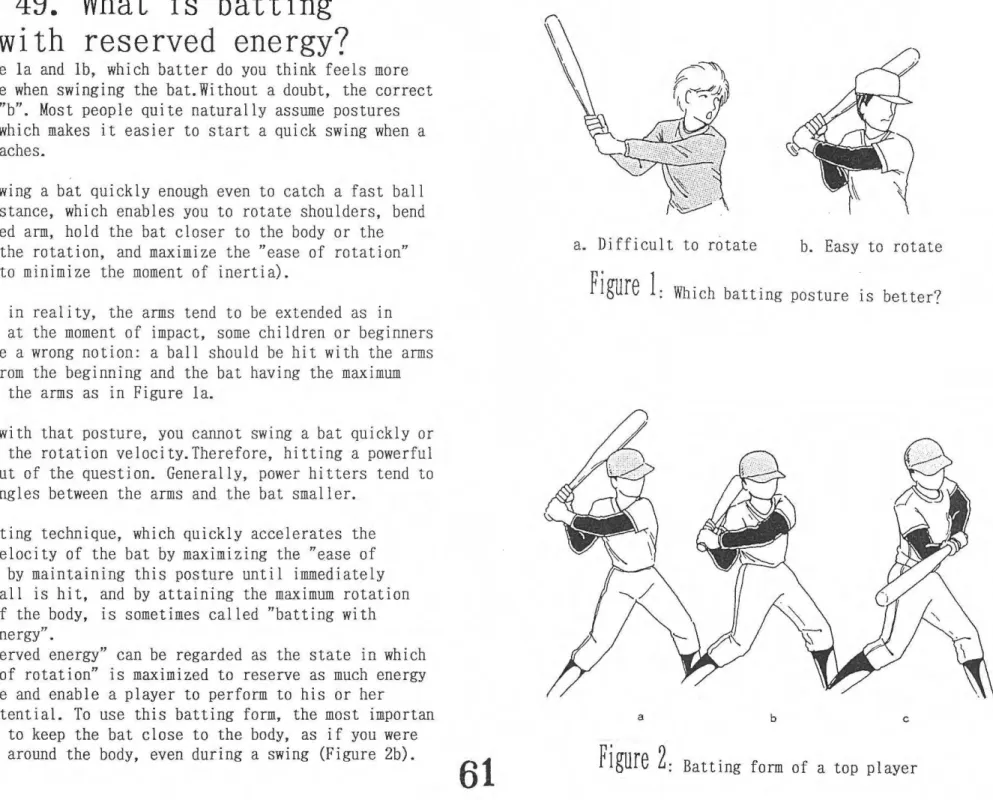
In Fi gure l a and lb, which batter do you th ink feels more comfortable when swinging the bat.Without a doubt, the correct answer is "b". Most peopl e quite natur al ly ass ume postures
like "b, " which makes it eas ier to sta rt a quick swing wh en a ball approaches.
You can swing a bat quickly enough even to catch a fast ball with this stance, which enables you to rotate shoulders, bend your favored arm, hold the bat closer to the body or the cente r of the rotation, and maximize t he "ease of rotation"
(that is, to minimize the moment of inertia).
Because, in reality, the arms tend to be extended as in Figure 2c, at the moment of impact, some ch ildren or beginners may acquire a wrong notion: a ball should be hit with the arms extended from the beginning and the bat having the maximum ang l e with the arms as in Figure la.
However, with that posture, yo u cannot swi ng a bat quickly or accelerate the rotation velocity.Therefore, hitting a powerfu l pitch is out of the question. Generally, power hitters tend to make the angles between the arms and the bat smaller.
This batting technique, which quickly accelerates the rotation ve locity of the bat by maximizing the "ease of rotation," by maintaining this posture until immedi ately before a ball is hit, and by attaining the maximum rotation velocity of the body, is sometimes called "batting with
reserved energy" .
This "reserved energy" can be regarded as the state in which the "ease of rotation" is maximized to reserve as much energy as possible and enable a player to perform to his or her maximum potential. To use this batting form, the most importan
t thing i s to keep the bat close to the body, as if you were winding it around the body, even during a swing (Figure 2b).
61
a. Di fficult to r6tate b. Easy to ro tat e
Figure 1: Which batting posture 1s better?
a b c
Figure 2: Batting form of a top player
50. A bat held short 1s e asy to swing!
When you w ere a small child, you may have tried choking up on a bat, that is, holding it a little shorter than usual . This can also be done in .tennis or golf. Choking up on a racke t or club enables you to swing it with surpris ing ease (Figure 1 ).
T o further examine the question of "how easy (difficult) something is to rotate , " let's make two sticks with differe nt
lengths and attach the same weights to the tips (Figure 2).
What will happen if you swing them (the lengths of the sticks, A and B, are at a ratio of 2 to 1)?
This corresponds to the case in which a bat is held shorter and its weight remains the same. From your exper ience, you may know that a shorter bat is much easier to swing, and you may believe that the difference in ease is much greater than the differenc e in length. That is exactly the case. Theore tical ly,
the difficu l ty of swinging increases in proportion to the square of the length. In other words, if the length is doubled, the difficulty of swinging is quad rup l ed; conversely, if the l ength is halved, the ease is increased four times .
For example, if the length is shortened by 10% , the ease is increased by about 20% ((0 . 9)2
=0. 81) . In add ition, because the mass of a bat i s more dispersed than that of an ordinary stick, swinging a bat becomes much easier.
Some batters choke up on a bat to hit balls more accuratel y, aiming at getting bas e hits rather than home runs. Th is is possible because they can readily respond to different ki nds of ba ll s through the increased maneuverability allowed by choking up on a bat.
62
Figure 1 : If you choke up on a bat , you can
swing it with surprising ease.
A
8
Figure 2: How easy will the swinging become?
(Ha lving the l ength makes it eas i er
four times to swing t he stick . )
51. Holding a racket short 1s another tactic!
A tennis t i p, "Choke up on a racket and swi ng th rough," i s very eff ective for children who cannot swing t hrough a r acket due to insuffici ent phy sical strength or players whose
physical st r ength is diminished because of a lack of exercise.
I occasionally take t hi s approach w he n serving (Figure 1) , and f rom time to ti m e I score an ace.
The same is true of golf. W hen the body fee l s st if f immediately after the start due to a lack of s l eep or an insufficient w arm-up, when the arms or upper body cannot be used effect ivel y because the ball is on a slope or in deep rough, w hen the club is hitched by long grass, or when in a b unker, it is ef fec tiv e to swi ng by choking up on a club (that
is, by reducing the moment of inertia) (Figure 2).
Recent ly , some people have even started adding smal l weights to the end of the grip. This i s another application of the same principle.
Also, some fem ale profess ional golfers cus t omize t heir clubs to enhance the ir approach. Such clubs are the same length as the eight clubs, so choking up is easier and great shots result (Figure 3).
Given that sports involve a great m any st ra teg i es , players have to respond to their own physical conditions or
sur round ing ci rcumstances. Choki ng up on a club i s nothing to be ashamed of. R at her, it is adv i sabl e
tomake an act ive use of this l aw of physics as a strategy for upgrading
performance.
63
~til 0 1/1!11/1
Choking up on a p· l
club will enable you to get out lgUre : Tennis: G o for an ace of the deep rough more eas il y. by choking up on a r acket.
Figure 3: Professional golfer s sometimes
choke up on a club as a strategy ....
52. Is difficulty
1n turning around the same as difficulty in movement?
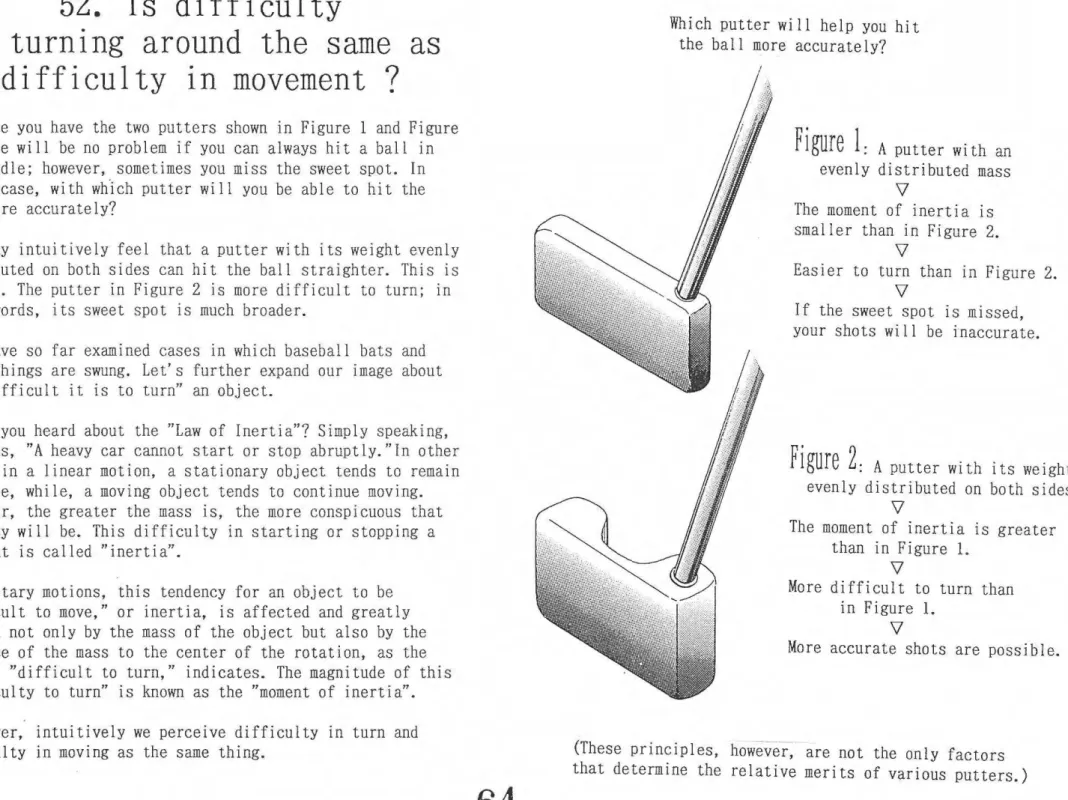
Suppose you have the two putters shown in Figure l and Figure 2. There will be no problem if you can always hit a ball in the middle; however, sometimes you miss the sweet spot. In such a case, with wh1ch putter will you be able to hit the ball more accurately?
You may intuitively feel tha t a putte r with its w eight evenly distributed on both sides can hit the ball straighter. This is correct. Th e putter in Figure 2 is more difficult to turn; in other words, i ts sweet spot i s much broader.
We have so far exam ined cases in which baseball bats and other things are swung. Let's further expand our image about
"how difficult it is to t urn" an object.
Have you heard about the "Law of Inerti a"? Simply speaking, it means, "A heavy car cannot start or stop abruptly." In othe r words, in a linear motion, a stationary object tends to remain
immobil e, while, a moving object tends to continue moving.
Moreover, the greater the mass is, the more conspicuous that t endency will be. Thi s difficulty in starting or stopping a movement is called "inertia".
In rotary motion s, this tendency for an object to be
"difficult to move," or inertia, is affected and greatly changed not only by the mass of the object but al so by the distance of the mass to the center of the rotation, as the
phrase, "di fficult to turn," indicates. The magnitude of this
"difficulty to turn" is known as the "moment of inerti a".
However, intuitively w e perceive difficulty in turn and difficulty in moving as the same thing.
64
Which putter will he lp you hit the ball more accurately?
Figure 1: A putter with an evenly distributed mass
\1
The moment of inerti a is small er than in Figure 2.
\1
Easier to turn than in Figure 2.
\1
If the sweet spot is missed, you r shots will be inaccurate.
Figure 2: A putter with its weight evenly distributed on both sides
\1
The moment of inertia is greater than in Figure l .
\1
More difficult to turn than in Figure
l.\1
More accurate sho ts are possible.
(These principles, howeve r, are not the on ly factors
that determine the r elative merits of various putters.)
53. Why throw with a bent
a ball arm?
We have observed that , in rotary motions like the batting of a baseba l l, the maxi m um power can be elicited by keeping the arms and bat as close to the body as possib le, facilitating
rotation.
In thi s sect i on, w e will ta ke pit ch ing in baseb all as an example to review how the pri ncipl e works, and exami ne the mechan i sm of the last stages of sports movements in hitting,
t hro wing, and k icki ng a ball.
About two thirds of our phys ica l power is generated by the lower part of our bodies. Furthermore, if we exclude the pow er gene r ated by l ean ing and twi st ing the upper body, the power genera ted by our arms represents a very modest portion of the
tota l power generated.
Therefore, in orde r to real ize the max imum potentia l of the smal l portion of power gener ated by our arms , it i s very
impor t ant to facilitate the ir rotation by bending them (that is , minimi zi ng the moment of iner t i a).
As ind icated in the Figure on the nex t page , a pitcher starts the motion in a high wind- up position, then lowers the center of gravi ty by t he fo rce of gravity. In other words, the
kineticenergy toward the right is inc reased by uti l ization of potential energy through gravity.
Bending the arm facilitates rotation, and at the same t ime, raising the elbow high increases the potential energy . It is f rom tha t high position that a ball is thrown. In other w ords,
the arm is bent to acce l e r ate the rotation velocity, whi ch is aimed at mak ing the most of gravity .
A s we will further look into various types of s ports
movements, it is important to realize that, in al l cases , the moment of inertia should be m in imized to make the most of grav ity or the power generated by the lower part of t he bo dy.
65
The center of gravity i s lowered from a high wi nd-up position.
I
That ro t ation energy is transformed into the
kinetic energy of the ball.
The rotation energy of t he 1
body is transformed into the rotat i on ene rgy of the arm, and :
1
1
A great amount ofpotential energy is sustained by the right leg.
This potential ene rgy i s trans f ormed into kinetic energy toward the r ight.
<A p i t c h e r " s
The kinetic energy i s sustainedby the lef t l eg, which transform s it into the rotation energy of the body.
throwing motion>
elbow serve!
54. Hold up your and deliver a strong
Baseball , javel in throw, t ennis, ke ndo, volleyball, handball , and basketball, .. . what is co mmon in a ll these spo rts is the fact that a ba l l or racket is empowered by keepi ng the arm or racket as c lose t o the body as poss ible or by keeping them close to the sho ul der, wh i ch acts as a pivot for the rotary mot i on (Figure 1 - Figure 6) .
Some peopl e may say, "Everybody bends the arm when t hrowing s omethi ng. "
True enough, th i s is an instinctive motion that we acquire naturally, an d there i s nothing surpr i sing in it .
Howeve r , those who have neve r played ten ni s m ay not unders tand why the rac ke t should be lowered behind the body during a serv ice, or m ay not see the common factors rel ated to other motions .
In this sense , i f a player unde rstand s t hat the motion of
"ben ding an arm" makes it easier to rotate aro und t he shoulder, reduces the moment of inertia fro m a dyn amics' point of view, and e li c its the player' s maximum potential, he or she will be able to use such kno wl edge to improve his or her spo rts techniques.
In other w ords, eliciting one's maximum potential means mak ing the most of the ef fects of acti on and react ion in various spor t s movement s.
It is my b e l ief that, in the world of sports, instead of fol lowing .dogmatic tra in ing methods or blindly repeat ing what
is taught,adopting more theoretical ly and scientifical l y sound me tho ds will Improve your t echni ques faster.
66
Bending your a rm and holding up your elbow allows you t o reach
yo u r maximum p o t e n t i a l_
Figure 3: Javelin throw Figure 2: T enn is Figure 1 : K en do
Figure 4: Basketbal l
Figure 6 : Voll eybal l Figure 5: H andba ll
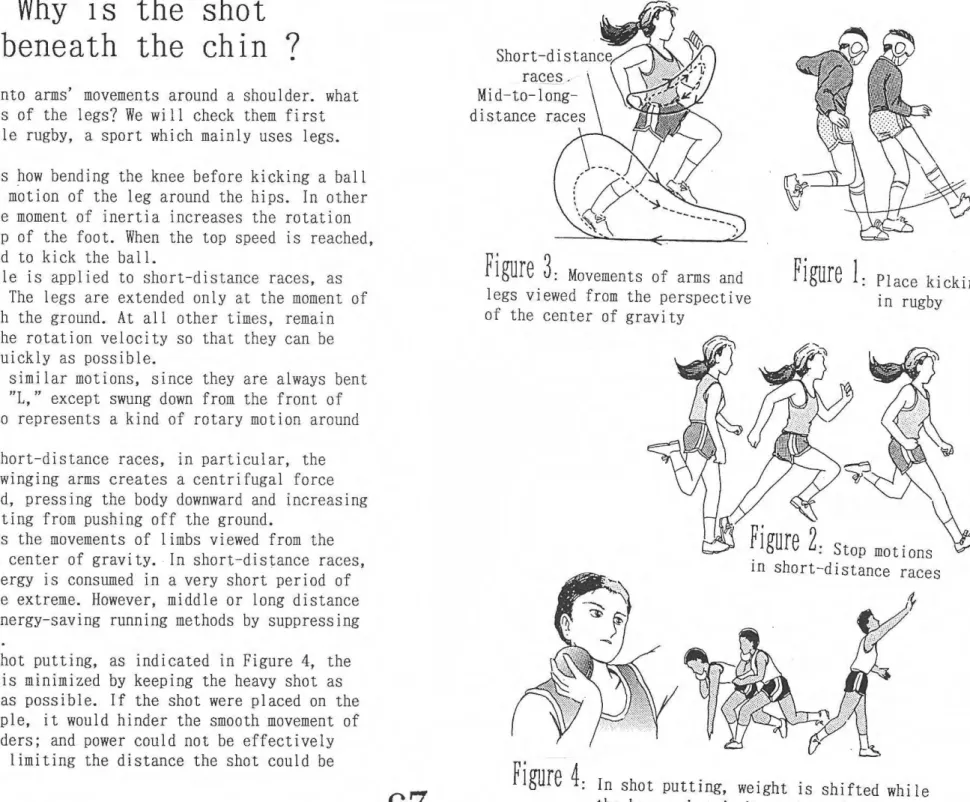
55. Why is held beneath
the the
shot chin ?
We have looked into arms' movements around a shoulder. what about the movements of the l egs? We will check them first taking as an example rugby, a sport which mainly uses legs.
Figur e l indicates how bending the knee before kicking a ball assists the rotary motion of the leg around the hip s. In other words, reducing the moment of inertia increases the rotation velocity of the tip of the foot. When the top speed is reached,
the l eg is extended to kick the ball.
The same principle is applied to short-distance races, as shown in Figure 2. The l egs are extended only at the moment of wh en the f ee t touch the ground. At all other times , remai n bent to increase the rotation velocity so that they can be moved forward as quickly as possible.
The arms exhibit similar motions, since they are always bent in the shape of an "L," except swung down from the front of the body. This also represents a kind of rotary motion around the shou lders.
In the case of short-distance races, in particu l ar, the rotary motion of swinging arms creates a centrifugal f orce that works downward, pressing the body downward and increasing the reaction resulting from pushing off the ground.
Figure 3 indicates the movements of limbs viewed from the perspective of the center of gravity. In short-distance races, because all the energy is consumed in a very short period of
time, movements are extreme. However, middle or long distance runners use more energy-saving running methods by suppressing the up-down motion .
In the case of shot putting, as indicated in Figure 4, the moment of inertia i s minimized by keeping the heavy shot as close to the body as possible. If the shot were pl aced on the shoulder, .for example, it would hinder the smooth movement of the body and shou lders; and power could not be eff ect ively generated, thereby limiting the dis tance the shot could be thrown.
67
races , Mid-to-long- distance races
Figure 3: Movements of arms and legs viewed from the perspective of the center of gravity
Figure 1 : Place kicking in rugby
Figure 2.. Stop motions \~ ~
Figure 4:
in short-distance races
In shot putting, weight is sh ift ed while
the heavy shot is kept close to the neck.
56. Can your body turn in the air
only by bending ?
Let's review the moment of inertia once again. When the limbs are kept close to the pivot or the mom ent of inertia is kept to a minimum, the body is easier to rotate. However, thi s is not the only factor that rotates an object.
We have so far discussed movements performed when the feet are planted on the ground. In this section, w e will look at wh at happens when the feet are off the ground, or t he body is
in the air.
Figure 1 shows an examp le of aerial movement during platform diving. The highlight s of this sport consist in leaping from a high position where most people would feel dazzled, giving a brilliant aerial performance by rotating and twisting the body, an d entering the wat er qui etly without splashi ng.
In this event, the initial momentum f or aerial rot ation is generated at take- off from the platform; and during the flight, the body is rolled up and rotat es. Then at the fin ish, the body
i s extended to stop the rotation and enable a fine- l ook ing entry.
Rotation in this case a lso takes place around a center of gravity,and the small initial momentum for the aerial rotation must be generated upon t ake off from the platform. This is expressed in technical terms as, start ing "the drag-in moment".
Otherwise, the body will not rotate even if the moment around the center of grav ity is red uced by bending the body.
As indicated in Figure 2, there are four aeria l forms in platform diving. Each form requires its own initial momentum.
Given that condition, the more the mass is concentrated around the pivot, the eas i er the rotation will become. T he motion ind icated by Figure 2a, in particular, uses a differ ent pivot,and also requires a twisting motion, both of which make it more difficult to perform.
68
the body Ro 11 ing up
starts the
r~tation. ~~~~Initial momentum is
~ 'i...L · --.. g - en _e_r..:..,ated at take-off.
Stretching the body
stops the rotation. '
\
Figure 1: Platform diving (Rotation is made possib le by the initial momentum.)
a. Free- sty le
c. With pike if d. Layout
Figure 2: Aerial performance during platform diving
(Turning smoothly around pivots)
57. Why land with open arms ?
The princ ipl e of faci litat ing rot ation by bending the body Is used in many spo rts movem ents.
A some rsault in gymn astics or from a tram poli ne (Figu re 1) is performed with a bent body, a l so applyi n g the samep rinc iple.
T he »k i ck- up» is a basic movement o n the horizontal bar. As indicated in c and d of Figu re 2, rotation is qu ickened by getting the body closer to the pivot or the bar, in other w ords , by reducing the moment of inertia.
In the high jump, when the body goes over the bar, it is bent bac kward. Thi s posture i s also regarded as convenient fo r rotating around t he bar quick ly (F igure 2, 107).
Conversely, there are many s por ts movements i n which the body is stretched or the arms are opened up to prevent the ro tatio n of the body.
For examp le, upon landing dur ing ski jumping (Figure 3) or in var ious gymnastic events , the arms are almost al w ays extended.
T h is increases t he moment of inertia and prevents the la teral sw ayi ng of the body.
T his principle works both positive ly and negatively for a l l kinds of sports movements. By app lying this pr inc ip le
conscious l y and approp r i ate l y i n each case, yo u wi l l be abl e to
upgrad~your techniques.
69
Figure 1:
Figure 2:
Figure 3:
Tucked front somersault in gymnastics
St op mo ti ons in kick- up
Extending arms when landing hel ps stabili ze
the body in ski jumping.
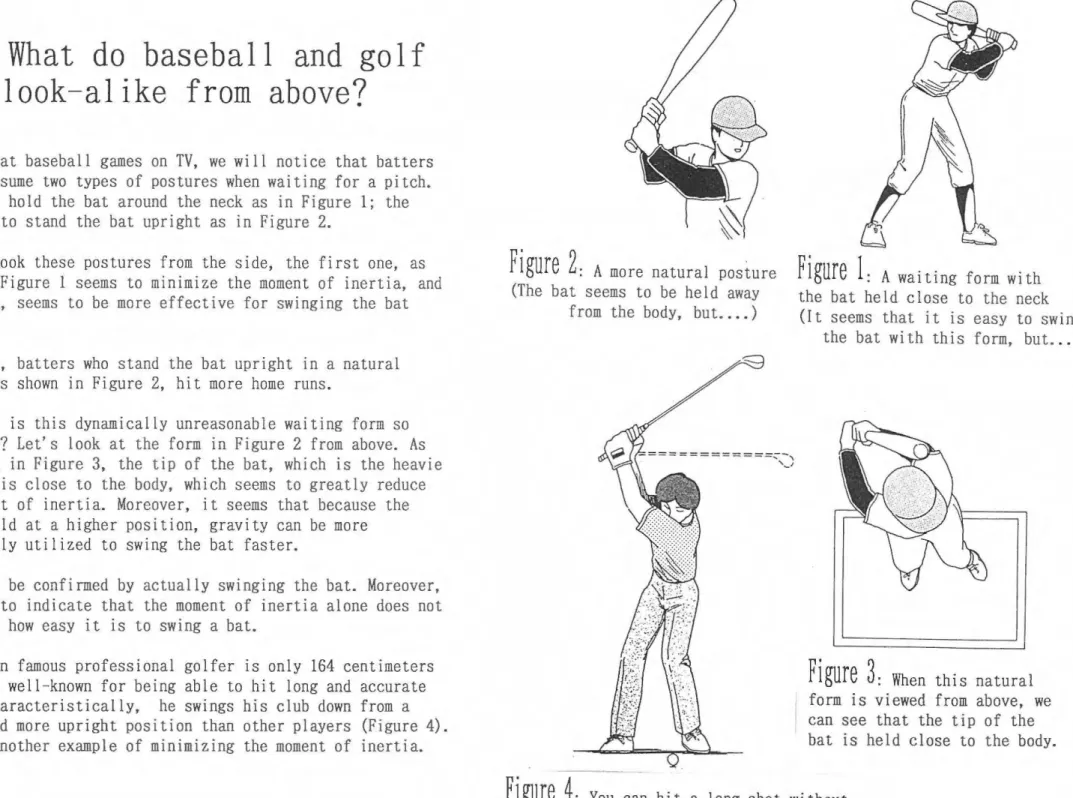
58. What do baseball and gol f look - al i k e from above?
Looking at baseball games on TV, we wil l notice that batters mainly assume two types of postures w hen waiting for a pitch.
One is to ho ld the bat around the neck as in Figure 1; the other is to stand the bat upright as in Figure 2.
If w e l ook these postures from t he side, the first one, as shown in Figure
1seems to minimize the moment of inertia, and therefore , seems to be more effective for swinging the bat quickly.
However, batters who stand the bat upright in a natural manner, as shown i n Figure 2, hit more home runs.
So, why is t his dynamical ly unreasonab le waiting fo rm so effective? Let's l ook at the form in Figure 2 from above. As
indicated in Figure 3, the tip of the bat, which is the heavie st part, is close to the body, which seems to greatly reduce
the moment of i nertia. Moreover, i t seems that because the bat i s held at a higher pos it ion, gravity can be more effect ively ut i lized to swing the bat faster.
This can be confirmed by actually swinging the bat . Moreover, it seems to indicate that the moment of inertia alone does not determ i ne how easy it i s to swing a bat.
A certain famous pro fessional go l fer i s only
164cent imeters ta ll, but we l l- known for be ing ab l e to hit long and accurate shots . Characteristica l ly, he swi ngs his club down from a higher and more upr ight position than other players (Figure 4) . This is another examp l e of minimizing the moment of inertia.
Fi gure 2: A more natura l posture (T he bat seems to be held away
from the body, but ... . )
Figure 1 : A w ai ti ng form with the bat held close to the neck (It seems that it is easy to
swin~the bat with this form, but ... )
Figure 3 : When thi s natural fo rm is vi ew ed f rom above, we can see that the t ip of the bat is held close to the body.
Figu re 4 : You can hit a l ong s hot without
sw ing ing the c l ub back to the ho r i zonta l leve l.
Chapter 8
Sports Movements:
Snaps
Quiz: Wh a t w i l l happen
i f you swing a r a c k e t on . a t u r n t a b l e ?
Q: Suppose you stand on a turntable, fix your right arm by holding it with your left hand, and swing the racke t by only moving the wrist, as shown in Figure 1. In which direction will the table turn? (I f you try the same thing without a
racket, you will not notice any movement.)
A:
The answer i s that it will move in "the direction indicated by b in Figure 1". Although only the wrist will seem to move independently, detached from the body, that is not the case. Because both the wrist and the racket are connected through the arm to the body which is s upported by the
turntable, the body itself will be affected by the movement of the racket. If only the wrist is swung without a racket, the body will not be affect ed because the weight of the wrist is negligible. However, i f it is swung while holding a racket with a certain weight, force will be transmitted through the arm to the body, which is rotating in the opposite direction.
In Chapter 2, we observed that if an arm i s swung on a turntable, the body moves in the opposite direction. The same principle can be viewed as working here and moving the body In the opposite direction. Moreover, in either case, a rotary motion will result from the effect of actio n and reaction.
As indicated in Figure 2, even if you try to throw a ball using only your wrist, the power will be almost negl igible.
However, snaps can be quite effective for transmitting much greater power. In this chapter,we will look at the transmission of power throughout the body from various angles, and try to prove that seemingly feeble snaps can actually generate great power.
71
A racket (A bat or a stick will do.)
A turntable th at can rotate smoothly
The same
The opposite direction
Figure 1: What happens if you swing a racket on a turntable ... ?
Figure 2: How fa r can you throw a ball
by only snapping your wrist?
59. There are two ways to snap a wrist '
When w e hear the word, "snapping," we usually think of the way indi cated in Figure 1. But this is not the onl y snap we us e. There ar e act ually t w o kinds of snaps. Unless we
di stingu i sh them f rom t he start,our discussio n may be somewhat confusing.
The t w o kinds of snaps are, of course, a lateral snap and a ve rtic a l snap. First, swi nging the wrist lateral ly,or rotating
it around the wri st as a pivot as in Figure 1, is called
"hinging". A "hinge" is a small part attached to the side of a door. This mov ement is frequently used in a shoulder pass in basket ball (Fi gure 2), in serving or sp iking a volleyball, in p itching a baseball, etc.
The other movem ent is called "cock ing, " which means swing ing the wrist verti cally as i n Figure 3. This i s typically
exhib ited in the movement of hitting a nail with a hammer (Figure 4).
In go l f , turning the wri st upward is fre quently called
"cocking"; whil e turning it downward is ca ll ed "un cocking" . Actually t hese mo vements are accom panied by some lateral motion. Otherwise, it woul d not be possib l e to move the wrists smoothly.
In any event, t hese wri st movements are qui te f r equent ly found in baseball, golf, kendo, etc., and are characteri zed by the movement of the hand that resembles the breaking of t he wri st downw ard, as shown in Figure 3c, at the moment of im pact .
T his occurs bec ause the arm is strongly pulled by a large centr i fuga l force at the moment of impact, as is usually t he case in golf.
72
Figure 1 : Hing i ng (l ate ra l rotation of the wrist)
Figure 2: Shoulder pass in basketball
bO c:
~ c.J u 0
b=:) -~
c~ -- '
\' '
Figure 4: The motio n of hitting Figure 3: Cocking (vertic al
a nail wi th a hammer rotation of the wrist)
60. Bodily movements can be explained by these models!
Bodily movements seem to be hard to grasp clear ly because the body can move quite free ly. But there are some common factors
looking at a golf swing or a batting motion (Figure 1), we notice that first the lower part of the body, which generates two thirds of a person's physical power, pushes off the ground, leading to a reaction that causes the body to turn. Then that rotation energy is transmitted to the arms, and from there to the cl ub or bat.
In the upper part of the body, in part icular, we notice that the power is conveyed in such the order of "torso
"*arm
"*apparatus". Yet, i n order to look into this phenomenon in more detail, we should replace it with a simpler model to make it eas i er to understand.
In the case of linear motions, we can use a model in which three carts with different weights are pushed with one's legs as in Figure 2. At first, these connected carts move at the same speed.
Starting from this state, first A pushes cart (2); then B pushes cart (3). The final outcome is that only the cart at the top, (3), is accelerated. That is, due to the effect of action and reaction, the pushed cart acce l erates.
This could serve as a simple model if we compare the pushing power of A and B to the muscle power of a person, and carts(l),
(2), and (3), to the torso, the arm, and the apparatus.
Th i s principle can be also appl i ed to a rotary motion. Figure 3 shows discs of different weight that rotate free l y. At the moment a disc is pushed, there is an action and reaction.
However this model is not quite adequate since in the case of rotary motions, the ease of rotat ion can be changed by bending the arms or t he apparatus. This point will be discussed later in greater detail .
73
d)f--- - -
cv----
< D - - - -
@apparatus i
~
arm
CD torso i
---i(V - - - ( i )
Figure 1 : What characteristics do a golf swing and a swing of a baseball bat have in common?
Figure 2: What if the connected carts are pushed one after another?
- - - - torso
\:----arm - - apparatus
Figure 3: What if rotating discs are pushed one
after another? (Each disc rotates smoothly.)
61.
"Use
What your
is the meaning of body like a whip"?
Although thus far we have compared arm movements to the simple motion of sticks , human arms actually cons i st of many sepa rate parts. Hands also have fingers wit h nume r ous joints.
Figure
1indicates how the fingers are involved in throwing a ball. The subt le movements of fingers cannot be ignored ; t he entire movement can be subdivided into tiny parts.
The often heard advice, "Use your body like a whip," can be easily understood by imaging that the force is effic iently transm i tted from larger parts (" levers") to sma ll e r ones, with each joint mov ing flexibly .
Figure 2 shows the mechanism of how a whip works . Al t hough each section a lone does not contribute much in te rms of strength and magnitude of the movement, if these sections are combi ned and the force i s concentrated on the tip, both the moveme nt and velocity are increased and able to perform a great amount of work.
A wrist may seem feeble, but since it 1s located on the ti p of an arm, or a whip, it can be used to concentrate the force of the enti re body. This explains the concept behind the express ion, "Snap your wrist when throwing the ball . " In go lf , the "whip" eff ec t is even more pronounced because the c lub is bent.
This kind of movement is not only located in the arm or upper part of the body; the enti re body or the legs can be involved.
As see n in Figure 3, kick i ng a bal l in soccer can be viewed as a ki nd of rotary motion around the hips.
74
F igure 1: Throwing a baseba l l with a snappi ng mo vement
F ig ure 3: A soccer kick : Legs move in a rotary motion around the hips (The leg is used like a wh ip) .
~ r, ' '
'' '' ''' ' ' ' ''
' '
Figu re 2: T he princip l e of a w hi p (A whip is a m u lti-leveled lever:
the magnitude and the velocity of
movement increase toward the t i p. )
62. You can hammer a nail harder
if you stop your hand!
In fact, a wh ip conveys force through multiple levels. But s ince it is much easier to think of the mechanism in simpler terms, w e will use a two- step mode l. Let's first look at the"
separation" phenomenon in linear and rot ary motion.
W hen two objects separate f rom stationary positions, they will move in oppos i te directions. But when two objects moving
in the same direction at the same speed separate, as when one object pushes the other (Figure 1) , the movements are so comp li cated that we may miss t he subtle dynamics unless we observe them closely. In a light push, cart (2) and disc (2) are ordinari ly acce l erated, and cart (1) and disc (1) are decelerated.
However, i f pushed with an app ropri ate amount of force, the cart and disk (1 ) can be stopped, a case which is anal ogous to ompletely conveying momentum of the body to o ne' s arms or sports equipment.
A simpler example of this case is found in hammering a nail:
if you keep your wrist flexib l e and stop your arm movement immediately before hitting the nail, the hammer will accelerate and t he nai l can be hit with much more force. This is exactly what occurs i n the previo us examples. If you draw back your arm a littl e more, the · tip of the hammer wi l l be fur t her acce lerated.
What happens if the cart in Figure 1 is pushed w i th more force? The pushed cart i s further accelerated an d the pus hing unit actually moves in the opposite direct ion.
Figure 2 depicts figures immediately after impact in baseball and golf . The l eaning back of the body in the di rection
opposite to the flying ball occurs for the reasons presented above. This principle, though not commonly recognized, Is actually t he secret to hitting a ball harder .
75
<Linear
<Rotary
~ l@:@ ,
Figure 1 : What if two objects moving at the same speed arepushed?
" ~' Golf ' \, u Bas eball
Figure 2: The key i s to hit a ball while leaning back.
63. Snapping is
"action - reaction"!
In the previous section, it w as stated that you can hammer a nail more easily if you pull back your wrist s l ightly , using the whip pr incip le . . T his effect is qu i te noticeable if you try this wi th a rope. As you swing the rope, releasing the force will stop your wrist; if you start with your wrist in a s l ightly cocked position, the end of t he rope w ill acce lerat e with a nswi shingn sound .
Thus, one en d accelerates as the other end is stopped or moved in the opposite direc tion . This motion is often called nus ing a snap,n and the entire motion is actually based on the
principle of actio n and reaction. T hi s is quite obvious in Figure 1, which shows the backward motion of the fo rearm while the hand is moved fo rward .
B ecause snapping has the great accele rating effect, it 1s used in all kinds of sports .
T ake a spike in volleyball , for instance. As Figure 2 depic ts, a setter tosses the bal l , t h en the spi ker qui ck ly jumps up, avo iding the opponents' blocks, and smashes the ball into the opponents ' cou r t by controlling his or her wr ist .
If t he spiking player makes too large an arm movement when close to the net, he or she may inadve rtently touch the net.
Thus , a snapping movement to pull back the arm slightly is necessary at the moment of the spike .
Figure 3 depicts a jump sho t in basketbal l,wh ich incorporates snapping movement in the fingers as w e ll as the wrist. Such movements supp lement jumping power and allow good ball control .
7 _ 6
c::J!:{,.
~
Figure 2: A spike in volleyball (Stop the arm swing and make effective use of snapping the wrist !)
F igure 3: A jump shot in basketball involves snapping both the wrists and f ingers .
f--A ction
N F igure L
What is a snap''t::j} really made of?
~~ J ;
~-I! I /
..__/.
I ': \ -
)
i