A model for the heat of transport in ionic conductors
journal or
publication title
Solid State Ionics
volume 180
number 6‑8
page range 467‑470
year 2009‑05‑14
URL http://hdl.handle.net/2298/11669
doi: 10.1016/j.ssi.2008.09.001
A Model for the Heat of Transport in Ionic Conductors
S. Taniguchi, M.Aniya
Department of Physics, Graduate School of Science and Technology, Kumamoto University, Kumamoto 860-8555, Japan
Abstract
The ion flow caused by a temperature gradient originates the ionic thermopower which is quantified by the heat of transport. Experimentally, it is known that in superionic conductors, the heat of transport Q is nearly equal to the activation energy for ion transport Ea. In the present paper, a model for the heat of transport in ionic conductors has been proposed based on a lattice dynamical theory of diffusion. We have shown that the relationship between Q and Ea is determined by the participation degree of different phonon modes, in particular the short wavelength phonons to the atomic jump processes. The implication of this finding to the transport properties of superionic conductors has been discussed, and it is suggested that the degree of the collective motion in ionic conductors increases with the increase in Q/Ea. The model predicts that good ionic conductors will show large value of Q/Ea. The importance of the acoustic phonons in the ion transport processes has been also pointed out.
Keywords: heat of transport, thermoelectric power, ionic conductors, phonons
1. Introduction
The thermoelectric effects provide a means by which thermal energy can be converted into electricity and by which electricity can be used for heat pumping or refrigeration.
Thermoelectric materials have been studied extensively in the late 1950s and 1960s after Ioffe first proposed the investigation of semiconductor materials for utilization in thermoelectric applications. Recently, there has been a resurgence of interest in thermoelectrics, and over the past few years many new classes of materials have been investigated. Much of the recent interest was motivated by the need for new alternative energy materials. Many new concepts of materials, including bulk and thin films with complex structures and geometry, new materials synthesis, theories, and characterizations have been advanced during the last few years [1-4]. However, this situation is mainly for electronic conductors in which the charge is carried by electrons or holes. Concerning the thermoelectric effect in ionic conductors, the situation is very different. Although the ionic thermopower has been studied over the decades [5-18], its understanding from the fundamental point of view remains still obscure. For instance, it is known that in superionic conductors, the heat of transport which is determined from the thermopower measurement is nearly equal to the activation energy determined from ionic conductivity [9,10]. Why must be so? Its exact origin is not known. In the past, some challenges have been done to explain this behavior [5-8]. Among these, the free ion model catches in a simple way the basic phenomenology of the ionic thermopower [5]. However, the assumption used in this model is questionable. More elaborated model for ionic thermopower dealing with the relationship between heat of transport and activation energy of ion transport have been also proposed [6-8]. In the present paper, a model for the heat of transport in ionic conductors is presented. The model is based on a lattice dynamical theory of diffusion [19-21].
Our model indicates that the relationship between the heat of transport and the activation
energy of ion conduction is determined by the participation degree of the short wavelength phonons in the atomic jump processes.
2. Model
In this paper we consider an ionic conductor, in which the charge transport is due to the displacement of ions. According to the laws of irreversible thermodynamics, when gradients of temperature T and ion concentration n exist in the system, the ion flow density rj
is written as [22]
⎟⎠
⎜ ⎞
⎝
⎛ +
−
= T
T k n Qn D
j grad 2 grad
B
r , (1)
where D is the diffusion coefficient, Q is the heat of transport of the ions and kB is the Boltzmann constant. The diffusion coefficient is written as
[
E k T]
f a
D= 02 exp− a B , (2) where a0 is the interatomic distance, f is the mean vibrational frequency and Ea is the activation energy.
The thermopower, S is defined as
T Sgrad
gradφ = , (3) where φ is the electrochemical potential induced by the applied temperature gradient. The heat of transport is related with the thermopower as
eT H
S =− Q + , (4)
where e is the charge of the mobile ion species and H is a term due to the electrode contact potential [9,10].
In the following, we consider a linear chain of atoms which are oscillating around their equilibrium sites. The chain may contain vacancies that permit the adjacent atom to jump into these vacancies as illustrated in Fig. 1. In the lattice dynamical theory of diffusion, the atomic jump is accomplished by the in-phase superposition of lattice modes. That is, whole group of atoms contribute to the activation process. When an ion jumps, the vibration amplitude of the jumping ion should be sufficiently large. As illustrated in Fig. 2, here it is assumed that the ion jumps when its amplitude of vibration exceeds a critical value q0. Although the physical phenomena are not the same, the model contains similar idea with the Lindemann’s theory of melting, which assumes that the melting occurs when the amplitude of atomic vibration reach a certain fraction of interatomic separation [23].
In terms of the superposition of lattice modes, the displacement of an ion from the equilibrium lattice sites is written as
∑
∑ =
=
i
i i
i i
i
iM t
q α α ε 12cosω . (5) Here εi is the energy of the mode Mi and αi is the weight factor of the mode that has frequency ωi. In terms of the quantities qand q0, the jump rate Γ can be expressed as
⎥⎦
⎢ ⎤
⎣
⎡−
=
Γ 2
2
exp 0
q
f q , (6)
where the mean frequency f is defined as
∑
∑
=
i i i
i i f
f2 α2 2/ α2 , (7)
where
π ω 2
i
fi = . (8)
From the condition of occurrence of ion jump, q>q0, we obtain the minimum energy required for the jump [19],
1 2 2 0
−
⎟⎠
⎜ ⎞
⎝
= ⎛∑
i i
a q
E α . (9) Consider two ions adjacent to the vacancy as shown in Fig. 1. In thermal equilibrium, the phonon distribution is symmetric around the vacancy. Therefore, both ions will jump with equal probability into the vacancy. In a temperature gradient, however, phonons in one direction will dominate those in the opposite direction. In this case, the jump probability of the two ions will be different, and a net flow of ions parallel to the temperature gradient will set up. Denoting by Γ−and Γ+ the ion jump rate from left-to-right and right-to-left sides, respectively, the ion flow j is written as
(
Γ−−Γ+)
=na0
j . (10)
The energy of the mode εi in a temperature gradient, is obtained by solving the Boltzmann transport equation [19] and it is written as
T v k T
k i i
i B Bτ grad
ε = − , (11)
where the first term is the equilibrium value at temperature T, and the second term is its departure which represents the non-equilibrium part. Here,
dk vi = dωi
(12) is the group velocity of the mode and τi is the relaxation time which takes into account effectively all the interactions that contribute to the phonon damping processes.
By using Eqs. (5) and (11), Eq. (6) becomes
⎭⎬
⎫
⎩⎨
⎧ −
⎥⎦
⎢ ⎤
⎣
⎡−
=
Γ T
T k
l E T
k
fexp Ea 1 a2 grad
B B
, (13)
where
∑
≡∑
i i i
i i
i v
l 2
2
α τ α
. (14)
Note that the quantity l has the dimension of length and that it is weighted by the coefficient
2
αi used in the expansion of the displacement given in Eq. (5).
We have derived the above equations in one dimension for mathematical simplicity. The expression for the ion flow density is obtained by applying Eq. (13) into Eq. (10), and in three dimensions it is written as
T T k
l E T
k f E
na
j a 2 a grad
exp 2
0
B
B ⎭⎬⎫
⎩⎨
⎥⎦⎧−
⎢⎣ ⎤
⎡−
r=
. (15)
Comparing this expression with the phenomenological relation given by Eq. (1), we obtain the following relationship between the heat of transport and the activation energy,
Ea
a Q l
0
= 2 . (16)
In the derivation of Eq. (16) we have assumed that there is no gradient in the concentrations of ions in the system. That is, we have assumed that gradn=0. The result shown in Eq. (16) indicates that the ratio Q/Ea is determined by the quantity l defined in Eq. (14), because the interatomic distance a0is a material constant.
3. Discussion
As mentioned in the introduction, experimentally, it is known that in superionic conductors, the heat of transport is nearly equal to the activation energy. According to our model, this fact
indicates that l ≈a0 /2. At a glance, this result seems strange, because l is smaller than the interatomic distance. However, it is not the case as will be shown below. Before entering into this subject, it will be convenient to compare the result obtained with the results of previous studies. The free ion model [5] predicts that Q=Ea. On the other hand, according to the polaron lattice gas model [6], the result is Q<Ea, and in a calculation using the Fokker- Planck equation [7], the result is Q>Ea. On the experimental side, according to the data collected for Ag ion conducting materials, all the three cases are available [10]. More specifically, the data are dispersed in the range of 0.7<Q/Ea <1.1. For the case of Cu ion conducting materials [13], the data indicate that Q<Ea. For the case of mixed AgIxBr1-x system, it is reported that Q> Ea [15]. It is gratifying to note that our result given by Eq. (16) can account for all these cases found experimentally. However, it must be reminded that the experimental values of Q and Ea contains errors. Therefore, the numerical values given above for the Ag ion conducting materials have only a qualitative meaning.
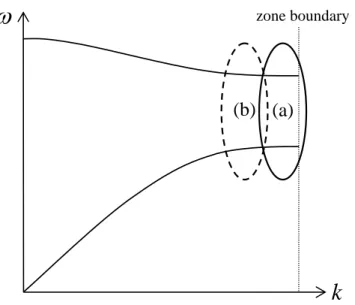
Concerning the subject of relative magnitude of lcompared with a0, the following physical argument may be given. It is not hard to accept that the phonon modes that contribute effectively to the ion jump processes are vibrations that create elongated space around the vacancy site that we are focusing. The vibration mode could be of both types, acoustic and optical modes. The situation is illustrated schematically in Fig. 3 (A). To avoid confusion, it must be reminded that we are representing the physical idea by using a linear chain. In a real system, the jump could also occur into an interstitial position. The important thing lies in to recognize that short wavelength phonons are involved in the ion jump processes. As is well known, these short wavelength phonons are located near the zone boundary in the phonon dispersion relation as illustrated by area (a) in Fig. 4. If the contribution of these short
wavelength phonons is dominant in the expansion of the displacement given by Eq. (5), the quantity l will take a small value, because the group velocity viof these phonons is very small. Therefore, the result found above, l ≈a0 /2 is not an unphysical result. Another interesting point that should be noted is that the model suggests the importance of the acoustic modes in the ion transport processes. This observation arises from the positive value of l. The above discussion leads also to an interesting picture concerning the ion transport mechanism in superionic conductors. It has been recognized that an important characteristic of the superionic conductors is that many ions move collectively [24,25]. The origin of this collective motion has been studied by different models [25] and more recently, from the point of view of the chemical bond of the materials [26]. The collective nature of the ionic motion suggests that the in-phase motions of the ions are involved. In terms of the concepts gained in the present work, phonons with longer wavelength compared with those involved in the individual ion jump become important. Schematically speaking, these phonons belong to the area (b) shown in Fig. 4. Fig. 3 (B) illustrates the collective nature of the ion dynamics. These observations suggest that in superionic conductors, the energy barrier determined by the chemical bonding is low [26] and that the ions overcome collectively the barrier with the help of phonons.
It is interesting to note at this point, that superionic conducting materials exhibit a relatively flat phonon dispersion curve as compared with other non-superionic materials [27].
This property has been recognized as the low energy excitations in the field of superionic conductors [28-31]. The flat phonon band implies that many phonon modes have almost the same energy. It is quite probable that this characteristic is reflected in the participation degree of the different phonon modes in the collective ion dynamics of superionic conductors.
Concerning this point, further study is required.
The above discussions and the result of the present model shown in Eq. (16) suggest that the degree of the collective motion in ionic conductors increases with the increase in Q/Ea. That is, the model predicts that good ionic conductors will have large value of Q/Ea . According to the data reported, at T =555K , the conductivity of AgI is σ ≈1.8Scm-1, andQ/Ea ≈1.3[15], whereas for AgCl,σ ≈1.1×10⁻³Scm-1, and Q/Ea ≈0.3[32,33]. This result is in accordance with the prediction of the model. However, since the number of data on Q is limited and there are discrepancies between the data reported by different groups, systematic experimental studies are recommended.
4. Conclusions
The heat of transport which is determined from the measurement of the ionic thermopower provides important information to understand the fundamental properties of ion transport in solids. However, its understanding from the microscopic point of view is insufficient. In the present paper, a model for the heat of transport in ionic conductors has been proposed based on a lattice dynamical theory of diffusion. We have focused in to understand what will be the physical background which is behind the empirical observation that in superionic conductors, the heat of transport is nearly equal to the activation energy. We have shown that the relationship between the heat of transport and the activation energy of ion conduction is determined by the participation degree of different phonon modes, in particular the short wavelength phonons to the atomic jump processes. We have also suggested that in superionic conductors, the collective motion of the ions arise with the help of phonons which have longer wavelength compared with those involved in the individual ion jump processes. The
model predicts that good ionic conductors will have large value of Q/Ea. The importance of the acoustic phonons in the ion transport processes has been also pointed out.
Acknowledgments
We would like to thank Prof. J.Kawamura for the valuable discussions. This work was supported in part by a Grant-in-Aid for Scientific Research on Priority Area, “Nanoionics (439)” from the Ministry of Education, Culture, Sports, Science and Technology of Japan and by a Grant-in-Aid for Scientific Research from the Japan Society for the Promotion of Science (No. 19560014).
References
[1] T.M.Tritt (Ed.), Recent Trends in Thermoelectric Materials Research, Academic Press, 2001.
[2] R.Venkatasubramanian, E.Siivola, T.Colpitts, B.O’Quinn, Nature 413 (2001) 597.
[3] K.F.Hsu, S.Loo, F.Guo, W.Chen, J.S.Dyck, C.Uher, T.Hogan, E.K.Polychroniadis, M.G.Kanatzidis, Science 303 (2004) 818.
[4] H.Ohta, Ceramics Japan 42 (2007) 592.
[5] M.J.Rice, W.L.Roth, J.Solid State Chem. 4 (1972) 294.
[6] S.M.Girvin, J.Solid State Chem. 25 (1978) 65.
[7] A.R.Allnatt, Z.Naturforsch. 26a (1971) 10.
[8] W.D.Lukas, I.Peschel, Z.Phys. B 45 (1982) 283.
[9] K.Shahi, S.Chandra, J.Phys. C 9 (1976) 3105.
[10] K.Shahi, Phys.Stat.Solidi (a) 41 (1977) 11.
[11] M.Kobayashi, Y.Yamada, J.Phys.Soc.Jpn. 44 (1978) 259.
[12] J.Kawamura, M.Shimoji, H.Hoshino, J.Phys.Soc.Jpn. 50 (1981) 194.
[13] O.P.Srivastava, A.K.Srivastava, H.B.Lal, J.Mater.Sci. 20 (1985) 1763.
[14] P.E.Bean, M.Tomozawa, Solid State Ionics 18&19 (1986) 397.
[15] M.Kusakabe, M.Arai, Y.Ito, S.Tamaki, Solid State Ionics 121 (1999) 295.
[16] M.Vennekamp, J.Janek, Solid State Ionics 118 (1999) 43.
[17] V.I.Tsidilkovski, V.P.Gorelov, V.B.Balakireva, Solid State Ionics 162-163 (2003) 55.
[18] S.Dayal, K.Shahi, Prog.Cryts.Grow.Charac.Mater. 52 (2006) 46.
[19] S.A.Rice, Phys.Rev. 112 (1958) 804.
[20] G.Schottky, Phys.Stat.Solidi 8 (1965) 357.
[21] I.M.Boswarva, P.L.Tan, Phys.Stat.Solidi (b) 50 (1972) 141.
[22] P.G.Shewmon, Diffusion in Solids, McGraw-Hill, New-York 1963.
[23] F.A.Lindemann, Z.Phys. 11 (1910) 609.
[24] I.Yokota, J.Phys.Soc.Jpn. 21 (1966) 420.
[25] W.Dieterich, P.Fulde, I.Peschel, Adv.Phys. 29 (1980) 527.
[26] M.Aniya, Solid State Ionics 50 (1992) 125.
[27] H.Bilz, W.Kress, Phonon Dispersion Relations in Insulators, Springer Verlag, 1979.
[28] M.Kobayashi, T.Tomoyose, M.Aniya, J.Phys.Soc.Jpn. 60 (1991) 3742.
[29] M.Aniya, T.Tomoyose, M.Kobayashi, Phys.Stat.Solidi (b) 196 (1996) K17.
[30] T.Sakuma, K.Shibata, S.Hoshino, Solid State Ionics 53-56 (1992) 1278.
[31] K.Wakamura, Solid State Ionics 171 (2004) 229.
[32] H.C.Abbink, D.S.Martin, J.Phys.Chem.Solids 27 (1966) 205.
[33] J.Corish, P.W.M.Jacobs, J.Phys. C 6 (1973) 57.
Fig.1. Illustration of a linear chain of atoms in a temperature gradient. The atoms can jump to a neighbor site separated by a0 with different probabilities Γ− and Γ+.
Γ− Γ+
a
0T T+Δ T
Fig.2. Schematic views of ion migration. The ion overcome the energy barrier Ea when the amplitude of vibration q exceed the critical value q0.
E
aq0
q
Fig. 3. (A) The ions can jump to a vacant site helped by short wavelength phonons. In this case, the jumping process is isolated.
Fig. 3. (B) The occurrence of collective motion of ions is helped by long wavelength phonons.
Fig. 4. A schematic representation of the phonon dispersion relation for a diatomic linear chain model. For the meaning of areas (a) and (b) see the text.
zone boundary
k ω
(b) (a)