Usefulness of Combined Screening with Conventional Procedure and Screening
Mammography in the Detection of Breast Cancer : Results from the Mass Survey for Breast
Cancer in Kumamoto Prefecture
journal or
publication title
熊本大学医学部保健学科紀要
volume 5
page range 19‑25
year 2009‑02‑27
URL http://hdl.handle.net/2298/11270
Usefulness of Combined Screening with Conventional Procedure and Screening Mammography in the Detection of Breast Cancer
— Results from the Mass Survey for Breast Cancer in Kumamoto Prefecture —
Shinichi Kihara n, Misako Oyama 2>, Naotoshi Tsuchikame 2), Mika Murakami n, Shoko Umeki n, Chieko Kukinaka n, Miki Fukuyama n, Mariko Taniguchi1' and Rie Kigon
Abstract
Purpose ! The aim of this study was to evaluate the usefulness of combined screening with conventional procedure and screening mammography by comparing a number and detection rate of breast cancers between conventional procedure without (CP group) and with screen ing mammography (MMG group) performed in Kumamoto prefecture from 1999 to 2005.
Materials and method: A total of 225,509 cases were enrolled in this study. They were 124,239 in CP group and 101,270 in MMG group, respectively. Conventional procedure was performed by inspection and palpation of the breast. MMG group included the cases of suspected or suggestive of breast cancer by conventional procedure. Final diagnosis of breast cancer was obtained by the fine or core needle biopsies. The detection rate of breast cancer was compared between two groups and further evaluation was performed in MMG group of the breast cancer screening on 2005.
Results ! The breast cancer was detected in 73 (0.06%) cases of CP group and 198 (0.2%) of MMG group during 7 years' screening, respectively. Detection rate of the breast cancer was significantly higher in MMG group than that in CP group (p<0.01). Further more, early breast cancer was obtained in 50 (83.3%) of 65 cases in MMG group of the breast cancer screening on 2005.
Conclusion : Breast cancer screening using mammography is more useful procedure in the detection of early breast cancer than the conventional procedure alone. Combined breast cancer screening with mammography and conventional procedure is recommended for the mass survey of breast cancer. For women in age of under 40 years, a MRI or ultrasonography is, however, necessary for the screening in addition to combined screening with mammography.
Introduction
Incidence and mortality of the breast cancer have been increasing recent years in Japan n.
Annual increase in the number of cases with breast cancer reaches approximately 40,000 n.
Moreover, higher mortality rate has been observed especially in breast cancer as compared with other primary cancers occurred in Japanese women in their prime n. Therefore, the mass
1) School of Health Sciences, Kumamoto University
2 ) Kumamoto General Health Center
survey for breast cancer has started to decrease its mortality rate in accordance with the legislative action in 1987. The conventional procedure including the inspection and palpation of breast was firstly introduced into the breast cancer survey. Various strategies for the breast cancer screening have been recommended for increase in screening accuracy since then. A com bined screening with conventional procedure and biennial mammography had been performed in women of 50 years or older in 1995-1996. The combined screening has been extended to women of 40 years or older on 2004.
The breast cancer screening for most women residents in Kumamoto prefecture has been car ried out for many years at Kumamoto General Health Center. The conventional procedure and screening mammography (Combined screening) were used for the breast cancer survey at this institution. The aim of this study was to obviate the usefulness of combined screening with mammography in the breast cancer survey.
Materials and Methods
The breast cancer survey was performed in 225,509 cases from 1999 to 2005 at the Kumamoto General Health Center. All of them were enrolled in this study. They were 124,239 with only conventional procedure (CP group) and 101,270 with conventional procedure and screening mammography (MMG group), respectively. Conventional procedure was performed by inspection and palpation of the breast. MMG group included the cases of suspected or suggestive of breast cancer by conventional procedure. The method for the survey was selected by each case after giving an informed consent. Final diagnosis of breast cancer was obtained by the fine or core needle biopsy. The detection rate of breast cancer was compared between the groups with or without screening mammography in cases underwent breast cancer survey from 1999 to 2005. The further analysis was performed in MMG group on 2005.
Statistical analysis was performed using a Med Calc software. Type I error was used for the comparison of detection rate between two groups. Significant difference was defined as p<0.05.
Results
1 . Breast cancer survey from 1999 to 2005
The number of cases surveyed in each year from 1999 to 2005 is summarized in Table 1. The
number of cases with screening mammography increased every year with decrease in that
with conventional procedure. The number of cases with screening mammography increased to
10 times from 1999 to 2005. There was not a significant difference in age distribution between
CP and MMG groups. They ranged from 30 to 90 years. Highest incidence of the number of
cases was observed in ages from 50 to 74 years.
Table 1 Number of Surveyed Cases from 1999 to 2005
Year ^^\^
1999 2000 2001 2002 2003 2004 2005 Total
Screening Case (N) CP
35,755 30,961 19,747 15,103 12,811 8,525 1,337 124,239
MMG 2,314 5,457 13,054 16,763 19,577 20,643 23,462 101,270 CP, conventional procedure; MMG, combained
screening with conventional procedure and mammography
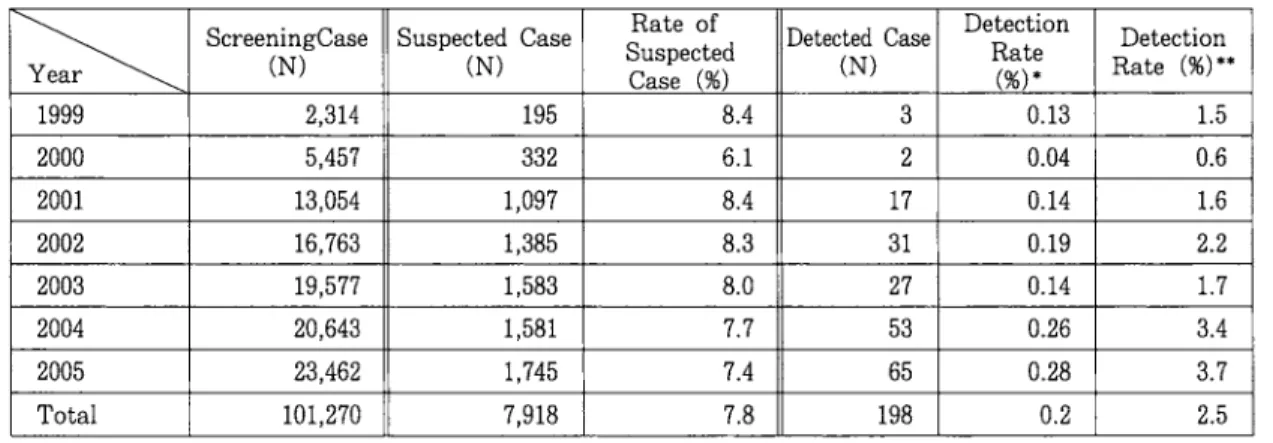
The number and detection rate of the breast cancer from 1999 to 2005 are demonstrated in Table 2. The breast cancer was observed in 73 (0.06%) of CP group and 198 (0.2%) of MMG group, respectively. The number of cases with breast cancer in CP group decreased every year, while that in MMG group increased. The detection rate of breast cancer in each year ranged from 0.04 to 0.11%, although the number of screening cases decreased in CP group. Remarkable change in the detection rate of each year was not found in CP group excluding that of 2004.
On the other hand, the detection rate of breast cancer in each year increased from 0.04 to 0.28% in MMG group. The number and detection rate of breast cancer in each year were remarkably higher on 2004 and 2005 in MMG group. The detection rate of breast cancer was significantly higher in MMG group than in CP group (p<0.01).
Seven-thousand nine-hundred eighteen (7.8%) of 101,270 cases in MMG group were suspected of breast cancer (Table 3). The rate of suspected breast cancer in each year ranged from 6.1%
Table 2 Number of Detected Breast Cancer and Detection Rate from 1999 to 2005
Year ^"^-\^
1999 2000 2001 2002 2003 2004 2005 Total
Detected Breast Cancer (N) IP
20 19 8 9 7 9 1 73
MMG 3 2 17 31 27 53 65 198
Detection Rate (%) * IP
0.06 0.06 0.04 0.06 0.05 0.11 0.07 0.06
MMG 0.13 0.04 0.14 0.19 0.14 0.26 0.28 0.2
breast cancers / all screening cases
to 8.4% (Table 3). One-hundred ninety eight biopsy-proven breast cancers were discovered, which corresponded to 0.2% of all screening cases and 2.5% of suspected cases in MMG group.
Table 3 Summary of Breast Cancer Survey in MMG from 1999 to 2005
Year^\^
1999 2000 2001 2002 2003 2004 2005 Total
ScreeningCase (N)
2,314 5,457 13,054 16,763 19,577 20,643 23,462 101,270
Suspected Case (N)
195 332 1,097 1,385 1,583 1,581 1,745 7,918
Rate of Suspected
Case (%) 8.4 6.1 8.4 8.3 8.0 7.7 7.4 7.8
Detected Case (N)
3 2 17 31 27 53 65 198
Detection Rate
(%)*
0.13 0.04 0.14 0.19 0.14 0.26 0.28 0.2
Detection Rate (96)"
1.5 0.6 1.6 2.2 1.7 3.4 3.7 2.5 breast cancers / all screening cases ** breast cancers / suspected cases
2. MMG group on 2005
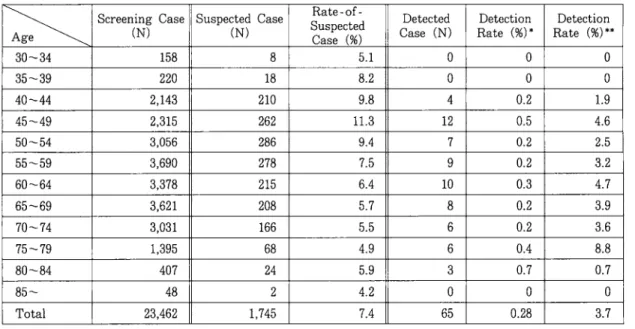
The number of screening cases in MMG group was 23,462 cases, which were obviously greater than 13,337 cases in CP group (Table 1). They were classified into three groups by their ages as follows; ages of 30 to 34 years, 35 to 85 years and over 85 years. The number of screening cases increased in order of their ages of sixties, fifties, forties and seventies (Table 4).
The breast cancer was suspected in 1,745 (7.4%) of 23,462 cases. The rate of suspected breast cancer was 5.2% in their ages of 30 to 34 years, 11.3% in 35 to 85 years and 4.2% in over 85 years, respectively. In ages of 35 to 85 years, it increased in order with ages of 45 to 49 years, 50 to 54 years and 35 to 39 years (Table 4). 65 breast cancers were diagnosed by the fine or core needle biopsy. The detection rate of breast cancer was 0.28% of all screening cases and 3.7% of suspected cases, respectively (Table 4). The highest detection rate of breast cancer was obtained in MMG group on 2005 in mass screenings from 1999 to 2005 (Table 3). Their ages ranged from 44 to 84 years. The detection rate of breast cancer in respective ages ranged from 0.2% to 0.7%. The highest detection rate of 0.7% was observed in ages of 80 to 84 years.
In the suspected cases, the detection rate of breast cancer ranged from 0 to 8.8% with its
highest value in ages of 75 to 79 years.
Table 4 Summary of Breast Cancer Survey in MMG on 2005
Age ^\
30-34 35-39 40-44 45-49
50-5455-59 60-64 65-69 70-74 75-79 80-84 85- Total
Screening Case (N)
158 220 2,143 2,315 3,056 3,690 3,378 3,621 3,031 1,395 407 48 23,462
Suspected Case (N)
8 18 210 262 286 278 215 208 166 68 24 2 1,745
Rate-of- Suspected Case (96)
5.1 8.2 9.8 11.3
9.47.5 6.4 5.7 5.5 4.9 5.9 4.2 7.4
Detected Case (N) 0 0 4 12 7 9 10 8 6 6 3 0 65
Detection Rate (%)*
0 0 0.2 0.5 0.2 0.2 0.3 0.2 0.2 0.4 0.7 0 0.28
Detection Rate (%)**
0 0 1.9 4.6 2.5 3.2 4.7 3.9 3.6 8.8 0.7 0 3.7
* breast cancers / all screening cases ** breast cancers / suspected cases
Clinical stages of 65 breast cancers in their respective ages are summarized in Table 5. Surgical resection was appropriately performed in all cases with breast cancer. There were 37 cases in stage 1, 13 in stage II and 2 in stage III, respectively. As a result, the early breast cancer of stage I or stage II was obtained in 50 (83.3%) of 65 detected breast cancers. Except for ages of 70 to 74 years, the stage I breast cancer was most frequently observed in the respective
ages.
Table 5 Stage
^\Stage Age ^\
30-34 35-39 40-44 45-49 50-54 55-59 60-64 65-69 70-74 75-79 80-84 85-
and Age Distribution of Detected Breast Cancer in MMG on
Stage 0
1 2 2 2 3 2
1
Stage I
2 5 3 6 6 6 2 5 2
Stage n
1 4 1 1 1 1 4
Stage HI
1 1
2005
Stage IV Total
4
12
7
9
10
9
6
5
3
Discussion
It is difficult for all municipalities to employ the ideal screening for breast cancer because of high cost for introducing the devices of mammography and idiosyncratic circumstances behind individual screening cases. In Kumamoto prefecture, combined screening with conventional pro cedure and screening mammography has started in 1999. The number of screening cases in MMG group increased annually from 2,314 in 1999 to 23,462 in 2005 owing to the effort of the municipality. As combined screening increased, screening with conventional procedure alone remarkably decreased from 35,755 in 1999 to 1,333 in 2005. However, there were still such cases surveyed alone with the conventional procedure present in 2004 and 2005. They rejected the screening mammography because of pain during the positioning of mammography, economic burden and poor understanding of the value of screening mammography. Combined screening is the best method for early detection of breast cancer 2>4>5). Therefore, public education is important to increase combined screening for breast cancer.
Seventy three breast cancers were found in CP group and 198 in MMG group from 1999 to 2005, respectively. The detection rate of breast cancer in MMG group was 0.2%, which was 3.3 times higher than 0.06% in CP group. In MMG group, the detection rate of breast cancer was 2.5 % in breast cancer suspected cases. The detection rate in MMG group is compatible with those reported by others 6). Furthermore, the detection rate of breast cancer remarkably increased on 2004 and 2005. Improvement in diagnostic technique associated with mammography probably results in increase in the detection rate on 2004 and 2005.
On 2005, the number of screening cases was mainly distributed from forties to sixties. Many women at high risk of breast cancer tended to complain a discomfort. They were observed in the same ages from forties to sixties. Therefore, breast cancer screening is better to be more frequently performed in these ages than the other ages. However, false-positive result in the breast cancer screening is higher in an relatively younger women because of their dense breast7>8).
In this study, the rate of suspected breast cancer increased in order of 45-49 year-old ages, 40- 44, 50-55 and 35-39. Breast cancer was found only in 65 cases of 1,745 suspected cases on 2005.
Then, 1,680 cases (96.2%) of suspected women were diagnosed as false-positive. These false- positive cases are suggestive of high risk cases of subsequent interval cancers 7). Although false-positive cases are less likely to receive the same subsequent screening than those assessed as negative, breast cancer screening should be performed annually. On the other hand, highest rate of diagnosed cancers in the suspected cases was observed in ages of 75-79 years. Women with low-dense breast are suggested to exhibit a higher detection rate by breast cancer screen ing. In this study, more breast cancers were obtained by the combined screening than that by conventional procedure. In combined screening on 2005, 83.3% of them were diagnosed as early breast cancer. Combined screening with mammography may be more powerful in detecting early breast cancer than the conventional procedure.
On the basis of these results, mammography is recommended to be employed in breast cancer
screening for women aged over 40 years, as has been found in other countries49*. Screening
mammography is better to be performed once a year rather than biennially. On the other
hand, screening mammography without conventional procedure is being carried out in many
municipalities. However, conventional procedure is an important in the diagnosis of particular cancers such as inflammatory carcinoma and Paget disease of breast. Furthermore, conventional procedure seems to bring a sense of relief or familiarity on the subject from the examiner.
Ultrasonography has been reported to be powerful particularly in the detection of breast cancer in dense breasts of younger than 40 years of age. A study employing ultrasonography into the combined screening for Japanese women of 40 ages started in 200610) . Magnetic resonance imaging (MRI) is reported to be another useful modality in screening women at high risk for breast cancer 21112). MRI for the breast also provides accurate information on patient management10. They include the assessment of response to treatment and decision of appro priate surgery. MRI has been utilized as an additional modality for young women at high risk for breast cancer because of poor sensitivity of their screening mammography 13). There fore, it is necessary to employ ultrasonography or MRI to the combined screening in case of screening for the young women 313).
In conclusions, breast cancer screening using mammography is more useful procedure in the detection of early breast cancer than the conventional procedure alone. Combined breast cancer screening with mammography and conventional procedure is recommended for the mass sur vey of breast cancer. For women in age of under 40 years, a MRI or ultrasonography is, how ever, necessary for the screening in addition to combined screening with mammography.
References
1 ) VITAL STATISTICS OF JAPAN 1958-2004 : the Ministry of Health, Labor and Welfare.
2) Wujcik, D. Fair, AM. ! Barriers to diagnostic resolution after abnormal mammography : a review of the literature.
J Cancer Nurs 31 ! 16-30, 2008.
3 ) Honjo, S. et al. ! Relative and combined performance of mammography and ultrasonography for breast cancer screen
ing in the general population '. a pilot study in Tochigi Prefecture, Japan. Jpn J Clin Oncol 37 I 715-720, 2007.4 ) Armstrong, K. et al. ! Screening mammography in women 40 to 49 years of age ! a systematic review for the Ameri can College of Physicians. Ann Intern Med 146 : 516-526, 2007.
5) Morimoto.T. et al. ! A comparison of Mass Screening for Breast Canser Using Mammography and Physical Examina
tion Alone in Japan. Breast Cancer 30 : 19-25, 1995.6) Japan Cancer Society in 2006 '. The detection Rate of Breast Cancer by Screening. 2006.
7 ) McCann, J. et al. ! Impact of false-positive mammography on subsequent screening attendance and risk of cancer.
Breast Cancer Res 4 : 11-16, 2002.