191 Eds., A. Ishimatsu and H.-J. Lie, pp. 191–204.
© by TERRAPUB and Nagasaki University, 2010.
Relationship between Concentration of Chemical Substances in Estuarine Sediments and Concentration of Vitellogenin in
Mudskipper (Periophthalmus modestus) and Common Goby (Acanthogobius flavimanus) Serum
Yuji TAKAO1, Kazuko KUWAHARA1, Masaki NAGAE1
and Kiyoshi SOYANO2
1Faculty of Environmental Science, Nagasaki University, Bunkyomachi 1-14, Nagasaki 851-8521, Japan
2Institute for East China Sea Research, Nagasaki University, Tairamachi 1551-7, Nagasaki 851-2213, Japan
Abstract—Sediments, mudskippers, and common gobies were collected from the estuaries of nine rivers along the coast of the Ariake Sea in the northwestern part of Kyushu. The sediments were analyzed for alkylphenols, organotin compounds, and polycyclic aromatic hydrocarbons. Then, male mudskippers and common gobies were analyzed for serum vitellogenin concentration. Sediments from the estuary of the Omuta River, which has residential areas in its upper reaches and many large-scale chemical plants in its lower reaches, exhibited higher concentrations of these three types of chemicals than the other rivers, and male mudskippers caught in the Omuta River exhibited higher serum vitellogenin concentrations than mudskippers caught in other rivers. One chemical substance thought to be responsible for these elevated vitellogenin concentrations is nonylphenol, a type of alkylphenol.
Male common gobies caught in the Suwa River exhibited higher vitellogenin concentrations than common gobies caught in other rivers. Although the Suwa River had high polycyclic aromatic hydrocarbon concentrations, the elevated vitellogenin concentrations of these male common gobies were thought to be attributable to factors such as sewage treatment plants, not polycyclic aromatic hydrocarbons. However, organotin compounds were detected in all estuarine sediments. This was attributed to the fact that the Ariake Sea is a good area for fishing and a number of small fishing vessels anchor and operate in the estuaries of all these rivers.
Keywords: estuarine sediment, alkylphenol, polycyclic aromatic hydrocarbons, Organotin compound, mudskipper, common goby, Vitellogenin, Ariake Sea
1. INTRODUCTION
Accumulation in estuarine sediments of chemicals released into the environment Due to the increasing sophistication of human social activities, a wide range of chemical substances continue to be produced and consumed. For example, large quantities of crops are needed to feed large populations, and in order to ensure a stable supply of crops, agrochemicals are needed. “Agrochemicals” is a general term for
chemicals such as insecticides, herbicides, and bactericides; most of these substances act by adversely affecting organisms other than the plants being harvested. As pointed out by Rachel Carson in Silent Spring (Carson, 1962), it is known that previously used types of agrochemicals, especially those containing chlorine atoms, are chemically stable and highly persistent in the environment, bioaccumulate, and have an adverse effect on wildlife (Vasseur and Cossu-Leguille, 2006). Here, we report on chemical substances released into the environment, focusing on chemical substances that have been analyzed for many years.
Mechanized agricultural equipment is also indispensable for the mass production of crops. This type of equipment is powered by internal combustion engines that run on oil, a type of fossil fuel. Internal combustion engines are also used in cars and buses, which serve as a means of transportation to facilitate daily life. Furthermore, the heat of combustion of fossil fuels is used in power stations in order to produce electrical power day and night. The proportion of energy sources used to generate electrical power varies from country to country, but approximately 70–90% is produced from oil, natural gas, and coal, with the remainder derived from nuclear or hydroelectric power. It is known that a variety of chemical substances are generated when fossil fuels are burnt. Of these, nitrogen oxides and sulfur oxides are well known as substances that cause acid rain, which causes forests to decay and buildings to erode. In addition, it is known that carcinogenic polycyclic aromatic hydrocarbons (PAHs) and highly toxic dioxins are contained, albeit in small quantities, in the incomplete combusted substances that are generated when fossil fuels are burnt.
These chemical substances are not synthesized by humans for a specific purpose, but rather generated unintentionally, and are therefore different from agrochemicals.
Oil is not only used as a source of energy through combustion; for example, oil is also used to manufacture plastics. Because plastics have the useful properties of being light and inexpensive, they are important materials for maintaining high living standards. Plastics have molecular weights of several tens of thousands or more, and although this in itself does not indicate an ecological impact, low molecular weight compounds generated via the degradation of plastics by light or ozone can have an ecological impact. In addition, unpolymerized compounds contained in plastics, such as monomers and trimers, can leach into the environment as a result of various factors;
for example, there have been several reports on polystyrene (Tatarazako, 2002) and bisphenol A (Kang et al., 2002; Lindholst et al., 2000; Yokota et al., 2000; Pastva et al., 2001) leaching from epoxy resins and polycarbonates. The flexibility of plastics can be adjusted through the use of additives. Plasticizers that are added for this purpose leach from the host material during use over long periods. Examples of such plasticizers are phthalic acid esters (Pakalin et al., 2008), which are added to polymers such as PVC. It is dangerous to incorporate plasticizers in soft plastic toys because babies and children often put toys in their mouths (Chen, 1998; Sugita et al., 2003;
David, 2000).
In addition, large quantities of synthetic detergents produced from oil are used in daily life and in applications such as cleaning industrial products. Nonylphenol and Octylphenol, which are generated via the decomposition of several types of synthetic
industrial detergents in the environment, is known to affect the reproduction of fish (Yokota et al., 2001; Kang et al., 2003; Seki et al., 2003; Lin et al., 2004).
Moreover, tributyltin compounds have come to be used as an active ingredient in ship-bottom paints. If organisms such as shellfish adhere to the bottom of a ship, the speed of the ship decreases and its fuel economy suffers. Because tributyltin compounds have excellent anti-fouling properties that are maintained over a long period, these compounds have become widely used throughout the world. However, it is now clear that tributyltin compounds have an adverse effect on the reproduction of shellfish (Bryan et al., 1986; Horiguchi et al., 1997), even at extremely low concentrations; consequently, strict international regulations have been placed on their use and production.
In recent years, a variety of pharmaceutical products have been detected, albeit in extremely small quantities, in river water and effluents from sewage systems, including the antipyretic analgesic ibuprofen and the antiepileptic drug carbamazepine (Ferrari et al., 2003; Carballa et al., 2004; Seino et al., 2004; Bendz et al., 2005;
Arizono and Takao, 2006). In addition, a variety of antibiotics and antimicrobials used in veterinary products have also been detected (Pailler et al., 2009). Antimicrobials such as trichlorsan, which is contained in products such as antibacterial hand soap, have also been detected (Waltman et al., 2006). At present, no reports have linked these substances to any adverse effect on wildlife, but because all of these chemical substances have been designed to affect organisms at low concentrations, it is thought that they should continue to be monitored in the future.
The above-mentioned chemical substances have come under scrutiny in the field of environmental analysis, and have a number of characteristics in common. However, because the various types of agrochemicals and pharmaceutical products are so numerous, we focus here on the characteristics of a select few. The characteristics that these substances have in common are (1) a molecular weight in the range of about 100–300, (2) low water solubility and varying degrees of lipid solubility, and (3) they are often detected in urban river water. However, tributyltin compounds are often detected in harbors and bays. The fact that these chemical substances are detected means that they persist in the environment and do not undergo rapid decomposition.
In addition, (4) these substances have an impact on organisms.
Once chemical substances that facilitate high living standards, such as those mentioned above, have been consumed, most are washed into rivers, either by rainfall or via sewage treatment plants, and ultimately flow into the sea. Of course, degradation by microorganisms and photodegradation can occur en route; however, considering the reports of detection from throughout the world, it can be surmised that degradation requires a certain length of time and that the rate of degradation is lower than the rate of supply. In addition, because these chemical substances have low water solubility, the proportion that adheres to ultrafine particles is higher than the proportion dissolved in water. In estuaries and bays, these ultrafine particles settle and form sediments. The rate at which sediments are deposited varies greatly depending on factors such as the flow rate of the river, the size of the catchment area, and the type of soil in the area, but is generally around several centimeters per year. Therefore, by
sampling and measuring the top few centimeters of sediment, it is possible to gauge the level of chemical substance pollution in the catchment area. Another typical method for analyzing chemical substances is to determine their concentration in water. However, because currents move in estuaries due to tidal movements, water sampled at high tide is only sea water; thus, the timing of water sampling is a problem.
In addition, the day on which the water is sampled is also an issue, due to factories being either operational or closed. Furthermore, rainfall has an effect on the water sampled, and the properties of domestic waste water vary greatly depending on the time of day. The use of heaters and the rate of degradation by microorganisms, which depend on the season and temperature, are also problems. Therefore, to investigate chemical substance pollution in the catchment area in question by analyzing water quality, it is necessary to mix some water samples for average value. To do this, we carried out chemical analysis on estuarine sediments. The substances analyzed were PAHs from the combustion of fossil fuels, alkylphenols from plastics and synthetic detergents, and organotin compounds from ship-bottom paints.
2. IMPACT ASSESSMENT USING THE MUDSKIPPER (PERIOPHTHALMUS MODESTUS) AND COMMON GOBY (ACANTHOGOBIUS FLAVIMANUS) The effects on wildlife of chemical substances discharged by humans have been studied extensively, but many reported cases involve the discharge of chemical substances at relatively high concentrations into the environment. For example, if a fire breaks out at a chemical plant (Capel, 1988), chemicals leak out, flow into a river and kill a large number of fish. Alternatively, if a tanker runs aground, heavy oil is released and kills many birds. However, pollution and the effects caused by the chemical substances we have selected for analysis are different from such cases.
Specifically, we investigated the effects on wildlife of the long-term low-level discharge of chemical substances into the environment, not temporary discharges caused by accidents. Because many wildlife deaths at one time are rare in such cases, it is difficult to identify the causative substance and its effect. For example, if the population of a certain species in a certain urban river gradually declines at the same time as civil engineering works are carried out on the river, a variety of factories are operating, the human population is increasing, and the amount of agricultural land and forest land is decreasing, it is difficult to identify the primary cause of this gradual decline.
Evaluation techniques for measuring the concentration of vitellogenin in male fish have been reported in recent years (Sumpter and Jobling, 1995; Kime et al., 1999). In the 1980s, hermaphroditic loaches were found in rivers in the United Kingdom. As a result of a multi-year investigation, it was determined that the primary causative substance was nonylphenol, a degradation product of a detergent discharged from wool washing factories (Harries et al., 1996). In addition to nonylphenol, it was thought that a natural female hormone (17β-estradiol (E2)) and ethynyl estradiol, which is an oral contraceptive, were also causative substances (Routledge et al., 1998). In that investigation, rainbow trout were placed in a cage in river water downstream of a sewage treatment plant for 3 weeks, and the degree of increase in the
vitellogenin concentration in the serum of the males was determined. Vitellogenin is an egg yolk precursor protein that is produced in the liver of mature females, and vitellogenin production is triggered by E2 being released into female serum. However, because almost no E2 is present in male serum under normal circumstances, males do not produce vitellogenin. When normal males in a water tank in a laboratory were exposed to E2 or nonylphenol in the water for a period of approximately one week, vitellogenin was detected in their serum (Nishi et al., 2002; Ohkubo et al., 2003a). By using this evaluation system in the field, it is possible to determine whether chemical substances with female hormone activity are present in the environmental water being investigated. Previously, there have been reports on the evaluation of female hormone activity in environmental water using fish species such as rainbow trout (Harries et al., 1996; Lye et al., 1998), medaka fish (Nishi et al., 2002), marbled sole (Hashimoto et al., 1998), common goby (Ohkubo et al., 2003b), and grey mullet (Aoki et al., 2010). As discussed above, the present research is based on the fact that estuarine sediments are places where chemical substances in a catchment area accumulate.
Therefore, the mudskipper and common goby were selected, which have a relatively narrow range of activities and live in close contact with sediments; the vitellogenin concentration in the serum of these fish was measured.
Moreover, the following five methods are typical exposure methods for measuring vitellogenin in fish: 1) catching live fish living at the location being investigated, 2) submerging a cage containing fish in the location being investigated and then removing the fish in the cage after a fixed period, 3) taking water from the location being investigated and using that water in a laboratory to rear fish, 4) taking sediments from the location being investigated and using those sediments and clean water in a laboratory to rear fish, and 5) using water mixed with a suspect chemical substance to rear fish in a laboratory. Method 1) was used in this research. Because taking blood samples is difficult if a fish dies when using this method, it is necessary to catch a large number of live fish. Because approximately half the caught fish are male and half are female, fishing at the site must be carried out such that 10-20 males for use in the measurement are caught. Because it is essential to take blood samples immediately after the fish are caught, it is necessary to select a type of fish for which 20–40 individuals can be caught in approximately 2 h. The mudskipper and common goby used in this research satisfy these conditions. Because they are fish having large populations over a wide area around the coasts of the East China Sea, including Japan, comparison with other areas is simple. For the mudskippers, we approached the fish on a board on tidal flats at low tide and caught the fish with a small net on the upper part of the tidal flats. We used fishing rods and baited fishing hooks to catch the common gobies in estuarine water.
3. AREA AND CHEMICAL SUBSTANCES UNDER INVESTIGATION Many data obtained from environmental chemistry field surveys inevitably comes from locations close to research institutions. Because many research institutions are located in urban areas in developed countries, for example, near Tokyo Bay in Japan, even if there is no collaboration between researchers conducting biological
impact surveys and those conducting analytical chemical surveys, discussions regarding obtained data and speculation regarding causes are facilitated by referring to existing reports. In other areas, however, because the number of reports is lower in proportion with the population, collaboration between surveys is highly necessary.
This need for collaboration is especially high in regional areas, and in countries in southeast Asia in particular, where the need for surveys will increase in the future. We have carried out analytical chemical surveys in parallel with biological impact surveys for fish by focusing on the coastal areas of Korea, China, and Kyushu, which are countries and regions around the East China Sea. As one example of these collaborative survey results, this report presents the results obtained for the Ariake Sea.
In this study, we targeted the area around the Ariake Sea, including Omuta City, Fukuoka, Japan, where previous studies have found relatively high concentrations of vitellogenin in the serum of male grey mullets (Aoki et al., 2010). The Ariake Sea is located in the northwestern part of Kyushu. It is the largest bay in Kyushu, and straddles the prefectures of Fukuoka, Saga, Nagasaki, and Kumamoto. Of the bays in Japan, the Ariake Sea is notable for its tidal range, the number of rivers flowing into it, the variation in its salinity, its muddiness, having the largest tidal flats in Japan, and its unique biota. It has an area of 1700 km2, which is larger than Kagoshima Bay, Tokyo Bay, and Osaka Bay, and almost as large as Ise Bay. Its deepest point is 165 m, near the mouth of the bay, but its average water depth is only around 20 m;
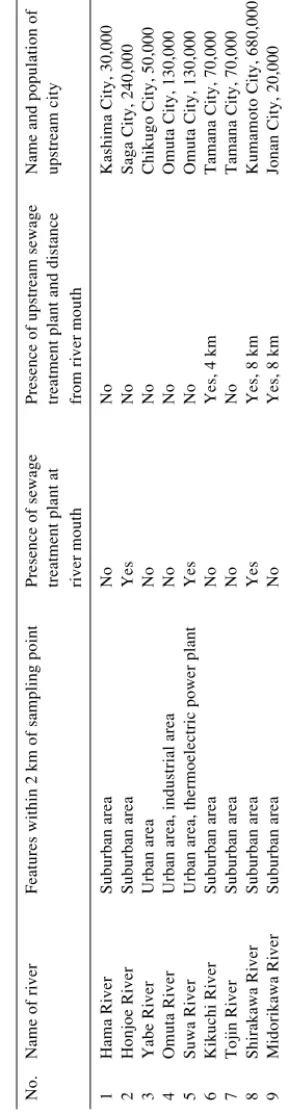
therefore, the Ariake Sea is generally a shallow bay. The inner part of the bay contains a number of alluvial plains including the Isahaya Plain, Saga Plain, Tsukushi Plain, Kikuchi Plain, and Kumamoto Plain. Many rivers flow into the Ariake Sea, including the Chikugo River, Kyushu’s longest river, and the total catchment area of these rivers is approximately 8000 km2, which is approximately five times the area of the sea itself. Soil and sand carried by these rivers are deposited and form large tidal flats around the coast of the Ariake Sea. The area of these tidal flats is approximately 188 km2 at low tide during spring tides, accounting for approximately 40% of all tidal flats in Japan. The coast of the Shimabara Peninsula, in Kumamoto Prefecture in the southern part of the Ariake Sea, consists of sandy tidal flats, but further into the bay, the proportion of mud increases, and most of the coast of Saga and Fukuoka Prefectures is muddy tidal flats. The Ariake Sea and the rivers targeted in this survey are shown in Fig. 1. As can be seen in this figure, several relatively large rivers have been omitted from the survey. This is because mudskippers and common gobies, the fish targeted in this survey, could not be caught in the omitted rivers. Table 1 shows the name of each river, the name and population of upstream cities on these rivers, and features within a 2-km radius of the sampling point. Table 1 also shows whether or not the rivers have sewage treatment plants, which are discharge sources of natural and artificial chemical substances that have an impact on fish. The distances from the sampling points to upstream sewage treatment plants, if present, are also listed in this table.
The chemical substances targeted in this survey were p-nonylphenol (NP) and p-t-octylphenol (OP), which are environmental degradation products of industrial
detergents; bisphenol A (BPA), which is a primary raw material of polycarbonates and epoxy resins; tributyltin (TBT) and triphenyltin (TPT) compounds, which were used in the past as active ingredients in ship-bottom paints; dibutyltin (DBT), monobutyltin (MBT), diphenyltin (DPT) and monophenyltin (MPT) compounds, which are degradation products of TBT and TPT compounds; and PAHs, which are environmental pollutants derived from oil. The PAHs measured were naphthalene, fluorene, acenaphthylene, anthracene, acenaphthene, phenanthrene, 1,2- benzanthracene, benzo[k]fluoranthene, dibenz[a,h]anthracene, fluoranthene, chrysene, benzo[a]pyrene, pyrene, benzo[b]fluoranthene, indeno[1,2,3-cd]pyrene, benzo[g,h,i]peryrene, benzo[e]pyrene, anthanthrene, dibenzothiophene, 4,5- methylene-phenanthrene, benz[a]anthracene-7,12-dione, perylene, and 5,6-benzo- quinorline.
Estuarine sediments were collected and analyzed in 2003–2004, mudskippers were caught and analyzed in 2002, and common gobies were caught and analyzed in 2004.
4. METHOD FOR ANALYZING CONCENTRATION OF ORGANIC COMPOUNDS IN SEDIMENTS
Sediments collected from the estuaries of the rivers were brought back to the laboratory, dried for a period of approximately a week, and then sieved using a 1-mm
Fig. 1. Map of sampling sites at the Ariake Sea in northwestern Kyushu, Japan. Sediments, mudskippers, and common gobies were collected from river mouths labeled 1–9. Black, gray, and white areas indicate river, land, and sea areas, respectively.
No.Name of riverFeatures within 2 km of sampling pointPresence of sewagePresence of upstream sewageName and population of treatment plant attreatment plant and distanceupstream city river mouthfrom river mouth 1Hama RiverSuburban areaNoNoKashima City, 30,000 2Honjoe RiverSuburban areaYesNoSaga City, 240,000 3Yabe RiverUrban areaNoNoChikugo City, 50,000 4Omuta RiverUrban area, industrial areaNoNoOmuta City, 130,000 5Suwa RiverUrban area, thermoelectric power plantYesNoOmuta City, 130,000 6Kikuchi RiverSuburban areaNoYes, 4 kmTamana City, 70,000 7Tojin RiverSuburban areaNoNoTamana City, 70,000 8Shirakawa RiverSuburban areaYesYes, 8 kmKumamoto City, 680,000 9Midorikawa RiverSuburban areaNoYes, 8 kmJonan City, 20,000
Table 1.Information on sampling sites: number, name, features, presence of sewage treatment plant on river, and name and population of upstream city.
sieve in order to remove large foreign objects such as sea shells. Acetone and several internal standards (bisphenol A-d16, p-nonylphenol-d4, pyrene-d10, TBT-d27, DBT- d18, TPT-d15, DPT-d10) were added to the sediments, and the chemical substances contained therein were ultrasonically extracted. The extracts were passed through a silica gel column, dehydrated, derivatized, and then analyzed by GC/MS. The derivatization was carried out by trimethylsilylation of the alkylphenols and ethylation (Iwamura et al., 2000) of the organotin compounds.
5. METHOD FOR ANALYZING VITELLOGENIN CONCENTRATION IN MUDSKIPPER AND COMMON GOBY SERUM
The caudal peduncle of the mudskippers that were caught in nets was cut off, and blood was collected by holding a hematocrit capillary tube against the exposed caudal vein. Plasma was separated from the blood by centrifugation. The common gobies caught on fishing lines were allowed to rest for 1–2 h to recover from the acute stress reaction, since such reactions make it difficult to collect blood from freshly caught fish. The fish were anaesthetized and blood was collected from the caudal peduncle using a syringe. After collection, the blood was allowed to stand for a short period to coagulate, and the serum was then collected by centrifugal separation. Measurement of vitellogenin in the serum of mudskippers and common gobies was carried out by the sandwich ELISA method, using a specific antibody (primary antibody) and a biotin-labeled antibody (secondary antibody) to vitellogenin, respectively. The concentration of vitellogenin in the sample was calculated by constructing a calibration curve from measurements using standards of known concentrations.
6. RELATIONSHIP BETWEEN CHEMICAL SUBSTANCES CONTAINED IN SEDIMENTS AND VITELLOGENIN CONCENTRATION
IN BLOOD SERUM
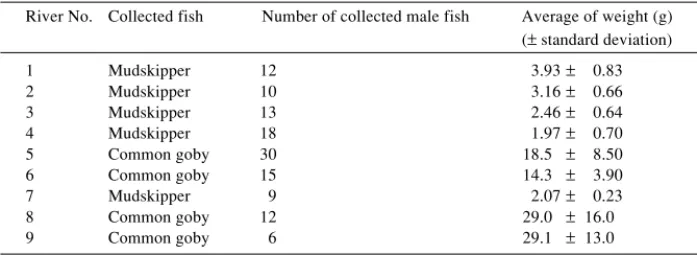
Table 2 shows the average weight and standard deviation of fish caught in each river. The weight of the mudskippers was 2–4 g, which was less than the weight of the common gobies (15–30 g); the weights were fairly uniform. In addition, there was an imbalance in terms of the geographical location of the river in which the fish were caught, with mudskippers being caught mainly in the inner part of the Ariake Sea and common gobies being caught mainly near the mouth of the sea. Moreover, it was not possible to catch both species in the same river. The mudskippers were caught in the inner part of the Ariake Sea due to the presence of muddy tidal flats, which are a favorable habitat for mudskippers. In addition, it was not possible to catch common gobies in the inner part of the Ariake Sea, possibly because the muddy estuarine sediments are not a suitable breeding environment for the common goby, although the exact details are not clear.
Figure 2 shows the results of this research. The upper part of Fig. 2 shows serum vitellogenin concentration by river. All results are from male fish. The upper left part shows the results for mudskippers and the upper right part shows those for common gobies. The lower part of Fig. 2 shows the concentration of organic compounds in sediments collected from the estuary of each river. There are three columns for each
river in the graph, with the left column showing the concentration of alkylphenols, the middle column showing the concentration of organotin compounds, and the right column showing the concentration of PAHs. Moreover, the PAH column shows the total concentration of 23 types of PAHs.
The vitellogenin concentration in male mudskipper serum was several dozen times higher than in male common goby serum. In the past, there have been reports on the vitellogenin concentrations in fish such as loach, rainbow trout, medaka fish, flounder, and grey mullet, but these normal levels are all similar to the common goby concentration levels shown on the right of the graph. The vitellogenin concentration was thought to be high in only male mudskippers because the other types of male fish typically spend their life in the water, whereas mudskippers spend most of their lives either on the surface of tidal flats or on rocks at sea level, but the exact details are unclear. It can be seen from Fig. 2 that the river having the highest male mudskipper vitellogenin was the Omuta River, with four other rivers showing similar levels. Of the nine rivers targeted, the Omuta River has residential areas in its upper reaches, but between its middle section and its estuary, many large-scale industrial developments such as chemical plants are located in close proximity to each other. From the chemical analysis of sediments from the estuary of the Omuta River, high concentrations of alkylphenols, which are industrial raw materials, and especially high concentrations of nonylphenol, which is a degradation product of industrial detergents, were detected. In addition, high concentrations of PAHs, which are derived from combustion or leakage of fossil fuels, were detected. High concentrations of organotin compounds from ship-bottom paints were also detected. Of these three types of chemical substances, only alkylphenols are known to exhibit female hormone activity in fish.
In particular, nonylphenol is known to exhibit activity approximately ten times higher than that of bisphenol A. Therefore, it is thought that nonylphenol is highly likely to be one of the main reasons for the high concentrations of vitellogenin being detected in male mudskippers in the Omuta River.
Table 2. River number, kind of collected fish, number of collected male fish, and average weight (± standard deviation).
River No. Collected fish Number of collected male fish Average of weight (g) (± standard deviation)
1 Mudskipper 12 3.93± 0.83
2 Mudskipper 10 3.16± 0.66
3 Mudskipper 13 2.46± 0.64
4 Mudskipper 18 1.97± 0.70
5 Common goby 30 18.5 ± 8.50
6 Common goby 15 14.3 ± 3.90
7 Mudskipper 9 2.07± 0.23
8 Common goby 12 29.0 ± 16.0
9 Common goby 6 29.1 ± 13.0
Organotin compounds were detected at varying concentrations in the estuaries of all nine rivers. Since the Ariake Sea is known to be a relatively good area for fishing, a large number of fishing vessels anchor in the estuaries of the rivers, and there are a number of small scale fishing ports in which around ten fishing vessels anchor.
Small quantities of organotin compounds were detected in the estuaries of the Hama River (No. 1), the Honjoe River (No. 2), the Kikuchi River (No. 6), the Tojin River (No. 7), the Shirakawa River (No. 8), and the Midorikawa River (No. 9), where populations are low. However, although the Omuta River does not have a large fishing port or a large number of boats relative to the other estuaries, higher concentrations of organotin compounds than in the other estuaries were detected there. This is likely attributable to the effects of industrial raw materials such as
Fig. 2. Vitellogenin concentration in serum of male mudskippers and common gobies collected at river mouths in the Ariake Sea, and concentration of alkylphenols, organotin compounds, and PAHs in sediments collected at the same locations. Minus symbol denotes concentrations below limit of detection or quantification.
stabilizers and catalysts used in chemical plants, in addition to the effects of fishing vessels, but confirming the contribution from each source is difficult. Because we are not aware of any research indicating that organotin compounds raise the vitellogenin concentration in the serum of male fish, it is not possible to discuss the relationship between environmental pollution caused by these chemical substances and the elevated vitellogenin concentrations in fish.
Elevated vitellogenin concentrations in the serum of male common gobies were seen in the Suwa River and the Kikuchi River. The concentrations in the serum of male common gobies in the Shirakawa River and the Midorikawa River were below the limit of detection. The concentration of PAHs in the Suwa River was the highest of the nine rivers targeted, likely owing to the thermoelectric power plant near the estuary (see Table 1). Furthermore, this area has long been home to coal-related industries. However, even if PAHs have a toxic effect on fish, because there have been no reports of these compounds inducing female hormone activity, it is not thought that PAHs cause elevated vitellogenin concentrations. However, nonylphenol and bisphenol A, which exhibit female hormone activity in fish, were detected, albeit at lower concentrations than in the Omuta River. It is thought that the effects of these compounds cannot be ignored. There have been previous reports from other Japanese researchers on the effects of chemical substances on fish in urban rivers, which concluded that of these, the main chemical substances responsible for such effects are estrone (E1), 17β-estradiol (E2), and estriol (E3), which are natural female hormones, and nonylphenol. This hypothesis cannot be corroborated by the present research since these natural female hormones were not analyzed, but the Omuta River and the adjacent Suwa River both have estuaries located in densely populated regions.
Because of the sewage treatment plant located at the estuary of the Suwa River, it is highly likely that untreated natural female hormones contained in water discharged from this plant contribute to the elevated vitellogenin concentration in the serum of male common gobies.
The vitellogenin concentration in the serum of male common gobies in the Kikuchi River was lower than that in the Suwa River, but higher than those in the other two rivers. However, no prominent chemical substances were detected from the results of the chemical analysis. In addition, the estuary of the Kikuchi River is a rural area with a low population density and no sewage treatment plants. However, Tamana City (population 70,000) and a sewage treatment plant are located 4 km upstream, which possibly contribute to the elevated vitellogenin concentration. In contrast with the Shirakawa River, in which the vitellogenin concentration in the serum of male common gobies was below the limit of detection, the Shirakawa River has a sewage treatment plant near its estuary and a city with a population approximately ten times larger (680,000) upstream, as shown in Table 1. In addition, the Midorikawa River has a sewage treatment plant located 8 km upstream. Therefore, it is difficult to identify a clear reason for the elevated vitellogenin concentration in the serum of male common gobies in the Kikuchi River. However, in order to clarify the effects of the low (43.9%) coverage of the public sewage system in Tamana City on the upper reaches of the Kikuchi River, natural female hormones in the water should be analyzed and compared in the future.
Acknowledgments—The work was supported by a grant of the Ministry of Education, Culture, Sports, Science and Technology in Japan and Grant-in-Aid for Scientific Research (C), No.
20510066.
REFERENCES
Aoki, J., M. Nagae, Y. Takao, A. Hara, Y.D. Lee, I.K. Yeo, B.S. Lim, C.B. Park and K. Soyano. 2010.
Survey of contamination of estrogenic chemicals in Japanese and Korean coastal waters using the wild grey mullet (Mugil cephalus). Science of the Total Environment 408: 660–665.
Arizono, K. and Y. Takao. 2006. The environmental pollution of pharmaceuticals and its ecotoxicological impacts. Journal of Japan Society on Water Environment 29: 200–204.
Bendz, D., N. A. Paxeus, T. R. Ginn and F. J. Loge. 2005. Occurrence and fate of pharmaceutically active compounds in the environment, a case study: Hoje river in Sweden. Journal of Hazardous Materials 122: 195–204.
Bryan, G. W., P. E. Gibbs, L. G. Hummerstone and G. R. Burt. 1986. The decline of the gastropod Nucella lapillus around south-west England: evidence for the effect of tributyltin from anti-fouling paints.
Journal of the Marine Biological Association of the United Kingdom 66: 611–640.
Capel, P.D. 1988. Accidental input of pesticides into the Rhine River. Environmental Science and Technology 22: 992–997.
Carballa, M., F. Omil, J. M. Lema, M. Llompart, C. Garcia-Jares, I. Rodriguez, M. Gomez and T. Ternes.
2004. Behavior of pharmaceuticals, cosmetics and hormones in a sewage treatment plant. Water Research 38: 2918–2926.
Carson, R. 1962. Silent Spring. New York, NY: Houghton Mifflin Co.
Chen, S.-B. 1998. Migration of DINP from polyvinyl chloride (PVC) children’s products. U.S. Consumer Product Safety Commission, Bethesda, MD.
David, R.M. 2000. Exposure to Phthalate esters. Environmental Health Perspectives 108: A440–A443.
Ferrari, B., N. Paxeus, R.L. Giudice and A. Pollio. 2003. Ecotoxicological impact of pharmaceuticals found in treated wastewaters: study of carbamazepine, clofibric acid, and diclofenac. Ecotoxicology and Environmental Safety 55: 359–370.
Harries, J.E., D.A. Sheahan, P. Matthiessen, P. Neall, R. Rycroft, T. Tylor, S. Jobling, E.J. Routledge and J.P. Sumpter. 1996. A survey of estrogenic activity in United Kingdom inland waters. Environmental Toxicology and Chemistry 15: 1993–2002.
Hashimoto, S., H. Bessho, K. Sato, A. Hara and K. Fujita. 1998. Vitellogenin in wild male flounder, Pleuronectes yokohamae, in Tokyo Bay, Japan. Japanese Journal of Environmental Toxicology 1:
75–85.
Horiguchi, T., H. Shiraishi, M. Shimizu and M. Morita. 1997. Effects of triphenyltin chloride and five other organotin compounds on the development of imposex in the rock shell, Thais clavigera.
Environmental Pollution 95: 85–91.
Iwamura, T., K. Kadokami, D. Jin-ya and K. Tanada. 2000. Determinationof organotin compounds in biological samples using ethyl derivatization and GC/MS. Bunseki Kagaku 49: 523–528.
Kang, I.J., H. Yokota, Y. Oshima, Y. Tsuruda, T. Oe, N. Imada, H. Tadokoro and T. Honjo. 2002. Effects of bisphenol A on the reproduction of Japanese Medaka (Oryzias latipes). Environmental Toxicology and Chemistry 21: 2394–2400.
Kang, I. J., H. Yokota, Y. Oshima, Y. Tsuruda, T. Hano, M. Maeda, N. Imada, H. Tadokoro and T. Honjo.
2003. Effects of 4-Nonylphenol on Reproduction of Japanese Medaka, Oryzias latipes. Environmental Toxicology and Chemistry 22: 2438–2445.
Kime, D.E., J.P. Nash and A.P. Scott. 1999. Vitellogenesis as a biomarker of reproductive disruption by xenobiotics. Aquaculture 177: 345–352.
Lin, B.-L., S. Hagino, M. Kagoshima, S. Ashida, T. Hara, T. Iwamatsu, A. Tokai, K. Yoshida, Y.
Yonezawa, M. Tominaga and J. Nakanishi. 2004. Three-generation full-life-cycle study on 4- nonylphenol using S-rR strain medaka (Oryzias latipes). Journal of Japan Society on Water Environmant 27: 727–734.
Lindholst, C., K.L. Pedersen and S.N. Pedersen. 2000. Estrogenic response of bisphenol A in rainbow trout (Oncorhynchus mykiss). Aquatic Toxicology 48: 87–94.
Lye, C.M., C.L.J. Frid and M.E. Gill. 1998. Seasonal reproductive health of flounder Platichthys flesus exposed to sewage effluent. Marine Ecology Progress Series 170: 249–260.
Nishi, K., M. Chikae, Y. Hatano, H. Mizukami, M. Yamashita, R. Sakakibara and E. Tamiya. 2002.
Development and application of a monoclonal antibody-based sandwich ELISA for quantification of Japanese medaka (Oryzias latipes) vitellogenin. Comparative Biochemistry and Physiology Part C: Toxicology and Pharmacology 132: 161–169.
Ohkubo, N., K. Mochida, S. Adachi, A. Hara, K. Hotta, Y. Nakamura and T. Matsubara. 2003a.
Development of enzyme-linked immunosorbent assays for two forms of vitellogenin in Japanese common goby (Acanthogobius flavimanus). General and Comparative Endocrinology 131: 353–
364.
Ohkubo, N., K. Mochida, S. Adachi, A. Hara, K. Hotta, Y. Nakamura and T. Matsubara. 2003b.
Estrogenic activity in coastal areas around Japan evaluated by measuring male serum vitellogenins in Japanese common goby Acanthogobius flavimanus. Fisheries Science 69: 1135–1145.
Pailler, J.-Y., A. Krein, L. Pfister, L. Hoffmann and C. Guignard. 2009. Solid phase extraction coupled to liquid chromatography-tandem mass spectrometry analysis of sulfonamides, tetracyclines, analgesics and hormones in surface water and wastewater in Luxembourg. Science of the Total Environment 407: 4736–4743.
Pakalin, S., K. Aschberger, O. Cosgrove, B-O. Lund, A. Paya-Perez and S. Vegro. 2008. EU Risk Assessment Report, bis(2-ethylhexyl) phthalate (DEHP), vol. 80, EUR23384EN.
Pastva, S. D., S. A. Villalobos, K. Kannan and J.P. Giesy. 2001. Morphological effects of bisphenol-A on the early life stages medaka (Oryzias latipes). Chemosphere 45: 535–541.
Routledge, E.J., D. Sheahan, C. Desbrow, G.C. Brighty, M. Waldock and J.P. Sumpter. 1998. Environmental Science and Technology 32: 1559–1565.
Seino, A., S. Furusho and S. Masunaga. 2004. Occurrence of pharmaceuticals used in human and veterinary medicine in aquatic environments in Japan. Journal of Japan Society on Water Environment 27: 685–691.
Seki, M., H. Yokota, M. Maeda, H. Tadokoro and K. Kobayashi. 2003. Effects of 4-nonylphenol and 4- tert-octylphenol on sex differentiation and vitellogenin induction in medaka (Oryzias latipes).
Environmental Toxicology and Chemistry 22: 1507–1516.
Sugita, T., Y. Kawamura, M. Tanimura, R. Shinno, R. Ishibashi, M. Hirabayashi, I. Matsuki, T. Yamada and T. Yonetani. 2003. Estimation of daily oral exposure to phthalates derived from soft polyvinyl chloride baby toys. Shokuhin Eiseigaku Zashi 44: 96–102.
Sumpter, J. P. and S. Jobling. 1995. Vitellogenesis as a biomarker for estrogenic contamination of the aquatic environment. Environmental Health Perspectives 103: 173–178.
Tatarazako, N., Y. Takao, K. Kishi, N. Onikura, K. Arizono and T. Iguchi. Styrene dimers and trimers affect reproduction of daphnid (Ceriodaphnia dubia). 2002. Chemosphere 48: 597–601.
Vasseur, P. and C. Cossu-Leguille. 2006. Linking molecular interactions to consequent effects of persistent organic pollutants (POPs) upon populations. Chemosphere 62: 1033–1042.
Waltman, E. L., B.J. Venables and W.T. Waller. 2006. Triclosan in a North Texas wastewater treatment plant and the influent and effluent of an experimental constructed wetland. Environmental Toxicology and Chemistry 25: 367–372.
Yokota, H., Y. Tsuruda, M. Maeda, Y. Oshima, H. Tadokoro, A. Nakazono, T. Honjo and K. Kobayashi.
2000. Effect of bisphenol A on the early life stage in japanese medaka (Oryzias latipes). Environmental Toxicology and Chemistry 19: 1925–1930.
Yokota, H., M. Seki, M. Maeda, Y. Oshima, H. Tadokoro, T. Honjo and K. Kobayashi. 2001. Life-Cycle Toxicity of 4-Nonylphenol to Medaka (Oryzias latipes). Environmental Toxicology and Chemistry 21: 2552–2560.
Y. Takao (e-mail: [email protected]), K. Kuwahara, M. Nagae and K.
Soyano