Toward the research on innovation mechanism of diversified firm:
integrating resource-based-view and innovation research.
Masatoshi FUJIWARA
Abstract
The aim of this paper is to find out the untouched common research site in innovation research and resource based view of the firm (RBV). To achieve this purpose we mainly review two researches on innovation and RBV.
The structure of this paper is as following: in section 2 we review papers about technological change and its impact on competition. We show that researchers rarely take account of whether established firm is diversified or not. Therefore they fail to analyze the merit of diversified firm in adapting to technological change.
In section 3 we review researches on RBV dealing with diversification strategy. We show that many researchers regard a technology as given so that they tend to focus heavily on its relationship among divisions. As a result, they rarely refer to the possibility of creating new technologies or losing their value.
In section 4 we conclude that innovation research and RBV have a common research site. This site stems from those two researches separately, but can contribute to both of them simultaneously. We determine that this untouched field is not sterile, but worth cultivating.
Keywords : Innovation mechanism of diversified firm, Resource-Based-View, technology transfer, integration, relationship between theory and reality.
1. Introduction
The aim of this paper is to find out the untouched common research site in innovation research and resource based view of the firm (RBV). So far, these two researches developed independently, and each of them had many specific problems. However, they are essentially close to each other. Therefore, we try to point out a common problem and integrate innovation research and Resource Based View. To
achieve this purpose we mainly review two researches on innovation and RBV.
The structure of this paper is as following: in section 2 we review papers about technological change and its impact on competition. We show that researchers rarely take account of whether established firm is diversified or not. Therefore they fail to analyze the merit of diversified firm in adapting to tech- nological change.
In section 3 we review researches on RBV dealing with diversification strategy. We show that many researchers regard a technology as given so that they tend to focus heavily on its relationship among divisions. As a result, they rarely refer to the possibility of creating new technologies or losing their value.
In section 4 we conclude that innovation research and RBV have a common research site. This site stems from those two researches separately, but can contribute to both of them simultaneously. We determine that this untouched field is not sterile, but worth cultivating.
2. Review of innovation research
(1) Overview
It is ordinary recognized that an established giant firm often loses its competitive power because of innovation by new small firms. To keep its power, the firm should develop new technologies and adapt to technological changes. On the other hand, small firms can win the competition by developing a new technology. Innovation is a serious matter for any firms.
Not only managers in firms, but also many researchers have been interested in technological change and its impact on competition. Tushman and Anderson (1986) has done one of the most stimulating research, for they’re being the first researchers to examine Schumpeter (1934)’s assertion. They found out two types of innovation and the difference of impact on competition by looking into three industries:
mini-computer, cement, and airplane.
Two points are very important for us. Firstly, while competence-destroying innovation is often real- ized by a new firm, competence-enhancing innovation is realized by an established firm. Secondly, the former destroys market environment but the latter makes it more stable. They certainly contribute to the researchers interested in the technography of industry.
Anderson and Tushman (1990) also stood in the same stance. Especially, they proposed the con- cept of “dominant design” to understand the technography of industry. According to their result, many technologies are competitive in the early period of industry development, but as it grows up a sort of technology becomes dominant. And after dominant design is formed, an uncontinuous technological
change happens again.
This is an important idea to understand the technography of industry, too. However, these researches applied their logic to judge a firm’s competitive power. This logical expansion unfortunately falls into tautology, because they suggested competence-destroying innovation destroys an established firm’s competence1). In spite of its tautological assertion, many researchers have been stimulated by their researches. Especially, while Tushman and Anderson (1986) paid attention to a peculiar factor to technology, others started to look into factors besides technology2).
For example, Henderson and Clark (1990) focused on organizational factor. They analyzed the tech- nological change in photolithography industry in which an established firm lost its advantage in spite of the innovation been competence-enhancing. By tracing the decline process of the established firm, they insisted that the way of organizational activity in its firm had been developed to manage an existing technological architecture. And this process achieved so efficiently that the firm could not adapt to the architectural change3).
Leonard-Barton (1992) also paid attention to organizational capability. She showed that as a firm constructs its core competence to realize an innovation effectively, the organizational routine in the firm changes to suit the same kind of innovation best. As a result, the firm loses the flexibility of adapting to various innovations4).
In addition, Abernathy and Clark (1985) shed light on market factor. They asserted that an estab- lished firm loses its competitive power not only because a new technology is destroying, but also because the value of a new market is uncontinuous to the firm. When the value of a new market is con- tinuous to the established firm, the firm can adapt to a technological change.
However, the continuity of market also has an opposite side, since it causes the rigidity of cus- tomers’ reputation. Existing customers have their own dimension of reputation. This is very important for an established firm to survive in an existing market. Therefore, as an established firm is likely to value its customers’ evaluation too much, it tends to undervalue a new technology. To make it worse, the performance of a new technology becomes lower than that of an existing technology. It makes the firm hold prejudice against a new technology. Christensen (1997) and Christensen and Bower (1996) explained this mechanism sharply by looking into HDD industry.
(2) An implicit assumption in innovation research
The former researches, which have been developed mainly in USA, have regarded their unit of analysis as firm. However, we should take care of the meaning of firm. What kind of firm do they study?
Most of former researchers rarely mind this question. This leads to an implicit assumption in innovation research; most of them tacitly assume that established firms are single business firms.
The reason is as following; the range of their researches is restricted to division facing a technologi- cal change. To say it strictly, their unit of analysis is division. But firms normally engage in some busi- nesses, and have some divisions nowadays. Therefore, we have to look into other divisions, when we set the unit of analysis as firm.
If there is no need to look into them, we can imagine at least two cases. Firstly, we can point out the case that there is no relationship among divisions in a firm. When the divisional activities are completely independent, we may not study other divisions. However, there are sometimes unintended relationships among them. And in many cases, those relationships are beyond our image. Therefore, we should not remove the potential relationship easily.
Secondly, we can find the case of firm engages in only one business. When it is a single business firm, we cannot image any divisional relationships. Perhaps, this is the only case that allows us to look into one division. Many former researchers in innovation research can be justified in this case.
Otherwise, they have to check potential relationships among divisions.
Actually, this tacit assumption does not cause a serious problem, because most of the studied firms are likely to be single business firms. It may not be their fault at all, according to the tendency in USA.
Single business firms are certainly increasing in early 90’s (Markides, 1993; 1995).
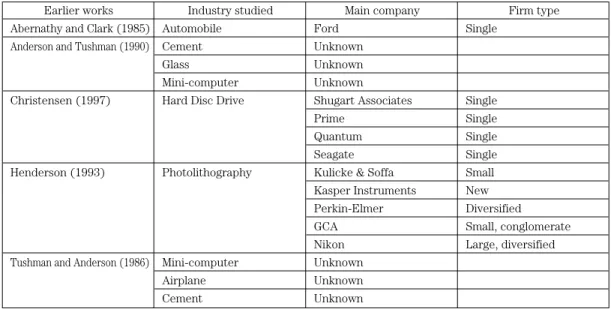
Table 1 shows the industries and firms studied by former researchers. According to the table, most of the firms engage in only one business5). By using this data bias, many researchers naturally tend to regard their unit of analysis as firm. They do not have to think about any synergy effect, which stems from the relationship among divisions. The environment in USA implicitly causes this lapse.
In opposite to this tendency in USA, diversified firms have been constantly increasing in Japan.
Iwasaki and Ohtsuki (2002) found out that there are too many diversified firms in Japan and called it as
“saturation of diversified firms”. We have to take this state into consideration to study Japanese firms.
Table 2 shows this relationship between theory and reality in USA and Japan. It means that there are two kinds of relationships between them. If we look into the industry in USA, we can regard a firm as engaging in a single business. On the other hand, if we look into the industry in Japan, we cannot regard it as the same. We have to construct logic according to their own environments.
It is good to gloze before stepping further. We do not mean to assert that former researchers were wrong. We want to insist not on the misleading of them, but on the tacit assumption of them. The tacit assumption can be a serious problem not for them, but for us. By figuring out the assumption, we intend
Table 1: industries studied in main earlier works
Tushman and Anderson (1986) and Anderson and Tushman (1990) did not mention the firm names. However, many of them might be single business firms, because they studied industries in the early 20th century.
Earlier works Industry studied Main company Firm type
Abernathy and Clark (1985) Automobile Ford Single
Anderson and Tushman (1990) Cement Unknown
Glass Unknown
Mini-computer Unknown
Christensen (1997) Hard Disc Drive Shugart Associates Single
Prime Single
Quantum Single
Seagate Single
Henderson (1993) Photolithography Kulicke & Soffa Small Kasper Instruments New
Perkin-Elmer Diversified
GCA Small, conglomerate
Nikon Large, diversified
Tushman and Anderson (1986) Mini-computer Unknown
Airplane Unknown
Cement Unknown
Table 2: comparison between Japan and USA
Difference in reality
USA Japan
Tushman and Anderson (1986)
Abernathy and Clark (1985) Need to regard existing firms not
Theory Christensen (1997) as single, but as diversified.
etc
The unit of analysis fits reality
Reality Increasing single business firms Saturation of diversified firms (Markides, 1993) (Iwasaki and Otsuki, 2002)
to clarify an untouched research site. It is the site of innovation research on diversified firms.
There are few researches on it, but some researchers mentioned it briefly. Henderson (1993) referred to the difference of firms’ form when studying the photolithography industry. However, her main focus was on the examination of the relationship between established firms’ motivation to invest on a new technology and its effect. In her article, whether they are diversified or not was only regarded as a control variable. She did not refer to the merit of diversification in detail.
However, diversified firms can have a power to adapt to technological changes. There are at least two patterns of contribution as below:
1. A larger amount of money can be invested on a new product development.
2. Current informational resources in another division can be transferred to the division facing inno- vation.
The first contribution is the one which Henderson (1993) imagined. To make this contribution effective, a diversified firm should select the division to invest and collect the financial resources. The second contribution is which we point out. Established firms, which depend on an old technology, can rarely have resources enough to develop a new technology. However, resources in another division might contribute to develop the technology. Especially, informational resources can play an important role, because it is tacit and cannot be replicated easily (see Itami, 1987: Praharad and Hamel, 1990).
There may be no certain relationships in advance, but may be a critical relationship as a result.
Therefore, we have to study resource transfer across divisions in a diversified firm to judge its adaptabil- ity to technological changes.
3. Review of Resource-Based-View research on diversified firms
(1) Overview
When we turn to study resource transfer, we have to review the researches about RBV. The researchers on RBV were mainly interested in the profitability of diversification strategy. The first researcher who stimulated many RBV researchers was Ansoff (1965). He found one of the merits which diversified firms can enjoy, and he called it “synergy”. He pointed out four types of synergy, which are sales synergy, operating synergy, investment synergy, and management synergy. He argued that diversi- fied firms are able to enjoy these merits because they can share some resources.
After Ansoff’s research, Rumelt (1974) and Berry (1975) examined the profitability of diversified
firms. They showed that the financial performance of related business firms are better than that of unre- lated business firms. They explained its difference by using the concept of synergy, and many researchers have supported this explanation (see Bettis, 1981; Montgomery and Wernerfelt, 1988; Singh and Montgomery, 1987)6). This difference among diversified firms can be recognized not only in USA, but also in Japan. Yoshihara, Sakuma, Itami, and Kagono (1981), and Hakota (1986) found the same result as in USA. Especially, Yoshihara et al. (1981) insisted that informational resources played a very important role to make a difference among diversified firms.
However, we can also find some researchers who cast doubts on these results mentioned above.
They argued that results could not find an evidence to prove the difference. This confrontation against former researches is perhaps caused by the confusion of the definition of “relatedness” (Pitts and Hopkins, 1982; Fan and Lang, 2000).
Markides and Williamson (1994) insisted two points about the reason why researchers were incon- sistent with each other: Firstly, most researchers failed to measure the relatedness strictly, because the traditional method of measuring them did not reflect the strategic importance. Secondly, they failed to grasp the essential benefit of synergy accurately, because most researchers saw the benefit only stati- cally.
This second problem stems from the traditional way of analyzing diversification firms: most researchers only recorded a snapshot of diversified firms. After that, they divided the firms into some groups by seeing the technologies they had at the time. In this conceptual world, technology can hardly lose its value. If the technology can change easily, diversified firms cannot be separated easily since the relatedness may become obsolete soon. They rarely imagined that technology might be created or over- come.
(2) An untouched research sites in RBV
Static analysis of diversified firms discussed above surely has some merits. It stimulates the research to figure out what kind of resources can make profit or firms have to contain, and whether good resources have common character, and so on. To answer these questions, many researchers fol- lowed three steps: Firstly, they picked up some excellent companies. Secondly, they specified the resources which make profit. And finally, they analyzed the specific character of those resources.
Representatively, researchers showed that resources with causal ambiguity (Lippman and Rumelt, 1982) and imperfect substitutability (Dierickx and Cool, 1989) can rarely be duplicated by competitors because they cannot find any clues how to construct those resources. This sort of research is probably
the mainstream of RBV in USA.
In fact, the approach of specifying the character of resources is very similar to Porter’s framework (Porter, 1979: 1980). Porter focused on industrial structure and suggested five forces to analyze firms’
performance, and researchers applied his framework to RBV. They thought some resources can be trad- ed through market, but some cannot be traded easily. The reason is that the market structure is weak:
potential competitors and/or the threat of replacing are weak.
Barney (1986) stimulated this tendency. He called the market, in which resources are traded,
“strategic factor markets”. He suggested that if a strategic factor market is imperfectly competitive, resource increase its value7). Peteraf (1993) also brought market factors into her main consideration.
She argued that imperfect resource mobility could be one of the drivers for competitive advantage. As a result, static analysis of RBV had been accelerated, whereas dynamic approach been forgotten.
There are three possible ways to dynamic approach. Firstly, we can study the utilizing process of resources, since they never create value without human behavior. Earlier works have exclusively focused on physical factors such as technology itself. However, their approach cannot help finding simi- larity to Porter’s framework as discussed above. Therefore, by focusing on the side of human behavior we are able to make RBV more dynamic.
Secondly, we can enlarge our analysis to cover all aspects of accumulating and utilizing resources.
Yoshihara et al. (1981) and Wernerfelt (1984) looked into a causal chain of resource accumulation and utilization8). They explained that resources which are accumulated after diversification strategy can be a driving force for next diversification. We can say that these researches developed the static framework to a more dynamic one9).
And finally, we can study how to maintain a competitive advantage in each existing business field after diversification. To analyze this question, we must think of innovation because established busi- nesses are often disrupted by technological change even in matured markets. For example, we find an innovation in Japanese powder detergent market in 1980’s. Although people thought that the market was completely matured, innovation still occurred. By this innovation, Lion had lost its competitive power and its rival firm, Kao, had gained a competitive advantage. Therefore, how to maintain competi- tive power in each existing business field is a serious matter for any firms.
4. Conclusion
In this article, we made two points clear. First, we pointed out an implicit assumption in innovation research. To put it concretely, earlier works regarded firm’s type as single business firm. They rarely
referred to the firms’ type, and so technology transfer between divisions to adapt to a technological change was not mentioned. However we suggest that technology transfer can be a key factor for diversi- fied firms to develop a new technology. We analyzed the reason why earlier works rarely referred to this topic.
Secondly, we figure out that earlier works in RBV lack the view of how to respond to a technological innovation. Many of them analyzed a lot of diversified firms, but did not mention the possibility of adapt- ability to innovation. We reasoned that it is because earlier works regard resources or technology as given in many cases. To put it concretely, they divided many diversified firms into some groups to ana- lyze the difference of their profitability. Then, they argued what type of diversification strategy would be most profitable.
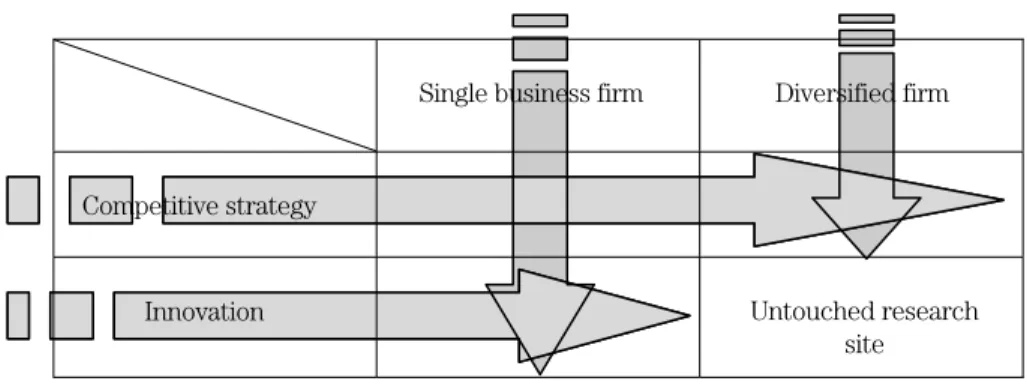
In innovation research, changing the assumption of firm’s type from single business firm to diversi- fied one blazes an untouched research site. And in RBV, the innovation study of diversified firms is a much neglected field. Table 3 shows the difference in the point of view between former researches and this article. According to it, we should look into the innovation mechanism of diversified firm. If the merit of diversified firms has a strong power enough to make the adaptability of established firms to innovation higher, we have to correct some implicit assumptions to study Japanese firms.
Notes
1)They said, “While competence-destroying discontinuities are initiated by new firms and are associated with increased environment turbulence, competence-enhancing discontinuities are initiated by existing firms and are associated with decreased environmental turbulence”. It means that the competitive power of an established firm is likely to be DESTROYED when competence-DESTROYING innovation occurs.
2)Certainly, we can find some researches focusing on technological factor. One of the most famous research- es is perhaps Foster (1986). He asserted that the development curve of technology draws S character,
Table 3: untouched research site
Single business firm Diversified firm
Competitive strategy
Innovation Untouched research
site
because technology has its physical limitation. According to Foster’s S-curve, an old technology surpasses a new technology when it just appears. But gradually, the new technology increases the growth rate, whereas the old technology decreases it. Sahal (1985) also focused on a technological factor to explain the conceptual limitation of dominant design.
Opposed to these researchers, Henderson (1995) insisted on another aspect of technology. This opposition is explained by Numagami (1999).
3)They call this kind of innovation “architectural innovation”. We have to note that Abernathy and Clark (1985) also used the concept of “architectural innovation”, but the definition is different from Henderson and Clark (1990). However it is not the main topic in this paper to show the difference.
4)She called it “core rigidity”.
5)According to Rumelt (1974), diversified firms are surely recognized in the glass industry in 1970’s. On the other hand, Anderson and Tushman (1990) studied the industry in the early 20th century. Therefore, the firms in glass industry are not likely to be diversified.
6)Montgomery and Wernerfelt (1988) used Tobin’s q to show the merit of related business firms.
7)He also suggested that luck increases the value of resources.
8)We should note that although Wernerfelt (1984) certainly looked into a dynamic process from resource accumulation process by diversification strategy to utilization process, his assertion relied on Porter’s framework because he took resource position barrier into consideration. It is easy to think that the con- cept of resource position barrier is very similar to “mobility barrier” (Porter, 1979).
9)Itami (1987) called the dynamic process of resource accumulation and utilization “dynamic synergy”. He suggested that firm should realize a dynamic synergy for further corporate growth.
<References>
Abernathy, W. J., and K. B. Clark, “Innovation: Mapping the Winds of Creative Destruction,” Research Policy, Vol. 14, No. 1, 1985, pp. 3-22.
Anderson, P., and M. L. Tushman, “Technological Discontinuities and Dominant Designs: A Cyclical Model of Technological Change,”Administrative Science Quarterly, Vol. 35, No. 4, 1990, pp. 604-633.
Ansoff, H. I., Corporate Strategy: An Analytic Approach to Business Policy for Growth and Expansion, McGraw-Hill, 1965.
Barney, J. B., “Strategic Factor Markets: Expectation, Luck and Business Strategy,” Management Science.
Vol. 32, No. 10, 1986, pp. 1231-1241.
Berry, C. H., Corporate Growth and Diversification, Princeton, NJ: Princeton University Press, 1975.
Bettis, R. A., “Performance Differences in Related and Unrelated Diversified Firms,” Strategic Management Journal, Vol. 2, No. 4, 1981, pp. 379-393.
Christensen, C. M., The Innovator’s Dilemma: When New Technologies Cause Great Firms to Fail, Cambridge, MA: HBS Press, 1997.
Christensen, C. M., and J. L. Bower, “Customer Power, Strategic Investment, and the Failure of Leading Firms,”
Strategic Management Journal, Vol. 17, No. 3, 1996, pp. 197-218.
Dierickx, I., and K. Cool, “Asset Stock Accumulation and the Sustainability of Competitive Advantage,”
Management Science.Vol. 35, No. 12, 1989, pp. 1504-1511.
Fan, J. P., and L. H. P. Lang, “The Measurement of Relatedness: An Application to Corporate Diversification,”
The Journal of Business, Vol. 73, Issue 4, 2000, pp. 629-660.
Hakota, S., Kigyo no Takakuka to sono Seika: Denki Kikai Sangyo to Senyi Sangyo wo Chushin ni, Kinki Daigaku Sekai Keizai Kenkyujo Kenkyu Ronsho, 1986 (in Japanese).
Henderson, R. M., “Underinvestment and incompetence as responses to radical innovation: evidence from the photolithographic alignment equipment industry,” RAND Journal of Economics, Vol. 24, No. 2, 1993, pp.
248-270.
Henderson, R. M., and K. B. Clark, “Architectural Innovation: The Reconfiguration of Existing Product Technologies and the Failure of Established Firms,” Administrative Science Quarterly, Vol. 35, 1990, pp. 9-30.
Itami, H. (with T. W. Roehl), Mobilizing Invisible Assets, Harvard University Press, 1987.
Iwasaki, K., and A. Ohtsuki, “Jigyo no Saikochiku: Senryaku Pattern no ‘Tokyocho’ to ‘Jirei’,” Itami Hiroyuki, Itami Kenkyushitsu (eds), Kigyo Senryaku Hakusho 1: Nihon Kigyo no Senryaku Bunseki 2001, Toyo Keizai Shinposha, 2002, pp. 192-226 (in Japanese).
Leonard-Barton, D, “Core Capabilities and Core Rigidities: A Paradox in Managing New Product Development,”
Strategic Management Journal, Vol. 13, 1992, pp. 111-125.
Lippman, S. A. and R. P. Rumelt, “Uncertain imitability: an analysis of interfirm differences in efficiency under competition,” The Bell Journal of Economics, Vol. 13,No. 2,1982,pp. 418-438.
Markides, C. C., “Corporate Refocusing,” Business Strategy Review, Vol. 4, No. 1, 1993, pp. 1-15.
Montgomery, C. A., and B. Wernerfelt, “ Diversification, Ricardian Rents, and Tobin’s q,” RAND Journal of Economics, Vol. 19, No. 4, 1988, pp. 623-632.
Peteraf, M. A., “The Cornerstones of Competitive Advantage,” Strategic Management Journal, Vol. 14, 1993, pp. 179-188.
Pitts, Robert A., and H, Donald Hopkins, “Firm Diversity: Conceptualization and Measurement,” The Academy of Management Review, Vol. 7, No. 4, 1982, pp. 620-629.
Porter, M. E., “The Structure within Industries and Companies’ Performance,” The Review of Economics and Statistics, Vol. 61, No. 2, 1979, pp. 214-227.
Porter, M. E., Competitive Strategy: Techniques for Analyzing Industries and Competitors, Free Press, 1980.
Prahalad, C. K., and G. Hamel, “The Core Competence of the Corporation,” Harvard Business Review. Vol.
66, 1990, pp. 71-91.
Rumelt, R. P., Strategy, Structure, and Economic Performance, Boston: HBS Press, 1974.
Sahal, D., “Technological guideposts and innovation avenues,” Research Policy, Vol. 14, Issue 2, 1985, pp. 61- 82.
Tushman, M. L., and P. Anderson, “Technological Discontinuities and Organizational Environments,”
Administrative Science Quarterly, Vol. 31, 1986, pp. 439-465.
Wernerfelt, B., “A Resource-Based View of the Firm,” Strategic Management Journal. Vol. 5, 1984, pp. 171- 180.
Yoshihara, H., A. Sakuma, H. Itami, and T. Kagono, Nihon Kigyo no Takakuka Senryaku: Keiei-shigen Approach, Nihon Keizai Shinbunsha, 1981 (in Japanese).
多角化企業におけるイノベーションメカニズムの研究に 向けて:経営資源観とイノベーション研究の統合
藤 原 雅 俊
要 旨
本稿の目的は、イノベーション研究と企業の経営資源観(RBV)における共通の未開拓領域を見い だすことにある。この目的に達するため、我々は主にイノベーションとRBVという2つの研究をレ ビューしていく。本稿の構成は、以下の通りである。第2節で技術変化とその競争へのインパクトを めぐる研究論文をレビューする。ここで我々は、過去の研究は既存企業が多角化しているかどうかを さほど考慮してこなかったことを示す。それゆえに過去の研究は、技術変化に対する適応力を向上さ せうるといったような多角化企業の利点を見逃してきた、というのがこの節での見解である。
つづく第3節では、主に多角化戦略をめぐるRBVの研究論文をレビューする。ここでは、多くの 論者達が、技術を所与のものとして扱ったうえで事業間での関係を論じる研究に傾注しがちであった ことを示す。そのうえで、先行研究では新しい技術を生み出したり技術が価値を失ったりする可能性 についてさほど言及されてこなかった、という見解を示していく。
そして第4節では、イノベーション研究とRBVは共通の研究領域を備えることを示す。この研究 領域は2つの研究分野から独立して生じてくるものだが、各領域に同時に貢献しうるものである。本 稿が見いだすこの未開拓な領域は不毛ではなく耕す価値のある領域である、ということが本稿の基本 主張となる。
キーワード:多角化企業におけるイノベーションメカニズム/経営資源観/技術転用/統合/
理論と現実の相互作用