1
Development of a semi-automatic measurement method for presampled MTF using virtual slit images1.Introduction
Photostimulable storage phosphor (PSP) and the flat panel detector (FPD) are used in a digital X-ray detector. The modulation transfer function (MTF) is used to evaluate the resolution property of the digital X-ray detector for quality assurance (QA) and quality control (QC) . The slit and edge methods are usually used to measure the MTF for the digital X-ray detector [1, 2]. The International Electrotechnical Commission
(IEC) recommends the edge method for digital X-ray detectors [3].
The edge method uses an edge image of a slightly slanted tungsten edge device on the digital X-ray detector. The edge image is used to generate a composite oversampled edge spread function (ESF) , which is differentiated to obtain a synthesis line spread function (LSF) . Finally, the MTF is calculated by Fourier transform of the synthesis LSF. Although the edge method is simpler than the slit method, the former requires accurate measurement of the edge
angle from the edge image. The measurement error of the edge angle influences the accuracy of the MTF, so the edge angle is used to calculate the MTF. In addition, the edge method complicates the LSF generation process and requires a great deal of experience with its measurement. Many researchers were reported the precise of edge angles [5, 6].
We previously proposed the “virtual slit” method, which uses an edge image [7]. The virtual slit method is a simplified MTF measurement process based on the edge method. Our original approach obtains a virtual slit image by subtracting the original edge image from the same image shifted one pixel in the horizontal direction. However, the virtual slit method has a problem in that the measurement error of the edge angle depends on a manual measurement process using ImageJ (National Institutes of Health, USA) [8].
The virtual slit method requires an accurate measurement of the edge angle because it is based on the edge method. For the virtual slit method, the
*Corresponding author. Tatsunori Kobayashi.
Tel.: +81 92-554-1244 Fax: +81 92-552-0072
E-mail: [email protected]
原著
Development of a semi-automatic measurement method
for presampled MTF using virtual slit images
Tatsunori Kobayashi, Yasuyuki Kawaji
Abstract: We have been researching the use of a virtual slit method on the presampled modulation transfer function
(MTF) . The virtual slit method obtains a virtual slit image by subtracting the edge image from an image shifted one pixel in the vertical direction. In our previous study, the measurement of the edge angle and synthesis of a line spread function
(LSF) were fully manual processes, which affected the MTF calculation error. The aim of the present study was developing semi-automatic software for the virtual slit method. We used four simulation edge images (edge angles: 1.5° , 2.0° , 2.5° , and 3.0°) and obtained three experimental edge images with an indirect flat panel detector. Our software can measure the edge angle, generate the LSF, and calculate the MTF semi-automatically. The measurement error of the edge angles was within 0.01° in all simulation images and within 0.02° in all experimental edge images, respectively. The error ratio of the simulated and theoretical MTFs was within 1.0% at the Nyquist frequency. The average standard deviation of the MTFs with the experimental edge images was within 0.0006 (maximum: 0.0013) . Thus, we developed semi- automatic software for the virtual slit method. Our results showed that the software can stably measure the MTF. We consider the software to be a useful semi-automatic assistant for the virtual slit method.
Key words: modulation transfer function, virtual slit image, edge angle, semi-automatically measurement
Department of Radiological Science, Faculty of Health Science, Junshin Gakuen University
純真学園大学雑誌 第9号 令和2年3月
Journal of Junshin Gakuen University,
Faculty of Health Sciences Vol.9, March 2020
2 Tatsunori Kobayashi, Yasuyuki Kawaji
measurement error of the edge angle has to be reduced to improve the MTF calculation accuracy.
Therefore, we developed software that semi- automatically measures the MTF by using the virtual slit method. The purpose of this study was to develop a semi-automatic method to reduce the measurement error from manual processes. Our software can measure the edge angle, generate the synthesis LSF, and calculate the MTF semi-automatically. In this paper, we discuss the accuracy of the edge angle and MTF with the proposed method and describe the usefulness of our software.
2
.Materials and methods 2.1. Simulation edge image
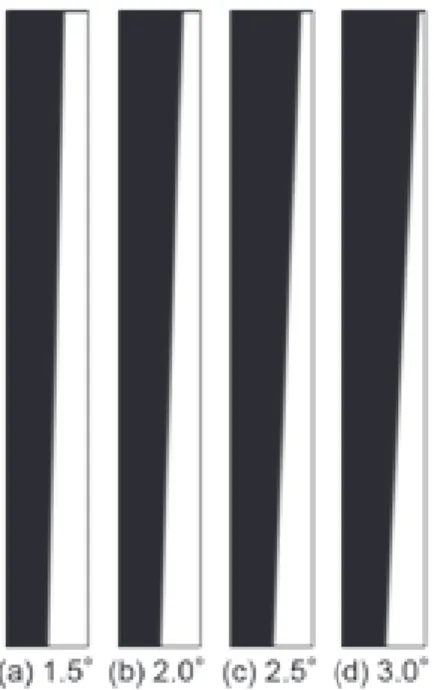
We simulated images by using a Lorentzian-shaped function [6]. The simulation images had a matrix size of 65×512 pixels, gray-level resolution of 16 bits, and sampling pitch of 0.0875 mm/pixel. The Nyquist frequency (Ny) was 5.71 cycles/mm. Figure 1 shows four simulation images with edge angles of 1.5° , 2.0° , 2.5° , and 3.0° .
Fig. 1 Simulation images with edge angles of (a) 1.5°,
(b) 2.0°, (c) 2.5°, and (d) 3.0°.
4
the edge angle and MTF with the proposed method and describe the usefulness of our software.
67 68
2. Materials and methods 69
2.1. Simulation edge image 70
We simulated images by using a Lorentzian-shaped function [6]. The simulation images had a 71
matrix size of 65 × 512 pixels, gray-level resolution of 16 bits, and sampling pitch of 0.0875 72
mm/pixel. The Nyquist frequency (Ny) was 5.71 cycles/mm. Figure 1 shows four simulation images 73
with edge angles of 1.5°, 2.0°, 2.5°, and 3.0°.
74
Fig. 1 Simulation images with edge angles of (a) 1.5°, (b) 2.0°, (c) 2.5°, and (d) 3.0°.
2.2. Experimental measurements
We used three experimental edge images that were the same as those used in our previous study [7].
These images were obtained with an indirect FPD detector (PLAUDR, Konica Minolta, Tokyo, Japan)
and the tungsten edge device. The FPD was implemented with a CsI-based phosphor. We removed the X-ray scatter reduction grid and disabled all image processing. The RQA5 spectrum was used for all measurements by adding 21 mm of aluminum to a 74 kV X-ray beam to provide an approximate half-value layer of 7.1 mm of Al. The experimental edge images had a matrix size of 1K × 1K pixels, resolution of 16 bits, and sampling pitch of 0.139 mm/pixel. Ny of the edge images was 3.60 cycles/mm. The tungsten edge device was slightly slanted at 1.5 ° -3 ° relative to the vertical direction of the pixel matrix on the FPD. Our software used a region of interest (ROI) image with a matrix size of 768 × 512 pixels from the experimental edge image to measure the MTF. Figure 2 shows an example ROI image with the tungsten edge device on the right side.
Fig. 2 Example ROI image obtained from the experimental edge image. The right side shows the tungsten edge device with a slight angle.
5 75
2.2. Experimental measurements 76
We used three experimental edge images that were the same as those used in our previous study 77
[7]. These images were obtained with an indirect FPD detector (PLAUDR, Konica Minolta, Tokyo, 78
Japan) and the tungsten edge device. The FPD was implemented with a CsI-based phosphor. We 79
removed the X-ray scatter reduction grid and disabled all image processing. The RQA5 spectrum 80
was used for all measurements by adding 21 mm of aluminum to a 74 kV X-ray beam to provide an 81
approximate half-value layer of 7.1 mm of Al. The experimental edge images had a matrix size of 82
1K × 1K pixels, resolution of 16 bits, and sampling pitch of 0.139 mm/pixel. Ny of the edge images 83
was 3.60 cycles/mm. The tungsten edge device was slightly slanted at 1.5°-3° relative to the vertical 84
direction of the pixel matrix on the FPD. Our software used a region of interest (ROI) image with a 85
matrix size of 768 × 512 pixels from the experimental edge image to measure the MTF. Figure 2 86
shows an example ROI image with the tungsten edge device on the right side.
87
Fig. 2 Example ROI image obtained from the experimental edge image. The right side shows the tungsten edge
2.3. Semi-automatic processing
Figures 3 (a) and (b) show fl owcharts comparing the
processes of our previous study and our software. The
dotted lines in Fig. 3 (b) indicate the semi-automated
process in our software.
3 Development of a semi-automatic measurement method for presampled MTF using virtual slit images
Fig. 3 Comparison of the process fl ows in the previous study and with the semi-automatic MTF calculation software: (a) fl owchart of the previous study [7] and
(b) fl owchart of our semi-automatic method. 6
device with a slight angle.
2.3. Semi-automatic processing 88
Figures 3a and b show flowcharts comparing the processes of our previous study and our software.
89
The dotted lines in Fig. 3b indicate the semi-automated process in our software.
90
Fig. 3 Comparison of the process flows in the previous study and with the semi-automatic MTF calculation software:
2.4. Dose image
A pixel is a saved digital value in a digital image obtained by using FPD. We can convert the digital value (DV
i) into the dose value (d
i) in each pixel by using Eq. (1) on the measurement MTF:
d
i= a × e
b ・(DVmax DVi)(1)
where a and b are coefficients obtained from the digital characteristic curve and DVmax is the maximum digital value in the ROI image. In this study, a was 1.058, and b was 0.014.
2.5. Virtual slit image
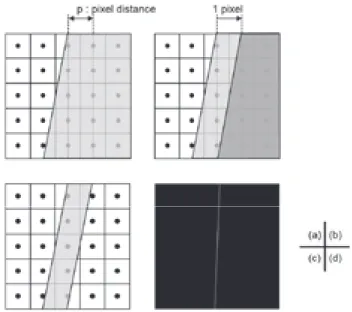
Here, we describe the generation of the virtual slit image in Fig. 4. First, we shift the dose image by one
pixel in the horizontal direction, as shown in Figs. 4
(a) and (b) . The virtual slit image is obtained by subtracting the dose image from the shifted image, as shown in Fig. 4 (c) . Figure 4 (d) shows an example virtual slit image of the experimental edge image.
Fig. 4 Generation of a virtual slit image: (a) schematic diagram of a dose image, (b) shifted image generated by moving the dose image by one pixel to the horizontal direction, (c) subtraction image obtained by subtracting the dose image from the shifted image, and (d) example virtual slit image in the experiment.
8
Fig. 4 Generation of a virtual slit image: (a) schematic diagram of a dose image,
(b) shifted image generated by moving the dose image by one pixel to the horizontal direction, (c) subtraction image obtained by subtracting the dose image from the shifted image, and (d) example virtual slit image in the experiment.
103
2.6. Measurement of the edge angle 104
Our proposed method measures the edge angle by using the maximum pixel in each row of the 105
virtual slit image. Our software can objectively measure the edge angle by using the maximum 106
image. The maximum image is obtained by extracting the maximum value of each row in the virtual 107
slit image, as shown in Fig. 5a. The maximum pixels are continuous in the maximum image, as 108
shown in Fig. 5b. Thus, we extract the maximum pixel value from the continuous maximum pixels, 109
as shown in Fig. 5c. The edge angle is calculated by using the x-axis and y-axis coordinates of the 110
discrete maximum pixel value in the maximum image. The edge angle is calculated as follows:
111
2.6. Measurement of the edge angle
Our proposed method measures the edge angle by using the maximum pixel in each row of the virtual slit image. Our software can objectively measure the edge angle by using the maximum image. The maximum image is obtained by extracting the maximum value of each row in the virtual slit image, as shown in Fig. 5a.
The maximum pixels are continuous in the maximum image, as shown in Fig. 5b. Thus, we extract the maximum pixel value from the continuous maximum pixels, as shown in Fig. 5c. The edge angle is calculated by using the x -axis and y -axis coordinates of the discrete maximum pixel value in the maximum image. The edge angle is calculated as follows:
α = tan (1 x y
upper y
lower
lower
x
upper) (2)
where x
upperand y
upperare the x- and y-axis coordinates
for the upper row, and x
lowerand y
lowerare the x- and
4 Tatsunori Kobayashi, Yasuyuki Kawaji
y-axis coordinates for the lower row in the maximum image, as shown in Fig. 5 (d) .
Fig. 5 Calculation of the edge angle using the maximum image: (a) maximum pixel values of each row in the virtual slit image, (b) maximum pixel value in each sequential column of the maximum pixel value, as shown in Fig. 3(a), and (c) edge angle calculated from the coordinate information for the maximum pixel value in the upper and lower rows of the maximum image.
9 𝛼𝛼𝛼𝛼= tan−1�𝑦𝑦𝑦𝑦𝑢𝑢𝑢𝑢𝑢𝑢𝑢𝑢𝑢𝑢𝑢𝑢𝑢𝑢𝑢𝑢𝑢𝑢𝑢𝑢 − 𝑦𝑦𝑦𝑦𝑙𝑙𝑙𝑙𝑙𝑙𝑙𝑙𝑙𝑙𝑙𝑙𝑢𝑢𝑢𝑢𝑢𝑢𝑢𝑢
𝑥𝑥𝑥𝑥𝑙𝑙𝑙𝑙𝑙𝑙𝑙𝑙𝑙𝑙𝑙𝑙𝑢𝑢𝑢𝑢𝑢𝑢𝑢𝑢 − 𝑥𝑥𝑥𝑥𝑢𝑢𝑢𝑢𝑢𝑢𝑢𝑢𝑢𝑢𝑢𝑢𝑢𝑢𝑢𝑢𝑢𝑢𝑢𝑢� (2)
112
where xupper and yupper are the x- and y-axis coordinates for the upper row, and xlower and ylower are the 113
x- and y-axis coordinates for the lower row in the maximum image, as shown in Fig. 5d.
114
Fig. 5 Calculation of the edge angle using the maximum image: (a) maximum pixel values of each row in the virtual slit image, (b) maximum pixel value in each sequential column of the maximum pixel value, as shown in Fig. 3(a), and (c) edge angle calculated from the coordinate information for the maximum pixel value in the upper and lower rows of the maximum image.
115
2.7. Calculation of the integer number N 116
The edge method uses the integer number N to generate the synthesis LSF [8]. We obtain the N as 117
follows:
118
𝑁𝑁𝑁𝑁=tan 𝛼𝛼𝛼𝛼1.0 (3)
119
2.7. Calculation of the integer number N
The edge method uses the integer number N to generate the synthesis LSF [8]. We obtain the N as follows:
N = 1.0
tan α (3)
where α is the edge angle.
2.8. Generation of the synthesis LSF
Our software extracts an ROI with ±2N rows around the center y-coordinate to measure the MTF in the virtual slit image, as shown in Fig. 6 (a) . We can obtain the synthesis LSF by repositioning the pixels within the ROI in the virtual slit image [1], as shown in Fig. 6 (b) .
Fig. 6 Generation of a synthesis LSF: (a) ROI region of N rows extracted from the virtual slit image and
(b) synthesis LSF obtained from repositioning the pixels in the ROI from Fig. 6(a).
10 where α is the edge angle.
120 121
2.8. Generation of the synthesis LSF 122
Our software extracts an ROI with ±2N rows around the center y-coordinate to measure the MTF 123
in the virtual slit image, as shown in Fig. 6a. We can obtain the synthesis LSF by repositioning the 124
pixels within the ROI in the virtual slit image [1], as shown in Fig. 6b.
125
Fig. 6 Generation of a synthesis LSF: (a) ROI region of N rows extracted from the virtual slit image and (b) synthesis LSF obtained from repositioning the pixels in the ROI from Fig. 6(a).
126
2.9. Generation of averaged synthesis LSF 127
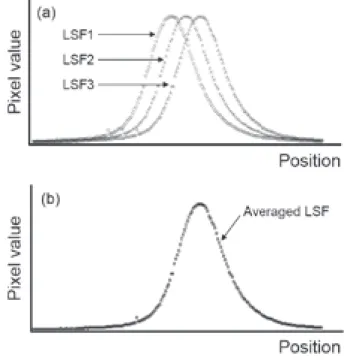
We use three synthesis LSFs to calculate an MTF. The maximum value positions are different for 128
each synthesis LSF as shown in Fig. 7a. To obtain the averaged synthesis LSF as shown in Fig. 7b, 129
the peak coincides with each synthesis LSF, and the average value of these LSFs is calculated. We 130
verify the peak of each synthesis LSF using the Excel spreadsheet application (Microsoft 131
Corporation, Redmond, WA, USA).
132
2.9. Generation of averaged synthesis LSF
We use three synthesis LSFs to calculate an MTF.
The maximum value positions are different for each synthesis LSF as shown in Fig. 7a. To obtain the averaged synthesis LSF as shown in Fig. 7b, the peak coincides with each synthesis LSF, and the average value of these LSFs is calculated. We verify the peak of each synthesis LSF using the Excel spreadsheet application (Microsoft Corporation, Redmond, WA, USA) .
Fig. 7 Generation of the averaged synthesis LSF: (a)
the positions of maximum value are diff erent in each synthesis LSF; (b) the positions of the maximum pixel values are repositioned to coincide with the maximum pixel value position in each LSF to obtain the averaged LSF.
11
Fig. 7 Generation of the averaged synthesis LSF: (a) the positions of maximum value are different in each synthesis LSF; (b) the positions of the maximum pixel values are repositioned to coincide with the maximum pixel value position in each LSF to obtain the averaged LSF.
133
2.10. Calculation of the resampled MTF 134
The presampled MTF (MTFo) is obtained by using discrete Fourier transform (DFT) on the 135
synthesis LSF. We correct the presampled MTF(MTFp) with the sinc function as follows [9]:
136
𝑀𝑀𝑀𝑀𝑀𝑀𝑀𝑀𝑀𝑀𝑀𝑀𝑝𝑝𝑝𝑝= 𝑀𝑀𝑀𝑀𝑀𝑀𝑀𝑀𝑀𝑀𝑀𝑀𝑙𝑙𝑙𝑙 sin (𝑓𝑓𝑓𝑓𝑓𝑓𝑓𝑓𝑓𝑓𝑐𝑐𝑐𝑐𝑙𝑙𝑙𝑙𝑐𝑐𝑐𝑐𝑐𝑐𝑐𝑐𝑓𝑐𝑐𝑐𝑐)
(𝑓𝑓𝑓𝑓𝑓𝑓𝑓𝑓𝑓𝑓𝑐𝑐𝑐𝑐𝑙𝑙𝑙𝑙𝑐𝑐𝑐𝑐𝑐𝑐𝑐𝑐𝑓𝑐𝑐𝑐𝑐)
(4) 137
where f is the spatial frequency, α is the edge angle, and s is the sampling pitch of the input image. 138
139 140
5 Development of a semi-automatic measurement method for presampled MTF using virtual slit images
2.10. Calculation of the resampled MTF
The presampled MTF (MTF
o) is obtained by using discrete Fourier transform (DFT) on the synthesis LSF. We correct the presampled MTF(MTF
p) with the sinc function as follows [9]:
MTF
p= MTF
osin(f・π・cosα・s)
(f・π・cosα・s)
(4)
where f is the spatial frequency, α is the edge angle, and s is the sampling pitch of the input image.
2.11. Calculation of the theoretical MTF
The theoretical MTF of the edge image can be analytically computed and is given by a Lorentzian- type function. The theoretical MTF (MTFt) is calculated by using Eq. (5) [8] and then corrected by the sinc function [9]. Equation (5) uses the regular subsampling pitch given by the lateral distance between two adjacent pixels p divided by the number of lines N corresponding to a lateral shift of the edge by one pixel:
MTFt = r
2r
2+ (2πf)
2× sin (f・π・cosα・s)
(f・π・cosα・s) (5)
where r is the value of (1/p) for the edge parameter, as shown in Fig. 4a, f is the spatial frequency, α is the edge angle, and s is the sampling pitch of the input image.
2.12. Calculation of the error ratio of MTF
We can calculate the error ratio between the MTF of the simulation images (MTFsi) and MTFt by using Eq. (6) to estimate the accuracy of MTFsi.
error ratio = MTF
siMTF
tMTF
t× 100 (6)
3.Results
3.1. Measurement of the edge angle in simulation images
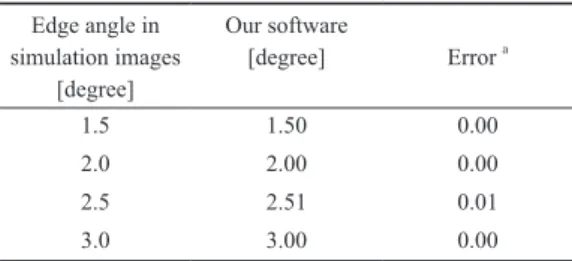
We measured the edge angles in simulation edge images by using Eq. (2) , and the results are presented in the second column of Table 1. We calculated the errors between the edge angle of the simulation images and our results to estimate the accuracy of our method.
The measured edge angle in the simulation images is presented in the third column on of Table 1. The measurement error of the edge angle was within 0.01°
for all of the simulation images.
Table 1 Edge angles measured by our software in four simulation images
Edge angle in simulation images
[degree]
Our software
[degree] Error a
1.5 1.50 0.00
2.0 2.00 0.00
2.5 2.51 0.01
3.0 3.00 0.00
a = error is between our software and the average of the manual measurement
3.2. Measurement of the edge angle in experimental edge images
We measured the edge angles in the experimental edge images by using Eq. (2) , and the results are presented in the first column of Table 2. The edge angle was manually measured by two radiological technologists (RTs) independently, and the results are presented in the second and third columns of Table 2.
The maximum error was 0.04 by RT1, and the minimum error was 0.01. We calculated the average edge angle of each experimental edge image by the two RTs. We calculate the errors between the averaged and semi- automatically measured results to estimate the accuracy of our method. The measurement error of the edge angle was within 0.02° for all of the experimental edge images.
Table 2 Comparison between the edge angles with our software and manual measurement in three experimental edge images
Image number
Our software [degree]
Manual measurement [degree] (errora)
RT1 RT2 Average
1 2.32 2.35 (0.03) 2.31 (-0.01) 2.33 (0.01) 2 2.32 2.36 (0.04) 2.31 (-0.01) 2.34 (0.02) 3 2.32 2.35 (0.03) 2.31 (-0.01) 2.33 (0.01) a= error is between our results and the average of the manual measurement RT= radiological technologist
3.3. Presampled MTFs of the simulation image
Figure 8 (a) - (d) compares the simulation and
theoretical MTFs. The error ratio of these MTFs was
within 1.0% (at Ny/2 and Ny) , as given in Table 3.
6 Tatsunori Kobayashi, Yasuyuki Kawaji
14
Fig. 8 Comparison between the MTFs of four simulation images and the theoretical values. The MTF with edge angles of (a) 1.5°, (b) 2.0°, (c) 2.5°, and (d) 3.0°.
183
Table 3 Comparison between the error ratios of the MTFs in four simulation edge images Edge angle of simulation
image [degree] error ratio [%]
at Ny/2 error ratio [%]
at Ny
1.5 -0.03 -0.17
2.0 -0.05 -0.68
2.5 0.05 -0.07
3.0 0.04 -0.02
Ny = Nyquist frequency, Ny/2 = Half of the Nyquist frequency 184
3.4. Presampled MTF of the experimental edge image 185
Figure 9a-c compares three MTFs of the experimental image and the averaged MTF of the three 186
Fig. 8 Comparison between the MTFs of four simulation images and the theoretical values. The MTF with edge angles of (a) 1.5°, (b) 2.0°, (c) 2.5°, and (d)
3.0°.
Table 3 Comparison between the error ratios of the MTFs in four simulation edge images
Edge angle of simulation image [degree]
error ratio [%]
at Ny/2 error ratio [%]
at Ny
1.5 -0.03 -0.17
2.0 -0.05 -0.68
2.5 0.05 -0.07
3.0 0.04 -0.02
Ny = Nyquist frequency, Ny/2 = Half of the Nyquist frequency
3.4. Presampled MTF of the experimental edge image
Figure 9 (a) - (c) compares three MTFs of the experimental image and the averaged MTF of the three MTFs. The averaged standard deviation (SD) was 0.0006 (maximum: 0.0013) among the three MTFs.
4.Discussion
We developed a semi-automatic measurement software for the virtual slit method to realize accurate measurement of the edge angle. The edge angle affects the accurate calculation of the MTF because it is used to calculate N in Eq. (3) . Therefore, evaluating the accuracy of the edge angle measurement with our software was important.
In our previous study, the edge angle was measured through a manual process [7]. In this study, our proposed method can semi-automatically measure the
edge angle by using the coordinates of the maximum pixel in the edge image. This approach can reduce the subjective error depending on the manual process and assure a reproducible measurement of the edge angle.
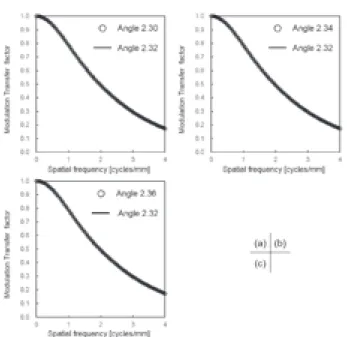
The measurement results of our software matched the edge angles in the simulation images and experimental edge images, as given in Tables 1 and 2. The maximum error of the edge angle was 0.02° . We calculated the MTFs for edge angles of 2.30° , 2.34° , and 2.36° and compared them with an MTF for an edge angle of 2.32° , as shown in Fig. 10. The fi rst three MTFs approximately coincided with the last MTF, and the SD for the four MTFs was 7.5 × 10
−4. We concluded that the error of the edge angle did not infl uence the calculation of the MTF and that our software can accurately measure the edge angle.
The SD of the MTFs for the simulation images was within 1.0% (at Ny/2 and Ny) , as given in Table 3 and Fig. 8. The results showed that our method can approximate the theoretical MTF. The maximum error ratio of our result was -0.68 at 2° in the simulation image. In Bhur et al.ʼs study, the error was within 1.0%
at 2° in simulation images [6]. Our proposed method can reduce the relative error of the MTF in simulation images.
15
MTFs. The averaged standard deviation (SD) was 0.0006 (maximum: 0.0013) among the three 187
MTFs.
188
Fig. 9 Comparison between MTFs of three FPD images and the average value. The MTF with (a) edge image 1, (b) edge image 2, and (c) edge image 3.
189
4. Discussion 190
We developed a semi-automatic measurement software for the virtual slit method to realize 191
accurate measurement of the edge angle. The edge angle affects the accurate calculation of the MTF 192
because it is used to calculate N in Eq. (3). Therefore, evaluating the accuracy of the edge angle 193
measurement with our software was important.
194
Fig. 9 Comparison between MTFs of three FPD images
and the average value. The MTF with (a) edge
image 1, (b) edge image 2, and (c) edge image 3.
7 Development of a semi-automatic measurement method for presampled MTF using virtual slit images
17
Fig. 10 Comparison between MTFs with edge angles of 2.32°and (a)2.30°, (b)2.34°, and (c)2.36° in experimental edge image 2.
210
For the simulation image with an edge angle of 2.0°, the error was higher than in other simulation 211
images. This error may have been due to the N value used to generate the synthesis LSF. Although 212
we obtained a true N of 28.59 with Eq. (3), our method used the integer N of 29 in the semi- 213
automatic process. The difference between the true N and integer N affected the accuracy when the 214
synthesis LSF was generated. Further investigation is needed to reduce the influence of the error 215
between the integer N and true N on the virtual slit image.
216
The averaged SD of the MTFs in the experimental edge images were within 0.0006 (maximum:
217