Geochemical study on tektites: Implications for their parent materials and the presence of
meteoritic components
テクタイトの地球化学的研究:源物質の化学的特徴と隕石成分存在の可 能性について
Applicant: Rabeya Akhter 申請者: ラベア アクタル Supervisor: Mitsuru Ebihara
: 海老原充
Department of Chemistry, Graduate School of Science and Engineering, Tokyo Metropolitan University
首都大学東京 理工学研究科
A dissertation submitted for the application of Ph.D degree September, 2015
i
TABLE OF CONTENTS
ACKNOWLEDGEMENTS ... iii
ABSTRACT ... iv
INTRODUCTION 1.1 Meteoritic impact event on the Earth ... 2
1.2 Tektites ... 4
1.3 Tektite strewn fields ... 4
1.4 Classification of tektites depending on the formation ... 8
1.5 Presence of meteoritic component in tektites ... 9
1.6 Accurate determination of PGE... 12
1.7 Objective of this study ... 13
SAMPLES and METHODS 2.1 Samples ... 15
2.2 Analytical Methods ... 16
2.3 Accuracy and precision of the analytical methods ... 21
RESULTS 3.1 Determination of major and trace elements by using instrumental neutron activation analysis ... 34
3.2 Comparison of major elemental abundances among tektites from four strewn fields ... 47
3.3 Determination of Major and trace elements in GPt-5 samples by using instrumental neutron activation analysis ... 51
3.4 Determination of Mg in Dalat indochinite by using inductively coupled plasma atomic emission spectrometry ... 51
3.5 Determination of rare earth elements, thorium and uranium using inductively coupled plasma mass spectrometry ... 51
3.6 Determination of Platinum group elements (PGE) using nickel sulfide fire assay associated with isotope dilution inductively coupled plasma mass spectrometry ... 55
ii DISCUSSION
Part-one
4.1 Determination of PGE and, Comparison of Ir values between INAA and NiS-FA
combined with ICP-MS... 65
4.2 Comparison of Ir values between INAA and ICP-MS with NiS-FA ... 67
Part-two 5.1 Comparison of Chemical Variation in Vietnam indochinite ... 69
5.2 Rare earth elemental pattern of tektites ... 70
5.3 Characterization of parent materials using trace elemental abundances ... 74
5.4 Moderately siderophile elemental abundances in tektites ... 78
5.5 Comparison between Mg and moderately siderophile elemental abundances in tektites... 82
5.6 Platinum group elemental abundances in tektites ... 87
CONCLUSIONS ... 96
BIBLIOGRAPHY ... 99
iii
ACKNOWLEDGEMENTS:
I would never have thought to be a student again after a gap of 11 years. The second student life was genuinely challenging and interesting, sometimes paining and frustrating. But I have cherished the life by going through new arena of knowledge in a different environment. I would like to express my deepest gratitude to my advisor, Prof. Mitsuru Ebihara for giving me the opportunity to know science more. Without his support and guidance I would have not been able to experience the research. It was my honor to work under his supervision. I would like to express my special appreciation and thanks to Assistant Prof. Dr. Naoki Shirai whose advices on both research as well as my life in Japan have been invaluable. From him I have learnt all the analytical techniques I have used in this research. It is not sufficient to express my gratitude with only few words to him. My sincere thanks go to Associate Prof. Dr. Yasuji Oura for his kind help for different purpose during my study at the university. I also thank Prof. Nobuyuki Takegawa for his valuable comments to improve my dissertation. I would like to express my appreciation to all my lab-mates for their friendship and kind help. Wada-san, Yokozuka-san, Takahashi-san, Tanaka-san, Utaka-san, Ikeda-san, Yoshioka-san, Miura-san, Terai-san, Nakamura-san, Terasaki -san, Maeda-san, Saito-san, Endou-san, Rahat-san and Vu-san - I am indebted to all of them.
I thank Academy of Science (Czech Republic), Smithsonian institute (USA) and Mr. Cao Dong Vu (VAEI) for providing me the tektite samples. I also like to thank Dr. Shun Sekimoto of Kyoto University Research Reactor Institute for allowing me to use the reactor facility.
I have no words to express my heartfelt gratitude to my family. I am here only because of them. I owe all my achievements to them.
iv
ABSTRACT
Tektites are natural glass and produced from the upper crustal materials during the meteoritic impact event on the Earth. They are found in four known strewn fields. The study of tektites is important as tektites convey the chemical properties of the parent material during impact event as well as the information of the projectile. Several attempts have been carried out to find a clear evidence of the meteoritic presence, but no definite conclusions have been achieved so far. In this study, tektites from four strewn fields were analyzed to verify the characteristics of the parent materials based on major, minor and trace elemental abundances and to evaluate the data for the presence of extra-terrestrial components specially focusing on siderophile elemental compositions.
Twenty five samples of tektites from 4 strewn fields were analyzed in this study.
Instrumental neutron activation analysis, inductively coupled plasma atomic emission spectrometry, and inductively coupled plasma mass spectrometry were performed for the determination of major, minor and trace elements in the samples.
The major, minor and trace elemental abundances of tektites provide information about the characteristics of parent materials. For central European strewn field, elemental abundances describe that the parent materials of moldavites were not homogenous in chemical composition and that they had the composition similar to sedimentary rock based on La/Th ratio. For North American strewn field, the parent materials were enriched with compatible elements and have the characteristics similar to sedimentary rock with distinct Rb/Cs ratio. On the contrary, Ivory Coast tektites resemble the Archean sediments in relative content of compatible and incompatible elements.
For tektites collected from Australasian strewn field, major elements show large variation in their concentration e.g. Ca, Al, Mg, and Fe- implying the heterogeneous nature of parent material. Tektites of Australasian strewn filed are enriched with incompatible elements e.g.- La, Th, Rb, Cs, and depleted with compatible elements e.g.- Sc but Ni, Co and Cr. CI chondrite-normalized patterns of REE with significant Eu anomaly for these tektites are very comparable to post Archean upper continental crust.
Several comparisons were made to predict the nature of parent material and to find extra- terrestrial signature to be present in tektites using the siderophile elemental abundances. For moldavites, the Ni/Co and Cr/Co ratios do not show any strong correlations. The contents of these siderophile elements are very low compared with other strewn field, expressing that the
Figure 1: Co abundances versus Ni from this work and literature for strewn fields.
v
precursor materials were depleted in these elements. The possibility of presence of chondritic component in these tektites is low. The Ivory Coast tektite is enriched with these siderophile elements, which explains that the parent materials were enriched with these elements. The possibility of meteoritic components present cannot be ruled out for this tektite. From Australasian strewn field, moderately siderophile elements for both southern and western australites are lower than those of upper continental crust (UCC), whereas, indochinites (tektite from Vietnam and Cambodia) are much enriched with these elements. All these results together show good positive correlation for siderophile elements among tektites collected from this strewn field. This positive correlation could be explained by incorporation of mafic rock or meteoritic component with different mixing amount with different tektites.
Three Dalat indochinites have higher abundances of Ir, and all tektites (this study) are enriched with Ru and Rh in comparison to UCC. In contrast, Pd data shows depletion in abundances compared with UCC. The enrichment of platinum group elements (PGE) can be due to presence of mafic component in the parent material. Although presence of mafic rocks in tektites is geologically feasible but the trace elemental characteristics determined by this study and many other researchers’ constraint the parent materials as sedimentary rocks. The CI normalized PGE pattern is non-chondritic which may indicate the projectile nature as iron meteorite or achondrite. Cr/Ir ratio in tektite is significantly high enough for any known iron meteorite as projectile. As achondrite are depleted to PGE compared to chondrite or iron meteorite, the CI normalized PGE pattern of tektites will not reflect the presence of this type of projectile. The indigenous characteristic of parent materials of this strewn field cannot be ruled out for explaining the higher content of moderately siderophile elements and some highly siderophile elements. Because large impact event usually involves a large volume of crustal materials it is conceivable that the indigenous component in the tektites was derived from a particular material enriched with moderately and highly siderophile elements.
1
1. INTRODUCTION
2 1.1 Meteoritic impact event on the Earth
Although compared with the vast, enormous universe, Earth is very small but it experienced lots of asteroid, comet or meteoritic impact events after the formation. These impact events have played major role in the geological and biological history of the Earth, e.g., 65 million years ago, one of these impact event caused a major biological extinction which also known as ‘Cretaceous-Tertiary Extinction’(Alvarez et al. 1980).
The impact of an extraterrestrial object on Earth begins when the impactor (asteroid, comet or meteoroid) penetrates the upper atmosphere. At this time the projectile has the speed of 11-72kms-1 with an angle 0o (parallel to the surface of the Earth) to 90o, the most likely impact angle is 45° (Shoemaker 1962). During travelling through the atmosphere the impactor experiences a great collision with the atmosphere which produces tremendous heat as well as disrupts the speed of the impactor significantly. Small impactors (typically a few meter or less, French, 1998) are disrupted entirely during their atmospheric traverse, lost their kinetic energy well above the surface and form no crater. They are usually collected as meteorite and subjected to scientific research. Larger objects, however, retain sufficient momentum through the atmosphere to strike the Earth with enough energy (kinetic energy) to produce high pressure and enormous temperature. This high pressure eventually generates and transmits intense shock
waves through the target materials which are excavated to form an impact crater much larger than the impactor (Figure1-1). As the crater grows, large volumes of rock debris are ejected onto the surface of the Earth surrounding the crater. Sometimes due to the enormous temperature produced due to the collision with the earth the projectile vaporizes immediately and it also melts and vaporizes some portion of the target materials (Grieve, 1991; Collins et al., 2005).
Figure 1.2 shows a schematic drawing of a meteoritic impact event.
Figure: 1-1 Barringer crater, Arizona, USA. 50,000 years old.
Awell preserver meteoritic impact craters in USA. This crater was formed 50000 years ago with an iron meteorite.
3
Figure: 1-3Map of confirmed impact structures on the Earth surface (180 structures) and on the oceanic bottom (24 structures). Size of circles is proportional to the crater diameter. Color shows the age of formation divided into four groups.
Source - Expert Database on the Earth Impact Structures (EDEIS), Tsunami Laboratory, ICMMG SD RAS, Novosibirsk, 2006
Figure: 1-2 Schematic drawing of Meteoritic impact event on earth
4 1.2 Tektites
Tektites are the product of the large impact event. They are natural glasses which are formed when a big meteorite or asteroid hit the earth with high velocity at certain angle (Artemieva et al, 2002), a huge quantity of the earth’s crust is melted and some are thrown out in the atmosphere. These molten crustal materials then travel a long way in the sky and fall on the ground as aerodynamically shaped material. They are solidified either before or after they touch the ground. Due to the high SiO2 content, these materials are glass in texture. These are known as tektites.
During large impact event the projectile vaporizes due to the tremendous heat produced.
It is assumed some vaporized projectile material may incorporate with tektite. So the study of tektite will provide not only the information about target material but also the projectile. Many research works were carried out to find the nature of projectile by analyzing the chemistry of tektites.
1.3 Tektite strewn fields
The large areas on the Earth’s surface where tektites are found are known as tektite strewn fields. There are four commonly known strewn fields. In the following table the information about the strewn fields are mentioned.
Table: 1-1 Four commonly known tektite strewn fields:
Strewn Field Country of origin
Age of the strewn field, Ma
Name of the tektites Related impact crater
North American
USA (Texas,
Georgia, Barbados) 34.9
Bediasite, georgiates Micro tektites
Chesapeake Bay
Central Europe
Czech Republic and Slovakia, Austria, Germany
14.5 Moldavite Ries impact
crater
Ivory coast Ivory coast 1.07 Ivory coast,
microtektites
Lake Bosumtwi
Australasian
Australia, Thailand, Laos, Cambodia, China,
Philippines, Vietnam, Cambodia
etc
0.77
Australites, philippinites, indochinites,
thailandites, javanites and billitonites, microtektites
Not known
5 1.3.1 North American strewn field:
Depending on the country and place where the tektites are found, all strewn fields except Ivory Coast are divided to several sub strewn fields. For examples, North American strewn field is divided to two sub fields; a) Texas and b) Georgia. Tektites found in Texas are known as bediasites whereas tektites collected from Georgia are recognized as georgiates. Besides them, tektite fragments and microtektites were also found in Barbadose and deep sea drill cores at New Jersey (Koeberl and Glass, 1988). These tektites do not have any specific name. A single tektite is also found at Martha’s vane yard at Massachusetts.
The impact crater associated with this strewn field is Chesapeake Bay (Albin et al., 2000;
Deutsch and Koeberl, 2006; Koeberl et al., 1996). The age of the Chesapeake Bay crater has Figure 1-5 Bediasite
Figure 1.4 Montanari and C. Koeberl, Impact stratigraphy. The Italian record, Springer-Verlag, Berlin-Heidelberg, 364 pp, (2000) (Modified)
6
been estimated using fossil stratigraphy and magnetostratigraphy to be 35.5 Ma (Poag and Aubry, 1995). The crater age is consistent with 40Ar/39Ar age measurements of 35.3 ± 0.2 Ma for four North American tektites (Horton and Izett, 2005). The bediasites and georgiaites have noticeable chemical differences (Albin et al. 2000).
1.3.2 Central European strewn field:
The central European strewn filed is extended to four countries – the Czech Republic and Slovakia, Austria, and Germany. The corresponding impact crate of this strewn field is Ries crater at Southern Germany.
The common name of tektites of this strewn field is moldavites. However this filed has two major sub fields- Moravia and Bohemia, also new locations of occurrences (Austria, Lusatia) and new type of glasses have been reported (Meisel et al., 1997). The moldavites have radiometric ages identical to the ages of the Ries impact craters in Germany, 14.3 Ma (Buchner et al., 2003; Laurenci et al., 2003). Moldavites are very heterogeneous in their chemical composition (Engelhardt et al., 2005).
1.3.3 Ivory Coast European strewn field:
This strewn field is located at in the Ivory Coast, West Africa. The Bosumvi impact crater, Ghana is the source crater for this strewn field. This strewn field does not have any sub group, though microtektites related to this strewn field are found in deep –sea drill cores.
Figure 1-6 Moldavite
7
The age determined by 40Ar-39Ar analyses of these tektites is 1.1 ± 0.05 Ma. This age agrees well with a fission track date of 1.03 ± 0.11 Ma for impact glass from the 10.5 km diameter Bosumtwi impact crater in Ghana, (Koeberl et al., 1997; Koeberl et al., 1998).
1.3.4 Australasian strewn field:
The Australasian strewn field is the largest of the four strewn fields, covering the area of
~5x10⁷ km2(around one tenth of the earth’s surface, Figure. 1-4, Koeberl, 1994). Sub fields of these strewn fields are many and they are named after the geographic locations. For example tektites found in Australia are named as australites, in Philippines are philippinites, in Java (Indonesia) are javanites, in Indochina (China, India, Cambodia, Laos and Vietnam) are
Figure 1-7 Ivory Coast tektite
Figure 1-8 Tektites from Australasian strewn field
8
indochinites etc. Each tektite subgroup has little chemical variation within itself, but the subgroups vary significantly from one another (Chapman and Scheiber, 1969).
Although the chemistry differs, all of the subgroups have 40Ar/39Ar ages of 0.8 Ma (Izett and obradovich, 1992,Yamei et al., 2000), signifying that the entire strewn field formed in a single impact event, but Wasson (1991) argued for multiple impact events occurring within short period of time. However, the impact crater and source of the Australasian strewn field is presently unknown. Some authors have suggested locations for the missing Australasian tektite source crater near the northern end of the strewn field in Vietnam or Thailand (Ma et al., 2004 using 10Be isotopic systematics). Whereas using Pb/Pb isotope data (206Pb/204Pb, 207Pb/204Pb and
208Pb/204Pb) Milliot et al. (2004) describes the crater position possibly near the Mekong River (S.
Vietnam). Both Schnetzler (1988) and Stecher et al. (2009) have analyses satellite data and suggested the impact site for Australasian strewn field is off the coast of Vietnam. Still any strong prove for the position of the impact event is not recognized yet.
1.4 Classification of tektites depending on the formation According the way of forming tektites are classified to four groups.
a. Moung-nong b. Splash form c. Ablated form d. Microtektites
1.4.1 Moung-nong type tektites: These tektites are irregular in shape and named after a region in Laos where they were first found (Lacroix, 1935; Glass et. al 1995). They are also known as ‘layered tektites’. These are blocky, large size tektites (mass up to 24kg, Koeberl 1992) containing more volatile materials, gas inclusions, crystalline inclusion e.g., quartz, zircon, rutile, corundum, chromite etc. (Glass et al. 1998; Koberl 1986). They are chemically less homogenous, compositional variations are seen between layers (Koeberl, 1994; Son and Koeberl, 2005). The occurrence of large (>1000 g) Muong Nong tektites appears to be restricted to a small area within strewn field. Muong Nong type tektites are abundant in the Australian strewn field, but a few samples of Muong Nong type have also been found in Central European and North American strewn field (Koeberl, 1992).
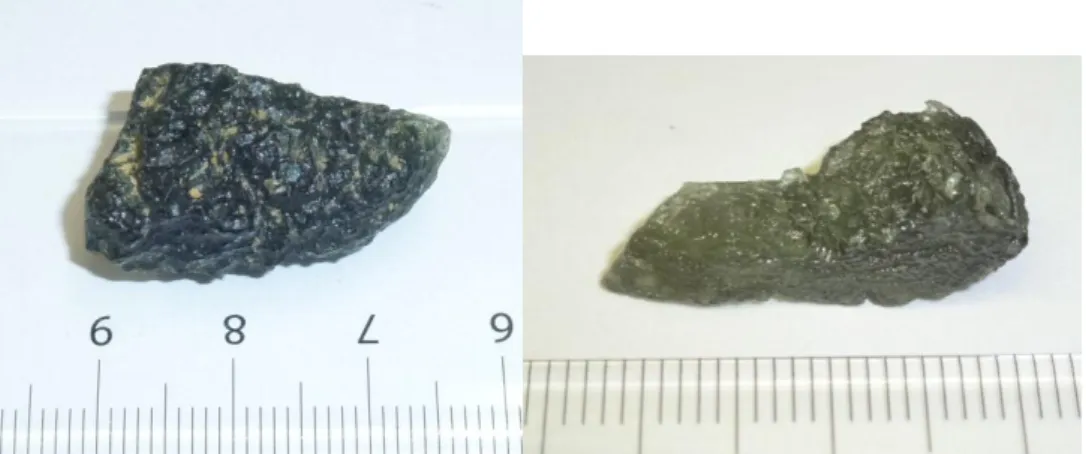
1.4.2 Splash form tektite: This is the normal or most common form of tektites. These tektites are formed by solidification of rotating molten rock in air or vacuum. These tektites are of many shapes e.g. - sphere, droplets, tear drop, dumbbells etc. and are found in all strewn fields.
9
1.4.3 Ablated form: Tektites, belong to this group, are found only in Australia of Australasian strewn field.They are formed by aerodynamic ablation during the re-entry through the atmosphere (Koeberl, 1994). During the re-entry, the tektites glasses went through partial re- melting which resulted in the ablation of the tektite. These tektites are also known as flanged button tektites.
1.4.4 Microtektites: Micro tektites are found in deep sea drilling cores. They are generally less than 1mm in size, though in Barbados some tektites are obtained which has the size between micro and macro tektites. Except Central European, microtektites are found in deep sea drilling cores for other three strewn filed.
1.5 Presence of meteoritic component in tektites:
Smaller impact crater usually retain the physical residue of the projectile, thus it becomes easier to determine and categorize the projectile (Grieve, 1991). For larger impact event, the projectile generally vaporized and destroyed due to the tremendous heat and pressure generated during the impact (Grieve, 1991, Koeberl and Shirey, 1997). Only a small amount of vaporized materials is mixed with a much larger quantity of target–derived vapor and mixed in the impact melt tock, melt breccia and impact glass deposits (Koeberl and Shirey, 1997, Koeberl at el. 2004).
Sometimes distal ejecta may also contain a small meteoritic contribution as the famous K-T boundary example (Alvarez, 1980)
As the melt composition are largely controlled to a large extent (>>99%), by the target material, it is extremely difficult to detect the compositional characteristics of the meteorite (Koeberl, 1998). Only elements that have high abundances in the meteorite but low abundances in geological samples, e.g., siderophile elements can be used to identify the projectile signature.
Identification of the chemical nature of projectiles mostly has been achieved by the study of concentration and interelement ratio of moderately siderophile (and related) elements (Ni, Co, Figure 1-9Splash form (left) from Vietnam and Ablated form (right) tektite from Australia
10
Cr) and specially highly siderophile elements–the platinum group elements (PGE- Ru, Rh, Pd, Os, Ir, Pt). Abundances of these elements in chondrite are several order magnitude higher than the terrestrial rock. So, they can be used as fingerprint for projectile identification even for the presence of <1% meteoritic components in the sample (Figure- 1-10).
Previous studies have revealed the projectile type for a number of impact crater using the siderophile elements abundances and interelement ratios (Grieve, 1991, Koeberl, 1998). In some impact structures, the identification based on siderophile elements were hampered due to several complications. Sometimes terrestrial rocks contain very high abundances of moderately siderophile elements (Ni, Co) which could not be accounted for meteoritic signature. For highly
siderophile elements PGE- the complications arise from variation in concentration in target rock, mobility and concentration of PGE by purely terrestrial processes and fractionation during impact process (Colodner, 1992; Sawlowicz, 1993; Evans and Chai, 1997; Koberl and Shirey, 1997; Schmitz et al. 2004; Lee et al 2006)
Several attempts were carried out to decipher the compositional characteristics of projectile for the four tektite strewn fields. Chao et al. (1964) found some metallic spherule (Ni-F spherules) in phillippinites and Dalat indochinite. The authors recognized them as the signature of meteoritic composition. But Ganapathy and Larimer (1983) opposed the idea of Chao et al.
(1964). They argued that the presence of metallic spherule was the in-situ reduction of host rock, and was not of meteoritic origin. Chapman & Scheiber (1969) found high magnesium content in some Australasian tektites which were also enriched with Ni, Co and Cr. The authors suggested tektites as lunar origin, and therein explained the enrichment of siderophile elements and related Figure 1-10 CI chondrite normalized major and trace elements pattern for abundances of upper continental crust (UCC), 1% mixing of CI chondrite with UCC and 1% mixing of ultramafic rock with UCC. Even 1% mixing of CI chondrite to UCC changes significantly in the pattern for Ni, Ru, Pd, Ir and Pt; smaller changes are also observed for Co and Cr.
1.0E-05 1.0E-04 1.0E-03 1.0E-02 1.0E-01 1.0E+00 1.0E+01 1.0E+02 1.0E+03
Al K Ca Sc Cs Ba La Sm Eu Tb Yb Lu Hf Ta Th Cr Fe Mg Co Ni Ru Pd Os Ir Pt
CI Chondrite normalised abundance
CI UCC
1% meteorite and 99% UCC mixing 1% Ultramafic and 99% UCC mixing
11
elements. Although, based on rare earth elemental abundances as well as other trace elemental abundances and ratios, Taylor (1962a, 1962b, 1966, 1973); Taylor and Sachs, (1964); Taylor &
McLennan, (1969, 1979); Koeberl (1992) – recognized origin of tektites is terrestrial, not extra- terrestrial.
Morgan (1978) conducted radiochemical neutron activation analysis of six high Mg Australites from South Australia. Only one sample out of 6 showed significant enrichment with Re and Os. The author concluded this enrichment was due to the meteoritic component, most probably Enstatite or ordinary chondrite. Although Koeberl (1998) was agreed with Morgan (1978) data, he suggested the projectile type was not chondrite as the Ni, Co and Cr abundances in that tektite could not explain the chondritic presence and there was lack of Ir data also. Later Meisel and Koeberl (1990) and Koeberl (unpublished data, Koeberl, 1998) analyzed some Muong-Nong type tektite and achieved Ir and Os contents near about the crustal value. Koeberl (1993) found a minor but distinguishable layer of Ir enrichment in ejecta layer compared with adjacent sediment layer of Australasian microtektites. This finding supported Morgan (1978) statement. Tagle et al. (2014) determined PGE in Australasian tektites and based on this, they reported the presence of meteoritic components in Ni- rich samples.
Palme et al (1978, 1981) analyzed two Ivory Coast tektites and found enriched Ir and Os content compared with crustal material. The authors suggested Iron meteorite was the projectile as for the reason of enrichments in siderophile elements. Later Jones (1985), Dai et al. (2005), Goderis et al. (2007), Koeberl and Shirey (1993) analyzed impact melt and suevite samples (target lithology) of the Bosumtwi crater. All these literatures reported high abundances of siderophile elements in the analyzed samples and the possibility of this enrichment was due to terrestrial origin related to gold mineralization known in the region. However the 187Os/188Os ratio of tektites determined by Koeberl and Shirey (1993) was very close to carbonaceous chondrite and iron meteorite, and inconsistent with the crustal rock. Koeberl et al. (2007) measured 53Cr/52Cr ratio of Ivory Coast tektite (same sample used by Koeberl and Shirey, 1993) and found the ratio close to ordinary chondrite.
The target rocks, fall back material of the Ries impact crater as well as the related tektites, moldavites, do not show any enrichment of moderately of highly siderophile elements.
These phenomena discourage to find chondritic component with these samples. Morgan et al.
(1979) analyzed both tektite and impact lithology to detect meteoritic component by measuring PGE. The authors found no significant enrichment of PGE and concluded low siderophile elements contents might be typical for Ries ejecta and fall back and possibly aubrite type meteorite was the projectile of this crater. Schmidt and Pernicka (1994) analyzed target rock collected from drill core samples and came upon exploring ultramafic rock in the crystalline
12
basement far below the crater. They also determined PGE in their samples and found enrichment with Ir and Os in their samples. This enrichment did not produce any evidence for any meteoritic contribution rather was due to crystalline crustal characteristics.
Asaro et al. (1982), Ganapathy (1982) and Alvarez et al. (1982) detected elevated Ir abundances in deep sea drill cores located in the Caribbean Sea for North American strewn field.
Glass et al. (1982) analyzed samples from the same drill core to get a better concept of the sources of Ir anomaly and found the Ir anomaly related to some clonopyroxene-bearing spherule, not to the normal microtektites. The authors suggested these clonopyroxene bearing spherule formed during the same event caused the North American strewn field.
1.6 Accurate determination of PGE:
Platinum group elements (PGE; Ru, Rh, Pd, Os, Ir and Pt) are an important group of elements for understanding some fundamental aspects of the origin and the evolution of the solar system, and differentiated planets including Earth, the moon and Mars, and planetesimals (e.g., Walker, 2009; Day, 2013). Analyses of mantle rock sample indicated that PGE are fractionated from each other (Barnes et al., 1985). Osmium, Ir and Ru behave as compatible element, while Rh, Pd and Pt behave as incompatible element during igneous processes. Recently, chromite, FeCr2O4, is considered to play an important role for the fractionation of PGE. Ultramafic and mafic samples have a positive correlation between Cr vs. Os and Ir vs. Ru, implying that these four elements are partitioned into the same minerals (e.g., Pagé et al., 2012). Partition coefficients of Os, Ir and Ru between chromite and silicate melt are higher than those of Rh, Pd and Pt (Puchtel and Humayun, 2001; Righter et al., 2004; Finnigan et al., 2008; Pagé et al., 2012).
It has been getting common to use inductively coupled plasma mass spectrometry (ICP- MS) for the determination of PGE in rock samples (Jarvis et al., 1997). In solution-based ICP- MS, complete digestion of rock samples, especially chromite, is essential for the reliable determination of PGE. The commonly used digestion techniques are alkali fusion with Na2O2
and NaOH, NiS-FA and acid digestion in Carius tube and a high pressure asher (HPA-S) for the determination of PGE in rock samples (Enzweiler et al., 1995; Jin and Zhu, 2000; Gregoire, 1988; Ravizza and Pyle, 1997; Li and Feng, 2006; Resano et al., 2008; Shirey and Walker, 1995;
Pretorius et al., 2003; Meisel et al., 2001, 2003; Vanhaecke et al., 2004). Among them, NiS-FA has been the most commonly applied for the determination of PGE. As this technique is able to digest a large amount of sample (>10 g), sampling bias called nugget effect could be reduced and, as a consequence, analytical results become more reproducible. For NiS-FA, absolute amounts of PGE in procedural blank become higher due to the use of a large amount of fluxes and the difficulty in obtaining of highly pure fluxes. On the contrary, acid digestions in Carius tube and a HPA-S have lower procedural blank level compared with that of NiS-FA and are able to
13
determine Re in addition to PGE. Carius tube and HPA-S digestions can process relatively smaller amount of samples (< 2 g), which involves a higher possibility that analytical data are affected by nugget effect.A major concern in ICP-MS of PGE in rock samples has been whether NiS-FA can completely dissolve chromite or not (e.g., Savard et al., 2010). Puchtel et al. (2004) used both NiS-FA and Carius tube digestion for the determination of PGE in komatiites samples and found that PGE values obtained from NiS-FA are systematically lower than those from Carius tube digestion (38% for Os, 21% for Ir, 42% for Ru, 37% for Pt and 17% for Pd).
Undissolved chromites were found in glassy slag obtained after NiS-FA (Bédard and Barnes, 2004; Puchtel et al., 2004). In the later studies, komatiite samples were analyzed by using both NiS-FA and acid digestion in Carius tube or HPA-S, and it was demonstrated that two analytical results are not distinguishable from each other (Barnes and Fiorentini et al., 2008; Savard et al., 2010).
1.7 Objective of this study:
Tektite is a one of the most chemically diagnosed terrestrial materials. Most works are related to the determination of major, minor are trace elements to imply for the origin of tektites, chemical nature of parent materials and also the formation of tektites. Some researchers worked on the identification of projectiles related to impact events. Identification of the chemical nature of projectile mostly has been achieved by the study of the concentration and interelement ratios of siderophile elements especially platinum group elements (PGE). Many researchers tried to find out the extra-terrestrial signature present in tektites using Ir, Os, Re. The whole budget of PGE determination was carried out for philippinites by Tagel et al. (2014) only. Actually the difficulty to determine trace amount PGE in terrestrial material with accuracy and precision impose constrain in the experiment.
Four strewn fields of tektites - North American strewn field (NAS), Central European strewn field (CES), Ivory Coast strewn field (IVC) and Australasian strewn field (AAS) have different geological positions, age of formation and essentially distinct chemical compositions of the target materials. In this study tektites from these four strewn fields were. Objectives of the study are-
1. Comparison among four strewn fields regarding to major, minor and trace elemental abundances of respective tektite samples.
2. Determination of PGE in tektite samples.
3. Evaluation of extra-terrestrial component present in tektite using PGE abundances.
14
2. SAMPLES AND METHODS
15 Table 2-1 List of samples
2.1 Samples
Twenty five tektites of four strewn fields and an impact melt from Zhamanshin impact crater were analyzed in this study. In Table 2-1 country of origin, numbers and masses of the samples analyzed in the study are listed. The samples were received from different sources.
Regarding the number and size of samples from one specific area, tektites from Dalat, Vietnam were considered as a group.
Strewn Field Country of origin
Received from No. of samples
Weight Other
Australasian strewn field
Dalat, Vietnam Mr. Cao Dong Vu, Vietnam Atomic Energy
Institute
13 12-48g
Vietnam Smithsonian Institute (USNM 2141)
1 7.02g
Kalgoorlie, Western Australlia
Mineral show, Japan 1 9.3g
Finke River area, South Australia
Mineral show, Japan 2 6.42g, 7.08g Paracale,
Philippines
Academy of Science, Czech Republic
1 3.96g Lots of small pieces Pailin Mount,
Cambodia
Academy of Science, Czech Republic
1 5.22g Lots of small pieces
Central European strewn field
Prof. Mitsuru Ebihara, a gift from Goldschmidt
2011, Prague , Czech Republic
1 1.62g
Bohemia, Czech Republic
Academy of Science, Czech Republic
2 1.53g,
2.47g Czech
Republic
Smithsonian Institute (USNM 2235)
1 5.7g
Ivory Coast Strewn field
Ivory Coast Smithsonian Institute (USNM 6011)
1 6.4g
North American strewn field
Bediasite, Texas, North
America
Smithsonian Institute (USNM B-59)
1 7.4g
Impact melt Irghizite,
USSR
Zhamanshin Crater
Academy of Science, Czech Republic
1 1.23g
Besides tektite samples a geological sample, GPt-5, was also analyzed. GPt5- is a chromitite type certified reference material (CRM) prepared by Institute of Geophysical and Geochemical Exploration (IGGE), China for comparison of PGE content for different geochemical analysis. Not so much information is available about this CRM with INAA
16
(Instrument neutron activation analysis), two sets of information about PGE are accessible which were done by Xiaolin Li et al. 1995 and Jorge et al. (1999). Most of the elemental abundance of this CRM was detected by XRF, CHEM and AAS which are used for establishing certified values.
2.1.1 Sample preparation
The tektite samples were cleaned by dipping in ~1M HCl, MilliQ water and acetone successively for 15 minutes each under ultrasonication. After this primary cleaning, surface of some of the tektites was removed with the help of router. Then the tektites were again cleaned according the previous cleaning procedure with 1M HCl, MilliQ water and acetone. After cleaning the samples were ground to powder by an agate mortar and pestle to confirm homogeneity. As the tektites from Philippines and Cambodia consisted of lots of small pieces, surface was not removed by router. GPt-5 sample was in powder form, so no further preparation was required for this sample.
2.2 Analytical Methods:
Three analytical methods were performed to determine the major, minor and trace elements in the tektite samples..
2.2.1 Instrumental neutron activation analysis (INAA):INAA was performed for the determination of major, minor and trace elements (Na, Mg, Al, K, Ca, Sc, Ti, V, Cr, Mn, Fe, Co, Ni, Zn, Rb, Sr, Zr, Cs, Ba, La, Ce, Nd, Sm, Eu, Tb, Yb, Lu, Hf, Ta and Th) of all the samples after irradiating them in the reactor at Kyoto University Research Reactor Institute (KURRI).
Tektite and GPt-5 samples along with JB-1 (a geochemical standard reference material, issued by the Geological Survey of Japan), Allende (a well-studied carbonaceous chondrite meteorite, received from Smithsonian Institute position 22, split 6) and some high purity chemical reagents (Si, MgO, Al, and Ir-Au) were also irradiated. For INAA, JB-1 was used as the reference materials for the determination of elemental abundances in the samples whereas Allende was used as the control material to check the accuracy of the analytical process, and also as reference material to determine Ni. The INAA procedure used in this study was essentially the same as that previously reported by Shirai et al. (2015).
Small amounts (40-50mg) of samples, JB-1, Allende were taken into 1cmx1cm high quality polythene bag and were sealed. Each bag was then doubly packed with another layer of polythene. All samples along with JB-1, Allende and the chemical reagent (except Ir-Au) went also irradiated for short duration (10 seconds, thermal neutron flux= 4.68x1012 cm-2s-1). After cooling, the outer layer of the sample was changed and gamma spectra of samples were measured for short lived radionuclides using high purity germanium (HPGe) detector in KURRI.
17
Cooling and counting time for short measurement were ~5-10 minutes and 300 seconds, respectively. After finishing the counting for short irradiation, a long irradiation (~4hours) was performed for all samples, JB-1, Allende and Ir-Au chemical reagent. Depending on the half- lives, three sets of measurements with different cooling periods were carried out for the long irradiated samples to determine medium and long lived radionuclides.
In INAA, Al and Mg contents were determined from the radioactivity of 28Al and 27Mg, respectively. These nuclides are formed by the (n, γ) reactions of 27Al and 26Mg. But both Al and Mg encounter spectral interference from 28Si (n, p) 28Al and 27Al (n, p) 27Mg, respectively. To correct the interference- spectral interference of 28Al from 28Si (n, p) and 27Mg from 27Al (n, p) were monitored and necessary correction were made for the samples using the high purity chemical reagent (Si, MgO, Al). Ir-Au standard was used for determination of Ir in GPt-5 samples.
2.2.2 Acid digestion of samples: Sm spike (147Sm/149Sm = 0.0577) was added toaround 15 mg of samples and hydrofluoric acid, nitric acid and per chloric acid were added to the samples. Then the samples were subjected to heating under different temperature setting for different time duration. Acid digestion procedure was carried out for the precise determination of Mg (which can be determined by INAA also, but experiences spectral interference from Al) by inductively coupled plasma atomic emission spectrometry (ICP-AES) using Lu as internal standard to correct plasma drift during measurement of the solution. This experiment was performed for only the tektite samples collected from Dalat, Vietnam.
The same acid digested solution was used for the determination of rare earth elements (REEs), Th and U using the isotope dilution method for determination of Sm and external calibration method for other elements. Inductively coupled plasma mass spectrometry (ICP-MS) was used to determine the elemental abundances. The acid digestion process of the tektites is described in the Figure 2-1.
18 Teflon beaker
Heating at 1200C (closed system, 3h)
Heating at 1750C (closed system, overnight)
Heating to dryness at 2000C (open system,)
Heating to dryness at 2000C (open system,)
Heating to dryness at 1500C (open system)
Heating to dryness at 1500C (open system,)
Heating at 1100C (closed system, overnight)
Dilution to 15g solution to prepare Stock solution (dilution factor 1:1000) Sample (~15mg) and Sm spike
1ml of mixed acids (HF, HNO3, HClO4-2:1:1)
0.1ml HClO4
0.1ml HCl
HNO3
1ml HNO3
3 times
3 times
0.5g stock solution 0.2g stock solution
1:20000 dilution 1:20000 dilution
Mg measurement by ICP-AES
REEs, Th and U measurement by ICP-MS
Lu In, Tl, Bi
Figure 2-1:- A flow diagram for sample analysis by acid digestion.
19
2.2.3 Nickel sulfide fire assay (NiS-FA) for platinum group elements determination:
NiS-FA method is used for the pre-concentration of platinum group elements Ru, Rh, Pd, Os, Ir and Pt), Re and Au. Usually PGE abundances in geological samples are very low (Juvonen et al.
2002,; Jarvis et al., 1997; Man and Hailing, 2004) and PGE distribution within the sample is very heterogeneous (due to nugget effect). For these reasons, most analytical procedures require separation and concentration of PGE prior to measurement. Different analytical techniques for pre-concentration of PGE are used e.g. lead fire assay, nickel sulfide fire assay, antimony fire assay (Yan at al., 1998; Frimpong et al., 1995), sometimes followed by tellurium coprecipitation for further concentration of PGE in the measurement solution (Jackson et al. 1990; Oguri et al., 1999; Shinotsuka et al., 2003). Since fire assay procedure often faces the drawback of high blank contribution, an acid digestion followed by cation exchange separation is occasionally preferred instead of fire assay. But acid digestion sometimes is not sufficient enough to dissolve some refractory host phase of PGE. Furthermore, with acid digestion only small test portion can be analyzed which cannot suppress the problem of heterogeneity of sample (Shinotsuka et al. 2003).
In this study, NiS-FA in combination of isotope dilution method was used for the determination of PGE in tektites. The analytical process was adopted from Shirai et al., (2003).
To overcome the problems of heterogeneity and lower amount of PGE present in samples, 10g of sample size was used for this experiment. The requirements of large mass samples of this procedure constrained our experiment with only tektites (n=13) collected from Dalat Vietnam.
Owing to the larger sample size compared with the case of Shirai et al. (2003), the quantities of fluxes were also increased for this experiment.
NiS-FA experiment was also performed with the same GPt-5 samples used for INAA.
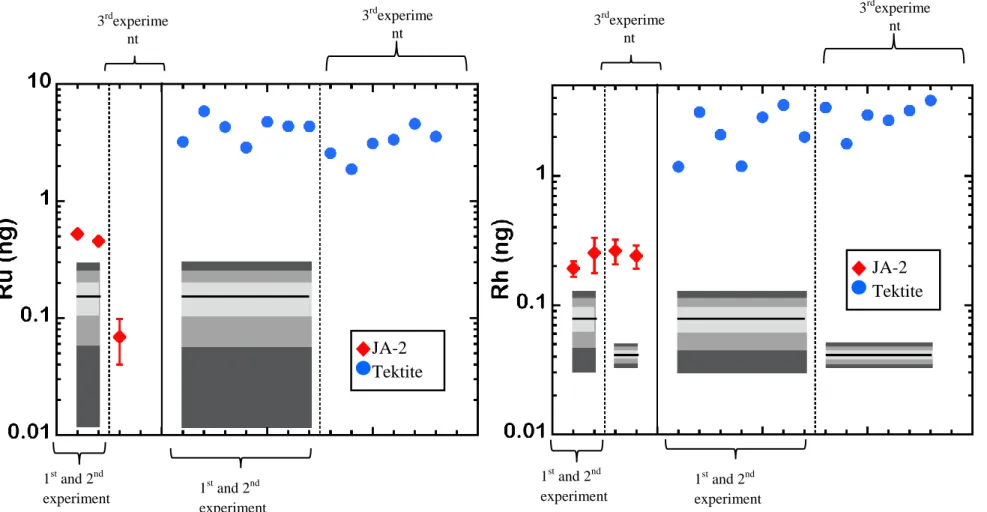
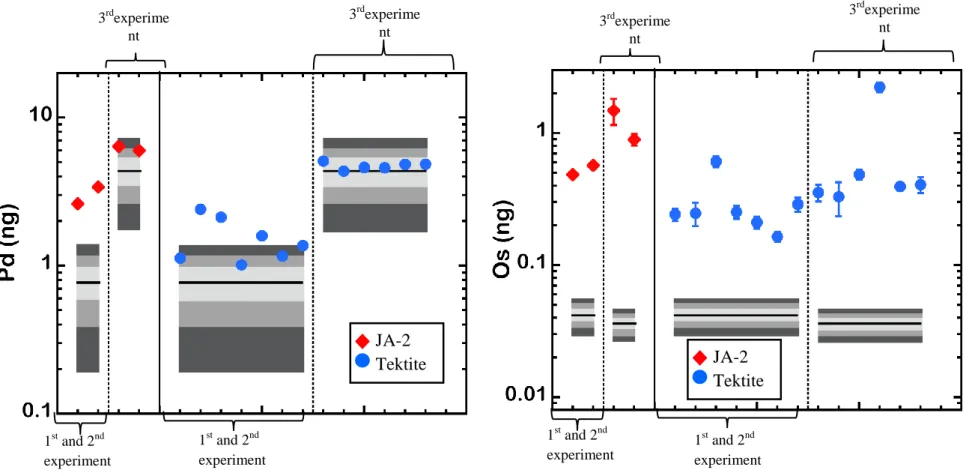
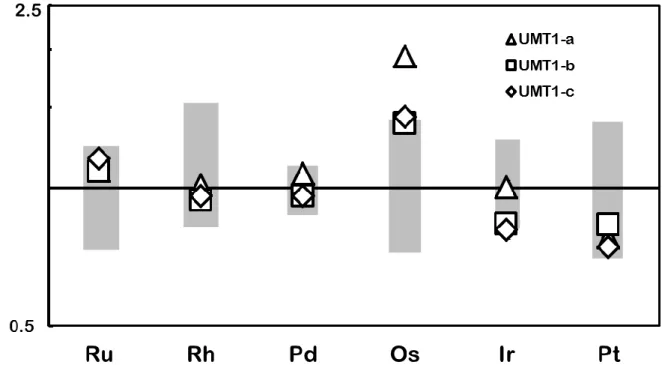
As the sample size of GPt-5 was very small (40-50mg), the amount of fluxes used in this experiment was similar to Shirai et al. (2003). To ensure the accuracy and precision of NiS–FA experiment, different analyses were performed with geological reference material prior to measurement with tektite and GPt-5 samples. UMT-1(ultramafic ore tailings PGE material, Canadian certified reference material used for PGE), FC-1 (Fish Clay, reference material, collected from Cretaceous-Tertiary boundary layer in Stevens Klint, Denmark), FC-2 (a reference material, similar toFC-1 except having different grain size) and JA-2 (an andesite, geochemical standard reference material, issued by the Geological Survey of Japan ) were used for the determination of PGE using isotope dilution ICP-MS combined with NiS-FA preconcentration method. Figure 2-2 describes the process for the PGE determination.
20 SiO2 in crucible
Drying in oven at 400C Content transfer to polybag
Mixing thoroughly and content transfer to crucible
Fusion of the content in muffle furnace for 30 minutes at 8500C And for one hour at 10000C(total time supposed to be 2 hours)
Collection of the Ni-S beads
Crushing the beads in a steel mortar and transfer to glass beaker
Heating at 1000C until no bubbles are seen Filtration through 0.2µ cellulose filter
4M NaOH 2 sets of spikes
Filter residue in a glass beaker
PGE measurement by ICP-MS
Na2B4O7, Na2CO3, flour, Ni-S mixture
6M HCl
12M HCl, 30% H2O2 Heating at 900C
MilliQ, In,Tl,Bi
Figure 2-2:- A flow diagram for sample analysis by Ni-S fire assay
21
2.3 Accuracy and precision of the analytical methods:
Accurate and precise determination of the chemical abundance of any terrestrial or extra- terrestrial material is of great importance to explain the characteristics of the material as well as geological exploration. Accuracy expresses how close the measured data is to the actual value whereas precision describes the closeness of individual measurements to each other (Betz et al.
2011). The size and type of sample demonstrates what kind of analytical procedure should be followed to achieve a reliable data. The use of proper certified reference material confirms the authenticity of the measurement. To ensure the accuracy and precision of the measurement in this study, several control materials were analyzed along with the samples, e.g. in INAA Allende meteorite was used as the control sample, and in ID ICP-MS coupled with NiS-FA UMT-1, FC-1, FC-2 and JA-2 were used as the control samples.
2.3.1 Instrumental neutron activation analysis:
INAA is one of the most sensitive, non-destructive analytical techniques used for the quantitative multi-element analysis of major, minor, and trace elements in samples. For INAA, Allende was used as the control material to confirm the accuracy of the measured data. The INAA data is shown in Table 2-2 (with 1σ uncertainty, due to counting statistics). The literature data for Allende (Kallemeyn and Wasson, 1981; Kallemeyn et al., 1989; Jarosewich et al., 1981;
Wasson et al., 2013) is also mentioned in Table 2-2.
Figure 2-3 shows the abundances of the major minor and trace elements in Allende relative to literature value. Error bars show1σ uncertainty due to counting statistics. The elements are ordered along the x-axis in accordance with their atomic number and the relative abundances are plotted along the y-axis. The solid line represents the literature value as 1 in the y- axis. Most major, minor and trace elemental abundances measured in this study are very consistent with literature value within <10% variation.
The error related to counting statistics for Ti is significant. The lower cross section (0.14±0.03 barn), short half-life (5.76 minutes), lower gamma energy (320 keV), and high background render the reproducibility of Ti measurement. Similar higher errors were also obtained for As and Yb due to their lower gamma energy for detection, short half-life and high background. Although Ti, As and Yb have larger deviation from literature but these results are within 1σ uncertainty for two different measurements of Allende. For Zn two measurements are significantly different; no overlapping between two data sets is seen. As geological samples contain very high amount of rare earth elements and Zn compared with Allende, sensitivity related to gamma energy was good enough to achieve reliable data for these elements.
22
Table 2-2: The INAA data for Allende meteorite
2.3.2 Nickel sulfide fire assay: Assessment of the accuracy of an analytical method is difficult, especially when dealing with elements such as platinum group elements (Balaram et al.
2006). PGEs are often partitioned into some specific trace mineral phases such as sulfides, oxides and potentially many rare metal alloys (Cabri 1976, 1981) as well as the pure metallic form (Schurayatz et al., 1996). These properties of PGEs introduce the heterogeneous
Element keV Half life unit Counting Standard Allende
1 ± Allende
2 ± Literature value
Na 1368 14.9h % 1st long JB 1 0.33 0.03 0.34 0.00 0.33
Mg 1015 9.46m % Short MgO 14.7 0.3 15.2 0.3 14.8
Al 1778 2.25m % Short Al 1.65 0.02 1.67 0.02 1.8
K 1525 12.4h ppm 1st long JB1 276 0.003 313 0.01 295
Ca 3088 8.72m % Short JB 1 1.96 0.17 1.76 0.15 1.8
Sc 889 83.8d ppm 3rdlong JB 1 11.30 0.02 11.11 0.02 11.3
Ti 320 5.76m % Short JB 1 0.07 0.03 0.08 0.02 0.09
V 1434 2.25m ppm Short JB 1 91 3 92 3 99
Cr 320 27.7d ppm 2ndlong JB 1 3538 12 3603 9 3640
Mn 1810 2.58h % Short JB 1 0.15 0.004 0.15 0.003 0.15
Fe 1099 44.5d % 2nd long JB 1 24.04 0.07 23.8 0.1 23.7
Co 1332 5.27y ppm 3rdlong JB 1 687 2 662 2 662
Zn 1115 244d ppm 3rdlong JB 1 167 3 96 3 117
As 559 1.09d ppm 1st long JB 1 1.82 0.78 2.02 0.72 1.57
La 1596 1.68d ppm 1st long JB 1 0.54 0.06 0.56 0.17 0.494
Sm 103 1.95d ppm 1st long JB 1 0.30 0.04 0.39 0.07 0.302
Eu 1408 13.3y ppm 3rdlong JB 1 0.10 0.01 0.13 0.01 0.113
Yb 283 4.19d ppm 2nd long JB 1 0.23 0.09 0.26 0.14 0.33
Ir 468 73.8d ppb 3rd long Ir-Au stand. 711 16 718 6 756
Figure 2-3:-Elemental abundances of Allende normalized to literature value 0.3
0.4 0.5 0.6 0.7 0.80.91 2
Na Mg Al K Ca Sc Ti V Cr Mn Fe Co Zn As La Sm Eu Yb Ir Allende 1
Allende 2
Allende data normalised to literature value


![Table 3-4:PGE abundances in JA-2 samples determined by NiS –FA ID-ICP-MS [ppt]](https://thumb-ap.123doks.com/thumbv2/123deta/10115762.1949741/35.1262.98.1104.199.364/table-pge-abundances-ja-samples-determined-nis-icp.webp)