UNP-RC Discussion Paper Series 20-E-01
Is Supply Chain Globalized or Localized after COVID-19?
Ryuhei Wakasugi
University of Niigata Prefecture
Research Center of International Economy and Industry University of Niigata Prefecture
471 Ebigase, Higashi-ku, Niigata, 950-8680 JAPAN http://www.unii.ac.jp/economy-center/
1
Is Supply Chain Globalized or Localized after COVID-19?
Ryuhei Wakasugi
*1. Introduction: Collapse of Trade and Economy
COVID-19 has rapidly expanded to every corner of the world, with the number of worldwide cases exceeding 18 million within half a year. This virus has had serious effects on the world economy. The virus spread from China to Eastern Asia, Europe, and North America, as well as other areas of South Asia, the Middle East, South and Central America, Africa, and every other country and region of the world. In many countries, severe regulations that restrict people’s movements and contact have been introduced to prevent the spread of the virus. Individuals have taken their own actions to secure a social distance so as to protect themselves from infection.
These have brought about significant shocks to the economy, such as sharp fall of production of goods and services, sudden disappearance of consumer demand, and massive unemployment in labor markets. The virus has ruinous effects on the economies of countries and regions across the world, via the international trade.
A long-term growth of the world economy has accompanied the expansion of international trade. As Figure 1 shows, the import-export volume in the world increased more than 3.4 times during recent twenty years, which exceeded the 2.7 times increase of the world GDP. The rising ratio of the trade volume in the world to the world GDP, as presented in the figure, was caused by the increase of frequent transaction of final and intermediate goods between trade partners. The trade in services expanded far larger by fifty percent than the trade in goods1. The globalization of the economy since the end of the 20th century accompanied not only the growth of the trade in final goods and services, but also the growth of the trade in intermediates goods via the global supply chain, which comprises two-thirds of global trade2.
Figure 1
* Ryuhei Wakasugi is President and Chair of the Board, University of Niigata
Prefecture and Professor Emeritus, Kyoto University. He acknowledges the financial support from the Japan Society for the Promotion of Science’s Grant-in-Aid for Scientific Research (No. 16H03620)
1 As for the expansion of the international movement in goods, services, and passengers of international airlines, refer to Wakasugi (2020).
2 As for the structure of global value chain in world trade, refer to Baldwin and Lopez- Gonzalez (2015).
2
The effects of the novel coronavirus on the world economy has appeared in two ways.
The first way refers to the spread of the novel coronavirus infection to other countries and regions, and the ensuing threat to the lives of these populations. The effects of this calamity, and the need for individuals to protect themselves from the infection, have caused significant stagnation in supply and demand of goods and services. The second way has been the contagion of economic shocks from one country to another, which brings about economic stagnation to a globalized economy, eventually.
The rapid contraction of the demand and supply of goods and services in infected countries, via the global trade, has been transmitted to the countries that may not have many infected cases of the novel coronavirus, but whose economies are tied to those who do. For example, travel and tourism industries in Japan were significantly impacted by the decrease of tourists from China beginning in January 2020. Automobile production in Japan and South Korea was also shut down in February due to the supply shortage of automobile parts from Chinese factories. The suspension of production in Chinese factories responsible for the production of the iPhone has led not only to a major fall in demand for Japanese, South Korean, and Taiwanese smartphone parts, but also a global reduction in the supply of smartphones. There are innumerable similar examples else.
As Figure 2 shows, the World Trade Organization (WTO) predicts that global trade will decrease by as much as 30% in 2020. The world economy will experience a significant slump due to the “transmission” of economic shocks through the global supply chain. The International Monetary Fund predicts that the global economy will contract by 4.9% in 2020, resulting in an unprecedented economic crisis.
Figure 2
2. Development of the GVC
The expansion of international trade since 2000 is characterized by the formation of a global value chain (GVC) due to the fragmentation of production process of value added at a global scale. Textbook of international trade teaches that international trade substitutes the international movement of production factors, and if the relative abundance of labor force is largely different among countries and regions, the international trade in goods and services cannot completely substitute the international movement of work force. In the case, slicing the production process and formation of the GVC will function to fill the large gap of labor abundance between countries and regions. This is the reason that the GVC hubs and spokes have migrated to link between labor abundant countries like China and labor scarce countries like Japan, EU, and the United States.
3
Manufacturers in many countries or regions have participated in the GVC network. The participation of countries in the global supply chain is not properly expressed by the amount of gross trade that each country conducts with every other country, but by trade in added value (TVA) generated in each country. The amount of value added imported by a given country from its trade partner can be calculated from the total of (i) the added value represented by importing final goods (if these final goods include intermediate goods provided by a third country, then this amount must be deducted), (ii) the value added represented by the import of intermediate goods, and (iii) the value added included in goods imported from third countries. The size of TVA is reported by the OECD Trade in Value Added Data. Looking at the size of the value added transacted between countries, every country does not necessarily participate in the GVC, uniformly. It can be seen that the US, Germany, China, and Japan supply the most value added3.
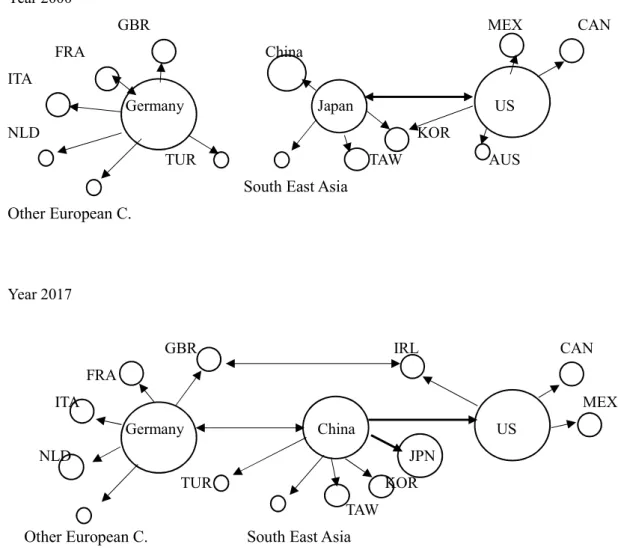
In particular, from 2000 to the present, the production of value added in China has increased remarkably. During this period, the abundant labor force, the vigorous domestic demand, and high level of investment in China accelerated the expansion of its production capacity. China, receiving the favorable condition to freely access the world market under the free trade system of WTO, became the world’s factory. This is shown by the change in the structure of the GVC from 2000 to 2017. Xin Li et al. (2019) show that, based on the amount of TVA, the GVCs in the world are composed of three clusters: Europe, East Asia, and North America, and that the countries and regions that make up these clusters have changed between 2000 and 20174. As Figure 3 shows, in 2000, the European cluster had Germany as its hub, with links to the UK, France, Italy, Spain, Turkey, the Netherlands, the Czech Republic, and so on. In East Asia, the cluster had Japan as the hub, with links to China, Taiwan, South Korea, and the ASEAN countries. In North America, the cluster was formed with the US as the hub with links to Canada and Mexico. In 2017, no significant changes were seen to the hubs and the countries linked to them in the European and North American clusters, but China had replaced Japan as the GVC hub in East Asia and has shown to have links with the European and North American clusters as well. Along with expanding to become the hub of the East Asian cluster, China has expanded the supply of its value added to the North American and European clusters.
Figure 3.
The supply chain linked between China and many countries worldwide have expanded, and the proportion of value added generated in China to total value added of the world has increased. This is particularly striking in electronic devices and textiles industries. The world
3 Refer to Richard Baldwin and Eiichi Tomiura (2020).
4 Refer to Xin, Li, Bo Meng, and Zhi Wang (2019).
4
economy rapidly raised its economic dependency on Chinese market. The expansion and the recent change of the GVC is an essential factor to understand why the global economy has been so seriously affected by today’s spread of coronavirus.
3. Effect of Coronavirus Pandemic on Global Supply Chain 3.1 Diversification of the GVC
The collapse of global trade caused by the coronavirus can be argued from the contraction of trade caused by the rapid transmission of economic shocks under the global supply chain. The suspension of manufacturers in Wuhan and other areas of China suffering from the novel coronavirus in January 2020, affected seriously both the suppliers in the backward and the users in the forward which were involved to the GVC with China as a hub. It reduced the production of manufacturing companies in the US, Europe, and East Asia. For twenty years suppliers and assemblers in the world have expanded their production network linked to the GVC with China as a hub and raised their dependency on Chinese market. Of course, such an increase in the dependence on Chinese GVC was rational. Companies all over the world have evaluated the advantage of Chinese economy due to its abundant labor force, large market size, and economy of scale due to the agglomeration. China committed to reform its economy to a market- oriented one in the accession to WTO. In addition to the factors, the reductions in communication and transportation cost enabled foreign firms outside China to choose Chinese market as the optimal location for production network. Deep involvement of manufacturers in the world to the GVC led to the serious damages on the world trade and economy
As Table 1, based on a survey jointly conducted by the author and the Bank of Yokohama Research Institute in 2003, shows that many of the surveyed 1,500 Japanese firms responded their expectation to maintain or further expand operations in China within the next 5 years. It could reasonably be concluded that the current form of the GVC with China as a hub represents an optimal choice for Japanese firm’s offshoring.
Table 1
It is noted that the survey also reported that more than half of the surveyed firms viewed ASEAN countries as potential alternative to replace for the Chinese market. They expressed the intention to avoid the risk caused by the concentrated location. It is certain that the replacement of production location from China to other countries and regions will be accompanied by additional costs of remote transportation and information exchange. Such a rise of production and trade costs for cultivating the global supply chain might have prevented Japanese firms from diversifying the production location.
5
Nevertheless, it is well known that when firms in one country or region suffer from the natural disaster and are obliged to suspend production, or when the production of firms in one country or region is damaged by the contagion of economic shocks of other countries, the diversification of trade partners to the countries which do not suffer from the disaster or the contagion of economic shocks will reduce the risk of concentration and fasten the recovery of the suffering firms. Accumulated disaster experiences at the Great Hanshin-Awaji Earthquake, the Niigata Chuetsu Earthquake, and the Great East Japan Earthquake in Japan provide evidence that the firms linked to the widely spread supply chains recovered faster than firms without such a supply chain.
If the deficit caused by the breakdown of the GVC due to the coronavirus is greater than the costs of diversifying the GVC, the coronavirus disaster will become a big push to change the GVC concentrated in China and to diversify the GVC to other countries and regions. As Javorcik (2020) asserts, even small countries and regions that have so far not participated in the GVC may gain an opportunity to enter, replacing those countries and regions that have participated up until now. The coronavirus disaster may reform the GVC in the world5.
3.2 Innovation and Reverse Globalization
The collapse of global trade caused by the coronavirus also can be argued from the direct effect of the coronavirus infection on the suspension of production and consumption in infected countries and regions. Now almost all countries in the world have been infected by COVID-19. There is no way but the strict suppression of human contact, so as to control the spread of infection and guard people’s health. It can be said that the infection risk is almost equivalent in every country and region of the world, then decentralizing the GVC does not necessarily disperse risk. Furthermore, it must be taken into account that the diversification of GVC may incorporate new and unknown risks into the GVC.
The effects of coronavirus infection are different from those caused by other natural disasters, in that the infection risk prevents people from taking part in production and trade related activities. While the spread of the disease will hopefully be controlled quickly by the development of a treatment or vaccine, economic activity cannot be restored until this occurs or until a new way to produce and consume goods and services without interactions between people can be found. This hazardous situation provides an opportunity to produce new innovations in production and trade.
In order to avoid a contact between people which holds infection risks, a transition from
5 Javorcik (2020) anticipates that small countries in Europe which were not linked to the GVC before the coronavirus pandemics may have an opportunity to enter the GVC in Europe.
6
face-to-face to remote communication has begun for a wide range of activities such as business, education, health care, and so on. Robots have also been introduced to perform production activities and provide interpersonal services, stimulating advances in automation. The necessity to maintain economic activity, while protecting our physical selves from the novel coronavirus, accelerates innovative activity that generates technology to combine human resources and capital goods (machines). Such an innovation will reduce the relatively high risk associated with the use of human resources and eventually will bring changes to the GVC.
If the threat of the novel coronavirus creates a big push on innovation towards minimizing the use of labor and accomplishes rapid advances in substitutes by capital goods, it will be less necessary to disperse production location globally for seeking the rich labor force. In the case, the need for the international division of production processes which is undertaken to access to abundant labor, will be reduced. A reverse globalization of production processes will occur. Technological innovation leads to the expansion of production process with high productivity, while production processes with low productivity cannot but exit from the market.
As a result, the GVC will become more concentrated, and the reverse globalization including a return to domestic production will be regarded.
Although the decentralization and concentration of the GVC may look contradictory, this is not the case. If the distribution of GVC production matches the geographical risk of infectious disease, the decentralization of the GVC is an effective countermeasure for avoiding risk. Of course, as the decentralization of the supply chain is accompanied by additional costs for production, transportation and communication, the diversification of production locations may be limited in some extent. On the other hand, the decentralization will not be effective to adverse the risk if a pandemic covers the entire world. In order to mitigate the economy to the disastrous pandemic of COOVID-19, innovation of new production, transportation and communication technology for supplying goods and services with less human contact is indispensable, instead of the dispersion of production location. Signs of new combinations between human resources and machines can already being found in advanced countries, such as increases in remote work and automation. Innovation in production methods and processes may consolidate the GVC, which has expanded up until now for utilizing the abundant labor force.
4. Discussion of Policy Aspect
Optimal trade policies are requested to mitigate the serious problems caused by the spread of the novel coronavirus. First, one necessary policy goal in every country and region is the disclosure of information related to the outbreak and infectiousness of diseases and medical care systems with high transparency. This would make it possible for firms participating in the GVC to adjust their decision making to infectious disease risks in each country or region. It has
7
been pointed out that if information about the spread of the novel coronavirus, which originated in China, had been swiftly shared with the international community, then the disease may have been contained without the serious degree of international spread that we see today. Despite past experiences with new types of influenza and SARS, in the beginning stage of infection the World Health Organization (WHO) did not function adequately to internationally supply the necessary information and warn to the world. Supply of the information with regard to spreading infection is essential for firms participating in the GVC to select the best choice for their production location in the world and minimize economic damages due to infectious disasters.
Secondly, trade policies in all countries are required to be consistent with the rules under the WTO and avoid the exclusive principle of own nation first. The function of WTO, in particular the function of dispute settlement, must be strengthen. The development of the GVC through clusters in Europe, East Asia, and North America indicates that geographical proximity is important to expand the trade. Regional trade agreements, which must be consistent with the WTO rules, are also expected to enhance free trade beyond the WTO rules. According to the WTO secretariat, in April 2020, because of the spread of the novel coronavirus, export restriction measures were undertaken on more than 250 items of medical materials and sanitary supplies including masks, protective clothing, and gloves6. For national security or health reasons, temporary trade restrictions are allowed as an exceptional case, but the enforcement of these must be minimized.
The approval of trade restrictions does not seem to assume the situation in which today’s spread of an infection virus creates a continuous contagion of economic collapse via international trade. The medical materials for which the demand suddenly increased because of the infection of COVID-19 are different in factor intensity of production: labor intensive goods such as masks and protective clothing and the knowledge intensive goods such as ventilators and ECMOs. The international division of labor and the exchange of products, according to the comparative advantage, is the key to expand the supply size of goods in the world. Furthermore, medical materials to guard the health from the coronavirus infection can be thought as international public goods. If a country restricts the export of them in order to fill its own domestic demand of them, it leads to shortages in its trade partners and raises the difficulty of the trade partners to prevent the spread of infectious disease. This eventually would bring about further international spread of the disease, in turn damaging the exporting country as a result. Policies that pursue the own interests of the country are not optimal policies for the country in the next time.
The government interventions such as government subsidies to nationalized companies in China, and the introduction of retaliatory tariffs in the United States and China should be eliminated, as they cause distortions and biasedness in international trade. The government fund
6 See WTO Secretariat (2020).
8
in Japan to support the increase of supply capacity in home market may have a trade distortive effect if it intends to change the production location from foreign market to domestic market.
What is needed is not a policy to stimulate the reverse globalization of production, but a policy to encourage new innovations to optimize the combination between labor force and capital goods and to lead to automation. The result of such policies will make the GVC more productive and may accelerate the return of production processes overseas to the domestic market.
Finally, it must be argued what degree of the intellectual property rights protection is given to the discoverers of vaccines and other pharmaceutical products. It appears that vaccines and remedies for the novel coronavirus will be discovered and ultimately supplied. However, it is not easy to supply a sufficient volume of medical supplies at a reasonable price simultaneously to every country and region in the world. Regarding medical and pharmaceutical products, how strongly the discoverers and manufacturers are given the protection of intellectual property rights with the provision of such products to consumers in low-income countries has been a major research subject for a long time. Now, the novel coronavirus presents this problem again at a previously unseen scale due to a plenty number of patients distributed in both high and low- income countries. Furthermore, as vaccines and medicines control the spread of coronavirus, they are classified into the international public goods. It is therefore necessary to examine, from the aspect of international cooperation, how strongly the intellectual property rights of the discoverers of such medical and pharmaceutical products in high income countries should be protected, while ensuring the supply of such products to consumers in low-income countries.
9
References
Baldwin, Richard and Eiichi Tomiura (2020), “Thinking ahead about the trade impact of COVID-19,” in Richard Baldwin and Beatrice Weder di Mauro (eds), Economics in the Time of COVID-19, A VoxEU.org Book, CEPR Press.
Baldwin, Richard and Lopez-Gonzalez (2015), “Supply-chain Trade: A Portrait of Global Patterns and Several Testable Hypotheses,” The World Economy, vol.38, No.11.
Javorcik, Beata (2020), “Global supply chain will not be the same in the post-COVID-19 world,” pp111-116, in Richard Baldwin and Simon J. Evenett (eds), COVID-19 and Trade Policy: Why Turning Inward Won’t Work, A CEPR Press VoxEU.org eBook.
IMF, World Economic Outlook Update, June 2020.
Li, Xin, Bo Meng, and Zhi Wang (2019), “Recent patterns of global production and GVC participation,” in WTO Global Value Chain Development Report 2019, Technical Innovation, Supply Chain Trade, and Workers in a Globalized World, Chapter 1.
Seric, Adnan, and Deborah Winkler, 2020, “COVID-19 could spur automation and reverse globalization-to some extent,” VOX CEPR Policy Portal.
WTO Secretariat (2020), Export Prohibitions and Restrictions: Information Note, April 23, 2020.
WTO, Trade set to plunge as COVID-19 pandemic upends global economy, 8 April 2020.
Wakasugi, Ryuhei (2020), “Beyond the Crisis of COVID-19: A Rise of Productivity due to the Concentration of GVC,” Nikkei Keizai-kyoshitsu, June 3rd, 2020.
10
Figure 1. Increase of World Trade and Growth of World Economy
(Source) The number of passengers until 2014 is cited from International Civil Aviation
Organization (ICAO)、after 2015 is from IATA. World GDP and trade in goods and services are cited from UNCTAD stat.
11 Figure 2. World Economy and Trade after COVID-19
(Source)IMF, World Economic Outlook Update, June 2020.
WTO, Trade set to plunge as COVID-19 pandemic upends global economy, 8 April 2020.
12
Figure 3. Changes of Supply Chain Network (in value added)
Year 2000
GBR MEX CAN FRA China
ITA
Germany Japan US NLD KOR
TUR TAW AUS South East Asia
Other European C.
Year 2017
GBR IRL CAN FRA
ITA MEX Germany China US
NLD JPN TUR KOR
TAW Other European C. South East Asia
(Source)Xin Li, Bo Meng, and Zhi Wang (2019), “Recent patterns of global production and GVC participation”, WTO Global Value Chain Development Report 2019, Technical Innovation, Supply Chain Trade, and Workers in a Globalized World , Chapter 1, p27, Figure 25
13
Table 1 Diversification of Production Location Overseas of Japanese Firms