The effects of foreign direct investment on regional growth and productivity
著者(英) Jaegon Park
journal or
publication title
AGI Working Paper Series
volume 2018‑11
page range 1‑21
year 2018‑11
URL http://id.nii.ac.jp/1270/00000149/
Creative Commons : 表示 ‑ 非営利 ‑ 改変禁止 http://creativecommons.org/licenses/by‑nc‑nd/3.0/deed.ja
Asian Growth Research Institute
The effects of foreign direct investment on regional growth and productivity
Jaegon Park
Senior Research Fellow
Korea Institute for Industrial Economics and Trade
Working Paper Series Vol. 2018-11 November 2018
The views expressed in this publication are those of the author(s) and do not necessarily reflect those of the Institute.
No part of this article may be used reproduced in any manner whatsoever without written permission except in the case of brief quotations embodied in articles and reviews. For information, please write to the Institute.
The effects of foreign direct investment on regional growth and productivity
1Jaegon Park Senior Research Fellow
Korea Institute for Industrial Economics and Trade
November 2018
Abstract
To promote regional economic growth in the current global environment, nations have begun methodically combining internal assets with external capabilities. Against this backdrop, this paper demonstrates how foreign direct investment (FDI) — a major channel for participating in the global production network — influences regional economic development. Its key findings are as follows: 1) Korea has reached the stage where outbound overseas investments outpace inbound FDI, 2) FDI in Korea is heavily concentrated in a handful of regions and in particular the Seoul capital region, 3) inbound FDI has a statistically significant positive impact on regional growth and productivity and 4) outbound foreign investment weighs negatively on regional growth and productivity. The paper concludes by arguing the necessity of utilizing a global perspective in regional policymaking.
KEYWORDS: GLOBAL PRODUCTION NETWORK, FOREIGN DIRECT INVESTMENT, GROWTH AND PRODUCTIVITY, REGIONAL POLICY
JEL classification codes: C33, D24, R11, R58
1 This study comprises a revision to and expansion of existing research by Park et al. (2016).
- 1 -
Ⅰ. Introduction
Korea has taken comprehensive measures to improve the economic performance of its provincial regions. Many of these initiatives have taken the form of policy efforts to enhance competitiveness, pursue economic specialization, and support balanced regional development.
Such provincial development policies often encourage investment in predetermined industries or sectors, where certain regions have been determined to possess some measure of competitive advantage. In addition, some policies funnel public investment to underdeveloped areas to fulfill national balanced-growth directives. Yet some have argued that these measures are too parochial, obsessing over the minutiae of the local economy and failing to effectively incorporate global perspectives.
The Korean economy is an open economy with high levels of imports and exports, making it particularly sensitive to fluctuations in the global trading volumes. Following the outset of the 21st century, global trade and foreign investment levels mushroomed worldwide as costs plummeted. The drop in the price of doing business internationally is partially thanks to the development of revolutionary new technologies in the transportation and communications sectors that slashed shipping costs and curtailed unforeseen expenditure. Against this backdrop of flourishing global trade, several nations signed free trade agreements that institutionalized trading relationships. Many of them are mediated by the World Trade Organization, itself established when the modern global trading regime was still in its infancy.
As the global trade environment as we understand it was being established, global production bases shifted and disseminated. As trade and investment are inextricably linked, one common feature has emerged that is essential to understanding both: the behavior of multinational corporations. These actors wield no small measure of influence over the global economy;
according to Dicken (2015), 70,000 multinationals directly control over 700,000 overseas subsidiaries. This is a reflection of how complex and segmented multinationals’ global production networks have become.
With this in mind, it is not difficult to conceive the role that regional economies play in the global economy, and through the concepts of the global value chain (GVC) and global production network (GPN) it is both possible and fruitful to analyze regional economic performance from a
- 2 - global perspective.
The two conceptual frameworks share broad similarities, but differ in two fundamental ways.
The GVC is above all a concept that describes trade and trading relationships, whereas the GPN is focused on investment. Yet both are essentially just two different approaches to breaking down the processes of globalization, by identifying areas where production and innovation functions can be performed more efficiently and describing the integrated management systems built by multinational companies.
The global value chain refers to activities in which the production, distribution, and consumption of goods and services is globally dispersed.2 So the GPN can be simply understood as a set of interrelated functions that enable multi-scalar production, distribution and consumption (Henderson et al., 2002).
The GPN also provides a framework through which particular regions’ growth and development patterns can be gainfully analyzed, and can explain the both preference for particular areas and the localization of certain production activities in specific regions. Through this lens, regional economic development can be seen as a strategic integration of internal resources and capabilities and global production networks outside the region.
In addition, depending on whether or not local growth patterns emphasize internal factors or external factors, it is possible to distinguish between endogenous development and exogenous development. Exogenous development can be defined as regional growth that depends on extrinsic resources, focusing on the investments of external companies as well as public investment from the central government. This approach is not without its criticisms, however. It has been argued that an overreliance on large outside firms leads to the neglect of local businesses, in particular small- and medium-sized enterprises (SMEs), and that negligence can cause wealth to leak to other regions. These criticisms revolve around a common thread:
exogenous development often fails to see growth from a regional perspective.
In contrast, endogenous development constitutes an approach wherein a region’s internal assets and resources are mobilized to the greatest possible degree for the purpose of securing local growth. It emphasizes local entrepreneurship, support for SMEs, regional innovations and learning networks. The model has been lauded for respecting local capabilities, resources and communities, but has been criticized on the grounds that it is difficult to find growth momentum
2 As defined by Duke University’s Global Value Chains Initiative(http://www.globalvaluechains.org).
- 3 -
when local resources are scarce. And it has been pointed out that cultivating players that compete on the global stage using only internal resources is difficult.
Given the limitations of these two models if employed exclusively, and that regional development is a multi-faceted, multi-layered process, it follows that growth is best effected when external and internal growth factors harmonize. Moreover, in the globalized economic environment, external links are often just as important as internal factors in regional development.
Global production network theory emphasizes dynamic interactions between regional growth factors and global growth factors, as described in Coe et al. (2004) and Henderson et al.
(2002). Coe et al. (2004) called this marriage of regional assets with global resources “strategic coupling.” Yeung (2015) explained regional development by describing the dynamic interactions that result when local growth factors (resources, latent potential, and other assets) meet the strategic needs of multinational companies.
This study seeks to analyze regional development using the GPN as a conceptual framework.
This includes an analysis of the effects of FDI on regional growth and productivity and an explanation of the implications carried by the analysis’ results. Section II focuses on the status and trends of inbound FDI in Korea, while Section III comprises an analysis on the economic effects of foreign direct investment. The final section concludes the study with a summary of analytical results and the implications they carry for public policy.
Ⅱ. Analysis of current trends in FDI
1. Global production networks as an analytical framework
The global value chain refers to a value chain that is formed globally as multinational companies produce their products overseas. As production activities began globalizing in earnest in the late 1990s, GVC had fully emerged as a conceptual framework to analyze them in the early 2000s. It was at this time that the term global value chain, coined by Gereffi and Korzeniewicz (1994), entered the lexicon of economics. In the GVC, both public and private entities can ensure production occurs in the most favorable locations. This specialization of the production process leverages comparative advantage, increasing productivity and generating
- 4 -
higher profits. This understanding of comparative advantage is supported both by classical trade theory and Krugman’s (1980) new trade theory.
The global production network provides a conceptual framework for analyzing economic growth and development in specific regions. And while the relationship between FDI and regional development has long been studied, a rigorous analysis centering on the role of multinationals’ subsidiaries — how they come into being, how they evolve, and their effects on regional economies — is lacking.
The global production network theory of Henderson et al. (2002) sought to analyze economic activity from a multidimensional and multi-scalar perspective. Coe et al. (2004) described how global production network theory stresses the importance of strategic coupling of external and internal factors in its criticism of New Regionalism and endogenous growth theory, which in contrast emphasizes local assets and internal factors.
The proper combination of internal and external factors is important for the growth of a regional economy. They constitute the source of regional development, and it appears as though it is when these factors are wed that economic growth occurs. In the current global economic climate, businesses tend to compartmentalize their production processes and deploy their segmented activities in the most cost-effective locations in the world.
Segmentation takes place sequentially according to the value-creation process, eventually coming to form a network. This network allows multinationals to concentrate resources on core competencies and utilize global procurement (including contracting) to outsource other production activities. Both the GVC and GPN models concern themselves with this phenomenon, a salient difference being the actors upon which the models focus their analyses. The GVC is mostly limited to transactions between businesses, but the GPN broadens its scope beyond private enterprises to include labor, state actors, and other economic players, in addition to non- economic issues such governance and institutional matters.
2. Literature survey
Dunning (2003) described the close relationship between national competitiveness and FDI in his competitive advantage “diamond” model. In the model, FDI was added to four other elements previously acknowledged as contributors to national competitiveness (factor, demand,
- 5 -
corporate strategy, and related/supporting industries). The OECD (2002) had argued that FDI was not merely the movement of capital between nations but rather an essential lubricant in the healthy functioning of an open and efficient economic system, functioning as a basic facilitator of economic development. From this point of view, FDI represents not only the inflow of capital but the accumulation of advanced technologies, knowhow and management experience, thereby powerfully demonstrating a positive diffusion effect. The OECD (2002) further postulates that the FDI recipient nations benefit from capital formation, job creation, technological expansion and productivity growth via knowledge transfers, enhanced competitiveness and increased trade.
Yet the extant literature yields a diversity of arguments, some of them conflicting. Among those who found FDI exerted positive effects, Blomström and Kokko (1998) argued that FDI had a net positive effect on productivity improvement. Rodriguez-Clare (1996) found that foreign investment had a positive effect on industrial linkages, and Glass and Saggi (1999) proposed that multinational companies wield their market power to increase exports. Writing later, Swenson (2007) demonstrated the diffusion of knowledge and technology held by multinationals boosts exports for trading partners, though earlier Rodriguez-Clare (1996) and Aitken and Harrison (1999) pointed out that large multinationals could force domestic firms to withdraw from certain markets upon entry, significantly affecting their viability. Yet the results of a survey conducted by Moon and Jeong (2010) indicated that the positive effects of FDI outweighed the negatives.
Kim (2013) conducted a previous study focusing on the effects of foreign investment on regional growth in provincial areas, and Kim (2010) performed research on FDI’s effects on regional productivity. Kim's 2013 study analyzed the effects of FDI on regional economic growth in the province of Gyeongnam in southeastern Korea, which includes the large and municipally independent port cities of Ulsan and Busan. Employing the Cobb-Douglas production function for a panel model analysis, Kim (2013) found inbound FDI had a net positive effect on both economic growth and fixed capital formation. Furthermore, according to the study, FDI demonstrated positive effects not only on economic growth, but on employment and exports as well.
Kim (2010) analyzed the effects of FDI on value added and total factor productivity using panel data collected from 10 industries from 1988 to 2006. The results of the research suggest
- 6 -
that FDI increases both value-added and total factor productivity, but the study also reported that while backward FDI buttressed both total factor productivity and value added, forward FDI had a depressing effect on total factor productivity.
3. Analysis of FDI by region
FDI in Korea began to grow rapidly following the foreign exchange crisis of the late 1990s, as the government sought to attract foreign capital to overcome the exigency, but inbound investments are now outpaced by outbound flows. Inflows grew to around 10 billion USD annually in the wake of the Asian financial crisis and have remained steady ever since, whereas outflows reached 20 billion USD in 2007 and surpassed 30 billion USD in 2014. Net outflows have not fallen below 20 billion USD since 2010, and net inflows have in fact been negative since 2008, as seen in Figure 1.
Figure 1. FDI trends in Korea
SOURCE: UNCTAD, UNCTADSTAT (HTTP://UNCTADSTAT.UNCTAD.ORG).
According to Investment Development Path Theory, as one country’s economy grows, so does foreign investment by companies. The theory posits that until the third stage, outbound FDI is less than inbound FDI, but that by the fourth stage outward FDI overtakes inward FDI (Dunning and Narula, 1996).
With inward investment now soundly eclipsed by outbound investment, it would appear as though Korea has now formally entered the fourth stage of its investment development path.
- 7 -
Furthermore, with FDI showing incremental but steady growth, and outbound investment flows increasing rapidly, it can be argued that both the country’s locational and corporate competitiveness are improving.
Inbound foreign direct investment has averaged 11.1 billion USD over the previous five years, recording a figure of 12.1 billion USD in 2014 but jumping to 16.4 billion USD by 2015, demonstrating a clear upward trajectory. The capital city of Seoul received the lion’s share of these funds, with an average intake of 5.2 billion USD annually since 2013. The metropolitan area surrounding the capital was the beneficiary of a 1.2 billion USD average yearly injection; Incheon was the subject of an average 1.1 billion USD of FDI for the same period. In the country’s regional areas, the industrial city of Ulsan and the province of North Gyeongsang both reported 900 million USD in average FDI over the last five years, the highest among all areas outside the capital region.
Looking at regional FDI performance reveals the extent to which the greater metropolitan area including the capital absorbs most inbound investment: the region accounted for over 70 percent of all FDI inflows from 2001 to 2014. Seoul itself took in 52.7 percent of all foreign investment, with its suburbs and surrounding environs absorbing 12.9 percent of FDI; Incheon was the beneficiary of 7.7 percent of foreign investors’ dollars. In the provinces, South Chungcheong, North Gyeongsang and North Chungcheong accounted for 6.2, 4.6, and 3.4 percent of inbound investment, respectively (see Figure 2).
Figure 2. FDI by region, 2001-2014
SOURCE: KOREAN MINISTRY OF TRADE, INDUSTRY AND ENERGY (HTTP://WWW.MOTIE.GO.KR).
- 8 -
Examining the ratio of FDI to regional GDP by city, Seoul and Incheon exhibit the highest ratios, with rates of 1.8 and 1.2 percent, respectively. In North Chungcheong and South Chungcheong provinces, the ratio is 0.9 percent, similar to the national average.
However, regional FDI performance can be assessed on a relative basis that takes into account the size of regional economies. The method that does so is called the Inward Performance Index (IPI), and it is calculated in the same manner as the location coefficient:
. , / ∑
1,) / (, / ∑
1,)
A region with an IPI value greater than one (1) is performing better than the national average.
Looking at IPI scores for Korea, Seoul and Incheon boast superior performance in the index, with figures of 2.2 and 1.5, respectively. North Chungcheong and South Chungcheong province also rate favorably by this measure. IPI ratios for other regions are shown below in Figure 3.
Figure 3. Regional FDI ratio and IPI scores
SOURCE: KOREAN MINISTRY OF TRADE, INDUSTRY AND ENERGY AND STATISTICS KOREA.
- 9 -
Ⅲ. Results of the empirical analysis
This section comprises an analysis of FDI’s effects on regional economic growth and productivity. First, regional growth is measured by the value added that it produces. A regional economy’s value added consists of labor and capital, but other FDI-influenced effects contributing to the growth of regional value added are considered as well. Following the calculation of regional value added, regional productivity is assessed by calculating total factor productivity. Total factor productivity is obtained residually, by subtracting the contributions of labor and capital from value added in the production function.
1. The effects of FDI on regional economic growth
This section analyzes the effects of FDI on regional economic growth using the Cobb-Douglas production function. Following Kim (2013) and Kim (2010), this analysis adds R&D investment, FDI and overseas investment in addition to labor and capital as explanatory variables in the following formula:
Y,= + ,+ ,+ , + ,+ ,+ .
Whereas, represents value added, refers to labor and stands for capital. R&D is represented by , inbound FDI by and outbound investments by . The subordinate variable i refers to the region. In order to analyze regional economies and FDI at the regional level, sets of panel data were built by variable for 16 different regions covering a 19-year period from 1995-2014.
Regional value added is pulled from regional gross domestic product (GRDP) data and the total number of employed figure from Statistics Korea’s National Business Survey at Establishments is used to represent the labor variable in the equation. Capital was estimated using the permanent inventory method with regional fixed capital formation data provided by Statistics Korea, to which
- 10 -
a 7 percent depreciation was applied.3 Regional FDI and overseas investment data were provided by the Ministry of Trade, Industry and Energy and the Export-Import Bank of Korea, respectively.
Considering that investment can result in cumulative effects, this analysis utilizes stock data, rather than highly-variable flow data. And in addition to FDI, the effects of R&D investment on regional value added are included as a control variable, using the figure for total regional investment as determined by the Ministry of Education, Science and Technology through its Survey of Research and Development in Korea. All figures were converted to real data by using a GDP deflator and obtaining logarithmic values. The analytical method employs panel cointegration relationships and assumes the establishment of a long-term equilibrium between FDI and regional value added; this study seeks to verify that relationship. If a stable relationship is found to exist, then a cointegration regression analysis can be performed.
Cointegration relationships are relationships in which individual variables have unit roots and non-stationary time series, but wherein linear combinations of them have a lower order of integration, thus establishing long-term equilibrium. This means that even as unstable time series are likely to produce spurious regression, if long-term equilibrium is established, then the estimated coefficients of a spurious progression have economic meaning without the additional manipulation of time series data that can lead to information loss. To do this, a panel root test on the employed variables must be performed first, before determining the existence of a long term equilibrium among the variables using the cointegration test. Finally, the effects of FDI on regional economic growth can be measured by performing a cointegration regression.
The method for testing panel unit roots was employed by Levin-Lin-Chu (LLC, 2002), Im-Pesaran- Shin (IPS, 2003), ADF-Fisher and PP-Fisher (Maddala-Wu, 1999) and Choi (2001) among others (Park and Byeon, 2012). Among these, LLC (2002) assumes that all data have a common unit root process, whereas in IPS (2003), ADF-Fisher and PP-Fisher (Maddala-Wu, 1999), all data has its own unit root process. In the latter, this means that the autocorrelation structure allows for differences in each piece of data. For this study, a panel unit root test using key variables such as GRDP, outbound investment and FDI was conducted. Most of test results could not reject the null hypothesis that there are unit roots.4
3 The 7 percent depreciation hypothesis follows Kim (2010).
4 Some analyses do not support the existence of unit roots in the case of FDI. However using a different sample period (from 2000 to 2014), tests conducted by LLC, IPS, ADF, and PP resulted in P values of 0.224, 0.875, 0.692 and 0.803,
- 11 -
Table 1. Panel Unit Root test results LLC
t-stat
IPS W-stat
ADF-Fisher
-stat
PP-Fisher
-stat
GRDP -4.133
(0.000)
2.454 (0.993)
25.016 (0.805)
88.876 (0.000)
Capital -5.137
(0.000)
-1.723 (0.042)
43.587 (0.083)
486.256 (0.000)
Labor 5.371
(1.000)
8.177 (1.000)
2.734 (1.000)
1.567 (1.000)
R&D expenditure 1.562 (0.941)
4.372 (1.000)
5.966 (1.000)
13.681 (0.998)
Inbound FDI -11.557
(0.000)
-9.242 (0.000)
169.510 (0.000)
195.024 (0.000)
Outbound FDI -1.750
(0.040)
1.184 (0.882)
24.927 (0.809)
46.026 (0.052)
NOTE: FIGURES IN PARENTHESES REPRESENT P VALUES. GRDP, CAPITAL, AND LABOR FIGURES FROM 16 REGIONS AND CITIES PROVIDED BY STATISTICS KOREA. AGGREGATE DATA ON FDI AND OUTBOUND FOREIGN INVESTMENT WAS PROVIDED BY THE KOREAN MINISTRY OF TRADE, INDUSTRY AND ENERGY AND THE KOREAN EXPORT-IMPORT BANK, RESPECTIVELY.
The following comprises a panel cointegration test between GRDP and the variables of labor, capital, and investment. There are various methods by which a cointegration test of panel data might be conducted, including those used in Pedroni (1999, 2004), Kao (1999) and Johansen (Maddala- Wu, 1999). For this study, the test as performed by Pedroni (1999, 2004) is used. A principal advantage of the Pedroni test is that it allows for heterogeneity between cross-section groups, providing two types of panel cointegration test statistics: within dimension and between- dimension.5
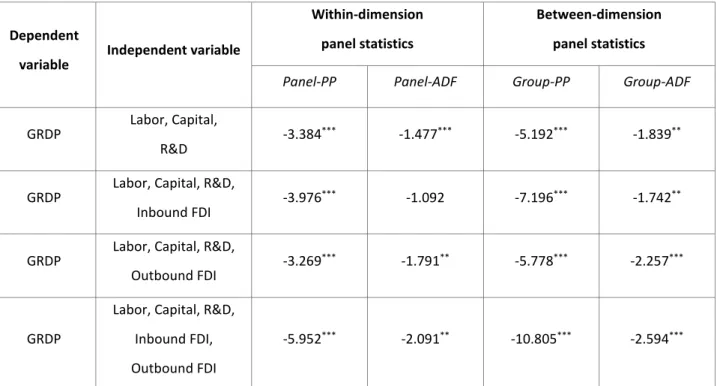
The results of the cointegration test between GRDP and other variables such as labor, capital, R&D spending, inbound FDI and outbound investment variables reject the null hypothesis and support to
respectively, failing to reject the null hypothesis implicating the existence of unit roots.
5 For more information in the Pedroni panel cointegration test, see Park and Byeon (2012), pp. 26-31.
- 12 -
the existence of a stable, long-term relationship between regional value added, and FDI and outbound foreign investment. These results indicate that it is econometrically reasonable to examine the relationship between variables using regression coefficients estimated with a panel conintegration regression.
Table 2. Results of a panel cointegration test on the relationship between value added and other variables
Dependent
variable Independent variable
Within-dimension panel statistics
Between-dimension panel statistics
Panel-PP Panel-ADF Group-PP Group-ADF
GRDP Labor, Capital,
R&D -3.384*** -1.477*** -5.192*** -1.839**
GRDP Labor, Capital, R&D,
Inbound FDI -3.976*** -1.092 -7.196*** -1.742**
GRDP Labor, Capital, R&D,
Outbound FDI -3.269*** -1.791** -5.778*** -2.257***
GRDP
Labor, Capital, R&D, Inbound FDI, Outbound FDI
-5.952*** -2.091** -10.805*** -2.594***
NOTE:*,**,*** REPRESENT LEVELS OF 10%,5% AND 1% SIGNIFICANCE, RESPECTIVELY.
Here, the relationship between regional economies and FDI is examined through a panel cointegration regression estimation. The estimates of the regression are then taken using the panel FMOLS (Fully-Modified OLS) technique, which takes into account heterogeneity between cross sections. First, a basic model with a reference variable comprising the labor, capital, and R&D investment variables was estimated. Then the degrees of change and significance levels of the estimates were analyzed, using the extended model including changes in FDI and outbound foreign investment.
In the model (estimation equation 2) estimated with the reference variable and foreign direct investment, FDI was shown to have a positive effect on economic growth. To wit, a 1 percent rise in inbound investment resulted in GRDP growth of 0.09 percent. On the other hand, when the
- 13 -
estimation is made for outbound investment flows (estimation equation 3), regional value-added dips. Specifically, a 1 percent increase in outbound investment was shown to reduce regional value added by 0.05 percent, demonstrating what appears to a negative influence on regional economic growth. This trend holds when the estimation includes both inbound FDI and outbound overseas investment (estimation equation 4): a 1 percent increase in FDI produces a 0.09 percent increase in regional value-added while a 1 percent increase in outbound foreign investment leads to a 0.05 percent decrease of that same indicator.
These results imply that first and foremost, it is necessary to attract FDI in addition to expanding labor and capital for regional economic growth to take root. However the results also appear to suggest that outbound overseas investment has a negative impact on regional economic growth. It is possible to conclude based on this evidence that outward investment flows are related to the loss of regional growth drivers, yet as previous research has pointed out, the domestic economic effects of overseas investment may vary depending on its strategic purposes and the country in which it is made. Given this it is clear that a more detailed approach is required.
Table 3. The relationship between regional economies and FDI
Explanatory variable
Dependent variable: GRDP
Estimation Equation 1
Estimation Equation 2
Estimation Equation 3
Estimation Equation 4
Labor
0.526*** 0.731*** 0.642*** 0.744***
(20.10) (43.44) (38.24) (43.37)
Capital
0.280*** 0.160*** 0.268*** 0.186***
(25.73) (13.95) (23.41) (14.19)
R&D expenditure
0.069*** 0.073*** 0.089*** 0.075***
(3.23) (3.12) (4.01) (3.17)
Inbound FDI -
0.091***
-
0.093***
(6.29) (6.30)
Outbound FDI - -
-0.046*** -0.051***
(-3.59) (-4.63)
NOTE:*,**,*** REPRESENT LEVELS OF 10%,5% AND 1% SIGNIFICANCE, RESPECTIVELY. FIGURES IN PARENTHESES REPRESENT T-VALUES.
- 14 - 2. The effects of FDI on regional productivity
The impact of FDI on regional productivity is measured by Total Factor Productivity (TFP).
Similar to the estimation as performed in the previous section, the analytical model used here employs the Cobb-Douglas production function in addition to an endogenous growth model that accounts for intermediate goods. , , and represent value added, capital and labor, respectively. refers to the constant, while stands for intermediate goods. The subordinate i represents the region.
. = ... .
The following expression is produced when the logarithmic value of the above equation is expressed in terms of TFP:
log. = log,− αlog, − 1 − log, = log,+ log,
It can be assumed that total factor productivity is affected by constants, , and variables represented by intermediate goods, , Bearing this in mind, it is possible for FDI, outbound foreign investment and R&D spending to affect productivity through these variables’ influence on the quantity and quality of intermediate goods.6 Making these assumptions, total factor productivity can thus be expressed as a function of FDI, overseas investment, and domestic R&D expenditure, as shown below.
log, = + log,+ log,+ log,+ ,
The data for this analysis is the same panel data from 1995 to 2014 covering 16 different
6 See Kim (2010) for a more detailed explanation of the model. In that work, Kim expands on Grossman and Helpman's theory (1994), which hypothesized that the quantity and/or quality of intermediate goods is reliant on R&D investment, and additionally estimated that FDI and outbound overseas investment function as variables affecting intermediate goods.
- 15 -
cities and regions. However to estimate total factor productivity using a growth accounting method, it is necessary to incorporate the ratio of labor compensation (1 − α). This factor may be re-estimated using the data, but it is also possible to employ the constant as determined in the previous literature. This study assigns it value of 0.65, following the results of the majority of existing research.7
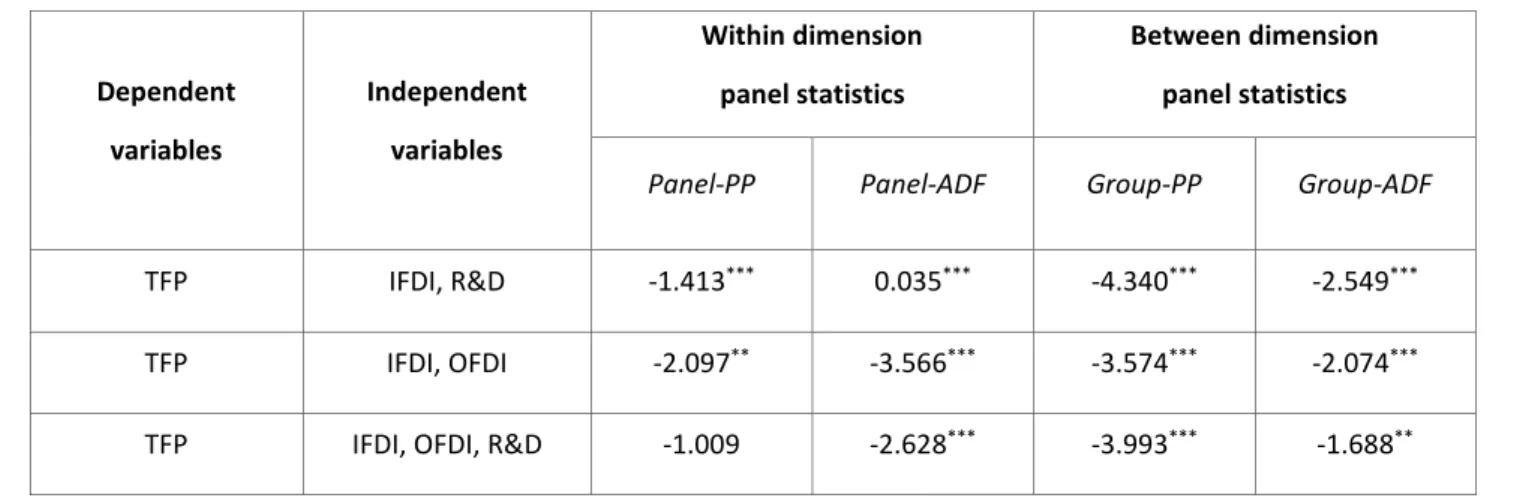
A panel cointegration test is performed for this analysis, as it was earlier in the paper (the panel unit root test was already conducted). Total factor productivity has a unit root process because in it the contributions of labor and capital are subtracted from total value added.
The panel conintegration test as performed by Pedroni (1999, 2004) is also used here. As for the results, the analysis demonstrates a stable long-term relationship between regional productivity and other varibles such as FDI and outbound foreign investment in the long term.
This rejects the null hypothesis positing the absence of a panel cointegration relationship among the primary variables.
Table 4. The relationship between productivity and independent variables
Dependent variables
Independent variables
Within dimension panel statistics
Between dimension panel statistics
Panel-PP Panel-ADF Group-PP Group-ADF
TFP IFDI, R&D -1.413*** 0.035*** -4.340*** -2.549***
TFP IFDI, OFDI -2.097** -3.566*** -3.574*** -2.074***
TFP IFDI, OFDI, R&D -1.009 -2.628*** -3.993*** -1.688**
NOTE:*,**,*** REPRESENT LEVELS OF 10%,5% AND 1% SIGNIFICANCE, RESPECTIVELY.
As a the above test confirmed a cointegration relationship between the variables of principal concern for this research, this study runs an estimation testing whether or not the relationship described above constitutes a long-term equilibrium between regional productivity and the independent variables: FDI, outbound foreign investment and R&D spending. To account for cross-sectional heterogeneity, the FMOLS method was employed in the estimation.
7 For more on the labor compensation ratio, refer Park et al. (2011), pp. 91-92.
- 16 -
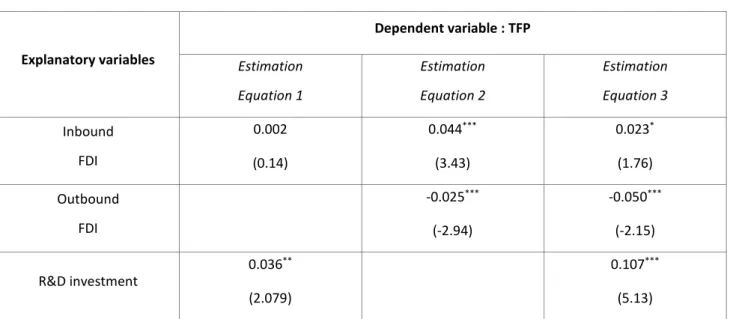
Given the results of various cointegration tests, FDI appears to have a positive relationship not only with total factor productivity, but with other variables as well, as its sign is uniformly positive throughout. Moreover this relationship is statistically significant (see table 5).
The results are consistent with those of Yeon (2003) and Keller and Yeaple (2009), who demonstrated that productive foreign firms increase the overall productivity of their host countries. The results of this study confirm that the productivity improvements of FDI apply at the regional level, and that attracting foreign investment can improve the productivity of any given region.
Table 5. Results of the cointegration estimation for total factor productivity
Explanatory variables
Dependent variable : TFP
Estimation Equation 1
Estimation Equation 2
Estimation Equation 3
Inbound FDI
0.002 0.044*** 0.023*
(0.14) (3.43) (1.76)
Outbound FDI
-0.025*** -0.050***
(-2.94) (-2.15)
R&D investment
0.036** 0.107***
(2.079) (5.13)
NOTE:*,**,*** REPRESENT LEVELS OF 10%,5% AND 1% SIGNIFICANCE, RESPECTIVELY. FIGURES IN PARENTHESES REPRESENT T-VALUES.
Meanwhile, as demonstrated before in its relationship with value added, outbound foreign investment is here shown to have a negative relationship with productivity. Several reasons might help explain this phenomenon, and it has been noted that the effects of overseas investment can vary depending on the characteristics of the country to which those investments flow. In an analysis of outbound foreign investment, Ahn et al. (2013) first separated investments into two categories — investments in advanced countries and investments in developing countries — and then found that the effects those investments had on domestic employment differed depending on the recipient countries’ levels of income and technology. In sum, the research found that productivity gains observed following outbound overseas investments were obtained through the acquisition of advanced managerial techniques and technologies.
- 17 -
Considering this, the fact the countries currently the focus of overseas Korean investments are developing countries, and that for the most part these investments are not being made with the purpose of acquiring advanced foreign technologies, can help explain how Korea’s outbound overseas investments are hindering productivity gains. Thus in the event that outbound foreign investment is shown to have a negative relationship with productivity in a country, it is reflective of the characteristics the host country, not the nature of the investment itself.
IV. Conclusion
The conceptual framework of a global production network stresses the importance of developing regional economies by acknowledging and incorporating relevant external factors at play in the global economy with local assets. Among these factors, foreign direct investment has emerged as a crucial variable. The following comprises a summary of the effects that this paper’s analyses has shown FDI has on regional economies.
First, Korea has entered a mature stage in its investment development path, as outflows now surpass inbound investments. Second, inbound FDI is concentrated in a small handful of regions.
Since 2001, 71.9 percent of FDI has flowed into in the capital region. For outbound foreign investment, that figure stands at 75.3 percent. Third, empirical analysis shows that FDI has a significant positive impact on regional growth and productivity. For every 1 percent increase in FDI, regional value added increases by 0.09 percent, and regional total factor productivity exhibits increases between 0.02 and 0.04 percent. This demonstrates that the conceptual framework of global production networks, which show that attracting FDI is important for regional growth, is useful.
Fourth, outbound overseas foreign investment was shown to have a negative effect on regional growth and productivity. For every increase in outbound investment of 1 percent, a concomitant decrease of 0.05 percent in regional value added was recorded, as well as a 0.03 to 0.05 percent decrease in regional total factor productivity. It is possible to argue that this is because foreign investment in developing countries, where Korea is currently focusing its overseas investments, reflects the loss of growth engines in regional economies, as production functions are transferred abroad.
The results of this study carry the following policy implications. First, it is necessary to
- 18 -
establish and implement regional policies that incorporate a global perspective. For a region to develop it must take advantage not only of its latent resources and competencies but also recognize and incorporate into local policies the potential of leading global firms and suppliers.
In doing so it becomes increasingly important to combine, coordinate and deploy internal and external factors. Establishing long-term partnerships with regional companies is crucial to transfer the knowledge and technology held by global firms.
Second, it is now necessary to craft industrial policies oriented around the global production network. Sourcing globally has become standard procedure and the value chain is becoming increasingly specialized. In this environment it is necessary for regions to discover specialties to participate in the value chain.
Third, any strategic responses must assess, acknowledge and appreciate local characteristics and conditions, whether they be social, political or demographic in nature. To find a place in the global economy, it is necessary to first determine the appropriate role for any given region, whether that means promoting exports or supporting domestic R&D, or making efforts to attract FDI. And depending on the nature of a region, it may be more advantageous to attract specialized global suppliers, rather than merely to draw in a major leading international firms.
Finally, it is critical to institute policies that support SMEs by cultivating their global capabilities. This may mean strengthening export abilities, introducing and applying global standards, and supporting the transfer of global firms’ technologies and managerial know-how.
- 19 -
Bibliography
Aitken, Brian J. and Ann E. Harrison (1999), “Do Domestic Firms Benefit from Direct Foreign Investment? Evidence from Venezuela”, American Economic Review, 83(3), 605-618.
Ahn, Sanghoon, Woosuk Oak, Hongsik Lee, and Minsik Choi (2013), Internationalization of Production in East Asia and Changes in Employment Structure, Korea Development Institute. (in Korean)
Blomström, M. and A. Kokko (1998), “Multinational Corporations and Spillovers”, Journal of Economic Surveys, 12(3), 247-277.
Choi, I. (2001), “Unit Root Tests for Panel Data”, Journal of International Money and Finance, 161-178.
Coe, Neil M., Martin Hess, Henry Wai-Chung Yeung, Peter Dicken, and Jeffrey Henderson (2004),
“‘Globalizing’ regional development: a global production networks perspective”, Transactions of the Institute of British Geographers New Series, 29(4), 468-484.
Dicken, Peter (2015), Global Shift: Mapping the changing contours of the world economy, London: Sage Publications Ltd. 7th edition.
Dunning, John. H. and Rajneesh Narula (1996), “The Investment Development Path Revisited: Some Emerging Issues”, in John H. Dunning and Rajneesh Narula(ed), Foreign Direct Investment and Governments, New York: Routledge.
Export-Import Bank of Korea, Foreign Investment Statistics, Each Year. (in Korean)
Gereffi, G. and M. Korzeniewicz (1994), Commodity Chains and Global Capitalism: ABC-CLIO.
Glass, A. J. and K. Saggi (1999), “Foreign Direct Investment and the Nature of R&D”, Canadian Journal of Economics, Vol.32, 92-117.
Global Value Chains Initiative (http://www.globalvaluechains.org).
Henderson, J., P. Dicken, M. Hess, N. Coe, and H. Wai-Chung Yeung (2002), “Global production networks and the analysis of economic development”, Review of International Political Economy, 9(3), 436-464.
Im, K. S., M. H. Pesaran, and Y. Shin (2003), “Testing for Unit Roots in Heterogeneous Panels”, Journal of Econometrics, 115, 53-74.
Johansen, Søren (1991), “Estimation and Hypothesis Testing of Cointegration Vectors in Gaussian Vector Autoregressive Models,” Econometrica, 59, 1551-1580.
Kao, Chinwa D. (1999), “Spurious Regression and Residual-Based Tests for Cointegration in Panel Data”,
- 20 - Journal of Econometrics, Vol.90, 1-44.
Keller, W. and S. R Yeaple (2009), “Multinational Enterprises, International Trade, and Productivity Growth:
Firm level Evidence from the United States”, The Review of Economics and Statistics, Vol. 91.
Kim, Hongkee (2010), “The Effects of Inward and Outward Direct Investment on Total Factor Productivity by Manufacturing Industry in Korea: Using Panel Data”, Journal of Korean Economics Studies, Vol.28, No.2, 145-170. (in Korean)
Kim, Seongki (2013), “The Economic Effects of Inward Direct Investment on GRDP in Busan, Ulsan and Gyeongsangnam-do”, Journal of International Trade and Insurance, Vol.14, No.3, 153-167. (in Korean)
Krugman, Paul (1980), “Scale Economies, Product Differentiation, and the Pattern of Trade”, American Economic Review, Vol.70, No.5, 950-959.
Levin, A., C. F. Lin, and C. Chu (2002), “Unit Root Tests in Panel Data: Asymptotoc and Finite-Sample Properties”, Journal of Econometircs, 108, 1-24.
Maddala, G. S. and Shaowen Wu (1999), “A Comparative Study of unit Root Tests with Panel Data and a New Simple Test”, Oxford Bulletin of Economics and Statistics, 61, 631-652.
Ministry of Industry, Trade and Energy, Foreign Investment Statistics, Each Year.
(http://www.motie.go.kr/). (in Korean)
Moon, Hwychang and Jinsup Jung (2010), “Economic Effects of Inward Foreign Direct Investment: A case of Korea”, Korean Corporation Management Review, Vol.17, No.2, 133-156. (in Korean) OECD (2002), Foreign Direct Investment for Development: Maximising Benefits, Minimising Costs,
OECD Publication Service.
Park, Jaegon, Changuk Byeon, Jisoo Kim, and Junghyun Yoon (2016), International Trade and Global Investment Analysis in Regional Economy, Korea Institute for Industrial Economics and Trade.
(in Korean)
Park, Jaegon and Changuk Byeon (2012), Estimation and Forecasting of Industrial Land Use in Korea:
Using Panel Cointegration Relationship, Korea Institute for Industrial Economics and Trade. (in Korean)
Park, Jaegon, Changuk Byeon, and Yoonseon Jeong (2011), Regional Analysis on the Efficiency and Effectiveness of the Investment in the Korean Manufacturing Sector, Korea Institute for Industrial Economics and Trade. (in Korean)
Pedroni, P. (1999), “Critical Values for Cointegration Tests in Heterogeneous Panels with Multiple Regressors”, Oxford Bulletin of Economics and Statistics, Vol.61, 653-670.
- 21 -
Pedroni, P. (2004) “Panel Cointegration; Asymptotic and Finite Sample Properties of Pooled Time Series Tests with an Application to the PPP Hypothesis”, Econometric Theory, Vol.20, 597-625.
Rodriguez-Clare, A. (1996), “Multinationals, Linkages, and Economic Development”, The American Economic Review, 86(4), 852-873.
Statistics Korea, Regional Income Statistics, Each Year. (in Korean)
Swenson, Deborah L. (2007), “Multinationals and the Creation of Chinese Trade Linkages”, NBER Working Paper No.13271.
UNCTADSTAT (http://unctadstat.unctad.org).
Yeon, Taehoon (2003), Study on the impact of foreign direct investment on inter-industry productivity, Korea Development Institute. (in Korean)
Yeung, H. Wai-chung (2015), “Regional development in the global economy : A dynamic perspective of strategic coupling in global production networks”, Regional Science Policy and Practice, 7(1), 1-23.