THE CHOICE OF ELICITATION METHODS IN CVM AND THEIR IMPACT ON WILLINGNESS TO PAY IN ENVIRONMENTAL ASSESSMENT
by
Sarwar Uddin AHMED
*and Keinosuke GOTOH
**The choice of the question format constitutes one of the major exercises in contingent valuation method (CVM) studies. However, although various methods are available, none of these are considered to be perfect. This paper aims to examine the effects of varying the elicitation methods on willingness to pay (WTP) of the respondents by summarizing the findings of two environmental assessment case studies conducted on Nagasaki City. Three types of elicitation methods are applied in the case studies: open-ended, single bounded dichotomous-choice and double-bounded dichotomous-choice questions. Results indicate that free riding and lack of base for answering question leads to underestimation of WTP under open-ended format. Whereas, the anchoring effect is presented in dichotomous choice format where the bid level provided raises the probability of accepting it. Based on the drawbacks of both the methods, recommendations are provided for using a new format of question to avoid the demerits.
Key Words: elicitation methods, willingness to pay, contingent valuation method 1. INTRODUCTION
There are different ways to ask willingness to pay (WTP) questions in contingent valuation (CV) surveys, which are known as elicitation methods.
Presently four types of elicitation methods are commonly used in CVM studies e.g., open-ended (OE), bidding game (BG), single-bound dichotomous-choice (1DC) and double-bound dichotomous-choice (2DC). Among them especially dichotomous-choice (DC) format is the most widely used one. Follow-up questions are also used to increase the precision of the estimate with DC question. The NOAA blue ribbon panel advocated this method as the most appropriate one in most circumstances
1). While among others bidding game (BG) approach has been almost deserted because it tends to result in a starting point bias. However, all these methods of asking questions have their relative advantages and disadvantages and none is free from criticisms. A summary of the characteristics of the
most commonly used elicitation methods is provided in Table 1. In this context, this study is a modest attempt to study the impact of different elicitation methods on willingness to pay of the same respondents by using the CVM study data of two environmental assessment case studies.
Fig.1 Survey area in Nagasaki City Tachibana
Bay Oomura
Bay
Nagasaki Shikimi City
Azekari
Kawabira Koga
Fukida
Himi
Kogakura Minamiyamate Katsuyama
Fukahori Bunkyo
Sakamoto
Received on December 14, 2006
* Department of Civil Engineering, Faculty of Engineering, Nagasaki University
** Graduate School of Science and Technology, Nagasaki University
Table 2 Survey description
HTB Study
Public Park Study
Location Nagasaki
City Nagasaki City Questionnaire
Distributed 950 1000
Questionnaire
Returned 232 194
Elicitation Methods Used
OE, 1DC,
2DC OE, 1DC, 2DC
2. METHODS AND DATA
Database of the following two CVM case studies are used to examine the effect of elicitation methods on the WTP of the respondents (see Table 2 for survey details). Both of these studies have Nagasaki City as their sample area and attempted to estimate the value of sustaining and increasing recreational parks (see Fig.1 indicating the survey area).
As a methodology statistical model has been constructed by dividing the elicitation methods into two groups OE and DC responses. 1DC and 2DC are merged into a single model of DC, as same 1DC model can be extended to 2DC with the basics remaining the same
3). Also the ‘anchoring effect’ (the probability of the respondent accepting the offered bid) is common in all DC formats. Thus 2DC, 3DC etc. are a simple extension to the DC bidding game and therefore the drawbacks of IDC also applies
7),8).
(1) Huis Ten Bosch Study
Huis Ten Bosch (HTB), meaning “House in the Forest” in Dutch, is one of the biggest theme parks in Kyushu, Japan. It is a famous private recreational theme park opened on March 1992 at an approximate cost of ¥ 300 billion, created by transforming 152 hectares of industrial wasteland through various environmentally affable mechanisms
9).
Modeled after a Dutch town, the resort and theme park was once considered as popular as Tokyo Disneyland. Huis Ten Bosch attracted 4.25 million visitors in 1996 at the peak of its popularity, and 3.55 million in year 2001.
Although Huis Ten Bosch marked a bright start by attracting visitors not only form Japan, but also from neighboring Asian countries, this trend did not continued. HTB started to fall into financial difficulties for the following reasons
10).
Accordingly, HTB revenues continued shrinking and stood at about ¥35 billion in 2001, down 40 percent from the peak annual revenues of about
¥49.6 billion in 1996, while the liabilities stood at about ¥229 billion, including about ¥180 billion in loans
11). Eventually on February 2003, operators filed for protection from its creditors under the Corporate Rehabilitation Law and currently efforts are continuing for its revival. Accordingly, on this background we have conducted a CV study to Table 1 Elicitation methods used in CV survey
Open-ended question Dichotomous-choice method
Double Bounded Dichotomous-choice method How-To’s Respondents are asked to state
their maximum WTP for the amenity to be valued
Respondents are asked if they are willing to pay single randomly assigned amount on
all-or-nothing basis
Respondents are asked an additional question if they would pay a higher or lower amount
Number of Question Single Single Iterated series of question
WTP Obtained Actual Discrete indicator of WTP Discrete indicator of WTP
Major Advantage
Provides Straightforward actual valuation of amenities
Much more familiar to the respondents because of the similarity to the market condition
2)
More statistical efficiency can be achieves than that of DC as additional information can be elicited
3)Major Disadvantage Might lead to understatement of WTP due to lack of knowledge of costs and benefits and free riding
4),5)‘Framing’ or ‘Anchoring’ effect arising from the probability of accepting the bid level due to ignorance about true valuation
6)Danger that the respondents exposure
to the first offer would influence them
to accept the follow-up offer.
estimate the socio-environmental value of Huis Ten Bosch.
(2) Public Park Study
Public parks provide different benefits to the community such as: recreational benefits, economic benefits, environmental benefits, safety benefits and so on. Especially in a hillside city like Nagasaki, where plain spaces are hard to find, public parks have more wide uses. But unfortunately adequate space or number of public parks are lacking in Nagasaki City, which also can be considered as one of the important reasons for making the Nagasaki city poorly ranked urban city (497th C grade city among 678 urban cities of Japan
12). The ratio of public park per square meter (PPSM) is alarmingly low in Nagasaki City as compared to the national standard and actual national average of Japan. As we can see in Fig. 2, national standard of public park is 9.5 PPSM and the actual national average is 8.1 PPSM. Whereas, in Nagasaki city it is 6.6 PPSM.
On the basis of the background portrayed above, it
is interesting to investigate how the residents of Nagasaki City are viewing the need for public parks, in order to plan for the increase and improvement of it. And one common and more easily understood method to articulate the need of some public good, is to express it in monetary terms by valuing it.
Consequently, in this study we are going to estimate the willingness to pay for preserving the nearest public parks as a means to express the urge for the maintenance and development of public parks in Nagasaki City. As a method for estimating the WTP, we are going to use contingent valuation method (CVM).
3. FINDINGS
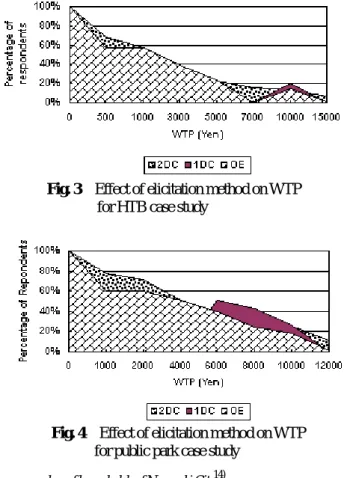
The findings of the study are summarized through Table 3 and Figs. 3 and 4.
(1) Open-ended Format (HTB Study)
Under the OE elicitation method the mean WTP is estimated as ¥2,760 for the entire sample (95%
CI=¥2,150~¥3,370) (see Table 3). All those who refused to pay anything are treated as having zero WTP. But as common to the OE format the standard deviation is revealed to be very high. A model is constructed to check the validity and explanatory power of the related variables. Accordingly, the double-log form model derived is as follows:
LWTP (OE) = 5.854 + 0.219LINC (1)
(7.192) (1.547)
Where,
LWTP (OE) = Natural log of open-ended WTP response
LINC = Natural log of the respondent’s income
0 .0 2 .0 4 .0 6 .0 8 .0 1 0 .0 1 2 .0
Natio n al S t an dar d
Ac tu al Co u n t r y Ave r age
Nagasaki City Ave r age
(Square meters/person)
Fig.2 A comparison of public park area per person
Public Pa rk Area
Table 3 Mean WTP under various elicitation methods HTB
Study
Public Park Study Elicitation
Method
Mean WTP
(¥) SD 95% CI
(¥)
Mean WTP
(¥) SD 95% CI
(¥)
OE 2,760 4,230 2,150-3,370 4,660 5,490 3,880-5,440
1DC 3,360 330 2,700-4,020 4,960 240 4,490-5,430
2DC 3,520 320 2,890-4,150 5,370 340 4,700-6,040
Numerals in the parenthesis are t values.
The variables shown above are significant at least at 0.10 level. Other variables such as: visit and demographic variables sex and age were also inserted in the model, but they were not significant.
The R
2(adj.) = 4%. Thus it indicates that the explanatory variables are not properly explaining the OE willingness to pay.
(2) Dichotomous-choice Format (HTB Study) Under the DC elicitation method the mean WTP is estimated as ¥3,360 (95% CI=¥2,700-¥4,020) (see Table 3). The standard deviance reduced significantly compared to the OE format. With dichotomous structure of the dependent variable, the model can be estimated through a non-linear probability model and the most common one is the logit model
13). Accordingly a logistic model is constructed to check the validity and explanatory power of the relevant factors is as follows:
Ln[prob(yes)/{1 - prob(yes)}]=
6.670- 0.6272LBID
(10.686) (10.688) (2) Where,
LBID = Natural log of the proposed bid value Numerals in the parenthesis are t values.
The variables shown above are significant at least at 0.10 level. The overall explanatory power of the model is higher than OE format. The overall model is significant at the 0.01 level. The model reasonably predicts 71% of the responses correctly. The R
2= 8.88%. Thus it indicates that the explanatory power of the variables increased in the DC format. But the influence of the bid level variable remains highest, indicating the presence of anchoring effect, as it alone can explain almost 71% changes in the willingness to pay.
(3) Open-ended Format (Public Park Study) In this study, OE format mean WTP is estimated as ¥4,660 for the entire sample (95%
CI=¥3,880~¥5,440) (see Table 3). Also like the
HTB study, the standard deviation is high. A model is constructed to check the validity and explanatory power of the related variables. Here the double log form model derived is as follows:
LWTP (OE) = 7.781 + 0.285VISIT + 0.003AGE
(7.321) (1.761) (0.571)
+0.059LINC (3)
(0.378)
Where,
LWTP (OE) = Natural log of open-ended WTP response
VISIT = Whether the respondent went to visit public parks at least once in a month. Yes=1, No=0
AGE = Age of the respondent’s in years LINC = Natural log of the respondent’s
income
Numerals in the parenthesis are t values.
The variables shown above are significant at least at 0.10 level. But the overall explanatory power of the model is as usual very low. The R
2(adj.)= 0.5%.
(4) Dichotomous-choice Format (Public Park Study)
Under the DC elicitation method the mean WTP is estimated as ¥4,960 (95% CI=¥4,490-¥5,430) (see Table 3 ). The standard deviance reduced highly as compared to the OE format. The logistic model constructed to check the validity and explanatory power of the relevant factors is the following:
Ln[prob(yes)/{1 - prob(yes)}]=
1.883- 0.665LBID-1.290VISIT
(0.485) (5.226) (14.011)
+0.054AGE+0.002INC (4)
(11.824) (12.335)
Where,
LBID = Natural log of the proposed bid value INC = Income of the respondent household (in
ten thousand yen)
Numerals in the parenthesis are t values.
Rest of the variables are same as explained before.
The variables shown above are significant at least at 0.10 level. The overall explanatory power of the model is higher than OE format. The model reasonably predicts 71.94% of the responses correctly. The R
2= 15.99%. As also seen in the HTB study, . influence of the bid level variable remains highest, indicating the presence of anchoring effect, as it alone can explain almost 60% changes in the willingness to pay.
4. DISCUSSION
From the ongoing discussion the following points can be put forward:
(1) From the results of both of the case studies, we have seen that under OE question format willingness to pay (WTP) is lower and the variance is higher leading towards the possibility of underestimation of the true WTP (see Table 3 and Figs. 3-4).
(2) Whereas under dichotomous-choice question format the WTP is higher and the variance also decreases.
(3) As shown in Table 4, extrapolating the average WTP calculated to the total number of households of Nagasaki City makes the impact of elicitation methods on aggregate environmental assessment more clear. The range of variation is in between ¥486-619 million in HTB study and ¥820-945 million in public park study. This indicates the larger impact of choosing elicitation method on environmental assessment. But the difference is not so significant as evident in other relevant studies
3).
Table 4 Aggregate willingness to pay
(In million yen) Elicitation
Methods
HTB Study
Public Park Study
OE 486 820
1DC 591 873
2DC 619 945
Note: Average WTP of Table 3 is multiplied by the total
number of households of Nagasaki City
14).
(4) From the model construction statistical inaccuracy of the OE format is again revealed due to poor ability of the explanatory variables to explain the WTP.
(5) DC format model construction showed more relative explanatory power of the related variables, but highly influenced by the bid level.
5. CONCLUSION
From the results of the study we have seen that both OE and DC approach have their relative advantages and disadvantages. Lack of knowledge of cost-benefit and free riding lead to understatement of WTP under OE question format. Whereas, although DC format is free from many of the demerits of OE format, still the ‘framing’ or
‘anchoring’ effect arising from the probability of accepting the bid level due to ignorance about true valuation is present. Thus to sum up, both OE and DC format are prone to biases and may lead to improper environmental assessment, as the
Fig. 3 Effect of elicitation method on WTP for HTB case study
Fig. 4 Effect of elicitation method on WTP
for public park case study
respondents might base their answers without having
adequate knowledge about the actual cost-benefit behind the valuation. In order to avoid this, we would like to propose an alternative method, which are expected to overcome the demerits of the two above stated methods.
As shown in Fig. 5, in the proposed method additional information on cost-benefit of the concerned good and other relevant good would be provided in order to assist the respondent’s decision in numerical from. Also a number of randomly assigned bid values would be provided to reduce anchoring effect arises under DC format. In this respect, this paper tested the accuracy of OE and DC question format in eliciting WTP. Based on the findings of this study, we would like to test the accuracy of our proposed alternative question format in our future environmental assessment studies.
REFERENCES
1) Arrow, K., Solow, R., Portney, P., Leamer, E., Radner, R., and Schuman, H.: Report of the NOAA Panel on contingent valuation. Federal Register, 58, No. 10, p.4608, 1993.
2) Desvousges, W. H., Smith, V.K., and McGivency, M. P.:
A comparison of alternative approaches for estimating recreation and related benefits of water quality improvements, Office of Policy Analysis. US Environmental Protection Agency, Washington, 1983.
3) Bateman, I., J., Langford, I. H. and Rasbash, J.:
Willingness-to-pay question format in contingent valuation studies, pp.511-539, in Bateman, I., J. and Willis, K. G. (ed.), Valuing environmental preferences:
theory and practice of the contingent valuation method in the US, EU, and the developing countries, Oxford University Press, New York, 1999.
4) Brubaker, E.: Sixty-eight percent free revelation and thirty –two percent free ride? Demand disclosures under varying conditions of exclusion. pp.151-166 in V.L. smith (ed.), Research in Experimental Economics, ii, JAI Press, Greenwich, Conn, 1982.
5) Hoen, J. P. and Randall, A.: A satisfactory benefit-cost indicator from contingent valuation. Journal of Environmental Economics and Management, 14, pp.226-247, 1987.
6) Kahneman, D., Solvic, P., and Tversky, A.: Judgement under uncertainty: Heuristics and biases, Cambridge University Press, New York., 1982.
7) Hanemann, W. M., Loonis, J., and Kanninen, B.:
Statistical efficiency of double-bounded dichotomous choice contingent valuation. American Journal of Agricultural Economics, 73, pp.1255-63, 1991.
8) McFadden, D., and Leonard, G. K.: Issues in the contingent valuation of environmental goods:
methodologies for data collection and analysis, in Hausman, J. A. (ed.) Contingent Valuation: A Critical Assessment, North-Holland, New York, 1993.
9) Huis Ten Bosch (HTB): Huis Ten Bosch environmental accounting report: 1992-2001. Environmental Group, Huis Ten Bosch Ltd., 2002.
10) The Daily Yomiuri: Outlook grim for Dutch village theme park, Feb 28, 2003, p.16. 2003a.
11) ____ Huis Ten Bosch goes belly-up, Feb. 27, 2003, p.18. 2003b.
12) Toyo Keizai Inc.: Urban City Data Bank, Toyo Keizai Supplement, 137, Tokyo, 2003.
13) Pate, J., and Loomis, J.: The effect of distance on willingness to pay values: a case study of wetlands and salmon in California, Ecological Economics, 20, pp.199-207, 1997.
14) Ministry of Public Management, Home Affairs, Posts and Telecommunication (MPHP).: Statistical Yearbook.
Statistical Survey Department, Statistics Bureau, Japan, 2003.
OE DC
Underestimation Anchoring effect Most Commonly Used Elicitation Methods
Need some alternative elicitation method
Cost-benefit based dichotomous choice method
Description of the per capita costs-benefits of the concerned good
Description of the costs and benefits of some similar goods
Reducing the probability of underestimation seen in OE
Reducing the anchoring effect seen in DC
Efficiency Achieved Additional
Information
Major Problem