The Effects of Volcanic Disaster on the Prevalence and Severity of Bronchial Asthma
Hatsuyo SASAYAMA1), Kiyoshi AOYAGI1), Yoshimasa TAGAWA1), Masako TAGAWA 1), Kazuhiko Moii2), Sumihisa HONDA 3), Tai-ichiro TAKEMOTO1)
1) Department of Public Health, Nagasaki University School of Medicine 2) Department of Nursing, Nagasaki University School of Health Sciences
3) Department of Radiation Epidemiology, Atomic Bomb Disease Institute, Nagasaki University School of Medicine
Objectives: To evaluate the impact of volcanic disaster on bronchial asthma, the prevalence and the extent of deterio- ration of asthma were studied among primary school chil- dren aged 6 to 11 years who experienced the volcanic erup- tion of Mt. Unzen Fugen, Nagasaki, Japan.
Methods: Questionnaire data were collected from the par- ents or guardians of primary school children. Asthma was classified into four categories: diagnosed asthma, current asthma, remitted asthma, and deteriorated asthma, and the prevalence of each category was compared according to sex and grade. We also analyzed the relation between asthma and past illness and family history including experience of volcanic disaster.
Results: Multiple logistic regression analysis showed that past illnesses of allergic diseases, such as allergic rhinitis, dermatitis and conjunctivitis were associated with either current asthma or deteriorated asthma. On the effects of volcanic disaster, a change of family member after vol- canic disaster was significantly associated with deterio- rated asthma (odds ratio=3.20, 95% confidence interval=1.79-5.70). Location of school seemed to somewhat influence the prevalence of deteriorated asthma, which might relate to the distance from the volcanic crater.
Conclusion: Our findings suggest that not only gases and ash but also changes in psychosocial conditions by refuge or related anxiety may influence the prevalence of asthma among primary school children.
ACTA MEDICA NAGASAKIENSIA 47: 31-36, 2002
Key Words: Mt. Unzen-Fugen, volcanic eruption, primary
school-children, bronchial asthma, refugee, logis-
tic analysis
Address Correspondence: Kiyoshi Aoyagi, M.D.
Department of Public Health, Nagasaki University School of Medicine, 1-12-4 Sakamoto, Nagasaki, Japan 852-8523
TEL: +81-95-849-7067 FAX: +81-95-849-7069 E-mail: [email protected]
Introduction
The prevalence of bronchial asthma has been in- creasing with great variability among local popula- tions and communities (1-5). The differences among populations suggest that the prevalence and severity of asthma are influenced by human-environment sys- tem that has been established in each local commu- nity (6-9). Although the etiology of increased preva- lence of asthma is not fully understood, exposure to air pollutants, such as dust, pollen, gases and chemi- cals according to urbanization and industrialization has been considered to affect the prevalence and de- velopment of asthma (1,10). In addition, susceptibility to asthma is reported to be influenced by the psycho- somatic condition of children as well as family situa- tion (11-15). Previous studies have suggested that fam- ily factors can be important predictors of asthma (16-
18). Further, Boyce et al. (19) reported a strong relationship between childhood respiratory illness and the degree of chronic family stress. Another study re- lated to depression or hopelessness and cholinergic ac- tivation suggests that sad emotion states can evoke patterns of autonomic reactivity that predispose to cholinergically-mediated airway construction in asthma (11, 12). In this regard, pathological family set- tings are known to cause more emotional and behav- ioral problem in children, and influence the attitude and/or personality of asthmatic children (16).
Several studies have focused on the effects of vol- canic eruptions on prevalence of asthma and/or respi- ratory function, but the results are inconsistent among studies on volcanic eruptions in Mt. St. Vincent (20),
Mt. St. Helens (21, 22), Mt. Runapehu (23), and Mt.
Sakurajima (24-30). In a series of human ecological studies, we previously examined the environmental ef- fects of volcanic eruption of Mt. Unzen Fugen on health. Particular points related to the eruption in- cluded both environment pollution by volcanic
Hatsuyo Sasayama et al : Volcanic Disaster and Bronchial Asthma
emissions, such as gases, and related psychosomatic stress of refugees seeking safer places and living at unfamiliar places (31-34). The impact of psychological changes on asthma has already been reported (11-19).
However, previous studies only examined the effects of volcanic ash or gases on asthma (20-30), and did not consider the changes in human and environment system per se on the prevalence of asthma. The aim of the present study was to elucidate the impact on childhood asthma of volcanic eruption, based on the disaster at Mt. Unzen Fugen volcanic eruption, Nagasaki, Japan. We conducted a comprehensive study of the effects of both psychosomatic factors as well as volcanic gases and dust on asthma in school children.
Background
Volcanic eruption of Mt. Unzen Fugen (elevation, 1,500 m) in Unzen mountains in the Shimabara Peninsula, east of Nagasaki City, Southwestern Japan (Figure 1) started its activity in November 1990. The biggest pyroclastic flow occurred on June 29th 1991, in which 44 people died. The volcanic debris (lahars) have endangered several thousand people and de- stroyed more than 2,000 buildings and farmland. The government committee in charge officially declared
the end of eruption and the restoration of safety on May 25th, 1995.
One of the characteristics of that volcanic activity was that densely populated areas (e.g., Shimabara City with 44,800 residents and Fukae Town with 8,422 residents according to 1990 census) were located only 6 km away from the crater of Mt. Unzen Fugen. To avoid the damage caused by flows, over three thou- sands households took temporary refuge in community houses and gymnastic halls of schools (35, 36). Following continued volcanic activity, the local government built temporary houses for refugees. In addition to dormito- ries, schools also moved to safer places (37).
The average concentrations of sulfur dioxide (S02) and suspended particle matter (SPM) were continu- ously measured at the roof of Shimabara City Council located 7 km northeast from the volcanic crater. The concentration of SO 2 never exceeded the Japanese standard for air pollution control (0.04 ppm of daily average and 0.1 ppm of an hour average), but those of SPM measured at the station exceeded the standard (0.1 mg/ml of daily average and 0.2 mg/m 3 of an hour average) (38), and reached up to 1.56 mg/ml in July of 1991. Following a decrease in the frequency of eruptions, the concentrations of both S02 and SPM progressively decreased but the annual average of SPM in 1995, 0.37 mg/m3, was the highest among 48 stations in Nagasaki prefecture.
Figure 1. Sketch map of Shimabara Peninsula and Shimabara city.
Striped lesions show pyroclastic and volcanic debris flows which occurred from 1990 to 1995. School A and B in northern part and School C-F in southern part are respectively located in less and severe hazardous districts.
Figure 2. Annual changes of concentration of sulfur dioxides (SO2) and suspended particulate matter (SPM) at the monitor- ing station on roof Shimabara city council located at 7 km east distance from the crater. Solid and dotted line show the highest and annual average of concentrations for an hour measurement, respectively.
Materials and Methods
The target population consisted of the total number of 3,029 pupils aged 6 to 11 years old in all six pri- mary schools in the Shimabara City. Two types of questionnaires were given to the parents or guardians and were related to the asthma conditions of the pu- pils. The first survey was carried out in September 1994. A total of 2,958 questionnaires (97.7%) were col- lected. The questionnaire on asthma consisted of the following eight questions, representing the Japanese version of ATS-DLD (American Thoracic Society- Division of Lung Diseases) questionnaire (39-41). 1) Has the child ever had an attack of wheezing or whis- tling that caused him/her to be short of breath? 2) Has he/she had 2 or more such episodes? 3) Has a doctor ever said that the child had asthma or asth- matic bronchitis? 4) Since the child was diagnosed with asthma or asthmatic bronchitis, had he/she an attack of wheezing? 5) Since the child was diagnosed with asthma or asthmatic bronchitis, had he/she an attack of whistling? 6) Has he/she had such episode or medical treatment for bronchial asthma or asth- matic bronchitis in the past two years? 7) Does he/she have such sound only when he/she has a cold? 8) Has he/she had such sound twice or more times in the past two years?
Those who answered "yes" to questions 1) to 6) were classified as the diagnosed asthma group. The diag- nosed group was classified into two subgroups based on the response to question 6): those who responded
"yes" were classified as current asthma group , and those who answered "no" as the remitted asthma group. In addition to the above eight questions, we used one question related to the effect of the volcanic
eruption: 9) Did his/her asthma become more frequent or were more severe symptoms noted after the erup- tion of Mt. Unzen-Fugen? Those who answered "yes"
were classified as the deteriorated asthma group.
The second survey was carried out in December of 1994, and the recovery rate was 93.8%. The aim of the second survey was to evaluate the extent of risks as listed by ATS-DLD (39). The survey contained ques- tions regarding 1) feeding patterns and type of food during babyhood, 2) past illnesses, such as respiratory diseases, eczema until 2 years of age, pertussis, atopic dermatitis, allergic rhinitis and allergic conjunctivitis, 3) family history of allergic diseases including asthma among parents, grandparents and uncle/aunt, 4) in- door environment and living factors, i.e., whether he/- she is living with smoker(s), construction of houses, especially material of floor (wood/tatami), whether the heating system is ventilated or not, and whether a dog or cat was kept indoor, and 5) impact of volcanic disaster, including whether he/she lived in a refuge or dormitory, and whether the family member(s) has changed after the eruption.
For 3,029 children, 2,304 pair of questionnaires (76.1%) were completed by parents or guardians for both first and second questionnaire (Table 1).
Statistical analyses were performed by the SAS statis- tical package.
Table 1. The grade-distribution of school children in six pri- mary schools in Shimabara city
South area North area All the cit
n= n= n=
Grade Boy Girl Both sexes Boy Girl Both sexes Boy Girl Both sexes
1st 131 134 265 59 60 119 190 194 384 (16.7)
2nd 137 143 280 66 64 130 203 207 410 (17.8)
3rd 135 131 266 49 63 112 184 194 378 (16.4)
4th 151 158 309 64 52 116 215 210 425 (18 .4)
5th 128 158 286 52 53 105 180 211 391 (17.0)
6th 114 121 235 39 42 81 153 163 316 (13.7)
Total 796 845 1641 329 334 663 1125 1179 2304 (100.0)
" : Numerals in parenthesis are number of primary school
Results
1. Prevalence of bronchial asthma
The prevalence of diagnosed asthma was 15.4% for boys and 10.6% for girls. In both sexes, the rates tented to decrease with advancing grade; the preva- lence in boys decreased significantly between 1st/2nd grade (6 and 7 years old) and 3rd/4th grade (8 and 9 years old), but the decline of prevalence in girls was found between 3rd/4th grade and 5th/6th grade (10 and 11 years old) (Table 2). Among those of diagnosed asthma group, 28.5% of reported asthma in boys (49/172) and 34.7% in girls (43/-124) remitted asthma
Hatsuyo Sasayama et al : Volcanic Disaster and Bronchial Asthma
Table 2. Prevalence of bronchial asthma
1st & 2nd grade 3rd & 4th grade Stir & 6th grade Total
No. % No. % No. % No.
Boy Diagnosed BA 66 /392 16.8 57 /393 14.5 49 /330 14.8 172 /1115 15.4 Current BA 49 /393 12.5 36 /398 9.0 38 /333 11.4 123 /1124 10.9
Remitted BA 17 /393 4.3 21 /398 5.3 11 /333 3.3 49 /1124 4.4
Deteriorated BA 31 /386 8.0 18 /386 4.7 18 /328 5.5 67 /1100 6.1 Girl Diagnosed BA 46 /399 11.5 46 /402 11.4 32 /371 8.6 124 /1172 10.6
Current BA 26 /401 6.5 34 /403 8.4 21 /374 5.6 81 /1178 6.9
Remitted BA 20 /401 5.0 12 /403 3.0 11 /374 2.9 43 /1178 3.7
Deteriorated BA 15 /395 3.8 18 /401 4.5 16 /365 4.4 49 /1161 4.2 Both Diagnosed BA 112 /791 14.2 103 /795 13.0 81 /701 11.6 296 /2287 12.9
Sexes Current BA 75 /794 9.4 70 /801 8.7 59 /707 8.3 204 /2302 8.9
Remitted BA 37 /794 4.7 33 /801 4.1 22 /707 3.1 92 /2302 4.0 Deteriorated BA 46 /781 5.9 36 /787 4.6 34 /693 4.9 116 /2261 5.1
attack during primary school age. The prevalence of current asthma was significantly higher in boys than in girls at every grade (overall prevalence, boys: 10.9%, girls: 6.9%), and was still high at the 5th/6th grades of primary school. Moreover, 68.9% of current asthma was reported to be worse after volcanic eruption.
2. Relationship between past illness, family history, in- door environment and volcanic disaster and asthma The extents of contribution of factors in past illness, family history, indoor environment and volcanic disas- ter to bronchial asthma was estimated by crude odds ratio (OR). The highest crude OR for current asthma was found in past illness of allergic rhinitis (OR=7.12, 95% confidence interval [CI]=5.19-9.78) (Table 3). The next highest one was family history of asthma (OR=3.65, 95%CI=2.61-5.10). All the factors in either past illness or family history showed highly signifi- cant associations for current asthma. Among indoor
environment, only the use of unventilated heating sys- tem was a contributing factor although its signifi- cance was weak. Among the factors related to vol- canic disaster, a change of family member living with showed significance for current asthma (OR=1.67, 95%CI=1.08-2.58). The results for deterioration of asthma were substantially similar to those for current asthma. However, the odds ratio of change of family member was higher (OR=2.49, 95%CI=1.51-4.09).
3. Associations with asthma in multiple variable ad- justed model
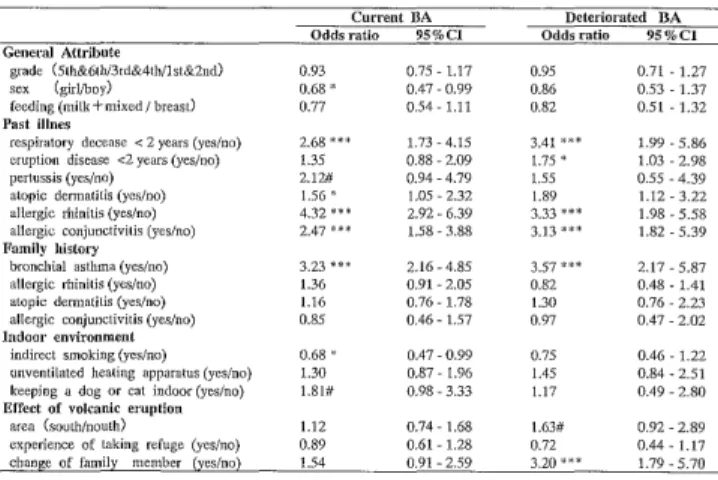
Multiple variable adjusted odds ratios showed al- most similar pattern with respect to statistical signifi-
Table 4. Adjusted odds ratio of bronchial asthma
Current BA Deteriorated BA
Odds ratio 95%C1 Odds ratio 95%C1
General Attribute
grade (5tlr&6th/3rd&4th/1st&2nd) 0.93 0.75 - 1.17 0.95 0.71 -1.27
sex (girl/boy) 0.68 * 0,47-0.99 0.86 0.53 -1.37
feeding (milk+mixed / breast) 0.77 0.54 - 1.11 0.82 0.51 -1.32
Past illnes
respiratory decease < 2 years (yes/no) 2.68 * * * 1.73-4.15 3.41 * * * 1.99 -5.86
eruption disease <2 years (yes/no) 1.35 0.88-2.09 1.75 * 1.03 -2.98
pertussis (yes/no) 2.12# 0.94-4.79 1.55 0.55 -4.39
atopic dermatitis (yes/no) 1.56 * 1.05 - 2.32 1.89 1.12-3.22
allergic rhinitis (yes/no) 4.32*** 2.92-6.39 3.33*** 1.98-5.58
allergic conjunctivitis (yes/no) 2.47 "* * 1,58-3.88 3.13 * * * 1.82-5.39 Family history
bronchial asthma (yes/no) 3.23 *** 2.16 - 4.85 3.57 *** 2.17-5.87
allergic rhinitis (yes/no) 1.36 0.91 - 2.05 0.82 0.48-1.41
atopic dermatitis (yes/no) 1.16 0.76-1.78 1.30 0.76-2.23
allergic conjunctivitis (yes/no) 0.85 0.46 - 1.57 0.97 0.47 -2.02
Indoor environment
indirect smoking (yes/no) 0.68 * 0,47-0-99 0.75 0.46-1.22
unventilated heating apparatus (yes/no) 1.30 0,87-1.96 1.45 0.84-2.51
keeping a dog or cat indoor (yes/no) 1.81# 0.98-3.33 1.17 0.49-2.80
Effect of volcanic eruption
area (south/nouth) 1.12 0,74-1.68 1.63# 0.92-2.89
experience of taking refuge (yes/no) 0.89 0.61 - 1.28 0.72 0.44- 1.17
change of family member (yes/no) 1.54 0.91 - 2.59 3.20 * * * 1.79-5.70 Statistical significant level : #<0.1, * : p<0.05, ** : p<0.01, *** : p<0.001
CI = confidence interval
Table 3. Prevalence and crude odds ratio of bronchial asthma
Current BA Deteriorated BA
Prevalence Odds ratio 95%CI Prevalence Odds ratio 95%CI
General attribute
Grade (3rd&4th/lst&2nd) 8.7/9.4 0.92 0.64-1.31 4.6/5.9 0.77 0.48-1.23
(5th&6th/Ist&2nd) 8.3/9.4 0.87 0.60-1.27 4.9/5.9 0.82 0.51-1.33
Sex (girl/boy) 6.9/10.9 0.60*** 0.44-0.81 4.2/6.1 0.68* 0.46-1.01
Lactation (not only breast milk / breast milk only) 8.3/9.9 0.82 40.61 - 1.12 4.9/5.6 0.88 0.59-1.31 Past illness
Respiratory diseases < 2 years (yes/no) 21.4/7.1 3.57**': 2.51-5.06 13.6/4.0 3.79**- 2.44-5.90 Eruption diseases <2 years (yes/no) 16.6/7.0 2.66* * * 1.93-3.66 11.9/3.5 3.69*** 2.47-5.52
Pertussis (yes/no) 20.6/8.5 2.79** 1.45-5.29 11.9/4.9 2.63* 1.13-5.89
Atopic dermatitis (yes/no) 14.3/6.0 2.62*** 1.94-3.54 9.0/3.1 3.06*** 2.05-4.56
Allergic rhinitis (yes/no) 28.0/5.2 7.12*** 5.19-9.78 15.7/3.1 5.81*** 3.87-8.71
Allergic conjunctivitis (yes/no) 22.0/7.2 3.64*** 2.53-5.23 15.4/3.9 4.45*** 2.86-6.91 Family history
Bronchial asthma (yes/no) 21.2/6.9 3.65*** 2.61-5.10 13.6/3.6 4.17*** 2.72-6.39
Allergic rhinitis (yes/no) 16.0/6.6 2.72*** 1.98-3.72 8.8/4.0 2.32'1 * * 1.54-3.50
atopic dermatitis (yes/no) 13.9/7.5 2.00*** 1.43-2.78 9.5/3.9 2.57*** 1.69-3.90
Allergic conjunctivitis (yes/no) 18.1/8.4 2.42*** 1.51-3.86 14.3/4.5 3.50*** 2.03-5.99 Indoor environment
Indirect smoking (yes/no) 8.3/10.2 0.79 0.58-1.08 5.1/5.2 0.97 0.64-1.47
Unventilated heating apparatus (yes/no) 9.7/7.4 1.34# 0.95-1.89 5.8/3.8 1.56# 0.98-2.51 Keeping a dog or cat indoor (yes/no) 9.7/8.8 1.12 0.65-1.90 5.0/5.1 0.97 0.45-2.02 Effect of volcanic eruption
Area (south/north) 9.2/8.1 1.14 0.81-1.59 5.7/3.8 1.51# 0.94-2.44
Experience of refuge (yes/no) 9.6/8.4 1.16 0.86-1.56 5.6/4.9 1.16 0.79-1.72
Change of family member (yes/no) 13.1/8.3 1.67* 1.08-2.58 10.6/4.5 2.49*** 1.51-4.09
Statistical significant level : # : p<0.1, * : p<0.05, ** : p<0.01, *** : p<0.001 CI = Confidence interval
cance between current asthma and deteriorated asthma (Table 4). However, only asthma in family his- tory remained significant, and the other factors in family history diminished in significance. Past illness, such as allergic rhinitis, allergic conjunctivitis and res- piratory diseases before 2 years of age still showed significant associations. The volcanic eruption was as- sociated with deteriorated asthma; a change of family
member living with during the disaster showed sig- nificant association. Children who lived in the south- ern part of the city where the disaster was more seri- ous showed borderline association with deteriorated asthma. Cohabitation with a smoker and keeping a dog or cat indoor was slightly related to only current asthma.
Discussion
In the present study, the overall prevalence of asthma was 12.9%, which seems to be higher than that reported in previous studies on Japanese children in western Japan (4). With regard to the survey of preva- lence in asthma, it is considered that the definition of asthma is the most problematic point in such surveys
(43). We used the standardized method developed in USA (39). Although our school nurse and school doc- tor provided sufficient instructions on how to answer the questionnaire, misunderstanding of parents or guardians might increase or decrease the prevalence.
Admittedly, however, under hazardous situation such as volcanic disaster, people, especially parents would pay too much attention for their children's health.
In our previous study using self-reported question- naire on school children who took refuge in Shimabara City in 1993, the prevalence of diagnosed asthma was 6.2% among primary school children (34), which was slightly different from the present result. This differ- ence may be influenced by differences in timing of ex- posure to the volcanic disaster and definitions of asthma used in the two studies.
Studies on the natural history of asthma during childhood indicate that the frequency of asthma de- creases with age (1, 4, 42). However, the prevalence of current asthma in the present study was still high at the 5th/6th grades of primary school. Moreover, 68.9%
of current asthmatics were reported to be worse after volcanic eruption. The volcanic disaster may in part contribute to the higher prevalence of current asthma and deterioration of asthma.
We showed the associations of both current and de- teriorated asthma with past illness of allergic diseases, which is in agreement with the established theory
that most cases of asthma are related to allergic reac- tion (1). The extraordinary high prevalence of asthma throughout grades indicates that environmental fac- tors may act on vulnerability for allergic reaction.
With respect to the effect of volcanic disaster on asthma, previous studies described direct effects by volcanic ash (20). As one of etiological factors, expo- sure to indoor pollutants, such as dust mites, cock- roaches, mammal dander, and molds may result in the development of allergic symptoms (1, 43).
Our crude analysis showed that unventilated heat- ing apparatus was slightly responsible for both cur- rent and deteriorated asthma. In the multiple adjusted model, cohabitation with a smoker and keeping a dog or cat indoor slightly contributed to current asthma.
It is not clear at present why cohabitation with a smoker showed a negative association. The main agri- cultural product in the study area is tobacco leaves and the percentage of smokers is rather higher than in other areas of Nagasaki prefecture. It is conceivable that such close relation with tobacco might influence the response to smoking-related question.
On the effect of volcanic ash and gases to asthma, increased frequency of asthma and deterioration of asthma have already been reported (23,26,29,30). On the other hand, several other studies concluded that asthma is not negatively influenced by volcanic erup- tion. While we do not have any direct parameter to evaluate individual exposure level among children, significant association of living in the southern part of the city, where both exposure to volcanic ash and largest number of refugee were found, and deteriora- tion of asthma may indicate that volcanic ash contrib- utes to the development of asthma.
Interestingly, the change of family member was sig- nificantly associated with asthma. Previous studies have noted that psychosocial factor and stress or post traumatic factor could modify the occurrence of asthma among children (33). In our previous study, 60% of children experienced a change of family mem- ber through the refuge (34). Family type in this area is in general a traditional expanded family. In addition to refuge in small public houses, parents had to change their jobs from farming to part-time work in retail shops or buildings, which might influence the life style of their children. In our previous study, one third of primary school children reported stress-related symptoms, such as anxiety about surrounding (22.7%), frequent experience of nightmare (31.0%) and getting angry about issues of little significance (36%) (34).
Psychological factors such as change of family mem- bers may be a risk factor for development of asthma.
Hatsuyo Sasayama et al : Volcanic Disaster and Bronchial Asthma
Acknowledgments
We are grateful to Dr. S. Mizuta (Shimabara Medical Association), school nurses (primary schools in Shimabara City) for the generous co-operation, and Ms. M. Hayashida (Department of Public Health, Nagasaki University School of Medicine) for prepara- tion of the manuscript.
References
1. Drazen JM. Asthma. In Textbook of Medicine (Goldman L , Bennett JC eds.; W. S. Saunders Co., Philadelphia) pp. 387-393,
2000
2. Weltzman M, Gortmaker SL, Sobol AM , et al: Recent trends in the prevalence and severity of childhood asthma. JAMA 268: 2673-
2677,1992
3. Beasley R, Keil U, von Mutius E, et al: Worldwide variation in prevalence of symptom of asthma, allergic rhino-conjunctivitis,
and atopic eczema: the International Study of Asthma and Allergies in Childhood (ISAAC) Steering Committee. Lancet 351:
1225-1232,1998
4. Nishima S. A study on the prevalence of bronchial asthma in school children in western districts of Japan. Jpn J Allergy 42:
192-204,1993
5. Gergen PJ, Mullally DI, Evans R: National survey of prevalence of asthma among children in the United States, 1976 to 1980.
Pediatrics 81: 1-7, 1988
6. Weiss KB, Wagener DK: Geographic variations in US asthma mor- tality: small-area analyses of excess mortality, 1981-1985. Am J
Epidemiol 132: S107-115, 1990
7. Ray N, Thamer M, Fadilloglu B, et al: Race, income , urbanicity, and asthma hospitalization in California: a small area analysis.
Chest 113: 1277-1284, 1998
8. Halfon N, Newacheck PW: Childhood asthma and poverty: differ- ential impacts and utilization of health services. Pediatrics 91: 56-
61,1993
9. Stout WJ, White LC, Redding GR, et al: Differences in asthma prevalence between samples of American Indian and Alaska na-
tive children. Public Health Rep 116: 51-57, 2001
10. Philip RM. Indoor air quality in nonindustrial occupational envi- ronment. In Pattys Industrial Hygiene 5` ed vol.4 (Robert L.
Harris eds.; John Wiley & Son, Inc., New York) pp. 3160-3161,
2000
11. Miller BD, Wood BL: Psychophysiologic reactivity in asthmatic children: A new perspective on emotionally triggered asthma.
Pediatric Asthma, Allergy & Immunology 9: 133-142, 1995 12. Miller BD, Wood BL: Psychophysiologic reactivity in asthmatic
children: A cholinergically mediated confluence of pathways. J
Am Child Adolesc Psychiatry 33: 1236-1245, 1994
13. Miller BD, Wood BL: Influence of specific emotional states on automatic reactivity and pulmonary function in asthmatic children .
J Am Child Adolesc Psychiatry 36: 669-677,1997
14. MacLean Jr. WE, Perrin JM, Gortmaker S, et al: Psychological ad- justment of children with asthma: Effects of illness severity and
recent stressful life events. J Pediatr Psychol 17: 159-171, 1922 15. Kashani JH, Konig P, Shepperd JA: Psychopathology and self-
concepts in asthmatic children. J Pediatr Psychol 13: 509-520, 1988 16. Baron C, Veilleuz P, LaMarre A: The family of the asthmatic
child. Can J Psychiatr 37: 12-16, 1992
17. Perrin JM, Maclean WE, Perrin EC. Parental perceptions of health status and psychologic adjustment of children with asthma .
Pediatrics 83: 26-30, 1989
18. Wamboldt MZ, Weintraub P, Krafchick D, et al: Psychiatric family history in adolescent with severe asthma. J Am Acad Child
Adolesc Psychiatry 35: 1042-1049, 1996
19. Boyce WT, Jensen EW, Cassel JC, et al: Influence of life events and family routines on childhood respiratory tract illness.
Pediatrics 60: 609-615, 1977
20. Leus X, Kintanar C, Bowman V: Asthmatic bronchitis associated with a volcanic eruption in St. Vincent. West Indies Disaster 5: 67-
69,1981
21. Nania J, Bruya TE: In the wake of Mount St. Helens. Ann Emerg Med 11: 184-191,1982
22. Buist AS, Bernstein RS, Johnson L, et al: Evaluation of physical health effects due to volcanic hazards: Human studies . Am J Publ
Health 76 (Suppl. B) 8: 66-75, 1986
23. Ronan KR: The effects of a series of volcanic eruptions on emo- tional and behavioural functioning in children with asthma . NZ
Med J 110: 145-147, 1997
24. Yano E, Yokoyama Y, Nishii S: Chronic pulmonary effects of vol- canic ash: An epidemiologic study. Arch Environ Health 41: 94-99 ,
1986
25. Yano E, Yokoyama Y, Higashi H, et al: Health effects of volcanic ash: A repeat study. Arch Environ Health 45: 367-373 , 1990 26. Wakisaka T, Yanagibashi J, Tomari Y, et al: Mortality pattern
from respiratory diseases. Jpn J Publ Health 36: 316-322, 1989 (in
Japanese)
27. Higashi H, Yano E, Yasuhiko Y, et al: Seasonal variations in the responses to a respiratory symptom questionnaire: A study in an
area exposed to volcanic ash. Jpn J Publ Health 34: 453-458 , 1987
(in Japanese)
28. Yano E, Higashi H, Nishii S, et al: Respiratory function among forest workers exposed by volcanic ash of Sakurajima volcano.
Jpn J Publ Health 34: 251-254, 1987 (in Japanese)
29. Wakisaka T, Yanagihashi J, Tomari T, et al: Effects of volcanic activity on the mortality figures for respiratory diseases. Jpn J
Hygiene 42: 1101-1110, 1988 (in Japanese)
30. Wakisaka T, Yanagihashi J, Tomari T, et at: Effects of Sakurajima
volcanic eruption on respiratory diseases. Jpn J Air Pollution 22:
251-259, 1987 (in Japanese)
31. Takemoto T, Izumi T, Tagawa Y, et al: Health effects of volcanic disaster of Mt. Unzen Fugen. 4th Report on Mt Unzen- Fugen
Disaster of Research Group of Nagasaki University: 81-86, 1994 (in
Japanese)
32. Aikawa K. Effects of Mt. Unzen- Fugen volcanic disaster on men- tal health among school children. In The Proposal from Nagasaki
University for Recovery of Mt. Unzen-Fugen Disaster (Research
Center of Life-Long Learning of Nagasaki University eds.; Bureau
of Printing Japanese Ministry of Finance, Tokyo) pp. 267-308,
1993
33. Ota Y, Araki K, Kawasaki N, et al: Two year follow up study of psychiatric problems among evacuees of the Mt. Unzen volcanic
eruption. Jpn J Social Psychiatry 6: 197-214, 1998 (in Japanese) 34. Takemoto T: Impacts of volcanic disaster of Mt. Unzen- Fugen on
health and lifestyle among school children. Igaguno-Ayumi 167:
175-176, 1993 (in Japanese)
35. Record on Mt. Unzen- Fugen Disaster. Shimabara City Office , 1994
36. Record on Mt. Unzen- Fugen Disaster. Fukae Town, 1994 37. Tagawa Y, Tagawa M, Takemoto T. Risk management for vol-
canic disaster-An experience of Mt. Unzen-Fugen eruption. Jpn J
Publ Health 61: 891-895, 1997 (in Japanese)
38. Annual Report of Environmental Pollution Department of Environment Protection, Nagasaki Prefecture, 1995
39. Ferris BG: Epidemiology standardization project. 2 recommended
respiratory disease questionnaire for use with adults and children in epidemiological research. Am Rev Respir Dis 118: 5-73, 1983 40. Adachi M, Kobayashi M, Iwasaki A, et al: A new children's respi-
ratory disease questionnaire (ATS-DLD) (1) Comparison of inter-
view and self-completion method. Jpn J Publ Health 29: 557-565 ,
1982 (in Japanese)
41. Adachi M, Kobayashi M, Iwasaki A, et al: A new children's respi- ratory disease questionnaire (ATS-DLD). (2) Testing unclear an-
swer. Jpn J Publ Health 30: 581-587, 1983 (in Japanese)
42. Nakamura T, Nishima S: The study of the difference in prevalences rate due to the difference in the definition of bron-
chial asthma in children. Jpn Pediatr Allergy 7: 102-108, 1993 43. Gold DR, Rotnitzky A, Damokosh AI, et al: Race and gender dif-
ferences in respiratory illness prevalence and their relationship to
environmental exposures in children 7 to 14 years of age. Am Rev
Respir Dis 148: 10-18, 1993