Relations between Paddy‑Field Rice Cultivators and Hunter‑Gatherer‑Fishers in Japanese
Prehistory : Archaeological Considerations of the Transition from the Jomon Age to the Yayoi Age
著者(英) Ryuzaburou Takahashi journal or
publication title
Senri Ethnological Studies
volume 73
page range 71‑97
year 2009‑03‑31
URL http://doi.org/10.15021/00002589
71
Archaeological Considerations of the Transition from the Jomon Age to the Yayoi Age
Ryuzaburou Takahashi
Waseda University
INTRODUCTION
Recent accelerator mass spectrometry (AMS) dates suggest that the transition from a hunting and gathering way of life to paddy-field rice cultivation in Japan occurred about 3,000 years ago, coinciding with the transition from the Jomon age to the Yayoi period. It is important to consider the reasons why and how this transition occurred, and how it promoted the development of symbiotic relations between hunter-gatherers and farmer. This paper examines both questions using archaeological data.
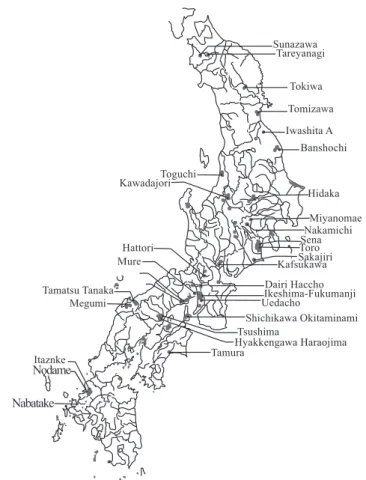
Rice is not indigenous to the Japanese archipelago, but was introduced via the Korean peninsula at the end of the Jomon age. It is now evident that Jomon people in the Kyushu, Chugoku, and Kinki regions accepted rice paddy field cultivation relatively readily, and that even allowing for a time lag in its spread to eastern Japan (Figure 1), there too Jomon people accepted rice cultivation as one of their subsistence activities.
For most Japanese archaeologists, the transition from a hunting and gathering society to the farming societies of the Yayoi age based on rice cultivation is critically important, because the latter established the economic foundations on which all subsequent Japanese societies were built. Japanese archaeologists have therefore greatly emphasised the division between the Jomon and the Yayoi periods. While some insist on viewing this transition in terms of the adoption of rice monoculture, to the neglect of other subsistence activities, recent investigations indicate that not only rice but also other crops, such as soy beans and millet, were cultivated in Yayoi times over almost all of the main islands of Japan. The facts suggest that slash-and- burn farming could have been carried out in mountainous areas since the beginning of the Yayoi age at the latest.
Here I discuss regional variations in attitudes toward rice cultivation, and
consider the reason for the adoption of rice cultivation and its process in terms of
social circumstances rather than economic frameworks.
RICE CULTIVATION AND OTHER SUBSISTENCE
As well as the experience of cultivating domesticated plants, some hunting, gathering and fishing activities were also carried over from the Jomon period into Yayoi times. For Yayoi people to have depended purely on rice monoculture would have been very risky, because rice is vulnerable to variation in temperature and hours of sunlight. Other subsistence activities, including hunting, gathering and fishing, could therefore complement any possible shortage in rice cultivation. A more complex subsistence strategy can be expected to have given an advantage to Yayoi farmers and the precise subsistence combinations pursued can be explored by analysing archaeological data from Yayoi sites. The choice of these combinations is likely to have varied with local ecology, with various possibilities tested as rice cultivation spread through Japan from west to east, initially at least among Jomon hunter-gatherers. We can also expect there to have been differences between
Nabatake Nodame
ItaznkeMegumi Tamatsu Tanaka
Mure Hattori
Sunazawa Tareyanagi
Tokiwa Tomizawa Iwashita A
Banshochi
Hidaka Miyanomae Nakamichi ToroSena Sakajiri Kafsukawa Dairi Haccho Ikeshima-Fukumanji Uedacho
Shichikawa Okitaminami Tsushima
Hyakkengawa Haraojima Tamura
KawadajoriToguchi
Figure 1 Distribution of paddy field sites in Japan (from Latest
Jomon to Yayoi).
organised and managed in the landscape; and knowing how and why paddy-field rice cultivation was accepted by each Jomon society from Kyushu across to eastern Japan, especially in the Kanto and Tohoku districts, where many other subsistence activities provided a wealth of foods available all year around that could themselves support a considerable degree of sedentism and social complexity.
As this last point makes clear, regional variability in the timing of subsistence change, the direction of that change, and its effects on social organisation and the relations between communities committed to a degree of rice cultivation and those still pursuing a more fully hunter-gatherer-fisher way of life are all to be expected.
Regional variation in decision-making on how to accept rice cultivation would have occurred in western and eastern Japan in accordance with the social organisation of those areas.
SUBSISTENCE COMBINATIONS AND ECOLOGICAL SETTINGS
In the Kanto district of Japan at least three key spatial divisions based on ecological settings can be identified:
1) the coast and adjacent area not far from the sea, where the coastal plain, alluvial flood plains, and river terraces have developed;
2) the interior far from the sea, with tablelands that face the river terraces and flood plains; and
3) the high mountains still further inland, with high altitude away from the foothills.
Various combinations of subsistence activities would have been likely, depending on these ecological settings. For example, a combination of rice cultivation with hunting and gathering was probable in both the coastal and the interior areas, but the specific character of the hunting activities undertaken was probably quite different in each case, with coastal farmers awaiting the arrival of animals attracted to paddy fields, but inland farmers dispatching task-specific hunting parties into the mountains in search of game. The precise nature of both rice cultivation and fishing is also likely to have differed. Thus, at the coast fishing is likely to have been very actively pursued, with fishermen seeking to catch large migratory fish such as tuna and bonito as well as shark. Many fishing implements have been found in sites of Yayoi age in this area, whereas freshwater fishing activities in the interior area have left almost no material traces as the implements required were quite different from those used in sea fishing. To explain by analogy with modern Japanese rural practice, freshwater fishing is typically passive in nature as people wait for fish to come into the paddy fields.
In addition to those already mentioned, other subsistence activities that may be
detectable in the Yayoi archaeological record include millet cultivation by slash-and- burn farming on mountain slopes, and hunting and gathering near human settlements, in the interior highlands and still further inland in the mountains. I now look at examples of how these various activities may have been combined.
RICE CULTIVATION IN KYUSHU AND WESTERN JAPAN
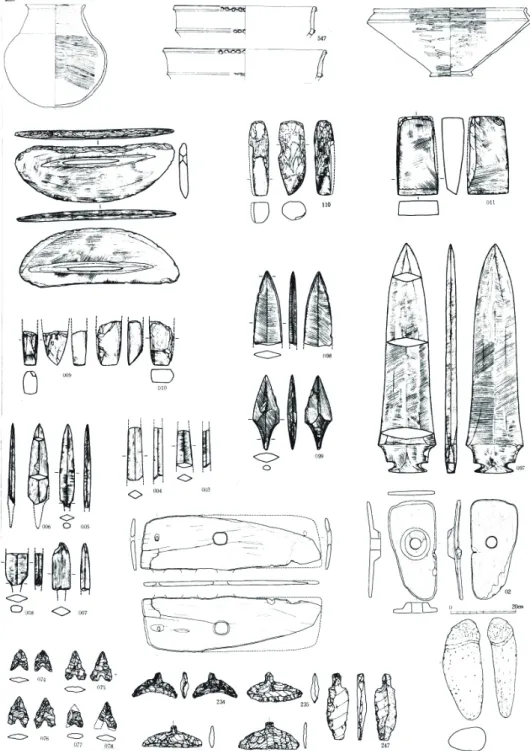
Stone reaping hooks and wooden ploughs and hoes used in rice cultivation, as well as stone arrowheads and wooden bows related to hunting activities, have been found at the Nabatake site (Board of Education of Karatsu city 1982) in Saga Prefecture, Kyushu (Figure 2). This site is located 1 km from the seashore. Layers 9 ‑ 12 yielded evidence of rice paddy field cultivation and farming implements from the Yayoi period, accompanied by Latest Jomon pottery of Yamanotera type. Bones of wild boar indicate that hunting was also pursued, while hooks and other fishing implements suggest marine fishing activities.
This combination of rice cultivation, hunting, and fishing indicates that the first farmers in Japan were not oriented to rice monoculture alone, and that the exploitation of a variety of wild resources complemented those that were cultivated.
Paddy fields with drainage system inlets and outlets have been discovered at the sites of Nodame, Shichidamae, and Itazuke, all in Fukuoka Prefecture. Evidence of garden farming of fields with ridges was also found, while the remains of soy beans and millet have been recovered from an excavation at Mitsusawa-Futsugaura, again in Fukuoka Prefecture (Kataoka 2007).
Evidence of fishing is also widespread. At Tsujibatake in Fukuoka Prefecture fish traps made of twigs that are of Yayoi age were found, indicating that early farmers exploited fish entering paddy fields or small irrigation canals (Figure 3). In the Kansai district, too, fishing implements have been found at settlements of Yayoi age, including fishing traps made of twigs found in a stream near the Early Yayoi Yamaga site, Osaka (Figure 3). The recovery of many wooden spears at the same site suggests that people also stabbed fish entering into man-made aquatic environments near the settlement. Elsewhere, a small shell midden found at Ohnakanoko, Shiga Prefecture, also indicates that farmers engaged in small-scale fishing activities and shellfish collection, while many octopus pots of Yayoi age discovered in a shallow pit at the seafront at Tamatsu-tanaka in Hyogo Prefecture confirm the exploitation of marine cephalopods.
Ethnoarchaeological observations of freshwater fish today tell us that in spring
fish enter the irrigation channels of paddy fields to spawn as soon as they detect the
first running water from the paddy field (Negi et al. 1991). Japanese ethnographers
reported some decades ago that rural villagers living in the Okayama plain caught
catfish and other fish running up the canal to paddy fields at night, a practice
referred to in Japanese as namazugiri (“catfish hooking”) (Yuasa 1977). People also
enjoyed hooking fish in ponds used for irrigation in autumn, and eating the fish on
ritual occasions.
Figure 2 Incipient farming implements and other materials found at Nabatake site
(modified from Board of Education of Karatsu City 1982).
Figure 3 Fishing implements in lakes and marshes found at Yayoi sites in the Kyushu and Kinki district (modified from Higashiosaka City Cultural Association 1987;
Archaeological Research Group of the Second Hanwa National Highway 1970;
Osaka Cultural Heritage Center 1984; Board of Education of Fukuoka 1979).
RICE CULTIVATION AND OTHER SUBSISTENCE COMBINATIONS IN THE TOKAI AND CHUBU DISTRICTS
As previously indicated, three kinds of settlement pattern can be distinguished according to their ecological settings.
1) Coast
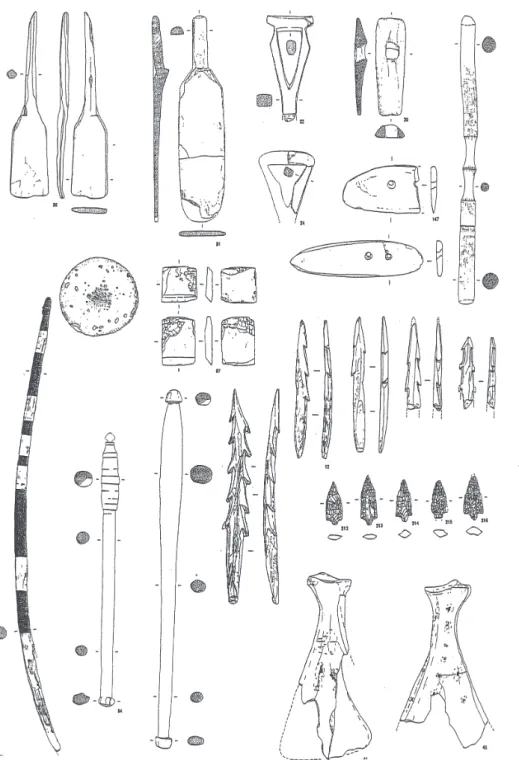
Asahi is a well-known Yayoi-period site because of the large size of its settlement area and the fact that it was surrounded by circular ditches. Paddy-field rice cultivation is inferred to have taken place near the site because of the discovery of many wooden ploughs and hoes (Figure 4), as well as the presence of carbonised rice grains in the excavated deposits (Board of Education of Aichi Prefecture 1982).
Well-preserved barbed harpoons and spears made of deer antler (Figure 4) and a rich
assemblage of fish bones indicate that marine fishing was also important. Whether
Figure 4 Archaeological materials found at Asahi site (modified from Board of Education
of Aichi Prefecture 1982).
⑴ Location of Weir in the site
⑵ Location of Weir in Ditch
⑶ Detail of Weir