著者(英) Yoshio Nishi, Yasuhiko Nagano journal or
publication title
Senri Ethnological Reports
volume 19
page range 1‑30
year 2001‑03‑28
URL http://doi.org/10.15021/00002140
A general review of the Zhangzhung studies
Yoshio NisHi
Kbbe City [iniversity ofIloreign Stndies (ITmeritusi
and Yasuhiko NAGANO
AIZztional Museum of Ethnology Osako
1. Introduction
Zhangzhung is a Tibeto‑Burman (I'B, hereafter) language that was spoken in Western Tibet before the establishment of the Tibetan Empire (the first unified kingdom in Tibet). This language was gradually replaced by Tibetan as the latter became dominant, and finally died out completely around the 11th century. While Zhangzhung is often said to have been spoken by believers of the Bon religion, this is not strictly correct. In fact, Zhangzhung was the language of the dMtz tribe in lower Zhangzhung, and this tribe believed in Bon. This is how the Bon religion came to be associated with Zhangzhung.
The kingdom of Zhangzhung existed in Western Tibet and exerted strong political influence even before the establishment of the Tibetan Empire. The existence of the kingdom of Zhangzhung has been known for many years because it played an important role in the establishment of the Tibetan Empire. However, little mention has been made of the language spoken in Zhangzhung.
There are several reasons for this. First, only few Zhangzhung texts are extant.
Second, no corresponding bilingual texts have been identified. Third, the Zhangzhung language died out completely, making it impossible to identify which modern Tibeto‑Burman languages can be directly compared with Zhangzhung.
Since the beginning of the 20th century, research on the Tibetan texts unearthed in Dunhuang has made considerable progress, and it has been found that some of these texts are written in unknown languages using Tibetan letters. F. W.
Thomas assumed these languages were Zhangzhung and Nam. He analyzed the forms of the fragments of words appearing in these texts and framed the following hypothesis:
(1)
(2)
The two texts which were available at the time of the analysis and which were supposedly written in Zhangzhung deal with issues relating to herbal
medicine. (A third text was analyzed later.)
The lexical forms excluding those of the Written Tibetan and Sanskrit loanwords indicate a genealogical relationship between Zhangzhung and the
̀pronominalized languages' (S. Konow's terminology in his Lingutstic Survay ofIhdia [LSI]) of Western Tibet.
1
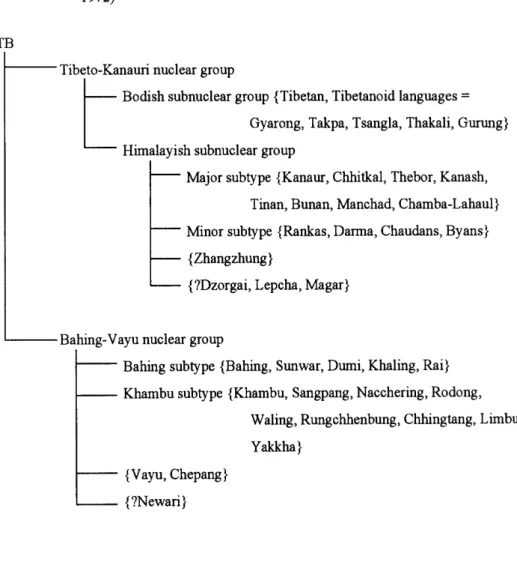
2. With the advances in Sino‑Tibetan and Tibeto‑Burman linguistics that followed, many more texts suitable for comparative study were discovered. For example, using the same texts used by Thomas, R. Shafer described Zhangzhung as Old Almora (1957: 195 => Table 1), while Benedict classified Zhangzhung under Tibeto‑Kannaur (1972: 7 => Table 2).
However, when Tatsuo Nishida analyzed the same texts he concluded that Zhangzhung shares some linguistic characteristics with the Tibetan sub‑group. He wrote, " It is not at all impossible to construct a provisional grammar by analyzing the texts and examining the units, words, and affixes that repeatedly appear in these texts, even if the meaning or function of the individual units remains unknown... To give an easily understandable example, I will discuss some yet‑to‑be clarified Zhangzhung words I have been studying for years." He then examines some words that are considered to have Tibetan correspondence, such as cigun‑kha (Written Tibetan) and gun‑kha (Zhangzhung) meaning winter; and ston‑thog (Written Tibetan) and tog‑kha (Zhangzhung) meaning harvest time. He also argues that particles appearing at the end of sentences such as nwe'o, ‑khyiro, and ‑shido have Tibetan correspondence, and this usage is characteristic of Tibetan (Nishida 1982:21‑24). Nishida also tells us, "Nevertheless, we have yet to clear many hurdles before we are able to apply certain grammatical rules to the general relationship between Written Tibetan and Zhangzhung, because it is difficult to identify the Tibetan correspondence of many Zhangzhung words. Yet, this does not necessarily mean that al1 the Zhangzhung words that have Tibetan correspondence are loanwords (Nishida 1982: 24)." Indeed, the examples shown above indicate a relationship between Tibetan and Zhangzhung, but it can also be argued that al1 of these words are loanwords. Nishida (1987:112) classifies Zhangzhung in the Tibetan language group, positioning it closer to Written Tibetan than to the Gyarong and Himalayan pronominalized languages (=>Table 3).
Our predecessors' achievements provide important clues to help us identify the unknown languages used in the Dunhuang texts. However, we must not accept al1 these theories without question, because there is no proof that the three Dunhuang texts are written in Zhangzhung. We have only Thomas claim and there are no firm grounds for determining that these languages are Zhangzhung. Thomas wrote, " The language is clearly Tibeto‑Burman, and there are many indications of close relation to the Lepcha, even if it is not an old form of that language" (1926:
506), but did not show any real evidence for this inference.
The whole picture of Thomas' hypothesis remains obscure because he died
before completing his study. However, Professor Tsuguhito Takeuchi who is
involved in our project discovered Thomas' notes containing research results on the
Zhangzhung language in the British Library. We plan to edit and publish these notes
in hopes that they wil1 add to our understanding of Thomas' study.
A general review of the Zhangzhung studies 3
Table 1 Shafer's classification of the TB languages in the Himalayas (Shafer 1 966;
reinterpreted by Nishi 1 990) [N.B.:The name of language is shown in a brace while its dialects are in a square bracket.]
Bodish Division
Bodish Section
L Gumg Branch (Tamang group) {Gurung, Tamang, Thakali}
West Himalayish Section NNW Branch
t
{Bunan}
{Thebor} [Sumchu, Zhangram, Kanam, Lippa]
NW Branch
L
{Kannaur} [Upper, Lower, Chhitkal, Tikpa, Kanash]
{Manchad} [Chamba Lahaul, Ranglo]
Almora Branch {Rangkas, Darrniya}
{Chaudans, Byans}
Janggali Branch
Eastern Branch {Thami, Bhramu}
West Central Section {Vayu, Chepang, Magar}
East Himalayish Section Western Branch
Bahing Unit {Bahng, Sunwar}
Thulung Unit {Thulung}
Chourase Unit {Chourase}
Dumi Unit {Dumi, Khalmg, Rai}
Eastern Branch
trlig.allRIXU.Ili,1{,K.h,zm,R,E'Sil;・;:.,g',.N.a.c,hg.erlnig..,,
Kiranti, Dungmali] , Lambichhong, Lohorong, Limbu [Limbu, Yakha] }
Newarish Section {Newari, Pahn}
Dhimalish Section {Dhimal, Toto}
Table 2 Benedict's classification ofthe TB languages in the Himalayas (Benedict 1972)
TB
Tibeto‑Kanauri nuclear group
Bodish subnuclear group {Tibetan, Tibetanoid languages = Gyarong, Takpa, Tsangla, Thakali, Gurung}
Himalayish subnuclear group
Major subtype {Kanaur, Chhitkal, Thebor, Kanash, Tinan, Bunan, Manchad, Chamba‑Lahaul}
Minor subtype {Rankas, Darma, Chaudans, Byans}
{Zhangzhung}
{?Dzorgai, Lepcha, Magar}
Bahing‑Vayu nuclear group
Bahng subtype {Bahng, Sunwar, Dumi, Khaling, Rai}
Khambu subtype {Khambu, Sangpang, Naccheimg, Rodong, Waling, Rungchhenbung, Chhingtang, Limbu, Yakkha }
{Vayu, Chepang}
{ ?Newari }
A general review of the Zhangzhung studies 5
Table 3 Nishida's classification of TB languages (Nishida 1987)
Himalayish pronominalized languages Zhangrhung
Amdo Tibetan Western Tibetan Khams Tibetan
Tibetan Medieval Tibetan
Written Tibetan Central Tibetan Southern Tibetan Tsona Monpa Tibetan Gyarong
TB
Qiang
LB Chin Bodo‑Naga
Nonhern Assam
Generally speaking, most of the lexical items that have・Written Tibetan correspondence are Tibeto‑Burman roots (= widely spread shapes among various sub‑groups of Tibeto‑Burman), and are not characteristic of Tibetan alone.
However, not al1 lexical forms that have West Himalayan correspondence are Tibeto‑Burman roots. Therefore, it is logical to examine Zhangzhung in light of its relationship to the West Himalayan languages.
3. In previous research, too much importance was placed on the association of
Tibeto‑ lexical forms considered typical of Zhangzhung with any sub‑groups of
Burman. Of course, examining the genetic relationship is necessary, but we must
first try to find what is written in the three Dunhuang texts. Lacking any bilingual
texts, this work presents serious difficulties, but steady progress has been made with
the help of mathematical statistics. While we have not yet made any dramatic
discoveries, examining the frequency and distribution of words in their various forms and comparing them with the syntax of the Tibeto‑Burman languages has led us to believe that Zhangzhung is not characterized by the pronominalization, in spite of its possible genetic relationship with the Western Himalayan languages. However, we cannot be certain that this language has no pronominalization, because if these texts actually discuss issues relating to medicine as Thomas claimed, then first and second person pronouns are unlikely to appear. The results of this research will be shown in Takeuchi, Ueda and Nagano (pp. 45‑96).
4. Another important object of research is the Tibetan‑Zhangzhung Dictionary published in 1965 in Delhi. This dictionary is a compilation of Zhangzhung words and usage collected by Nyima Dakpa from Zhangzhung texts preserved in Bon monasteries, and is edited by Tenzin Namdak, presently chief priest of the Tritan Norbutse Monastery in Kathmandu. Most of the examples shown in this dictionary were taken from gZi‑bnjid and mDzod‑phug, and are believed to relate to the tradition of ̀organized' Bon in its early days.
Erik Haarh who analyzed this Dictionary in detai1 and compared the language with Tibeto‑Burman languages, concluded that:
The above few examples of word‑correspondence, which are characteristic for the whole vocabulary of the dictionary, together with the evidence of the particles in the above table, indicate that the Zhangzhung language belongs to the West Tibetan languages, most probably among the Complex Pronominaiized dialects of the Western group, following the terminology of the Linguistic Survey of India. This confirms the allegations of F. W. Thomas and R. Shafer with regard to the manuscript from Tutkestan mentioned above (Haath 1968:
26).
R A. Stein (1971) and Yamaguchi (1988) fOcused on the vocabulary used in
the teachings of Bon. They concluded that the Zhangzhung language was created by
Bon believers, since most of the words are loaned from Tibetan, formed by
modifying Tibetan words through metathesis, backward reading and/or back
formation, or by combining Sanskrit and Written Tibetan words. Yamaguchi even
disputed the authenticity of the texts themselves, saying, "Although the Zhangzhung
language is known to us as the language of the dMu tribe, the origin and authenticity
of this language is still open to question." (Yamaguchi 1988: 5). However, their
arguments focused solely on the religious terms, and they showed little interest in
examining the characteristics of the language as a whole. Bon believers tried to
arrange their religious texts much later than Buddhists, and it seems plausible that
they coined words based on Sanskrit and Tibetan to explain their beliefs. Moreover,
word formation in various types is a widely observed practice, as is evidenced by
many translations of the Buddhist texts. If Stein and Yamaguchi had directed their
attention at the basic vocabulary as well, they would certainly have reached different
A general review ofthe Zhangzhung studies 7
conclusions. In fact, Zhangzhung does make a kind of link language connecting the Himalayan languages, and there is little doubt as to the authenticity of most of the examples contained in the dictionary.
5. Next, we will examine the comparative linguistic studies of Haarh (1968) and Sharma ( 1988).
1. Haarh examined LSI's materials, and compared suffixes, numerals from one to ten, and words which he thought were characteristic of the Himalayan languages such as ̀ear', ̀iron', ̀water', ̀horse' and ̀dog' (see Table 4). However, LSI's materials themselves were not reliable enough to be used for a comparison of suflixes. Moreover, his comparison chart contains few examples that strongly support his hypothesis. It could be inferred that, based on the comparison of ̀one',
̀four' and ̀seven', the Zhangzhung language does not belong to the Tibetan sub‑
group but Haarh failed to show convincing evidence that this language is closely associated with the Himalayan languages. The Zhangzhung word hrang ̀horse' has Written Tibetan correspondence, and even Jingpho and Burman, the languages of geographically remote areas, have words that seem to stem from the same origin.
The words ting ̀water' and ku‑ra ̀dog' are widely distributed and should be regarded as having Tibeto‑Burman roots. Clearly, the word zangs ̀iron' corresponds to the Written Tibetan word meaning ̀copper', although there has been a shift in meaning. Most likely, this word is a loanword. From this, we can conclude that, among the words Haarh listed as examples, only ra‑tse ̀ear' positively demonstrates Zhangzhung's genetic relationship with the Himalayan languages.
Yet, as Nishi (1989) claims, there are many other important words than those Table 4 Haarh's comparison (Haarh 1968: 25‑26)
Newari Pahri Tinan Bunan Byangsi Zhang‑
Classi Collo‑ Collo‑ Written Collo‑ Written Collo・‑ Collo‑ zhung
cal quial quial [21] quial [21] quial quial
19 20 [20] 20 20 [20]
1 chi chi thi‑・ki i,id ti'ti‑ki ti‑ki
.tlg .tlg2 ni nlsl ‑‑ nyi‑ji nyizhi nyls nyis‑king ni
jv ‑
3 swom so songo srum shrummu sum SUMI sum sum
. . .
‑7‑ e‑
. ‑4 Pl Pl pmgl Pl1 Pl Pl Pl bing
e‑
.5 nga nga ngongu nga ngar nga1 ngal nge nga
6 khu khu khugu tru'i trug truk drug
7 hnas nhasa nhagi nyi‑ji nyid‑chi nyi‑・ji nyizhi ms
‑sms8 cya chya chegi gye'i gyad gyel jedr gyad
9 gu g.N gugu gu gu gu gu‑dug
10 'i sanha ‑‑‑
11 sa sa cu' i chui chi cu
1