Plasma-wall interaction is one of important issues to control the plasma confinement. The effect of high-heat load on the first wall from the plasma has been stud- ied widely from a viewpoint of the radiation damage.
However, the foundamental process of plasma particle interaction with the wall materials still remains as one of unresolved problems. For an example, the data of the characteristics of the particle reflection from the wall has not been accumulated satisfactory. In the plasma cham- ber, interestingly, nano-materials have been found in the plasma dust. Recently nano structure materials have been paid much attention due to physical properties, unique structure and future application. But the un- derstanding of particle interaction with nano-materials is unknown. In this report we briefly show the result of our study on the low-energy particle interaction with car- bon nano tube (CNT). We prepare super-growth CNT which are vertically-aligned with Si and graphite tar- gets. 1) By comparing to the graphite, which is one of the candidates of the first wall materials in fusion re- actor, with vertically-aligned CNT we may understand more precisely the process of the particle interaction with matters.
We have been developed an experimental system to study the fundamental processes of particle interac- tion with solid surfaces.2, 3) Figure 1 shows a schematic diagram of the experimental setup. Incident H+ beam is injected on the target and reflected ions are detected by a magnetic momentum analyzer. With this analyzer system angle- and energy-resolved measurements were performed for the reflected H+ ions. We can change the angles of the target and analyzer independently. We had studied low energy particle (<10 keV) interaction with nano-materials such as carbon nanowall and nanotubes (CNT), and other bulk materials such as W, graphite and Ti. The CNT samples were synthesized with ther- mal CVD (chemical vapor deposition) technique on a Si crystal. 1) Fe layer as catalysis was coated on the Si surface. We prepared the vertically-aligned CNT with thickness of about 50, 100 and 300 μm. X-ray diffrac- tion on the horizontal plane shows that the CNTs are nearly single wall.
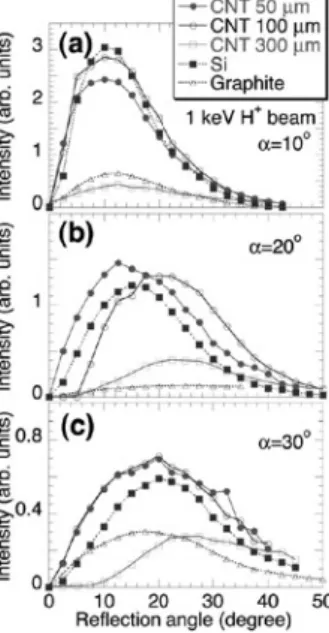
Figure 2 shows an example of the incident beam energy dependence of the reflected H+ particles at the incident angle of (a) 10◦, 20◦, and 30◦, where the inci- dent angle is defined to be the angle from the surface.
Fig. 1: Schematic diagram of the experimental setup.
We can change the angles of the target and magnetic momentum analyzer independently. Incident (α) and re- flection (β) angles are defined as the angles from the target surface.
Fig. 2: Characteristics of the reflected H+ ions with the incident H+ion energies of 1 keV on super growth CNT targets at the incident angle of (a) 10◦, 20◦, and (b) 30◦. The results for Si crystal and graphite are also shown for comparison.
These samples show specular reflections on the whole.
Atα=10◦reflection characteristc of 300μm-CNT is very similar to that of graphite, showing a broad specular re- flection. On the other hand, 50 and 100 μm-CNTs are similar to Si crystal. Atα=20◦the peak of the 100μm- CNT shifts to those of the 300 μm-CNT and graphite.
Mean free path of the incident H+ beam depending on the target density using the ACAT code is under calcu- lations.
1) K. Hataet al.,Science306(2004) 1362.
2) M. Wadaet al.,Rev. Sci. Instrum.73(2008) 955.
3) N. Tanaka et al., J. Nucl. Mater. 390-391 (2009) 1035.
442
§14. Low-energy Particle Reflection from Highly-oriented Carbon Nano-tubes
Yamaoka, H. (Harima-RIKEN), Tanaka, N. (Tohoku Univ.), Nishiura, M., Tsumori, K.,
Kenmotsu, T., Wada, M., Sasao, M. (Doshisha Univ.), Matsumoto, Y. (Tokushima Bunri Univ.),
Hata, K. (AIST)