Current Trends of Out‑Migration from Kosrae and Pohnpei, the Federated States of
Micronesia
著者(英) Akitoshi Shimizu
journal or
publication title
Bulletin of the National Museum of Ethnology
volume 20
number 4
page range 753‑771
year 1996‑03‑29
URL http://doi.org/10.15021/00004179
Sumnzu Current Trends of Out-Migration from Kosrae and Pohnpei
Current Trends of Out-Migration from Kosrae and Pohnpei, the Federated States of Micronesia
Akitoshi SrnMizu*
INTRODUCTION
This paper is to report and analyse certain basic statistical data I collected con- cerning out-migration from Kosrae and Pohnpei, two states constituting the eastern half of the Federated States of Micronesia (FSM) .1) The topic was the first necessary agendum for a comprehensive study I intended to conduct on out-migration from those two states; that topic was necessary and indispen- sable, since available official statistics, compiled by the federal and state govern- ments, scarecely mention out-migration from the FSM. One may say that this virtual non-existence of official statistics constitutes part of the whole phenomenon of out-migration from the FSM.2> There are at least two reasons for the federal and state governments of the FSM to be indifferent to citizens' out-migration; first, the wave of mass out-migration from the FSM began only recently; second, the immigration-emigration control of the FSM is only con- cerned with foreigners. These two features are not isolated phenomena; the
* 4th Research Department
, National Museum of Ethnology
Key Words : migration. FSM. Kosrae. Pohnnei. Pacific. MIRAB economy. development キ ー ワ ー ド:移 民,出 稼 ぎ移 民,ミ ク ロ ネ シ ア 連 邦,コ シ ャ エ(コ ス ラ エ),ポ ーン ペ イ,太 平 洋,MIRAB経 済,開 発
1) The present paper is an interim report of my research on out-migration from Kosrae and Pohnpei which was conducted during three fiscal years from 1992/93 to 1994/95, and in this paper primarily the data obtained while I was in Kosrae and Pohnpei for two months in early 1993 are presented and analysed.
2) Here the emphasis is placed on the characteristic lack of information provided by authorities of the FSM. In Guam, federal and local government offices and scientists have been paying at- tention to immigrants from Micronesia and their social effects. The 1990 Census of Population and Housing for Guam reports that, among the total 133,152 residents of Guam in the census year, those who were born in the FSM numbered 2,964 , of whom 1,843 were born in Chuuk, 136 in Kosrae, and 662 in Pohnpei [US DEPARTMENT OF COMMERCE 1992: 15]. The University of Guam has also conducted censuses on Micronesians in Guam, the report of which for 1992 counted 3,556 Chuukese, 192 Kosraeans and 866 Pohnpeians [UNIVERSITY OF GUAM 1992: 4].
Rubinstein and Levin [1992] analyse general characteristics of Micronesian migration to Guam. Thus, specifically for Guam, information on out-migration from the FSM has been systematically collected and analysed, but information concerning Guam represents only part of the whole out-migration from the FSM.
753
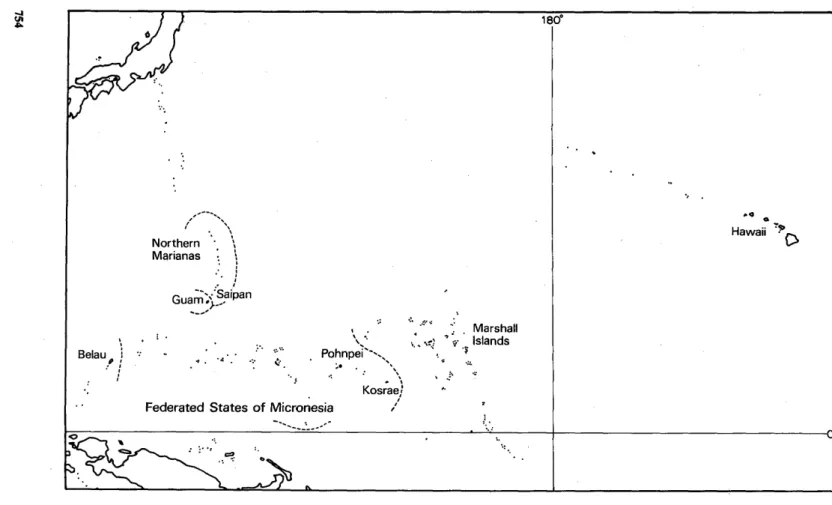
Fig. 1. Federated States of Micronesia in the Pacific
Szu Current Trends of Out-Migration from Kosrae and Pohnpei
first is deeply concerned with the structure of the FSM's national economy and its change in recent years; the second implies immaturity of the FSM as an in- dependent state. An extended interpretation of those correlates will constitute a good introduction to the politico-economic background of out-migration.
Structural Change of the National Economy
First, the very few official sources of information on out-migration suggest how recently, and in what situation of the national economy, the wave of mass out-migration began. Among the documents officially published by the FSM government, I found two which mention out-migration of FSM citizens, i.e.
the First and the Second National Development Plans for 1985-1989 and 1992-1996, respectively [FSM 1985, 1991]. The First Development Plan, ap- proved by the Congress of the FSM in 1985, referred to migration of citizens in the chapter on population. Noting rapid natural growth of the FSM's popula- tion with a structure heavily weighted towards youth, both implying increasing burdens for administrative expenditure, and offsetting the prospected slight economic growth, the book mentioned out-migration of the FSM citizens as follows:
The population projections [for the years 1980-1990] do not take into considera- tion any (net) international migration of the FSM's population during the Plan period. Emigration has been relatively insignificant, being mostly on a temporary basis for higher education [FSM 1985: 86] .
On the other hand, the Second National Development Plan, approved by the-Congress in 1991, counts out-migration of population as one of the crucial
factors influencing development, or rather underdevelopment, of the national economy. The book starts with the following introduction:
[...] Economic development is progressing slowly, levels of out-migration are high, [...] [FSM 1991: 3].
Since most elements of the national economy—funding under the Free Association with the USA (see below) , the national budget, the domestic labour market, domestic industries and commerce in the private sector, etc.—are anticipated either to remain the same or to worsen, the Second Development Plan finds out-migration of population as the only positive factor which is expected to contribute towards improvement of the difficult situation of economic development. The book frankly admits, 'the exact magnitude [of out-migration] is not known because of inadequate statistics' [FSM 1991: 40], and `[d]espite their obvious importance, statistics relating to immigration and emigration suffer from serious inadequacies' [FSM 1991: 43]. Neverthe-
755
国立民族学博物館研究報告 20巻4号
less, it projects as follows:
Over much of the last forty years, the growth proportion of population in the FSM has exceeded 3% per annum [...] However, since the Compact agreement was sign- ed, a major change has taken place, and out-migration is now a significant factor.
Approximately 2% of the population of the FSM is leaving each year, so that the annual growth proportion of the domestic population has now fallen below 1%
[FSM 1991: 39].
The growth of the population, even at an overall proportion of less than 1%
per year, will place severe strains on the nation [FSM 1991: 42] .
If new employment opportunities are not created quickly enough, living stan- dards will begin to fall and out-migration will increase further. Fortunately, migra- tion to the US is a continuing option under the Compact, and the availability of this option provides an important safety valve, [...] [FSM 1991: 5, italics added].
Those citations from the development plans of the FSM suggest the recent, rapidly changing situation of the FSM's national economy, which seems to be pertinently analysed by referring to the seminal concept of the MIRAB economy coined by Bertram and Watters [1985]. The concept was devised in order to characterise the national economies of the microstates in the Pacific, which more or less consisted of the four structural elements, MIgration, Remit- tance, Aid and Bureaucracy.
When the First Development Plan was drafted in 1985, the FSM was to at- tain national independence in the next year. Inheriting the colonial legacy, the economy of the FSM had already been structured with aid and bureaucracy.
The two factors were given institutional endorsement by the Compact of Free Association with the USA. As the frequent references which the Second Development Plan makes to the Free Association suggest, as far as aid and bureaucracy were concerned, the FSM's national economy remained the same until the period covered by the Second Development Plan. The citation from the First Development Plan indicated that both migration and remittance were still insignificant. Since the FSM's national economy at the time of in- dependence consisted of two structural factors, Aid and Bureaucracy, out of the four factors constituting the MIRAB economy, it can be characterised as an AB economy.
On the other hand, when the Second Development Plan was drafted, the
factor of migration had been fully built into the structure of the national
economy. The Second Development Plan projects that, during the period
1990-1995, about 580 Pohnpeians and 110 Kosraeans will emigrate every year
[FSM 1991: 41]. As for the factor of remittance, however, `it is likely that the
contribution made by remittances [sent back to the FSM by emigrants] to
disposable incomes [at home] will be small' [FSM 1991: 43]. The FSM's na-
Snanzu Current Trends of Out-Migration from Kosrae and Pohnpei
tional economy at the time when the Second Development Plan was drafted can be characterised as a MIAB economy. The FSM's national economy changed from an AB to a MIAB economy during a brief period of six years—such a rapid change that, as the Second Development Plan frankly admits, the FSM's government remained indifferent to taking statistics of out-migration.
An Immature State
The second reason for the FSM government's indifference to compiling statistics on out-migration is concerned, I argue, with the nature of the FSM as an independent state. In order to obtain an overview on the out-migration of FSM citizens, I approached relevant offices of the FSM federal government and offices of the state governments of Pohnpei and Kosrae, and collected as many official publications as possible on general statistics, population censuses, development plans, etc., issued by the national and local governments in recent years. However, my endeavour turned out to be disappointing and futile; ex- cept for just three publications, I found no mention of citizens' out-migration in any publications I collected. I have already referred to two out of those three available publications. The remaining exceptional publication which mentions citizens' out-migration is the Kosrae State Statistical Bulletin.
Out of this situation, I conclude that any offices of the federal and state governments do not appear to take charge of the following two tasks:
1) collecting the statistics on the FSM citizens emigrating to and returning
from foreign countries; the offices of immigration only pay attention to non-FSM-citizens visiting and staying in the FSM;
2) looking after the FSM citizens staying temporarily or living permanently in foreign lands; even though it was reported that a large number of FSM
citizens living Guam were suffering from the damages by a typhoon which at-
tacked that island in August 1992, no government offices at Palikir,
Pohnpei, had the exact number of the FSM citizens staying there, and
basically remained indifferent while the local government of Guam took
charge of relief policies.
Probably, this governmental indifference to immigration-emigration control of the FSM's citizens can be correlated with the Compact of Free Association enacted between the FSM and the US. Article IV, Section 141 of the Compact states:
(a) Any person in the following categories may enter into, lawfully engage in oc- cupations, and establish residence as a non-immigrant in the United States and its territories and possessions [...]
(1) A person who ... has become a citizen of Palau, the Marshall Islands or the Federated States of Micronesia; [...]
Such persons shall be considered to have the permission of the Attorney General of
757
国立民族学博物館研 究報告 20巻4号
the United States to accept employment in the United States.
Thus, the Compact assures citizens of the FSM free entrance to, free residence in, and free employment in, the USA. So far as these rights are concerned, FSM citizens are treated in the USA exactly in the same way as US citizens are.
From the point of view of FSM citizens, the Compact made the border separating the FSM and the USA meaningless, and it seems that the federal and state governments of the FSM share this view. FSM citizens may be motivated to emigrate to countries other than the USA (in one case actually more than a
hundred FSM citizens went to Japan to attend a 'job-training project' in the 1970s and `80s), but the nearest foreign lands are Guam and Hawaii, where FSM citizens can expect more chances of occupation and higher education than in more distant foreign lands. The FSM government itself considers that in most cases FSM emigrants go to Guam, Saipan, Hawaii and the US mainland [FSM 1991: 40]. It is inferred that the Compact of Free Association with the USA induced the FSM government to be entirely indifferent to citizens' emigra- tion in general. Nevertheless, FSM citizens are required to have passports when they enter the USA. To protect citizens visiting or residing in foreign countries is definitely part of the sovereign duty of an independent state. In this respect, it is to be regretted that both federal and state governments of the
FSM pay so little attention to emigrating citizens.
PATTERNS OF OUT-MIGRATION FROM KOSRAE
Statistical Data
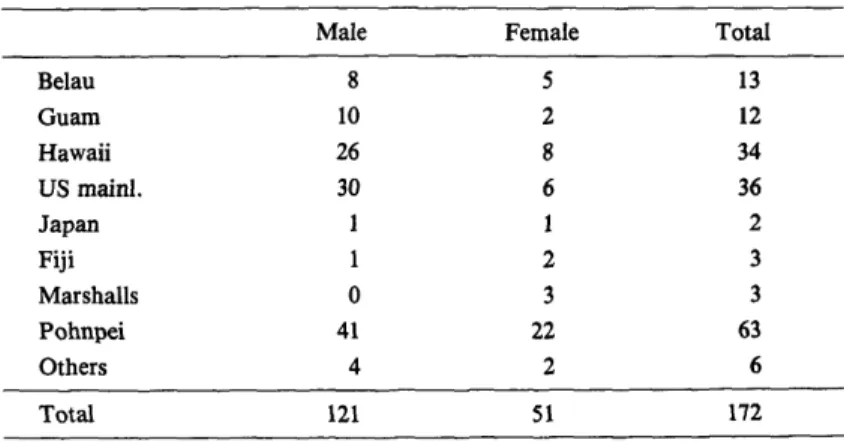
As already noted, the only official source of information which provides concrete statistics on FSM citizens' out-migration is the Kosrae Statistical Bulletin. The Bulletin for 1991 gives the number of Kosrae citizens residing abroad, as presented in Table 1. A comparison of the total emigrants (A in this table) with the total population of Kosrae indicates the scale of out-migra- tion; we obtain the following statistics on population estimates (B) and, by dividing A in Table 1 by the population (B), the proportion of emigrants (A/B in Table 2) . The proportions for municipalities are not even, but on average nearly 9% of the Kosraean population are living abroad and in one municipali- ty that proportion amounts to almost 16%.3) .3) Although those proportions are
3) The proportions mentioned here are those of migrants to the resident Kosraeans (or the resi- dent members of the municipalities) . In theory, the more meaningful proportion may be that of migrants to the total population consisting of the resident Kosraeans and the emigrants.
However, since not all emigrants maintain contact with their families and relatives at home, it is
more realistic to consider that the resident Kosraeans virtually constitute the population of
Kosrae. This conforms to the view adopted in the National Development Plan of the FSM.
SmEzu Current Trends of Out-Migration from Kosrae and Pohnpei
Table 1. Kosraean Citizens Residing Outside by Municipality and Sex, 1991
Municipality Male
Female Total (A)
Lelu Malem Utwa Tafunsak
105 156 55 128
68173 89245 2580 43171
Total 444 225669
(Source: Kosrae Statistical Bulletin 1991: 63)
still low compared with their counterparts in typical MIRAB economies like Cook Islands, Niue and Tokelau, where emigrants are almost equal to, or even outnumber, the residents of their home islands [BERTRAM and WATTERS
1985: 502], the actual number of Kosraean emigrants are almost six time that of the annual emigrants projected by the Second Development Plan [FSM
1991: 41]. As far as Kosrae is concerned, one may say that people's out-migra- tion has become a structural feature of Kosraean society.
Places of emigration from Kosrae
In order to analyse factors involved in people's out-migration, I chose Malem as a sample municipality for a more detailed investigation. The Bureau of Planning and Statistics, as a special favour, co-operated in my research and offered me a list of those Malem people who were residing abroad at the time when the Bureau researched Kosraean emigrants in 1991, on condition that I pay full attention to the privacy of those people concerned. The list contained
210 out of the total 245 Malem emigrants, and the name and sex of each emigrant were recorded.
First I tried to ascertain for each person in the list the initial objective of emigration and his/her later life—where and how he/she lived thereafter—till the time of my investigation. Since the information I obtained was basically of hearsay nature, and not a few emigrants' families remaining at Malem had only
Table 2. Population Estimates by Municipalities in 1991
Population Estimates (B) Proportion (A/B)
Lelu Malem Utwa Tafunsak
2,811 1,568 1,206 2,000
6.2%
15.6%
6.6%
8.6%
Total 7,585
8.8%
(Source: Kosrae Statistical Bulletin 1991: 63. The proportions are added by the present author)
759
国立民族学博物館研究報告 20巻4号
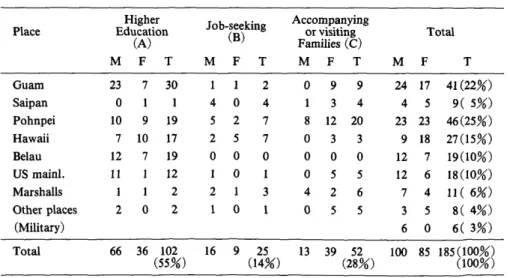
a meagre knowledge of where and how their emigrating families were living, the information cannot be claimed to be comprehensive and fully accurate. Out of the 210 emigrants from Malem, I could identify the places of emigration and their initial objectives for 185 persons, on whom the following analyses will be based.
Interviews with Malem people revealed that post-high-school education and job-seeking were the main objectives of emigration. Formerly voluntary military service in the US Armed Forces was one of the most conspicuous motivations of emigration. Of course a salary is paid for that service and one may consider it a case of getting a job abroad. It is also true that various scholarships and other chances for education provided by the US Armed Forces are great incentives to applying for military service. Thus military service as an objective of overseas emigration overlaps education and job-seeking but, con- sidering its political as well as economic characteristics, I distinguish it from the other two. By classifying the sample emigrants by place and objective I obtain- ed Table 3.
Pohnpei and Guam attracted the most numerous emigrants. Since Saipan is adjacent to Guam and both are the largest tourist resorts in Western Micronesia, we may count the two places together. Then Guam/Saipan at- tracted 50 persons or 27% of all sample emigrants. Pohnpei is comparable with Guam/Saipan, and they are followed by Hawaii, Belau (Palau) , the US mainland, etc. While Guam, Pohnpei and Hawaii attracted both students and working emigrants, Belau received only student emigrants. In contrast, Saipan, considered individually, was predominantly a place for job-seeking.
Table 3. Initial Objectives of Malem Emigrants, 1991
Place
Higher Education
(A)
Jo
Job-seeking (B)
Accompanying or visiting Families (C)
Total
M F T M F T M F T M F T
Guam 23 7 30 1 1 2 0 9 9 24 17
41(22%)
Saipan 0 1 1 4 0 4 1 3 4 4 5
9( 5%)
Pohnpei 10 9 19 5 2 7 8 12 20 23 23
46 (25%)
Hawaii 7 10 17 2 5 7 0 3 3 9 18
27 (15%)
Belau 12 7 19 0 0 0 0 0 0 12 7
19 (10%)
US mainl. 11 1 12 1 0 1 0 5 5 12 6
18 (10%)
Marshalls 1 1 2 2 1 3 4 2 6 7 4
11 ( 6%)
Other places 2 0 2 1 0 1 0 5 5 3 5
8 ( 4%)
(Military)
6 06( 3%)
Total 66 36 102 16 9 25 13 39 52 100 85
185 (100%)
(55%) (14%) (28%) (100%)
Keys M: Male, F: Female, T: Sub-total
Slummy Current Trends of Out-Migration from Kosrae and Pohnpei
Objectives of out-migration from Kosrae
It is one of the most conspicuous features of Kosraean out-migration that those who went abroad to study at colleges or universities far outnumbered
those who emigrated to seek jobs abroad. In the official statistics, it is reported that 172 Kosraean students received official (i.e. federal and state) scholarships to study abroad in 1991/92 (Table 5) . In comparison with the total 669 Kosraeans living abroad in the same year, students comprised 26% of all emigrants. But my investigation on the initial objectives of emigration reveals that education is far more important than other motivations, particularly job- seeking.
Table 3, which is compiled in terms of the initial objective of emigration, indicates that, among the 185 Malem emigrants, 102 persons left Kosrae in 1991/92, or earlier than that year, in order to study abroad; hence we have a sharp contrast between the two major objectives: 102 student emigrants (55%
of all sample emigrants) as against 25 working emigrants (14%) . Since thir- teen (4 males and 9 females) among the total 42 persons accompanying emigrating families are accompanying working emigrants, emigrants belonging to the latter category may be enlarged to 38 (i.e. 25 plus 13) persons, and yet the contrast between students and workers is 102 (55%) to 38 (21%) . The relatively small proportion of working and other emigrants in my statistics in comparison with the official data (Table 5) implies that there were many ex- students among working emigrants; even after leaving colleges, student emigrants tended to continue staying abroad, thus becoming working emigrants. An overall summary of my investigation reveals that Kosrae is very unique in having high, one should say exceptionally high, motivation for col- lege/university education abroad.
In this regard, the Department of Education compiled statistical data which endorses Kosraean high motivation for education after high school (Table 4) . Since the Kosrae High School (KHS) allowed enrolment of all ap- plicants graduated from elementary schools in the FSM, there were students coming from other states, particularly from Pohnpei where, due to the limited capacity of the one state high school (Pohnpei Island Central School, PICS) , the entrance examination was a high barrier for applicants. The statistics do not mention Kosraeans who entered high schools in other states, either.
Therefore, the statistics should be accepted only as representing an approxima- tion for each item.
In spite of this reservation, Table 4 suggests a very high proportion of Kosraean youths going on to high school; on average, nearly 64% of the Kosraean age-group population have been graduating from high school. More astonishing is the high proportion of those high school graduates who have fur- ther proceeded to higher education. Compare the Kosraean proportion of
761
国立民族学博物館研究報告 20巻4号
Table 4. Population by Single-Year Age Group KHS (Kosrae High School) Graduated from 1986-1992
The table is read as: In 1986, 84 students graduated from the KHS. 116 Kosraeans were born in the same year as those graduates were. Among those graduates, 70 proceeded to further education.
(Source: the Department of Education. * Calculated proportions are added by the present author.)
75% with the Japanese counterpart; in recent years less than 40% of youths enter college/university. In this regard, Kosraean aspiration for post-high- school education is remarkable.
Places for studying abroad
Since there are no colleges or other institutions educating high school graduates in Kosrae, post-high-school education means studying abroad.
Table 3 indicates that, as the places of post-high-school education for Malem students, Guam received more students than Pohnpei, Belau and Hawaii, whereas the US mainland comes after Hawaii. But the official statistics (Table 5) present a different pattern: among all the Kosraean recipients of official
Table 5. Students Studying Abroad by Country, 1991/92
(Source: Kosrae Statistical Bulletin 1991: 70)
Simazu Current Trends of Out-Migration from Kosrae and Pohnpei
(federal and state) scholarships, the largest number went to Pohnpei and fewer students went to the US mainland or Hawaii. Belau and Guam even appeared as minor places to study abroad. The difference between the two sets of data re- mains to be further analysed; it is inferred that it may reflect the different ways of compiling data and some conditions specific to Malem emigrants.
Studying abroad and thereafter
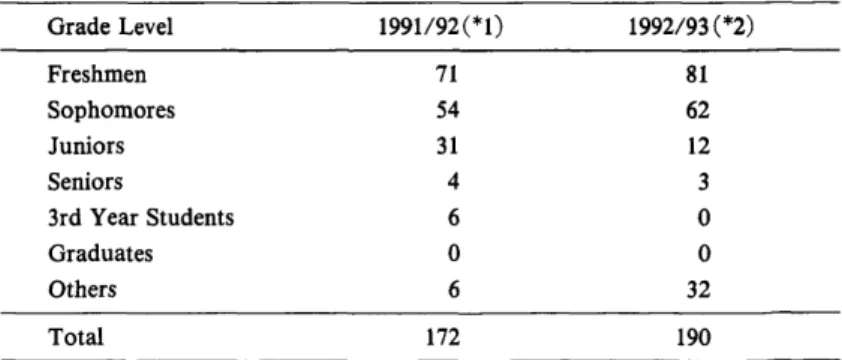
Although the motivation for post-high-school education is very strong, very few graduated from colleges. Official statistics suggest how swiftly students tend to withdraw from colleges and how graduation from colleges is difficult (Table 6) . Since the total number of post-secondary (i.e. post-high- school) students are uneven from year to year, a single year's statistics do not present the exact pattern of diminishing numbers of students in consecutive years. Rather, by checking statistics for two consecutive years, we can infer that pattern:
Among 71 freshmen in 1991/92, 62 became sophomores in 1992/93, Among 54 sophomores in 1991/92, 12 became juniors in 1992/93,
Among 31 juniors in 1991/92, 3 became seniors in 1992/93,
and among 4 seniors in 1991/92, no one graduated in 1992/93. There were no graduates in 1991/92, either.
These calculations are no more than an abstract simulation, since they do not take account of those students who remained in the same grade levels or those who returned to colleges after a temporary absence. Moreover, not all
students are studying in four-year courses of colleges or universities; the sharp drop in the number of students who advanced from sophomores to juniors may contain those who finished two-year courses of education. Despite these points to be further considered, the above-mentioned simulations are suggestive
enough of how rapidly Kosraean students leave colleges.
Table 6. Post-Secondary Students Studying Abroad by Grade Level and Sex
Grade Level
1991/92(*1) 1992/93 (*2)
Freshmen 71 81
Sophomores 54 62
Juniors 31 12
Seniors 4 3
3rd Year Students 6 0
Graduates 0 0
Others 6 32
Total 172 190
(Source: *1 Kosrae Statistical Bulletin 1991: 70; *2 Courtesy of the Department of Education)
763
国立民族学博物館研究報告 20巻4号
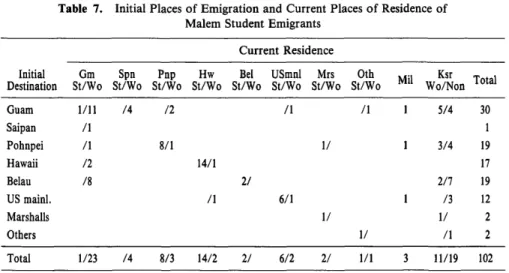
Table 7. Initial Places of Emigration and Current Places of Residence of Malem Student Emigrants
Current Residence Initial
Destination Gm St/Wo
Spn St/Wo
Pnp St/Wo
Hw St/Wo
Bel St/Wo
USmn1 St/Wo
Mrs St/Wo
Oth
St/Wo Mil Ksr
Wo/Non Total
Guam 1/11 /4 /2 /1 /1 1 5/4 30
Saipan /1 1
Pohnpei /1 8/1 1/ 1 3/4 19
Hawaii /2 14/1 17
Belau /8 2/ 2/7 19
US mainl. /1 6/1 1 /3 12
Marshalls 1/ 1/ 2
Others 1/ /1 2
Total 1/23 /4 8/3 14/2 2/ 6/2 2/ 1/I 3 11/19 102
Keys Gm: Guam, Spn: Saipan, Pnp: Pohnpei, Hw: Hawaii, Bel: Belau, USmnl: US mainland, Mrs: Marshalls, Oth: Others, Mil: Military service, Ksr: Kosrae, St: Studying at colleges, Wo:
Working, Non: Neither studying nor working
The data I collected and presented in Table 3 do not directly indicate the number of dropout students, but by following the life course of each student after 1991/92—whether he/she is still studying, or has left college and is now working in the same place or in some other foreign land, or has returned to Kosrae, etc.—I was able to specify functions of student emigration for Kosraeans. Emigrants' life during 1991/92 and January 1993 (the time of my investigation) is summarised in Table 7.
A relatively large proportion of students who went to Hawaii and the US mainland appear to continue studying, but information on emigrants to Hawaii and the US mainland is relatively poor and it is highly probable that their hav- ing left colleges is not yet known to their families at home. If we accept these data at face value, then the initial student emigrants who left Kosrae in 1991/92 or in earlier years were in time divided into three groups with relatively even numbers: 34 students are still studying at colleges; 35 persons left colleges and remain working as overseas emigrants; and 30 ex-students returned to Kosrae.
The most drastic cases of dropouts are those who went to Guam and Belau; on- ly one among 30 student emigrants in Guam and only two among 19 student emigrants in Belau are still studying at colleges.
Ex-students
The majority of the dropouts, a total of 35 ex-students, still stayed abroad
and joined the group of working emigrants. Guam is, so to speak, the largest
haunt of Malem ex-student working emigrants coming from other places and at
the same time the largest port of departure for ex-student workers moving to
764
Stmvuzu Current Trends of Out-Migration from Kosrae and Pohnpei
other places of emigration. In addition to eight ex-students from Belau, four ex-students moved to Guam from Hawaii, Pohnpei and Saipan; four ex- students moved from Guam to Saipan, two to Pohnpei and one to the US mainland and one to another place. It may be postulated that there is a regular route for those students who go to Belau: student emigrants studying on Belau, mostly at MOC (Micronesian Occupational College) , inevitably stop off in Guam on their return journey to Kosrae; they can easily find fellow Kosraean emigrants working there, and can easily find employment there, too. Accord- ing to this hypothetical pattern, about half of the Malem dropouts from Belau stayed in Guam, the remaining half having returned to Kosrae.
Among the 30 emigrants who returned to Kosrae, only one third or 11 per- sons could find jobs at home. The remaining two thirds or 19 persons remain unemployed. If individual Kosraeans and the state of Kosrae expect that stu- dent emigrants will come back to Kosrae someday and contribute to the develop- ment of Kosraean society, one should say that the result of sending out student emigrants is disappointing; except for 34 emigrants who are still studying at col- leges, 65 student emigrants have left colleges, and only 11 among them could
successfully find positions making contributions to Kosraean society. A larger number of ex-students stay abroad as working emigrants, and also a larger number of ex-students come back to enlarge unemployment in Kosrae.
The function of studying abroad: a mechanism of siphoning human resources
If the fact that so large a number of students withdrew so rapidly from stu- dying was unexpected, the high unemployment proportion among the returnee ex-student emigrants should actually have been expected. Official statistics in- dicate that the Kosraean domestic labour market is very small (Tables 8 and 9) . •
The largest employer is the Kosrae State Government, and the private sec- tor only occupies 19% of the total employment. Both sectors grow very slowly and are static; the government sector has only a few annual retirees in recent years. Thus the Kosraean labour market is not only very small-scale, but also fully matured. Young Kosraeans, who have arrived at the age of graduating from high school, are given only the alternatives of either staying on Kosrae unemployed or going abroad to study and/or work. And once having emigrated, they will have very few chances to come back to Kosrae and suc- cessfully find jobs there.
If we regard the various elements circumscribing student emigration—high motivation among youths to study abroad and the public facilities such as scholarships which encourage students to go abroad to study—as constituting a social system, then the system of studying abroad functions, not as a mechanism for producing college graduates who are to contribute to Kosraean society, but instead as a mechanism which siphons out young Kosraeans, par-
765
国立民族学博物館研究報 告 20巻4号
Table 8. Government Employment by Sex and Municipality, 1991 Lelu
Malem Utwa Tafunsak
246 140 77 131
57 30 21 30
303 170 98 161
Total 594 138 732
(Source: Kosrae Statistical Bulletin 1991: 57)
Table 9. Private Employment, 1991 Public
Private
732 172
81%
19%
Total 904
100%
(Source: Kosrae Statistical Bulletin 1991: 57)
ticularly the better educated, to send to foreign labour markets.
It is also noted that returnee dropouts tend to be reluctant to engage in subsistence agriculture;
they simply waste time waiting for jobs in Kosrae. In a sense, because of unsuccessful student emigration, the no- tion of unemployment was introduced into Kosraean society.
FEATURES OF OUT-MIGRATION FROM POHNPEI
Compared with Kosrae, the conditions for my research on Pohnpei was far less favourable. Even mainland Pohnpei alone has a much larger population than Kosrae. In this sense, in order to grasp an overview of out-migration, statistical data are more desirable than for Kosrae. But actually, as stated earlier, no official data on the statistics of Pohnpeian out-migration are available. The only data which I could obtain and which are indirectly sug- gestive of those statistics are concerned with national elections and scholar- ships.
The National Election Commission of Pohnpei State registered a poll book for Pohnpeian overseas emigrants when the election of the FSM Congress was held in 1991. In that poll book emigrants from Pohnpei State were grouped ac- cording to their localities (Table 10) . Due to legislation, the poll book does not register people without suffrage, i.e. those under eighteen years old.
Overseas voters are registered in the poll book only at their own request. It means that those emigrants who lived among a relatively large local community of Pohnpeians could have the chance of registration, but that those emigrants living alone and ill-informed of the election might have missed that chance.
Due to those conditions, the poll book is far from being a comprehensive source of statistical data on overseas emigrants.
Despite these limitations, the list of overseas voters is suggestive of some
features of Pohnpeian out-migration. There were at least 641 adult
Pohnpeians living in foreign lands in 1991. There seem to be large Pohnpeian
Smnzu Current Trends of Out-Migration from Kosrae and Pohnpei
Table 10. Registered Overseas Voters of Pohnpei State, 1991
Belau 44
Saipan 278
Guam (US)
197Hawaii (US)
43Kansas (Missouri, US)
57Neosho (Missouri, US)
22Total 641
(Source: Courtesy of the National Election Commission, Pohnpei State)
communities not only on Saipan and Guam but also in such isolated places as Kansas City and Neosho, Missouri.
To grasp a rough image of the scale of Pohnpeian out-migration, a certain enumeration is possible by referring to available official data on Pohnpeian population [POHNPEI STATE 1992]. The total population of Pohnpei for 1991 was projected to be 40,953 [POHNPEI STATE 1992: 136], of which the age-group from zero to nineteen years old occupied 57% [POHNPEI STATE 1992: 130].
Therefore, the population over nineteen years old can be enumerated about 17,600. Supposing this approximately represents the total number of the voters in 1991, then the registered overseas voters (641) occupied 3.6%.
Kosraean emigrants occupied 8.8% of the total population (Table 2) . Thus we may infer that the proportion of overseas emigrants in the total population of Pohnpei is, roughly speaking, one half of that of Kosrae.
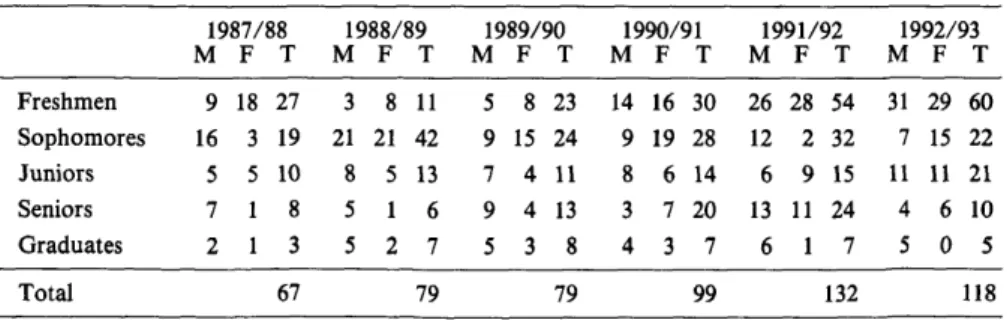
The other official data which are also distantly suggestive of Pohnpeian out-migration are the number of students receiving official scholarships (Table
11) . Compared with their Kosraean counterparts (Table 6) , the number of Pohnpeian student emigrants is very moderate; one may say it is even im- pressively small if one considers the fact that Pohnpei has five times the popula- tion as Kosrae. These official data suggest that Pohnpeian out-migration is not
Table 11. Students out to Colleges and Universities, 1987-93
1987/88 1988/89 1989/90 1990/91 1991/92 1992/93
M F T M F T M F T M F T M F T M F T
Freshmen 9 18 27 3 8 11 5 8 23 14 16 30 26 28 54 31 29 60
Sophomores 16 3 19 21 21 42 9 15 24 9 19 28 12 2 32 7 15 22
Juniors 5 5 10 8 5 13 7 4 11 8 6 14 6 9 15 11 11 21
Seniors 7 1 8 5 1 6 9 4 13 3 7 20 13 11 24 4 6 10
Graduates 2 1 3 5 2 7 5 3 8 4 3 7 6 1 7 5 0 5
Total 67 79 79 99 132 118
Keys M: Male, F: Female, T: Sub-total
(Source: Courtesy of Scholarship Office, Pohnpei State)
767
国立民族学博物館研究報告 20巻4号
so much oriented toward education as other objectives, particularly job-seek- ing.
In order to grasp an overall view of out-migration from Pohnpei in more detail, I chose Woane area in Kiti Municipality---one of the remotest areas from Kolonia, the administrative and commercial centre of Pohnpei State—as a sam- ple site of my research, and I conducted census in February 1993. Due to the limitation of time, I could cover only four sections in that area. The census is far from being comprehensive, and can only be useful for general overview.
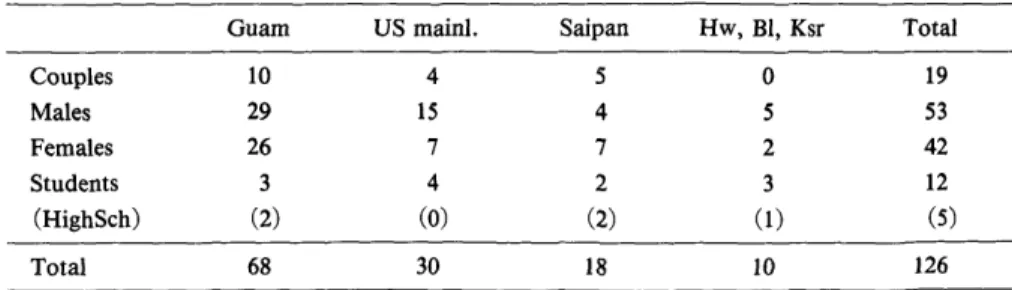
My census revealed the following data. The four sections consist of 30 homesteads (lain or peliensapw, each comprising an extended family) , which contained 158 married couples and 839 persons; among the 30 homesteads, 20 sent out some members abroad. The composition of emigrants and their places of residence are summarised in Table 12. Those emigrants occupy 15%
of the total population covered by my census. It is much larger than the enumerated proportion of emigrants among the total population of Pohnpei
(3.6%) . The difference should reflect either biases of my census, or those of the enumeration based on the poll book, or local characteristics of the sample area.
Table 12 suggests that most Woane emigrants went abroad for job-seek- ing. A few families remaining in Woane say their families went to Guam with a definite objective in mind, to pay off the loan of their house obtained from the Farmer's Home project. But most remaining families could not tell me the ob- jectives of emigration. The most conspicuous pattern is as follows. A person goes abroad, mostly to study at a college. But in need of money to make a liv- ing and to pay college fees, he/she starts to work, and often withdraws from studying at college. Getting extra money, he/she buys tickets and sends them to some of his/her family members, particularly his/her spouse or brothers and sisters. With those tickets, other emigrants go abroad and join him/her. This process recurs and relatives go abroad one after another in a chain pattern.
Although the sections covered by my census did not contain many emigrants to
Table 12. Emigrants from Woane, Kiti, 1993
Guam US mainl. Saipan Hw, Bl, Ksr Total
Couples Males Females Students (HighSch)
10 29 26 3 (2)
4 15 7 4 (0)
5 4 7 2 (2)
0 5 2 3 (1)
19 53 42 12 (5)
Total 68 30 18 10 126
Keys Hw, BI, Ksr: Hawaii, Belau and Kosrae
Note: Pohnpeians married to foreigners are counted as couples but their spouses are not included in the table.
Sxnvnzu Current Trends of Out-Migration from Kosrae and Pohnpei
Kansas, one of the neighbouring sections sent several emigrants to that city, and the Pohnpeian community there seems to have grown typically in that chain pattern.
Sometimes, emigrants send tickets to their parents, who then visit their sons or daughters living abroad. They convey a sort of success story to people at home. The parents, returning to Pohnpei, talk about how their sons or daughters are successful in their work, how their sons or daughters let them en- joy a journey, visiting many tourist spots, and how much electrical apparatus they were presented with by their sons or daughters, and the like.
It is observed that there are relatively many couples among Woane emigrants. This also reflects the tendency that Pohnpeian emigrants are largely seeking jobs abroad. Emigration of adult members can have grave effects on their family remaining at home. Among the 53 male emigrants in Table 12, there were three husbands who went abroad alone, leaving their wives and children at home. One of those husbands is said to have 'remarried' a local woman. It seems that emigrants made very few economic contributions to their families at home.
CONCLUSION
The living condition of emigrants and their relations with their families re- maining at home were out of the scope of my research program in 1992/93; that topic was surveyed in Guam and Hawaii in 1994, with a result representing a similar pattern. While Kosraean emigrants make up a tightly organised com- munity in Guam, Pohnpeians living in Guam are dispersed, not only locally but also socially. Reflecting those differences in their community patterns, my in- vestigation was more productive on Kosraean emigrants than on Pohnpeians.
Kosraeans are more unitary, and more community-oriented. Although very few Kosraean emigrants regularly send remittances to their families in their home country, Kosraean emigrants seem to maintain closer ties with their families at home. Those features will be described and analysed in more detail in my next report.
ACKNOWLEDGEMENTS
This paper is based on an investigation conducted by the author on recent migration of people out of Kosrae and Pohnpei, the FSM. The research was part of a project, Cultural An- thropological Research on the International Emigration Movement in Oceania, which was represented by Dr. Ken'ichi Sudo, Kobe University, and which was financially supported by a grant-in-aid of the Ministry of Education and Culture, Japanese Government. The project was conducted for three academic years commencing 1992/93. I would like to express my sincere gratitude to the people of Kosrae and Pohnpei, particularly the local people of Malem and Kiti Municipalities, who kindly accepted my requests for interviews. I owe much to the Governments
769
国立民族学博物館研究報告 20巻4号
of Kosrae and Pohnpei States for various kinds of information. The following offices are due par- ticular thanks: Bureau of Planning and Statistics, Office of Budget and Planning, and Department of Education, Department of Personnel and Employment Services, of Kosrae; Office of Budget, Planning and Statistics, National Election Commission, and Scholarship Office, of Pohnpei. I am indebted to Rev. F. X. Hezel for his comment on an earlier draft of this paper.
BIBLIOGRAPHY
BERTRAM, I. G. and R. F. WATTERS
1985 The MIRAB Economy in South Pacific Microstates. Pacific Viewpoint 26 (3) : 497-519.
FSM (Federated States of Micronesia)
1985 First National Development Plan, 1985-1989. Palikir, Pohnpei: Office of Planning and Statistics, FSM.
1991 Second National Development Plan, 1992-1996. Palikir, Pohnpei: Office of Planning and Statistics, FSM.
KOSRAE STATE
1992 Kosrae State Statistical Bulletin 1991. Kosrae: Bureau of Planning and Statistics, Office of Budget and Planning.
POUNPEI STATE
1992 Pohnpei State Statistics Yearbook 1992. Kolonia, Pohnpei: Office of Budget, Planning and Statistics, Pohnpei State Government.
RUBINSTEIN, D. H. and M. J. LEVIN
1992 Micronesian Migration to Guam: Social and Economic Characteristics. Asian and Pacific Migration Journal 1(2) : 350-385.
UNIVERSITY OF GUAM (census coordinator, D. RUBINSTEIN)
1992 Micronesian Census Guam 1992. Guam: University of Guam.
US DEPARTMENT OF COMMERCE
1992 1990 Census of Population and Housing—Social, Economic, and Housing
Characteristics—Guam. Washington D.C.: U.S. Government Printing Office.
SHIMIZU Current Trends of Out-Migration from Kosrae and Pohnpei
ミク ロネ シ ア 連 邦,コ シ ャエ 州 お よび ポ ーン ペ イ州 か らの 海 外 移 民 の 動 向
清 水 昭 俊
太 平 洋 島嶼 部 の小 規 模 国家(マ イ ク ロス テ ー トと呼 ぼれ る)に お い て は,急 速 な 人 口増 加 と 経 済 開 発 の遅 滞 を 背 景 と して,海 外 に労 働 市 場 を求 め る移 民(出 稼 ぎ移 民)が 顕 著 で あ り,こ
の移 民(MIgration)に 加 え て,移 民 か ら の送 金(Remittance),海 外 か らの 公 的 援 助(Aid), 経 済 の私 的 セ ク タ ーに対 して は るか に比 重 の大 き い公 的 セ ク タ ー(Bureaucracy)の4項 目を構 造 的 特 徴 とす るrMIRAB経 済 」 の概 念 【BERTRAM 1110 WATTERS l 985】が有 効 性 を 発揮 して き
た。 ミク ロネ シア連 邦 に お け る大 量 な海 外 移 民 の歴 史 は 新 し く,ア メ リカ合 衆 国 と の 「自由連 合 」 に よ って 独 立 を達 成 した1986年 以 来 の こ とで あ る。 「自 由連 合 」 に よ って 両 国 は互 い に 相手 国 の 国民 に,自 国 で の 自由 な 入 国,居 住,労 働 を 保 証 す る。 これ に よっ て,ミ ク ロネ シ ア 連邦 の 国民 は 米 国民 と同 じ資格 で 米 国 に移 住 す る こ とが 可 能 と な り,大 量 の移 民 流 出 を派 生 した。
本 稿 で は,1993年1月 か ら2か 月 間 に ミ ク ロネ シ ア連 邦 の コ シ ャエ 州 お よび ポ ー ンペ イ 州 で 行 った サ ー ヴ ェイ 調査 に基 づ い て,両 州か らの海 外 移 民 の お お まか な動 向 を 述 べ る。
ミク ロネ シア連 邦 は 自国 民 の 出 入 国 の 管 理 に 全 く無 関 心 で あ り,海 外 移 民 の統 計 を殆 ど全 く 持 って い な い 。 国 家 と して の 未 成 熟 を 指 摘 した い と こ ろ で あ り,調 査 は 海外 移 民 の 数量 的 傾 向 を 把握 す る こ とに 焦 点 を絞 ら ざ るを え な か った 。 調 査 は コ シ ャエ の方 が条 件 に 恵 ま れ,海 外 移 民 の 動 向 の 概 略 を 把 握 す る こ とが 出 来 た 。 コシ ャエ の海 外 移 民 に つ い て,次 の よ うな特 徴 を 指 摘 す る こ とが 出 来 る。
1)高 等 学 校 へ の 高 い進 学 率 を延 長 した,高 等 教 育 の た め の海 外 留 学 が 最 大 の 動 機 で あ る。
2)複 数 の 留学 先 の 内,互 い に 近 接 し,相 互 の交 通 の容 易 な グ ア ム 島周 辺(と くに ベ ラ ウ)に 留 学 した学 生 は,早 期 に勉 学 か ら脱 落 して,グ ア ム に集 積 し,労 働 移 民 に な る傾 向 が 強 い。
3)コ シ ャエ の 労働 市 場 は小 さ く,公 的 雇 用 が圧 倒 的 な比 重 を 占め てい る上 に,公 的雇 用 は 流動 性 が 低 い。 留 学 先 を 退 学 して コ シ ャエに 帰 島 す る もの の過 半 は 失 業 者 とな る。
4)海 外 留学 へ の 高 い意 欲 は,コ シ ャエ 人 に 高 学歴 を もた らす も の では な く,コ シ ャエ の 過剰 人 口を,そ れ も教 育 意 欲 の高 い 部 分 を,海 外 の 低 賃 金 労働 に 送 り出す 機 能 を果 た して い る。
771