T itle
C GmC GC G is a versatile substrate with which to evaluate T et
protein activity.
A uthor(s )
K izaki, S eiichiro; S ugiyama, Hiroshi
C itation
Organic & biomolecular chemistry (2014), 12(1): 104-107
Is s ue D ate
2014-01-07
UR L
http://hdl.handle.net/2433/193040
R ig ht
©
T he R oyal S ociety of C hemistry 2014; T his is not the
published version. Please cite only the published version. この
論文は出版社版でありません。引用の際には出版社版を
ご確認ご利用ください。
T ype
J ournal A rticle
T extvers ion
author
Journal Name
Cite this: DOI: 10.1039/c0xx00000x
www.rsc.org/xxxxxx
Dynamic Article Links
►
ARTICLE TYPE
CGmCGCG is a versatile substrate with which to evaluate Tet protein
activity
Seiichiro Kizaki
aand Hiroshi Sugiyama*
a,bReceived (in XXX, XXX) Xth XXXXXXXXX 20XX, Accepted Xth XXXXXXXXX 20XX DOI: 10.1039/b000000x
5
Tet family proteins have the ability to convert 5-methylcytosine (mC) to 5-hydroxy5-methylcytosine, further to 5-formylcytosine and 5-carboxycytosine. We found that CGmCGCG can be the substrate of Tet protein, and observed iterative oxidation of mC by HPLC analysis. We also 10
demonstrated that Tet protein favours single-stranded DNA over double-stranded DNA.
Introduction
Since discovery of the ability of Tet (ten-eleven-translocation) protein to convert methylcytosine (mC) to
5-15
hydroxymethylcytosine (hmC) in 2009,1 Tet family proteins have
attracted a great deal of attention because of their postulated involvement in the active demethylation pathway.2,3 In 2011, it
was found that Tet proteins can oxidize hmC further to 5-formylcytosine (fC) and 5-carboxycytosine (caC).4,5 Many 20
methods to detect hmC, fC and caC in genomic DNA have been developed,6-10 and all of these oxidized derivatives of mC are
known to exist in mammalian tissues .1,4,11-13
To evaluate the ability of Tet proteins to oxidize mC, 20-mer or longer DNAs containing mC were incubated with Tet protein
25
followed by enzymatic digestion, and TLC, mass spectroscopy or liquid chromatography analysis.1,4,5,14 However, these methods
require many steps and are time-consuming. In this study, we present a simple and versatile method for assessment of iterative oxidation of mC by Tet protein.
30
RESULTS AND DISCUSSION
First, 3- to 6-mer short DNAs containing mC were synthesized using phosphoramidite chemistry. After purification, each DNA was incubated with mTet1 protein at 37 °C for 1 hour, and then the reaction mixture was directly analyzed by reversed-phase
35
HPLC. The percentage of conversion was calculated from the peak area of mC-containing material and hmC-containing product (Fig. 1). Identification of hmC-containing product was conducted by HPLC analysis following enzymatic digestion. Additionally, the reactivity of 20-mer DNAs4 was also checked by HPLC 40
following enzymatic digestion of the product (Fig. 1 and Fig. S1, ESI†). The reactivity of short DNAs was much higher than that of 20-mer DNAs. A 6-mer DNA containing mC at a non-CpG site also reacted with mTet1 to form a hmC-containing product. For
45
Fig. 1 Reactivity of various DNAs with mTet1 protein. 55.4 μM of DNA and 729 nM mTet1 protein were incubated at 37 °C for 1 hour.
Fig. 2 (A) Oxidation of CGmCGCG by mTet1 protein to form
CGhmCGCG, CGfCGCG and CGcaCGCG. 55.4 μM DNA and 7.29 μM
50
mTet1 protein were incubated at 37 °C. Elution was with 50 mM ammonium formate containing 0–9% acetonitrile in a linear gradient at a flow rate of 1.0 mL/min for 30 minutes, at 40 °C. (B) Before incubation, (C) 1 min, (D) 3 min, (E) 5 min.
further analysis of the reactivity of short DNA, CGmCGCG was
55
Fig. 3 Kinetic analysis of mTet1 protein. 55.4 μM DNA and 7.29 μM mTet1 protein were incubated at 37 °C. Relative amount of mC and its oxidized derivatives at different time points after incubation of mTet1 protein with CGmCGCG.
5
Fig. 4 Temperature-dependency of the reaction of CGmCGCG with
mTet1 protein. 55.4 μM DNA and 729 nM mTet1 protein were incubated for 1 hour.
To investigate dynamic change in the amount of CGmCGCG
10
and its oxidized derivatives, CGmCGCG was incubated with a higher concentration of mTet1 to observe further oxidation of hmC to fC and caC. CGhmCGCG, CGfCGCG, and CGcaCGCG were synthesized using phosphoramidite chemistry and checked by reversed-phase HPLC and ESI-TOF-MS (Fig. S2 and S3,
15
ESI†). By co-injection of these authentic samples with the reaction mixture of mTet1 and CGmCGCG, each peak was identified in two different solvent systems. After mixing CGmCGCG and mTet1, the reaction was quenched by dilution after an appropriate length of time, and then the reaction mixture
20
was directly analyzed by HPLC (Fig. 2). The oxidation from mC to hmC was rapid and it took only about 3 minutes for CGmCGCG to be completely consumed (Fig. 3). At around 3 minutes, the amount of hmC began to decline and concomitantly the amount of caC began to gradually increase. Finally, the
25
relative amount of each oxidized derivative reached a plateau. This may be the result of the inactivation of the mTet1 protein described in a previous report.4 Additionally, the effect of ATP in
the reaction mixture on the oxidation reaction was examined by
30
Fig. 5 Oxidation of CCmCGCC by mTet1 protein. 55.4 μM DNA and 729 nM mTet1 protein were incubated at 37 °C for 1 hour. Elution was with 50 mM ammonium formate containing 0–9% acetonitrile in a linear gradient at a flow rate of 1.0 mL/min for 30 minutes, at 40 °C.
35
Fig. 6 Comparison of the reactivity of 20-mer DNA in the (A) presence or
(B) absence of its complementary strand. 16.3 μM DNA and 729 nM mTet1 protein were mixed and incubated at 37 °C for 1 hour. Elution was with 50 mM ammonium formate containing 0-3% acetonitrile in a linear gradient at a flow rate of 1.0 mL/min for 30 min, at 40 °C.
40
using CGmCGCG as a substrate (Fig. S4, ESI†). In the absence of ATP, the conversion efficiency from mC to hmC markedly decreased. This finding clearly shows that the activity of Tet protein is greatly regulated by ATP as described in a previous report.5
45
To determine the temperature dependency of the oxidation reaction of mC to hmC by mTet1 protein, CGmCGCG was incubated with mTet1 protein for 1 hour at various temperatures (Fig. 4). The optimum temperature for the oxidation reaction was around 37 °C. To our surprise, the reaction occurred even at
50
50 °C. At this temperature, almost all CGmCGCG strands are considered to be present as single strand, suggesting that single-stranded DNA can be the substrate of Tet protein. Therefore, the reactivity of single-stranded DNA was investigated subsequently.
Non-self-complementary 6-mer DNA, CCmCGCC was
55
incubated with mTet1 protein at 37 °C for 1 hour followed by direct analysis of the reaction mixture by HPLC (Fig. 5). Indeed, CCmCGCC was oxidized to form CChmCGCC, indicating that Tet protein can act on single-stranded DNA.
Subsequently, to examine whether Tet protein prefers mC
5
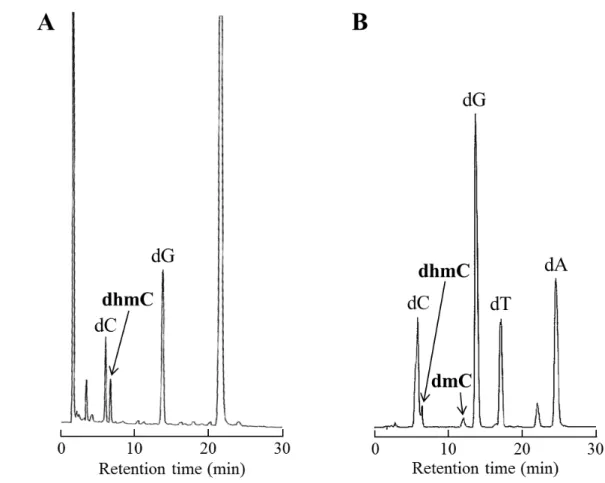
oxidation in single-stranded or double-stranded DNA, the percentage of the conversion from mC to hmC was calculated using 20-mer DNA, 5’-GAGCGTGACmCGGAGCTGAAA-3’ in the presence or absence of its complementary strand (Fig. 6). The percentage of the conversion was 29% for double-stranded DNA,
10
and 68% for single-stranded DNA. Similar experiment using 5’-TTTCAGCTCmCGGTCACGCTC-3’ showed same preference (Fig. S5, ESI†). These results suggest that Tet protein has higher activity on single-stranded DNA than double-stranded DNA.
In this study, mTet1 active domain was used for all assays. It is
15
not clear whether full length mTet1 and the other members of Tet family proteins show similar activity. However, it was recently reported that the activity of full length mTet1 is higher than that of mTet1 active domain,5 and all Tet family proteins possess
similar activity.4,5,14 20
Conclusions
In the present study, we demonstrated that 4 to 6-mer DNAs can be substrates of Tet protein. In particular, 6-mer DNAs were much more reactive than conventional 20-mer DNAs. Although there is a report about the effects of substrate length on AlkB,
25
ABH2 and ABH3 proteins,15 to our knowledge this is the first
study which has shown the effect of substrate length on Tet protein. By using CGmCGCG, it is possible to readily observe the oxidation of mC to hmC, fC, and caC. We also showed that Tet protein can oxidize mC in single-stranded and double
30
stranded DNA.
Experimental
General
For the synthesis of 3- to 6-mer short DNAs, N4-benzoyl-5’-O-
(4,4’-dimethoxytrityl)-2’-deoxycytidine-3’-O-[O-(2-cyanoethyl)-35
N,N’-diisopropylphosphoramidite and N2-isobutyryl-5’-O-(4,4’- dimethoxytrityl)-2’-deoxyguanosine-3’-O-[O-(2-cyanoethyl)-N,N’-diisopropylphosphoramidite were purchased from Sigma Aldrich Japan, 5'-dimethoxytrityl-N-benzoyl-5-methyl-2'- deoxycytidine,3'-[(2-cyanoethyl)-(N,N’-diisopropyl)]-40 phosphoramidite, 5'-dimethoxytrityl-N-benzoyl-5-cyanoethoxy- methyl-2'-deoxycytidine,3'-[(2-cyanoethyl)-(N,N’-diisopropyl)]-phosphoramidite, 5'-dimethoxytrityl-N-acetyl-5-(1,2-diacetyloxy- ethyl)-2'-deoxycytidine,3'-[(2-cyanoethyl)-(N,N’-diisopropyl)]-phosphoramidite and
5'-dimethoxytrityl-N-benzoyl-5-45
ethylcarboxy-2'-deoxycytidine,3'-[(2-cyanoethyl)-(N,N’-diisopropyl)]-phosphoramidite were purchased from Glen Research. Short DNAs were synthesized on 3400 DNA synthesizer (Applied Biosystems). After purification with high-performance liquid chromatography (HPLC) system equipped
50
with reversed-phase ODS column CHEMCOBOND 5-ODS-H (Chemco Scientific), synthesized short DNAs were checked by HPLC and ESI-TOF-MS Bruker BioTOF II (Bruker Daltonics). DNA concentrations were determined by using Nano drop ND-1000 (Thermo Scientific) (50 cm-1M-1). The sequences of 20-mer 55
DNAs are 5’-TTTCAGCTCmCGGTCACGCTC-3’, 5’-GAGCGTGACmCGGAGCTGAAA-3’, 5’-TTTCAGCTCCGGTCACGCTC-3’ and 5’-GAGCGTGACCGGAGCTGAAA-3’. These 20-mer DNAs were purchased from Japan Bio Services (for mC-containing DNA)
60
and Sigma Aldrich Japan.
Tet activity assay
mTet1 active domain (1367-2039) was purchased from Wisegene, stocked in 20 mM HEPES (pH 7.4), NaCl 50 mM, glycerol 50%. DNAs containing mC were incubated with mTet1
65
protein in 50 mM HEPES (pH 8.0), 100 mM NaCl, 2 mM L-ascorbic acid, 1 mM 2-oxoglutarate disodium salt hydrate, 105
μM Fe(NH4)2(SO4)2 6H2O, 1.2 mM ATP and 2.5 mM DTT.
For analysis of the reactivity of 3- to 6-mer DNAs with mTet1 protein, 55.4 μM DNA and 729 nM mTet1 protein were
70
incubated at 37 °C for 1 hour (total volume: 25 μL). After
incubation, 3 μL of the reaction mixture was used for HPLC
analysis. For analysis of the reactivity of 20-mer DNAs with
mTet1 protein, 55.4 μM DNA and 729 nM mTet1 protein were incubated at 37 °C for 1 hour (total volume: 25 μL). After
75
incubation, the reaction mixture was purified by QIAquick Nucleotide Removal Kit (Qiagen) followed by incubation with nuclease P1 (Wako) and Antarctic Phosphatase (New England
Biolabs) at 37 °C for 4 hours. All of the reaction mixture was used for HPLC analysis. For time-course analysis of the reaction
80
of CGmCGCG with mTet1 protein, 55.4 μM DNA and 7.29 μM
mTet1 protein were incubated at 37 °C for 1, 3, 5, 10, 15, 25, 30, 40 minutes (total volume: 25 μL). After incubation, the reaction
was quenched by dilution, and 3 μL of the reaction mixture was
used for HPLC analysis. For temperature-dependency analysis of
85
the reaction of CGmCGCG with mTet1 protein, 55.4 μM DNA
and 729 nM mTet1 protein were incubated at 4, 20, 30, 37, 50 °C for 1 hour (total volume: 25 μL). After incubation, 3 μL of the reaction mixture was used for HPLC analysis. For analysis of the
reactivity of CCmCGCC with mTet1 protein, 55.4 μM DNA and 90
729 nM mTet1 protein were incubated at 37 °C for 1 hour (total
volume: 25 μL). After incubation, 3 μL of the reaction mixture
was used for HPLC analysis.
For analysis of the reactivity of 20-mer DNA with mTet1 protein in the absence or presence of its complementary strand,
95
16.3 μM DNA and 729 nM mTet1 protein were incubated at
37 °C for 1 hour (total volume: 50 μL). After incubation, all of the reaction mixture was purified by QIAquick Nucleotide Removal Kit (Qiagen). Purified DNAs were digested with nuclease P1 (Wako) and Antarctic phosphatase (New England 100
Biolabs) at 37 °C for 4 hours. All of the reaction mixture was used for HPLC analysis. Elution was with 50 mM ammonium formate containing 0-3% acetonitrile in a linear gradient at a flow rate of 1.0 mL/min for 30 minutes, at 40 °C.
Notes and references
105
a Department of Chemistry, Graduate School of Science, Kyoto University,
Kitashirakawa-Oiwakecho, Sakyo-ku, Kyoto, 606-8502, Japan. Fax: +81 75 753 3670; Tel: +81 75 753 4002; E-mail: [email protected]
b Institute for Integrated Cell-Material Sciences (iCeMS), Kyoto
University, Yoshida-ushinomiyacho, Sakyo-ku, Kyoto 606-8501, Japan
110
1 M. Tahiliani, K. P. Koh, Y. Shen, W. a Pastor, H. Bandukwala, Y. Brudno, S. Agarwal, L. M. Iyer, D. R. Liu, L. Aravind, and A. Rao, Science, 2009, 324, 930.
2 J. U. Guo, Y. Su, C. Zhong, G. Ming, and H. Song, Cell, 2011, 145,
5
423.
3 S. C. Wu and Y. Zhang, Nat. Rev. Mol. Cell Biol., 2010, 11, 607. 4 S. Ito, L. Shen, Q. Dai, S. C. Wu, L. B. Collins, J. a Swenberg, C. He,
and Y. Zhang, Science, 2011, 333, 1300.
5 Y.-F. He, B.-Z. Li, Z. Li, P. Liu, Y. Wang, Q. Tang, J. Ding, Y. Jia, Z.
10
Chen, L. Li, Y. Sun, X. Li, Q. Dai, C.-X. Song, K. Zhang, C. He, and G.-L. Xu, Science, 2011, 333, 1303.
6 M. Yu, G. C. Hon, K. E. Szulwach, C.-X. Song, L. Zhang, A. Kim, X. Li, Q. Dai, Y. Shen, B. Park, J. Min, P. Jin, B. Ren, and C. He, Cell, 2012, 149, 1368.
15
7 M. J. Booth, M. R. Branco, G. Ficz, D. Oxley, F. Krueger, W. Reik, and S. Balasubramanian, Science, 2012, 336, 934.
8 P. Schüler and A. K. Miller, Angew. Chem., Int. Ed. Engl., 2012, 51, 10704.
9 C.-X. Song, K. E. Szulwach, Q. Dai, Y. Fu, S.-Q. Mao, L. Lin, C.
20
Street, Y. Li, M. Poidevin, H. Wu, J. Gao, P. Liu, L. Li, G.-L. Xu, P. Jin, and C. He, Cell, 2013, 153, 1.
10 X. Lu, C. Song, K. Szulwach, Z. Wang, P. Weidenbacher, P. Jin, and C. He, J. Am. Chem. Soc., 2013, 135, 9315.
11 S. Kriaucionis and N. Heintz, Science, 2009, 324, 929.
25
12 M. Münzel, D. Globisch, T. Brückl, M. Wagner, V. Welzmiller, S. Michalakis, M. Müller, M. Biel, and T. Carell, Angew. Chem., Int. Ed. Engl., 2010, 49, 5375.
13 T. Pfaffeneder, B. Hackner, M. Truß, M. Münzel, M. Müller, C. a. Deiml, C. Hagemeier, and T. Carell, Angew. Chem., Int. Ed. Engl.,
30
2011, 123, 7146.
14 S. Ito, A. C. D’Alessio, O. V Taranova, K. Hong, L. C. Sowers, and Y. Zhang, Nature, 2010, 466, 1129.
15 P. Koivisto, T. Duncan, T. Lindahl, B. Sedgwick, J. Biol. Chem., 2003, 278, 44348.
35
SUPPLEMENTARY INFORMATION
Fig. S1 Comparison of the reactivity between (A) CGmCGCG and (B) 20-mer DNAs. 16.3 μM
DNA and 729 nM mTet1 protein were incubated at 37 °C for 1 h our (total volume: 50 μL). After
incubation, half of the reaction mixture was purified by (A) illustra Micro Spin G-25 Columns (GE
Healthcare Life Sciences) or (B) QIAquick Nucleotide Removal Kit (Qiagen). Purified DNAs were
digested with nuclease P1 (Wako) and Antarctic phosphatase (New England Biolabs) at 37 °C for
4 hours. All of the reaction mixture was used for HPLC analysis. Elution was with 50 mM
ammonium formate containing 0-3% acetonitrile in a linear gradient at a flow rate of 1.0 mL/min
A B
C D
Fig. S2 ESI-TOF-MS analysis of synthesized (A) CGmCGCG, (B) CGhmCGCG, (C) CGfCGCG
and (D) CGcaCGCG. Calculated and found m/z value: (A) 902.18 and 902.40, (B) 910.18 and
Fig. S3 HPLC analysis of synthesized CGCGCG, CGmCGCG, CGhmCGCG, CGfCGCG and
CGcaCGCG. Elution was with 50 mM ammonium formate containing 0-7% acetonitrile in a linear
Fig. S4 Oxidation of CGmCGCG by mTet1 protein in the (A) presence or (B) absence of ATP.
55.4 μM of DNA and 729 nM mTet1 protein were incubated at 37 °C for 1 hour(total volume: 50
μL). After incubation, 3 μL of the reaction mixture was used for HPLC analysis. Elution was with
50 mM ammonium formate containing 0-9% acetonitrile in a linear gradient at a flow rate of 1.0
Fig. S5 Comparison of the reactivity of 20-mer DNA, 5’-TTTCAGCTCmCGGTCACGCTC-3’ in
the (A) presence or (B) absence of its complementary strand. 16.3 μM DNA and 729 nM mTet1
protein were mixed and incubated at 37 °C for 1 hour (total volume: 50 μL). After incubation, all
of the reaction mixture was purified by QIAquick Nucleotide Removal Kit (Qiagen). Purified DNAs
were digested with nuclease P1 (Wako) and Antarctic phosphatase (New England Biolabs) at
37 °C for 4 hours. All of the reaction mixture was used for HPLC analysis. Elution was with 50
mM ammonium formate containing 0-3% acetonitrile in a linear gradient at a flow rate of 1.0