A Study of Exercise Problems in Java Programming Learning Assistant System
March, 2018
Khin Khin Zaw
Graduate School of
Natural Science and Technology (Doctor’s Course)
Okayama University
Dissertation submitted to
Graduate School of Natural Science and Technology of
Okayama University for
partial fulfillment of the requirements for the degree of
Doctor of Philosophy.
Written under the supervision of Professor Nobuo Funabiki
and co-supervised by Professor Satoshi Denno
and
Professor Yasuyuki Nogami
Okayama University , March 2018.
To Whom It May Concern
We hereby certify that this is a typical copy of the original doctor thesis of Ms. Khin Khin Zaw
Signature of Seal of
the Supervisor
Graduate School of
Prof. Nobuo Funabiki Natural Science and Technology
Abstract
As a reliable and portable object-oriented programming language, Javahas been extensively used in a variety of practical systems. A large number of universities and professional schools are offering Java programming courses to meet these needs. To assist Java programming ed- ucations in schools, we have developed the Web-basedJava Programming Learning Assistant System (JPLAS). JPLAS mainly provides two types of exercise problems, called theelement fill-in-blank problem, and the code writing problem, to support self-studies by students at various learning levels.
Theelement fill-in-blank problem intends for a novice student to learn the Java grammar and basic programming through code reading. To generate the feasible problem, we also proposed the graph-based blank element selection algorithm that selects the blank elements that satisfy the unique correct answers. The code writing problem intends for a student to learn the Java source code writing from scratch, after completing the grammar study. In this problem, we adopted the test-driven development (TDD)method using JUnit to verify its correctness of the answer code from the student. It tests the behaviors of the code via the test code.
However, through applications to students, we have observed that several drawbacks ex- ist in the current exercise problems in JPLAS. First, in the element fill-in-blank problem, generally, students can solve the problems mechanically without reading carefully and under- standing the code behaviors correctly, if they know the Java grammar, because of the limited choices for each blank. Thus, the difficulty of the problem should be controlled by changing the number and importance of blank elements. Then, in the code writing problem, on the other hand, a lot of students cannot solve harder problems that require multiple classes and methods. More detailed code specifications should be provided to help the students to design the proper classes and methods for the code.
In this thesis, we present the five contributions on advancements of exercise problems in JPLAS. In the first contribution, we present the extensions of the blank element selection algorithm to change the number of blank elements to control the difficulty level of the gen- erated problem, and to additionally blank key elements such as conditional expressions. We verify the effectiveness of these extensions through applications to various Java codes and evaluations of how they affect the solution performances of the students. The results show that these extensions can control the number of blank elements and the problem difficulty, where the solution performance is greatly affected by them.
In the second contribution, we propose the core element fill-in-blank problemto enhance the code reading studies by novice students. In this problem, to control the importance of blank elements in terms of algorithm/logic implementations, we adopt the program depen- dence graph (PDG) in the blank element selection algorithm. We verify the effectiveness of this problem through applications of the problems using the codes for the graph theory or
fundamental algorithms to students with questionnaire. The results show the highly cor- rect answer rates, nevertheless the code understanding is necessary to solve the problems.
Many students commented that the problems are helpful to understand the behaviors of the algorithms.
In the third contribution, we propose thevalue trace problemas a new type of fill-in-blank problem. This problem asks students to trace the actual values of the important variables in a code implementing a data structure or an algorithm. To select the tracing values of the variables, we present the blank line selection algorithm. We verify the effectiveness of this problem through generated problems for sorting and graph theory algorithms to students with questionnaire. The results show that some problems are much more difficult than the element fill-in-blank problem. Many students commented that they are effective in understanding the algorithm in a code by code reading, and a long problem code is more difficult to read out because of the limited interface space in JPLAS.
In the fourth contribution, we study the workbook design for three fill-in-blank problems for use in a Java programming course to enhance the self-studies of Java programming by novice students. This design consists of 15 categories that are arranged in the conventional learning order of Java programming. In this thesis, we collect the Java codes from textbooks and Web sites, and discuss their use in a Java programming course. Then, element fill-in- blank problems are generated from source codes by using the extendedblank element selection algorithm. For the preliminary evaluations, we assign several problems in the workbook to novice students. The results show that the problem codes including object array and double loops are difficult for the novice students.
In the last contribution, we propose the informative test code approach for the code writing problem. To help the students to solve harder problems that require multiple classes and methods, the informative test code describes the detailed specifications of the names, access modifiers, and data types of the classes, methods, and arguments. We verify the effectiveness of this approach through applications of generated test codes to students. The software metrics of student answer codes are also evaluated usingEclipse Metric Plugin. The results show that all the students could complete the qualitative codes using informative test codes, whereas most students could not complete them without the informative test code.
To complete the works on exercise problems in JPLAS, there are still a lot of issues to be solved. In future studies, we will further improve the blank element selection algorithm, improve the PDG generation method, generate the different element fill-in-blank problems using these algorithms for the workbook, improve the user interfaces for displaying the problem codes, improve the informative test code approach to avoid the drawbacks, prepare informative test codes for a variety of source codes, and assign these generated problems in JPLAS to students in Java programming courses.
Acknowledgements
It is my great pleasure to thank those who made this dissertation possible. I want to say so much, but I can hardly find the words. So, I’ll just say that you are the greatest blessing in my life.
I owe my deepest gratitude to my supervisor, Professor Nobuo Funabiki, who has sup- ported me throughout my thesis with his patience and knowledge. I am greatly indebted to him, whose encouragement, advice, and support from the beginning enabled me to develop the understanding of the subject, not only in scientific but also in life. He gave me wonder- ful advices, comments, and guidance when writing papers and presenting them. Thanks for making me what I am today.
I am heartily thankful to my co-supervisors, Professor Satoshi Denno and Professor Yasuyuki Nogami, for their continuous supports, guidance, and proofreading of this work.
I would like to acknowledge Japan International Cooperation Agency (JICA) for finan- cially supporting my doctoral course study in Okayama University and Yangon Technological University (YTU) where I am working as a lecturer.
I would like to thank for the helpful discussions from many people including, Professor Toru Nakanishi, Associate Professor Minuro Kuribayashi, Mr. Nobuo Ishihara, Dr. Tana, and all the FUNABIKI Lab’s members. Thank you for believing in me when I was too weak and exhausted to believe in myself. Thank you for pushing me, you have supported me in all the tough times that I have ahead and thank you to share your thoughts and experiences with me.
Last but not least, I am eternally grateful to my beloved family, who always encouraged and supported me throughout my life. Thank you for being with me all that difficult time.
Your support and understanding gave me the strength to continue fighting.
List of Publications
Journal Paper
1. Khin Khin Zaw, Nobuo Funabiki, and Wen-Chung Kao , “A proposal of value trace problem for algorithm code reading in Java programming learning assistant system,”
Journal of Information Engineering Express, vol. 1, No. 3, pp. 9-18, September 2015.
2. Khin Khin Zaw and Nobuo Funabiki, “A design-aware test code approach for code writing problem in Java programming learning assistant system,” International Journal of Space-Based and Situated Computing, vol.7, No.3, pp. 145-154, September 2017.
International Conference Paper
3. Khin Khin Zaw and Nobuo Funabiki, “A concept of value trace problem for Java code reading education,” IIAI International Congress on Advanced Applied Informatics 2015, pp. 253-258, July 2015.
4. Khin Khin Zaw, Nobuo Funabiki, and Minoru Kuribayashi “A proposal of three ex- tensions in blank element selection algorithm for Java programming learning assistant system,” 2016 IEEE 5th Global Conference on Consumer Electronics, pp. 3-6, October 2016.
5. Khin Khin Zaw and Nobuo Funabiki “A core blank element selection algorithm for code reading studies by fill-in-blank problems in Java programming learning assistant system”, The 7th International Conference on Science and Engineering 2016, pp. 204- 208, December 2016.
6. Nobuo Funabiki, Shinpei Matsumoto, Khin Khin Zaw, and Wen-Chung Kao, “Ap- plications of coding rule learning function to workbook codes for Java programming learning assistant system,” The 7th International Conference on Science and Engineer- ing 2016, pp. 1170-1175, December 2016.
7. Khin Khin Zaw, Nobuo Funabiki, and Wen-Chung Kao, “A proposal of informative test code approach for code writing problem in Java programming learning assistant system,” The 8th International Conference on Science and Engineering 2017, pp. 260- 265, December 2017.
Other Papers
8. Khin Khin Zaw and Nobuo Funabiki, “A blank line selection algorithm for value trace problem in Java programming learning assistant system,” IEICE Society Conf., BS-6-2, pp. S19-S20, September 2015.
9. Khin Khin Zaw and Nobuo Funabiki, “A value trace problem for prim algorithm in graph theory in Java programming learning assistant system,” 17th IEEE Hiroshima Section Student Symposium (HISS 2015), pp. 444-447, November 2015.
10. Khin Khin Zawand Nobuo Funabiki, “A study of value trace problems for graph the- ory algorithms in Java programming learning assistant system,” IEICE Tech. Report, SS-2016-01, pp. 159-164, January 2016.
11. Khin Khin Zaw, Nobuo Funabiki, and Minoru Kuribayash, “Extensions of blank element selection algorithm for Java programming learning assistant system,” IEICE Tech. Report, ET-2016-06, pp. 41-46, June 2016.
12. Khin Khin Zaw and Nobuo Funabiki, “Preliminary evaluation of blank element selection algorithm for fill-in-blank problem in Java programming learning assistant system,” IEICE Society Conf., BS-5-24, pp. S98-S99, September 2016.
13. Khin Khin Zawand Nobuo Funabiki, “A blank element selection algorithm extension for algorithm code reading by fill-in-blank problems in Java programming learning assistant system,” The 18th IEEE Hiroshima Section Student Symposium (HISS 2016), pp. 129-132, November 2016.
14. Khin Khin Zaw, Nobuo Funabiki, and Minoru Kuribayash, “Element fill-in-blank problems in Java programming learning assistant system,” IEICE General Conf., BS- 1-21, pp. S41-42, March 2017.
15. Khin Khin Zawand Nobuo Funabiki, “A proposal of design-aware test code approach for code writing problem in Java programming learning assistant system,” IEICE So- ciety Conf., BS-7-8, pp. S56-S57, September 2017.
16. Khin Khin Zaw and Nobuo Funabiki, “An informative test code approach for code writing problem in Java programming learning assistant system,” IEICE Tech. Report, SS-2017-10, pp. 31-36, October 2017.
List of Figures
2.1 Software platform for JPLAS . . . 5
3.1 Constraint graph for bubbleSort . . . 12
3.2 Example of improved edge generation method for bubbleSort . . . 15
4.1 Sample PDG . . . 21
5.1 Interface for assignment answering . . . 32
List of Tables
3.1 Vertex information . . . 10
3.2 Operators in conditional expressions for blank . . . 14
3.3 Average number of vertices and blanks by extensions 1 and 2 . . . 16
3.4 Average number of blanks for different BG and CB . . . 17
3.5 Parameter values for problem generations . . . 17
3.6 Statistics of generated problems . . . 18
3.7 Solution results for each group . . . 18
3.8 Average solution performance . . . 18
4.1 PDG property of adopted Java codes . . . 23
4.2 Number of selected elements by two algorithms . . . 24
4.3 Student assigned problem and correct rate . . . 24
4.4 Solution performance for each problem . . . 25
4.5 Questions in questionnaire . . . 25
4.6 Questionnaire results by students . . . 25
5.1 Five value trace problems for evaluations . . . 38
5.2 Questions in questionnaire . . . 39
5.3 Solution and questionnaire results . . . 39
5.4 Questionnaire results on effectiveness of value trace problem . . . 40
5.5 Size of value trace problems for graph theory algorithms . . . 42
5.6 Size of value trace problems for fundamental data structures or algorithms . 42 5.7 Questions in questionnaire . . . 43
5.8 solutions and questionnaire results . . . 43
6.1 Workbook code collection . . . 47
6.2 Workbook design of element fill-in-blank problems . . . 48
6.3 Trial application results for four students . . . 49
7.1 Comparison of metric values for BFS algorithm using proposal . . . 66
7.2 Metric values for four algorithms without using proposal . . . 67
7.3 Metric values of source codes . . . 68
List of Codes
2.1 Source code for MyMath class . . . 7
2.2 Test code for MyMath class . . . 7
3.1 Source code for BubbleSort . . . 12
4.1 Core element fill-in-blank problem for KnapSack . . . 26
5.1 Source code for InsertionSort . . . 30
5.2 Insertionsort main class . . . 30
5.3 InsertionSort code with output function . . . 31
5.4 Output data file for InsertionSort . . . 31
5.5 Blanked data file for InsertionSort . . . 31
5.6 Blanked data file for InsertionSort by algorithm . . . 34
5.7 Pseudo code for Dijkstra . . . 34
5.8 Source code for WeightedGraph class . . . 35
5.9 Source code for DijkstraMethod class . . . 36
5.10 Dijkstra main class . . . 37
5.11 Output data file for Dijkstra . . . 38
5.12 Blanked data file forDijkstra. . . 38
5.13 Value trace problem for QuickSort . . . 40
6.1 Problem Q2 . . . 49
6.2 Problem Q8 . . . 49
6.3 Problem Q4 . . . 50
7.1 Input data file for BFS . . . 56
7.2 Output data file for BFS . . . 56
7.3 Informative test code for BFS . . . 57
7.4 Simple test code for BFS . . . 60
7.5 Example source code for Encapsulation . . . 61
7.6 Example source code for Inheritance . . . 61
7.7 Example source code for Polymorphism . . . 62
7.8 Source code for Queue . . . 62
7.9 Informative test code for Queue . . . 63
7.10 Source code for Stack . . . 64
7.11 Informative test code forStack . . . 64
Contents
Abstract i
Acknowledgements iii
List of Publications iv
List of Figures vi
List of Tables vii
List of Codes viii
1 Introduction 1
1.1 Background . . . 1
1.2 Contributions . . . 2
1.3 Contents of This Dissertation . . . 4
2 Overview of JPLAS 5 2.1 Software Platform for JPLAS . . . 5
2.2 User Services . . . 5
2.2.1 System Utilization Procedure . . . 6
2.3 Fill-in-blank Problem in JPLAS . . . 6
2.3.1 Lexical Analyzer . . . 6
2.4 Code Writing Problem in JPLAS . . . 7
2.4.1 TDD Method . . . 7
2.4.1.1 JUint . . . 7
2.4.2 Test Code . . . 7
2.4.2.1 Features in TDD Method . . . 8
2.5 Summary . . . 8
3 Extensions of Blank Element Selection Algorithm 9 3.1 Introduction . . . 9
3.2 Review of Blank Element Selection Algorithm . . . 9
3.2.1 Vertex Generation for Constraint graph . . . 9
3.2.2 Edge Generation for Constraint graph . . . 9
3.2.2.1 Group Selection Category . . . 10
3.2.2.2 Pair Selection Category . . . 10
3.2.2.3 Prohibition Category . . . 11
3.2.3 Example Constraint Graph . . . 12
3.2.4 Compatibility Graph Generation . . . 12
3.2.5 Maximal Clique Extraction of Compatibility Graph . . . 13
3.2.6 Fill-in-blank Problem Generation . . . 13
3.3 Extension 1: Additional Blank Candidates . . . 13
3.4 Extension 2: Improvement of Edge Generation . . . 13
3.4.1 Overview . . . 13
3.4.2 Improved Edge Generation Procedure . . . 14
3.4.3 Example . . . 14
3.5 Extension 3: Introduction of Two Parameters . . . 15
3.5.1 Overview . . . 15
3.5.2 Blank Gap Number . . . 15
3.5.3 Continuous Blank Number . . . 15
3.6 Evaluations . . . 16
3.6.1 Blank Selection Evaluation of Extensions 1 and 2 . . . 16
3.6.2 Blank Selection Evaluation of Extension 3 . . . 16
3.6.3 Solution Performance Evaluation . . . 17
3.6.3.1 Assigned Element Fill-in-blank Problems . . . 17
3.6.3.2 Problem Assignments to Students . . . 17
3.6.3.3 Solution Results . . . 18
3.7 Summary . . . 19
4 Core Element Fill-in-blank Problem 20 4.1 Introduction . . . 20
4.2 Review of PDG Generation . . . 20
4.2.1 Basic PDG Generation for Variable . . . 20
4.2.2 Extended PDG Generation for Object . . . 21
4.2.3 Example of PDG . . . 21
4.2.4 Restrictions of PDG . . . 21
4.3 Core Blank Element Selection Algorithm using PDG . . . 22
4.3.1 Overview . . . 22
4.3.2 Threshold Selection . . . 22
4.3.3 Modification of Clique Extraction . . . 22
4.4 Evaluations . . . 22
4.4.1 Java Source Codes . . . 23
4.4.2 PDG Property of Adopted Codes . . . 23
4.4.3 Number of Selected Blanks . . . 23
4.4.4 Solution Performance of Students . . . 24
4.4.5 Questionnaire Evaluations . . . 24
4.4.6 Generated Problem Example . . . 26
4.5 Summary . . . 27
5 Value Trace Problem 28 5.1 Introduction . . . 28
5.2 Related Works . . . 28
5.3 Concept of Value Trace Problem . . . 29
5.3.1 Generation Procedure of Value Trace Problem . . . 29
5.3.2 Step 1): Selection of Java Code for Insertion Sort . . . 30
5.3.3 Step 2): Generation of Main Class . . . 30
5.3.4 Step 3): Adding Output Functions . . . 30
5.3.5 Step 5): Obtaining Output Data File . . . 31
5.3.6 Step 6): Blanking Values for Problem Generation . . . 31
5.3.7 Step 7): Generating Assignment . . . 32
5.4 Blank Line Selection Algorithm . . . 32
5.4.1 Idea . . . 32
5.4.2 Procedure . . . 32
5.4.3 Example Problem for Insertion Sort . . . 34
5.5 Value Trace Problem for Dijkstra Algorithm . . . 34
5.5.1 Background . . . 34
5.5.2 Dijkstra Algorithm . . . 34
5.5.3 Pseudo Code for Dijkstra Algorithm . . . 34
5.5.4 Java Classes . . . 35
5.5.4.1 WeightedGraph Class . . . 35
5.5.4.2 DijkstraMethod Class . . . 36
5.5.4.3 Main Class . . . 37
5.5.5 Generated Value Trace Problem . . . 38
5.6 Evaluation for Sorting Algorithms . . . 38
5.6.1 Five Value Trace Problems for Sorting Algorithms . . . 38
5.6.2 Solution Performances by Students . . . 39
5.6.3 Difficulty Analysis of Quick Sort . . . 40
5.7 Evaluation for Graph Theory Algorithms . . . 41
5.7.1 Size of Generated Value Trace Problems . . . 41
5.7.2 Solution Performances by Students . . . 42
5.8 Summary . . . 44
6 Workbook Design for Fill-in-blank Problems 45 6.1 Introduction . . . 45
6.2 Review of Three Fill-in-blank Problems . . . 45
6.2.1 Element Fill-in-blank Problem . . . 45
6.2.2 Core Element Fill-in-blank Problem . . . 46
6.2.3 Value Trace Problem . . . 46
6.3 Workbook Design for Fill-in-blank Problems . . . 46
6.3.1 Code Collections . . . 46
6.3.2 Programming Course Use . . . 47
6.4 Applications of Workbook . . . 48
6.4.1 Generated Problems for Workbook . . . 48
6.4.2 Trial Application Results to Novice Students . . . 48
6.5 Summary . . . 50
7 Informative Test Code Approach for Code Writing Problem 51 7.1 Introduction . . . 51
7.2 Related Works . . . 51
7.3 Eclipse Metrics Plugin . . . 53
7.3.1 Software Metrics . . . 53
7.3.2 Eclipse Metrics Plugin . . . 54
7.3.3 Adopted Seven Metrics . . . 54
7.4 Informative Test Code Approach for Code Writing Problem . . . 55
7.4.1 Concept of Informative Test Code . . . 55
7.4.2 Problem Generation with Informative Test Code . . . 55
7.4.3 Example Problem Generation for BFS Algorithm . . . 56
7.4.3.1 Input Data File . . . 56
7.4.3.2 Model Source Code . . . 56
7.4.3.3 Expected Output Data File . . . 56
7.4.3.4 Informative Test Code . . . 57
7.4.3.5 Informative Test Code Example . . . 57
7.4.3.6 Simple Test Code Example . . . 59
7.5 Informative Test Code for Three Fundamental Concepts . . . 60
7.5.1 Overview of Three Fundamental Concepts . . . 60
7.5.1.1 Encapsulation . . . 61
7.5.1.2 Inheritance . . . 61
7.5.1.3 Polymorphism . . . 61
7.5.2 Example Informative Test Code Generation for Three Concepts . . . 62
7.5.2.1 Source Code for Queue . . . 62
7.5.2.2 Informative Test Code for Queue . . . 63
7.5.2.3 Source Code for Stack . . . 64
7.5.2.4 Informative Test Code for Stack . . . 64
7.6 Evaluations . . . 65
7.6.1 Evaluation for Five Graph Algorithms . . . 65
7.6.1.1 Code Completion Results . . . 65
7.6.1.2 Metric Results for BFS . . . 65
7.6.1.3 Metric Results for Four Graph Algorithms . . . 66
7.6.2 Evaluation for Three OOP Concepts . . . 67
7.7 Summary . . . 68
8 Conclusions 69
References 70
Chapter 1 Introduction
1.1 Background
As a reliable and portable object-oriented programming language, Javahas been extensively used variety of practical systems. They involve Web application systems, mission critical systems for large enterprises, and small-sized embedded systems. Thus, the cultivation of Java programming engineers has been in high demands amongst industries. As well, a great number of universities and professional schools are offering Java programming courses to meet these needs. A Java programming course usually combines grammar instructions by classroom lectures and programming exercises by computer operations. However, in programming exercises, a teacher can be overloaded in verifications of a lot of codes from students and in giving feedbacks with proper comments to them. If responses from the teacher becomes late, students may lose the learning motivations.
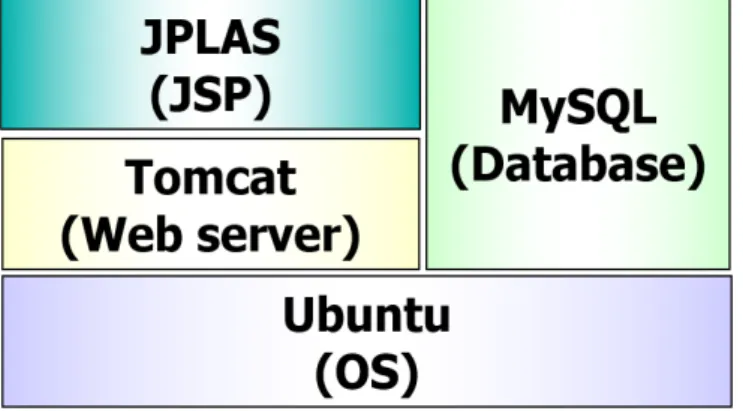
To help Java programming educations, we have developed the Web-basedJava program- ming learning assistant system (JPLAS). JPLAS adopts theUbuntufor the operating system, Tomcat for the Web application server, JSP for the application programs with HTML, and MySQL for the database for managing the data. The user can access to JPLAS through a Web browser.
JPLAS has two user service functions: teacher servicesandstudent services. The teacher services includes the problem registration and the assignment generation. The student ser- vices include the assignment solution and the score reference. JPLAS mainly provides two types of exercise problems, namely the element fill-in-blank problem and, the code writing problem, to support self-studies of students at various learning levels. It has been expected that this system be a great help for reducing the teacher loads and improving the learning motivations of the students.
Theelement fill-in-blank problemin JPLAS intends for a student to learn the Java gram- mar and basic programming through code reading. This problem asks a student to fill the correct elements in the blank in a given Java code. The correctness of the answer is marked by comparing it with the original element in the code. Thus, the original element must be the unique correct answer for the blank.
In this problem, anelementis defined as the least unit of a code such as a reserved word, an identifier, and a control symbol. A reserved word is a fixed sequence of characters that has been defined in Java grammar to represent a specified function, and should be mastered first by the students. An identifier is a sequence of characters defined in the code by the author to represent a variable, a class, or a method. A control symbolintends other grammar
elements such as . (dot), : (colon), ; (semicolon), (, ) (bracket), {,} (curly bracket).
In JPLAS, the teacher needs to register a new assignment with the problem code and answer in the database. Then, a student solves the problem through accessing to an assign- ment, checking the results, correcting and resubmitting the answer if necessary. To help a teacher to generate an element fill-in-blank problem, we also proposed a graph-based blank element selection algorithmthat selects proper blank elements that satisfy the unique correct answers [1].
The code writing problem in JPLAS intends for a student to learn writing a Java source code from scratch. This problem asks a student to write a source code that satisfies the specifications given in thetest code. In this problem, we adopted thetest-driven development (TDD) method usingJUnit [6][7]-[8]. JUnit automatically tests the answer code via the test code on the server, to verify its correctness when submitted from a student. In JPLAS, the teacher needs to register the assignment with the problem statement and the test code. Then, a student writes a source code through reading the statement and the test code, and testing, modifying and resubmitting the code if error occurs. As a target of user, we considered a student who may not be able to write a proper code, but who has studied simple Java codes in textbooks through exercises
However, through applications to students, we have observed that several drawbacks exist in the current problems. Firstly, in the element fill-in-blank problem, generally, the students can solve mechanically without reading carefully and understanding the code behaviors, if they are familiar with Java grammar. Due to the unique answer constraint, only limited choices of elements may exist for many blanks. Actually, we have found that as the number of solving element fill-in-blank problems increases, students could reach correct answers much faster than the beginning. Thus, the difficulty of the problem should be controlled by changing the number and importance of blank elements. In our previous studies [10][11], we found that as the number of blanks increases, the correct answer rates by students decreases.
In the programming educations, the students should study the codes that implement some algorithms or logics such as standard inputs/outputs, data structure, fundamental algorithms including sorting, graph algorithms. Thus, in these codes, the blank elements should be considered not only by the grammar but also by their importance in the code in terms of algorithm/logic implementation.
On the other hand, in thecode writing problem, a lot of students who are studying Java programming, cannot solve harder problems that require multiple classes and methods even after solving many simple problems. For example, the implementation of a graph theory algorithm is included in such problems, where the code needs the handling of the graph data in addition to the algorithm procedure. More detailed code specifications are necessary to help students to find the proper classes and methods for the code.
1.2 Contributions
In this thesis, motivated by the above mentioned problems, we propose the five advancements of the exercise problems for JPLAS as the contributions.
In the first contribution, we present the extensions of theblank element selection algorithm to change the number of blank elements to control the difficulty level of the generated problem, and to additionally blank key elements such as conditional expressions. Specifically,
first, we extend this algorithm by 1) adding operators in conditional expressions for blank candidates, 2) improving the edge generation method in the constraint graph to increase the number of blanks, and 3) introducing two parameters to change the frequency of selecting blanks [22] [23]. To verify the effectiveness of these extensions, we apply the extended blank element selection algorithmto 55 Java codes, and confirm that they can increase the number of blanks and control the problem difficulty. For the trial evaluation, we generated element fill-in- blank problems by applying this extended algorithm with different parameter values to investigate the solution performance of students. The results show that the number of blanks and the code length affect the solution performances by students.
In the second contribution, we propose the core element fill-in-blank problemto enhance the code reading studies by novice students. In this problem, a long Java source code imple- menting the graph theory or fundamental algorithm is used. To select the blank elements while controlling the importance in terms of algorithm/logic implementations, the blank ele- ment selection algorithmis extended by using theprogram dependence graph (PDG)together [28]. The students need to fill in blanks by reading and understanding the code structure.
For evaluations, we apply the extended algorithm to four source codes for the graph theory or fundamental algorithms, and asked six students in our group to solve them. The results show that it has the highly correct answer rate, whereas code understanding is still necessary to solve the problems. The students commented that they are helpful in understanding the algorithm/logic implementation in a code.
In the third contribution, we propose thevalue trace problemas a new type of fill-in-blank problem [44]. It asks the students to trace the actual values of important variables in a Java code implementing some algorithms such as sorting and graph algorithms. Basically, the whole data in the line of the output data is blanked through executing theblank line selection algorithm [46], such that at least one data is changed from the previous one. To verify the proposal, we generated value trace problems for sorting and graph theory algorithms, and asked students in our lab. The results show that some problems are much more difficult than the element fill-in-blank problem. Some students commented that they are effective in understanding the algorithm in the Java code and the code reading, and that a long problem code is difficult to read out because of the one column page in JPLAS.
In the fourth contribution, we study the workbook design for the threefill-in-blank prob- lems for use in Java programming courses to enhance self-studies of Java programming by students and to help preparing assignments for JPLAS by teachers [53][54]. This workbook design consists of 15 categories that are arranged in the conventional learning order of Java programming. Basically, the fill-in-blank problems are used for studying the grammar and basic programming skills through code reading. For evaluations, the suitable Java source codes are collected from textbooks and Web sites. Then, element fill-in-blank problems are generated from source codes by using the extendedblank element selection algorithmfor the workbook, and are assigned to students. The results show that the problem codes including the object array and double loops are more difficult for novice students.
In the last contribution, we propose theinformative test codeapproach for the code writ- ing problem in JPLAS [75][76]. To help the students to solve harder problems that require multiple classes and methods, the informative test code describes the detailed specifications of the names, access modifiers, and data types of the classes, methods, and arguments. By writing a source code to pass this test code, a student is expected to write a source code with the proper classes/methods in the model code. To verify effectiveness of this approach, first we prepared the informative test codes for five well known graph algorithms that consist
of multiple classes/methods and asked seven students to write the source codes for them.
Then, the software metrics of student answer codes are evaluated using Eclipse Metric Plu- gin. The results showed that all the students completed the high-quality source codes for the harder problems using informative test codes, whereas most students could not complete them without informative test codes.
1.3 Contents of This Dissertation
The remaining part of this thesis is organized as follows.
In Chapter 2, we review the software architecture and two problems in JPLAS.
In Chapter 3, we propose the extensions of blank element selection algorithm for fill-in- blank problem in JPLAS.
In Chapter 4, we propose the core element fill-in-blank problem.
In Chapter 5, we propose the value trace problem.
In Chapter 6, we propose the workbook design for the three fill-in-blank problems.
In Chapter 7, we propose theinformative test codeapproach for thecode writing problem.
Finally, in Chapter 8, we conclude this thesis with some future works.
Chapter 2
Overview of JPLAS
In this chapter, we introduce the outline of Java Programming Learning Assistant System (JPLAS).
2.1 Software Platform for JPLAS
Figure 2.1 illustrates the software platform for JPLAS. In JPLAS, Ubuntu-Linuxis adopted for OS. The current system is running onVMwarefor portability. Tomcatis used as the Web server for JSP. JSP is a script language that can embed Java codes within HTML codes.
Tomcat returns the dynamically generated Web page to the client. MySQL is adopted as the database for managing the data in JPLAS.
Figure 2.1: Software platform for JPLAS
2.2 User Services
The functions of JPLAS consist of teacher service functions and student service functions.
Teacher service functions include the problem generation, the assignment generation, and the student performance reference. Student service functions include the assignment view, the problem view, the problem solution, and the score reference.
2.2.1 System Utilization Procedure
The utilization procedure for both JPLAS functions by a teacher and a student is given as follows:
1. A teacher generates a new problem and registers it to the database.
2. A teacher generates a new assignment by selecting proper problems in the database and registers it to the database.
3. A student selects an assignment to be solved.
4. A student selects a problem in the assignment to be solved.
5. A student solves the questions in the problem and submits the answers to the server.
6. The server marks the answers and returns the marking results.
7. A student modifies the incorrect answers and resubmits them to the server, if necessary.
8. A student refers to his/her solution results of the assignments.
9. A teacher refers to the solution results of all the students of the assignments.
2.3 Fill-in-blank Problem in JPLAS
The element fill-in-blank problemin JPLAS intends for a student to learn the Java grammar and basic programming through code reading. This problem asks a student to fill the correct elements in the blank in a given Java code. The correctness of the answer is marked by comparing the student answer element with the original element in the code. Thus, the original element must be the unique answer for the blank. To help a teacher to generate an element fill-in-blank problem, the blank element selection algorithm has been proposed [1]-[3]. To generate a new problem by using this algorithm, a teacher needs to prepare the high quality source code.
2.3.1 Lexical Analyzer
For the element fill-in-blank problem, we adopt open source software JFlex [4] and jay [5].
JFlex is a lexical analyzer generator for a Java code, which is also coded by Java. It trans- forms a source code into a sequence of lexical units that represent the least meaningful elements to compose the code. It can classify each element in a code into either a reserved word, an identifier, a symbol, or an immediate data. A reserved word signifies a fixed se- quence of characters that has been defined in Java grammar to represent a specific function, which should be mastered first by the students. An identifier is a sequence of characters defined in the code by the author to represent a variable, a class, or a method. A control symbol in this paper indicates other grammar elements such as ”.” (dot), ”:” (colon), ”;”
(semicolon) , ”(, )”(bracket), ”{, }” (curly bracket).
For example, a statement int value = 123 + 456; is divided into int, value, =, 123, +, 456, and ;. Unfortunately, JFlex cannot identify an identifier among a class, a method, or a variable. Thus, jay is applied as well. Since, jay is a syntactic parsing program based on the LALR method, it can identify an identifier.
2.4 Code Writing Problem in JPLAS
The code writing problem in JPLAS intends for a student to learn writing a source code from scratch. This problem asks a student to write a whole source code from scratch that satisfies the specifications given by the test code [6]. The JPLAS function for this problem is implemented based on the test-driven development (TDD) method using an open source framework JUnit [7]-[8]. It automatically tests the answer code on the server to verify the correctness when submitted from a student. A teacher needs to prepare the specification and the test code to register a new assignment in JPLAS.
2.4.1 TDD Method
Here, we discuss the test-driven development (TDD) method [7].
2.4.1.1 JUint
JUnitcan assist an automatic unit test of a Java source code or a class. SinceJUnithas been designed with the Java-user friendly style, including the use of the test code programming, is rather simple for Java programmers. In JUnit, one test can be performed by using one method in the library whose name starts with assert . For example, assertEquals method is used to compare the execution result of the source code with its expected value.
2.4.2 Test Code
A test code should be written by using libraries inJUnit. The followingMyMathclass source code is used to introduce how to write a test code. MyMath class returns the summation of two integer arguments.
Listing 2.1: Source code for MyMathclass
1 public classMath {
2 public int plus(int a,int b) {
3 return( a + b );
4 }
5 }
Then, the following test code tests plus method inMyMath class.
Listing 2.2: Test code for MyMathclass
1 import staticorg.junit.Assert.∗;
2 import org.junit.Test;
3 public classMyMathTest {
4 @Test
5 public voidtestPlus(){
6 MyMath ma = newMyMath();
7 int result = ma.plus(1, 4);
8 assertEquals(5, result);
9 }
10 }
The test code importsJUnit packages containing required test methods at lines 1 and 2, and declares MyMathTest at line 3. @Test at line 4 indicates that the succeeding method
represents the test method. Then, it describes the procedure for testing the output of plus method. This test is performed as follows:
1. An instance ma for MyMathclass is generated.
2. plus method for this instance ma.plusis called with given arguments.
3. The resultresult is compared with its expected value usingassertEquals method.
2.4.2.1 Features in TDD Method
In the TDD method, the following features can be observed.
1. The test code represents the specifications of the source code, because it must describe every function which will be tested in the source code.
2. The testing process of a source code becomes efficient, because each function can be tested individually.
3. The refactoring process of a source code becomes easy, because the modified code can be tested instantly.
2.5 Summary
In this chapter, we introduced the outline of Java programming Learning assistant System (JPLAS). The software architecture of the JPLAS implementation, and the two offering problems, the element fill-in-blank problemand the code writing problemwere discussed.
Chapter 3
Extensions of Blank Element Selection Algorithm
In this chapter, we present the extensions of the blank element selection algorithm for the element fill-in-blank problem in JPLAS.
3.1 Introduction
The blank element selection algorithm is extended in three ways to control the difficulty level of the generated problem by changing the number of blank elements. 1) It adds the operators in conditional expressions for blank element candidates. 2) It improves the edge generation method in the constraint graph to increase the number of blanks. 3) It introduces two parameters to change the frequency of selecting blanks.
In this chapter, the overview of the existing blank element selection algorithm is first reviewed. Then, the three extensions are presented sequentially. After them, these extensions are evaluated. Finally, the conclusion is given for this chapter.
3.2 Review of Blank Element Selection Algorithm
In this section, we review the blank element selection algorithm in [1]. This algorithm gen- erates the constraint graph to describe the constraints in the blank element selection.
3.2.1 Vertex Generation for Constraint graph
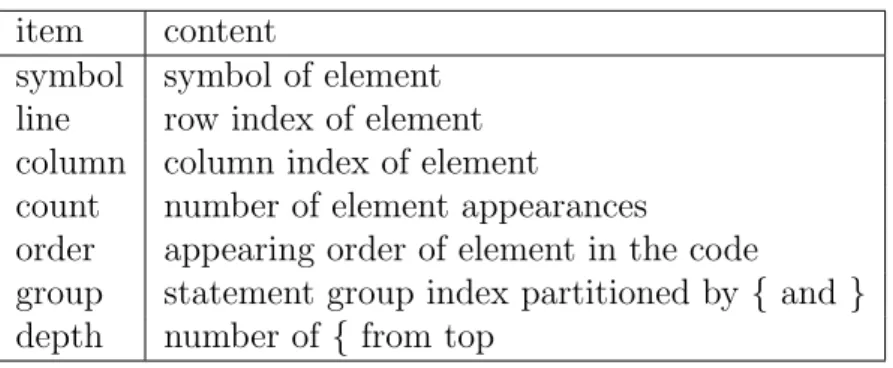
In the constraint graph, each vertex represents a candidate element for being blank. The candidate elements or vertices are extracted from the source code through the lexical analysis usingJFlex [4] andjay[5]. Each vertex contains the associated information in Table 3.1 that is necessary for the following edge generation.
3.2.2 Edge Generation for Constraint graph
Then, an edge is generated between any pair of two vertices or elements that should not be blanked at the same time. There are three categories to represent the constraints in selecting blank elements with unique answers.
Table 3.1: Vertex information item content
symbol symbol of element line row index of element column column index of element
count number of element appearances
order appearing order of element in the code
group statement group index partitioned by{ and } depth number of{ from top
3.2.2.1 Group Selection Category
In the group selection category, all the elements related with each other in the code are grouped together. In each group, one vertex is randomly selected first. Then, edges are generated between this vertex and the other vertices so that at least this selected element is not selected for blank. There are five conditions of this category.
(1) Identifier appearing two or more times in the code
The multiple elements representing the same identifier of variable, class and method using the same name, are grouped together. If all such elements are blanked, a student cannot answer the original identifier.
(2) Pairing reserved words composed of three or more elements
The three or more elements representing the reserved words in pairs are grouped together.
If all of them are blanked, the unique answers may become too difficult as the following two cases:
• switch-case-default
• try-catch-finally
(3) Data type for variables in equation
The elements representing the data types for variables in one equation are grouped to- gether. For example, in sum = a + b, the data types of the three variables, sum, a, and b, must be the same.
(4) Data type for method and its returning variable
The elements representing the data type of a method and its returning variable are grouped together.
(5) Data type for arguments in method
The elements representing the data type of an argument in a method and its substituting variable are grouped together.
3.2.2.2 Pair Selection Category
In the pair selection category, the elements appearing in the code in pairs are grouped together. For each pair, an edge is simply generated between the two corresponding vertices so that at least one element is not selected for blank.
(1) Elements appearing continuously in statement
The two elements appearing continuously in the same statement are paired in the code.
If both of them are blanked, their unique correct answers may not be guaranteed. The two elements connected with a dot (“.”) are also paired.
(2) Variables in equation
The elements representing any pair of the variables in an equation are paired. If both are blanked, the unique answers become impossible. For example, for sum = a + b, sum = b + a is also feasible.
(3) Pairing reserved words
The two elements representing the paring reserved words are paired. If both are blanked, the unique correct answers may not be guaranteed. The following five paring reserved words are considered:
• if-else
• do-while
• class-extends
• interface-extends
• interface-implements (4) Pairing control symbols
The two elements representing a pair of control symbols, namely “(,)” (bracket) and “{, }” (curly bracket), are paired. The novice students should carefully check them in their codes because they often make mistakes with them.
3.2.2.3 Prohibition Category
In the prohibition category, an element is prohibited from the blank selection because it does not satisfy the uniqueness with the high probability. There are four conditions for this category. However, an element in a fixed sequence of elements indicating a specific meaning in a Java code, such as public static void mainand public void paint(Graphics g), are excluded from this category, because they should be mastered by students.
(1) Identifier appearing only once in code
The selected element representing the identifier in this category appears only once in the code. If it is blanked, a student cannot answer the original identifier.
(2) Operator
The element representing an operator such as the arithmetic operator: =, +, -,*, /, the comparative operator: <, >, <=,>=,==,!=, and the logical operator: &, |,^,! is selected to this category. If an operator is blanked, a student cannot answer the original one unless the proper explanation on the specification related to the operator is given.
(3) Access modifier
The element representing an access modifier for an identifier is selected to this category.
If it is blanked, either public,protected, private can often be grammatically correct.
(4) Constant
The element representing a constant is selected to this category. If it is blanked, a student cannot answer the original constant.
3.2.3 Example Constraint Graph
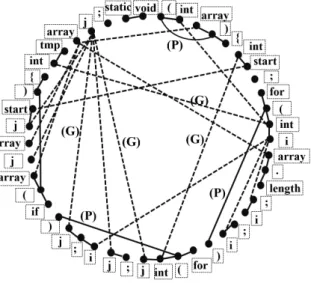
Figure 3.1 illustrates the constraint graph for lines 1-6 in the Java code forbubbleSort. Some elements are excluded there by the prohibition category. For example, the four array are grouped together by 3.2.2.1 (1), and static and void are paired by 3.2.2.2 (1), public is excluded by 3.2.2.3 (3).
Listing 3.1: Source code for BubbleSort
1 public static void bubbleSort(int[ ] array){
2 intstart=1;
3 for(int i=array.length−1; i>0; i−−)
4 for(int j=0; j<i; j++)
5 if (array[j]>array[j+start]){
6 int tmp= array[j];
7 array[j]=array[j+1];
8 array[j+1]=tmp;
9 for(int k:array){
10 System.out.print(k);
11 System.out.print(",");
12 }
13 System.out.println();
14 }
15 }
16 }
17 }
Figure 3.1: Constraint graph forbubbleSort
3.2.4 Compatibility Graph Generation
By taking the complement of the constraint graph, the compatibility graph is generated to represent the pairs of elements that can be blanked simultaneously.
3.2.5 Maximal Clique Extraction of Compatibility Graph
Finally, a maximal clique of the compatibility graph is extracted by a simple greedy algorithm to find the maximal number of blank elements with unique answers from the given Java code.
A clique of a graph represents its subgraph where any pair of two vertices is connected by an edge. The procedure for our algorithm is described as follows:
1) Calculate the degree (= number of incident edges) every vertex in the compatibility graph.
2) Select one vertex among the vertices whose degree is maximum. If two or more vertices have the same maximum degree, select one randomly.
3) If the selected vertex is a control symbol and the number of selected control symbols exceeds 1/3 of the total number of selected vertices, remove this vertex from the com- patibility graph and go to (5).
4) Add the selected vertex for blank, and remove it as well as its non-adjacent vertices from the compatibility graph.
5) If the compatibility graph becomes null, terminate the procedure.
3.2.6 Fill-in-blank Problem Generation
In the maximal clique procedure, 3) is used to sustain the total number of blank control symbols, because a code usually has a lot of control symbols. Here, we examined the aver- age number of blanks for control symbols and other symbols by the algorithm. Then, we empirically selected 1/3 as an appropriate ratio to generate the feasiblefill-in-blank problems for novice students. However, in these condition, the generated fill-in-blank problems can be solved without reading out the code if students are familiar with Java grammar.
3.3 Extension 1: Additional Blank Candidates
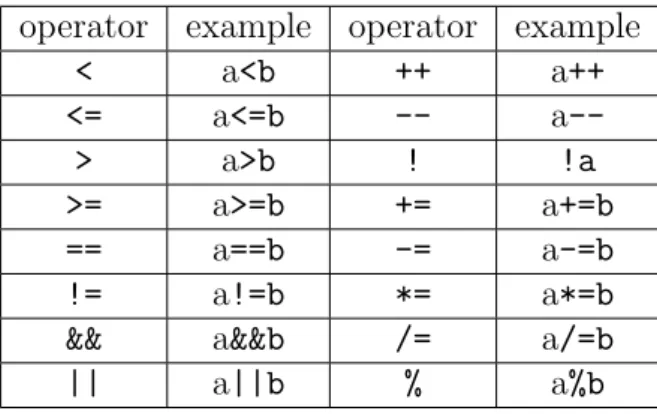
In this section, we present the first extension of the blank element selection algorithm. 16 operatorsfor conditional expressions in Table 3.2 [9] are added for blank element candidates.
To satisfy the uniqueness of the correct answers and avoid the extreme hardness for novice students, theoperatorsin the same conditional expression are grouped together as the group selection category, where at least one element in the same group is not selected for blank.
In the code for bubbleSort, > and -- in line 3 and <and ++ in line 4 are grouped together.
3.4 Extension 2: Improvement of Edge Generation
In this section, we present the second extension.
3.4.1 Overview
In our previous studies [10][11], it was found that as the number of blanks increases, the correct answer rates by students decreases. Thus, even from the same source code, the different number of blanks can change the difficulty level of theelement fill-in-blank problem.
Table 3.2: Operators in conditional expressions for blank operator example operator example
< a<b ++ a++
<= a<=b -- a--
> a>b ! !a
>= a>=b += a+=b
== a==b -= a-=b
!= a!=b *= a*=b
&& a&&b /= a/=b
|| a||b % a%b
In this thesis, to select a larger number of blanks, the following improved edge generation method is adopted for the group selection category in the constraint graph. Here, instead of randomly selecting one vertex in the same group in the previous work, the vertex that has the largest number of incident edges is selected. As a result, other many vertices can be selected for blanks when this vertex is not selected for the blank.
3.4.2 Improved Edge Generation Procedure
The following procedure describes the details:
1) Generate the edge between two vertices for each vertex pair in the pair selection cate- gory.
2) Sort the vertex groups for the group selection category in the descending order of the group size.
3) Select one vertex for each group in 2) from the top by the following procedure:
(1) Calculate the degree of the vertices in the group.
(2) Select the vertex that has the largest degree. If two or more vertices have the same largest degree, randomly select one among them.
(3) Generate the edges between the vertex in (2) and the other vertices in the group.
3.4.3 Example
InbubbleSort, the fourintin lines 1, 3, 6 and 9 are grouped by the group selection category.
At least one int must not be selected as the blank element for the unique correct answer.
Using this group, we explain the improved edge generation method for the constraint graph.
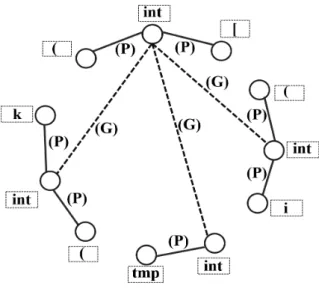
Figure 3.2 illustrates the four vertices in this group and their incident vertices are selected by the pair selection category. int and (, int and [ in line 1, int and (, int and i in line 3, int and tmp in line 6, int and (, intand k in line 9 are connected by the pair selection category respectively. These edges are described by the straight lines with (P). Then, int in lines 1, 3 and 9 has the same largest degree 2 among the four. Thus, we select intin line 1 among the two randomly. Then, we generate the edges between this vertex and the other three vertices for intthat are described by the dotted lines with (G).
Figure 3.2: Example of improved edge generation method forbubbleSort
3.5 Extension 3: Introduction of Two Parameters
In this section, we present the third extension.
3.5.1 Overview
The ratio between the number of blank elements and non-blank ones in the problem code can change the difficulty of the element fill-in-blank problem. In general, more blanks makes the problem harder, and less blanks make it easier. To control this ratio, the two new parameters are introduced, namely, BG (blank gap number) and CB (continuous blank number).
3.5.2 Blank Gap Number
The non-blanked elements in a problem code become hints to solve the element fill-in-blank problem. As more non-blanked elements exist between blanked elements, it becomes easier.
Thus, we try to control the difficulty of the problem by changing the number of non-blanked elements between blanked ones by introducing the blank gap number BG. To realize it, for the constraint graph, we generate an edge for each vertex with every vertex in the same statement in the code that exists within its BG neighbors. Here, we note that the previous algorithm actually adopts BG = 1 where at least one non-blanked element exists. For example, in the case of BG = 2, bubbleSort at line 1 has an edge with static, void, (, and intso that at least two non-blanked elements exist in the problem code.
3.5.3 Continuous Blank Number
On contrary, as more blanked elements continue in a problem code, it becomes harder. Thus, we also try to control the difficulty by changing the number of continuously blanked elements by introducing the continuous blank numberCB. Here, we note that whenCB is 2 or larger, BG must be set 0. The following procedure describes the extension to realize it:
Table 3.3: Average number of vertices and blanks by extensions 1 and 2 avg.# of vertices 127.39 132.41 127.39 132.41 BG CB previous extension 1 extension 2 both
1 1 34.59 37.15 35.91 37.65
0 8 52.81 57.41 53.39 58.11
(1) Find a solution by applying the blank element selection algorithm with BG= 0.
(2) Change the last blanked element into non-blanked one if the number of continuously blanked elements exceeds CB.
For example, in the case of CB = 3, the following blanks can be generated for line 1.
1 public static void bubbleSort _1_ _2_ _3_ array)
3.6 Evaluations
In this section, we evaluate the three extensions of the blank element selection algorithmfor the element fill-in-blank problemin JPLAS.
3.6.1 Blank Selection Evaluation of Extensions 1 and 2
55 Java source codes for fundamental data structure or algorithms in textbooks and Web sites in [12]-[21] are collected to generate element fill-in-blank problems. First, the effects of Extensions 1 and 2 are evaluated by applying the extended algorithm with BG = 1 and CB = 1 in Extension 3. Table 3.3 shows the average number of blank candidates or vertices in the constraint graphs and the average number of blanks for the 55 problem codes that are generated by the previous algorithm, the extended algorithm with Extension 1 only (operators in conditional expressions), the one withExtension 2 only (improved edge generation method), and the one with bothExtensions 1 and 2. Table 3.3 indicates that the number of blanks increases by applying each extension and becomes the largest by applying both extensions at the same time. Extension 1 increases the number of blanks by increasing the number of vertices in the constraint graphs, while Extension 2increases it even with the same number of vertices as in the previous algorithm by selecting better edges among them for the constraint graph.
Then, their effects are examined in the extreme case of BG= 0 and CB = 8 to remove the limitation of controlling the ratio of blank elements and non-blank ones in each problem code. In this case, the number of blanks can be the largest. Table 3.3 also shows the average number of blanks by the four algorithm cases, where the proposed two extensions can increase the number of blanks.
3.6.2 Blank Selection Evaluation of Extension 3
Then, the effects of Extension 3 is evaluated by applying the extended algorithm with dif- ferent values for BG and CB, while Extensions 1 and 2 are adopted together. Table 3.4
Table 3.4: Average number of blanks for differentBG and CB
BG 3 2 1 0 0
CB 1 1 1 2 3
avg.# of blanks 23.35 28.33 37.65 57.61 57.69 Table 3.5: Parameter values for problem generations
L1 L2 L3
BG 3 1 0
CB 1 1 3
shows the average number of blanks for 55 problem codes when BG and CB are changed from 0 to 3 respectively. It is noted that for BG ≥1, CB must be 1, because at most one blank element can be selected continuously to have BG non-blank elements between blank ones, and for CB ≥2, BG must be 0, because two or more blank elements can be selected continuously. Table 3.4 indicates that the larger BGcan decrease the number of blanks and the larger CB can increase it. Thus, it is confirmed that they can control the difficulty of the element fill-in-blank problems.
3.6.3 Solution Performance Evaluation
Then, the solution performances of students are evaluated by the algorithm extensions by applying the generated problems to students.
3.6.3.1 Assigned Element Fill-in-blank Problems
As Java source codes for the assigned element fill-in-blank problems, three codes related to the RSA algorithm, namely Euclid (calculate the GCD of two arguments using the Euclid method), TrialDiv(calculate the GCD using the trial division method), andModExp(calcu- late the modulo exponentiation of a big integer) [21], are used. For the two parameter values in Extension 3, the three sets in Table 3.5 are adopted to examine three different levels,L1, L2, and L3.
Table 3.6 shows the LOC (the number of lines) in the problem code and the number of blanks in each problem with three levels. As LOC is larger, the number of blanks increases for any difficulty level.
3.6.3.2 Problem Assignments to Students
The 33 students are randomly divided into three groups,A,B andC, with the equal number.
Then, one level of each problem is assigned to each group, so that every student solves the different problems with the different levels. Thus, any student solved any level in our problem assignment.
Table 3.6: Statistics of generated problems Java code LOC number of blanks
L1 L2 L3
Euclid 12 6 9 16
T rialDiv 19 14 19 38 M odExp 13 11 14 20 Table 3.7: Solution results for each group
Euclid T rialDiv M odExp
Group L correct rate (%) L correct rate (%) L correct rate (%)
A 1 76 % 2 71% 3 75%
B 2 87% 3 67% 1 73%
C 3 80% 1 78% 2 84%
3.6.3.3 Solution Results
Table 3.7 shows the solving problem level and the percentage of the correctly solved blanks among the students in each group. This table indicates that in each group, this percentage for TrialDiv is smaller than the others at any difficulty level.
Table 3.8 shows the average correct rate for each group, problem, and level. First, among the three groups, Group C has the highest average correct rate. Thus, Group C is the best student group. Then, among the problems, the average correct rate for TrialDiv is the lowest, because this problem has the largerLOC and number of blanks than other problems at any difficulty level. Finally, among the three levels, L3 has the lowest average correct rate. However, L2 has the higher rate thanL1, because Group B solved better than Group A forEuclidandGroup Csolved better thanGroup BforModExp. It is necessary to further investigate the relationship between the two parameter values for the difficulty level and the average correct rate of students, which will be in our future works.
Table 3.8: Average solution performance
Euclid TrialDiv ModExp
A 73% Euclid 81% L1 76%
B 71% T rialDiv 70% L2 79%
C 80% M odExp 77% L3 71%
3.7 Summary
In this chapter, we presented the three extensions of theblank element selection algorithmfor the element fill-in-blank problem in JPLAS. Firstly, the effectiveness of Extensions 1-3 was evaluated through applications to 55 Java source codes for fundamental data structure or algorithms. Then, the solution performance of students was evaluated through the generated problems by applying the extended algorithm. The future studies include the improvement of the blank element selection algorithm by adopting more sophisticated maximal clique algorithm to further increase the number of blanks and the generation of element fill-in- blank problems using the algorithm to assign them in Java programming course.
Chapter 4
Core Element Fill-in-blank Problem
In this chapter, we present the core element fill-in-blank problemin JPLAS.
4.1 Introduction
The core element fill-in-blank is proposed to enhance the code reading studies by the novice students. In this problem, a Java code implementing the graph theory or fundamental algorithm is used. In general, such the code is longer and usually includes multiple class- es/methods and the blank elements are selected while controlling the importance in terms of algorithm/logic implementations by applying core blank element selection algorithm. This algorithm is extended by using the program dependence graph (PDG) together from the previous blank element selection algorithm. PDG represents the dependency between the statements or lines in the code. Thus, it is used to compute the importance of blank ele- ments with regarding the statements that implement the algorithm/logic in the code. The students need to fill in the blanks by reading and understanding the code structure.
In this chapter, the procedure for the PDG generation is first reviewed. Then,core blank element selection algorithm is presented. After them, the proposed problem is evaluated.
Finally, the conclusion is given for this chapter.
4.2 Review of PDG Generation
In this section, we review the PDG generation procedure in [24].
4.2.1 Basic PDG Generation for Variable
In the PDG, a vertex represents a statement in the code and an edge represents the de- pendency between the corresponding two statements. Thus, a statement, or vertex, with a larger degree can have influence to many other statements in the code [25], and can be considered as a core statement. Based on the data flow dependence, an edge is generated between two statements s1 and s2 in a code when the following conditions are satisfied.
1) A variable v1 is defined at s1 (definition).
2) v1 is referred ats2 (reference).
4.2.2 Extended PDG Generation for Object
In [24], the PDG generation method was extended for a Java source code. As an object- oriented language, an object in a Java code should be considered in addition to a variable in a non-objected oriented language. Then, the conditions for the edge are modified:
1) An object is considered as a variable in the data flow dependence. Besides, when a variable inside an object, or a member variable, is accessed, it is regarded that the object itself is accessed there.
2) The following two cases are regarded that an object is defined at the corresponding statement: 1) the object appears at the left side of an assign statement, and 2) the object is called.
3) The following two cases are regarded that an object is referred at the statement: 1) the object appears at the right side of an assignment statement, and 2) the object is used as an argument of a method.
4.2.3 Example of PDG
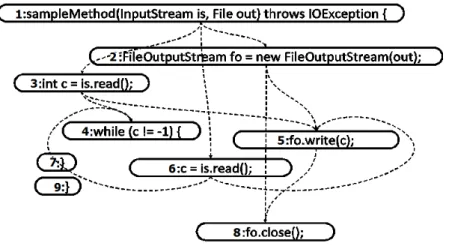
Figure 4.1 illustrates the PDG for a simple Java code that transfers the data from the input stream is to the file out . Each node represents a statement or vertex, and each directed edge represents the data dependency between statements. Line 2 is selected as the blank statement because it has the maximum degree of seven.
Figure 4.1: Sample PDG
4.2.4 Restrictions of PDG
This thesis only considers the dependency between the statements in the same method to simplify the implementation of the PDG generation. Because our proposal aims to offer Java programming learning environments to novice students, it is important for them to understand the structure of one method first. Besides, the core statements for an algorithm or logic are often described in one method. Then, the statements outside any method are assigned zero for the PDG degrees, and their elements are not selected in this extension at all. The consideration of the dependency between statements beyond a method will be in further works.