Study on Metabolic Behavior of Pesticides in Aquatic Plants: Uptake, Translocation and
Metabolism by Water Milfoil
Daisuke Ando
The United Graduate School of Agricultural Sciences, Tottori University
Doctoral Thesis
2019
Page
Abbreviations ... 1
1. Introduction ... 3
1.1 . Importance of Pesticide Risk Assessment for Water Milfoil ... 3
1.2 . General Knowledge of Pesticide Behavior in Terrestrial and Fresh Water Aquatic Plants ... 5
1.3 . Object of The Study... 13
2. Fate Comparison of Pesticides Between Terrestrial and Fresh Water Aquatic Plants ... 15
2.1. Behavior of Insecticide Metofluthrin ... 15
... ... ... 2.2. Behavior of Fungicide Mandestrobin ... 50
... ... ... 2.3. Conclusion ... 81
3. Development of Experimental Design to Investigate Uptake, Translocation and Metabolism of Chemicals by Water Milfoil ... 82
4. Uptake, Translocation, and Metabolism of Phenols by Water Milfoil: Kinetic Analysis and Correlation With Physicochemical Properties... 95
5. Fate of Flumioxazin in Aquatic Plants, Two Algae, Duckweed and Water Milfoil... 115
6. Overall Summary, Discussion and Conclusion ... 141
7. References ... 148
8. Acknowledgement ... 167
9. Synopsis ... 168
10. The List of Published Articles as Base of The Doctoral Thesis ... 170
1
ABC transporter: ATP (adenosine triphosphate)-binding cassette transporter ADME: absorption, desorption, metabolism and excretion
AR: the applied radioactivity BCF: bioconcentration factor BMF: biomagnification factor CYP: cytochrome P450
DEPT: distorsionless enhancement by polarization transfer DOM: dissolved organic matter
DT50: degradation half-life time EC50: 50% effect concentration EC: European Commission
ECOD: 7-ethoxycoumarin-O-deethylase EFSA: European Food Safety Authority EROD: 7-ethoxyresorufin-O-deethylase EU: European Union
FAO: Food Agriculture Organization of the United Nations GSH: glutathione
1H-1H COSY: correlation spectroscopy HCH: hexachlorohexane
HMBC: hetero-nuclear multiple-bond connectivity HPLC: high-performance liquid chromatography HRMS: high resolution mass spectrometry HSQC: hetero-nuclear single quantum coherence
LC ESI MS: Liquid chromatography electrospray ionization mass spectrometry LOD: limit of detection
log Kow: logarithm of octanol/water partition coefficient LSC: liquid scintillation counting
NOE: nuclear overhauser effect difference NOEC: non-observed effect concentration
2 NOESY: NOE correlated spectroscopy PCB: polychlorinated biphenyl
QoI: quinone outside inhibitor ROS: reactive oxygen species SOM: superoxide dismutase TLC: thin-layer chromatography TMS: tetramethylsilane
TRR: the total radioactive residue
TSCF: transpiration stream concentration factor US: United States
FAMIC: Food and Agricultural Materials Inspection Center PEC: predicted environmental concentration
3
1. Introduction
1.1. Importance of Pesticide Risk Assessment for Water Milfoil
Synthetic pesticides are chemical products which contribute to our continuous supply of agricultural food products by controlling harmful insects, fungus and weeds, and have been recognized as one of the important measures to encounter growing concerns for food shortage accompanying global population growth. Also, non- agricultural use of insecticides for household and public hygiene helps us to improve our living standards, and especially in developing countries, to refuge from infection such as malaria and dengue diseases mediated by mosquito or other vectors. While providing considerable profits, pesticides may cause adverse effects for crop consumers or users, workers, bystanders and wild lives, hence, safety for each of them must be assured. In addition, since they are directly sprayed or applied at outdoor environment, pesticides may unintentionally enter into fresh water aquatic ecosystem by spray drift, run-off, drainage or accidental spills. From such aspect, risk evaluation for aquatic ecology is necessary and has been gaining much attention in recent years.
The fresh water aquatic ecosystem consists of wide variety of aquatic organisms including aquatic plants as primary producers, animal planktons and larger fish or other predators, establishing sustainable trophic food chain and nutrient circulation through complex interactions in the aquatic community. Among them, aquatic plants are very important for production/circulation of oxygen and nutrient which securely provide precious food and shelter for many aquatic biota (Scheffer 1988; Maltbny et al. 2009;
Lewis 1995). They play key functions in biochemical cycles, through, for example, organic carbon production, phosphorous mobilization, the transfer of other trace elements, siltation of particulate matter as carbon sinks. They also directly influence the hydrology and sediment dynamics of fresh water ecosystems through their effects on water flow and particle trapping and re-suspension (Marion and Pailisson 2002;
Madesen et al. 2001).5-6 Because of their significance, adverse effects on aquatic plants will give serious impacts to deteriorate the overall aquatic ecosystem.
4
Herbicides and plant-growth regulators, from the aspect of their specific mode of actions uniquely designed for plants, may cause substantial damages toward non-target aquatic plant species. In the risk assessment for fresh water aquatic plants in EU, the acute toxicity data (EC50) for two algae and one macrophyte such as Lemna sp. had been required to determine fundamental adverse effect to aquatic plants (EC 2002) (for comparison, test with one and four algae is normally required in Japan and US
registration, respectively, although additional species are required in case by case basis, thus, EU intends to cover wider aquatic plants for the risk assessment). However, the limited assessment with these suspended or floating species may not be sufficient to cover entire aquatic flora, due to the sediment-rooted macrophytes may potentially be exposed to chemicals not only from the water but additionally from the bottom sediment via root uptake, especially in the case pesticides preferentially bound to the sediment (Lewis 1995; Belgers et al. 2007; Cedergreen et al. 2004b; Turgut and Fomin
2002). From such affairs, in the latest aquatic guidance issued by EFSA in 2013, the risk assessment for submerged-rooted macrophytes, water milfoil as representative, was newly included as additional toxicity test species to be evaluated, if both algae and Lemna are highly susceptible to the chemical or if chronic sediment exposure is to cause concerns.
As indicated, there are two major routes that water milfoil may be exposed to pesticides; shoot exposure via water column and root exposure via sediment, and these events could occur simultaneously. And after the pesticides entered into the
macrophyte, they will be translocated within the plant from root to shoot and vice versa with receiving metabolization/detoxification. While toxicological effect of pesticides are widely investigated, the information of metabolic behavior in aquatic plants is limited. And especially, there are few studies focused to clarify the uptake,
translocation and metabolism of pesticides individually after shoot and root exposures.
Since such knowledge is essential for understanding toxicity mechanism of the pesticides and for detailed risk evaluations, we developed an experimental design and studied the behavior of simple chemicals and a herbicide.
5
1.2. General Knowledge of Pesticide Behavior in Terrestrial and Fresh Water Aquatic Plants
To understand the behavior of pesticides in water milfoil, basic knowledge from terrestrial and fresh water aquatic plants are important. In this section, the information is briefly summarized, focusing on uptake, translocation and metabolism supplemented by abiotic factors affecting on the processes.
Terrestrial Plants
Foliar Uptake
The application of a pesticide is generally classified into foliar and soil treatments.
The behavior of pesticide in the former treatment has been investigated extensively, not only experimentally but also theoretically by many researchers, but fewer investigations are available for the latter. The foliar uptake is initiated by penetration of pesticide through cuticle and sometimes stomata, followed by apoplastic, symplastic transport or phloem translocation, whereas root hairs play the most important part in absorption of pesticide from soil (Field and Dastgheib 1996). The cuticle is a complex structure consisting of a pectin layer that binds the cutin to the epidermal cell walls and a layer of epicuticular wax on the outside, and this structure as well as thickness depends on plant species (McFarlane 1995; Bianchi 1995), which often causes difference in pesticide retention on plant surface among plant species. The aerial surfaces of all higher plants carry a partial or continuous coverage of amorphous wax and that formation of crystalline wax is frequently embedded on amorphous layers (Baker 1982). The wax mainly composed of long-chained organic acids, aldehydes, hydrocarbons, primary/secondary alcohols, -diketones (these up to C35), these alkyl esters and triterpenoids (Bianchi 1995;
Baker 1982). As general acceptance, the penetration of pesticide through the epicuticular wax or cuticle tends to increase with enhancing the hydrophobicity of the chemicals which is often described by log Kow. Although appropriate log Kow is certainly the prerequisite property, it is not the only factor determines the foliar penetration, but molecule size, concentration, surface tension, deposit area, crystalline nature and so on also contribute significantly (Baker et al. 1992; Stevens et al. 1988; Wang and Liu 2007).
6
On the other hand, hydrophilic chemicals are also known to diffuse through the cuticle via polar pathway, so-
cells, glandular trichomes or clacking (Schönherr 2002, 2002, 2006; Schlegel et al. 2005).
In addition to the above observations, the pesticide permeation through plant surface is critically affected by formulation or adjuvant which usually promotes and in some cases suppresses, depending on the type of its physicochemical character, contents and application ratio (Katagi 2008).
By the way, concomitantly or before the penetration, pesticides undergo sunlight- induced decomposition as the initial degradation process. Generally, most pesticide molecules have a substituted aromatic ring being connected with some lone-pair electrons or unsaturated bonds such as carbonyl or carbamoyl group, thus, exhibit a UV-vis absorption spectrum at >290 nm and gain solar energy to be shifted to the excited state (Katagi 2004; Burrows et al. 2002). Unless the energy of the excited molecule is lost by heat or light emission, it undergoes various reactions in the molecule. When carbonyl bond exists, C-C bond cleavage generates the ketyl radical (Norrish type I), or the carbonyl carbon in the excited state abstracts hydrogen from a neighboring alkyl group (Norrish type II) (Katagi 2004). The homolytic/heterolytic bond cleavage provides various photoproducts, while re-bond causes geometrical/optical isomerization or intramolecular rearrangement such as photo-Fries type rearrangement and cyclization or creating a new bond between nearby functional group via intramolecular transference (Katagi 2004; Remucal 2014). Even if the pesticide does not absorb the sunlight, the indirect reactions with ROS such as hydroxyl radical, 1O2, ozone, peroxides and etc., deeply involve in the degradation (Katagi 2002; Burrows et al. 2002; Remucal 2014).
And all these direct/indirect photodegradation profiles are influenced by surrounding medium, structural/physicochemical heterogeneity of plant surface, formulation type and state of the pesticides, where most of the pesticide photodegradation studies were conducted in the solubilized form in organic or aqueous solution, and studies in the solid state are limited which may exhibit difference in light absorption spectrum, restricted structural rotation, and give unique degradates (Katagi 2004).
Root Uptake
In addition to the foliar uptake, pesticides in soil can be taken up by plants. A
7
pesticide solute taken up can be transported to shoot along the transpiration stream at the xylem vessel, the water vapor at shoot as a driving force. To reach the xylem vessels, two pathways has been proposed. One is the apoplastic pathway, via the cell wall space of the epidermis and cortex, then, across cell membranes at the endodermis region (Bromilow and Chamberlain 1995). In the species that develop an exodermal Casparian strip (Peterson 1988), the pesticide solute must also cross the membrane at the exodermis region. The other path is the symplastic route, crossing cell membranes of root hairs, epidermis or cortex and moving to stele by successive permeation through plasmodesmata and membranes. The balance between the pesticide distribution in the apoplastic-symplastic compartments determines the overall transport pattern (Bromilow and Chamberlain 1995). Among physicochemical properties, lipophilicity is believed as the most important factor for root uptake. Briggs et al. (1982) examined the root uptake of chemicals by barley in the hydroponic system and correlated TSCF (concentration of the chemical taken up from root to shoot through xylem sap against the root exposure concentration) with log Kow, and found the well-cited bell-shaped uptake curve which has a vertex at log Kow 1.8 as the maximum, while the concentration in root kept increasing along with log Kow. This indicate that high lipophilic compounds irreversibly stick to root surface and become immobile. The similar trends are reported from many researchers by conducting hydroponic experiments, and even in the presence of soil, where the pesticide competitively distributes among soil particles or organic matters, pore water and root through adsorption/desorption (Hsu et al. 1990; Ryan et al.
1988). In this case, the bell-shaped curve shifts to lower or higher log Kow region, e.g., to lower region when contents of organic matters that binds pesticide increases. On the other hand, Dettenmaier et al. (2009) obtained the sigmoid plot to conclude that substances having lower log Kow with high water solubility are suitable for root uptake.
Since the experimental method, test substance, test condition, plant species and etc. are not identical, it is likely that the definitive conclusion for the responsible chemical properties for root uptake are still questionable and require more studies (Doucette et al.
2009).
It should be noted that, in addition to the sunlight-induced photodegradation on the soil surface followed by leaching, pesticides receive degradation in soil in parallel to the root uptake. In soil, biotic degradation by microbes and abiotic reactions induced by the
8
physicochemical properties occur. Microbial metabolism cause various reactions such as reduction at olefins, nitro, sulfone and other groups, oxidation at alkyl and benzene rings, dehalogenation, radical-mediated chain reactions and etc. (Vicente and Yolanda 2004; Sassman et al. 2004; Ghadiri and Rose 2001; Itoh et al. 2000). The abiotic ones are mainly hydrolysis, reduction catalyzed by redox reactions (Macalady et al. 1986), and interestingly, nitration was also reported as unique reaction (Kodaka et al. 2003).
Translocation
With respect of the pesticide translocation in plants, general acceptance is that pesticides with moderate lipophilicity show good transferability, due to the excess degree in lipophilicity cause strong irreversible adhesion on plant components, while immoderately polarized chemicals are repulsed from intrusion into inner plant, both result in a poor systemicity (Tyree et al. 1979). Hsu et al. (1996) studied the translocation of chemicals in plants and showed the mobility isotherm correlating pKa and log Kow which suggested the highest migration potential around pKa 3 to 8 and log Kow 2. Similar trends have been proposed in other studies (Bromilow and Chamberlain 1995; Satchivi et al. 2006), and these physicochemical properties are likely the important factors controlling the mobility of chemicals.
Incidentally, if the penetration barrier into plant was ignored, namely the foliar and root uptake processes, then the requirement of log Kow is diminished and solubility (or pKa) can be the dominant factor for transferability since the apoplastic and symplastic paths are the major pathway of water or mineral transport in plants (Campbell and Reece 2002). In many cases for the plant metabolism study of pesticides, e.g., triazole fungicides e.g., buromuconazole (EFSA 2010), organophosphates, e.g., dimethoate and Tolclofos-methyl (EFSA 2017, 2018), strobilurins, e.g., mandestrobin (EFSA 2015), and so on, at pesticide-untreated parts of the plant, the pesticide-derived residues often consisted of metabolites transported from distant area and have relatively high water solubility, while a limited parent pesticide was translocated. The fact supports the importance of solubility in considering the translocation of metabolites generated at inner plants.
9 Metabolism
After or in parallel to the translocation, pesticides undergo metabolism by various enzymatic reactions in plants which generally be categorized into three stages: phase I as basic detoxification, II as conjugation with small biomolecules and III as the final step for sequestration into vacuole or incorporation into plant natural components like pectin, lignin and cellulose. Various reactions such as hydroxylation, oxidation, epoxidation, demethylation, dealkylation, dehalogenation and sometimes reduction are known as phase I reactions basically to increase the solubility of the xenobiotics for detoxification and these are believed to be mostly mediated by CYP, Flavin-containing monooxygenases, laccases and other oxygenases (Kreuz et al. 1996; Van Eerd et al. 2003).
In phase II, plants show diverse conjugation at hydroxyl, amine, carbonyl groups or sometimes directly on aromatic ring of xenobiotics, with multiple natural small compounds, including saccharides, amino acids, organic acids, GSH and even other complex phytochemicals. Phase III, though it is still not well understood, is the terminal
animals excreting xenobiotics by urine or feces since plants do not have such functions.
Because the above detoxification mechanisms, mostly in phase I and II, have some similarity to the reactions in mammalian hepatic systems, the ter
adopted by Sandermann (1994). However, since not only the parent pesticide but also its degradates entered from plant surface and soil, mostly generated through the reactions by sunlight and by microorganisms or chemical reactivity in soil, respectively, are further metabolized in plants, it should be emphasized that the metabolites in plants are often more complicate and diverse.
Fresh water aquatic plants
Although it may not be directly applicable, the basic information summarized the above is useful to consider the behavior of pesticide in aquatic plants. On the other hand, compared to the terrestrial plants, the information is critically less for aquatic plants, especially for water milfoil. In this paragraph, we aimed to focus on the knowledge on water milfoil.
10 Shoot Uptake
Macrophyte cuticular membranes are generally thin (c.a. 20 nm versus ~4000 nm for terrestrial plants) (Denny 1980; Jeffree 2006), though their tissues likely contain comparable wax contents to terrestrials, e.g., 0.2% for Myriophyllum spicatum (water milfoil) on a wet weight basis (Gobas et al. 1991). The wax of macrophyte mainly consists of shorter n-alkyl lipids, length from C20 to C24, than the terrestrial plants (Gao et al. 2011), which may provide a higher fluidity. In addition, it was reported that the isolated cuticular wax of a fully submerged macrophyte, shining pondweed (Potamogeton lucens), is more permeable to water by a factor of 1000 than those of terrestrials (Schönherr 1976). These information indicate that low log Kow chemicals are possibly enable to penetrate into the water milfoil. However, hydrophobic chemicals still tend to be accumulated by macrophyte surface as summarized elsewhere (Wolf et al. 1991;
Turgut 2005; Arnot and Gobas 2006; Katagi 2010). For instance, Gobas et al. (1991) found the positive linear relationship between that the accumulation of chemical, expressed as BCF (calculated from the uptake (k1) and depuration rate constants (k2) as k1/k2), and log Kow, and showed that the bioconcentration elevates as log Kow value increases. Similar tendency was reported for waterweed and duckweed, except for the difference that the accumulation of hydrophilic chemicals at low log Kow range, approximately below 1, lost the linearity and plateaued to exhibit the minimum uptake potential (Carvalho et al. 2007). And the accumulation degree of pesticides is generally attenuated by the presence of DOM that interact with the pesticide through ion exchange, hydrogen bond, charge transfer, stacking and so on, reducing the availability of the pesticide in water column (Haizer et al. 1998).
The initial abiotic reactions in aquatic plant exposure are aqueous photolysis and hydrolyses. The relative contribution of each process highly depends on the chemical structure of the pesticide, and regarding the hydrolysis, most pesticides are stable at neutral aqueous condition at ambient temperature, so its contribution is usually limited, except for pesticides having hydrolytically labile ester linkage such as phosphorous, carbamate or pyrethroid types (Katagi 2002). The presence of DOM in the water could both assist and suppress the photolysis, serving as photosensitizer and as antioxidant, light screening or sink for ROS (Burrows et al. 2002). Incidentally, it is expected that the degradates, generated either by photolysis, hydrolysis or both, are less accumulative than
11
the parent pesticide for aquatic plants, due to the lower lipophilicity. However, this may not be the case when rearranged products are to be occurred, mainly by photolysis, since they possibly show comparable hydrophobicity as the parent, and especially, even higher for cyclization products (Dimou et al. 2004).
Root Uptake
In respect of the root uptake, for example, Carvalho et al. (2007) studied the root uptake by parrot feather having emergent shoot using the hydroponic system and obtained the bell shape relation between TSCF and log Kow, as observed for barley (Briggs et al.
1982), while the uptake amount was somewhat less in parrot feather. But in the case of submerged macrophytes, transpiration stream underwater must be much inactive and the TSCF concept may not be applied. To the best of our knowledge, the root uptake study of organic chemicals in sediment-inclusive test systems with submerged condition has been described only for Myriophyllum spicatum with one herbicide (Bure ov et al. 2013), Hydrilla verticillata with three insecticides (Hinman and Klaine 1992), and for Myriophyllum spicatum with two herbicides and PCBs (Dipens et al. 2014). The last two studies measured the concentration of test chemicals in root and shoot by applying the special exposure system introducing the Teflon boundary to separate shoot and root regions, and selectively exposed the root of the macrophytes. These two studies showed agreement for the accumulated concentration of the test chemicals in root with literature that the accumulation increases along with log Kow, however, the translocated concentration in shoot differed from the typical trait (Briggs et al. 1982; Carvalho et al.
2007; Trapp 2000), namely the bell shape relationship, indicated the effects of sediment interaction and diminished level of transpiration stream underwater condition are considered.
Metabolism
With respect to the manner of metabolism of xenobiotics, aquatic plants prone to have similarities with terrestrial plants, namely, possess phase I and II (and III) systems.
For instance, transcriptome analysis of alga and lemna revealed that they encode a variety of CYP families, peroxidase, oxidases which are presented in terrestrial plants (Bhattacharya et al. 2013; Wang et al. 2016). Though which family or species take part
12
in the pesticide metabolism is mostly unknown, as well as for terrestrial plants, it is expected that aquatic plants have the analogical potential. In fact, many hydroxylation reactions, which is the most basic one, on xenobiotics have been reported in a wide variety of aquatic plants including water milfoil (Katagi 2010; Ensley et al. 1994; Barber et al.
1995; Sharma et al. 1997; Wang et al. 2017). In the detoxification of organic compounds in algae and macrophytes, phase I metabolic reactions by pseudo-cytochrome P450 or its isozymes such as EROD (7-ethoxyresorufin-O-deethylase) and ECOD (7- ethoxycoumarin-O-deethylase) have been reported (Torres et al. 2008; Thies et al. 1996;
Pflugmacher and Steinberg 1997; Pflugmacher et al. 1999). Similarly, phase II reactions against xenobiotics to generate glucose and GSH conjugates are known in aquatic plants (Pflugmacher et al. 1999; Pflugmacher and Snadermann 1998a;
Pflugmacher et al. 2000). Thus, it is likely that aquatic plants have similar detoxification capacity to terrestrial plants. There may be the possibility that the metabolites of xenobiotics can be excreted back to water column, however, definitive evidence for such ability is not known. On the other hand, macrophytes possess vacuoles (Talarico 2002) and accumulation of some xenobiotics in the organ has been reported (Bondareva et al.
2012), which is the similar mechanism to terrestrial plants.
13
1.3. Object of The Study
In chapter 1, the importance of risk assessments of pesticides on water milfoil was described. Unlike algae and floating macrophytes, submerged, sediment-rooted macrophytes, water milfoil as representative, may be exposed to pesticides not only via water column, but via sediment as the additional route if the pesticide is absorbed to sediment. For robust hazard characterization(s) on water milfoil, it is essential to understand the behavior of pesticides in detail, namely, metabolic reactions in the plant following shoot/root uptake and translocation.
As fundamental knowledge, behaviors of chemicals in uptake followed by translocation and metabolism were briefly summarized for terrestrial and aquatic plants.
From the literature review, it was considered that biotic and abiotic reactions at outer plant could largely affects the fate of pesticides prior to be taken up by plants, depending on the chemical structure of the pesticide. The uptake is likely a process highly dominated, but not totally, by the physicochemical parameters such as hydrophobicity, water solubility and acidity, which may be applicable for water milfoil. However, since the structural difference and limited transpiration stream under submergence, a definitive relationship between physicochemical natures and shoot/root uptake by water milfoil requires further studies. With respect of the metabolic reactions, aquatic plants likely possess phase I, II (and III) mechanisms which can widely be seen for terrestrial plants and considered mostly similar, however, since only a limited information is available for water milfoil, this is not conclusive.
On the contrary to the lack of knowledge on water milfoil, it is cardinal to understand the fate of pesticides, namely, uptake/translocation/metabolism (and excretion, though not expected), so called ADME in the pharmacological research, for detailed toxicological assessment on the species. Moreover, in the case when unexpected, toxic metabolites are generated from pesticides in water milfoil, there is a risk(s) for further bioaccumulation/biomagnification through ecological food-chain to give adverse effects on higher organisms. To gain insight into the behavior of pesticides in water milfoil as essential knowledge for robust hazard characterization, the author have studied and clarified the fate of various compounds including simple chemicals, fungicide, insecticide
14
and herbicide, particularly by applying a newly developed exposure system designed to selectively expose the chemical to either shoot or root of water milfoil via water medium or via sediment, respectively.
In chapter 2, cabbage/wheat and water milfoil were exposed to the insecticide metofluthrin, a synthetic pyrethroid for hygiene usages, and the fungicide mandestrobin, a strobilurin to control wide range of crop diseases, as model case comparisons to experimentally confirm the differences of pesticide behavior in terrestrial plants and water milfoil.
In chapter 3, to establish the new exposure system which enables to separately expose either shoot or root and to reveal each uptake followed by translocation and metabolism behavior, 3-phenoxybenzoic acid was applied as the model test compound and validated the method.
In chapter 4, to understand basic relations between uptake/translocation/metabolism and the physicochemical properties of exposure compounds, the behavior of simple phenols were examined using the developed exposure system. The kinetics analysis of each behavior was implemented and compared with various chemical indexes.
In chapter 5, the fate of the widely used herbicide flumioxazin on water milfoil was investigated. For comparison, two algae and one floating macrophyte were also exposed to the herbicide.
In chapter 6, the newly obtained results are summarized, the importance of the study and contribution to the risk evaluations on aquatic plants are discussed, then, the overall conclusion is given.
15
2. Fate Comparison of Pesticides Between Terrestrial and Fresh Water Aquatic Plants
As described in the previous chapter, one of the critical factors determining the overall fate of pesticides could be the external abiotic/biotic reaction(s) involved under each circumstance where the plant is exposed to the compound. For terrestrial plants cultivated on the ground, pesticides applied on plant and soil surfaces receive direct/indirect photolysis and reaction by microorganisms as the initial driving forces for degradation before or simultaneously with the foliar/root uptake up followed by translocation and metabolism at inner plant. On the other hand for aquatic plants in fresh water, in addition to the aqueous photolysis, chemical hydrolysis as well as some biotic reactions by suspending microorganism and periphyton could take major roles for the decomposition.
To experimentally clarify such possibilities, we examined and compared the behaviors of pesticides in terrestrial and aquatic plants, using cabbage and wheat as terrestrial representative and water milfoil. Metofluthrin was selected as one of the two test compounds, since it possesses isopropenyl and ester bonds which are considered susceptible to direct/indirect sunlight photolysis and hydrolytically instable, respectively, during the exposure. The other test substance chosen was mandestrobin. In contrast to metofluthrin, mandestrobin is stable in water, while it is known to be somewhat reactive to photolysis. The obtained experimental results showed dissimilar trends between terrestrial plants and water milfoil, demonstrating the importance of the external factors which substantially affected the overall behavior of pesticides in the test plants.
2.1. Behavior of Insecticide Metofluthrin
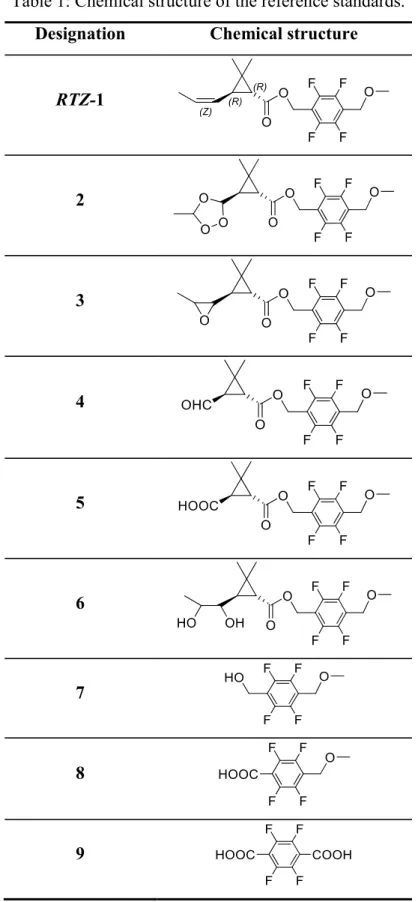
Metofluthrin (1) [SumiOne®, Eminence®;2,3,5,6-tetrafluoro-4-(methoxymethyl)- benzy (EZ)-(1R,3R)-2,2-dimethyl-3-(prop-1-enyl)cyclopropanecarboxylate], structure given in Table 1, is a pyrethroid insecticide for household and public hygiene usages developed by Sumitomo Chemical Co., Ltd., possessing a strong knockdown activity
16
especially against mosquitoes. Because of its high volatility (1.96 10-3 Pa) with a low mammalian toxicity, 1 can be used in the non-heated formulation such as fan-type, paper and resin emanators (Matsuo et al. 2005). The presence of the two optical centers at the cyclopropenyl ring and one geometrical isomerism at the propenyl side chain results in eight isomers, and 1 consists of the biologically active 1R-trans isomers having a E/Z geometrical ratio of 1/8, abbreviated as 1-RTE and 1-RTZ (Matsuo et al. 2005). The extremely limited emission of 1 to the environment is most likely because it is mainly used in indoor. However, as there is no geographic restriction, outdoor use, 1 may directly or indirectly reach to a non-target environment such as water body, soils and terrestrial and aquatic plants by personal outside insect repellent and other outdoor use.
In addition, with regards to biocide, the submission of the relevant data to an environmental fate has recently become inevitable irrespective of the use pattern especially in EU and EPA due to the possible contamination by sewage treatment plant effluent. From these aspects, it is important to obtain experimental data of 1 to show that it is benign to the environment.
Several studies of 1 showed the degradation behaviors of 1 in environment, as shown in Figure 1. The aerobic soil metabolism in two US soils has shown that 14C labeled 1-RTZ and 1-RTE rapidly degrade at the similar half-lives 2.3 3.5 days via cleavage of the ester linkage to produce corresponding acid (7) and alcohol (10), followed by successive oxidation at the prop-1-enyl group and the benzyl carbon to form terephthalic acid (9) and dicarboxylic acid (11) derivatives, respectively (Kodaka et al.
2007). Further degradation of the metabolites resulted in production of carbon dioxide.
The radioactivity was also detected as the soil bound residues which might derived from the high soil adsorption coefficient (Koc) of 1-RTZ determined as 3,553 6,142 (mL g-1 o.c.) by the batch equilibrium method (Kodaka et al. 2007). No enantiomerization and geometrical isomerization proceeded in the soils. Under illumination on the moisture- controlled soil, 1-RTZ degraded with DT50 8.1 12.0 days (Nishiyama et al. 2010;
Nishimura et al. 2011). The photodegradation pathway was oxidation of the double bond at the prop-1-enyl moiety and cleavage of the ester linkage followed by further decomposition to polar compounds and mineralization to carbon dioxide. The major degradates detected were caronaldehyde (4) and carboxylic acid (5) derivatives which were possibly generated by decomposition from ozonide (2) and diol (6) produced by the
17
activated oxygen species, i.e. ozone and hydrogen peroxide, respectively. The photo- isomerization hardly proceeded throughout the test duration (Nishimura et al. 2011). In the hydrolysis study, 1-RTZ moderately degraded by the ester cleavage with the half-life 26.8 days at pH 9 and 25°C, while it was much stable at pH 5 and 7. For aqueous photolysis using Xenon arc lamp, 1-RTZ and 1-RTE rapidly dissipated with their half- lives 1.1 3.4 days at pH 7 mainly due to ester cleavage to produce 7 and 10, and oxidation of the olefinic double bond to form 3 and 4 while isomerization was a minor route (Nishiyama et al. 2010).
Up to this date, metabolism studies of 1 by terrestrial and aquatic plants are not available. In addition to our purpose for the behavioral comparison between these plants, the information is necessary for the toxicological assessments in human and non-target species, and hence, the studies are useful. Cabbage was selected as a model plant because its broad and waxy leaves (Baker 1982) have potential to trap and minimize the loss of 1 by its rapid volatilization from leaf surface (Katagi 2004).
2.1.1. Metabolism of Metofluthrin in Cabbage.
MATERIALS AND METHODS Chemicals
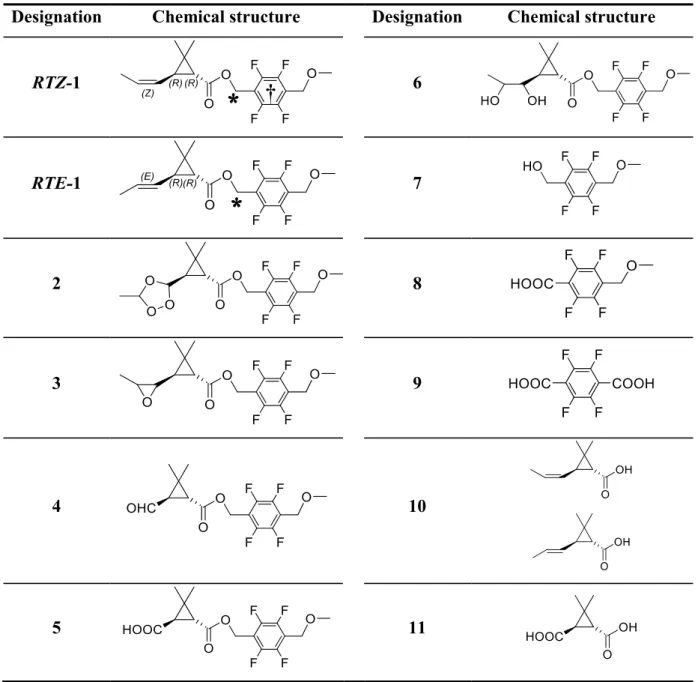
The non-radiolabeled metofluthrin (1) and their potential degradates as follows were synthesized in our laboratory according to the reported methods (Kodaka et al. 2007;
Nishiyama et al. 2010; Nishimura et al. 2011). The structure of the compounds are referred to Table 1; 2,3,5,6-tetrafluoro-4-(methoxymethyl)benzyl (1R,3R)-2,2-dimethyl- 3-(3-methyl-1,2,4-trioxolane-5-cyclopropanecarboxylate (2), 2,3,5,6-tetrafluoro-4- (methoxymethyl)benzyl (1R,3R)-2,2-dimethyl-3-(3-methyl-1,2-epoxy)cyclopropane carboxylate (3), 2,3,5,6-tetrafluoro-4-(methoxymethyl)benzyl (1R,3R)-2,2-dimethyl-3- formylcyclopropanecarboxylate (4), 2,3,5,6-tetrafluoro-4-(methoxymethyl)benzyl (1R,3R)-2,2-dimethyl-3-carboxycyclopropanecarboxylate (5), 2,3,5,6-tetrafluoro-4- (methoxymethyl)benzyl (1R,3R)-2,2-dimethyl-3-(1,2-propanediol)cyclopropane
carboxylate (6), 2,3,5,6-tetrafluoro-4-(methoxymethyl)benzyl alcohol (7), 2,3,5,6- tetrafluoro-4-(methoxymethyl)benzoic acid (8), tetrafluoroterephthalic acid (9), (1R,3R)-
18
2,2-dimethyl-3-(E,Z)-propenylcyclopropanecarboxylic acid (10), (1R,3R)-2,2-dimethyl- 3-carboxycyclopropanecarboxylic acid (11). The chemical purity of each standard was determined to be >95% by HPLC. Degradate 2 was prepared by the following method.
Each 3 mg of 1-RTZ or 1-RTE was dissolved in 1 mL of n-hexane solution and cooled to
< 40°C using dry ice/acetone prior to the ozone oxidation. Ozone gas produced at an approximate concentration of 20 g N-1m-3 using an ozone generator (type 0N-1-2, Nippon Ozone, Co, Ltd.) was gently bubbled into the reaction mixture for 3 min at <-40°C, which resulted in the formation of white precipitate of crude 2. After the solution returned to room temperature, 2 was successively purified by HPLC, the solvent was removed using evaporator and dried in vacuo to obtain colorless liquid whose chemical purity was determined to be >95%. The chemical structure of 2 was confirmed by various modes of NMR and LC-ESI-MS spectroscopies. 2 was stable in acetonitrile, n-hexane and chloroform for a few months at a freezer below 0°C, but rapidly decomposed to 4 and 5 in aqueous organic media. The following 14C labeled isomers of 1 were synthesized in our laboratory with the reported methods(Kodaka et al. 2007; Nishiyama et el. 2010;
Nishimura et al. 2011); 1-RTZ -position of 2,3,5,6-tetrafluoro- 4-methoxymethylbenzyl ring (benzyl-14C) or the carbonyl carbon (carbonyl-14C) and 1- RTE at the carbonyl carbon (carbonyl-14C) with the specific activity of 0.1654, 0.1651 and 0.1651 mCi mg-1, respectively. -Glucosidase (almond) and cellulase (Aspergillus niger) were purchased from Wako Pure Chemical Industries, Ltd. All the reagents and solvents used were of the analytical grade.
Chromatography
The reversed-phase HPLC analysis of metabolites within the leaf surface rinse and extract was conducted using a Hitachi LC module (model L-7000) equipped with a SUMIPAX ODS A-212 column (5 µm, 6-mm i.d. 15 cm, Sumika Chemical Analysis Service, Ltd.) at a flow rate of 1 mL min-1. The following gradient system was operated as the typical analysis with acetonitrile containing 0.05% formic acid (solvent A) and distilled water with 0.05% formic acid (solvent B); 0 min, %A/%B, 5/95; 0 to 3 min, 5/95, isocratic; 3 to 10 min, 45/55 at 10 min, linear; 10 to 70 min, 75/25 at 70 min, linear; 70 to 71 min, 5/95 at 71 min, linear; 71 to 80 min, 5/95, isocratic (HPLC method 1). For
19
the separation of four isomers of 2, the gradient system as below was applied; 0 min, %A (acetonitrile)/%B (water), 53/47; 0 to 3 min, 53/47, isocratic; 3 to 43.7 min, 58/42 at 43.7 min, linear; 43.7-44 min, 75/25 at 44 min, linear; 44-51 min, 53/47 at 51 min, linear; 51 to 60 min, 53/47, isocratic (HPLC method 2). The chiral analysis was conducted with a Shimadzu LC-10AT HPLC system connecting two SUMIPAX DI-NO2 columns (5 µm, 4 mm i.d.×25 cm, Sumika Chemical Analysis Service, Ltd.) and one CHIRALCEL OD- H column (5 µm, 4.6 mm i.d.×25 cm, Daicel Chemical Industries, Ltd.) in series using an isocratic eluent of n-hexane/ethanol, 1000/0.5 (v/v) at a flow rate of 0.9 mL min-1. The radioactivity eluted was monitored with a Flow Scintillation Analyzer Radiomatic 500TR (Perkin Elmer Co., Ltd.) or Ramona (Raytest Ltd.) radiodetector equipped with a 500-µL liquid cell using Ultima-Flo AP® (Perkin Elmer, Co., Ltd.) as the scintillator. The detection limit of the HPLC analyses was 30 dpm. The typical retention times of 1-RTZ and 1-RTE, and their related reference standards are reported previously (Kodaka et al.
2007; Nishiyama et al. 2010; Nishimura et al. 2011).
One- or two-dimensional TLC was carried out for an analytical purpose using precoated silica gel 60F254 thin-layer chromatoplates (20×20 cm, 0.25-mm thickness; E.
Merck). The non-radiolabeled reference standards were detected by exposing the chromatoplates to ultraviolet light for direct visualization or spraying bromocresol green reagent to distinguish acidic compounds. Autoradiograms were prepared by transcribing the TLC plates to BAS-IIIs Fuji Imaging Plate (Fuji Photo Film Co., Ltd.) for several hours. The radioactivity in each spot exposed onto imaging plate was detected by a Bio-Imaging Analyzer Typhoon (GE Healthcare). The solvent systems for 2D-TLC were chloroform/methanol, 9/1 (v/v) and toluene/ethyl acetate/acetic acid, 5/7/1 (v/v/v). For the analysis of 2, n-hexane/toluene/acetic acid, 3/15/2 (v/v/v) was applied for 1D-TLC development. The typical Rf values of 1-RTZ and 1-RTE, and their related reference standards are reported previously (Kodaka et al. 2007; Nishiyama et el.
2010; Nishimura et al. 2011).
Spectroscopy
For NMR spectrometric analyses, one-dimensional (1H-, 13C-, DEPT, NOE difference) and two-dimensional experiments (1H-1H COSY, HSQC, HMBC, NOESY)
20
were employed in d-chloroform including TMS using a Varian Mercury 400 (Varian Technologies Ltd.) spectrometer (400 MHz).
LC ESI MS analysis was conducted using a Waters Micromass ZQ spectrometer equipped with a Waters Separation Module 2695 and Photo Array Detector 2996 as a liquid chromatograph. For the conventional analysis of metabolites, the HPLC method 1 was applied with the analytical parameters controlled by the MassLynx software (version 4.00) as shown below: source temp., 100°C, desolvation temp., 350°C, capillary voltage 3.2 kV, cone voltage 10-40 V. For the analysis of 2, source temp., 70 and desolvation temp., 300°C were selected to mitigate its thermal degradation and the gradient system as below was applied; 0 min, %A (acetonitrile)/%B (methanol/20 mM ammonium acetate (20/10, v/v))/%C (water), 5/30/65; 0 to 50 min, 20/30/50, linear.
Radioanalysis
Radioactivity in liquid surface rinse and extract from plant was determined by mixing each aliquot with 10 mL of Packard Emulsifier Scintillator Plus® and analyzed by LSC with a Packard Model 2900TR spectrometer. Background level of radioactivity in LSC was 30 dpm, which was subtracted from the dpm value of a measured sample. The
14C in the extracted residues and untreated plant portions were individually measured as
14CO2 using a Packard Model 307 sample oxidizer. 14CO2 produced was absorbed into 9 mL of Packard Carb®-CO2 absorber, mixed with 15 mL of Packard Permafluor® scintillator and the radioactivity therein was quantified by LSC. The efficiency of combustion was determined to be greater than 95.8%.
Plant Material and Treatment
Cabbage (Brassica oleracea var. capitata, variety: Green Ball) was grown in a 1/5,000-are Wagner pot filled with Kasai soil (Hyogo, Japan) in a greenhouse at 25°C for day and 20°C for night, one plant in each pot, two pots for each test chemical (one pot for the leaf treatment and the other is for the soil treatment, prepared six pots in total). The application of each [14C] 1-RTZ and -RTE to the cabbage plant was conducted at the head forming growth stage (BBCH 41, Figure 2) (Meier 2001). The typical surface area and weight of a cabbage leaf at the application stage were 176.6 cm2 and 10.31 g, respectively.
The characterization of Kasai soil is as described below: soil texture (%) sand 82.9, silt
21
8.9, clay 8.2; soil classification, sandy loam; organic carbon content (g/g) 1.7; pH (H2O) 6.6; maximum water-holding capacity (g per 100 g of dry soil) 28.19.
The application dose of 1 to cabbage plants was 431 g a.i. ha-1. This was determined by assuming that all the active substance sprayed once using a typical commercial can was directly/evenly applied onto cabbage, and calculated based on the total surface area of cabbage leaves: 4 g aerosol of the water-based formulation containing 0.1% (w/w) of 1 was sprayed onto a square-foot field in purpose of general insect repellent.
Although the isomeric ratio of 1-RTZ and 1-RTE in the active ingredient is 8/1, the same dosing rate was used for each isomer in this study. For the leaf treatment, the dosing solution per leaf was prepared by mixing 0.167 MBq of each [14C] 1 isomer with 0.761 mg of the corresponding unlabeled material in 100 L of acetonitrile (0.212 MBq mg-1).
The prepared dosing solution was topically applied onto the front side of one leaf using a microsyringe, and additional two leaves of the same cabbage were treated (three leaves per each test chemical). In respect of the soil treatment, the same application ratio to the cabbage plant was applied, assuming that the substance was directly applied on the soil surface. Calculated from the surface area of the Wagner pot (1/5,000-are), the dosing solution per pot was prepared by combining 1.667 MBq of each [14C] 1 with 0.862 mg of the unlabeled material in 1 mL of acetonitrile, and was applied onto 120 g of Kasai soil in a plastic bag using pipet and thoroughly mixed for 30 min. After evaporation of acetonitrile, it was gently put onto the soil surface (approximately 1 cm in height) of the Wagner pot where cabbage plants were grown. For both leaf- and soil-treated pots, water was carefully supplied until the last sampling.
Sampling, Extraction and Analysis
With respect to the leaf treatment, three cabbage leaves per pot were sequentially harvested at 2, 7 and 14 days after the treatment, one leaf at each sampling point for each radiolabel. The leaf was cut from the stem using scissors, and untreated leaves neighboring the sampled leaf or stem of the cabbage were sampled. For the soil treatment, both cabbage plant and soil were separately sampled at 14 days after treatment.
The whole cabbage plant was obtained by cutting the stem just above the ground. The dried soil was vertically divided into three layers according to its depth (top, 0-2 cm;
middle, 2-10 cm; bottom, 10-18 cm) and the root was removed from the soil. All
22
samples were immediately weighed and stored in a freezer (<-
In the case of the leaf treatment, each sampled leaf was surface-washed was rinsed with 100 mL of acetonitrile and further extracted individually. The rinsed leaf was cut
10 min using a homogenizer AM-8 (Nissei Ltd.). The homogenate was vacuum filtered to separate the extract and the plant residue. The residue remained after filtration was extracted again in the same manners, and the filtrate was combined. The process was repeated using methanol/water (4/1, v/v). Each aliquot of the surface rinse, methanol and methanol/water extracts was analyzed with LSC, HPLC and 2D-TLC. The extracted residues were air-dried and individually combusted for LSC analysis. The soil in the leaf-treated pot was sampled at the last day, mixed and directly analyzed by combustion analysis without any extraction. For the soil treatment, a portion of each soil layer was subjected to a combustion analysis to determine the residual amount of 14C.
Approximately 50 g of the evenly mixed top layer soil for each label was transferred into 200-mL plastic centrifuge bottles and 100 mL of methanol was added. The bottle was mechanically shaken for 10 min with a Taiyo SR-IIw recipro-shaker, and then centrifuged at 5,000 rpm at 4°C for 10 min using a himac CR20G high speed refrigerated centrifuge (Hitachi Ltd.). The extract was recovered from the bottle by decantation and the residues were repeatedly extracted twice in the same manner, and then the extracts were combined. The procedure was repeated using methanol/conc. HCl (100/1, v/v). After radioassayed by LSC, the extracts were concentrated using an evaporator and each 10,000 dpm was subjected to HPLC and 2D-TLC analyses. The soil residues after extraction were air-dried in open vessels at room temperature for several days and subjected to combustion analysis to determine the remaining radioactivity.
TRR in the test system of the foliar application was determined as a sum of 14C in surface rinse, extract and unextractable from the leaf, and untreated leaves and soil. The TRR recovered from the test system of the soil treatment was determined as a sum of 14C in extractable and unextractable fractions of top soil and the one in middle and bottom soil layers and untreated plant.
Identification of Metabolites
23
In general, the identity of the metabolites was confirmed by HPLC and 2D-TLC co- chromatographies with the non-radiolabeled reference standards. In addition, LC ESI MS and NMR analyses were carried out for identification of 2. In order to identify conjugated metabolites, approximately 200,000 dpm of the extract was dissolved in 1 mL of 10 mM sodium acetate buffer at pH 5.0 and 10 mg of cellulase or -glucosidase was added to the solution. The mixture was incubated in a BR-180LF BioShaker (TAITEC Co. Ltd.) at 37°C and 100 rpm. The aliquot of the reaction mixture was sampled sequentially till 7 days and directly analyzed with HPLC and 2D-TLC. With regards to the characterization of metabolites in the extract, the chemical derivatizations (acetylation and methylation) were performed. The leaf extracts including 100,000 dpm were taken and the solvent was dried up using an evaporator. The dried extract was re-dissolved in 500 L of pyridine/acetic anhydride (50/50, v/v) and allowed to stand overnight for acetylation, and in 500 L of methanol with dropwise addition of 20 L of 0.1% TMS- diazomethane in n-hexane and mixing for 4 min for methylation. The derivatized samples were directly analyzed by HPLC.
For the purpose of collecting a sufficient amount of 2 for LC MS and NMR analyses, 0.167 MBq of [benzyl-14C] 1-RTZ mixed with 10 mg of the non-radiolabeled material in acetonitrile was applied onto the surface of three cabbage leaves (BBCH 41).
The plants were grown in the greenhouse for 7 days. After the sampling, the treated leaves were rinsed with acetonitrile and the rinsate was subjected to isolation of 2 using the HPLC method 2.
RESULTS
Distribution of 14C in Plant and Soil
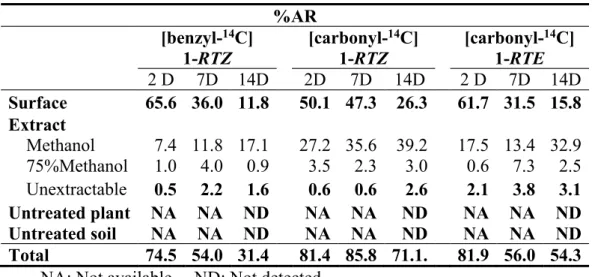
The distribution of radioactivity after the foliar application is summarized in Table 2. For the leaf treatment, the radioactivity recovered from the treated leaves was 31.4 71.1%AR after 14 days. The unrecovered 14C was most likely lost by vaporization considering the vapor pressure (1.96 10-3 10-4 m3 mol-
1) of 1. The 14C recovered by the surface rinse gradually decreased to 11.8 26.3%AR at the end of the study while that in the leaf extract concomitantly increased to 18.0 42.2%AR. Total amount of unextractable 14C was less than 3.1%AR during the study
24
in any case. Little amount of radioactivity was translocated from the treated leaf to the untreated portions of plant. In respect of the soil treatment, the 14C distribution is given in Table 3. The 14C recovered from the test system was 39.6 60.4%AR after 14 days.
Majority of the radioactivity remained in the top layer soil (0-2 cm) which amounted to 12.1 30.9%AR, while the ones in the middle (2-10 cm) and bottom (10-18 cm) layers were 13.1 16.1 and 4.8 9.9%AR, respectively. The uptake of 14C from the soil to plant was negligible as 1.5 3.6%AR.
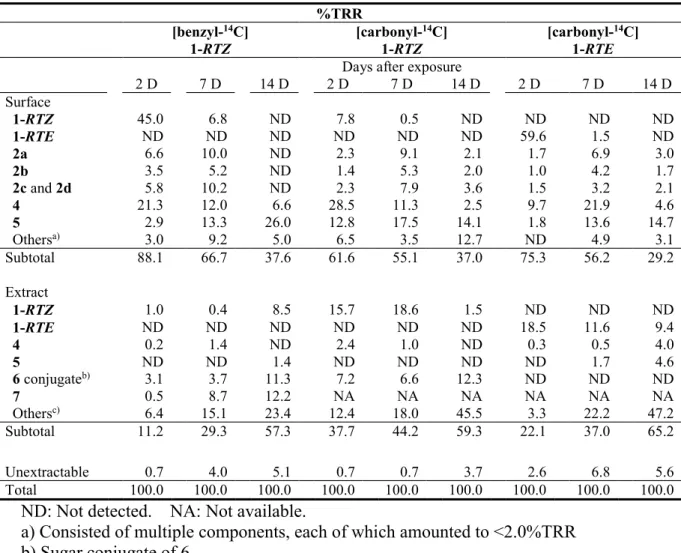
The metabolite distribution for the leaf treatments is summarized in Table 4. The representative HPLC chromatogram of the surface rinse fraction is shown in Figure 3.
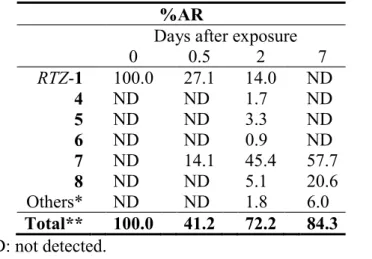
On the leaf surface, 1-RTZ and 1-RTE rapidly dissipated to <0.1%TRR at 14 days after treatment. 2, 4 and 5 were detected as major metabolites whose maximum amounts reached to 25.4, 28.5 and 26.0%TRR, respectively, at 7 days after treatment. Degradate 2 was separated into four peaks by using the HPLC method 2, i.e., the retention times of 2a, 2b, 2c and 2d were 33.7, 31.7, 30.0 and 29.3 min, respectively, which indicated the presence of four species, at least. Other minor metabolites were less than 2.0%TRR.
In the leaf extract, 1-RTZ and 1-RTE were detected at 0.4 18.6 and 9.4 18.5%TRR, respectively, during the test duration. The comparison of the metabolic profile has shown that it is relatively different between 1-RTZ and 1-RTE. In the case of 1-RTZ, the major metabolite having an intact ester linkage was the glucose conjugate of 6 amounting to its maximum 12.3%TRR. 7 was detected at 12.2%TRR for the benzyl label while 10 or 11 was not detected in cabbage plant. For 1-RTE, 4 and 5 were formed at 4.0 and 4.6%TRR, respectively, and none of the metabolites exceeded 7%TRR. To evaluate the isomeric ratio, the chiral HPLC analysis of 1-RTZ and 1-RTE remained on/in the leaf for the benzyl label was conducted, and demonstrated negligible isomerization to the other stereoisomers (<0.7%TRR). For the soil treatment, most of the radioactivity remained as the intact parent compound, except for [benzyl-14C] 1-RTZ which produced 8 in 41.9%TRR at 14 days after treatment.
Identification of Metabolite 2
Approximately 180 and 250 ng of possible isomeric metabolites 2a and 2b were obtained, respectively, from the experiment for collecting enough amounts for their identification. The purified metabolites 2a and 2b were individually subjected to 1H-
25
NMR and 1H-1H COSY, and 1D- and 2D-TLC analyses. The chemical shifts of these metabolites are listed in Table 5. Each proton signal pattern was very similar between the two, but was clearly different from that of 1-RTZ as its original two methine protons at the propenyl moiety shifted from 4.92 and 5.35 ppm to a lower magnetic field 5.11 and 5.62 ppm, respectively. With regards to 1H-1H COSY spectrum, no cross signal was observed between the above two adjacent methine protons for 2a and 2b, which suggested the cleavage of C-C double bond (Figure 4, showed 2a as representative). In the 1D- TLC analysis using an acidic solvent C, both 2a and 2b decomposed to caronaldehyde (4) and carboxylic acid (5) derivatives during the development. Therefore, the chemical structures of 2a and 2b were assumed to be ozonide derivatives possessing a 1,2,4- trioxolane ring. To identify the chemical structure as ozonide, 2 was synthesized from 1-RTZ and 1-RTE by ozonation. The modification of HPLC gradient system (method 2) enabled the synthetic 2 from RTZ and RTE isomers to be clearly separated into four isomers, namely, 2a-2d. The observed ratio of the four isomers was 2a/2b/2c/2d = 33/16/37/14 for 1-RTZ and 2a/2b/2c/2d = 40/21/28/11 for 1-RTE. The ozonation was performed several times followed by isomeric ratio confirmations by HPLC, each experiment showed similar ratio to the one mentioned above, suggested preferred generation of 2c/2d to 2a/2b from RTE isomer, while the ratio from RTZ was mostly even. The comparison of 1H-, 1H-1H NMR spectra and TLC, HPLC co-chromatograms has clarified that 2a, 2b, 2c and 2d produced on the leaf surface were definitively identical with those of the synthesized standards. Using each synthetic isomers, the 1H- and 13C- NMR spectra are tabulated in Table 5. The overall trends of the spectra were similar within four isomers, while the chemical shifts related to protons H5 and H6 on the cyclopropane ring were clearly different. The four isomers all exhibited identical cross peaks with 1 in various modes of 2D-NMR analyses, which clearly demonstrated the preservation of the chemical structures of the parent compound, except for the cleavage of the C-C double bond at the prop-1-enyl moiety. In the LC-ESI-MS analysis, the pseudo ions of 2a-2d were observed at m/z = 409 [M+H]+, 426 [M+NH4]+ and 431 [M+Na]+ in the positive ion mode, which indicated all products incorporated three oxygen atoms into 1. Taking all above into account, these four products were determined to be a pair of diastereomers of the ozonide derivative whose asymmetric two carbons exist in the trioxolane ring. Successively, the HPLC-purified synthetic isomers 2a, 2b and the
26
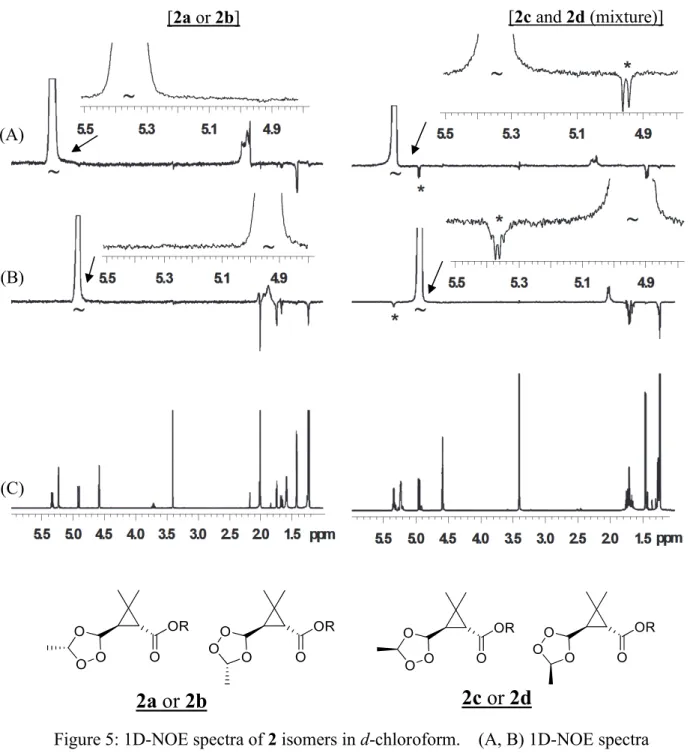
mixture of 2c and 2d were subjected to NOE difference analysis to gain insights into their conformations. The NOE resonance was clearly observed between the protons H10 (5.34-5.36 ppm) and H11 (4.92-4.96 ppm) in the trioxolane ring for the mixture (2c+2d), while little or no resonance was observed for 2a and 2b which indicated the structural distance between these protons are closer for the former isomers compared to the latter (Figure 5), thus, their configurations were characterized as trans (threo) and cis (erythro), respectively.
Identification of Metabolites 3 7
The chemical structures of 3 5 and 7 were confirmed by HPLC and 2D-TLC co- chromatographies with the synthetic standards. For the glucose conjugate of 6, the corresponding HPLC fraction was isolated and then incubated with cellulase or - glucosidase. A new peak produced by the enzymatic hydrolysis was identified as 6, as the aglycone, by the HPLC and 2D-TLC co-chromatographies with the reference standard.
Interestingly, the enzymatically liberated 6 predominantly consisted from the single isomer detected at the retention time 20.9 min, whose reference standard has four isomers in total arrived at different regions at 20.9 to 22.2 min.
DISSCUSSION
Significant radiocarbon loss, i.e. maximum 25.6%AR within 2 days, was observed after the foliar application of 1-RTZ and 1-RTE onto the cabbage plant (Table 1), which indicated their immediate volatilization from the leaf surface due to the high vapor pressure. The volatilization of pesticides from leaf surfaces can be conveniently 1 (2.1 10-4 m3 mol-1
fenpropathrin (1.8 10-4 m3 mol-1), phenothrin (1.4×10⁻⁶ m3 mol-1), permethrin (1.9×10⁻⁶ m3 mol-1) and cypermethrin (4.2×10⁻⁷ m3 mol-1), while those with low one tend to remain on the leaf surface for a relatively longer period like tralomethrin (3.9×10⁻¹⁵ m3 mol-1) (Nambu et al. 1980; Mikami et al. 1985; Cole et al. 1982; Gaughan and Casida 1978;
HHS 2003; Laskowski 2002).
Both E/Z geometrical isomers reacted with atmospheric O3 on the leaf surface
27
produced diastereomeric 2 as the major initial degradates. There are many precedent experiments indicated the formation of ozonide as a degradation intermediate for pyrethroids, but the detection of ozonide was not definitive probably due to their instability after generation and during chromatographic/spectroscopic analysis. Ruzo et al. (1986) studied the ozonolysis of synthetic pyrethroids, phenothrin and halothrin, in several organic solvents or on thin films and detected their ozonide derivatives which were tentatively identified by chemical ionization mass spectrometry (CI MS) and 19F-,
13C- and 1H-NMR spectroscopy. Nambu et al. (1980) studied the metabolism of phenothrin on bean foliage and proposed its ozonide form by its measured molecular weight by electron ionization mass spectrometry (EI MS) and, as supportive, detecting its typical degradates produced such as the caronaldehyde and carboxylic acid derivatives during the 1D-TLC development using an acidic solvent. However, both authors did not confirm the structures using synthetic standards and determined the stereostructures.
Incidentally, the halogen-substituted pyrethroids, e.g. deltamethrin, likely form less amount of ozonide products (Ruzo et al. 1986) and the corresponding degradates in their plant metabolisms (Mikami et al. 1985; Cole et al 1982; Gaughan and Casida 1978).
Difference of substituent groups at olefins is considered to be an important factor to determine the reactivity with ozone because an electron-withdrawing substituent reduces the electron density at the olefin to suppresses the 1,3-dipolar cycloaddition of ozone, while an electron-donating group enhances it (Pryor et al. 1985). Because 2 has two asymmetric carbons at the 1,2,4-trioxolane ring, there are four isomers, i.e., 2a-2d, which could be generated. From the detailed analysis of synthetic ozonide by 1D-NOE measurement together with the spectrum pattern and chemical shifts/coupling constants from various NMR analyses, the diastereomeric configurations of 2 isomers were determined as trans (threo) for 2a and 2b, and cis (erythro) for 2c and 2d. In the 13C- NMR spectra, the chemical shifts of C1 and C6 attached to the ozonide ring shifted to lower field and C11 to higher field for 2a and 2b compared to those of 2c and 2d. This difference in the chemical shifts was in good agreement with the results reported by Griesbaum et al. (2004) who have conducted extensive analyses to determine the configuration of several ozonide derivatives by 13C-NMR.
Furthermore, 2a and 2b were more preferentially produced from 1-RTE while 2c and 2d from 1-RTZ by the ozonolysis. This result supports our diastereomeric
28
assignment, because the empirical trend in a selectivity has been theoretically examined, especially for bulky substituents, that trans alkenes are more likely to be transformed to trans secondary ozonide via trans primary ozonide and syn carbonyl oxide, and cis alkenes and vice versa (Bauld et al. 1968; Ponce et al. 1997; Bailey and Ferrell 1978;
Murray et al. 1967). The production of four diastereomers in the ozonolysis at olefins
can be explained from a generaliz (Criegee 1975;
Geletneky and Berger 1998) as summarized in Figure 6, which can be briefly expressed by 3 steps: 1) 1,3-dipolar cycloaddition of O3 to olefin to produce a highly unstable primary ozonide, 2) dissociation of the primary ozonide to give the corresponding zwitterionic carbonyl oxide and carbonyl compounds, i.e. Criegee intermediate, 3) recombination of the Criegee intermediate via another 1,3-dipolar cycloaddition to produce more stable secondary ozonide. The step 2 should be the important path to produce four diastereomers on the cabbage leaf surface, in which the four patterns of nonhomologous random recombination of carbonyl oxide ions and carbonyl compounds produced from the primary ozonide may be deeply involved. Incidentally, the secondary ozonides are considered to be less toxic to mammal because they are highly likely to be unstable in mammalian tissue due to their rapid decomposition in aqueous solutions (Zaikov and Rakovsky 2009; Perry et al. 2006; Pryor 1991). Furthermore, an ozonide derivative of unsaturated lipid, methyl oleate, was orally administered to rat which resulted in low toxicity, probably due to its fast degradation by enzymes and biological antioxidants such as GSH transferase and vitamins or SOD, respectively (Pryor 1991).
In the leaf tissue, the sugar conjugate of 6 was only produced as a major metabolite in the leaves treated with 1-RTZ. This may be explained by the selective epoxidation of 1-RTZ to produce intermediate 3 under the function of enzymes probably by CYP, because CYP-catalyzed stereoselective epoxidation at olefin is a common reaction in living organisms such as lipid/hormone biosynthesis and xenobiotic detoxification (Guengerich 2003; Hayashi et al. 200; Vaz et al. 1998; Sauveplane et al. 2009).
Although 3 was not detected from neither 1-RTZ nor 1-RTE in cabbage plant, the epoxide derivative of 1 is reported to be produced in rat and photodegradation on soil (Nishimura et al. 2011; Kaneko 210). Vaz et al. (1998) clarified that the epoxidation of olefins by CYPs from several origins proceeded favorably with (Z)-2-butene than its (E)-isomer.
29
Sauveplane et al. (2009) reported the CYP derived from Arabidopsis thaliana, which was heterologously expressed in yeast, showed highly selective conversion of (Z)-configured unsaturated fatty acids to mono- or di-cis-epoxide. Ando et al. extensively studied the configuration of the epoxy chrysanthemate derivatives of (S)-bioallethrin and phenothrin produced by mouse microsomal CYP (Ando et al. 1991; Class et al. 1991). They have clarified that the oxygen atom was inserted to the propenyl double bond from the si face to produce the 7,8-epoxy derivative and its configuration at C7 carbon, the adjacent one to the cyclopropane ring, was R and S from selective oxidation of trans- and cis- chrysanthemates, respectively. Additionally, epoxy hydrolases which transform epoxy derivatives into diols are also reported to be stereoselective. Soybean-derived epoxy hydrolase converts cis-epoxy fatty acids into threo diols by catalyzing trans-addition of water into oxirane carbon which has the S-chirality (Blee and Schuber 1992). Taking all above into consideration, a single isomer of aglycone 6 detected in the cabbage plant is most likely to be the threo isomer in R-R configuration which was produced via the intermediate cis isomer of 3 in R-S configuration, and its estimated pathway is proposed in Figure 7.
In summary, the proposed metabolic pathway of 1 in the cabbage plant is described in Figure 8. 1-RTZ and 1-RTE reacted with atmospheric O3 on the leaf surface to form ozonide 2a-d as the initial product, and successively decomposed to caronaldehyde 4 and carboxylic acid 5 derivatives via opening of the trioxolane ring. At inner plant, they were further converted to the polar metabolites via cleavage of the ester linkage to 7 or dihydroxylation to 6 at the olefinic carbon, possibly mediated by epoxide 3, followed by conjugation with sugar. The isomerization on/in the cabbage leaf was a minor reaction.
30 Tables:
Table 1: The chemical structures of the test chemicals and reference standards.
Designation Chemical structure Designation Chemical structure
RTZ-1 6
RTE-1 7
2 8
3 9
4 10
5 11
*: 14C label position of carbonyl label, [carbonyl-14C]1-RTZ and RTE.
14C label position of benzyl label, [benzyl-14C]1-RTZ.
*
*
31
Table 2: Distribution of radioactivity after foliar applications.
%AR [benzyl-14C]
1-RTZ
[carbonyl-14C]
1-RTZ
[carbonyl-14C]
1-RTE 2 D 7D 14D 2D 7D 14D 2 D 7D 14D Surface 65.6 36.0 11.8 50.1 47.3 26.3 61.7 31.5 15.8
Extract
Methanol 7.4 11.8 17.1 27.2 35.6 39.2 17.5 13.4 32.9 75%Methanol 1.0 4.0 0.9 3.5 2.3 3.0 0.6 7.3 2.5 Unextractable 0.5 2.2 1.6 0.6 0.6 2.6 2.1 3.8 3.1 Untreated plant NA NA ND NA NA ND NA NA ND Untreated soil NA NA ND NA NA ND NA NA ND Total 74.5 54.0 31.4 81.4 85.8 71.1. 81.9 56.0 54.3
NA: Not available. ND: Not detected.
Table 3: Distribution of radioactivity after soil applications after 14 days.
%AR [benzyl-14C]
1-RTZ
[carbonyl-14C]
1-RTZ
[carbonyl-14C]
1-RTE
Treated Soil
Top layer 30.9 28.8 12.1
Methanol 23.8 21.7 10.0
Methanol/HCl 3.7 1.7 1.3
Unextractable 3.4 5.4 0.8
Middle layer 13.1 15.7 16.1
Bottom layer 4.8 13.7 9.9
Untreated Plant 3.6 2.2 1.5
Total 54.2 60.4 39.6
Layer: Top (0-2 cm), middle (2-10cm), bottom (10-18 cm).