Synthesis and characterization of sulfate-iodate ettringite; and their potential role in immobilization of
129I
Takeshi Iwaida* Kazuki Yano* Satoru Tanaka* Shinya Nagasaki**
To improve the reliability of safety assessment of radioactive waste disposal system, it needs to elucidate the retention mechanism of radioactive nuclides by cementitious barrier material. In this study, iodate immobilization mechanism by ettringite (Ca6Al2(SO4)3(OH)12·26H2O), which is one of the cement hydrated phases, was investigated. The sulfate-iodate ettringite which has various iodate concentration was synthesized by mixing KIO3 and the crystal structure and the chemical composition of synthesized sample were investigated by using XRD and ICP-OES. In addition the sorption mechanism of IO3- onto ettringite was examined by comparing the characterization result of sulfate-iodate ettringite with the solid and liquid analyze result of iodate sorption experiment.
Keywords: cement, ettringite, iodate, sorption, solid solution
1 Introduction
In a geological disposal of TRU radioactive wastes, the
129I is thought as the most important radioactive nuclide due to its remarkable long half-life (1.57 x 10⁷ [y]) and its low efficiency for sorbing onto the bentonite and the mineral surface [1]. It is, therefore, significant to develop the technologies on the disposal and the treatment of wastes containing 129I. Ettringite (Ca6Al2(SO4)3(OH)12·26H2O), which is one of the hydrated cement phases, is known as an anion substitutable crystal phase and expected for a host phase of radioactive anionic elements in a geological disposal condition [2]. In this study we scoped on the ettringite as a fixation material of 129I.
Ettringite forms a trigonal-hexaganal crystal [3-4]. The columns of composition {Ca6[Al(OH)6]2·24H2O}6+ build crystal structures through electrostatic interactions with the {(SO4)3·2H2O}6- in the channels between columns (Fig.1).
The columns are composed of Al(OH)6 octahedra alternating with triangular groups of edge-sharing CaO8 polyhedra, with which they share OH- ions. Each calcium atom is also coordinated by four H2O molecules, and the hydrogen atoms of coordinated H2O form the nearly cylindrical surface of the column. The columns are parallel to the c-axis of crystal unit cell. Per formula unit with six calcium atoms, the channels contain four sites, of which three are occupied by sulfate ions and one by two water molecules. It has been reported that the channel site can host varieties of oxyanions (AsO43-
, B(OH)4
−
, CrO42-
, SeO42-
, and VO43-
) [5-9].
Although it needs to elucidate sorption mechanism for the long-term safety assessment of radioactive waste disposal, the immobilization process of iodate by ettringite is not fully
understood. It is expected that a study of the synthesis and characterization of iodate-containing ettringites provides useful information correlated with iodate immobilization.
In this paper, the sulfate-iodate ettringite which has various iodate concentration was synthesized by mixing KIO3. From the characterization of the prepared samples, the solid solution of the iodate-sulfate ettringite was confirmed and the uptake form of iodate was studied. The sorption experiment of iodate onto the pure ettringite was also carried out to examine the sorption mechanism of the iodate. The crystal structure and the chemical composition of synthesized sample were analyzed by using XRD (X-ray diffractometry), SEM (scanning electron microscope), ICP-OES (Inductively coupled radio frequency plasma optical emission spectrometry), and TG/DTA (thermogravimetry / differential thermal analysis).
Fig.1 Structure of ettringite [3-4].
This article was presented in Japan-China Workshop on Nuclear Waste Management and Reprocessing .
Synthesis and characterization of sulfate-iodate ettringite; and their potential role in immobilization of 129I, by Takeshi Iwaida ([email protected]), Kazuki Yano, Satoru Tanaka,Shinya Nagasaki
*Department of Quantum Engineering and Systems Science,
Graduate School of Engineering, The University of Tokyo 7-3-1, Hongo, Bunkyo-ku, Tokyo, 113-8656, Japan
* *Department of Environmental Studies, Graduate School of Frontier Sciences, The University of Tokyo 7-3-1, Hongo, Bunkyo-ku, Tokyo, 113-8656, Japan
原子力バックエンド研究 March 2001
2 Experimental
2.1 Synthesis of ettringite
Ettringite was synthesized by mixing Ca(OH)2 and Al2(SO4)3·18H2O in a 0.1M NaOH solution (liquid-solid ratio of 0.01 m3/kg), to give a Ca:SO4 mole ratio of 2:1.
6 Ca(OH)2 + Al2(SO4)3 ・ 18H2O
→Ca6Al2(SO4)3(OH)12・26H2O (1) The slurry was aged for two days, and filtrated using a membrane filter with a pore size of 0.45µm. The slurry on the filter was flushed to remove NaOH. A mild vacuum was applied to take away excess water from solid products with hygroscopic P2O5.
2.2 Synthesis of sulfate-iodate ettringite
To synthesize sulfate-iodate ettringites, various amounts of Ca(OH)2, KIO3, Al2(SO4)3·18H2O, and Al(OH)3 were mixed in a 0.1M NaOH solution (0.01 m3/kg). The amount of Al2(SO4)3·18H2O in Eq. (1) was alternated as following:
Al2(SO4)3·18H2O
→(1-x)Al2(SO4)3・18H2O+6xKIO3+2xAl(OH)3 (2) The samples were so prepared that the iodate compositions in one mole of iodate-sulfate ettringite became 0.6, 1.2, 1.8, 2.4, and 3.0 mol. The slurries were aged for two days, separated from water, washed, and dried in the same way as section 2.1.
For synthesizing the different ettringite solid solutions, two methods have been chiefly used.
1.Paste reaction [7, 8, 10-12]: The sample is prepared by mixing lime-water, aluminum salt, and salts containing the different anions.
2.The saccharat-method [5, 7, 9]: A solution of aluminum salt and salts containing the different anions are mixed with the soluble calcium complex consisting of lime dissolved in a 10% sucrose solution.
Poellmann et al [10]. reported that the crystal shapes and cell volumes of ettringite solid solutions containing B(OH)4-
and CrO42-
were depended on the preparation methods. In this paper, paste reaction method was chosen for preparation of iodate-sulfate ettringite to avoid the effect of the sucrose (e.g. complexation of sucrose with iodate).
2.3 X-Ray diffraction
The MAC science M03X was used to obtain X-ray diffractograms. XRD patterns of solid products were collected with Cu-Kα1 radiation at 35kV/20mA. The diffraction angle scans ranged from 8.5 to 40° (2θ ) with a speed of 0.5°
(2θ ) per 1min. The positions of seven peaks (see Fig.2-a)
were measured and corrected with mica (NIST Standard Reference Material SRM 675). Lattice constants were refined by a least squares method [13]. For hexagonal crystal, flowing
2 (3)
0 2 2
0 2 2
2 3
4 1
c l a
k hk h
d = + + +
Where, d nm is the interplanar spacing which have Miler indices (hkl). In addition, a0 and c0 are the lattice constants of a axis and c axis, respectively. The lattice constants of the samples were obtained by fitting d’s into Eq.3 at the seven peaks.
aq.
2.4 Chemical analysis
The prepared samples were dissolved in a 0.5N HNO3
solution at liquid-solid of 1m3/kg. Quantitative elemental analyses were performed for Ca, Al, S, I, Na, and K using ICP-OES (ICPS-10004, Shimadzu). We carried out the experiments in oxidizing environment and there is no reducing agent. It was considered, therefore, I in solution and solid existed as IO3-
. The amount of impurities (Al(OH)3, and Ca(OH)2) in the solids and water content of each sample were determined by gravity changes from 25°C to 1000°C using TG/DTA (DTG-30, Shimadzu). The weight reduction at 270°C and 420°C were measured to determine the amount of Al(OH)3 and Ca(OH)2, respectively. We had already confirmed that the weight reductions corresponded with each compound by analyzing TG/DTA of Al(OH)3 and Ca(OH)2
aq.
reagents. The weight reduction corresponded with CaCO3 was not observed by TG/DTA. Therefore it is considered that the amounts of CaCO3 in the samples are negligible.
2.5 Sorption experiments
The pure ettringite samples were weighted in polypropylene bottles. The 0.01M KIO3 solutions (0.1 m3/kg) of which pH was adjusted to be 12 by dissolving NaOH were poured into the bottles. We chose this high pH to avoid solid alteration occurring at low pH [12]. After 1, 3, 7, 14, 21, and 49 days, the solids were separated from the solutions by filtration using a membrane filter with a pore size of 0.45µm.
Concentrations of I in the filtrates were determined by ICP-OES. The solids of 21days on the filter were dried and analyzed in the manner as sections 2.2 and 2.3.
In this study, the pure water (Millipore, Milli-Q plus) was decarbonated by purging N2 gas, and the experiments were carried out in a glovebox filled with N2 gas (N2
purity>99.99%) at room temperature. All reagents were analytical grade and supplied by Wako Pure Chemical Industries.
3 Results and discussion
3.1 SEM and XRD characterization
In Fig.2 (a), every peak position of XRD patterns of solid products without KIO3 matched well to reported values
Fig.2 X-ray diffraction pattern characteristic of the synthesized solid products: (a) pure ettringite; (b-f) the samples prepared with initial KIO3 to be 0.6, 1.2, 1.8, 2.4, and 3.0 mol, respectively.
原子力バックエンド研究 March 2001
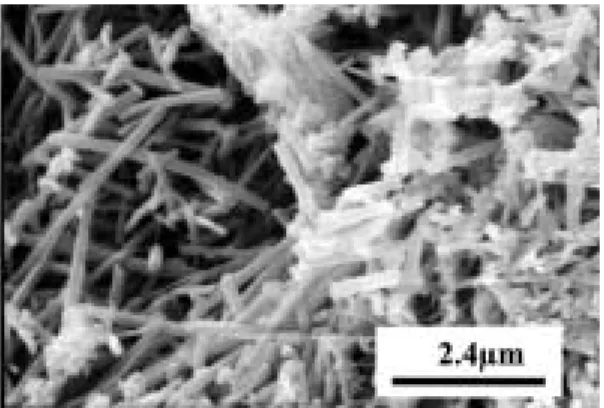
impurities (Al(OH)3, Ca(OH)2, and CaCO3) were close to the values of ettringite. Figure 3 are SEM (S-4100, Hitachi) images of synthesized sulfate-iodate ettringite. Crystal formed typical needle-shape of ettringite. From these results, it was confirmed that the ettringite was indeed formed by the methods mentioned in section 2.1and 2.2.
(a) SEM image of sample prepared with no KIO3 reagen
t
(b) SEM image of sample prepared with initial KIO3 to be 0.6 mol.
(c) SEM image of sample prepared with initial KIO3 to be 1.2 mol.
(d) SEM image of sample prepared with initial KIO3 to be
In Fig.4, lattice constants of ettringite were plotted against initial KIO3 additive. It was observed that lattice constant of a-axis increased linearly and that of c-axis decreased linearly along with increasing IO3- concentration till 1.5 mol. According to Vegard role[13], it is known that lattice constant linearly changes along with increasing concentration of solute end-member. It was considered that the change of lattice constants was caused by increasing concentration of end-member IO3- in ettringite. The changes stop around initial content of 1.5 mol. Thus, it was revealed that the solid-solution of IO3- in ettringite had a limitation at 1.5 of initial KIO3 additive.
3.2 Chemical Characterization
Table 1 gives structural formulae of prepared samples in which all elements are normalized to Ca = 6. Structural formulae have been calculated from the analyses using the following procedure [5]: The composition of solid products was determined in the way as section 2.3. However, XRD analysis showed that remarkable quantitative impurities remained in the products. The amount of impurities with prepared sample was measured using TG/DTA. We made the assumption that the composition of solid products without impurities corresponded to only one phase, sulfate-iodate ettringite, in which all initial additive iodate was included.
The composition of sulfate-iodate ettringite was determined by subtracting impurity contribution from total composition of solid products. Whole charge balance was adjusted by adding OH-. Finally the H2O content determined by weight reduction at 100~140 °C which was corresponded with strong endtherms of DTA curves of synthesized pure ettringite.
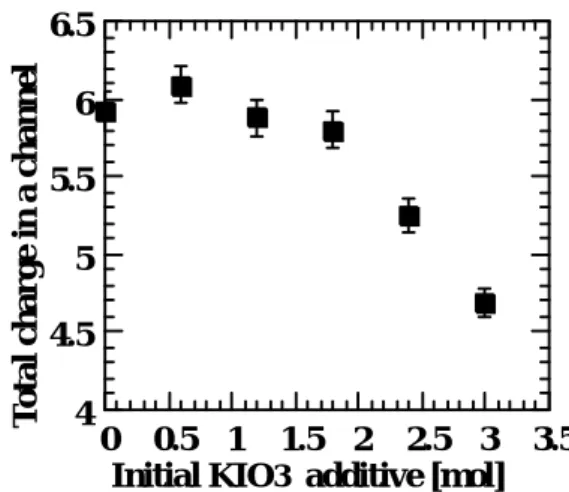
Table 1 shows that samples prepared with initial KIO3 to be less than 1.2 mol had Ca:Al ratio of 6:2. The ratio equals to that of column in pure ettringite. It is considered that the samples have those column structures. It is also observed that sulfate decreased with increasing iodate, and decreasing of sulfate was compensated by twice iodate ions. As shown in Fig. 1, ettringite has four sites in a channel for three SO42-
ions. Thus, total negative charge in a channel is six. Figure 5 showed the sum of anionic charges in the prepared samples.
The samples of which initial additive were lesser than 1.2 mol maintained six negative charges in a channel. It can be considered one SO42-
in the structure of ettringite substitute with two IO3-
s, considering charge difference between SO42-
and IO-. That is, because the stoichiometry of solid products
Table 1 Chemical compositions of prepared samples Table 1 Chemical compositions of prepared samples Initial KIO3 Additive
Initial KIO3 Additive Chemical FormulaChemical Formulaaa
Ca Al SO4 IO3 OH H2O
Ideal
ettringite 6 2 3 0 12 26 0 6 2.01 2.94 0.00 12.15 26.40 0.6 6 2.09 2.71 0.67 12.18 26.31 1.2 6 2.05 2.19 1.50 12.27 27.00 1.8 6 1.44 2.00 1.80 10.52 27.54 2.4 6 1.35 1.70 1.85 10.64 26.70 3 6 1.34 1.52 1.65 11.33 17.60 a. Normalized to Ca = 6
satisfied Ca6Al2(SO4)3(1-x)(IO3)6x,it was suggested that the sulfate-iodate ettringite have the column structure and the IO3-
existed in the channel of ettringite at low concentration samples.
If one SO42-
was completely substituting with two IO3-
s, final Ca:SO42-: IO3- ratio becomes 6:2:2. Nevertheless, the entering of IO3-
stops at 1.2 mol of initial additive. From XRD analysis, the similar limitation of lattice constants change was observed at the same initial additive. In the samples which have more than 1.8 mol of initial KIO3, Ca:Al ratio became 6:1.4, thus the structure of column could not maintain. The size and geometric differences between IO3-
and SO42-
are considered as one candidate of the cause. At high iodate concentration samples, much defects in the Al site of ettringite was observed. One of the possibilities for defects in the Al site is direct sorption of IO3-
ion onto the column of ettringite. In the case of arsenate sorption onto ettringite [7], it was said that the arsenate ion existed in the channel of etrringite with hydrated water molecules at low concentration of arsenate. At high concentration of arsenate, however, the arsenate ion sorbed directory onto the column of ettringite by distorting Ca polyhedra. If same kind of mechanism were occurred, Al that connected to Ca polyhedra must remove from the structure of the ettringite. However, exact solution to the cause could not be obtained. Further detailed study is necessary with a proof.
3.3 Sorption experiment
In this work, the distribution coefficient, Kd m3/kg, is defined as
liq liq init liq sorbed
C R ) C C ( C
C − ×
=
= (4)
Kd
Kd
1.120 1.125 1.130 1.135 1.140
0 0.5 1 1.5 2 2.5 3 3.5
L a ttice co n st a n t o f a ax is [ n m ]
Initial KIO
3additive [mol]
(a) attice constant of a axis of synthesized sulfate-iodate ettringite
(b) Lattice constant of c axis of synthesized sulfate-iodate ettringite
Fig.4 Variation of lattice constants of synthesized sulfate-iodate ettringite.
2.130 2.135 2.140 2.145 2.150
0 0.5 1 1.5 2 2.5 3 3.5 Initial KIO
3additive [mol]
L a tt ice co n sta n t o f c a x is [n m ]
4 4.5 5 5.5 6 6.5
0 0.5 1 1.5 2 2.5 3 3.5
T o ta l ch arge in a c h an n e l
Initial KIO
3additive [mol]
Fig.5 Total charge of anions in a channel of sulfate-iodate ettringite
原子力バックエンド研究 March 2001
where Cinit mol/m3 is the IO3-
concentration in initial solution.
Csorbed mol/kg and Cliq mol/m3 are the IO3--
concentrations in solid and liquid phases after certain periods, respectively. R m3/kg is the liquid-solid ratio of the samples. In Fig. 6, the Kd
values of IO3--
for sulfate ettringite were plotted against time.
The Kd value increased gradually with increasing time, and became seemingly stable at about 0.3 m3/kg after 21 days.
Csorbed mol/kg and Cliq mol/m3 are the IO3 concentrations in solid and liquid phases after certain periods, respectively. R m3/kg is the liquid-solid ratio of the samples. In Fig. 6, the Kd
values of IO3 for sulfate ettringite were plotted against time.
The Kd value increased gradually with increasing time, and became seemingly stable at about 0.3 m3/kg after 21 days.
1.120 1.125 1.130 1.135 1.140
0 0.5 1 1.5 2
Latti ce c o n stan t o f a ax is [n m ]
Final
IO concentration in solid [mol]
(a) Lattice constant of a axis of synthesized sulfate-iodate ettringite and IO3-
sorbed ettringite.
2.130 2.135 2.140 2.145 2.150
0 0.5 1 1.5 2
Final
IO concentration in solid [mol]
L a tt ice co n st a n t o f c a x is
[nm ]
(b) Lattice constant of c axis of synthesized sulfate-iodate ettringite and IO3-
sorbed ettringite.
Fig.7 Variation of lattice constants of synthesized sulfate-iodate ettringite and IO3- sorbed ettringite.
The chemical structure of the sample, which contacted with IO3--
solution during 21 days was determined as Ca6Al1.97(SO4)2.47(IO3)0.93(OH)12.04. The lattice constants of a axis and c axis were 1.132 nm and 2.142 nm, respectively.
The lattice constants of this sample (opened circle) and the synthesized samples (closed circle) are plotted in Fig.7 along with final IO3--
concentration in solid. The lattice constants of IO3--
sorbed sample suit well to fitting lines, which were drawn by the data of synthesized samples. It is considered that the sorbed IO3--
is retained in the way as synthesized sample, that is IO3-- sorbed into the channel of ettringite by substituting with SO42-2-
.
The chemical structure of the sample, which contacted with IO3 solution during 21 days was determined as Ca6Al1.97(SO4)2.47(IO3)0.93(OH)12.04. The lattice constants of a axis and c axis were 1.132 nm and 2.142 nm, respectively.
The lattice constants of this sample (opened circle) and the synthesized samples (closed circle) are plotted in Fig.7 along with final IO3 concentration in solid. The lattice constants of IO3 sorbed sample suit well to fitting lines, which were drawn by the data of synthesized samples. It is considered that the sorbed IO3 is retained in the way as synthesized sample, that is IO3 sorbed into the channel of ettringite by substituting with SO4 .
3 3
4 Conclusions 4 Conclusions
From the characterization of sulfate-iodate ettringite that has various iodate concentrations and the sorption experiment of iodate on ettringite, the following conclusions were drawn.
From the characterization of sulfate-iodate ettringite that has various iodate concentrations and the sorption experiment of iodate on ettringite, the following conclusions were drawn.
1. The lattice constants of sulfate-iodate were changed with increasing initial KIO3 additive. It is thought that the IO3--
entered ettringite structure as an end-member of solid solution. This solid solution had a limitation at 1.5 mol of initial KIO3 additive.
1. The lattice constants of sulfate-iodate were changed with increasing initial KIO3 additive. It is thought that the IO3
entered ettringite structure as an end-member of solid solution. This solid solution had a limitation at 1.5 mol of initial KIO3 additive.
33 2. From the chemical analysis of synthesized samples, it is
concluded that the two IO3--
s were entered ettringite channel by substituting with one SO42-2-.
2. From the chemical analysis of synthesized samples, it is concluded that the two IO3s were entered ettringite channel by substituting with one SO4 .
3. The sorption of IO3--
occurred by substituting with SO42-2-
in an ettringite channel.
3. The sorption of IO3 occurred by substituting with SO4 in an ettringite channel.
0 0.50 0.10 0.15 0.20 0.25 0.30 0.35
0 10 20 30 40 50 6
d
value [m
3/kg]
Time [days]
K
0
Acknowledgments Acknowledgments
We thank Dr. Toshiaki Yoneoka for help in performing the XRD detection, Mrs. Kazuko Haga for the SEM photomicrography, and Dr. Yuji Hosoya for many stimulating advice.
We thank Dr. Toshiaki Yoneoka for help in performing the XRD detection, Mrs. Kazuko Haga for the SEM photomicrography, and Dr. Yuji Hosoya for many stimulating advice.
References References
[1] Fujihara, H., Saito, N. : Radioactive Iodine Waste (1) Current status of the management of I-129 included wastes. J. Nucl. Fuel Cycle Environ. 6(1), 51-54 (1999) (in Japanese).
[1] Fujihara, H., Saito, N. : Radioactive Iodine Waste (1) Current status of the management of I-129 included wastes. J. Nucl. Fuel Cycle Environ. 6(1), 51-54 (1999) (in Japanese).
and C-S-H portland cement phases for waste ion immobilization. A review, Waste Management 16(4), 295-303 (1996).
and C-S-H portland cement phases for waste ion immobilization. A review, Waste Management 16(4), 295-303 (1996).
[3] Taylor, H. F. W., : Cement Chemistry, 2nd edn, Thomas Telford Services Ltd, London (1997).
[3] Taylor, H. F. W., : Cement Chemistry, 2nd edn, Thomas Telford Services Ltd, London (1997).
[4] Skibsted, J., Henderson, E., Jakobsen, H. J. : Characterization of calcium alminate phases in cements by 27Al MAS NMR spectroscopy. Inorg. Chem. 32, 1013-1027 (1993).
[4] Skibsted, J., Henderson, E., Jakobsen, H. J. : Characterization of calcium alminate phases in cements by 27Al MAS NMR spectroscopy. Inorg. Chem. 32, 1013-1027 (1993).
[5] Hassett, D. J., McCarthy, G. J., Kumarathasan, P., Pflughoeft-Hassett, D., : Synthesis and characterization of selenate and sulfate-selenate ettringite structure phases.
Mat. Res. Bull. 25, 1347-1354 (1990).
[5] Hassett, D. J., McCarthy, G. J., Kumarathasan, P., Pflughoeft-Hassett, D., : Synthesis and characterization of selenate and sulfate-selenate ettringite structure phases.
Mat. Res. Bull. 25, 1347-1354 (1990).
[6] Kumarathasan, P., McCarthy, G. J., Hassett, D. J., Pflughoeft-Hassett, D. : Oxyanion substituted ettringites:
Synthesis and characterization; and their role in immobilization of As, B, Cr, Se and V. Fly ash and coal conversion by-products : characterization, utilization, and disposal VI, (Mater. Res. Soc. Symp. Proc. Vol. 178) (Day, R. L., Glasser, F. P. ed.) Boston, Massachusetts, U.S.A, November 29-December 1, 1989, pp.83-104 (1990).
[6] Kumarathasan, P., McCarthy, G. J., Hassett, D. J., Pflughoeft-Hassett, D. : Oxyanion substituted ettringites:
Synthesis and characterization; and their role in immobilization of As, B, Cr, Se and V. Fly ash and coal conversion by-products : characterization, utilization, and disposal VI, (Mater. Res. Soc. Symp. Proc. Vol. 178) (Day, R. L., Glasser, F. P. ed.) Boston, Massachusetts, U.S.A, November 29-December 1, 1989, pp.83-104 (1990).
[7] Myneni, S. C. B., Traina, S. J. Logan, T. J., Waychunas, G. A. : Oxyanion behavior in alkaline environments:
sorption and desorption of arsenate in ettringite. Environ.
Sci. Technol. 31, 1761-1768 (1997).
[7] Myneni, S. C. B., Traina, S. J. Logan, T. J., Waychunas, G. A. : Oxyanion behavior in alkaline environments:
sorption and desorption of arsenate in ettringite. Environ.
Sci. Technol. 31, 1761-1768 (1997).
[8] Lukas, W. : Substitution of Si in the lattice of ettringite, Cem. Concr. Res. 6, 225-234 (1976).
[8] Lukas, W. : Substitution of Si in the lattice of ettringite, Cem. Concr. Res. 6, 225-234 (1976).
[9] Poellmann, H., Kuzel, H.-J., Wenda, R. : Solid solution of ettringites. Part I: Incorporation of OH- and CO32-2-
in 3CaO·Al2O3·3CaSO4·32H2O. Cem. Concr. Res. 20, 941-940 (1990).
[9] Poellmann, H., Kuzel, H.-J., Wenda, R. : Solid solution of ettringites. Part I: Incorporation of OH- and CO3 in 3CaO·Al2O3·3CaSO4·32H2O. Cem. Concr. Res. 20, 941-940 (1990).
[10] Poellmann, H., Auer, ST., Kuzel, H.-J., Wenda, R. : Solid solution of ettringites. Part II: Incorporation of B(OH)4--
and CrO42-2-
in 3CaO·Al2O3·3CaSO4·32H2O. Cem.
Concr. Res. 23, 422-430 (1993).
[10] Poellmann, H., Auer, ST., Kuzel, H.-J., Wenda, R. : Solid solution of ettringites. Part II: Incorporation of B(OH)4 and CrO4 in 3CaO·Al2O3·3CaSO4·32H2O. Cem.
Concr. Res. 23, 422-430 (1993).
[11] Perkins, R. B., and Palmer, C. D. : Solubility of ettringite (Ca6[Al(OH)6]2(SO4)3·26H2O) at 5-75°C. Geochim.
Cosmochim. Acta 63, 1969-1980 (1999).
[11] Perkins, R. B., and Palmer, C. D. : Solubility of ettringite (Ca6[Al(OH)6]2(SO4)3·26H2O) at 5-75°C. Geochim.
Cosmochim. Acta 63, 1969-1980 (1999).
[12] Warren, C. J., Reardon, E. J. : The solubility of ettringite at 25 ºC. Cem. Concr. Res. 24, 1515-1524 (1994).
[12] Warren, C. J., Reardon, E. J. : The solubility of ettringite at 25 ºC. Cem. Concr. Res. 24, 1515-1524 (1994).
[13] Cullity, B. D. : Elements of X-ray diffraction, 2nd edn, Addison-Wesley Pub. Co., (1978).
[13] Cullity, B. D. : Elements of X-ray diffraction, 2nd edn, Addison-Wesley Pub. Co., (1978).
原子力バックエンド研究 March 2001