Working Paper Series (E)
Hibiya Kokusai Building 6F, 2-2-3 Uchisaiwaicyo, Chiyoda-ku, Tokyo 100-0011 http://www.ipss.go.jp
No.29
Educational Assortative Mating in Japan:
Evidence from the 1980-2010 Census Setsuya Fukuda
Shohei Yoda Ryohei Mogi January 2019
http://www.ipss.go.jp/publication/e/WP/IPSS_WPE29.pdf
The views expressed herein are those of the
authors and not necessarily those of the
National Institute of Population and Social
Security Research, Japan.
Educational Assortative Mating in Japan: Evidence from the 1980-2010 Census
Setsuya Fukuda
1Shohei Yoda
1Ryohei Mogi
2Abstract
The existing results for Japan on the general trends in educational assortative mating are mixed largely due to data constraints. This study aims to describe the trends in educational assortative mating in Japan using four decennial population censuses conducted in 1980-2010 and to discuss their social and demographic implications. Our simple log-linear model shows that the strength of the association for educational homogamy remained constant between 1980 and 2000, and dropped significantly in 2010. From 1980 to 2010, the strength of the association for female educational hypergamy decreased, while, contrary to previous findings, both the share and the likelihood of female educational hypogamy increased. Our study is the first to use census data to provide clear findings on the trends in educational assortative mating in Japan and points to the emergence of new marriage behaviors which are, in fact, consistent with the observed shifts in educational assortative mating across the globe.
1 National Institute of Population and Social Security Research, Hibiya Kokusai Building 6th Floor, 2-2-3 Uchisaiwaicho, Chiyoda-ku, Tokyo, 100-0011, Japan
2
Introduction
Marriage plays a central role in forming a family in East Asia. The expansion of the never-married population is one of the most dramatic demographic changes in the latter half of the twentieth century in Japan. For example, Japanese census data shows that, in the period of 1970-2015, the proportions of never-married at age 25-29 is increased from 46.5% to 72.7% for men and from 18.1% to 61.3% for women (NIPSSR, 2017). Vital statistics also shows that, in the same period, average age at first marriage increased from 26.9 to 31.1 for men and 24.2 to 29.4 for women (NIPSSR, 2017). The trend toward later marriage and growth in the proportion of men and women who never marry is not only a major cause of Japan’s low fertility rate, but is also a driving force behind other major family and social changes.
Though correlates of the trend toward later and less marriage are complex, previous studies showed that women’s education was negatively associated with marriage (Raymo, 2003;
Raymo & Iwasawa, 2005; Retherford, Ogawa, & Matsukura, 2001). The official statistics of the School Basic Survey, conducted each year by the Ministry of Education, Culture, Sports, Science and Technology, indicates that women’s tertiary education (Note 1) (ISCED2011 level 5 and higher) very rapidly expanded since the 1960s in Japan. In the late-1970s, female enrollment rates to tertiary education caught up with those of men and have been higher than men’s since then. Although female enrollment to four-year universities among high school graduates is still slightly lagged behind that of men (55.9% for men and 49.1% for women in 2017), it shows rapid catch up since the mid-1980s (38.6% for men and 13.7% for women in 1985). The expansion of female tertiary education is considered as one of the most prominent social changes relating to the trends of later and less marriage in Japan.
Due to the rapid expansion of female tertiary education, education components in the
marriage market has been under tremendous shifts in Japan since the 1980s. Although these shifts are expected to play an important role in determining the patterns of educational assortative mating, evidence in Japan is incomplete and existing results are fairly mixed. For example, previous studies mostly employ the framework of the status homogamy (e.g. Blau and Duncan, 1967) and typically examine only the trends in educational homogamy as an indicator of “openness” of social stratification (Miwa, 2007; Raymo & Xie, 2000; Shida, Seiyama, &
Watanabe, 2000; Smits & Park, 2009). Therefore, the trends in educational heterogamy is largely ignored. Furthermore, previous studies show mixed results on the trends of educational homogamy as some found no change in the strength of educational homogamy (Shida et al., 2000), while others found weakening tendencies in educational homogamy (Miwa, 2007; Raymo
& Xie, 2000; Smits & Park, 2009). In addition to these limitations, there is no study which examined over-time shifts in the strength of educational homogamy as well as educational heterogamy by educational group. These incompleteness and inconsistency of the existing findings are primarily resulted from the use of a small sample, which makes it difficult for the previous studies to draw an accurate picture of time trends in educational homogamy as well as educational heterogamy in Japan.
Using an extensive dataset of population censuses from over 120 countries (Note 2), the
recent study by Esteve et al. (2016) revealed that given the reversal of gender gap in education,
young people are increasingly more likely to form unions in which wives have higher
educational attainment than their husbands, while decreasing the likelihood of forming the
historical hypergamic pattern. However, in Japan, existing evidence suggests that there is a
strong tendency to avoid female educational hypogamy, particularly among university graduates
(NIPSSR, 2012; Suzuki, 1991). Raymo and Iwaswa (2005) also found that one-fourth to
one-third of the decline in marriage rates of junior college and university graduates between 1980 and 1995 could be explained by the increasing numerical difficulty of meeting a potential husband with the same (or higher) educational qualifications as themselves, which, in turn, contributing to the growing negative educational gradients in marriage rates in Japan. It is, therefore, of prime interest to examine whether the patterns of educational assortative mating are kept relatively unchanged in Japan or the new mating patterns have emerged around the turn of the century as a result of the continuing expansion of female tertiary education, particularly that of four-year university education.
The aim of our study is to provide evidence on the trends in educational assortative mating by using for the first time census data to study educational homogamy/heterogamy in Japan. For our study, we accessed the individual records of the full census data of four decimal periods between 1980 and 2010. By relying on census data, we avoid any bias and complexity that might result from the use of a small sample and are thus able to provide reliable evidence on both the overall- and the education-specific trends in educational assortative mating in Japan.
In the following section, we first describe our data and methods. Then, we present our descriptive results. In the final section, we summarize our findings and discuss their implications.
Data
Individual-level data from the decennial Population Census of Japan from 1980 to 2010 are used
to examine educational assortative mating in Japan (Note 3). The census covers all residents of
Japan as of October 1 in each census year. The analytical cases were selected using the following
steps. For the analysis, we first selected married men and women who were living together in a
private household and identified marital pairs using information about each individual’s marital
status and relationship to the household head (Note 4). Second, from these identified couples, we selected only Japanese couples in which the wife was aged 30 to 39. Finally, we transformed the individual records of these paired couples into dyad records. Using this procedure, we selected over 25 million Japanese married couples for our analysis (8.6 million dyads in 1980, 6.8 million dyads in 1990, 5.7 million dyads in 2000, 4.8 million dyads in 2010).
In the census, an individual’s educational attainment is defined as the highest educational level he or she reached upon graduation, or the level in which he or she is currently enrolled. We use directly the following four educational categories measured in the census: (1) primary school / junior high school (“JHS”: ISCED2011 level 1/2), (2) high school (“HS”: ISCED2011 level 3/4), (3) two-year junior college / technical school / vocational school (“JC/VS”: ISCED2011 level 5), and (4) university and graduate university (“UNI”: ISCED2011 level 6+). Because there are only a few dyads (less than 0.5%) in which at least one of the spouses was still attending school, the educational levels of those who were in school are treated as though they had graduated. Because very few people in Japan marry before they finish their education, we also assume that the couples’ educational attainment levels at the time of their marriage and at the time of the census were identical.
However, there are at least two drawbacks to using census data for the analysis of educational assortative mating in Japan. First, we cannot describe assortative marriage trends for newlyweds, since there is no information about the date of marriage or the age at marriage.
Therefore, to analyze the trends in assortative mating, we use prevailing marriages observed at
each census rather than newlyweds or recently married. As has often been discussed, trends that
are based on the prevailing marriage patterns are subject to bias due to selective marital
dissolution, educational upgrading after marriage, and remarriage (e.g., Kalmijn, 1994; Mare,
1991; Qian, 1998; Raymo & Xie, 2000; Schwartz & Mare, 2005). As divorce is most frequent among the least educated group in Japan (Raymo, Fukuda, & Iwasawa, 2013), our analysis may include fewer couples in which the husband or wife has the lowest level of education than other analyses based on newlyweds.
Nevertheless, prevailing marriages are typically used for other studies of educational assortative mating using census data (Esteve & Cortina, 2006; Schwartz & Mare, 2005). For the U.S., it has been shown that trends in educational assortative mating for prevailing and new marriages are very similar, although trends for prevailing marriages lag those for newlyweds by several years (Schwartz & Mare, 2005). The length of the lag depends on the size of the age range and the marital duration used in examining the trends for prevailing marriages. As marriage duration is longer for older couples, the broader age range results in the longer lag. In our analysis, we chose couples in which the wife was aged 30 to 39 (Note 5). The average marriage duration for married women aged 30-39, which was calculated from multiple rounds of Japanese National Fertility Survey, was 10.5 years in 1982, 10.2 years in 1992, 8.9 years in 2002, and 8.6 years in 2010. We chose this age range for two reasons. First, because most women in this age group have completed their education, we can treat educational attainment as a fixed measure in the analysis. Second, we confirmed that more than 80% of women who eventually marry before age 50 are observed as “married” at age 30-39. Therefore, our analytical cases are considered representative of the overall patterns of educational assortative mating for the subjective female cohorts.
The second limitation associated with using census data is that we cannot distinguish
marriage order in the analysis. Thus, our analysis includes the assortative mating patterns of all
married couples, regardless of how many times the partners have been married. If the patterns of
educational assortative mating differ between couples in a first marriage and in a remarriage, the period trends in educational mating would be affected by the share of couples who are remarried.
According to the vital statistics, the percentages of all registered marriages that were remarriages increased between 1970 and 2010 from 10% to 20% for men and from 5% to 15% for women (Ministry of Health, Labour and Welfare, 2017). Thus, the percentage of remarriages among all marriages (i.e., couples in which at least one spouse is remarried) more than doubled from 11.1%
in 1970 to 25.6% in 2010. We, therefore, assume that in our data the share of marriages that were remarriages was larger in the later periods. However, there is no evidence yet in Japan that how educational mating patterns of remarried couples differ from those of couples in their first marriage. Therefore, we have no way to assess the impact of the heterogeneities that may have been caused by the increasing shares of remarried couples in the later periods.
Method
Our analysis is carried out in two steps. In the first step, we present a descriptive analysis of
trends over time in husbands’ and wives’ educational distributions and educational pairings
during the 1980-2010 period. In the second step, log-linear models are employed to examine the
strength of educational assortative mating patterns by controlling for the distributions of
husbands’ and wives’ educational components in each period. We are aware of the recent
critiques on the use of log-linear models in the study of assortative mating for the inability to
estimate people’s preferences for mates (Logan, 1996). But since the log-linear models are most
frequently used in previous studies examining patterns and strength of educational assortative
mating (Lichter & Qian, 2019; Schwartz, 2013), we present our results accordingly so that
readers can interpret the results in the same line with previous findings. The original data of the
analysis which is on the distributions of wives’ and husbands’ educational pairings in each period are provided in the appendix. The reader is invited to review these data and use them in the replication and/or modification of the model.
The log-linear model employed in the analysis is explained in the following. In the saturated model, the expected value of each educational pairing in each period is described as
= + + + + + + + ,
where each character stands for W: wife’s educational level, H: husband’s educational level, and P: census year. The most important parameter in this study is , which shows the periodical change in the association of particular educational parings, which is independent of the distributions of wives’ and husbands’ educational components in each period. Most of the previous research on assortative mating relied on the most parsimonious model, which approximates the observed cell with as few parameters as possible using likelihood statistics or AIC/BIC. However, our purpose is to draw as precise a picture as possible of the trends in the associations of educational assortative mating.
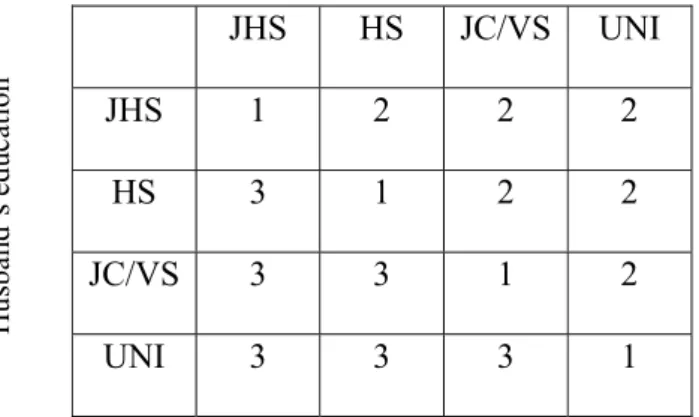
To achieve our analytical goal, we use both the simple model and the saturated model in our analysis. In the simple model, we estimated the overall trends in the strength of educational homogamy, hypergamy, and hypogamy, irrespective of educational levels, by inducing a design matrix for the parameter , which is expressed as follows;
[Table 1]
With our interpretation of the simple model, we conclude our prolonged discussion about the general trends in educational homogamy and heterogamy in Japan for the 1980-2010 period.
Next, we use the saturated model for our understandings of the education-specific trends in educational matings. The saturated model can fully replicate the observed educational pairings, while estimating by controlling for marginal distributions of educational pairings. The authors are aware that this approach is unusual in the research of assortative mating where unsaturated log-linear models are preferable since they have simpler interpretations. But after trying several design matrices for , to construct a parsimonious model, we found that there is no design matrix that can satisfactorily approximate the trends in the strength of education-specific homogamy, hypergamy, and heterogamy. Therefore, we decided to use the saturated model and interpret the behavioral patterns of educational assortative mating over time.
Results
Descriptive Analysis
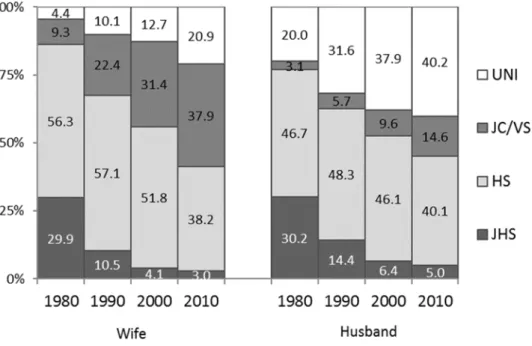
Figure 1 shows the distributions of husbands’ and wives’ educational attainment levels in our
analytical cases. Reflecting on the growing trends in tertiary education in Japan, the figure shows
a clear trend toward educational upgrading among both husbands and wives. The shares of
individuals with tertiary education (i.e., at the junior college / vocational school (JC/VS) or
university (UNI) level) increased over the study period, while the shares of those with primary or
secondary education (i.e., at the junior high school (JHS) or high school (HS) level) decreased in
the recent period. However, in line with the gender gap in university enrollment in Japan,
husbands are more likely than wives to have a university degree in all the study periods. After
1980, the percentage of wives with a university degree slowly started to catch up to that of men.
Thus, the gender gap among university graduates has been narrowing, particularly after 2000.
Wives are much more likely than husbands to have a JC/VS level of education. The JC/VS category consists of different kinds of schools and the gender compositions of these schools differ substantially. According to the School Basic Survey, only 1-2% of male HS graduates enroll in junior college. We can, therefore, assume that the majority of men in the JC/VS category received a degree from a vocational school (specialized training college) or a college of technology. The National Fertility Surveys have found that 60% to 70% of women with an educational qualification in the JC/VS category are junior college graduates. The JC/VS category also encompasses a wide range of school types, including schools that offer job-oriented training courses and schools that provide liberal arts education. Moreover, the types of individuals enrolled in the specific courses offered by these schools differ by sex and by year.
It is thus important to keep in mind that the definition of educational homogamy or heterogamy for men and women in this group is more ambiguous than for other education categories.
[Figure 1]
Next, we turn our attention to the patterns of educational mating. First, the educational
homogamy trends over time are presented in Figure 2. It is clear that the overall proportion of
couples in homogamous marriages decreased over the study period. The most frequent form of
educational homogamy is a marriage of two high school graduates. However, the proportion of
homogamous couples formed by high school graduates is decreasing rapidly by 2010. The
observed decline in homogamy among high school graduates is related to changes in the
educational composition of the study sample as shown in Figure 1. Although the share of junior
high school graduates who were in a homogamous marriage was relatively high in 1980, it declined sharply after 1990 and had fallen to very low levels by 2000 and 2010. Similar to the homogamous marriage patterns observed among high school graduates, the decline in the share of junior high school graduates in such marriages is attributed in part to the compositional change in the shares of wives and husbands with a junior high school degree only. However, the decline in homogamy among these educational groups may also be influenced by changes in their mating behaviors. We will examine whether this is the case using log-linear models in the following section.
[Figure 2]
By contrast, the shares of JC/VS and university graduates in homogamous marriages increased continuously from 1980 onward. In particular, we see that the percentage of university graduates in homogamous marriages increased substantially from 2000 to 2010 (+ 5.4 % points). In the next section, we examine whether this increase in homogamy among university graduates is attributed to changes in educational attainment levels or to changes in behavioral patterns.
Next, we describe the trends in educational exogamy shown in Figure 3. Both
hypergamy and hypogamy are defined from the perspective of the woman, and their shares in
total marriages are shown by the wife’s education. The overall share of hypergamous marriages,
which is typically high in societies with a large gender gap in educational attainment (Blossfeld,
2009), increased from 1980 to 2000, but decreased after 2000. When we look at the educational
differentials in hypergamous marriages, we see that the share of hypergamous couples in which
the wife had a junior high school degree only decreased over time, while the share of
hypergamous couples in which the wife had a JC/VS degree increased. These trends seem to reflect the changes in the educational attainment levels of wives and husbands as shown in Figure 1.
On the other hand, forms of educational hypergamy in which the wife had a high school degree increased moderately between 1980 and 2000, but had declined substantially by 2010.
These trends are likely to be affected by the changes in the educational components of wives with a high school degree. However, as the proportion of men who were highly educated (JC/VS + university) increased continuously throughout the observation period (see Figure 1), the availability of highly educated men for women with a high school degree should have been greater in the later period. Hence, the decline in hypergamous marriage among women with a high school degree might be related to changes in the strength of the matching. This question is investigated further in the following section.
[Figure 3]
Next, we describe the trends in female educational hypogamy in Figure 3. Female hypogamy is
an atypical marriage pattern, particularly in gender-traditional societies where male bread-winner
ideology plays an important role in a society (Blossfeld, 2009). Contrary to our expectation
derived from previous findings (NIPSSR, 2012; Raymo & Iwasawa, 2005; Suzuki, 1991), our
descriptive analysis shows that the percentage of couples in hypogamous marriages increased
from 1980 onward, and had reached 20% by 2010. Especially from 2000 to 2010, the proportion
of women in hypogamous marriages who had a tertiary education (e.g., a JC/VS or a university
degree) increased substantially. This finding is consistent with the global trends in the
educational mating found by Esteve et al. (2016). Moreover, when we looked more closely at our data, we found that this increase in the share of women in hypogamous marriages who were JC/VS or university graduates was brought by men with a high school education. While the share of husbands with a high school degree was declining in 2000-2010 (see Figure 1), this increase in the share of female hypogamous marriages between a highly educated wife and a husband with a high school degree is likely to be attributed to the increasing strength of the associations for this match.
In sum, our descriptive analysis shows relatively large changes in the patterns of educational mating between 2000 and 2010. However, these changes were influenced by changes in the educational composition of our sample. Thus, these descriptive results do not provide a full illustration of the changes in matching patterns regarding the partner’s educational level. In the following section, we employ log-linear models to examine the strength of the association between the educational assortative mating by controlling for the compositional changes in educational distributions of wives and husbands.
Log-linear Models
Figure 4 shows the association parameters estimated by the simple model. The overall trends in
the strength of educational homogamy, hypergamy, and hypogamy are shown, irrespective of
educational level. The association parameters are calculated as + in the model
equation (1). In the interpretation, the larger (or smaller) the association parameter is, the higher
(or lower) the odds of the given observed educational pairing are. When the association
parameter equals zero, the strength of the associations between the corresponding educational
pairing is considered as random, given the educational attainment levels of wives and husbands
at each period. The association parameter is estimated after controlling for the educational distributions of wives and husbands at each period. Therefore, this parameter can be understood as the strength of the matching or, at a lesser extent, the strength of the preferences for a particular educational pairing.
[Figure 4]
As is shown in Figure 4, the association of educational homogamy is stronger than those of educational heterogamy in Japan. Although Figure 2 indicates that its share declined, the strength of educational homogamy was stable in the 1980-2000 period and had weakened only slightly by 2010. While the likelihood of educational hypergamy was as high as the likelihood of educational homogamy in 1980, it had declined significantly by 1990 and by 2010. Although the likelihood of educational hypergamy tends to be high in gender-traditional societies in which women’s university enrollment lags behind that of men (Blossfeld, 2009), we find that this preference was negative in 2010. This suggests that in Japan, the likelihood of hypergamy is now lower than random matching. On the other hand, the likelihood of educational hypogamy was the lowest among other pairings and was less observable than random marriages. However, this form of marriage became less and less stigmatized after 1980. In 2010, the strength of educational hypogamy got much close to that of educational hypergamy. Our analysis based on the simple model indicates that the trends in the association of educational mating in Japan have been surprisingly consistent with global trends in educational assortative mating, including with the decline in female hypergamy and the increase in female hypogamy found by Esteve et al. (2016).
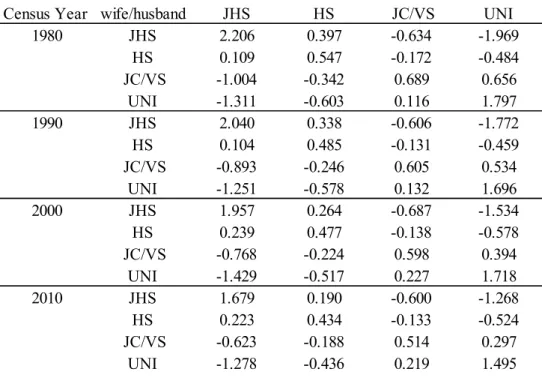
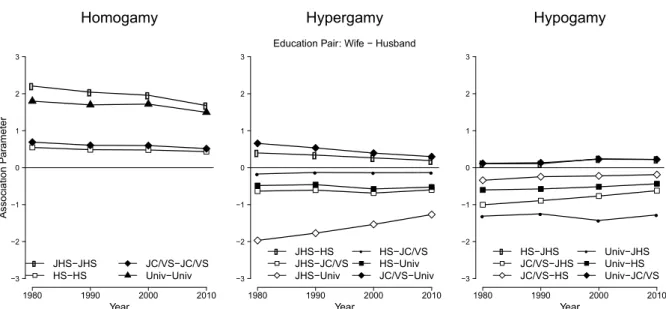
Next, the association parameters from the saturated model shown in Figure 5 are used to
examine the education-specific trends in the strength of educational mating. The parameter estimates for Figure 5 are shown in the appendix. As can be seen in Figure 5, the trends in the strength of educational assortative mating differ by educational level. The likelihood of educational homogamy was highest among couples with JHS education, followed by among couples with university education. However, in both groups, the strength of homogamy leveled off or declined only slightly from 1980 to 2000, and then declined relatively sharply from 2000 to 2010. This pattern indicates that the increase in the share of university graduates in homogamous marriages shown in Figure 2 is entirely due to the quantitative changes in the educational distribution – e.g., to the increase in the proportion of married people who were university graduates – rather than to changing patterns of educational mating. In fact, Figure 5 indicates that the increasing share of university graduates in homogamous marriages shown in Figure 2 is offset by a declining strength of the association.
[Figure 5]
On the other hand, the association parameters of educational homogamy are much lower among HS and JC/VS graduates than among JHS and UNI graduates. The shares of HS and JC/VS graduates in homogamous marriages are low because the men and women in these mid-level educational categories could choose to marry upward or downward. The trends in the association parameters show that the strength of educational homogamy declined only slightly among HS and JC/VS graduates (Note 6).
We now turn our attention to the education-specific trends in female hypergamy. The
highest likelihood this pairing can be found among the couples with a JC/VS wife and a UNI
husband and followed by the couples with a JHS wife and a HS husband. However, the strength of the associations of both educational pairings was gradually declining after 1980, and nearly reached the levels of random marriage in 2010. Among the hypergamous couples, these educational pairs were the only ones showing positive associations, with the rest of the educational pairs showing negative associations. The most distant educational pairings – e.g., a couple consisting of a JHS wife and a UNI husband – displayed a particularly low tendency for matching in the hypergamous situation. The strength of the association between a HS wife and a UNI husband also became weaker after 1990. In other words, we find that husbands with a university education were becoming more reluctant to marry a less educated wife.
Finally, we interpret the trends in the association parameters of female hypogamy shown in the right panel of Figure 5. Surprisingly, we see that two educational pairs – namely, a couple with a HS wife and a JHS husband and with a UNI wife and a JC/VS husband – had positive associations and that their associations even get stronger slightly after 1990. It is a new finding in Japanese marriage studies that some educationally hypogamous pairs show stronger associations than random matching. For other hypogamous educational pairs, all of the associations found have been negative, but the trends in these associations are getting closer to those of random marriages, which suggests that the social stigma of female hypogamy is weakening in Japan.
Summary and discussion
Japanese studies of educational homogamy have been largely hindered by small samples (Miwa,
2007). Because the trends in educational homogamy have not been clear, hypothesis testing of
the related theories on educational assortative mating has yet to be fully developed in Japan. Our
study uncovered the period trends in educational assortative mating in the 1980-2010 period
using micro-data of the Population Census of Japan. In the following, we summarize our findings and discuss social and demographic implications of the results.
First, our descriptive analysis revealed the trends in educational assortative mating in Japan in the 1980-2010 period. These trends can be briefly summarized as follows. The shares of couples in homogamous marriages declined continuously in the 1980-2010 period. However, our simple log-linear model shows that the strength of the association for educational homogamy remained constant between 1980 and 2000, and had dropped significantly by 2010. Similarly, the share of couples in female hypergamous marriages – which is a typical marital pairing in gender-traditional societies where men are more educated than women (Blossfeld, 2009) – increased from 1980 to 2000, and had decreased only slightly by 2010. But the estimated strength of the matching declined constantly between 1980 and 2010. As a result, by 2010, female hypergamous marriage had become a less preferred form of marriage than random matching. On the other hand, over the observation period, both the share of couples in female hypogamous marriages and the strength of the associations increased. For example, the share of couples in female hypogamous marriages increased from 12% in 1980 to 21% in 2010. Although the associations of female hypogamy were still negative and the lowest among the educational pairings over the entire period, by 2010 they are at similar levels as those for female hypergamy.
This descriptive information is invaluable for scholars who work on related studies on trends in educational pairings in Japan.
In our study, we also described the education-specific trends in the associations of
educational assortative mating, which, in fact, previous studies failed to investigate due to the
small sample size. Our analysis shows the recent decline in the strength of educational
homogamy among university graduates, the overall decline in the strength of female educational
hypergamy (except for the rare education pair of a UNI husband and a JHS wife), and the increasing tendency to engage in educational hypogamy among women with a university degree.
The evidence presented in our paper may point to the emergence of new marriage behaviors in Japan. Previous studies have shown that women with a university degree are especially likely to engage in educational homogamy (NIPSSR, 2012; Suzuki, 1991) and that their first marriage rates are the lowest across educational groups in Japan (Raymo, 2003;
Retherford et al., 2001). Therefore, female university graduates who did not find a similarly educated male partner tended to stay unmarried rather than to marry a less educated man (Raymo
& Iwasawa, 2005). By showing that in recent years the trends in the associations for educational hypogamy have been positive and increasing among university-educated women, however, our results deviate from conventional assumptions about patterns of educational assortative mating in Japan. One of the possible reasons behind the observed decline in educational homogamy and the increase in educational hypogamy among university-educated women is a growing economic inequality among university graduated men. The income gaps within the same age-education groups have been growing since the mid-1990s (Kambayashi, Kawaguchi, and Yokoyama 2008) and have been further increasing in the period beyond 2010 in Japan (Higuchi and Sato 2015).
Moreover, these within-group income gaps are particularly pronounced among male university
graduates (Ohta 2010). It, therefore, appears that the economic qualifications of university
graduates and of other less educated men are becoming less distinctive than they were in
previous periods. However, whether our finding that female university graduates are starting to
show a weakening preference for homogamy should require further research examining the trend
more carefully by using a dynamic model that takes into account the decisions of individuals
who have not married (Blossfeld, 2009).
Finally, we would like to discuss the social implications of our study. In many medium- to high-income nations, more women receive a tertiary education than men. Esteve et al. (2016) has pointed out that traditional female hypergamy is declining, while female hypogamy increases once the gender gap in tertiary education turns over. In Japan, although the gender gap in tertiary education has turned over already in the late-1970s, enrollment in four-year universities is still higher among men than among women. Our analysis shows that, in fact, the similar changes as the global trends in educational mating are already being observed in Japan at the behavioral level. In western societies, it is evident that the gender reversals in tertiary education correspond to changes in social norms, such as the increase in the share of households in which the woman is the breadwinner, the diffusion of more gender-egalitarian attitudes, and the decline in the divorce rates of female hypogamous couples (Esteve et al., 2016). Population scholars should be prepared to investigate whether similar changes are taking place in Japan as the expansion of female tertiary education continues.
Notes
1 Those include specialized training colleges, two-year junior colleges and four-year universities.
2 Data for Japan is not included in their study.
3 Permission to use the data on the Population Census of Japan was obtained through the Statistics Bureau, Ministry of Internal Affairs and Communications, on the basis of the Statistics Act, Article 33 (2016.5.10).
4 If the spouses were not sharing a household, the couples were removed from the analysis, as the census did not ask information about individuals who were living outside the household.
5 We changed the female age range to 25-34, but we got almost the same results as we did in this paper.
6 However, as we mentioned previously, the JC/VS category encompasses various kinds of schools, and their
compositions differ by period and sex. Therefore, a more precise examination is needed to determine whether
qualifications.
Acknowledgement
This research was supported by Grant-in-Aid for Scientific Research (A), “Marriage, Divorce and Remarriage in Japan: Trends, Causes and Social Implications” (Principal Investigator: Miho Iwasawa, JSPS KAKENHI Grant Number 25245061).
References
Blossfeld, H. P. (2009). Educational assortative marriage in comparative perspective. Annual Review of Sociology, 35(1), 513-530.
Esteve, A., & Cortina, C. (2006). Changes in educational assortative among in contemporary Spain. Demographic Research, 14(17), 405-428.
Esteve, A., Schwartz, C., van Bavel, J., Permanyer, I., Klesment, M., & García-Román, J. (2016).
The end of hypergamy: Global trends and implications. Population and Development Review, 42(4), 615-625.
Higuchi, Y. and Sato, K. (2015). The Japanese uniqueness compared with other developed countries using employment and income statistics. Mita business review, 58(1), 15-36. (in Japanese)
Kalmijn, M. (1994). Assortative mating by cultural and economic occupational status. American Journal of Sociology, 100(2), 422-452.
Kambayashi, R., Kawaguchi, D., and Yokoyama, I. (2008). Wage distribution in Japan,
1989-2003. Canadian Journal of Economics/Revue canadienne d'économique, 41(4),
1329-1350.
Review, 56(1), 15-32.
Ministry of Health, Labour and Welfare. (2017). Special report on the vital statistics in 2017:
The summary of statistics about marriage. Tokyo: Ministry of Health, Labour and Welfare. (in Japanese)
Miwa, S. (2007). Long-term trends in status homogamy. In Y. Sato (Ed.), Deciphering stratification and inequality: Japan and beyond (pp. 140-160). Melbourne: Trans Pacific Press.
National Institute of Population and Social Security Research. (2012). The process of marriage and fertility among the married Japanese women – the fourteenth national fertility survey.
Tokyo: National Institute of Population and Social Security Research. (in Japanese)
National Institute of Population and Social Security Research. (2017). Latest demographic statistics. Tokyo: National Institute of Population and Social Security Research. (in Japanese) Ohta, K. (2010). Income inequality: Among individuals, scale of company, and industry. In Y.
Higuchi and Economic and Social Research Institute. (Eds.). Labour market and income inequality (pp. 319-368). Tokyo: Keio University Press. (in Japanese)
Qian, Z. (1998). Changes in assortative mating: The impact of age and education, 1970-1990.
Demography, 35(3), 279-292.
Raymo, J. M. (2003). Educational attainment and the transition to first marriage among Japanese women. Demography, 40(1), 83-103.
Raymo, J. M., Fukuda, S., & Iwasawa, M. (2013). Educational differences in divorce in Japan.
Demographic Research, 28(6), 177-206.
Raymo, J. M. & Iwasawa, M. (2005). Marriage market mismatches in Japan: An alternative view
of the relationship between women's education and marriage. American Sociological Review,
70(5), 801-822.
Raymo, J. M., & Xie, Y. (2000). Temporal and regional variation in the strength of educational homogamy. American Sociological Review, 65(5), 773-781.
Schwartz, C. R., & Mare, R. (2005). Trends in educational assortative marriage from 1940 to 2003. Demography, 42(4), 621-646.
Shida, K., Seiyama, K., & Watanabe, H. (2000). The changes in marriage market. In K. Seiyama (Ed.), The system of Japanese social stratification 4: The future of gender, generation, and social stratification (pp. 159-176). Tokyo: University of Tokyo Press. (in Japanese)
Smits, J., & Park, H. (2009). Five decades of educational assortative mating in 10 East Asian societies. Social Forces, 88(1), 227-255.
Suzuki, T. (1991). Social intermarriages in Japan. Journal of Population Problems, 46(4), 14-31.
(in Japanese)
Appendix
TABLE A-1: The distribution of educational matching between wife and husband from 1980 to 2010 in Japan
SOURCE: The Population Census of Japan in each period.
wife husband JHS HS JC/VS UNI Total
JHS 21.1 8.0 0.3 0.5 29.9
HS 8.6 35.9 1.9 9.9 56.3
JC/VS 0.4 2.4 0.8 5.7 9.3
UNI 0.0 0.3 0.1 3.9 4.4
Total 30.2 46.7 3.1 20.0 100.0
wife husband JHS HS JC/VS UNI Total
JHS 6.4 3.6 0.2 0.3 10.5
HS 7.0 36.8 2.8 10.5 57.1
JC/VS 0.9 7.0 2.4 12.1 22.4
UNI 0.1 0.9 0.3 8.8 10.1
Total 14.4 48.3 5.7 31.6 100.0
wife husband JHS HS JC/VS UNI Total
JHS 1.6 2.0 0.2 0.3 4.1
HS 3.9 33.3 4.0 10.6 51.8
JC/VS 0.8 9.5 4.8 16.2 31.4
UNI 0.1 1.3 0.6 10.7 12.7
Total 6.4 46.1 9.6 37.9 100.0
wife husband JHS HS JC/VS UNI Total
JHS 1.0 1.5 0.2 0.3 3.0
HS 2.8 23.6 4.4 7.5 38.2
JC/VS 1.1 12.2 8.1 16.4 37.9
UNI 0.2 2.8 1.8 16.1 20.9
Total 5.0 40.1 14.6 40.2 100.0
1980 (N = 8,636,518)
1990 (N = 6,785,605)
2000 (N = 5,712,160)
2010 (N = 4,815,036)
TABLE A-2: Association parameters estimated by the saturated model
NOTE: Educational heterogamy is based on the female perspective. The subject cases are Japanese couples in which the wife is aged 30-39 in each year.
Census Year wife/husband JHS HS JC/VS UNI
1980 JHS 2.206 0.397 -0.634 -1.969
HS 0.109 0.547 -0.172 -0.484
JC/VS -1.004 -0.342 0.689 0.656
UNI -1.311 -0.603 0.116 1.797
1990 JHS 2.040 0.338 -0.606 -1.772
HS 0.104 0.485 -0.131 -0.459
JC/VS -0.893 -0.246 0.605 0.534
UNI -1.251 -0.578 0.132 1.696
2000 JHS 1.957 0.264 -0.687 -1.534
HS 0.239 0.477 -0.138 -0.578
JC/VS -0.768 -0.224 0.598 0.394
UNI -1.429 -0.517 0.227 1.718
2010 JHS 1.679 0.190 -0.600 -1.268
HS 0.223 0.434 -0.133 -0.524
JC/VS -0.623 -0.188 0.514 0.297
UNI -1.278 -0.436 0.219 1.495
TABLE 1. The design matrix for the parameter : The simple model
Wife’s education
JHS HS JC/VS UNI
JHS 1 2 2 2
HS 3 1 2 2
JC/VS 3 3 1 2
UNI 3 3 3 1
H us ba nd’s edu cation
FIGURE 1: Proportions of wives’ and husbands’ educational attainment, 1980-2010
NOTE: The subject cases are Japanese couples in which the wife is aged 30-39 in each year.
SOURCE: The authors’ calculation of the Population Census of Japan in each period.
FIGURE 2: The proportions of educational homogamy among all marriages, by educational level
NOTE: The subject cases are Japanese couples in which the wife is aged 30-39 in each year.
SOURCE: The authors’ calculation of the Population Census of Japan in each period.
FIGURE 3: The proportions of hypergamy and hypogamy among all marriages by the wife’s educational level
NOTE: The subject cases are Japanese couples in which the wife is aged 30-39 in each year.
SOURCE: The authors’ calculation of the Population Census of Japan in each period.
FIGURE 4: Overall trends in the strength of educational homogamy, hypergamy and hypogamy, The simple model
-2.0 -1.5 -1.0 -0.5 0.0 0.5 1.0 1.5 2.0
1980 1990 2000 2010
Association Parameter
Homogamy Hypergamy Hypogamy
FIGURE 5: Trends in the association parameters of the full educational pairings, The saturated model
NOTE: Educational heterogamy is based on the female perspective. The subject cases are Japanese couples in which the wife is aged
1980 1990 2000 2010
−3
−2
−1 0 1 2 3
Year
Association Parameter
JHS−JHS HS−HS
JC/VS−JC/VS Univ−Univ
Homogamy
1980 1990 2000 2010
−3
−2
−1 0 1 2 3
Year
● ● ● ●
JHS−HS ●
JHS−JC/VS JHS−Univ
HS−JC/VS HS−Univ JC/VS−Univ
Hypergamy
Education Pair: Wife − Husband
1980 1990 2000 2010
−3
−2
−1 0 1 2 3
Year
● ●
● ●
HS−JHS ●
JC/VS−JHS JC/VS−HS
Univ−JHS Univ−HS Univ−JC/VS