r
世界の日本語教育」
8, 1998年
6月Senko K. Maynard*
Key Words: rhetoric, discourse principles, newspaper columns, reading
This paper reports the results of analysis of Japanese mass media discourse, specifically 38 entries of newspaper opinion columns
,
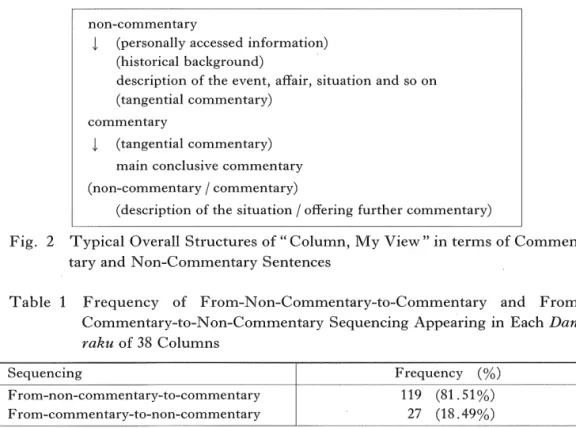
Columns, M y View,taken from Asahi shim bun (1994 ). Based on the results, I explore the possibilities of introducing discourse principles into the craft of teach目 ing students how to read Japanese.By appealing to the concept of commentary sentences, I examine how and where in the column the writer presents his or her views. The study reveals that (1) a paraphrase of the headline appears at a point somewhere around 86.73% into the column, (2) sentences in column由initialdα
?
are 12.24% commentary sentences, whereas sentences in column‑final danraku are 51.02% commentary sentences, and (3) the sequencing of non四
commentary to commentary sentences is prevalent in danraku (81.51 %). Accordingly, I conclude that the newspaper column writers opinions appear on multiple levels toward the end of the discourse‑within danraku as well as within the entire column.
Based on a review of the literature on applied linguistics, I discuss possi四
bilities of applying the discovered rhetorical sequencing as well as other principles of Japanese discourse to the teaching of reading. In addition, a schematic structure for a sample column is presented as an example of a possible pedagogical tool.
INTRODUCTION
Reading Japanese is a task that we perform on a regular basis. To facilitate this task, instructors inevitably engage in various pdagogically motivated activi‑ ties‑selection of material, preparation of vocabulary sheets and grammar notes, and planning of student tasks and assignments. More than a comprehensive
*泉子
K.メイナード:
Professor of Japanese Language and Linguistics, Rutgers University, U.S.A.[ 67 ]
knowledge of vocabulary and grammar is required, however, for students to comprehend the content. This is because, as pointed out by many previous studies (Kaplan 1972; Hinds 1983; Nagano 1983; Ronna 1989; Nishihara 1990; Nishida 1992; Kirkpatrick 1993), organizational principles of discourse di
妊
eracross genres and across languages. Given variabilities of organization in discourse, it seems important first to investigate discourse principles of di妊
erent genres, and second, to explore how the findings may be e妊
ectivelyapplied for pedagogical purposes.This paper first reports one of my recent discourse analytical studies ( detailed discussion available in Maynard 1996), and then considers its pedagogical appli‑ cability along with the usefulness of organizational principles of Japanese dis‑ course in general to the instruction of reading. The study asks the question of how and in what sequential context the writers view and/or opinion is p
代 田
sented in Japanese newspaper columns. If conveying one's views (and such is assumed here) is the purpose of writing a newspaper column, in what ways, at which point in the discourse and in what discourse‑internal context does the writer either implicitly or explicitly commit to expressing his or her opinion?
Data for this study consist of 38 newspaper columns taken from Asahi S himbun, titled Koramu Watashi no M
抜
ata(
Column,M y View), written by 38 di妊
erentreporters and writers. I have collected every column appearing in the Asahi S himbun (International Satellite edition) from January through April, 1994. Each column is approximately 1,500 characters in length and appears sporadically in the newspaper's political/economic as well as editorial sections. As made explicit by the column title, in this format writers are expected to present their views or opinions on current events and issues with which they are familiar.When inquiring into potential cultural di
百
erencesin the rhetorical ordering of persuasion, the logical progression of the text is often focused upon. In this regard, it has been said that Japanese discourse generally lacks a logicalfoundation, sometimes suggested to be illogical ot simply alogical. This stereotypical generalization is misleading. When comparing Japanese ways of rhetoric with Western ways, the so問called Western logical foundation normally refers to a logical syllogism which occurs only in limited cases in everyday rhetoric in the West.
Certainly, the logic田basedprescription is suitable for some discourse types‑
both in the West and Japan. A more accurate picture seems to be that depend悶 ing on genres, Japanese texts use a mixture of discourse organizational princi悶 ples including and beyond deductions (enthymemes) and inductions (use of examples). Thus, before making sweeping generalizations on the logical or illogical nature of rhetorical styles, the variability of rhetorical structure must be studied genre by genre, and language by language. This study squarely addresses this issue and as a starter examines a particular discourse type within a specific language.
As will be presented in what follows, the manner of argumentation observed
Understanding and Teaching Japanese Discourse Principles: A Case of Newspaper Columns 69
in Japanese newspaper opinion columns follows the sequencing of information: (1) providing relevant information, and (2) presenting ones views through a variety of what I call commentary strategies. Indeed, tracing the representa‑ tional manner and sequencing of commentary strategies reveals that Japanese persuasive discourse develops along the lines of ordinarily probable and sensible combinations of information and commentary strategies.
Regarding the discourse organization and the sequencing of rhetorical elements, perhaps Kaplans (1972) bold and controversial cross‑cultural contrast of rhe‑ torical organizational patterns deserves mention. According to Kaplan, five di
古
ere凶 typesof rhetorical movements (from topic introduction to conclusion) are found in expository writing; circular (Oriental), straight linear (English), zigzag (Romance), broken zigzag (Russian) and broken parallel linear (Semitic). The English way of argumentation is captured as a direct straight line starting from the topic to conclusion; Oriental (presumably including Japanese) goes around in circles before reaching a conclusion. Clearly, this characterization is overly simplified, if not somewhat ethnocentric. But it highlights important distinguishing perceptions of how di妊
erentcultures organize rhetoric.More recently, Kirkpatric (1993) provides evidence for cross‑cultural vari回
ability in the information sequencing of Chinese in comparison to English. After examining extended spoken discourse in Chinese, Kirkpatrick concludes that, unlike English, Chinese follows a BECAUSE‑THEREFORE order where the reason/cause for the speakers position is given first, which is then followed by the speaker's position.
As for Japanese discourse organization, Nagano (1983) examins 38 di
宜
erent news開commentarysegments ( called terebi koramu, Television Column) taken from Japanese television programs and focuses on where the announcement of content appears. Nagano contends that unlike written text, in orally presented television news田commentary,the central message is announced at the begin‑ ning, presumably to cue the audience immediately as to what follows in the presentation. Nagano mentions, although only in passing, that the conclusive statement appears toward the end in the presentation of the written news‑commentary. Kirkpatricks and Naganos studies point to the different organi由 zational principles at work across discourse types as well as across languages.
At this point I should mention a traditional discourse principle favored by Japanese. The Japanese are known to use a traditional four問partorganizational principle of h
付 加 −
ten− 抑 制
. K付 加 −
ten‑ketsu originates in the structure of four‑line Chinese poetry and is frequently referred to in Japanese as a model rhetorical movement or structure in expository (and other) writings.ki ( topic presentation) presenting topic at the beginning of ones argu‑ ment
sh