Fundamentals in Nuclear Physics (Kenichi ISHIKAWA) for internal use only (Univ. of Tokyo)
Fundamentals in Nuclear Physics
原子核基礎
Kenichi Ishikawa (石川顕一)
http://ishiken.free.fr/english/lecture.html [email protected]
2014/6/12
6/12
Nuclear decays and fundamental interactions (II)
2
Weak interaction and beta decay
弱い相互作用とベータ壊変(ベータ崩壊)
Fundamentals in Nuclear Physics (Kenichi ISHIKAWA) for internal use only (Univ. of Tokyo)
Four fundamental interactions
interaction 相互作用 exchanged particle
(gauge boson) decay 壊変
gravity 重力 graviton 重力子
weak 弱い相互作用 W±, Z0 beta decay
electromagnetic 電磁相互作用 photon 光子 gamma decay
strong 強い相互作用 gluon グルーオン
nuclear force 核力 pion and other hadrons
alpha decay tunnel effect
6/12
beta decay
4
decay
+ decay
dating 年代測定
half life = 5730 years
AZN AZ+1N + e + ¯e
AZN AZ 1N + e+ + e
Fundamentals in Nuclear Physics (Kenichi ISHIKAWA) for internal use only (Univ. of Tokyo)
6/12
Emitted electron (positron) energy has a broad distribution
5 206 4. Nuclear decays and fundamental interactions
to the overlap integral (4.84), and the Gamow–Teller term proportional to the matrix element of σ between initial and final state nuclei.
Just as in radiative decays, there are selection rules governing which com- binations of initial Ji and final Jf spins are possible. The Fermi term will vanishes if the angular dependences of the initial and final wavefunctions are orthogonal so we require
Fermi : Ji = Jf . (4.90)
The Gamow–Teller term can change the spin but vanishes if the initial and final angular momenta are zero:
GT : Ji = Jf, Jf ±1 Ji = Jf = 0 forbidden . (4.91) Additionally, in both cases, the parity of the initial and final nuclei must be the same. Transitions that respect the selection rules are called “Allowed”
decays. “Forbidden” decays are possible only if one takes into account the spatial dependence of the lepton wavefunctions, i.e. using (4.83) instead of (4.84) The examples of forbidden decays in Fig. 4.12 illustrate the much longer lifetimes for such transitions.
β_ β+
p (MeV/c) p (MeV/c)
0.2 0.6 1.0 1.4 1.8 0.2 0.6 1.0 1.4 1.8
Fig. 4.14. The β− and β+ spectra of 64Cu [44]. The suppression the of the β+ spectrum and enhancement of the β− at low energy due to the Coulomb effect is seen.
64
Cu
64
Cu
6/12
beta decay
The existence of the neutrino was predicted by Wolfgang Pauli in 1930 to explain how beta decay could conserve energy, momentum, and angular momentum.
6
decay
+ decay
dating 年代測定
half life = 5730 years
AZN AZ+1N + e + ¯e
AZN AZ 1N + e+ + e
Fundamentals in Nuclear Physics (Kenichi ISHIKAWA) for internal use only (Univ. of Tokyo)
6/12
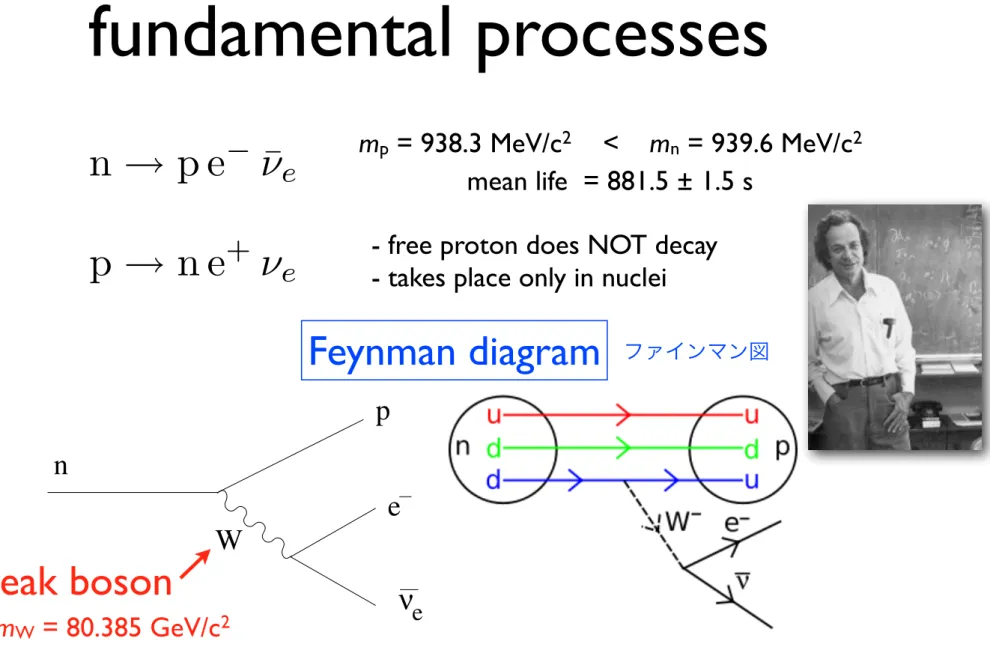
fundamental processes
7
n p e ¯e p n e+ e
mp = 938.3 MeV/c2 < mn = 939.6 MeV/c2 mean life = 881.5 ± 1.5 s
- free proton does NOT decay - takes place only in nuclei
196 4. Nuclear decays and fundamental interactions
the unified theory of weak and electromagnetic interactions due to Glashow, Salam and Weinberg.
4.3.1 Neutron decay
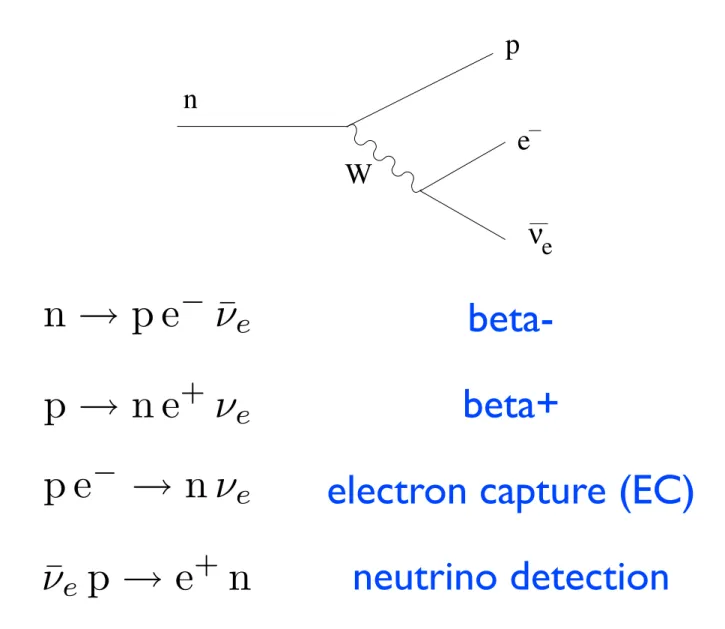
In the Fermi theory, neutron decay n → pe−¯νe is a point-like process. This is similar to what we discussed in Chap. 3, concerning the small range of weak interactions owing to the large masses of intermediate bosons. Here, the neutron transforms into a proton and a virtual W− boson, which itself decays into e−¯νe. This process is shown schematically in Fig. 4.8.
e W
n
p
νe
Fig. 4.8. Neutron decay.
To find the matrix element for neutron decay we first recall the matrix element for scattering of two free particles, as discussed in Sect. 3.4.1. If the two particles 1 and 2 interact via a potential V (r1−r2), then the scattering element is
⟨f|V|i⟩ = 1 L6
! ei(p1−p′1)·r1/¯hei(p2−p′2)·r2/¯hV(r1 −r2)d3r1d3r2 ,
where p1 and p′1 are the initial and final momenta for particle 1, and likewise for particle 2. The weak interactions can be described by a delta-function potential V ∼ Gδ(r1 −r2) so the matrix element is
⟨f|V|i⟩ = G L6
! ei(p1−p′1)·r/¯h ei(p2−p′2)·r/¯hd3r . (4.64)
There is a factor exp(ip·r) for each initial-state particle and a factor exp(−ip· r) for each final-state particle. This suggests that for neutron decay we use the matrix element
⟨pe−¯νe|H1|n⟩ = 2.4GF
L6
! d3r exp[i(pn −pp −pe −pν)· r/¯h] . (4.65)
The factor 2.4GF is the effective G for neutron decay and will be discussed below. Since we will not always want to use plane waves, we also write the more general matrix element as
weak boson
mW = 80.385 GeV/c2
cf. mpion = 139.570 MeV/c2 (±), 134.9766 MeV/c2 (neutral)
Feynman diagram ファインマン図
6/12
Fermi theory of beta decay
8
Fermi’s golden rule
w = 2⇡
~ |h p e|H | n ⌫i|2 dn dE
density of state
⇡ Z
e kpr2e ker2H (r2 r1)eknr1ek⌫r1dv
H (r2 r1) ⇠ G (r2 r1)
weak interaction is a short-range force
⇡ G
状態密度
Electron energy distribution dominated by density of state
Decay rate
放出される電⼦子のエネルギー分布は状態密度度で 決まる
Fundamentals in Nuclear Physics (Kenichi ISHIKAWA) for internal use only (Univ. of Tokyo)
6/12 9
Density of state 状態密度度
assuming plane waves
dn / p2dpq2dq p : electron momentum q : neutrino momentum
electron neutrino
energy E⌫ = cq Ee = p
m2ec4 + p2c2 E0 = Ee + E⌫
dE = dE⌫ = cdq dn
dE / p2q2dp / (E0 Ee)2p2dp
statistical factor 統計因⼦子
206 4. Nuclear decays and fundamental interactions
to the overlap integral (4.84), and theGamow–Teller term proportional to the matrix element ofσ between initial and final state nuclei.
Just as in radiative decays, there are selection rules governing which com- binations of initial Ji and final Jf spins are possible. The Fermi term will vanishes if the angular dependences of the initial and final wavefunctions are orthogonal so we require
Fermi : Ji = Jf . (4.90)
The Gamow–Teller term can change the spin but vanishes if the initial and final angular momenta are zero:
GT : Ji = Jf, Jf±1 Ji=Jf = 0 forbidden. (4.91) Additionally, in both cases, the parity of the initial and final nuclei must be the same. Transitions that respect the selection rules are called “Allowed”
decays. “Forbidden” decays are possible only if one takes into account the spatial dependence of the lepton wavefunctions, i.e. using (4.83) instead of (4.84) The examples of forbidden decays in Fig. 4.12 illustrate the much longer lifetimes for such transitions.
β_ β+
p (MeV/c) p (MeV/c)
0.2 0.6 1.0 1.4 1.8 0.2 0.6 1.0 1.4 1.8
Fig. 4.14. The β− andβ+ spectra of 64Cu [44]. The suppression the of the β+ spectrum and enhancement of theβ− at low energy due to the Coulomb effect is seen.
64Cu
0.5 1.0 1.5
0.1 0.2 0.3 0.4 0.5
p (MeV/c) theory experiment
6/12
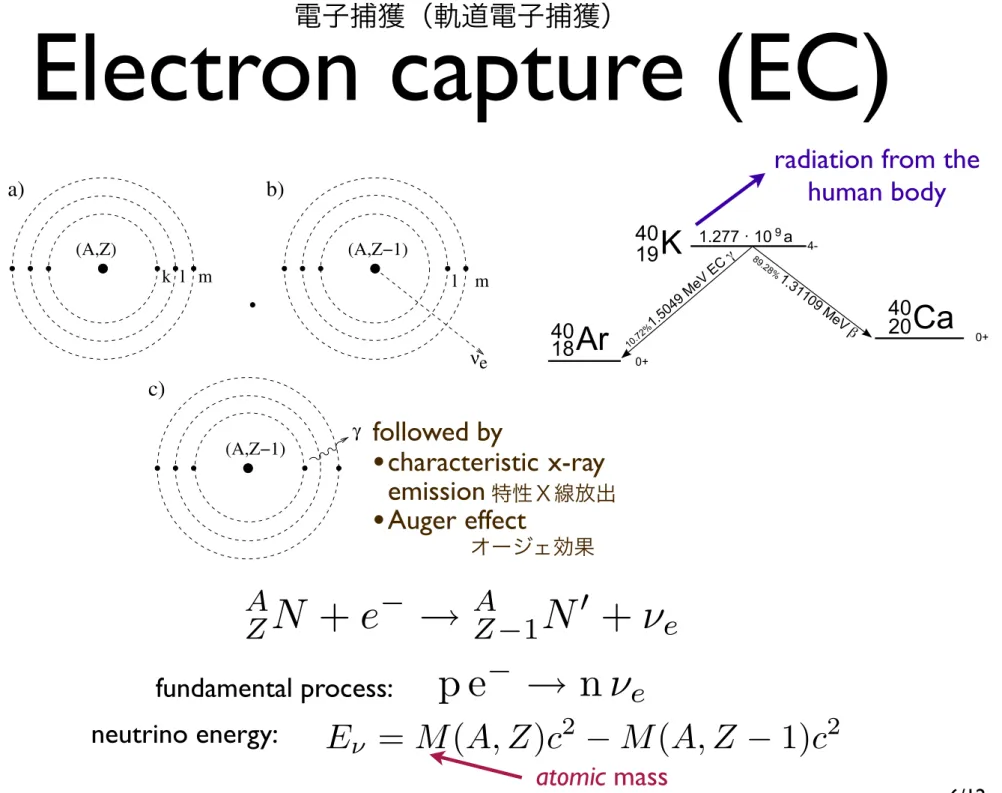
Electron capture (EC)
10
電子捕獲(軌道電子捕獲)
208 4. Nuclear decays and fundamental interactions
m l m l k (A,Z)
νe
(A,Z−1)
(A,Z−1)
a) b)
c)
γ
Fig. 4.15. Electron capture. After the nuclear transformation, the atom is left with an unfilled orbital, which is subsequently filled by another electron with the emission of photons (X-rays). As in the case of nuclear radiative decay, the X-ray can transfer its energy to another atomic electron which is then ejected from the atom. Such an electron is called an Auger electron.
The decay rate is then λ = c
π(¯hc)4
(2.4GF)2Z3
a30 |M|2Q2ec. (4.98)
Compared with nuclearβ-decay, theQdependence is weak,Q2ec rather than Q5β. This means that for smallQβ, electron-capture dominates overβ+decay, as can be seen in Fig. 2.13. The strong Z dependence coming from the de- creasing electron orbital radius with increasingZmeans that electron-capture becomes more and more important with increasingZ.
Finally, we note that nuclear decay by electron capture leaves the atom with an unfilled atomic orbital. This orbital is filled by other atomic electrons falling into it and radiating photons. The photons are in the keV (X-ray) range since the binding energy of the inner most electron of an atom of atomic number Z is
E ∼ 0.5Z2α2mec2 = 0.01Z2keV. (4.99)
Licensed to Kenichi Ishikawa<[email protected]>
followed by
•characteristic x-ray emission
•Auger effect特性X線放出
オージェ効果
10.72%
1.5049 Me
V ECγ 89.28%
1.31109 Me
V β 0+
0+
40K 4-
19
40Ar
18
20Ca
40
1.277 · 109a
radiation from the human body
AZN + e AZ 1N + e
fundamental process: p e n e
neutrino energy:
atomic mass
E = M(A, Z)c2 M(A, Z 1)c2
Fundamentals in Nuclear Physics (Kenichi ISHIKAWA) for internal use only (Univ. of Tokyo)
β+
decay and electron capture
+ decay AZN AZ 1N + e+ + e
AZN + e AZ 1N + e electron
capture
M(A, Z)c2 > M(A, Z 1)c2 + 2mec2
M(A, Z)c2 > M(A, Z 1)c2
atomic mass
Both may not always be energetically possible!
Fundamentals in Nuclear Physics (Kenichi ISHIKAWA) for internal use only (Univ. of Tokyo)
6/12
By transforming the Feynman diagram ...
12
p e n e
Salam and Weinberg.
4.3.1 Neutron decay
In the Fermi theory, neutron decay n → pe−¯νe is a point-like process. This is similar to what we discussed in Chap. 3, concerning the small range of weak interactions owing to the large masses of intermediate bosons. Here, the neutron transforms into a proton and a virtual W− boson, which itself decays into e−¯νe. This process is shown schematically in Fig. 4.8.
e W
n
p
νe
Fig. 4.8. Neutron decay.
To find the matrix element for neutron decay we first recall the matrix element for scattering of two free particles, as discussed in Sect. 3.4.1. If the two particles 1 and 2 interact via a potential V(r1−r2), then the scattering element is
⟨f|V |i⟩ = 1 L6
!
ei(p1−p′1)·r1/¯hei(p2−p′2)·r2/¯hV(r1 −r2)d3r1d3r2 ,
where p1 and p′1 are the initial and final momenta for particle 1, and likewise for particle 2. The weak interactions can be described by a delta-function potential V ∼ Gδ(r1 −r2) so the matrix element is
⟨f|V |i⟩ = G L6
!
ei(p1−p′1)·r/¯h ei(p2−p′2)·r/¯hd3r . (4.64) There is a factor exp(ip·r) for each initial-state particle and a factor exp(−ip· r) for each final-state particle. This suggests that for neutron decay we use the matrix element
⟨pe−¯νe|H1|n⟩ = 2.4GF
L6
! d3r exp[i(pn −pp −pe −pν)·r/¯h] . (4.65)
The factor 2.4GF is the effective G for neutron decay and will be discussed below. Since we will not always want to use plane waves, we also write the more general matrix element as
Licensed to Kenichi Ishikawa<[email protected]>
n p e ¯e p n e+ e
¯e p e+ n
beta- beta+
electron capture (EC) neutrino detection
Symmetry and conservation law
Parity violation ... but before that ...
β壊変と言えばパリティ非保存だが、その前に…
対称性と保存則
6/12
Any symmetry of a physical law has a corresponding conservation law
14
Noether’s theorem ネーターの定理
symmetry conserved quantity
temporal translation energy
spatial translation 平行移動 momentum
rotation 回転 angular momentum
reflection r→-r (P) 空間反転 parity time reversal (T) 時間反転 T-parity charge conjugation (C) 粒子反粒子変換 C-parity
gauge invariance ゲージ不変性 electric charge Example: Coulomb force V (r) = q1q2
4 0|r|2 or V (r1,r2) = q1q2
4 0|r1 r2|2
Fundamentals in Nuclear Physics (Kenichi ISHIKAWA) for internal use only (Univ. of Tokyo)
example in the classical mechanics
Hamilton equations
˙
qi = H
pi p˙i = H qi
If the Hamiltonian does not explicitly depend on qi
(invariant under the spatial translation)
˙
pi = 0 Conservation of momentumpi = const
gauge invariance
B = A, E = A t A A = A + , =
t
invariant under the gauge transformation
Conservation of the electric charge + j = 0
Invariance of the Action S 作用素積分
ゲージ不不変性
運動量量保存
6/12
Parity
16
If the physical law is invariant under the reflection (gravitational, electromagnetic, and strong interaction)
reflection ˆ (r) = ( r)
parity operator Eigenvalues → ± 1 ˆ2 (r) = (r)
i t ˆ = Hˆ i
t ˆ = ˆH ˆH = Hˆ [ˆ, H] = 0
Heisenberg’s equation of motion
i dˆ
dt = [ˆ, H] = 0 Conservation of parity
Fundamentals in Nuclear Physics (Kenichi ISHIKAWA) for internal use only (Univ. of Tokyo)
6/12
parity violation
nonconservation of parity
in the weak interaction
•
Prediction by T.-D. Lee and C. N. Yang in 1956•
Experimental verification by C.S. Wu in 195717
パリティ非保存
Cerium magnesium nitrate crystal
would coincide. The vanishing of the asymmetry at about g min is due to the gradual warming of the source and the corresponding loss in polarization of the 6oco nuclei, as is demonstrated by the observed 7-ray counting rates. Data from C. S. Wu el al., Phys. Rev.105,1419 (1957).
meson, which are analogous to B decays, even violate to a small extent the cp invariance. There is as yet no evidence that the Cp symmetry is violated in ordinary nuclear B decay.)
Before we leave this topic, we should discuss the effect of the p nonconserva- tion on nuclear spectroscopy. The interaction between nucleons in a nucleus consists of two parts: the "strong" part, which arises primarily from r meson exchange and which respects the P symmetry, and the "weak" part, which comes from the same interaction responsible for B decay:
Low-temperature cryostat
? anisotropy A
o
P asymmetry {a
6/12 18
Fundamentals in Nuclear Physics (Kenichi ISHIKAWA) for internal use only (Univ. of Tokyo)
Lee Yang Wu
Nobel prize in physics (1957)
6/12
CP violation
20
Toshihide Maskawa Makoto Kobayashi
Nobel prize in physics (2008)
Fundamentals in Nuclear Physics (Kenichi ISHIKAWA) for internal use only (Univ. of Tokyo)
CPT theorem
• Preservation of CPT symmetry by all physical phenomena
• Any Lorentz invariant local quantum field theory with a Hermitian Hamiltonian must have CPT symmetry
CPT定理
![Fig. 4.14. The β − and β + spectra of 64 Cu [44]. The suppression the of the β + spectrum and enhancement of the β − at low energy due to the Coulomb effect is seen.](https://thumb-ap.123doks.com/thumbv2/123deta/7073858.2311989/5.1262.234.1061.82.807/fig-spectra-suppression-spectrum-enhancement-energy-coulomb-effect.webp)
![Fig. 4.14. The β − and β + spectra of 64 Cu [44]. The suppression the of the β + spectrum and enhancement of the β − at low energy due to the Coulomb effect is seen](https://thumb-ap.123doks.com/thumbv2/123deta/7073858.2311989/9.1262.122.1152.153.858/fig-spectra-suppression-spectrum-enhancement-energy-coulomb-effect.webp)