H
i gh- pr es s ur e Synt hes i s and Phys i c al
Pr oper t i es of N
ew
Fi l l ed Skut t er udi t e Com
pound
BaO
s 4P12
著者
D
EM
I N
EM
I S, KAW
AM
U
RA Yuki hi r o, CH
EN
Y Q
,
KAN
AZAW
A M
, H
AYASH
I J , KU
ZU
YA T, TAKED
A K,
M
ATSU
D
A M
, SEKI N
E Chi hi r o
j our nal or
publ i c at i on t i t l e
J our nal of Phys i c s : Conf er enc e Ser i es
vol um
e
950
year
2017
U
RL
ht t p: / / hdl . handl e. net / 10258/ 00009589
Journal of Physics: Conference Series
PAPER • OPEN ACCESS
High-pressure Synthesis and Physical Properties
of New Filled Skutterudite Compound BaOs
4
P
12
To cite this article: S Deminami et al 2017 J. Phys.: Conf. Ser. 950 042032
View the article online for updates and enhancements.
Related content
High-pressure synthesis of new filled skutterudite compounds SrT4As12 (T = Fe, Ru, Os)
Kohei Nishine, Yukihiro Kawamura, Junichi Hayashi et al.
-Magnetic properties of new filled skutterudite compounds GdFe4As12 and TbFe4As12
C Sekine, K Ito, K Matsui et al.
-High-pressure Synthesis and Bulk Modulus of Non-centrosymmetric Superconductor Mo3Al2C
C Sekine, U Sai, J Hayashi et al.
1
Content from this work may be used under the terms of theCreative Commons Attribution 3.0 licence. Any further distribution
of this work must maintain attribution to the author(s) and the title of the work, journal citation and DOI. Published under licence by IOP Publishing Ltd
1234567890
AIRAPT IOP Publishing
IOP Conf. Series: Journal of Physics: Conf. Series 950 (2017) 042032 doi :10.1088/1742-6596/950/4/042032
High-pressure Synthesis and Physical Properties of New Filled
Skutterudite Compound BaOs
4P
12S Deminami, Y Kawamura, Y Q Chen, M Kanazawa, J Hayashi, T Kuzuya, K Takeda, M Matsuda and C Sekine
Muroran Institute of Technology, 27-1 Mizumoto-cho, Muroran 050-8585, Japan
E-mail: [email protected]
Abstract. We have succeeded in synthesizing samples of new filled skutterudite compound
BaOs4P12 using the high-pressure synthesis technique. The physical properties of the compound
are reported for the first time. The electrical resistivity decreases with decreasing temperature,
and drop sharply around 1.8K. This indicates that BaOs4P12 is a new superconductor. Before the
high-pressure synthesis, using synchrotron radiation x-ray, we tried to observe synthesizing
processes of BaOs4P12 in-situ at high temperature and high pressure to obtain the optimum
condition for synthesis.
1. Introduction
Filled skutterudite compounds AT4X12 (A = alkali metal, alkaline earth metal, lanthanide (Ln), and actinide; T = Fe, Ru, Os, and Pt; X = P, As, Sb, and Ge) crystallize in a body-centered cubic structure with a space group Im3̅ (T5
h, No. 204) [1]. Filled skutterudite compounds, especially compounds including Ln, have attracted much attention owing to their wide variety of strongly correlated electron behaviors, such as anomalous metal-insulator transition [2], multipole ordering [3] and unconventional superconductivity [4]. The various attractive features in these systems are believed to be mainly due to the large hybridization between f electrons of Ln and p electrons of X. The d electrons of Fe, Ru and Os atoms should also play important roles in the physical properties. However, the roles have not been well understood yet. Matsuoka et al. reported that filled skutterudite compounds including alkaline earth metal AFe4Sb12 (A = Ca, Sr, and Ba) have revealed strong ferromagnetic spin fluctuations of the Fe 3d electrons and the properties of nearly ferromagnetic metals [5]. Furthermore, AOs4Sb12 (A=Sr, Ba) show the character of enhanced Pauli paramagnets where Os 5d electrons play important roles [6]. The filled skutterudite compounds including alkaline earth metal could be a favorable system to systematically investigate the effect of d electrons in skutterudite systems because alkaline earth ions carry no magnetic moments. However, only preliminary studies have been conducted on the properties of P and As-based compounds including alkaline earth metal because the compounds are quite difficult to prepare. In this study, we focused on P-based filled skutterudite compounds including alkaline earth metal as part of our search for new materials using a high-pressure synthesis technique.
2. Experimental
2
1234567890
AIRAPT IOP Publishing
IOP Conf. Series: Journal of Physics: Conf. Series 950 (2017) 042032 doi :10.1088/1742-6596/950/4/042032
Factory (PF) in High Energy Accelerator Research Organization (KEK) (Tsukuba, Japan). The sample container made of pyrophyllite is formed a cube. The starting materials, which are mixture of Ba, Os and P, are put into a BN crucible. The crucible with a graphite heater is inserted in a cube-shaped pyrophyllite solid pressure medium. Pressure was determined by the lattice constant of NaCl internal pressure marker. The details of the in-situ observation method were described in previous reports [7, 8]. BaOs4P12 samples for measurements were prepared at high temperatures and high pressures using a double-stage multi-anvil high-pressure apparatus. The sample cell assembly is similar to that used for the high-pressure synthesis of CeRu4As12 [9]. The prepared samples were characterized by powder x-ray diffraction using CoK1 radiation and silicon as a standard. Resistivity was measured by a standard dc four-probe method in the temperature region from 0.4K to 300K.
Figure 1. X-ray diffraction patterns of synthesizing process of BaOs4P12 at 3.5 GPa. Open blue circles designate the Bragg peaks of Os. Solid blue squares and solid green triangles indicate the characteristic x-ray of Ba and Os. Open purple squares indicate the peaks of BN used for crucible. Solid red circles designate the Bragg peaks of the skutterudite structure. Open brown triangles, open green squares and blue crosses indicate the peaks of an impurity phase of OsP4, P4O8 and OsP2, respectively. (a) The starting materials at room temperature, (b)1000℃, (c)
1060℃ and (d) 1255℃.
3. Results and discussion
The results of in-situ x-ray diffraction experiments are shown in figure 1. Figure 1(a) shows x-ray diffraction pattern of the starting materials, which are mixture of each metal and phosphorus powder in the atomic ratio of Ba : Os : P = 1 : 4 : 12, at room temperature and 3.5 GPa. Open blue circles designate the Bragg peaks of Os. Solid blue squares and solid green triangles indicate the characteristic x-ray for Ba and Os, respectively. Open purple squares indicate the Bragg peaks of BN used for crucible. The
30 40 50 60 70 80
○ ○ ○ Energy (keV) In te nsi ty (a rb . u ni t) ○ (b)
1000 C 3.5GPa°
30 40 50 60 70 80
Energy (keV) In te ns ity (a rb . u ni t) ○ ○ ● ● ● ● × ○ (d) × × ×
1255 C 3.5GPa°
Starting materials (Ba, Os, P)
In te nsi ty (a rb . u ni t) ○ ○ ○ ○ RT, 3.5GPa (a) ○ ○ ○ ● In te nsi ty (a rb . u ni
t) 1060 C 3.5GPa
(c)
● ●
●
3
1234567890
AIRAPT IOP Publishing
IOP Conf. Series: Journal of Physics: Conf. Series 950 (2017) 042032 doi :10.1088/1742-6596/950/4/042032
diffraction peaks show no change up to 1000˚C (figure 1(b)). With increasing temperature above 1000˚C, the peaks of the skutterudite structure were observed above 1060˚C(closed red circles in figure 1(c)). The peaks for impurity phases of OsP4 and P4O8, which are indicated by open brown triangles and open green squares, respectively, also appeared at this temperature. Elevating temperature up to 1255˚C, the peaks of the skutterudite structure weakened and another impurity phase of OsP2 was observed (blue crosses in figure 1(d)). In series of the experiments, we found an appropriate temperature range of 1050-1200˚C for synthesizing BaOs4P12 at 3.5 GPa.
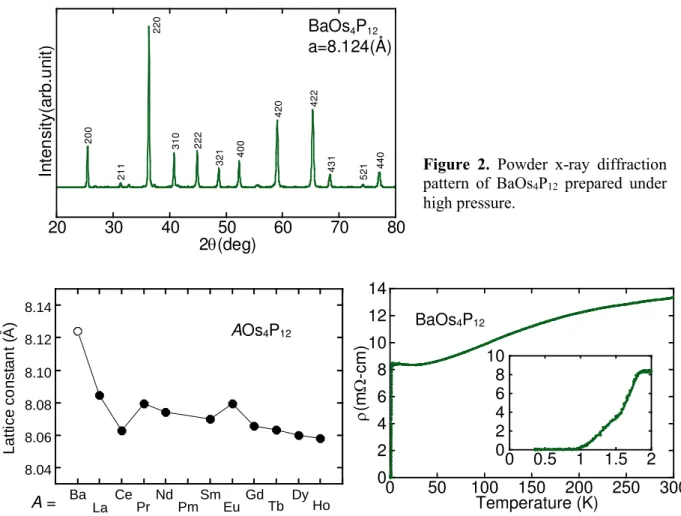
Based on the synthesis condition determined by the in-situ experiments, we have actually synthesized BaOs4P12 at 4GPa and 1050˚C using a Kawai-type two-stage anvil apparatus. Figure 2 shows a powder x-ray diffraction pattern of BaOs4P12 prepared under high pressure. Most of the observed diffraction peaks were indexable using the skutterudite structure. The lattice constant determined by a least-squares
fit to the data was 8.124Å. Figure 3 plots the lattice constant of BaOs4P12 along with values reported
earlier for filled skutterudite phosphides LnOs4P12 [10]. Starting with La, one observes the typical reduction of the lattice constant due to the contraction of the trivalent ionic radii of the lanthanides with increasing atomic number except for Ce and Eu compounds. The small lattice constant of Ce compound
is due to the strong hybridization between 4f electrons and conduction electrons, while the large lattice
constants of Eu compound is caused by the Eu ions being in the divalent or mixed-valence state. The large lattice constant of BaOs4P12 is considered to be due to the divalent Ba ions.
8.04 8.06 8.08 8.10 8.12 8.14 L a tt ic e c o n s ta n t (A ) Ba
La CePr NdPmSmEu GdTb DyHo
Figure 2. Powder x-ray diffraction pattern of BaOs4P12 prepared under high pressure.
Figure 3. Lattice constants of filled skutterudite phosphides AOs4P12.
20 30 40 50 60 70 80
In te n si ty (a rb .u ni t)
2(deg)
a=8.124(Å) 200 220 310 222 321 400 422 420 431 440 521 211
BaOs4P12
0 2 4 6 8 10 12 14
0 50 100 150 200 250 300
(m -cm ) Temperature (K) 0 2 4 6 8 10
0 0.5 1 1.5 2 AOs4P12
A =
Figure 4. Temperature dependence of electrical resistivity of BaOs4P12. The inset shows the low temperature data on an expanded scale.
4
1234567890
AIRAPT IOP Publishing
IOP Conf. Series: Journal of Physics: Conf. Series 950 (2017) 042032 doi :10.1088/1742-6596/950/4/042032
Figure 4 shows the temperature dependence of electrical resistivity (T) for BaOs4P12. The inset shows the low temperature data on an expanded scale. The (T) exhibits a positive temperature dependence like typical metals below room temperature and shows a sharp drop below 1.8K. This compound is a new superconductor. The application of a magnetic field suppresses superconductivity at fields above 1T. Furthermore, a broad shoulder around 170K in (T) was observed. The strong curvature of the compound may be due to strong electron-phonon interactions, which was discussed for
AOs4Sb12 (A = Sr, Ba). Matsuoka et al. proposed that the strong electron-phonon interaction in the presence of tunneling states of A2+ ions in the Os
4Sb12 cage is the origin of a similar shoulder observed in the resistivity of AOs4Sb12 (A = Sr, Ba) [6]. The electron-phonon interaction seems to be responsible for the formation of Cooper pairs in this system.
4. Summary
Using the high-pressure synthesis technique, we have succeeded in synthesizing a new skutterudite
compound BaOs4P12 with lattice constant of 8.124Å. BaOs4P12 was found to be a new superconductors
around 1.8K. We could obtained the optimum condition for synthesizing BaOs4P12 underhigh pressure
by the in-situ x-ray experiments. This is an excellent method for determining the condition for obtaining only target material without impurity phases for solid-phase reaction synthesis under high pressure.
Acknowledgments
This work was performed under the approval of the Photon Factory Program Advisory Committee (Proposal No. 2013G124, 2015G031). This work was supported by JSPS KAKENHI Grant Number 23340092.
References
[1] Jeitschko W and Braun D 1977 Acta Crystallogr., Sect. B 33 3401
[2] Sekine C, Uchiumi T, Shirotani I and Yagi T 1997 Phys. Rev. Lett.79 3218
[3] Yoshizawa M, Nakanishi Y, Oikawa M, Sekine C, Shirotani I, Saha S R, Sugawara H and Sato H 2005 J. Phys. Soc. Jpn.74 2141
[4] Aoki Y, Tayama T, Sakakibara T, Kuwahara K, Iwasa K, Kohgi M, Higemoto W, MacLaughlin D E, Sugawara H and Sato H 2007 J. Phys. Soc. Jpn.76 051006
[5] Matsuoka E, Hayashi K, Ikeda A, Yanaka K, Takabatake T and Matsumura M 2005 J. Phys. Soc. Jpn.74 1382
[6] Matsuoka E, Narazu S, Hayashi K, Umeo K, and Takabatake T 2006 J. Phys. Soc. Jpn.75 014602 [7] Sekine C, Kachi T, Yoshida T, Abe R, Namiki T, Akahira K and Ito K 2010 J. Phys.: Conf. Ser.
215 012141
[8] Sekine C, Kato H, Kanazawa M, Kawamura Y, Takeda K, Matsuda M, Kihou K, Lee C H and Gotou H 2014 J. Phys.: Conf. Ser.502 012017
[9] Sekine C, Kawata T, Kawamura Y and Yagi T 2013 J. Korean Phys. Soc.63 359