Low
- t em
per at ur e s ynt hes i s of r hodi um
phos phi de
on al um
i na and i nves t i gat i on of i t s c at al yt i c
ac t i vi t y t ow
ar d t he hydr odes ul f ur i z at i on of
t hi ophene
著者
KAN
D
A Yas uhar u, SAW
AD
A Ayaka, SU
G
I O
KA
M
as at os hi , U
EM
I CH
I Yos hi o
j our nal or
publ i c at i on t i t l e
Appl i ed Cat al ys i s A: G
ener al
vol um
e
515
page r ange
25- 31
year
2016- 04- 10
U
RL
ht t p: / / hdl . handl e. net / 10258/ 00009221
1
Low-temperatu re synthesis of rh odiu m phosphide on alu mi na and
inves tigation of its catalyti c activity toward the hyd rod esu lfurizati on
of thioph en e
Yasuharu Kandaa *, Yuki M ats ukurab, A ya ka S awadac, M as atos hi Sugi okad,
and Yoshi o Uem ichia
aAppli ed C hemist r y Res earch Unit, C oll ege of Envi ronm ental Technology,
Graduat e School of Engi neering, M uroran Instit ute of Technology, 27 -1
Mizumoto, M uroran 050 -8585, J apan
bDivisi on of Applied Sci ences , Graduate School of Engi neering, Muroran
Insti tut e of Technol ogy, 27 -1 Mizumot o, Muroran 050 -8585, J apan
cDivisi on of Chemi cal and M at erials Engi neering, Graduat e School of
Engi neering, M uroran Instit ut e of Technology, 27 -1 Mizumoto, M uroran
050-8585, J apan
dAeronaut ics and As tronauti cs Unit, C oll ege of Desi gn and
Manufacturing Technology, Graduat e School of Engi neering, Muroran
Insti tut e of Technol ogy, 27 -1 Mizumot o, Muroran 050 -8585, J apan
Abstract
In t his stud y, t he l o w-t emperature s ynthesis o f rhodium phos phide
(Rh2P) on al umina (Al2O3) usi ng t riphenyl phosphine (TPP ) as a
2
h ydrodes ulfuriz ati on (HDS ) were investi gat ed t o prepare a hi ghl y active
HDS catal ys t . TPP was more eas il y reduced t han phosphat e, and Rh2P was
formed i n the P (T)/R h/Al2O3 cat al yst prepared from TTP at lower
temperature as compared wit h the tem perature requi red b y Rh-P(A)/Al2O3
catal ys t prepared from a phosphate precursor . However, aft er reducti on at
a l ow tem perature (450 °C ), exces s P cover ed the surface of R h2P. The
optim al reduction t emperature for HDS rat e of t he P (T)/Rh/ Al2O3 cat al ys t
(650 °C ) was l ower t han that of the R h-P (A)/ Al2O3 cat al yst (800 °C ).
Furthermore, t his temperature was sli ght l y hi g her than the optimal
reduction t emperature for C O uptake (600 °C) . These res ults are
explai ned as fol lows : HDS rat e i s increas ed b y bot h e limi nat ion of e xcess
P on t he acti ve sit es at hi gher reduction t emperat ure s and enhancement of
the cr ys tal linit y of R h2P. Furthermore, becaus e t he part icl e siz e of t he
P(T)/Rh/ Al2O3 cat al yst (ca. 1.2 nm ) was s ubst anti all y s mal ler t han th at of
the Rh -P(A)/ Al2O3 cat al yst , t he P(T)/R h/ Al2O3 cat al ys t exhibi ted great er
HDS rat e compared with the Rh-P (A)/Al2O3 cat al ys t.
3
Rhodi um phos phide catal ys t; Al umina s upport ; H ydrodesul furization;
Tri phen yl phosphi ne ; Low-t em perature s ynthesis
1. In trodu cti on
Recentl y, the pet roleum indust r y has cl ai med that t he development of
hi ghl y act ive h ydrodesul furiz ation ( HDS) cat al yst s that exhi bi t great er
activit y than comm erci al CoMo cat al yst s will prevent air pol l ution, aci d
rai n, and t he deacti vation of aut omot ive exhaust catal yst s [1 -3]. New
active phases, es peci all y ni ckel phosphi de (Ni2P ), have received
extens ive att enti on [ 2-2 2]. Furthermore, our group [23 -2 7] and Bus sel l’s
group [3, 2 8] report ed that rhodium phosphide (Rh2P) support ed on SiO2
exhibits hi gh and st able cat al yti c acti vit y toward the HDS reaction.
Phosphat e reducti on is a convenient and s imple m ethod t o prepare
phos phide cat al ys ts [ 16]. Becaus e phosphat e has st rong P–O bonds ,
phos phat e reduc tion requi res hi gh temperature s [3]. In general , SiO2,
whi ch does not st rongl y i nteract with phosphate, i s a s uitabl e support for
phos phide cat al ys ts [ 2, 3, 1 0, 11]. For industri al us age , Al2O3 is a
4
stabilit y than S iO2. Unfortunat el y, Al2O3 is not a s uit abl e support for
phos phide cat al ys t s, becaus e phos phat e reacts with Al2O3 to form AlPO4
[3, 6, 10 , 11]. In fact , we have reported that t he opt imal reduct ion
temperatur e (800 °C ) for HDS acti vit y of the Rh-P/Al2O3 cat al ys t is
rem arkabl y hi gher than that for HDS acti vit y of the Rh -P/Si O2 catal ys t
(550 °C ) and that thi s hi gher t emperature induces aggregation of R h2P [24,
27]. Therefore, we expect that hi gh HDS activit y can be obt ai ned vi a t he
low-temperature s ynt hesi s of hi ghl y dispers ed R h2P on an Al2O3 support.
Num erous report s have descri bed the s ynt hesi s of phosphi de cat al yst s
at l ow tem perature s. Teixei ra da Silva et al. report ed that t he formation
temperature of Ni2P, whi ch was prepared from a phosphate precurs or, can
be decreased b y the addition of Pd [29]. Previousl y, we reported that t he
reduction t emperat ure of phosphates on Al2O3 and SiO2 s ubst rat es and t he
formation tem perature s of Rh2P were decreased b y the addit ion of Na [3 0].
However, noble m etal additi on i s not an appropriate method for the
s ynthesi s of noble m et al phos phides , and added Na would decrease the
catal yt i c activit y. Thus, phosphit e , whi ch is more reducibl e t han
5
[31]. However, phos phit e on an Al2O3 support is l ess reduci bl e t han that
on ot her support s [32]. Som e P precursors wit hout ox ygen , s uch as
phos phine (P H3) and tri oct yl phosphine (TOP), have been reported [3, 12,
33, 34]. P H3 easil y react s with m et als to form phos phide s at l ow
temperatures ; however , this reagent i s hi ghl y toxic. TOP also react s with
met al precursor s such as acet yl acet onat e com plex es t o form phosphide s at
lower t emperat ure s. But thi s m ethod require s a l arge amount of a P
precursor. Furt herm ore, the washed phosphides were im pregnated into
Al2O3 to obt ai n the s upport ed cat al ys t [35], whi ch is a compli cat ed
method. On the other hand, som e report s des cribed s ynthesis of Ni2P
catal ys t using t riphen ylphosphine ((C6H5)3P, TPP ) [36, 37] , but thi s
method was als o carried out in tri oct yl am ine sol ution under N2 flow.
In our previous paper, we reporte d t hat rhodium and pall adium
phos phides were more easil y form ed us ing TPP compared wit h the
corres ponding phosphides prepared from phos phat e , even in cas es where
the phosphides prepared fr om phos phat e were calci ned [25]. TPP is
widel y used as a li gand for homogeneous nobl e m et al cat al ys t s , indi cating
6
supporti ng substrat es . In addition, we obs erved t hat the phosphat e s that
interact ed with nobl e met als were more easil y reduced t ha n t hose on
support s [2 6]. W e ex pect that Rh2P would eas il y form on Al2O3 when TPP
is us ed as a P precursor. In t his stud y, the l ow -t emperat ure s ynthesis of
Rh2P on Al2O3 using TPP was examined t o enhance the HDS activi t y of
this phos phi de-bas ed cat al yst .
2. Exp eri men tal
2.1. Catalys t p reparation
Alumi na (Al2O3, BET surface area 101 m2 g−1) was suppli ed by
Nippon Aerosil C o. The Rh/ Al2O3 was prepared us ing an im pregnati o n
method. Rhodium ( III) chloride t rih ydrate (RhC l33H2O, Kanto Chemical
Co.) was us ed as an Rh precurs or and was dis solved in wat er. The R h
loading was 5 or 10 wt%. Aft er im pregnation, the Rh/Al2O3 was dri ed at
110 °C for 24 h, foll owed b y heat t reatm ent under an N2 st ream at 450 °C
for 1 h t o decom pos e the Rh s alt. The ram p rat e for t he N2 t reatment was
10 °C min−1.
7
b y an impregnation method. A TPP hexane solution was impregnat ed int o
Rh/Al2O3. The P loading was 1.5 or 3 wt %, and t he P/Rh m ol ar rati o in
the cat al ys ts was 1.0. The P (T)/R h/Al2O3 catal ys t was dri ed under an N2
stream at 110 °C for 24 h to avoid oxidati on of TPP. After dr ying, the
catal ys t was sieved i nto 3 0- to 42-m esh -s ize granul es . The hi gh-loading
(Rh: 10 wt %, P : 3 wt %) cat al ys t was l abel ed as H L -P (T)/Rh/Al2O3.
2.2. Catalys t characteri zation
The P(T)/Rh/ Al2O3 cat al yst w as characterized using
temperature -program med reduct ion (TPR), X -ra y di ffraction (XRD),
X-ra y phot oelect ron spect ros cop y (XPS), transmi ssion el ect ron
micros cop y (TEM ), and carbon monoxide (CO) adsorption anal ys es. TPR
measurements were perform ed us ing a S himadzu GC -8A gas
chrom atograph. The catal ys t (0.1 g) w as heat ed i n a He st ream (30 ml
min−1) from room t emperature to 11 0 °C at 10 °C min−1, followed b y He
treatm ent at 1 10 °C for 1 h. Aft er th is He treatm ent, t he cat al yst was
cooled to 30 °C in a He st ream , and the He was s wit ched to a h ydrogen–
nitrogen (5 vol % H2 in N2) gas mixture at 30 °C for 0.5 h before the
8
increased from 3 0 °C to 8 50 °C at 10 °C min−1; a thermal conductivit y
det ector (TC D) and a fl am e ionizat ion det ector (F ID ) were us ed to
monitor t he H2 consumption and the form ation of h ydrocarbons ,
respectivel y. When a TPR profil e was recorded b y TC D, w at er was
rem oved usi ng a m ol ecul ar si eve t rap. XP S spect ra of the catal ys ts aft er
reduction were m eas ured using a J EO L J PS-9010M X with Mg Kα
radi ation (10 kV, 5 mA) . Binding energy of meas ured spect ra were
correct ed using C 1s peak at 285.0 eV. The XRD patt erns of the catal ys ts
were coll ect ed using a Ri gaku Mini Fl ex equipped with a C u-Kα radiation
source operat ed at 30 kV and 15 mA. TEM observati on s were carri ed out
using a J EOL J EM -2 100F. The condit ions of TEM operation were an
accel erati on volt age of 200 kV and a m agnifi cation of 600000 x . The
parti cle siz e di stribution and average part icl e siz e were det erm ined from
the meas urem ent s of 1000 particl es in the TEM micrographs. The C O
upt ake of t he P(T)/R h/Al2O3 cat al yst s was meas ured usi ng the puls e
method. The P (T)/R h/Al2O3 catal ys t (0.1 g) w as reduced under H2 at
450 °C–750 °C for 1 h. C O was inj ect ed i nto t he cat al ys t l a yer at 25 °C
9
Shimadzu GC -8A ga s chromatograph equipped with a TC D.
2.3. Hyd rod esulfuri zation of thi ophen e
The HDS of thiophene was performed at 350 °C under 0.1 MPa using a
conventional fixed -bed flow react or. The P(T)/Rh/ Al2O3 catal ys t (0.1 g)
was charged into t he quartz react or and heated (10 °C m in−1) under an H2
stream (30 ml mi n−1) at 450 °C–700 °C for 1 h. A h ydrogen–thiophene gas
mixture (H2/C4H4S molar ratio = 30), obtained b y passi ng an H2 st ream
through a thi ophene trap cooled at 0 °C , was then int roduced into t he
reactor (W/ F = 37.9 g h m ol−1). The react ion products were anal yz ed
using a gas chromat ograph equi pped with a F ID and sili cone DC -550
(lengt h: 2 m, temperature: 110 °C) and Al2O3/KCl plot ( ID: 0.53 mm ,
length: 25 m, film thickness: 10 μm, temperature: 60 °C –190 °C, rat e:
7.5 °C mi n−1) col um ns.
The HDS rate cons tant was cal cul at ed from the foll owi ng equation
under the ass umpti on of a ps eudo -fi rst -order reaction:
���� =−ln −�/
�/� (1)
where kH D S is the reaction rat e of thi ophene HDS (m ol h−1 g−1) and x is t he
10
The turnover frequenc y (TOF) was cal cul at ed from t he followi ng
equati on:
��� =��/�� (2)
where F is the flow rat e of t hiophene (mol h−1), W is the wei ght of
catal ys t loading (g), and A is t he CO upt ake (mol g- 1).
3. Results and Dis cussion
3.1. Low -temp eratu re syn th esis of Rh2P on Al2O3 support s
We have report ed that t he reduction t emperat ure s trongl y affects the
formation of Rh2P catal ys t s [2 3-27]. Therefore, the TPR profil es of the
P(T)/Rh/ Al2O3 catal ys t were examined to cl arif y the reduci bil it y of t he
rhodium oxide and TPP. Figu re 1 shows t he TPR profil e of the
P(T)/Rh/ Al2O3 cat al yst recorded b y TCD and FID . Som e peaks (at 120 °C,
180 °C, 225 °C, and 490 °C) appeared in t he TPR profil e recorded b y TC D .
In t he TPR profil e recorded b y F ID , peaks appeared at 1 6 5 °C and 230 °C,
indi cat ing that t hese peaks were attri but able to t he format ion of
h ydrocarbons such as benzene and c ycl ohexane. However, n o peaks were
11
rhodium oxide int eracting with Al2O3 was reduced at 120 ° C [38]. This
result indi cat es t hat t he peak at 120 ° C was at tri but ed to reduct ion of
rhodium oxide int eract ed with Al2O3. O ya ma et al . reported t hat t he peak
of phosphi ne (P H3) product ion appeared around 530 °C (800 K) in the
TPR profil e of Ni2P/ SiO2 precurs or [7]. On t he basis of t hese resul ts, th e
peak at 490 °C is att ributed to PH3 form ation.
In the TPR profil e of the R h-P/ Al2O3 cat al ys t prepared from ammonium
dih ydrogen phos phat e (Rh -P(A)/Al2O3), t he h ydrogen consum ption ,
whi ch was due to the reducti on of AlP O4, was obs erved above 700 °C. In
contrast , the reducti on peak of TPP appeared at rem arkabl y l ower
temperatures (approximat el y 200 °C ) com pared with that of Al PO4.
Therefore, R h2P would be easil y formed on Al2O3 when TPP is used as a P
source. Figu re 2 shows the XR D patt erns of P (T)/Rh/ Al2O3 cat al ys ts after
reduction. Irres pecti ve of the reducti on t emperat ure , no peaks as sociated
with Rh s peci es were obs e rved i n t he XR D patt erns , indicati ng that R h
speci es were hi ghl y dispersed on t he Al2O3 support. Thus, we prepared
the HL-P (T)/Rh/ Al2O3 cat al ys t (Rh: 10 wt%, P: 3 wt%) t o evaluat e t he
12
The TPR profile of t he HL-P (T)/Rh/ Al2O3 catal ys t is s hown i n Fi g. 3.
Peaks were obs erved at the s am e t emperature s as th ose of t he
P(T)/Rh/ Al2O3 catal ys t (st andard loading) . This simi larit y indicates that
loading does not affect the reducibi lit y of the Rh and P s peci es . Therefore,
Rh2P form ation over Al2O3 support can be eval uat ed us ing the XRD
patt erns of the HL-P (T)/Rh/ Al2O3 cat al ys t. The XR D patt erns of t he
hi gh -loadi ng cat al ys t reduced at various t emperatures are shown in Fi g. 4.
Furthermore, Fig. S1 shows the background (support ) s ubt ract ed XR D
patt erns of the HL-P (T)/Rh/ Al2O3 cat al ys t. Aft er reduction at 350 °C, a
broad peak for m et al lic Rh appeared around 41 °. Furthermore , small peak
also appeared at 47.2 ° and this peak woul d cont ain two peaks (Rh2P:
46.7° and Rh: 47.8° ). However, no peak for R h2P was obs erved at 32.6 °.
These res ults indi cat e t hat m etal lic Rh cores covered with Rh2P shells
woul d be form ed . Above 450 °C, the i nt ensit y of the Rh2P peaks increas ed,
and that of the R h peaks decreased . Moreover, the peak around 41 ° was
hardl y observed aft er reduction above 550 °C. Thus, Rh2P would be
com plet el y formed on Al2O3 support b y reducti on wit h H2 at 550 °C.
13
Rh2P were obs erved aft er t he cat al ys t was reduced at t emperatures above
750 °C [24, 27]. Thus, the form ation t em perature of Rh2P can be
rem arkabl y decreas ed through the use of TPP as a P sour ce.
3.2. Surface p rop erties and parti cle si ze of Rh2P on Al2O3
Figu re 5 shows t he XPS spect ra of P ( T)/ Rh/Al2O3 cat al ys t aft er
reduction. After reduction at an y t emperat ure, t he peak for R h 3d5 / 2
appeared around 307.6 eV. P rins and Bus sell report ed that uns upport ed
Rh2P is m et alli c, whi ch is consist ent wi th obs ervat ions for som e other
met al-ri ch phosphide phas es (Ni2P, Ni3P, Cu3P) [3, 28]. Furthermore, R h
3d5/2 peak at 307.6 eV can be att ributed to Rhδ+
[28]. Therefore, R h i n
the P(T)/R h/Al2O3 catal ys t bears a parti al positi ve charge. However, i n
the s pect ra of R h-P (A)/ Al2O3 cat al ys t reduced at 600 °C and 800 °C ( Fi g.
S2), the peak for Rh 3d5 / 2 was obs erved at lower bindi ng energy (307.4
and 307.2 eV) than t hat in t he spect ra of P(T)/Rh/ Al2O3 catal ys t after
reduction (307.6 eV) . The binding energy of metal lic Rh speci es appears
at 307.0 -307.2 eV [3 9, 4 0]. Thus , Rh in t he P (T)/R h/Al2O3 cat al ys t aft er
14
XPS spect ra of P (T)/ Rh/Al2O3 and R h-P (A)/ Al2O3 cat al yst s after
reduction, t he peaks for P 2p3 / 2 were obs erved around 134.2 -134.4 eV,
whi ch was att ributed to phos phat e speci es form ed b y exposi ng in air aft er
reduction [28].
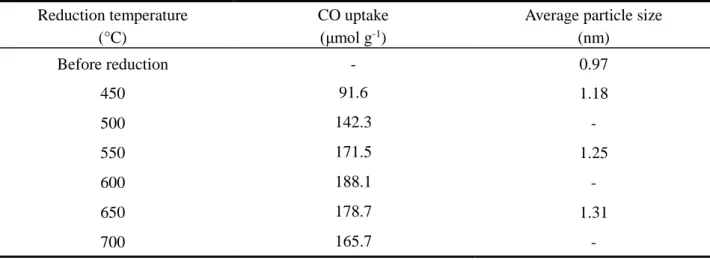
Table 1 s hows t he effect of the reducti on temperature o f P(T)/ Rh/Al2O3
catal ys ts on thei r C O upt ake. The maximum CO upt ake was obtained in
the cas e of the s am pl e reduced at 600 °C. In t he TPR profile s of the
P(T)/Rh/ Al2O3 catal ys t recorded b y TC D and F ID (Fig. 1 ), the peak
corres ponding to PH3 formation was observed at 490 ° C . Thes e result s
indi cat e the foll owi ng: At lower reduct ion t emperat ure s (bel ow 450 °C),
excess P (P/R h = 1.0) covers expos ed R h sites on Rh2P. In the TPR profil e,
h ydrogen cons umpti on peak for PH3 form ation was obs erved at 490 °C, as
shown i n Fi g. 1. Becaus e excess P ads orbed ont o Rh2P reacts with H2 to
form P H3, C O uptake increas ed with increasing reduction t emperat ure ,
when t he reduction t emperat ure was l es s than 6 00 °C. At reduction
temperatures above 6 00 °C , t he CO upt ake graduall y decreas ed wit h
increasing temperature.
15
in Fi g. 6. Hi ghl y dis pers ed parti cl es are evident i n all of t he m icrographs .
The particle size of t he R h s peci es appeared to remain unchanged aft er
reduction at 6 50 °C. Figu re 7 shows t he part icl e size dist ri buti on of
P(T)/Rh/ Al2O3 catal ys ts aft er reducti on , as cal cul at ed f rom TEM im ages .
With increasi ng reduction t emperat ure, t he parti cl e siz e dist ribution
shift ed to larger part icl e di am et er s. The part icl e dist ribution for t he
P(T)/Rh/ Al2O3 catal ys t before reduction exhibit ed a subst anti all y sharp
peak compared to that for t he Rh-P(A)/Al2O3 cat al yst ( Fig. S 3). The
average parti cl e size sli ghtl y increas ed with increas ing reduct ion
temperature (T able 1 ). Therefore , decreas e of C O upt ake above 6 00 °C
can be expl ained b y sint eri ng of Rh2P particl es. Before reducti on, t he
average parti cle s ize of the P(T)/R h/ Al2O3 cat al ys t (0.97 nm ) was sm all er
than that of the R h-P (A)/ Al2O3 cat al ys t (2.60 nm, Fig. S3). Furthermore,
the cr ys tal lit e siz e of the Rh -P(A)/Al2O3 cat al yst aft er reduction at
750 °C–850 °C was 5.3–8.5 nm (as cal culat ed from its XR D patt ern usi ng
the Scherrer equation ) [24]. Thes e resul t s indicat e that the parti cle siz e of
the P(T)/R h/Al2O3 catal ys t was rem arkabl y sm all er than that of the
16
form Rh3 +–O–Al speci es [41]. However, phosphat e preferenti al l y reacts
with Al2O3 t o form AlPO4 [3, 6, 10, 11] , resul ting in the Rh s peci es not
interact ing wit h t he Al2O3 surface. Furtherm ore, when phos phat e was
used as a P source, t he parti cl e s ize of the Rh speci es i ncreased wit h
increasing P loading [26]. On the basis of these res ults , hi ghl y dispers ed
Rh2P parti cl es can be obt ained b y s equential impregnati on usi ng TPP as a
P source.
3.3. Hyd rod esulfuri zation of thi ophen e over th e P(T )/ Rh/Al2O3
catalyst
Figu re 8 shows t he HDS of thi ophene over P(T)/ Rh/ Al2O3 cat al ys t
reduced at 450 -700 ° C. In the P(T)/R h/Al2O3 cat al yst s aft er reduction at
lower t emperat ures (bel ow 5 50 °C ), the HDS conversi on decreas ed wit h
time on stream. On t he ot her hand, the P(T)/R h/Al2O3 catal ys t s reduced at
hi gher t emperat ures (above 600 °C ) s howed stabl e HDS conversion. This
stabilit y was the s am e as that of Rh -P (A)/ Al2O3 catal yst reduced at hi gher
temperature (800 ° C ), as s hown i n Fi g. S 4.
17
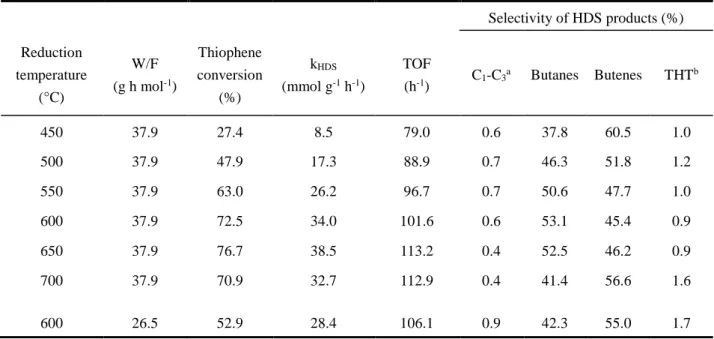
P(T)/Rh/ Al2O3 catal ys t after reacti on for 3 h are li sted i n Tab le 2. The
HDS rat e of t he cat al ys t remarkabl y i ncreas ed as the reducti on
temperature was increased t o 6 50 °C. In our papers , it was found that
Rh2P form ati on enhances HDS activit y of Rh -P catal ys t [ 23-27, 30]. Aft er
reduction at 450 °C, Rh2P were obs erved in the XRD patt ern of the
P(T)/Rh/ Al2O3 catal ys t (Fi gs. 4 and S1 ). Furt herm ore, CO uptake
increased with i ncreasing reduction t emperat ure from 450 °C to 6 0 0 °C,
as shown in Tabl e 1. Therefore, the enhancement of kH D S can be explained
b y Rh2P form ation and elimi nat ion of excess P on Rh2P. However, t he
optim al reducti on t emperature for maxim um kH D S was 650 °C, whi ch is
sli ghtl y hi gh er than t h e tem perature corresponding to maximum CO
upt ake (Tabl e 1 ). In the XPS spect ra, binding energy of R h 3d5 / 2 hardl y
changed with i ncreas ing reduction t emperature from 4 50 °C to 650 °C, as
shown i n Fi g. 5. These resul ts i ndi cate that t he di fference in t he optim al
reduction temperatures for kH D S and CO uptake cannot b e expl ained b y the
el ect ri c s tat e of Rh. In t he case of the R uS2/Al2O3 cat al ys t,
p yri te -st ructured RuS2 exhibit ed hi gher cat al yti c activi t y t han am orphous
18
size s trongl y affects the cr ys tal linit y of P t nanoparti cl e s [4 3]. The
disordered Rh particl e habit persi s ts to 4–5 nm; this val ue is substanti all y
greater t han t hat for Pt parti cl es (2–3 nm ) [44]. In t he present stud y,
becaus e the particle size of Rh2P on Al2O3 (after reduction at 450 ° C ) was
ca. 1.2 nm (Tabl e 1), the P (T)/Rh/ Al2O3 catal ys t should cont ain
amorphous and/ or low -cr yst alli nit y Rh2P parti cles. When the reducti on
temperature exceeded 600 °C , even though the C O upt ake decreased, the
cr ys t allinit y of Rh2P increas ed . Becaus e t he cr yst all init y of R h2P affects
HDS activit y and st abilit y, the optim al reduction temperature for kH D S
was hi gher than that for C O uptake .
The maximum kH D S of P (T)/Rh/Al2O3 cat al ys t (38.5 mm ol g- 1 h- 1) was
1.8 t imes hi gher than that of R h -P (A)/ Al2O3 cat al ys t (20.9 m m ol g- 1 h- 1,
Table S1). Hi gh acti vit y of the P (T)/Rh/ Al2O3 cat al ys t can be explai ned
b y formation of hi ghl y di spers ed Rh2P parti cles using TPP as a P source.
The optim al reduction t emperat ure for m aximum kH D S of the
P(T)/Rh/ Al2O3 catal yst (650 °C ) was 15 0 °C lower t han t hat for m aximum
kH D S of the Rh-P(A)/ Al2O3 cat al ys t (800 ° C) [24, 27] . This res ult is
19
TPP is us ed as the P source. At t emperat ures a bove 65 0 °C , t he HDS rat e
of t he P(T)/Rh/ Al2O3 cat al yst decreas ed. The average parti cl e size of the
P(T)/Rh/ Al2O3 catal ys t sl i ghtl y i ncreased wit h i ncreasing reducti on
temperature, as shown in Tabl e 1. Thus, t he decrease of HDS rat e was due
to si ntering of R h2P parti cle s.
The HDS reacti on products were but anes , but enes , t etrah ydrot hiophene
(THT), and trace am ounts of cracking products. The s electi vit i es for thes e
reaction product s in the thiophene HDS reacti on over the P (T)/Rh/Al2O3
catal ys t is li sted i n Table 2. Becaus e t he sel ectiviti es depend on the
thiophene conversion rat e, the product sel ectiviti es should be eval uat ed at
similar thiophene conversi on rat es. At hi gher reducti on t em perat ure s
(above 600 °C ), the s am e thi ophene conversion rate was obt ained. The
sel ectivit y for THT i ncreas ed wi th i ncreasing reducti on tem perat ure . At
similar conversion rates (ca. 53%), the P (T)/R h/Al2O3 cat al ys t (reduced at
600 °C) exhi bit ed remarkabl y hi gher but ane sel ecti vit y and l ower THT
sel ectivit y com pared to t hos e obt ained wi th the R h-P (A)/ Al2O3 catal ys t
reduced at 800 °C (T able S 2). TEM obs ervati on s reveal ed t hat average
20
reduction t emperature. However, th es e parti cle siz es (Tabl e 1) were
rem arkabl y sm all er t han that i n t he Rh -P(A)/ Al2O3 cat al yst ( Fig. S3).
These res ults indi cat e t hat sm all R h2P particl es exhibit hi gh er
h ydrogenati on and C–S bond -cl eavage abilities than l arge r particl es. The
sel ectivit y of THT over Rh-P/Si O2 cat al yst increas ed wit h decreasi ng W/ F
[26]. Furt herm ore, t he Rh2P/Si O2 cat al yst strongl y favored h ydrogenati on
pat hwa y [28]. Therefore, t hiophene m ainl y reacts vi a h ydrogenati on route
over t he P(T)/Rh/ Al2O3 cat al ys t with sm all Rh2P parti cle .
3.4. Turn over frequ ency of th e P(T )/Rh /Al2O3 catalys t
Table 2 also shows t he t urnover frequency (TOF) of the P (T)/ Rh/Al2O3
catal ys ts reduc ed at various t emperatures , which were cal culat ed from C O
upt ake (assumi ng C O/Rh = 1). The TOFs of the P (T)/Rh/ Al2O3 catal ys ts ,
whi ch were si gnifi cantl y great er than t hat of the R h/Al2O3 cat al ys t (15.9
h−1, Tab le S 1), i ncreas ed as the reduction temperat ure was i ncreas ed from
450 °C t o 650 °C . Thes e result s im pl y t hat the form ation and cr yst alli nit y
of R h2P positivel y affect ed the TOF. However, t he TOF of t he
21
lower than that of the Rh -P (A)/ Al2O3 cat al ys t (27 1.9 h−1, T able S1). The
XPS res ults (Figs . 4 and S1 ) reveal ed that the st at e of Rh i n t he
P(T)/Rh/ Al2O3 catal ys t is more cat ioni c t han that of Rh -P(A) / Al2O3
catal ys t. Furthermore, small Rh2P parti cl es i n t he P(T)/R h/Al2O3 cat al ys t
woul d b e am orphous and/or poorl y cr yst al line, as described above. Thus ,
the low TOF of the P (T)/Rh/ Al2O3 cat al ys t is explained b y t he existence
of cationic and/ or low cr ys t alline R h2P part icl es . In t he HDS of t hiophene
at 370 °C, the Ni2P/SiO2 (P/ Ni = 0.8) cat al ys t exhibit ed a TOF of 61 h−1
(0.017 s−1) [19]. The TOF of the P (T)/Rh/ Al2O3 cat al ys t reduced at 6 50 °C
(113.2 h−1) was hi gher than that of the Ni2P/SiO2 cat al yst .
4. Con clusion s
The lo w-tem perature s ynt hesis of Rh2P us ing TPP as a P source and its
catal yt i c activit y toward the HDS reaction were i nvesti gat ed. Because
TPP was easil y reduced under H2, Rh2P was formed on Al2O3 supports at
lower t emperat ure s t han Rh2P form ed from a phosphat e precursor. The
charact eriz ation results reveal ed the foll owing: Aft er reduction at lower
22
the reduct ion tem perature was increas ed t o 600 °C , excess P covering
Rh2P surface were reduced to the active R h2P phas e. Furt herm ore, t he
average parti cl e size of Rh2P prepared from TPP was approximat el y 1.2
nm; thi s parti cl e siz e was remarkabl y s maller than that of Rh2P prepared
from phos phat e . The P(T)/Rh/ Al2O3 catal ys t exhibit ed maxim al kH D S aft er
reduction at 650 °C , and thi s activit y was 1.8 tim es hi gher t han that of the
Rh-P (A)/Al2O3 cat al ys t reduced at 800 °C. Thus, the hi gh HDS rat e of t he
P(T)/Rh/ Al2O3 catal ys t was caus ed b y s mall R h2P particle s form ed at
lower reduction t emperat ure s.
Ackn owledgment
We would like to t hank Nippon Aerosi l C o. for s uppl yi ng the alumi na
support .
References
[1] Y. Okam oto, Bull . Chem. Soc. J pn. 87 (2013) 20 -58.
[2] S.T. O yama, T. Gott, H. Zhao, Y.K. Le e, C a t al. Toda y 143 (2009)
23
[3] R. Pri ns, M.E. Buss ell, Cat al . Lett . 142 (2012) 1413 -1436.
[4] P. Liu, J .A. Rodri guez, T. As akura, J . Gom es, K. Nakam ura, J . Ph ys .
Chem . B 109 (2005) 4575 -4583.
[5] W.R.A.M. R obins on, J .N.M.van Gest el , T. I. S. Koran yi , Ei j sbout s,
A.M. van der Kraan, J .A.R. van Veen, V.H.J . de Beer, J . C at al. 161,
(1996) 539 -550.
[6] C. Stinner, Z. Tang, M. Haouas , Th.Weber, R. Prins, J . Cat al. 208
(2002) 456 -466.
[7] S.T. O yam a, X.Wang, Y.K. Lee, K. Bando, F.G. R equejo, J . Cat al . 210
(2002) 207 -217.
[8] S.J . Sawhill, D.C . Phili ps, M.E. Bus sell, J . Cat al . 215 (2003) 208 -219.
[9] T.I. Korán yi , Appl. C at al. A: Gen. 239 (2003) 253 -267.
[10] A. Wang, L. Ruan, Y. Teng, X. Li, M . Lu, J . R ena, Y. Wang, Y. Hu, J .
Cat al. 229 (2005) 314 -321.
[11] S.J . Sawhil, K.A. La ym an, D.R. Van Wyk, M .H. Engel hard, C. Wang,
M.E. Bus sel l, J . C at al. 231 (2005) 300 -313.
[12] S. Yang, C. Li ang, R . P rins , J . C at al . 237 (2006) 118 -130.
24
[14] S.T. O yam a, Y.K. Lee, J . Catal . 258 (2008) 393 -400.
[15] E. Muthus wam y, G.H. L. Savithra, S.L. Brock, ACS Nano 5 (2011)
2402-2411.
[16] S.T. O yam a, J . Cat al. 216 (2003) 343 -352.
[17] J .A. Rodri guez, J .Y. Ki m, J .C. Hanson, S.J . Sawhill, M .E. Buss ell, J .
Ph ys. Chem. B, 1 07 (2003) 6276 -6285.
[18] P. Cl ark, X. Wang, S .T. O yam a, J . C at al. 207 (2002) 256 -265.
[19] S.J . Sawhill , D.C. Philli ps, M.E. Bussell , J . C at al. 215 (2003)
208-219.
[20] P.A. Cl ark, S .T. O yama, J . C at al. 218 (2003) 78 -87.
[21] A. M ont esinos -Cast ell anos, T. A. Zepeda, B. Pawelec, J .L.G. Fi erro,
J .A. de l os R e yes , C hem . M at er. 19 (2007) 5627 -5636.
[22] A. M ont esi nos -Cast ell anos, T.A. Zepeda, B. Pawel ec, E. Li ma, J .L.G.
Fi erro, A. Ol ivas, J .A. de los Re yes H., Appl . C at al. A: Gen. 334 (2008)
330-338.
[23] Y. Ka nda, C . Temma, K. Nakat a, M. Sugioka, Y. Uemi chi, Appl .
Cat al. A: Gen. 386 (2010) 171 -178.
25
Petrol. Inst. 55 (2012) 108 -119.
[25] Y. Kanda, T. Ichiki, S. Ka yaoka, A. S awada, M . S ugi oka, Y. Uemi chi ,
Chem . Lett . 42 (2013) 404 -406.
[26] Y. Kanda, C . Temma, A. S awada, M . Sugioka, Y. Uemi chi , Appl.
Cat al. A: Gen. 475 (2014) 410 -419.
[27] Y. Kanda, Y. Uemichi , J . J pn. Pet rol. Inst. 58 (2015) 20 -32.
[28] J .R. Ha yes , R.H. Bowker, A.F. Gaudett e, M.C. Smith, C.E. M oak,
C.Y. Nam, T.K. Pratum, M.E. Buss ell , J . Cat al. 276 (2010) 249 -258.
[29] V. Teixei ra da S ilva, L.A. Sous a, R .M. Amorim , L. Andri ni, S.J .A.
Fi gueroa, F.G. R equejo, F.C . Vi centini , J . Cat al., 279 (2011) 88 -102.
[30] A. S awada, Y. Kanda, M. Sugi oka, Y. Uemi chi, Catal . Commun., 56
(2014) 60-64.
[31] R.H. Bowker, M .C. Smit h, B.A. C arrillo, M.E. Buss ell, Top. C at al.,
55 (2012) 999.
[32] J .A. C ecili a, A. Infant es -Moli na, E. Rodrí guez -C ast ell ón, A.
J iménez -López , J . Phys . C hem . C , 113 (2009) 17032–17044.
[33] E.L. M uetterti es , J .C. S auer, J . Am. Chem . Soc., 96 (1974) 3410–
26
[34] A.E. Henkes, R .E. S chaak, Chem. M at er. 19 (2007) 4234 -4242.
[35] K.S. Cho, H.R. Seo, Y.K. Lee, C atal . Commun. 12 (2011) 470 -474.
[36] H. Song, M. Dai , H. Song, X. Wan, X. Xu, C . Zhang, H. Wang, Cat al .
Commun. 4 3 (2014 ) 151-154.
[37] H. Song, M . Dai , H.L. Song, X. Wan, X.W. Xu, Z.S. J in, J . Mol .
Cat al. A: Chem. 385 (2014) 149 -159.
[38] C.P. Hwang, C .T. Yeh, Q. Zhu, C at al. Toda y 51 (1999) 93 -101.
[39] J .P. Cont our, G. Mouv ier, J . Catal . 48 (1977) 217 -228.
[40] Y. Okamoto, N. Is hi da, T. Imanaka, S . Teranishi, J . C at al. 58 (1979)
82-94.
[41] C.P. Booker, J .T. Keis er, J . P h ys. Chem. 93 (1989) 1532 -1536.
[42] P. C astill o -Vill alón, J . R amí rez, F. M augé, J . Catal . 260 (2008)
65-74.
[43] L. Li, L. L. Wang, D.D. J ohnson, Z . Zhang, S . I. S anchez, J .H. Kang,
R.G. Nuzzo, Q . Wang, A. I. Frenkel , J . Li, J . Ciston, E. A. St ach, J .C. Yang,
J . Am. Chem. Soc. 135 (2013) 13062 -13072.
[44] S.I. S anchez, M .W. Smal l, E.S. Bozi n, J .G. Wen, J.M . Zuo, R.G.
27
Captions
Fi gure 1 TPR profi les of P(T)/Rh/ Al2O3 cat al yst recorded b y TC D and
F ID.
Fi gure 2 XRD patt erns of P(T)/R h/Al2O3 cat al ys t reduced at 450 °C–
650 °C.
Fi gure 3 XRD patt erns of H L -P (T)/Rh/ Al2O3 cat al ys t reduced at
350 °C–650 °C.
Fi gure 4 XPS s pectra of P (T)/Rh/ Al2O3 cat al yst reduced at 450 °C–
650 °C.
Fi gure 5 R el ations hip bet ween the reduction t emperat ure and CO
upt ake of P (T)/Rh/ Al2O3 cat al yst .
Fi gure 6 TEM im ages of P (T)/Rh/ Al2O3 catal ys t (A) before and aft er
reduction at (B) 450 °C, (C) 550°C, and (D) 650 °C .
Fi gure 7 P article s ize di stri buti on of P(T)/R h/Al2O3 cat al ys t (A) before
and aft er reduction at (B) 450 °C, (C ) 550°C, and (D) 650 °C.
Fi gure 8 HDS of thiophene over P(T)/R h/Al2O3 cat al yst aft er reduction
28
Table 1 CO uptake and average particle size calculated from TEM images of P(T)/Rh/Al2O3
catalyst before and after reduction.
Reduction temperature (°C)
CO uptake
(μmol g-1)
Average particle size (nm)
Before reduction - 0.97
450 91.6 1.18
500 142.3 -
550 171.5 1.25
600 188.1 -
650 178.7 1.31
29
Table 2 HDS properties of P(T)/Rh/Al2O3 catalyst. Reaction conditions: H2/C4H4S = 30, total
pressure = 0.1 MPa.
Selectivity of HDS products (%)
Reduction
temperature
(°C)
W/F
(g h mol-1)
Thiophene
conversion
(%)
kHDS
(mmol g-1 h-1)
TOF
(h-1) C1-C3
a Butanes Butenes THTb
450 37.9 27.4 8.5 79.0 0.6 37.8 60.5 1.0
500 37.9 47.9 17.3 88.9 0.7 46.3 51.8 1.2
550 37.9 63.0 26.2 96.7 0.7 50.6 47.7 1.0
600 37.9 72.5 34.0 101.6 0.6 53.1 45.4 0.9
650 37.9 76.7 38.5 113.2 0.4 52.5 46.2 0.9
700 37.9 70.9 32.7 112.9 0.4 41.4 56.6 1.6
600 26.5 52.9 28.4 106.1 0.9 42.3 55.0 1.7
a C1-C3 hydrocarbons
30
Fig. 1
0
200
400
600
800
TCD
TCD and FID s
ignal
(a.u.)
Temperature (°C)
31
Fig. 2
20
30
40
50
60
70
80
90
Int
en
sity
2
θ
(Degree)
650 °C
550 °C
450 °C
Al2O3 ● Rh2P
■ Rh
32
Fig. 3
0
200
400
600
800
P(T)/Rh/Al2O3
TCD si
gnal (
a.u.)
Temperature (°C)
33
Fig. 4
20
30
40
50
60
70
80
90
350 °C 650 °C
Int
en
sity
2
θ
(Degree)
550 °C
450 °C
Al2O3 ● Rh2P
■ Rh
34
Fig. 5
316
312
308
304
307.6 Rh 3d
Binding energy (eV)
650 °C
600 °C
450 °C
138
136
134
132
130
128
P 2p
Binding energy (eV)
650 °C
600 °C
450 °C
35
36
Fig. 7
0 1 2 3 4 5
0 10 20 30 40 (A) F req u e n cy (%)
Particle size (nm)
0 1 2 3 4 5
0 10 20 30 40 (B) F req u e n cy (%)
Particle size (nm)
0 1 2 3 4 5
0 10 20 30 40 (C) F req u e n cy (%)
Particle size (nm)
0 1 2 3 4 5
0 10 20 30 40 (D) F req u e n cy (%)
37
Fig. 8
0
1
2
3
0
20
40
60
80
100
650 °C 700 °C 550 °C
600 °C 450 °C
500 °C
Co
nve
rsio
n (%)
Time on stream (h)
Graphical abstract
●Conventional preparation of Rh2P/Al2O3
P O
-O
O-O
-P O
-OO-O
-P O
-O
O-O
-●New preparation of Rh2P/Al2O3
P P
P P
High activity! Reduction
at 650 °C Reduction