117
カブユタン・チブルイにおける写本で使われた古スンダ文字
Old Sundanese Script in Kabuyutan Ciburuy Manuscripts
本稿の著作権は著者が保持し、クリエイティブ・コモンズ表示 4.0 国際ライセンス(CC-BY)下に提供します。
https://creativecommons.org/licenses/by/4.0/deed.ja
ラフマット ソピアン Rahmat Sopian
要 旨
本稿はカブユタン・チブルイに保管される写本において、古スンダ文字の筆記システ ムとスタイルを分析したものである。カブユタン・チブルイは、インドネシア西ジャワ 州に位置しており、ロンタル又はグバンと称されるヤシ科パルミラヤシの葉から作られ た古写本を保管するという役割を担ってきた。カブユタン・チブルイに計726枚が保管 され、うち501枚には古スンダ文字が、うち225枚にはブダ文字(グヌン文字とも呼ばれる) が用いられていた。これらの写本は17世紀頃に制作され、現在26個のクロパック(写 本を収蔵するための小型の箱)に収められている。そして、これらのクロパックは3個 の大きな容器に保管されている。
本稿では、古スンダ文字で書かれた501枚を用いて、先行研究の結果を比較しながら 分析を行った。筆記システムの分析は、子音字に内在する母音の削除に焦点を当てた。
子音字に内在する母音の削除は「パサンガンのシステム」と「下線筆記のシステム」で ある。そして、筆記スタイルの分析は、筆記スタイルの識別と文字形態による分類につ いて行った。
分析した結果は、全ての子音字が「パサンガンのシステム」として利用可能というこ とであった。この筆記システムでは、<ya>を除き、子音が添え字として機能するように なる。子音字を「パサンガンのシステム」として書く場合、<ya>、<ra>、<wa>は普通形 と異なる形に書かれる。<ba> と <ma>は普通形と同様に書くことも、普通形と異なる形 に書くことも可能である。<ka>、<ga>、<nga>、<ca>、<ja>、<nya>、<ta>、<da>、<na>、
<pa>、<la>、<sa>、<ha>は普通形と同様に書かれる。1番目の容器に保管されてあった、
チブルイ7番のクロパックでは、<tra>という合字が見出され、それは「パサンガンのシ ステム」としても機能できる。また、「下線筆記のシステム」は<ka>、<ja>、<na>にの み現れる。さらに、カブユタン・チブルイに保管される写本において、古スンダ文字の 筆記スタイルが多様であることが判明した。
筆記スタイルが多様であるのは、カブユタン・チブルイでの筆記者が2人以上存在し たからだと考えられる。また、『セワカ・ダルマ』叙事詩のバージョンが2種類あること、
それぞれの文字スタイルで書かれたこと、伝統的な文房具が残っていることから、カブ ユタン・チブルイが写本の保存場所として機能しているほか、写字室としても役割を果 たしてきたことが示された。
言語・地域文化研究 第 ₂6 号 2020
118
1. Introduction
It is interesting to know that there is another collection of manuscripts found at around the same time as the Merbabu collection. For its owner, its importance is only in its sanctity. These collections were found in Ciburuy1 and Cilegon (Molen 2011, 140).
As stated by Van der Molen on Javaanse tekstkritiek: een overzicht en een nieuwe benadering geillustreerd aan de Kunjarakarna, the relationship between Kabuyutan Ciburuy and Merbabu is also shown by Acri. Acri states that collections preserving manuscripts of Old Javanese Tuturs2 (some with occasional Sanskrit quotations) were found in the course of the 19th Century in the Merapi-Merbabu area in Central Java and few locations in West Java (amongst them is Kabuyutan Ciburuy) (2011, 3). This relationship becomes clear with the discovery of Bhima Svarga manuscripts in Kabuyutan Ciburuy, Merbabu, Singaraja (Bali) and Karangasem (Bali) (Gunawan 2016, 9).
These facts show that Kabuyutan Ciburuy is one of the important places in Indonesian manuscripts. Even when compared to Merbabu, it can be said that Kabuyutan Ciburuy has a slight advantage because most of the manuscripts are still stored in Kabuyutan Ciburuy. While the manuscripts of Merbabu, based on reports dated April 27, 1952, have moved from Merbabu (Molen 2011, 135). Besides that, in Kabuyutan Ciburuy, there is still traditional preservation of the manuscripts3. Nevertheless, the interest of researchers in Kabuyutan Ciburuy manuscripts is still low. Of the 26 kropak Old Sundanese manuscripts in Kabuyutan Ciburuy, only 12 kropak have been studied (see table 2).
The lack of research in Kabuyutan Ciburuy manuscripts might be due to enormous challenges that researchers must face. For example, compared with Old Sundanese manuscripts stored in the National Library of Indonesia, the condition Tables of Contents
1. Introduction
1.1 Old Sundanese manuscripts 1.2 Kabuyutan Ciburuy 1.2.1 Chest 1.2.2 Kropak 2. Method
3. Result and discussion 3.1 Old Sundanese script 3.2 Writing system 3.3 Writing style of letters 3.4 Discussion
4. Conclusion Acknowledgment References Notes
(ラフマット ソピアン)
論文 カブユタン・チブルイにおける写本で使われた古スンダ文字
言語・地域文化研究 第 ₂6 号 2020 119
of Old Sundanese manuscripts in Kabuyutan Ciburuy is slightly different. First, most of the physical conditions of the manuscripts in Kabuyutan Ciburuy are damaged (fig. 1). Then, the story in the manuscript has been mixed up with another story. As stated by Ruhimat (2015, 1):
One of Kabuyutan Ciburuy collections that is very interesting to be studied is the Sons of Rama and Rawana manuscript. This manuscript is found in kropak 17, 18, 22, 26, and 29. All the leaves in kropak 18 and 22 contain the Sons of Rama and Rawana’s stories, while kropak 17, 26, and 29 are only two leaves. In kropak 17, 26, and 29, the Sons of Rama and Rawana’s stories are mixed up with another story.
Figure 1: The leaf of the manuscript of the Sons of Rama and Rawana stories. The leaf is stored in chest 1 kropak 26 Kabuyutan Ciburuy. In the picture, the leaf is damaged on the left and right, So that some of the letters are missing.
Despite the difficult condition, research on Kabuyutan Ciburuy manuscripts remains to be done. Kabuyutan Ciburuy manuscripts which are stored traditionally4 might be weathering faster. Then, there is no tradition of reading and copying manuscripts in Kabuyutan Ciburuy resulting in surviving manuscripts being the only data source.
In the Old Sundanese manuscript, the Kabuyutan Ciburuy collection has an important position. In terms of numbers, there are 726 leaves of Kabuyutan Ciburuy manuscripts becoming a large collection for an old manuscript.
There are 501 leaves written in Old Sundanese script and other 225 leaves are written in Buda or Gunung script. As many manuscripts are written in the Old Sundanese script, it is expected to describe the condition of the Old Sundanese script.
Research on the Old Sundanese script in Kabuyutan Ciburuy has been carried out since 1882. The result of K.F. Holle is included in the book Table van oud- en nieuw- Indische alphabetten: Bijdrage tot de palaeographie van Nederlandsch-Indië. Holle explains that Old Sundanese script in the book was taken from several manuscripts found in Kabuyutan Ciburuy. On number 77 ~ 109 in the “C. West Java” section, Holle presents 33 styles of scripts which are divided into 1 style of script in a charter (metal), 5 styles on stone inscriptions and 27 styles on manuscripts. Of the 27 styles of manuscripts, 5 of them are originated from Kabuyutan Ciburuy, namely 4 manuscripts written in Buda or Gunung scripts (see Molen 2011, 118 for further reading on Buda or Gunung script) and one manuscript written in Old Sundanese script (number 89). The Old Sundanese script in the Kabuyutan Ciburuy manuscript consists of 36 letters (consisting of consonant letters, independent vowel letters, and diacritics), 2 punctuations, and 10 numerical letters.
In 1864 I offered to the Batavia Society for Arts and Sciences for publication a table of alphabets, drawn from some Old Kawi and Old Sunda lontar manuscripts, found in the Ciburuy village, Limbangan subdistrict, Preanger Regentschappen district, which offer further up to led a proposal to the aforementioned Society to conduct an investigation into the alphabets used in the various divisions of this Colony. (Holle, 1882).
120
In the next period, the Old Sundanese script research in Kabuyutan Ciburuy manuscripts was also carried out by Atja (1970) and Danasasmita, et al. (1987). Atja and Danasasmita explain that the manuscripts were originated from Kabuyutan Ciburuy but currently are kept in the National Library of Indonesia. In the National Library of Indonesia, the manuscripts researched by Atja are kept in kropak 410 entitled Carita Ratu Pakuan (The History of Pakuan King) and the manuscripts researched by Danasasmita are kept in kropak 623 entitled Amanat Galunggung (The Messages of Galungung).
Regarding Danasasmita’s research, he also examined the manuscripts of kropak 408 entitled Sewaka Darma and kropak 630 entitled Sanghyang Siksa Kandang Karesian. Both manuscripts are not from Kabuyutan Ciburuy.
In his research, Atja wrote Old Sundanese script used in the manuscript of Carita Ratu Pakuan with the following details; 18 consonant letters, 4 independent vowel letters, 14 diacritics, 1 pasangan, 2 ligature, and 2 punctuations (Atja 1970, 25). Then, in Danasasmita’s research, it did not explain in detail a script used for each manuscript. In Danasasmita’s research explained as follows:
The script form in these manuscripts resembles the script in kropak 410 entitled Carita Ratu Pakuan. Until now, the script form is suspected to be the last period Sundanese script form because kropak 410 might have written in the early 18th Century according to a comparison to the Carita Waruga Guru manuscript from the mid-century of that period. Carita Waruga Guru was already written on the daluang paper. (Danasasmita, et al. 1987, 1)
The research on the Old Sundanese script is also carried out on the manuscripts kept in Kabuyutan Ciburuy. The studies were conducted by Sardjono, Ekadjati, and Kalsum (1987); Darsa, et al. (2008), Darsa (2012); Pratama (2014);
Ruhimat (2016); and Nawawi (2017). Similar to the predecessors, those researches only display the Old Sundanese script in the manuscripts used as the research object. The description on the Old Sundanese script is slightly longer in Sardjono, Ekadjati, and Kalsum entitled “Old Sundanese Manuscripts: Transliteration and Translation”. At the end of the book, there are 4 script styles written and a brief description of Old Sundanese script writing system. However, due to a brief description in the book, the condition of the Old Sundanese script in the Kabuyutan Ciburuy manuscripts is pretty unclear. Therefore, in this article, we will explain the condition of the Old Sundanese script in Kabuyutan Ciburuy through checking all manuscripts written in the Old Sundanese script. This article will focus on the writing system and the writing style of letters.
1.1 Old Sundanese manuscript
The Sundanese manuscripts are manuscripts compiled and written (or copied) in Tanah Sunda (now West Java Province and Banten Province, Indonesia) and texts containing stories or descriptions related to the region and the Sundanese as the core and subject matter of the manuscript (Ekadjati 1988, 4). However, according to Kalsum (2006, 2), to make precise limits on the term Sundanese manuscripts is very difficult because it contains indicators including ethnic, language, and region.
According to Ekadjati (2003, 128-129), based on the time of its composition as well as the features of the manuscript and its content, the Sundanese manuscript can be classified into three periods of composition, namely the (1) old, (2) transitional, and (3) modern periods. The old period includes manuscripts written in the pre-Islamic period, written by individuals bearing pre-Islamic identities living in localities of pre-Islamic cultures, of which the contents represent pre-
(ラフマット ソピアン)
論文 カブユタン・チブルイにおける写本で使われた古スンダ文字
121
Islamic people and cultures. Generally, the manuscripts were written on leaves with knife-pens (péso pangot) or pen and ink in Old Sundanese or Old Javanese script and language. The pre-Islamic period in Tanah Sunda covers the time prior to the 16th century (fig. 1 and 2). The transitional period produces Sundanese manuscripts written on paper, generally traditional paper (known as daluang or saéh) with pen and ink using Pégon or Carakan script in Javanese or the mixture of Javanese, Sundanese, and Arabic. They were written between the 17th and mid-19th century (fig. 3). The modern period produces Sundanese manuscripts written on paper, generally manufactured paper, with a pen, fountain pen, and ink using the Carakan, Pégon, and Roman scripts in modern Sundanese. This period is between the mid-19th and 20th centuries (fig. 4).
Figure 2: This photo is part of the Jatiraga manuscript. This manuscript is made from lontar leaves with the Old Sundanese script.
This manuscript is kept in Kabuyutan Ciburuy.
Figure 3: This photo is part of the Panyepuh Tapa manuscript. This manuscript is made from gebang leaves with the Buda or Gunung script. This manuscript is kept in Kabuyutan Ciburuy.
Figure 4: This photo is part of the medicine manuscript.
This manuscript is made from daluang or saéh paper (traditional paper) with the Pégon script (Arabic script used to write Sundanese). This manuscript is kept in the Museum of Sri Baduga, Bandung - West Java.
Source: Museum of Sri Baduga, Bandung - West Java.
Figure 5: This photo is part of the Babad Panjalu manuscript. This manuscript is made from paper with Latin script. This manuscript is kept in the Museum of Sri Baduga, Bandung - West Java.
Source: Museum of Sri Baduga, Bandung - West Java.
1.2 Kabuyutan Ciburuy
Kabuyutan Ciburuy is the name of a site in Pamalayan village, Garut regency, West Java province, Indonesia.
‘Kabuyutan’ comes from the word ‘buyut’ (ka + buyut + an) which means ancestor. Mardiwarsito (1990, 121) defines 言語・地域文化研究 第 ₂6 号 2020
122
µNDEX\XWDQ¶DV³VDFUHGSODFHVUXLQVVKULQHVWHPSOHVDQGDQFHVWUDOWRPEV´DQG5REVRQDQG:LELVRQRGH¿QH
‘kabuyutan’ as 1 place where a priest lives and works; 2 sacred ancestral worship- place; 3 ancestral and sacred (of places such as cemeteries). Then, ‘Ciburuy’ in this case is the name of a sub-village. Such a definition corresponds with the condition in Kabuyutan Ciburuy, in which it is sacred by the local society. The locals believe that their ancestors lived in that place a long time ago.
Kabuyutan Ciburuy has been managed by the people of Ciburuy since ancient times. At the time of this research, the caretaker or the juru kunci is Mr. Ujang Suryana. He has been a caretaker of Kabuyutan Ciburuy for almost twenty years.
He becomes the caretaker to replace his father. Mr. Engkon, Ujang Suryana’s father, at that time stopped being a caretaker Kabuyutan Ciburuy because he was old. Mr. Ujang Suryana does not remember all of Kabuyutan Ciburuy’s caretakers before him because there were so many. He can only remember 5 among them, namely Mr. Engkon, Mr. Cudi, Mr. Anéra, Mr. Misnam, and Mr. Usro.
Kabuyutan Ciburuy has been inventoried at the Balai Pelestarian Cagar Budaya Banten (Heritage Preservation 'LYLVLRQRI%DQWHQWKH0LQLVWU\RI(GXFDWLRQDQG&XOWXUHRI,QGRQHVLD,QWKHLQVWLWXWLRQ.DEX\XWDQ&LEXUX\LVFODVVL¿HG as a cultural heritage building and is given an inventory number 003.02.03.05.94.
Figure 6: The Map of Kabuyutan Ciburuy.
Kabuyutan Ciburuy is located on the base of Mount Cikuray with an altitude of 1.500 meters above sea level and has an area of 1.500 m2. Most of the area is an area covered with trees. Only in the northern part, there are several buildings. The buildings in Ciburuy Kabuyutan are as follows:
1. Leuit is a kind of little house built on stilt used to be a rice barn. Its size is 4 m x 2,5 m.
2. Saung lisung is a simple house to pound padi (unhulled rice) into rice. Its size is 9 m x 3 m.
3. Patamon is derived from the word ‘tamu’ (pa + tamu + an) which means guest. Patamon is a house built on stilt used to welcome guests and is a traditional community meeting place. Patamon is divided into tepas (terrace), pawon (kitchen), and tengah imah (family room). Its size is 8 m x 10 m.
4. Pangalihan is derived from the word “ngalih” ‘switch’ (Pa+ngalih+an). Pangalihan is a kind of little house built on stilt used to transit. Darsa (2012, 105-106) calls this place Panyarangan or Pasigaran which serves to store chests
(ラフマット ソピアン)
論文 カブユタン・チブルイにおける写本で使われた古スンダ文字
123
of manuscripts before they are stored in Padaleman during the Seba ceremony5. Its size is 1,5 m x 1,5 m.
5. Padaleman is a house built on stilt used to store Old Sundanese manuscripts and other heirlooms. Padaleman is divided into tepas (terrace) and main room. To get into Padaleman, we have to go through a special area surrounded by a bamboo fence called kikis and require permission from the caretaker. The size of the Padaleman is 9 m x 5 m.
Figure 7: Padaleman building is a place to store Old Sundanese manuscripts in Kabuyutan Ciburuy.
1.2.1 Chest
As mentioned before, Old Sundanese manuscripts in the Kabuyutan Ciburuy are kept in Padaleman. The manuscript is kept in 3 chests (locals call it peti) at the upper eastern corner of Padaleman main room. The chests are kept parallel from WKH(DVWWRWKH:HVW$FFRUGLQJWRWKHFDUHWDNHU0U8MDQJ6XU\DQDWKHFKHVWVDUHJLYHQQDPHDVDQG¿J
The naming of the chest in Kabuyutan Ciburuy is not very clear. The reason is that there are no numbers or writing on the chest that state its name (c.f. Darsa 2012, 107). Acri (2009) names chests in Kabuyutan Ciburuy with Arabic numerals, namely chest one, chest two, and chest three. Unfortunately, from photos on the website (https://eap.bl.uk/collection/
EAP280-1), the naming of chests is not accompanied by its picture. Acri only uses the name of the chest in order to group Kabuyutan Ciburuy manuscripts into 3 groups. While Darsa (2012, 107) names chests in Kabuyutan Ciburuy based on their location in Padaleman, from the East to the West. Darsa calls the chest stored in the easternmost as chest one, the chest in the middle as chest two, and the westernmost as chest three. Similar to Acri, Darsa does not display photos of the named chests.
The naming of the chest is quite important in the research of Kabuyutan Ciburuy manuscripts. Even though chests in Kabuyutan Ciburuy are new – previously, the manuscripts were kept in baskets made of bamboo called carangka – but in reality, today they are stored in three chests. Therefore, while researching manuscripts of Kabuyutan Ciburuy, mentioning the name of the chest is a must. The naming of the chest that has been done before was good and consistent. However, it QHHGVWREHFODUL¿HGDJDLQWRDYRLGPLVXQGHUVWDQGLQJLQWKHIXWXUH$VFKHVWQDPLQJE\'DUVDLVEDVHGRQWKHORFDWLRQRIWKH chest in Padaleman, we consider that it still needs an explanation because its location in Padaleman can change, as shown in
¿JDQG
言語・地域文化研究 第 26 号 2020
124
Figure 8: Photograph of chests in Kabuyutan Ciburuy on December 8, 2012.
Figure 9: Photograph of chests in Kabuyutan Ciburuy on July 31, 2019.
In this article, the chest naming will follow the previous naming, using Arabic numerals. Then, for continuity, the chest naming will consider Acri’s description at https://eap.bl.uk/collection/EAP280-1. In addition, we will provide information such as the physical characteristics of the chest that are easily recognized.
Table 1: Chests in Kabuyutan Ciburuy
No Name of chest Photo of chest Explanation
1 1 (one)
This is the largest chest and is dark brown colored. In 2019, this chest contains 12 kropak in which there are 261 leaves of manuscripts.
2 2 (two)
This is the smallest chest and is dark red colored. In 2019, this chest contains 6 kropak in which there are 299 leaves of manuscripts. In this chest, there are also heirlooms, namely: péso pangot (knife-pen), kujang, trident, spearhead, horn-made eyeglass frames, scissors, metal plates, and metal-legged tubes.
3 3 (three)
This is the medium chest and is dark red colored. In 2019, this chest contains 8 kropak in which there are 166 leaves of manuscripts.
1.2.2 Kropak
According to Robson and Wibisono at Javanese English Dictionary (2013, 403), “kropak 1 palm leaf used to write RQDSDOPOHDIERRN´'L൵HUHQWPHDQLQJVFRQYH\HGE\0HLMZKRVD\VWKDWkropak is a wooden box. As with the protective covers of takƟpan manuscripts, no detailed study has been made of the wooden boxes that contain lontar manuscripts. A kropak is usually made to the exact size of the manuscript to be put into it. If the box is too big for the manuscript inside, it means that this particular manuscript used not to be stored in that box. In this article, what is meant by kropak in Kabuyutan Ciburuy is by Meij.
Kropak in Kabuyutan Ciburuy is made of wood and plywood. Kropak, when stored in a chest, is wrapped in a kind of shroud (locals call it boéh). Its size ranges from 8 cm x 10 cm x 20 cm up to 8 cm x 10 cm x 50 cm. Based on the data collection in 2019, there are 26 kropak in Kabuyutan Ciburuy.
(ラフマット ソピアン)
論文 カブユタン・チブルイにおける写本で使われた古スンダ文字
125
There is no clear reference to the name kropak in Kabuyutan Ciburuy. Similar to Kabuyutan Ciburuy manuscript research conducted by Sardjono, Ekadjati, and Kalsum in 1987 which grouped the manuscript based on the results of the photograph. The manuscripts of Kabuyutan Ciburuy are referred to as the Ciburuy I (CB I) and Ciburuy II (CB II).
After research results from Sardjono, Ekadjati, and Kalsum are compared to other researches’, the Ciburuy I manuscript by Sardjono Ekadjati, and Kalsum is kropak 9 which is stored in chest 3. The manuscript (kropak 9) also becomes one of Darsa’s (2012) research objects entitled Sewaka Darma. Then, in subsequent studies (Darsa, et al. (2008), EAP (2009), Pratama (2014); Ruhimat (2016); Gunawan (2016); and Nawawi (2017)) mention the name of the kropak with one of the numbers or writings on kropak. The use of numbers or writings that is printed on the kropak for its name is actually quite confusing. The reason is that there are several numbers or writing on the kropakDVVKRZQLQ¿J
Figure 10: This photo is the top part of the kropak BPC6 which is kept in the chest 2.
Naming kropakIURPQXPEHUVRUZULWLQJVZULWWHQRQLWLVH൵HFWLYHEHFDXVHLWZLOOHDVHVRPHERG\ZKHQYHULI\LQJWKH original manuscript in Kabuyutan Ciburuy. The use of one of the numbers or writings written on kropak as its name has been done by Acri (2009) on the EAP website. However, after researching on the EAP website, there is the same kropak QDPLQJIRUGL൵HUHQWPDQXVFULSWVQDPHO\&LEXUX\;,,,kropak 20 and kropak 24. Kropak&LEXUX\;,,,LVXVHGIRUSKRWRVRI manuscripts stored at KWWSVHDSEOXNDUFKLYH¿OH($3 and KWWSVHDSEOXNDUFKLYH¿OH($3 Kropak 20 is used for photos of manuscripts stored at https://eap.bl.uk/archive-file/EAP280-1-2-2 and https://eap.bl.uk/archive-
¿OH($3 Kropak 24 is used for photos of manuscripts stored at KWWSVHDSEOXNDUFKLYH¿OH($3and KWWSVHDSEOXNDUFKLYH¿OH($3
For continuity in naming kropak, this article will use numbers or writings that are written on the kropak. This naming as much as possible will be adjusted to the research that has been done. However, if the naming remains unclear in previous research, the kropak will be given a new name taken from one of the numbers or writings written on it.
As mentioned earlier, based on the data collection in 2019, in Kabuyutan Ciburuy there are 26 kropak Old Sundanese manuscripts. The kropak are stored in three chests in Padaleman. The following is a list of kropak on each chest:
Table 2: List of Old Sundanese manuscripts in Kabuyutan Ciburuy
No Name of kropaks Number of leaves Type of scripts Title or story of the manuscripts based on previous research
Chest 1
1. 17 15 Old Sundanese
- (Sewaka Darma (fragment))
- (The Sons of Rama and Rawana (fragment)) - (Kawih Katanian (fragment))
2. 18 5 Old Sundanese - (The Sons of Rama and Rawana(fragment))
3. 19 27 Old Sundanese - (?)
言語・地域文化研究 第 26 号 2020
126
4. 20 26 Old Sundanese - (Bhima svarga (fragment))
- (?)
5. 21 14 Old Sundanese - (?)
6. 22-27 33 Old Sundanese - (The Sons of Rama and Rawana (fragment))
7. 24 16 Old Sundanese - (Kawih Katanian (fragment))
8. 26 35 Old Sundanese - (The Sons of Rama and Rawana (fragment))
- (?)
9. 28 46 Old Sundanese - (?)
10. 29 14 Old Sundanese
- (The Sons of Rama and Rawana (fragment)) - (Kawih Katanian (fragment))
- (?)
11. Ciburuy VI 19 Old Sundanese - (?)
12. Ciburuy VII 11 Old Sundanese - (Bhima svarga (fragment))
- (?) Chest 2
13. 22 108 Buda or Gunung - (Sanghyang Hayu)
14. 23 4 Buda or Gunung - (?)
15. BPC 6 27 Old Sundanese - (Sewaka Darma)
- (?)
16. BPC 8 27 Buda or Gunung - (?)
17. BPC 9 47 Old Sundanese - (?)
18. Ciburuy I 86 Buda or Gunung - (?)
Chest 3
19. 5 17 Old Sundanese - (?)
20. 9 33 Old Sundanese - (Sewaka Darma)
21. Ciburuy II 27 Old Sundanese - (?)
22. Ciburuy III 16 Old Sundanese - (?)
23. Ciburuy XII 19 Old Sundanese - (?)
24. Ciburuy XIII 34 Old Sundanese - (Bhima svarga (fragment))
- (?)
25. Ciburuy XIV 10 Old Sundanese - (?)
26. Ciburuy XV 10 Old Sundanese - (?)
Total of leaves 726
Note:
- One kropak can contain one story or more.
- One story can be in several kropak.
- (?): title or story not yet known.
2. Method
This study uses a qualitative method. To obtain comprehensive data, several procedures have been carried out.
First, a literature study on the Old Sundanese script was conducted, regarding the background, results, and development of research. That is an important step in establishing a research framework on the Old Sundanese script. Second, a field
(ラフマット ソピアン)
論文 カブユタン・チブルイにおける写本で使われた古スンダ文字
127
visit was made to Kabuyutan Ciburuy (in 26 – 27 July 2017, 16 August 2017, and 30 July – 1 August 2019), functioning as a visual description of the Old Sundanese script in the manuscripts in that location. All Old Sundanese manuscripts in Kabuyutan Ciburuy were photographed. Interviews were conducted with caretakers, the public, and government officials.
Third, the analysis of the forms of the Old Sundanese script was conducted by referring to the research that had been done.
3. Result and discussion
3.1 Old Sundanese script
Old Sundanese scripts are regional scripts used by ethic Sundanese people settling in the western part of Java Island a long time ago. These scripts are used in inscriptions, charters, and manuscripts during the Sundanese Kingdom era. The oldest use of these Old Sundanese script known to date was found on the Kawali inscription of the 16th century (Darsa. et.
al, 2008, 12) and the last one was found at the end of the 18th century, in the Waruga Guru manuscript written on European paper (Ekadjati, 1988, 11).
From the perspective of genealogy, Old Sundanese scripts have their roots back to the Pallava scripts, which were derivatives of the Southern Brahmi scripts. Brahmi, as developed in India and as exported to other parts of Asia in the first millennium C.E., is the ultimate source not only of all the indigenous scripts of South Asia but also of the major Southeast Asian scripts (Salomon 1996, 373). Court (1996, 446) states that the first stage of adaptation of Brahmi-based scripts in Southeast Asia consists of local writings of Indian languages in such scripts. Inscriptions prove that not only the languages – mostly Sanskrit but also Pali and Tamil – but also the scripts were indeed in use in Southeast Asia. The second stage, in which Southeast Asian languages are reduced to writing by using Indian or Indian-derived scripts, has been mentioned with regard to an early inscription in Old Cham; there are likewise inscriptions in Khmer, Old Malay, Old Javanese, Old Balinese, etc. The third stage of Indianization consists of local developments and variations in the scripts, with no counterpart India.
In the West Java region, the process began with inscriptions in Sanskrit language written in the Pallava scripts (such as the Jambu inscription - Bogor West Java) which was then followed by Old Sundanese scripts.
Similar to Brahmi-based scripts, Old Sundanese scripts (written from left to right) systematically have the same type, in which the consonant syllables are modified with diacritic, or alphasyllabary. This system is based on "syllable"
graphic units (type V, CV, and CCV). Syllables consisting of vowels (type V) (usually at the beginning of words or sentences) are written in independent vowels (table 3). Syllables consisting of consonants are followed by vowels (type CV), in which the vowel is indicated by diacritic marks attached to a consonant base sign; for example, /ki/ (table 6), basic consonant letters without diacritical modifications automatically understood show consonants with “innate” vowels / a/; for example, /ka/ (table 4). Syllables consisting of two consonants are followed by vowels in one letter (type CCV) are written in ligature (table 5). Ligature letter in the Old Sundanese script is a combination of two Old Sundanese letters to form a new letter.
Pasangan is a consonant letter (except letters of <ba>, <ma>, <ya>, <ra>, and <wa> write on a different form) in a subscript form (except letter of <ya> in parallel form), that eliminates the inherent vowel of the attaching syllable. It is used for consonant clusters or closed syllables. For example, /tka/ is made by attaching pasangan <ka> to the syllable <ta> (table 4). An independent vowel letter does not have a pasangan. In addition, pasangan, paéh or patén is used to eliminate the inherent vowels. For example, <k> is made by attaching paéh or patén to the syllable <ka> (see table 6 number 10).
言語・地域文化研究 第 ₂6 号 2020
128
Table 3: Independent vowels
No Letter
1. <a>
2. <i>
3. <u>
4. <é>
5. <e> or <eu>
6. <o>
7. <re> or <reu>
8. <le> or <leu>
9. <ro>
Table 4: Consonants
No Letter Pasangan
1. <ka> /tka/
2. <ga> /lga/
3. <nga> /tnga/
(ラフマット ソピアン)
論文 カブユタン・チブルイにおける写本で使われた古スンダ文字
129
4. <ca> /nyca/
5. <ja> /nyja/
6. <nya> /jnya/
7. <ta> /kta/
8. <da> /hda/
9. <na> /yna/
10. <pa> /ppa/
11. <ba> /mba/
12. <ma> /pma/
13. <ya>
(Usually called “Mingkal”)
/bya/
14. <ra>
(Usually called “Cakra”)
/kra/
言語・地域文化研究 第 26 号 2020
130
15. <la> /tla/
16. <wa> /hwa/
17. <sa> /lsa/
18. <ha> /pha/
Table 5: Ligature
No Letter
1. <tra>
2. <mpa>
3. <ksa>
Table 6: Diacritic
No Diacritic with consonant ‘ka’ Name of diacritic
1. /ka/ -
2. /ki/ hulu
3. /ku/ suku
4. /ké/ téléng
(ラフマット ソピアン)
論文 カブユタン・チブルイにおける写本で使われた古スンダ文字
131
5. /ke/ or /keu/ teuleung
6.
/
(In manuscripts there are two styles)
/
/ko/ tolong
7. /kang/ cecek
8. /kar/ layar
9. /kah/ wisad
10.
/
/
(In manuscripts there are three styles)
/
/ /k/ paéh or patén
There is no space to separate words or particles in the Old Sundanese script writing system. However, at the beginning and the end of the story, a marker is found. In addition to that, there are punctuation marks that function at the beginning of the story, the end of the sentence, the beginning or end of the story episode, and the end of the story (table 7).
However, these signs are not often used consistently. This leads, researchers of Old Sundanese manuscripts to frequently add or reduce punctuation to the results of Old Sundanese text editions.
Table 7: Punctuation
No Punctuations on the manuscript Meaning of the punctuation Storage location
1. The beginning of the story 1_28_019A
2. The beginning of the story 2_BPC6_005A
言語・地域文化研究 第 26 号 2020
132
3. or The end of the sentence 2_BPC6_002B
1_22-27_002B
4. The beginning or end of the story
episode 1_C7_010B
5. The beginning or end of the story
episode 3_C13_029B
6. The beginning of the story episode 3_C2_016A
7. The beginning of the story episode 1_21_003A
8. The beginning of the story episode 2_BPC9_012B
9. The end of the story episode 1_19_010A
10. The end of the story episode 1_19_019B
11. The end of the story episode 1_21_003A
12. The end of the story 2_BPC6_013B
3.2 Writing System
*HQHUDOO\WKH2OG6XQGDQHVHZULWLQJV\VWHPLQ.DEX\XWDQ&LEXUX\LVQRWGL൵HUHQWFRPSDUHGWR2OG6XQGDQHVH script writing in general. The writing starts off from left to right with 4 lines per page on average. On some leaves, the number of lines per page was found to be only 3 lines. Having less than 4 lines in a leaf is common in Old Sundanese manuscripts. In fact, several Old Sundanese manuscripts stored in the National Library of Indonesia have a total of 2 to 5 lines in every leaf.
The Old Sundanese script writing system on the manuscript is carried out by writing the ‘letter’ (independent YRZHOFRQVRQDQWDQGOLJDWXUHRQWKHOLQHRIZULWLQJ$IWHU¿QLVKLQJWKHWRSOLQHLWLVFRQWLQXHGWRWKHERWWRPOLQHXQWLO
(ラフマット ソピアン)
論文 カブユタン・チブルイにおける写本で使われた古スンダ文字
133
the last line. Furthermore, the diacritic is written on the left or right or top or bottom of the ‘letter’ (independent vowel, consonant, and ligature). Then, the punctuation is written parallel to the ‘letter’ (independent vowel, consonant, and ligature) on the left or right.
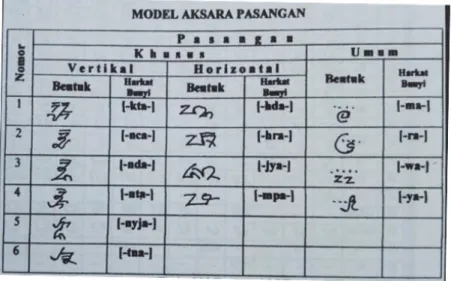
As mentioned before, in the Old Sundanese script there is pasangan. The number of pasangan found in the manuscripts in Kabuyutan Ciburuy continues to grow along with the increasing research on the manuscripts in Kabuyutan Ciburuy. In 1882, Holle found 5pasangan, namely <da>, <pa>, <ya>, and <ra> (1882, number 89). Darsa (2012) in the Old Sundanese script attachment, wrote 6 forms of verticalpasangan, 4 horizontal pasangan, and 4 general pasangan.
When arranged,pasanganRQO\FRYHUFD!MD!WD!GD!PD!\D!UD!DQGZD!DPRXQWLQJWROHWWHUV¿J
11). Ruhimat (2016: 26-27) found 13 forms of pasangan, namely <nga>, <ca>, <ja>, <da>, <na>, <pa>, <ba>, <ma>,
<ya> , <ra>, <wa>, <sa>, and <ha>. The combination of previous research in 1882 to 2016 reveals 14 pasangan in Ciburuy Kabuyutan manuscripts written in the Old Sundanese script.
Figure 11: List of pasanganletters in Old Sundanese script, research in 2012.
Source: Darsa (2012).
Based on an investigation of the Kabuyutan Ciburuy manuscripts written in the Old Sundanese script, in 2019, the pasangandata were found as follows:
Table 8: Pasangan in the Kabuyutan Ciburuy manuscripts written in the Old Sundanese script
No Name of
pasangan Writingpasangan in the manuscript Transliteration Storage location
1. <ka> niskala 3_C2_001B
2. <ga> lga 2_BPC9_036A
言語・地域文化研究 第 26 号 2020
134
3. <nga> tngih 1_22-27_011A
4. <ca> panycawati 1_22-27_020B
5. <ja> titisjati 1_C7_004A
6. <nya> ajnyana 3_C13_001B
7. <ta> pustaka 1_C7_001A
8. <da> hdap 1_21_002A
9. <na> satebeyna 3_C2_005B
10. <pa> puspa 1_C7_006B
11. <ba>
a)
b)
a) sanémbalna
b) ngawakbatara
3_C13_005B
3_C13_033B
12. <ma>
a)
b)
a) sukma
b) nukma
1_C7_006B
1_19_014A (ラフマット ソピアン)
論文 カブユタン・チブルイにおける写本で使われた古スンダ文字
135
13. <ya> cahya 3_C13_008B
14. <ra> wruh 2_BPC6_014A
15. <la> tlas 2_BPC9_029B
16. <wa> nyahwa 2_BPC6_008B
17. <sa> mijilsanghyang 1_C7_006B
18. <ha> tutapharan 3_C13_016A
19. <tra> sastra 1_C7_010B
Based on table 8, manuscripts in Kabuyutan Ciburuy are written in the old Sundanese script, all consonant can act as pasangan. In addition, the ligature can also act as pasangan (see table 8, no 19). Then, writing the pasangan for <ba> and PD!OHWWHUVDUHIRXQGLQWZRIRUPV7KH¿UVWIRUPDXVHVWKHFRPPRQOHWWHUIRUPIRUpasangan <ba> and <ma> and the second form (b) uses the consonant <ba> and <ma> in subscript form. (see table 8 no 11 and 12).
The system of writing pasangan in the Old Sundanese script is always in the form of subscripts (except <ya>
in parallel form) but pasangan in Kabuyutan Ciburuy manuscripts are also found in superscript form (table 9). Writing pasangan like this is not commonly found in writing the Old Sundanese script. In the superscript form, the pasangan is written in parallel with the writing line. Meanwhile, letters attached by pasangan are written above pasangan.
Compared to previous research, the results of this investigation (2019) found the new form of pasangan, namely
<ka>, <ga>, <nya>, <na> and <tra>. When viewed from the storage location, new pasangan (see table 8, no 1, 2, 6, 9, and 19) turn out to be in manuscripts that have not been researched (compare with data in table 2). Pasangan <ka> and <na>
were in the manuscripts in kropak Ciburuy II and the pasangan <ga> was in the manuscripts in kropak BPC 9. Based on the 言語・地域文化研究 第 26 号 2020
136
data in table 2, the title or content of the story is not known yet. This means that the manuscript has never been researched before. Then, pasangan <nya> and <tra> are in the manuscript of kropak Ciburuy VII. Based on the data in table 2, some of the leaves of kropak Ciburuy VII are about the story of Bima Svarga (mentioned in Gunawan’s study). However, the Gunawan’s research (2016) does not discuss in detail about the letter used in the Bima Svarga manuscript in Kabuyutan Ciburuy.
Table 9: Pasangan in superscript form
No Leaves of manuscripts Storage location
1. 1_C6_004B
2. 3_C15_003A
The systems for deleting vowels inherent in consonant letters in the Old Sundanese script is carried out with a pasangan and paéh or paténGLDFULWLF6SHFL¿FDOO\IRUWKHND!MD!DQGQD!OHWWHUVWKHXQGHUOLQHV\VWHPLVIRXQG to remove the inherent vowel (table 10). This system is done by underlining the characters <ka>, <ja>, and <na>. This XQGHUOLQHV\VWHPFDQQRWEHFODVVL¿HGLQWRGLDFULWLFVEHFDXVHLWFDQQRWEHXVHGIRUDOOFRQVRQDQWV,QVRPH2OG6XQGDQHVH PDQXVFULSWUHVHDUFKHVWKLVXQGHUOLQHV\VWHPLVUHIHUUHGWRDVWKH¿QDOFRQVRQDQW
Table 10: The underline system
No Letter Writing in the manuscript Transliteration Storage location
1. <ka> anak 3_C14_007A
2. <ja> ajna 2_BPC6_022B
3. <na> lain 1_21_001A
(ラフマット ソピアン)
論文 カブユタン・チブルイにおける写本で使われた古スンダ文字
137
The spelling system of the manuscripts in Kabuyutan Ciburuy written in the Old Sundanese script is different DPRQJWKHP7KHGL൵HUHQFHRFFXUVLQZULWLQJZRUGVWKDWKDYHWKHVDPHPHDQLQJWDEOH7KHQWKHGDWDLQWDEOHQR 4, and 6 show that the pasangan <wa> is used to write the vowel /u/, /o/, and /ua/. The vowel ambiguity is caused by <wa>, previously conveyed by Teeuw, reading Noorduyn’s transliteration (Noorduyn and Teeuw 2006, 21):
Where Noorduyn opts for a uniform spelling o the manuscript instead of o often spells wa and less frequently wé, DVFDQEHVHHQIURPKLV¿UVWGLSORPDWLFWUDQVOLWHUDWLRQ$JRRGH[DPSOHLVIRXQGLQOLQHV%0ZKHUHWKH word hoé is successively spelt hoé, hwaé and hwéé; compare also bogwéh and bwégwéh for bogoh (114-115). The particle mo is spelt mwa (5) as well as mwo (11); see also mwaréntang edited as moréntang (54), érwénan read as éronan (66), sapwaé as sapoé (19), nywéwana as nyowana (106), bwééh and bwaéh (212 and 213) for boéh, and many more.
The spelling wa also occurs as a variant of ua; both transliterations occur side by side in Noorduyn’s editions, for instance dwa bwah (386) becomes dua buah; pakwan (13, 64) becomes pakuan; alongside kadatuan (236) one
¿QGVsakadatwan (10); but the spelling ua also occurs frequently, for example, tuang (223 and elsewhere), buat (159 and elsewhere); compare nuar nyangkuduan (162, and elsewhere); more examples can be found in the section on the metrical system of the texts.
7DEOH'L൵HUHQFHVLQWKHVSHOOLQJRIWKH2OG6XQGDQHVHVFULSW
No Writings in the Manuscripts Transliteration Meaning Storage location
1. Buana World 3_9_007A
2. Bwana World 3_C13_001B
3. Hamo Will not 1_19_006A
4. Hamwa Will not 2_BPC6_022B
5. Dua two (numerals) 1_22-27_001A
6. Dwa two (numerals) 2_BPC6_007A
7. sangiang KRQRUL¿FVDUWLFOHRI
respect) 3_C15_005B
言語・地域文化研究 第 26 号 2020
138
8. sanghyang KRQRUL¿FVDUWLFOHRI
respect) 2_BPC6_015A
9. ajnyana The name of the story
¿JXUH 2_C13 _015A
10. anyjana The name of the story
¿JXUH 1_22-27_032B
11. ajana The name of the story
¿JXUH 2_BPC9_032A
12. Ajna The name of the story
¿JXUH 2_BPC6_022B
3.3 Writing style of letters
7KH2OG6XQGDQHVHVFULSWLQ.DEX\XWDQ&LEXUX\PDQXVFULSWVKDVGL൵HUHQWOHWWHUZULWLQJVW\OHV6DUGMRQR(NDGMDWL and Kalsum have previously highlighted the existence of this variation. However, the research does not discuss the letter GL൵HUHQFHVLQWKHPDQXVFULSWDQ\IXUWKHU
The transliteration of the CB I (kropak 9) manuscript has encountered numerous difficulties because the letter consists of 4 types of writing whose list is attached. It is not known why there are 4 types of writing in this PDQXVFULSWZKHWKHULWZDVZULWWHQE\GL൵HUHQWSHRSOHRULWZDVZULWWHQLQDGL൵HUHQWWLPHSHULRGRUZKHWKHUHDFK W\SHRIZULWLQJVKRZVDXQL¿HGVWRU\FRQWHQW6DUGMRQR(NDGMDWLDQG.DOVXP
7R¿QGRXWWKHZULWLQJVW\OHRIWKH2OG6XQGDQHVHOHWWHUVLQWKH.DEX\XWDQ&LEXUX\PDQXVFULSWVLQWDEOHZH show the writing style of letters in 22 kropakVZULWWHQLQ2OG6XQGDQHVHVFULSW%DVHGRQWKHLGHQWL¿FDWLRQRI2OG6XQGDQHVH letters in 22 kropaksRI.DEX\XWDQ&LEXUX\PDQXVFULSWVWDEOHWKHUHDUHGL൵HUHQWOHWWHUVZULWLQJVW\OHV7KHGL൵HUHQFHV can be grouped as shown in table 13.
(ラフマット ソピアン)
論文 カブユタン・チブルイにおける写本で使われた古スンダ文字
139
Table 12: List of consonant letters in Kabuyutan Ciburuy manuscripts 言語・地域文化研究 第 26 号 2020
140 論文 カブユタン・チブルイにおける写本で使われた古スンダ文字 (ラフマット ソピアン)
141
Table 13: Recapitulation of writing styles of Old Sundanese letters in Kabuyutan Ciburuy manuscripts 言語・地域文化研究 第 26 号 2020
142
Table 13 shows the differences in the writing styles of the Old Sundanese letters. The results of the writing style letters grouping are: <ka> 7 stlyes, <ga> 10 stlyes, <nga> 15 stlyes, <ca> 5 stlyes, <ja> 10 stlyes, <nya> 11 stlyes, <ta>
3 stlyes, <da> 5 stlyes, <na> 4 stlyes, <pa> 1 stlye, <ba> 10 stlyes, <ma> 5 stlyes, <ya> 3 stlyes , <ra> 8 stlyes, <la>
4 stlyes, <wa> 6 stlyes, <sa> 4 stlyes, and <ha> 3 stlyes. Those mostly occur in the <nga> letter amounting to 16 styles (table 13, no 3). Meanwhile, the writing styles of the <pa> letter has no difference in each kropak (table 13, no 10).
3.4 Discussion
The differences in the writing system and the writing style of letters in the Kabuyutan Ciburuy manuscripts written in the Old Sundanese script are interesting to be studied from various perspectives. In this article, we will examine these differences from the point of view of the scribe of the manuscript.
The different letters writing style shows that the scribe in Kabuyutan Ciburuy is more than one person. This goes accordingly with Kurnia (2012, 81) who states that there are 7 names of the scribe of the Old Sundanese manuscripts, namely: Buyut Ni Dawit, Kai Raga, Grandson of Sida or Buyut Tejanagara, Euncu nu Ngahérang, Buyut Téjanagara, Sang Bujangga Resi Laksa, and Sang Guguron. Despite no further explanation – other than those names written in the colophon of manuscripts – several names are worth to be considered as the scribe of Kabuyutan Ciburuy manuscripts.
Among seven names of the scribes of the Old Sundanese manuscripts, Kai Raga is the scribe who often appears in the Old Sundanese manuscripts. Suprianto (2015, 3) identified 8 manuscripts written by Kai Raga, namely: Kropak 410 entitled Carita Ratu Pakuan, 411 entitled Carita Ratu Pakuan, 416 entitled Carita Purnawijaya, 419 entitled Kawih Paningkes, 420 entitled Kawih Paningkes, 423 entitled Carita Purnawijaya, KBG 73 entitled Suluk Darmajati, and KBG 75 entitled Wirid Nur Muhammad. It is interesting to note that the colophons of Carita Ratu Pakuan and Kawih Paningkes manuscripts mention the place of writing, namely ‘Srimanganti’ and ‘Sutanangtung’. Based on Plyte’s research, the place sits at the base of Cikuray Mountain (Atja 1970, 20-21). Then, the Kropak 408 manuscript entitled ‘Sewaka Darma’ is
(ラフマット ソピアン)
論文 カブユタン・チブルイにおける写本で使われた古スンダ文字
143
identified as it is written by Buyut Nidawit. Based on Darsa’s (2012) research, the ‘Sewaka Darma’ manuscript is also found in Ciburuy Kabuyutan.
Figure 12: Leaf of the manuscript of Seawaka Darma is written by Buyut Nidawit (Nidauit?).
The leaf is stored in the National Library of Indonesia.
Source: National Library of Indonesia
Figure 13: Leaf of the manuscript of Purnawijaya is written by Kai Raga. The leaf is stored in the National Library of Indonesia.
Source: National Library of Indonesia
There are similarities of the letters writing style between Buyut Nidawit (fig. 12) and Kai Raga (fig. 13) compared with table 12. This strengthens the presumption that Buyut Nidawit and Kai Raga are the scribes in Kabuyutan Ciburuy.
However, these presumptions must still be proven with other facts. The similarity in the writing style of the letters might be caused by the tradition of transmission (copying the manuscript) by someone who did not change the colophon (copying like the original manuscript).
The existence of two versions of the Sewaka Darma manuscript in the collection of Kabuyutan Ciburuy as stated by Darsa:
From the given illustration, SD (Sewaka Darma) manuscripts can be categorized into two hyparchetypes which in philology both of them are commonly called as version, marked as α (alpha) and β (beta). Version α derives manuscript of A (kropak 408 from National Library of Indonesia collection) and manuscript of C (kropak BPC6 from Kabuyutan Ciburuy collection) each of which might still have to go through intermediary manuscript, while version β derives manuscript of B (CB I) and manuscript of D (kropak 9 from Kabuyutan Ciburuy collection) which also have their own intermediary manuscript.
Presumption of the intermediary manuscript from each manuscript is shown as there is variation among four SD manuscripts as previously explained which can be proven later through text criticism. However, it can provide assurance to define the relation among A, B, C, and D manuscripts through this stemma as follows:
言語・地域文化研究 第 ₂6 号 2020
144
This stemma description is essential as it can show that wordings in SD manuscript which are in written tradition (hiparketip α dan β) have a history, as well as have their prehistory in an oral tradition (arketip Ω: omega) which is exactly preceded by otograf (Darsa 2012, 228-229).
The two versions of Sewaka Darma manuscripts are proved by the different letter writing styles (see table 12, K.BPC6 dan K.9). Those versions might be caused by transmission practices. The transmission practices are supported by the fact that there are some old stationery in Kabuyutan Ciburuy (fig. 14). If the transmission practices in Kabuyutan Ciburuy occur, manuscript writing activities are also possible. Therefore, Kabuyutan Ciburuy is not only a place to store manuscripts, but also it is a scriptorium.
Figure 14: Heirloom objects (other than manuscripts) in Kabuyutan Ciburuy. 1) Genta varja (prayer bells), 2) Trident, 3) Kujang (Sundanese traditional weapon), 4) Metal plates (writing utensils), 5) Péso pangot (knife-pens, writing utensils), 6) Horn-made eyeglass
frames, 7) Scissors, 8) Spearhead, 9) Metal-legged tubes (writing utensils).
(ラフマット ソピアン)
論文 カブユタン・チブルイにおける写本で使われた古スンダ文字
145
4. Conclusion
Research on the Old Sundanese script in Kabuyutan Ciburuy manuscripts is important. The reason is that 22 of 26 kropaks manuscripts are written in Old Sundanese script. Then, the identification of the writing style of letters and the writing system of the Old Sundanese script are important to group Kabuyutan Ciburuy manuscripts based on their letters writing style and writing system used on each leaf. This grouping can ease the reconstruction of Kabuyutan Ciburuy manuscripts that have mixed up a story with the others. Moreover, this grouping can also be an alternative solution in collecting fragments of stories that difficult to reconstruct based on the storyline. This difficulty caused by some of the manuscripts in Kabuyutan Ciburuy that have been lost and damaged (c.f. Darsa 2012 and Ruhimat 2016).
Grouping based on the writing style of letters and the writing system is very possible through comparing the Kabuyutan Ciburuy collection with the National Library of Indonesia collection. The National Library of Indonesia manuscripts, written in the Old Sundanese script, are mostly have been studied and are easier to be read. This article identifies the Old Sundanese script in Kabuyutan Ciburuy manuscripts and compares them with the results of study of the Old Sundanese manuscript from the National Library of Indonesia collection. We corroborate the hypothesis that some of the Old Sundanese scribes (whose manuscripts are stored in the National Library of Indonesia) originated from Kabuyutan Ciburuy. Then, as several writing styles and writing systems are founded, there is more than one scribe in Kabuyutan Ciburuy. This fact (and the existence of old stationery in Kabuyutan Ciburuy) strengthens the presumption that Kabuyutan Ciburuy is not only a place to store manuscripts but also it is a scriptorium.
Acknowledgement
The author would like to express gratitude towards Professor Toru Aoyama, Ph. D. who has provided guidance so that this research can be done. The author would also like to thank the Rector of the Padjadjaran University for providing educational scholarships through the Study Support for Padjadjaran University employee No: 8193/UN6.WR2/KP/201772 dated October 30, 2017.
References:
Acri, Andrea. 2011. Dharma Pātañjala: A Śaiva Scripture from Ancient Java Studied in the Light of Related Old Javanese and Sanskrit Texts.
PhD diss., Leiden University.
Atja. 1970. Ratu Pakuan: Tjeritera Sunda-Kuno dari Lereng Gunung Cikuraj [The King of Pakuan: Old Sundanese tales from the base of mount Cikuray]. Bandung: Language and History Institute.
Court, Christopher. 1996. The Spread of Brahmi letter into Southeast Asia. In The World’s Writing Systems, ed. Peter T. Daniels and William Bright 445 - 449. New York: Oxford University Press.
Danasasmita, Saleh et al. 1986. Sewaka Darma, Sanghyang Siksakandang Karesian, Amanat Galunggung. Bandung: Bagian Proyek Sundanologi.
Darsa, Undang Ahmad, et. al. 2008. Fragmen Kisah Putra Rama dan Rawana (Naskah Lontar Kropak 18) [Fragment of The Sons of Rama and Rawana’s Story (Lontar Manuscript Kropak 18)]. Garut: Dinas Pariwisata dan Kebudayaan Kabupaten Garut.
言語・地域文化研究 第 ₂6 号 2020
146
⸺⸺⸺, (2012). Sewaka Darma dalam Naskah Tradisi Sunda Kuno Abad XV-XVII Masehi [Sewaka Darma in Old Sundanese Tradition Manuscripts XV-XVII AD]. Doctoral diss., Padjadjaran University.
Ekadjati, Edi S. 1984. Masyarakat Sunda dan Kebudayaannya [Sundanese Community and its Culture]. Jakarta: Girimukti Pustaka.
⸺⸺⸺, 1988. Naskah Sunda: Inventarisasi dan Pencatatan [Sundanese manuscript: Inventory and Recording]. Bandung: Lembaga Penelitian Unpad kerja sama dengan The Toyota Fundation.
⸺⸺⸺, 2003. Sundanese Manuscripts: Their Existence, Functions, and Contents (アジアにおける在地固有文書解題). 史資料ハブ: 地 域文化研究: 東京外国語大学大学院地域文化研究科21世紀COEプログラム「史資料ハブ地域文化研究拠点」(Journal of the Centre for Documentation & Area-transcultural studies) no.2 p.124 -134.
Gunawan, Aditia. 2016. BHĪMA SVARGA étude d’un texte vieux-javanais et de sa transmission manuscrite. Master’s thesis, Institut National des Langues et Civilisations Orientales.
Hinzler, H. I. R. 1993. Balinese palm-leaf manuscripts. Bijdragen tot de Taal-, Land- en Volkenkunde, Manuscripts of Indonesia 149, no: 3, 438-473.
Holle, K. F. 1882. Table van oud- en nieuw- Indische alphabetten: Bijdrage tot de palaeographie van Nederlandsch-Indië. Batavia: W.
Bruining & Co.
Kalsum. 2006. Wawacan Batara Rama: Kajian Struktur, Intertekstualitas, dan Edisi Teks [Wawacan Batara Rama: Analysis of Structure, Intertextuality, and Text Edition]. Doctoral diss., Padjadjaran University.
Kurnia, Atep. 2012. Sinurat Ring Merega; Tinjauan atas Kolofon Naskah Sunda Kuno [Sinurat Ring Merega; Overview of the Old Sundanese colophon manuscript]. Jumantara vol. 3, no. 1, 77-127.
Mardiwarsito, L. 1990. Kamus Jawa Kuna (Kawi) – Indonesia [Old Javanese Dictionary (Kawi) – Indonesia]. Flores: Nusa Indah.
Meij, Dick van der. 2017. Indonesian Manuscripts from the Islands of Java, Madura, Bali and Lombok. Leiden: Brill.
Molen, Willem van der. 2011. Kritik Teks Jawa, Sebuah Pemandangan Umum dan Pendekatan Baru yang Diterapkan kepada Kunjarakarna [Javanese texts criticism, a general view and a new approach applied to kunjarakarna]. Trans. Achadiati. Jakarta: Yayasan Pustaka Obor Indonesia.
Nawawi, Riki. 2017. Lontar Kropak 17 Kabuyutan Ciburuy: Deskripsi Model Aksara Sunda Kuno, Edisi Teks, jeung Tarjamahan [Palm leaf kropak 17 Kabuyutan Ciburuy: Description of the Old Sundanese script form, text edition, and translation]. Bachelor’s thesis, Padjadjaran University.
Noorduyn, J. & A. Teeuw. 2006. Three Old Sundanese Poems. Leiden: KITLV Press.
Pratama, Aditya. 2014. Naskah Lontar Kawih Katanian (Kisah Asal-Usul Padi dalam Naskah Sunda Kuno) Koleksi Kabuyutan Ciburuy Garut: Edisi Teks dan Terjemahan [Lontar Kawih Katanian manuscript (story of the origins of rice in the Old Sundanese manuscript) Kabuyutan Ciburuy Garut collection: Text edition and translation]. Master’s thesis, Padjadjaran University.
Ruhimat, Mamat. 2016. Kisah Putra Rama dan Rawana Abad XV Masehi: Rekonstruksi Teks yang Tercecer [The sons of Rama and Rawana’s stories XV Century AD: Reconstruction of spread texts]. Master’s thesis, Padjadjaran University.
Salomon, Richard G. 1996. Brahmi and Kharosthi. In The World’s Writing Systems, ed. Peter T. Daniels and William Bright 373 - 383. New York: Oxford University Press.
Sardjono, Partini, Edi S. Ekadjati, and Kalsum. 1987. Naskah Sunda Kuna: Transliterasi dan Terjemahan [Old Sundanese manuscripts:
transliteration and translation]. Bandung: Proyek Penelitian dan Pengkajian Kebudayaan Sunda, Pemda Jawa Barat, Dinas Pendidikan dan Kebudayaan.
Suprianto, Ade Ahmad. 2015. Transformasi Tradisi Penulisan Naskah Sunda Kuno pada Masa Peralihan Ditinjau Melalui Karya-Karya Kai Raga [Tradition transformation of Old Sundanese manuscripts writing during the transitional period reviewed through the works of Kai Raga]. Jumantara vol. 6, no. 2, 1-22.
Wartini, Tien, et. al. 2010. Tutur Bwana dan Empat Mantra Sunda Kuno [Tutur Bwana and Four Old Sundanese mantras]. Jakarta:
Perpustakaan Nasional Republik Indonesia - Pusat Studi Sunda.
(ラフマット ソピアン)
論文 カブユタン・チブルイにおける写本で使われた古スンダ文字
147
Note
1. Ciburuy referred by Molen, nowadays is known as Kabuyutan Ciburuy. This is important to be conveyed because there was a change in the name of the village. Previously, Kabuyutan Ciburuy was in Ciburuy village. However, nowadays Kabuyutan Ciburuy is in Pamalayan village. Therefore, to avoid ambiguity in this article, the word ‘Kabuyutan Ciburuy’ will be used.
2. The term Tutur is used in secondary literature and among the modern Balinese as a general label referring to the genre of Śaiva (and, to a much lesser extent, Buddhist) scriptures bearing either the one or the other denomination in their titles—or even none of them (Acri: 2011, 9).
3. This preservation is done by limiting the time of accessing the manuscript by the general public. According to Kabuyutan Ciburuy Caretaker, Mr. Ujang Suryana, the customary rules in Kabuyutan Ciburuy do not permit the opening of old Sundanese manuscripts on Tuesday and Friday, and a month before Muharram.
4. As compared to the library or the museum, the storage of manuscripts in the Kabuyutan Ciburuy is far from adequate. The storage area of the manuscripts is not equipped with temperature and humidity control devices. So, temperature and humidity in the storage of manuscripts are unstable. The protection of manuscripts from insects and mice is weak.
5. Séba ceremony is an annual ceremony in Kabuyutan Ciburuy. This ceremony is held on the last Wednesday of the month of Muharram (Hijri calendar).
言語・地域文化研究 第 ₂6 号 2020