ゴミ処理場にかかる周辺住民の受容プロセス:タイ の三事例分析
ペッカンチャナポーン, プーム
http://hdl.handle.net/2324/2236325
出版情報:Kyushu University, 2018, 博士(学術), 課程博士 バージョン:
権利関係:
Three case studies from Thailand
Submitted to
Graduate School of Integrated Science for Global Society Kyushu University
by
Poome Petkanjanapong
In Partial Fulfillment of Requirements For the Degree of Doctor of Philosophy
Advisory Committee Nobuhiro Aizawa
Kazuo Misumi Kimihiko Hyakumura
February 2019
Today, demonstrations and violence against municipal solid waste treatment sites (MSW treatment sites) are common in Thailand as well as many other countries, especially developing countries. Low levels of local acceptance of the sites is a major reason behind these conflicts.
Extensive fieldwork in Thailand addressed this research question concerning the key factors and process that create local acceptance of MSW treatment sites through a thorough investigation on three cases in Thailand: Nonthaburi Provincial, Phitsanulok Municipal, and Phuket Municipal waste treatment sites. These three MSW treatment sites encountered local resistance in the past, but they now coexist with local communities. Therefore, it is important and valid to ask why that change occurred. Data were collected mainly by interviewing lay people in the waste treatment sites’ surrounding communities, local leaders, and government agencies. With this study, we attempt to understand how the surrounding communities’ acceptance of the waste treatment sites arose.
Various factors that affect local acceptance quality have been found in this study; however, negative impacts from pollution on local communities and reasonable local benefits from the site are two significant factors. The operation of these two factors can be observed through social network analysis. The social networks between the waste treatment sites and local communities are important tools for local acceptance creation. Linkages in the network are a kind of channel to distribute resources –money and information— from the site or the government to individuals, or communities. They are also channels to get feedback of negative impacts from local people to the sites. This research found that both formal networks, such as the connection between local governments and the waste treatment sites which contain local administrative structures and legal contracts with private companies, and informal networks— groups of relationship between local
not— are used to increase local acceptance. Each kind of networks provide different kinds of resources and information to local communities and different groups of people can access to formal and informal networks. However, Most of the studies include Thai waste management master plan in 2014 focuses on only formal networks. Therefore, the research need to highlight necessary of informal networks. When small population is determined as locals of the waste treatment sites direct links between the waste treatment sites and local communities are used to distribute local benefit and exchanges information. In contrast, local leaders are requested as the brokers between local communities and waste treatment sites when large population is determined as stakeholders of the waste treatment sites. In this situation, relationship between local leaders and villagers become the channel of resources distribution and information exchange for the purpose of local acceptance creation.
Not only the channel of resources distribution and information exchanges. Local acceptance creation is also required resources which are constraint directly by the size of a waste treatment system. The large size of the waste treatment system attracts private companies to open their business in the site, such as junk shops, or waste to energy factories. These private companies create several local benefits, such as jobs, taxes, and community funds. Cooperation with private companies also reduces pollution because they hold enough budget and knowledge for clean technology construction and operation. Generally, Large waste treatment systems in Thailand are operated by the Provincial government while small waste treatment system is own by municipalities. Regulation of local governance in Thailand does not allow municipal governments to use their budgets outside their territories. However, in reality, most big municipalities place their waste treatment places outside their territories because landfills, which are the most common
for municipalities to compensate or give incentives to local people near the sites. In contrast, provincial waste treatment sites do not have the same constraints, and they have more budget for compensating, giving incentive, and constructing pollution control infrastructure. Therefore, it is easier to gain local acceptance for provincial waste treatment sites.
To conclude, a high level of local acceptance is the key to success in public service operations. The structures and related factors that affect the quality of acceptance are highly context-dependent. In the case of waste treatment sites in Thailand, environmental-health negative impacts and reasonable benefits from waste treatment sites were two main factors for winning local acceptance. While most research and policy concern only formal local networks between the waste treatment sites and surrounded communities as a main tool to create local acceptance to waste treatment site. This research want to highlight capability of informal networks in local acceptance creation. Size of waste treatment system also matter for local acceptance. Bigger size can provide more resources for local acceptance creations. Differences of the size determine resources for local pollution prevention and local benefit, in the same time these resources is a requirement for maintaining and operating informal networks between the waste treatment sites and local communities.
First of all, I would like to express my sincere gratitude to my advisor, Prof. Nobuhiro Aizawa, who supported me academically and mentally during 3 years at Kyushu University. His comments and suggestion were worthy and made a great impact on my thesis. He also encouraged and guided me how to survive in the academic world. Besides my advisor, I would like to thank the rest of my advisory committee, Prof. Kazuo Misumi and Prof. Kimihiko for their insightful comments. Moreover, the comments from Prof. Jun Yamashita and Prof. Kornatowski Geerhardt always pushed my thesis to go forward, so I thank both of them here. Finally, I thank Kyushu University for giving me a nice opportunity to study here.
I have to say thank you to every participant- villagers and local leaders in Tambon Klong Kwang, Tambon Bueng Kok, and Klong Koh Pee and Saphanhin communities. I really appreciate that they allow me to study their bitter experience with the waste treatment sites.
I personally thank my big family, who always supported me and kept telling how much they love me, which was really helpful to pass my tough times of Ph.D. study. Thank Bew, Win- Win, Joh, and other friends who helped me during my fieldwork in Thailand. Thank Dan, Fai, Panang, Ning, and Joseph for listening to me when I was weak. Thank every new friend I met in Fukuoka—O, Yok, N’ Pim, Gift, Silver, Book, and Notty— for their emotional and physical supports. My special thank goes to Chumpol, my senpai and classmate, who always helped me and comforted me whenever I had problems with my study. Lastly, Thank Prof. Pitch Pongsawat, who keep supporting me since the very beginning of my study. I sincerely appreciate his help, advice, comfort, and any good intention he give to me.
Poome Petkanjanapong
1. 1 Introduction………...1
1.1.1 Background information………...4
1.1.2 Research question and findings………...6
1.1.3 Research Objectives………..6
1.2 Waste treatment site and local acceptance studies... ...7
1.2.1 Factors of local acceptance……….……….………8
1.2.2 Waste management studies in Thailand: a lack of surrounding community studies………12
1.3 Framework: different levels of analysis and related concepts………...15
1.3.1 National institutions and constraints on local acceptance to waste treatment sites ………...16
1.3.2. Social network theory and resources transfer………...18
1.4 Methodology………..20
1.4.1. Case selection………...20
1.4.2 Data collection………...22
1.4.3. Politics of research………...23
Chapter 2: The Influences of Thailand National Institutions on Local Waste Management………...26
2.1 Overview of Thailand Waste Management ………...28
2.2 Waste Management Related Policies: Regulation and Central Government Campaign ………..29
2.2.1 Waste management regulation.……….30
2.2.2 Government campaigns...……….34
2.3 Political Structure of Waste Management………..39
2.3.1 Administrative actors in Thai waste management………39
2.3.2 Non-government actors……….44
2.4 Effects of National Policy and Political Structure on Local Waste Treatment………..46
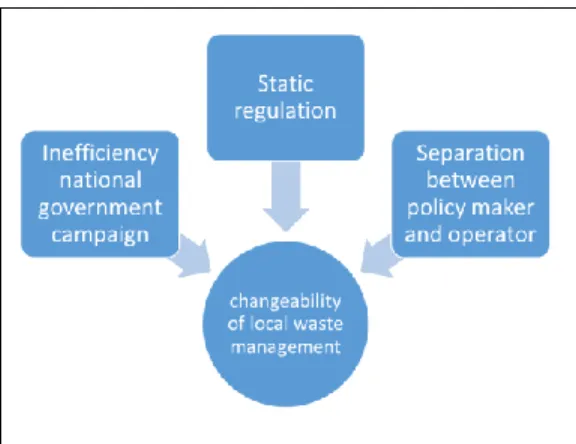
2.4.1 Changeability of local waste management……….…..47
2.4.2 Independency of local government………...49
2.4.3 Diversity of local waste management………...51
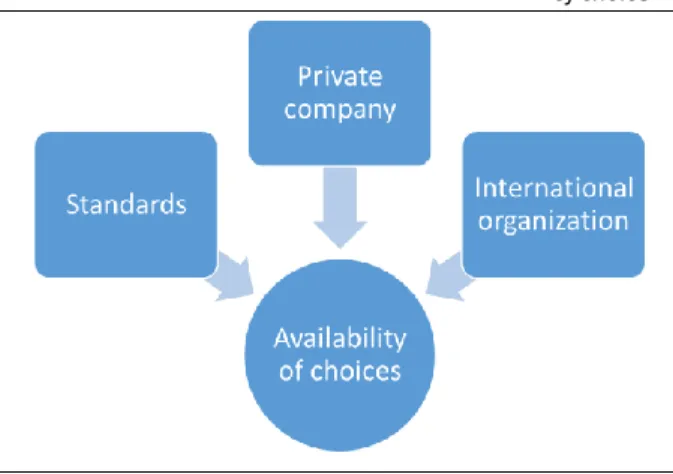
2.4.4 Availability of choice………53
2.5 Conclusion………..55
2.5.1 Future changes………..55
2.5.2 Link to local level analysis and case studies……….56
Chapter 3: Nonthaburi Provincial Waste Treatment Site: Decentralised Waste Treatment System and Provincial Government………59
3.1.2 Basic information regarding the Nonthaburi provincial waste treatment site………..64
3.1.3 Timeline of the site………...70
3.2 Importance Factors of Local Acceptance in Nonthaburi Provincial Waste Treatment Site………..75
3.2.1 Reduction of pollution and public private partnership……….75
3.2.2 Local benefit from provincial government and waste treatment site………78
3.2.3 Local leader and trust in the site………...82
3.3 Operation of Factors in Local Communities………..………...84
3.3.1 Formal linkage between Nonthaburi PAO and the Klong Kwang people………85
3.3.2 Informal linkages between the Kamnun and local community………87
3.4 Conclusion……….89
Chapter 4: Phuket municipal waste treatment site: Technology and Cooperation with Private Company.………91
4.1 Background………92
4.1.1 Waste creator, Waste treatment operator, Waste Receiver………...92
4.1.2 Basic Information of Phuket Municipal waste treatment site………...98
4.1.3 Timeline of the Local Acceptance………..102
4.2 Importance factors of local acceptance in Phuket municipal waste treatment site………,,108
4.2.1 Negative impact reduction of technology and cooperation with private company………109
4.2.2 Local benefit from Private section and incinerator……….111
4.2.3. Legitimacy for land usage………..113
4.3 Operational of factors at local communities………114
4.3.1 The joint committee a center of network between local communities and waste treatment site………115
4.3.2 Other linkages between the site and local community………117
4.5 Conclusion………118
Chapter 5: Phitsanulok municipal waste treatment site: Decentralization waste treatment and limitation of resource……..120
5.1 Background information………..121
5.1.1 Waste creator and waste receivers………..121
5.1.2 Phitsanulok Municipal waste treatment site………...124
5.1.3 Timeline of relationship between Phitsanulok municipal waste treatment site and local communities………130
5.2 Importance factors of local acceptance in Phitsanulok waste treatment site………...135
5.2.1 Negative impact reduction: limitation of municipality and size of waste treatment system………..135
5.2.2 Lack of local benefit: small size of waste treatment and restriction………...137
5.2.3. External forces………...139
5.3.2 Fail informal linkages between waste treatment site and local community………...142
5.4 Conclusion………....143
Chapter 6: Sizes of waste treatment and social networks between the waste treatment sites and the local communities…145 6.1 Size of the waste treatment system in Thailand and local acceptance……….147
6.1.1 Size of the waste treatment system and level of policy decision………148
6.1.2 Size of the waste treatment site and volume of garbage……….150
6.1.3 Waste treatment site ownership and regulation………..153
6.2 Social network and operation of local acceptance………...156
6.2.1 Formal network between the sites and local communities……….157
6.2.2. Informal network between the local community and a waste treatment site……….160
6.2.3 Formal and informal social network as a local condition of local acceptance………...165
6.3 Conclusion………170
6.3.1 The world of local acceptance and waste treatment studies………...173
6.3.2 Application to policy………...175
6.3.3 Further researches………...176
References………..…178
Appendix I Structure of local administration in Thailand ……….189
Figure 1.1: Structure of research framework……….13
Figure 2.1: Overview of Thailand’s waste management……….25
Figure 2.2 The effect of national institutions on changeability of local waste management ………47
Figure 2.3: The effect of national institutions on independency of local governments ………49
Figure 2.4: the effect of national institutions on diversity of local waste management ………...52
Figure 2.5: the effect of national institutions on available of choice………53
Figure 3.1: Map of Nonthaburi and location of the waste treatment site ………61
Figure 3.2: Map of Klong Kwang sub-district and the waste treatment site ……….63
Figure 3.3: Layout of Nonthaburi Provincial waste treatment sites ………67
Figure 3.4: Network between Nonthaburi Provincial waste treatment site and local communities ………85
Figure 4.1: Picture of Phuket Island, tourist area, residential area, and waste treatment site………93
Figure 4.2: Area of Phuket Municipality and Phuket municipal waste treatment site………...95
Figure 4.3: Area of Wichit Municipality and Phuket municipal waste treatment site………...96
Figure 4.4: Klong Koh Phee community, Saphan Hin community, and surrounded area………97
Figure 4.5: Phuket waste treatment site, and surrounded area………..101
Figure 4.6: Network between Phuket municipal waste treatment site and local communities………115
Figure 5.1: Geography of Phitsanulok Province, Location of Phitsanulok Municipality and Bueng Kok Sub-district…………122
Figure 5.2: Geography and territory of Bueng Kok Sub-district, and localtion of Phitsanulok municipal waste treatment site…123 Figure 5.3: Phitsanulok Municipal Waste treatment site— Facility and surrounded area………..127
Figure 5.4: Network between Phitsanulok municipal waste treatment site and local communities………141
Figure 6.1: Conclusion of centralised waste treatment system and its effects on negative impact reduction and local benefit….155 Figure 6.2: Figure 6.2: Model of informal network from three case studies………...164
List of Table
Table 2.1: The List of Domestic Waste Management Related Laws ……….31
Table 2.2: The Campaigns on Waste Management by Year ………..35
Table 2.3: Administrative Actor of Thai Waste Management ………..40
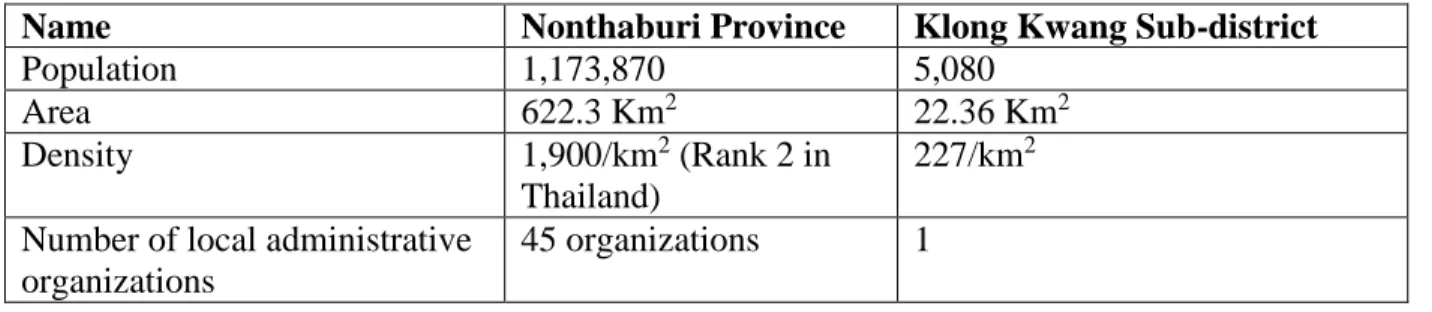
Table 3.1: Brief information regarding Nonthaburi province ……….60
Table 3.2: Basic information regarding Landfill ……….65
Table 3.3: Timeline of Nonthaburi provincial waste treatment site ………..…………..74
Table 3.4: Volume waste treatment, operation cost paid by Nonthaburi PA, and estimates of the operation fee …………..77
Table 3.5: Comparison between Klong Kwang TAO income and Waste treatment fee ……….79
Table 4.1: Basic information of Phuket province ………. ………..92
Table 4.2: Background information of Phuket municipal waste treatment site ………..99
Table 4.3: Timeline of Phuket municipal waste treatment site ……...………..……….105
Table 4.4: Volume of daily garbage and operation fee from 2013-2016 ………110
Table 5.1: Basic information of Phitsanulok Province ………..121
Table 5.2: Basic information of Phitsanulok municipal waste treatment site ……….125
Table 5.3: Timeline of Phhitsanulok municipal waste treatment site ………132
Table 6.1: Comparison between negative impact reduction, local benefit, and quality of local acceptance in three cases ……145
Table 6.2: Summary of waste treatment system’s size and actors of three case studies ………..149
Table 6.3: Comparison between formal linkages and resource transfer in three case studies ………158
Table 6.4: Comparison between informal linkages and resource transfer in three case studies ……….161
Table 6.5: Comparison between formal linkages and informal linkages in local acceptance creation ………169
Chapter 1: In the world of waste treatment site and local acceptance 1.1 Introduction
Waste is a one of the classic problems in human societies. The more developed our societies are, the more serious in this issue is. Increase in consumption positively affects the amount of waste. It is true that we have been investing in many studies in the fields of waste management technology and policies. However, problems around the issue of waste management have still been occurring. Among these problems, the conflicts of local people against waste treatment sites is one of the main problems. While the urban areas are extending and producing more domestic waste, more land is being sited for waste treatment with resistance from local people. This situation has led to the pressure for governments in finding new lands for waste treatment sites and various tools, such as policy (3Rs), technology (incinerators), or trading (waste exporting), to reduce this pressure. 3Rs (Reduce, Reuse, and Recycle) and other policies were implemented in order to reduce the volume of waste and stress of finding new waste treatment sites (Kojima, Yoshida, &
Sasaki, 2009). International waste trading is established to solve domestic problems and it keep expanding (Kojima, 2013). Moreover, incinerators were set up as a solution for reducing number of new landfills. However, these three tools can only buy more time to find the new lands for waste treatment sites. Japan seems to be a good example of this situation. It is the country with the highest density of incinerators per land. The technology of 3Rs of Japan is one the most advance in the world (Hershkowitz & Salerni, 1989). Furthermore, a part of these 3Rs activities of Japan operates oversea, so they can been seen waste exporting1. However, in Japan, there is resistance from local
1 In 2007 plastic waste, waste paper, iron and steel scrap, and nonferrous metal scraps are top 4 materials which were exported for recycling purpose (Okubo, Watabe, & Furuyama, 2016). Before 2018, 1.5 million tons of plastic waste per year was exports from Japan (“Plastic waste piling up in Japan after Chinese import ban,” 2018).
communities against waste treatment siting in around 60% of the municipalities of the whole country (Yoshida, 2002). This indicates that the 3Rs, incinerators and waste exporting cannot guarantee the solution of the conflicts between local governments and communities with regard to issues of waste management.
In case of Thailand, local acceptance and waste treatment site is a serious problem. On 26 July 2001, a head of local demonstration against waste treatment site in Samuth Prakarn province was shot dead (“Postpone of appeal for the case of Raja deva landfill assassination,” 2011). In 2016, there were at least 23 municipal solid waste (MSW) treatment sites which could not operate because of local resistance despite their completed construction (Department of pollution control, 2017). Under Junta government, since 2014, demonstration is prohibited. However, there are demonstrations related to waste treatment sites in the news almost every day. This shows the crisis of local acceptance to waste treatment site in Thailand. However, among several conflicts regarding waste treatments sites, there are some cases in which people are more tolerant to MSW treatment sites. This difference leads to the main questions of this research: what are the factors of local acceptance to waste treatment sites? How national institution affect these factors? How do they operate? In order to answer these questions, this research investigates three case studies of Thailand – Nonthaburi Provincial, Phuket municipal and Phitsanulok municipal waste treatment sites. The research found that the reduction of the negative impact of environmental health and the increase in local benefit are the main factors of local acceptance. However, this finding is not enough to explain the process of local acceptance of waste treatment sites. Therefore, this research investigates these factors and the local conditions in which these two factors operate. This research found that the size of the waste treatment system which are shaped by national institutions are important constraints of the reduction of the negative impact of environmental health negative
impact reduction and the increase in local benefit of surrounding communities around MSW treatment sites. Moreover, these two factors also need both formal and informal social networks between the waste treatment site and surrounded community to operate and create local acceptance. These three parts of the local acceptance process allow us to understand local acceptance to waste treatment site in case of Thailand.
This thesis has been divided into three parts – introduction, case studies, and analysis. In the first part, Chapter 1, the studies related to waste treatment sites and local acceptance will be reviewed. This review will help to develop a suitable framework which will be used for the case studies in this thesis. To conclude this part, methodology, such as case selection, methods, and politics of the research will be stated to be linked with the case studies. In case studies (chapters 2–5), the national institutions of waste treatment sites in Thailand will be initially introduced in order to understand the context of waste treatment sites in Thailand as well as the constraints in the size of the waste treatment system which will be important components of analysis in the rest of the research. Following this, in each chapter, each case study will be discussed by individually demonstrating the situation with reference to local acceptance between local communities and waste treatment sites, factors of local acceptance, and operation of local acceptance through network analysis. After analysing each case individually, they will be collectively compared in order to create an overview of local acceptance to waste treatment sites in Thailand which can be used as tools for the development of local acceptance in different kinds of sites apart from MSW treatment sites. In this part, the result will be conceptualised and the main research question will be answered.
1.1.1 Background information
Waste management is a crucial problem in Thailand. There are at least three kinds of waste in Thailand – MSW, industrial waste, and infectious waste. They are categorised by waste management laws in Thailand. Generally, industrial waste and infectious waste are managed by Provincial Administrative Organization (PAO). Moreover, MSW is completely managed by the sub-district governments—municipalities and TAO (Tambon administrative organization). This difference makes MSW management more local and varied. Along with the issues regarding industrial and infectious waste, such as illegal dumping, environmental contamination, and the standard of the treatment, that worries the public, MSW management, such as garbage collection, garbage separation, cost-efficiency, and environmental impact, concerns people more. In Thailand, MSW is managed by local governments, and there has not been any specific laws for MSW till 20172; therefore, each municipality had their own methods of management and treatment. Waste treatment sites are not welcome in most local communities. It is hard for the local government to setup waste treatment sites without resistance from the local communities, and in many cases, the lack of acceptance of the local people can lead to the abortion of the projects. However, there are some cases in which the local government persuade the local communities to accept the development of waste treatment projects. Three case studies in this research are also some of them.
It is necessary to find why local people accept or resist waste treatment siting. This can help local governments and society to increase the acceptance of local people regarding waste treatment projects. The local acceptance is a vital factor for waste treatment for two reasons. First, it is a basic condition for the development of the project because in many cases, waste treatment
2 Cleanliness and Tidiness of the Country Act of 2017 is the first law in Thailand which mention the important of MSW directly.
sites cannot be established due to the resistance from local people. For example, the case study of Chiangmai provincial government serving 1.678 million people which tried to find land for waste categorising factory. However, local communities rose against setting the factory near their communities. Therefore, although the central government supported the project financially, the local government could not establish it (Pharchaeuen, 2018). Second, local acceptance can lead to a healthy relationship between waste treatment sites and local communities. A healthy relationship between the actors would lead to cooperation; simultaneously, it can reduce the cost and increase efficiency of the project. For example, the case of Nonthaburi where communities around the landfill shared some benefit from the landfills and helped landfills in monitoring the pollution3.
Conclusively, local acceptance for waste treatment siting is an important issue in waste management. Currently, there is a higher pressure for local governments to find new land for waste treatment sites because there is not enough land for this activity, but the generation of waste has been increasing each year4. Without a proper study on the factors influencing local acceptance for the waste treatment sites, we cannot solve the conflict between waste treatment sites and its surrounding communities or reduce the resistance of local people in future waste treatment siting.
Thailand is in the forming stage of waste management; hence, studies on waste management in various perspectives, including local acceptance, is required for the successful establishment of new waste management in Thailand.
3 This case is presented in chapter 3 of this dissertation.
4 In 2014, there was 26.77 million tonnes of untreated waste in Thailand. And volume keep increasing (Budkod, 2014).
1.1.2 Research question and findings
This research begins with a very basic question: how can local governments or private companies increase local acceptance in waste treatment sites? Following, it needs to understand the process of local acceptance. It investigates three items to explain process of local acceptance:
1. Factors of local acceptance, 2. Constraints of these factors, and 3. Operation of these factors.
This research found that harmful health-environmental impact reduction and local benefit increase, which are the main factors of local acceptance to waste treatment sites, request efficient benefit distribution and information exchanges between a waste treatment sites and its surrounded community. These efficiencies are a consequence of the volume of resources for waste treatment and local network between waste treatment sites and the communities. Size of waste treatment system affects directly to the volume of the resources. The larger size of the waste treatment system or a centralized waste treatment system has a higher potential to provide a larger volume of resources for local acceptance creation by cooperating with the private sector; additionally, because of Thai administration, local governments of centralized MSW treatment system own more resources than local governments of decentralized MSW treatment system. Local networks between the waste treatment facilities and the surrounded community consists of formal and informal social network between the MSW treatment sites and communities. These two networks have different members in the network, and provide different kind of resources. In order to succeed in local acceptance creation, MSW sites need to establish formal and informal networks with local communities for the purpose of local benefit distribution and information exchange.
1.1.3 Research Objectives
The objectives of this research are beneficial for academia as well as society and its policy.
The objectives of this research are as follows.
1. To understand the process of local acceptance in waste treatment sites. By this purpose we need to understand factors of local acceptance, constraints of the factors, and operation of these factors. This finding will help to establish social acceptance and resolve problems of low local acceptance of projects.
2. To promote social acceptance in academic and policy process. This refers especially to the projects which usually face low local acceptance, such as waste treatment sites.
3. To understand local acceptance to waste treatment in the context of Thailand and to create tools for local acceptance creation.
The main audience for this research includes scholars and lay people who are interested in the situation of waste treatment sites in Thailand. Majority of waste treatment studies in Thailand focus on technology, economic, or management perspective. Alternatively, this research promises to provide a different perspective – local acceptance. The secondary audience is everyone who is interested in social acceptance. This research also investigates the link between national institutions and local acceptance. Moreover, social networks with link between the waste treatment site and surrounded communities are also discussed in this research. This method used in this study can be adapted to investigate other projects which are facing low social acceptance. Moreover, it can be used as an empirical material to construct a paradigm of social acceptance.
1.2 Waste treatment site and local acceptance studies
In this section, relevant studies of local acceptance and waste treatment sites will be reviewed. Both international and Thai studies will be presented in order to get an overview of the concepts related to local acceptance and academia. Finally, I will discuss what these present researches need to refer to and how my study and framework can contribute to the field of local acceptance and waste treatment sites at both Thai and international levels.
1.2.1 Factors of local acceptance
Social acceptance is the public attitude toward social or politic issues, such as policy, technology, or development projects (Fournis & Fortin, 2017). Social acceptance is an important topic concerned by governments and private projects because low social acceptance can lead to toughness in operating and siting of the projects (Kontogianni, Tourkolias, Skourtos, & Damigos, 2014; Haug & Stigson, 2016). In contrast, high acceptance from local people can benefit projects in various way (e.g., Haug & Stigson, 2016). The importance of social acceptance is not limited for waste treatment sites, but other kinds of public projects, such as power plants, dams, or event funeral places can face with the situation of low social acceptance. Local acceptance is a subset of social acceptance, but it refers to the acceptance of a certain group of people who have specific proximity to the projects5. The number of research about local acceptance is increasing especially in the renewable energy studies because of the rising of attention in renewable energy in this recent years. Several factors of local acceptance toward development facilities have been discussed, and this review group them into, benefits, risk, and fairness.
For the issues of benefit, some studies are based on rational choice theory. They see local communities as rational actors who calculate the cost and benefits of rejection or acceptance to a project siting. Some researches on this factors show that communities face the dilemma regarding the development of the project because some of the local people want to refuse while some want to accept the benefits of the project (e.g., Bechtel & Ts’erts’man 2003; Krannich, Little, & Cramer, 1993). These benefits do not necessarily refer to money or pension. Schwartz (1992) discusses that acceptance and rejection of local communities to projects depended on the belief and value of the
5 Some studies call this kind of acceptance as community acceptance (e.g., Hammami, Chtourou, & Triki, 2016)
communities. This statement corresponds with some works which show the different meaning of benefit in the local context. For example, study of indigenous people in Orchid Island, Taiwan shows that benefit for local people can mean daily life and their own cultures, and this kind of benefit cannot be replaced by pension or money (Fan, 2009). Moreover, healthy environment can also be considered as a benefit; therefore, if the project could lead to high risk of negative health impacts, it is impossible to gain acceptance from local people (Pol, Di Masso, Castrechini, Bonet,
& Vidal, 2006)
The next important factor of the local acceptance is risk of the project. A famous work by Beck in 1992 mentions risk as a part of our society which can increase local people’s rejection to development projects (Beck, & Ritter, 1992). Risk can lead to the fear of negative health effects which are a component of the NIMBY syndrome6 (Not In My Backyard) (Hunter & Leyden, 1995).
Health is not the only issue which can lead to fear among local people, but decrease in economic and standard of life are also triggers of the NIMBY effect. In other words, fear can be created by both objective and subjective risks (Pol et al., 2006). Objective risk is a kind of risk that can be calculated and controlled by money pension, such as preventing decreasing price of the land by building more facilities or preventing worse standard of local life by using separate tunnel for waste transportation. Subjective risk is harder to deal with because it is related to trust issues. This kind of risk does not create fear due to fact, this fear is created by casual factors, such as distrust in management and technology. Hunter and Leyden (1995), and Matheny and Williams (1985) state that the fear of negative health effects and intrust in government management are most effective triggers for NIMBY syndrome. Issue of risk and trust is one of the most important
6 NIMBY can see as a way of study relationship between local community and public facilities, as well as, a factors of local resistance against public projects. One of the most important characteristic of NIMBY facilities is creating public benefit, but also create some negative impacts to surrounded communities. (Feldman & Turner, 2014)
components for NIMBY effects; hence, we can find many works to conduct risk analysis which focuses on risk assessment and bad impact prevention (e.g., Ostrom, Wilhelmsen, & Wiley Online Library, 2012; Robertson, 2014) and risk communication which focuses on creating the same understanding of risk between officers and local people (e.g., Lundgren & McMakin, 2013;
Poortvliet, Duineveld, & Purnhagen, 2016). While the researches on risk assessment are mostly used for policy decision, cost benefit analysis, or pension calculation, the works on risk communication are used directly to increase local acceptance for projects by building creditability and trust. However, not every case referring to risk communication will always be successful. For example, in case of Japan, a local community refused to join the process of risk communication from the start (Ishizaka & Tanaka, 2003).
Another important factor for local acceptance of projects is fairness. In many cases, it is a result of bad impact which local people have to cope with. For example, in case of Orchid Island, Taiwan, nuclear waste sites affected local traditional life (Fan, 2006); or in case of Koto-ward, Tokyo, local people felt unfair that garbage from the greater Tokyo area had to be sent to their neighbourhood. Sometimes, fairness does not have to be related with risk or benefit. It is related directly to the emotions of local people and can lead to the question: “why do this project have to be near us”. There are serval ways to deal with this feeling of unfairness. It depends on what the root of the feeling of injustice is. For example, in Tokyo, Japan incinerators were constructed in each ward to reduce the unfair feeling of local people (Tanaka, Tojo, & Matsuto, 2005). Moreover, sometimes, showing perception of need to local people also can reduce this unfair feeling (Lobber
& Philips, 1994).
Other factors include participation, public acceptance, and experiences. Public participation can solve the problem of risk and unfairness. For example, Kikuchi and Gerardo
(2009) discuss that only information about technology is not enough to increase social acceptance, but public participation can increase it by making people understand and trust projects; moreover, the work of Ishizaka and Tanaka (2003) also discuss that letting local people get involved in site selection can increase the success of risk communication. For public acceptance, if society is appreciated in any kinds of project, there is a higher possibility for local people to accept the project.
If general public acceptance distrusts in a kind of project, it is referred to as not in any back yard (NIABY), such as nuclear power plants. Therefore, the greener projects have a higher possibility of getting local acceptance (Pol et. al., 2006). The last factor is the experience of local communities.
Furuseth and Callaghan (1991) discuss that the communities which have experience with development projects before tend to accept other projects.
Conclusively, several factors of local acceptance are reviewed above, and this research adopts some of them as its main factors, namely local benefit and environmental-health impacts.
Some of the reviewed studies, especially the studies of environmental risk projects, focus only on local resistance and ignore additional factors which can create local acceptance. However, this research intends to inspect the coexistence between MSW sites and local communities. Therefore, local resistance reduction is just the first half of local acceptance process. Combining two factors—
local benefit and environmental-health impacts— is suitable for explaining the process. Moreover, although some researches discuss the influence of national or international institutions on the factor of local resistance and acceptance, such as work of Beck and Ritter (1992), they do not explain how these factors operate at community levels. In contrast, the studies focusing on local involvement, such as work of Ishizaka and Tanaka (2003) which focusing on risk communication between local government and communities, do not pay attention to the impact of the national institutions on local acceptance process. By these limitations of previous studies, this research is
designed to study both local resistance and local acceptance, and study the whole picture of the process from the national level to the community level.
1.2.2 Waste management studies in Thailand: a lack of surrounding community studies Although MSW management is one of the duties of local government, and it is one of the highest-cost service that local governments have to manage, the mention of this issue in Thai decentralisation studies and local governance studies is pretty scarce as compared to other services, such as education or healthcare. The cooperation between local governments and local communities is one of the most popular topic in topic of waste management. These studies focus on the process of creating good cooperation between local governments and local communities in waste separation and the 3Rs, for example the study about the community waste management in Payoa Province conducted by Nethiya (2010) or the study about public involvement in waste management in Lumpang Province conducted by Kingkaew and Thanapong (2015). Efficiency and cost saving of waste management is another topic that pretty common in this field. Some contributions discuss suitable models of waste management according to the volume of household waste and the budget of local governments, for example the research about efficiency of waste to energy system for sub-district, conducted by Chiagmai University (Somchai, Doldej, Anusorn, &
Somjai, 2009). In fact, these researches still follow the indicators used in decentralisation studies which focusing mostly on efficiency of local administration, and none of them discuss issues of local acceptance.
Local cooperation and efficiency in waste management are only parts of waste management process. The issues around waste treatment sites are also important although sometimes, they are disregarded. While many studies consider waste collection and separation as service of local government, waste treatment lies between the issues of public service and
environmental problems. From a public service perspective, most studies of Thai waste treatment focus on efficiency or cost (e.g., Porntavee 2016; Sivakunako, Buatama, & Fongsuwan, 2014).
The rest of the research focuses on environmental issues of waste treatment site, especially pollution (e.g., Pansuk, Junpen, & Garivait, 2018; Yukalang, 2017; Jayangakula, 2010). Although there are very few studies focusing on local resistance and waste treatment sites, new researches about this issues are rising because of increase in local resistance against MSW treatment site in many areas.
Recently, after the rise of local resistance against waste treatment sites in several areas, there have been more studies about local resistance and waste treatment sites. Some of them discuss the factors of local resistance and other related issues. For example, work of Winit Pharchaeuen (2018) studies the factors of local movement against waste treatment site in the Chaingmai province. This research shows that pollution from the waste treatment site is the most important factor of local resistance. Further, it discusses strategies of the movement. Moreover, some researches discuss the conflicts regarding the waste treatment sites as an important factor of local politics, such as research of Kupirom (2014), which discussed how local resistance in a waste treatment site affects local election and local political issues. Some researches attempt to find the solution for local conflicts. However, most of them conclude that pollution is only one factor influencing local acceptance, so these researches focus on only policy and other methods to solve the pollution problem. For example, the work of Wutimethe and Piromthong (2015) blames bad management and low standard of waste treatment sites as a cause for pollution and local acceptance.
Wutimethe and Piromthong also state that unstable national policy and inadequate budget are the main origins of the problems. Yuklang, Clarke, and Ross (2018) also focused on pollution
prevention facilities; however, they also pushed stakeholder input as their suggestion for the solution.
In conclusion, in Thailand, waste management and communities are also the issues that people pay attention to. However, most of the research on this topic focuses on the first part of waste management – such as the 3Rs and waste collection. There are few researches focusing on waste treatment and most of them focus on pollution or cost-efficiency of the site. Few of them focus on surrounding communities. However, the number of local acceptance in waste treatment studies is rising; most of them still believe that pollution is the only factor of local acceptance or resistance because waste treatment site consists of negative reputation about environmental-health negative impact. This research state that only environmental-health negative impact is not enough to explain local acceptance, but other factors, such as local benefit and other unique factors, should be discussed because environmental-health negative impact can only show the process of local resistance. Moreover, for political constraints, most of the research blames national policies as an origin of every inefficient management and pollution of the waste treatment site. This research also considers significant effect of national policy and other national institutions. Moreover, it should be further analysed by providing more detail to demonstrate the relationship between national institutions and waste treatment system for explaining why under the same national policies three case studies of this research can create local acceptance. Finally, most of the research does not focus enough on operation of local acceptance. Therefore, this research aims to investigate these issues and use social network analysis as the main tool.
1.3 Framework: different levels of analysis and related concepts
This research intends to explain the process of local acceptance. To understand this process, the research must analyse on three levels. The first level is relationship between national institutions and local waste
treatment systems. This part will focus on how regulation and government campaigns affect the size of waste
treatment system.
Accordingly, the concept of institutionalism will be used to understand national regulation
as a constraints of lower level institutions. Following, at the local level, the factor of local acceptance will be discussed. Finally, the relationship between local communities and waste treatment sites will be analysed to explain the operation of factors. Social network analysis will be the main perspective in this analysis. Through multiple levels of analysis and multidisciplinary which is policy analysis and social network analysis, we will understand the process of local acceptance via three main items: factor of local acceptance, constraints of the factors, and the factors’ operation. This way of studies is original for study Thai waste treatment site and local acceptance. Generally, waste treatment and local acceptance in Thailand focus on only one case and ignore the whole picture of waste management. Moreover, there are not any studies about local accept to waste treatment site in Thailand which use the social network analysis as a tool to explain the operation of the local acceptance factor to MSW treatment site. In this section, important Figure 1.1: Structure of research framework
concepts of each level of analysis will be introduced. In subsection 1.3.1, the concept of institutions will be introduced this perspective will be used to explain how national institutions affect resources of local waste management and formation of formal structure in each case studies. In subsection 1.3.2, social network analysis (SNA) will be introduced. SNA will be used in each case to show the picture of local benefit creation and pollution prevention which are the main factors of local acceptance in three case studies.
1.3.1 National institutions and constraints on local acceptance to waste treatment sites This research considers local acceptance as a public behaviour. It intends to explain local acceptance as a result of multiple-level factors. Institutional analysis which focuses on the constraints of people’s behaviour is suitable as a ground theory because it allows us to observe the reaction between different levels of structure as well as between structure and agency.
Institutionalism is different from structuralism which believes in the power of social structure influencing people’s behaviours; institutionalism believes that institutions only limit the choice of an individual by some constraints. According to new institutionalism, the meaning of institutions does not cover only law or formal regulation but also informal regulation, such as local folkway and organization tradition. In fact, institutions can be considered cultures (Peters, 2012). Other formal regulation law or constitution are also the reflection of the culture which they are within (Baptista, 2010). For institutionalists, institutions are the rules of the game. People still decide and behave logically, but within the limited choices which have been provided by institutions. In other words, institutionalism simultaneously considers human rational choice and also power structure (Hadler, 2015).
Institutional analysis is a strong tool that explains people’s behaviour by finding institutions constraining focused behaviours to explain the process of these constriction (Engel &
Weber, 2007). This function leads to institutional analysis which has been using in various fields, such as sociology, political science, and behaviourism. In the field of environmental studies, institutional analysis has also been used for explaining peoples’ behaviour in environmental usages and changing people behaviours (e.g., Beauchamp & Childress, 2013; Ostrom, 2008). Moreover, institutional analysis can be used for multi-level studies. It can be used to study national institutions, such as policy and constitution, and also lower-level institutions, such as local tradition or organization policies (e.g., Selin & VanDeveer, 2009). The most important point of institutional analysis is sparing some rooms to analyse the interaction between to different levels of institutions (Ostrom, 2008).
Multi-level studies and the interaction between different-level institutions is really suitable to study waste treatment in Thailand. First, although generally, waste management is a local issue, in Thailand, this issue concerns both the local and national government. Therefore, multilevel perspective will be suitable in this context. Second, Most of Thai waste treatment studies research each case separately. There is a lack of comparative studies, as well as, multiple level studies. This framework can fill the gap in the field of waste management in Thailand, which is caused by most studies addressing only the local level, by investigating both local and national levels and their linkages. Finally, this research will explore multiple field studies in Thailand which have different methods of managing and treating MSW under the same national regulation. This indicates that each city has their own methods of providing feedback to the national regulation. We can see this as an interaction between the different levels of institutions, and the current local politics in waste management in different cities is because of these interactions. In this research, national regulation and government policy will be seen as the highest institutions. At national level, it will be used to explain how these two affect the size of waste treatment systems. Consequently, at local level, it
will be used to analyse how their sizes shape local benefit and negative impact prevention.
Conclusively, local acceptance will be seen as the result of multiple-level constraints from national level to individual level.
1.3.2. Social network theory and resources transfer
Social network theory will be used in order to explain the transfer of resources within the community and between communities and waste treatment sites. These resources transfer will be seen as the operation of the condition of the factors. The social network is a metaphor of relationship structure among groups of people. 7 By SNA (social network analysis), social relationship structure are draw in the form of graph or mapping. Nodes in the network refer to individuals while tie between nods refers to the relationship between individual. However, this node can also refer to organizations (Knox, Savage, & Harvey, 2006). There are several ways to analyse social network, such as weak tie and resources transfer (Granovetter, 1985), position of an individual in a social network and power (Lin, 2005), or structure of the network (Burt, 2000). In the same time, these analyses are used to explain the social phenomenon in several fields, such as organization studies, social capital, and social mobility.
Resources transfer and communication is also an important topic for SNA on which this research also will focus. As stated by Mische and White (1998) that individual embedded into multiple social network, this research focuses on two kinds of social network – formal and informal.
The difference in the coverage, resources transfer, and information exchanges of different types of
7 This is one of the important debates of social network analysis (SNA) if the social network is a metaphor of actual social structure, or the social network itself can be studied as an object of the real world. In the first stage of social network studies. The social network is used as a method to understand the actual set of relationship between individuals and others, such as concepts of Granovetter’s weak ties in (1973, 1985). Contrastingly, in the second phrase social network were studied as an actual object of the real world. The structure of each social network became the main focus and individuals in the network hold less attention. This kind of SNA create several concepts of social networks, such as Burt’s structure whole concept (2000, 2002), and Lin’s position generator concept (2001, 2005).
networks will be discusses. In the three case studies, both types of networks play an important role in local acceptance. Formal network indicates a group of relationship between or within organizations. This relationship is determined by the law or organizational regulations. Formal networks have been setup strategically. There are certain resources which move in a certain way because of the management of these networks (Musiolik & Markard, 2011). Since these have been set by regulation, their members are static, and their structure is transparent. There are certain methods of resources transfer as well as for communication through informal linkages. Information exchanges through formal network generally take a long time (Simon, 1976). In contrast, informal network is a group of interaction between agencies or organizations. Their relationship pattern is not constraints by regulations or laws, but is established through personal interaction. This kind of network does not have strict hierarchy. Therefore, resources transfer and information exchanges can go both vertically and horizontally (Cross, Borgatti, & Parker, 2002). Sometimes, this kind of network can be a shortcut of formal network. As there isn’t a strict regulation and management of the network, this kind of network is structurally more flexible.
In this research, both kinds of network will be discussed with reference to how, in each case, they encouraged local benefit transfer and information exchanges. Informal network, in this research, refers to interaction between actors without adherence to any regulation or laws, such as local leaders and villagers from the same communities, or unofficial job positions for scavenger and waste treatment sites. Formal network, in this thesis, refer to administrative linkages between actors, such as provincial government and people in their territory who are determined by local governance laws or relationship between a waste treatment company and Provincial government which is determined by an outsourced contract. Social network is a suitable theory to explain local acceptance at operational level because of the following reasons: 1. Local benefit and negative
impact prevention are aggravated on resources transfer. 2. Communities are the origin of local acceptance. Several information and resources are exchanged through casual interaction between the members of communities. Social network can present us these casual linkages; this method of analysis does not ignore bureaucratic linkages. More importantly, this research found that the members of the social network connecting the surrounding communities and waste treatment sites can define who locals are.
1.4 Methodology
This study intends to investigate local acceptance in MSW treatment sites. This kind of local acceptance is highly context-dependent, so empirical research by case studies is a suitable method for local acceptance study. Furthermore, this research observes the process of local acceptance; therefore, comparative studies between the sites can be efficient methods for generalisation. There are two levels of analysis in this thesis –the local level of the waste treatment sites and the general view of Thailand.
1.4.1. Case selection
Thailand has been chosen as the location for the case studies in this research because of the following reasons— a lack of research about waste treatment policy and waste treatment sites and a good case study for the involvement of central government in local waste management. Most studies in this field conduct case studies which focus only on a particular municipality. Through this pattern of the research, interesting or successful ways of waste management are discussed. For example, Nanthapong and Polprasert (2013), Iwase and Dilokwanich (2013), and Mongkolnchaiarunya (2015) talk about cooperation between local government and community in waste separation and recycling; Challcharoenwattana and Pharino (2015) discuss the co-benefit
model which is used in two small town in Thailand. This trend of waste management study has been rising recently in both English and Thai research. However, These studies ignore the context of Thai waste management where the central government policy strongly affects the local politics with reference to waste management. There is a limited number of research about national waste treatment policy in Thailand; for example, Chiemchaisri, Juanga, and Visvanathan (2007) discusses the policy of Thai waste management and Bangkok municipality. Sadly, they barely discuss the local level waste treatment or policy adoption. In other words, waste management studies in Thailand still need more research regarding the policy if the whole system, especially for the waste treatment sites. Although we have a lot of waste management studies at the local level, there is a limited number of researches which discusses the local communities with reference to the waste treatment facility. Therefore, this research studies the whole structure of waste management, impact of the national policy on local waste management, and relationship between waste treatment sites and local communities.
The second reason addresses the uniqueness of Thai politics and waste management. Hence, studying from the national intuitions of waste management to the local level is important. While in many countries waste management and treatment is a vital duty of local governments and they have high independency in waste management and treatment (Hoornweg, Bhada-Tata, & Open Knowledge Repository, 2012), Thai government follows a reverse administration for this issue.
Although they promote political decentralisation, but they centralise waste management, especially waste treatment; for example, the project that built a big savage treatment for multiple provinces (“Govt to seek retrial of Klong Dan case”, 2016), or forced small municipalities sharing landfill with big municipalities which we can see in case of Phitsanulok municipal waste treatment site in this research. This example shows how Thai government tries to centralise waste
management and control its issues which generally is the task of the local government. Therefore, by studying Thai case studies of waste management, we can recognise the effects of central structure on local politics and people’s habits, especially environmental issues, clearly. This unique characteristic of Thai waste management is also a reason why a multi-level study method, from the national structure to local politics, should be used.
Nonthaburi provincial waste treatment site, Phitsanulok municipal waste treatment site, and Phuket municipal waste treatment site will be selected as the cases studies for this thesis. These three sites are role models for many local waste treatment sites in Thailand. They had faced high local resistance before creating local acceptance and can, now, coexist with local communities.
Therefore, investigation in these three cases will provide pictures both of the situation when they held low local acceptance and when they acquired high local acceptance. Moreover, because Thailand does not have specific laws for waste management and waste treatment sites, most of the Thai municipalities imitate waste management and treatment systems from these role models.
Studying role models could provide insight regarding which majority of MSW treatment sites in Thailand might face the problem of low local acceptance in the future. This three case have different in size of waste treatment systems. Therefore we can see how difference in the size affect local acceptance. Moreover, this three case has their own ways of informal social network between the waste treatment sites and local communities, but they can provide enough level of local acceptance. By this points we can see role of informal social network in local acceptance creation.
1.4.2 Data collection
Interview will be the main tool for data collection for these three sites. Additionally, other documents and news about local resistance in the past will also be used as sources. This research interviewed both agencies who work with the waste treatment sites and people in the surrounding
communities. For the surrounding communities, the official leaders of each community who generally are bridges between lay people and administrative officers as well as MSW treatment sites were interviewed. Through the community leaders’ interviews, we investigated the following issues: 1. The general opinion of local people about the sites 2. The interaction between communities, local governments, and the sites 3. Official meeting and referendum about the sites 4. The history of local resistance and acceptance to the sites 5. Politics among villagers about the site 6. Review of the available information. Then, we used information from lay people to crosscheck information from the local leaders. We also asked how everyday life was affected by the MSW treatment site which might not have been mentioned by the local leaders. We randomly sampled approximately five people from each village who were in public spaces, such as temples, roads, or government offices. The rest of the interviews were conducted with local agencies, namely local administrative officers, waste treatment site managers, waste treatment sites owners, and provincial government officers. From these agency, we acquired information about: 1. Siting and operational problems 2. The problem of low local acceptance 3. Concern regarding local acceptance 4. The interaction between local communities and the sites 5. Local acceptance creation.
Moreover, this research also used news and local government reports in order to crosscheck the available data.
1.4.3. Politics of research
There are some political issues as well as biases in this research which have been mentioned here as a note for the researcher himself and for the readers to understand context of this research.
They can be grouped into politics of research and bias in data collection. Two important aspects regarding the overview of this research are as follows: 1. Bias as local acceptance studies 2. Waste treatment sites as a sensitive issue in Thailand. Social acceptance studies, especially at local level,
might be seen as a tool to force local communities to accept environmentally risky projects.
However, this research believes that the main aim of local acceptance studies is to create a coexistence between sites and communities. Moreover, local acceptance framework is a method of including community in the analysis for academia and policy design. Concerning the sensitivity of waste treatment sites in Thailand, there are several cases in Thailand where the conflict between local communities and MSW sites have led to penalty violence. Apart from being suitable for the selected framework, sensitiveness is another reason this research has selected cases of which the conflict is over. Due to this selection, participants are easily ready to be interviewed, and this research will not be a cause of local conflict.
For data collection bias, the three important aspects to be considered are as follows: 1.
Administrative unit as unit of analysis 2. Minimum risk 3. Status of the researcher. There are positives and negatives to using administrative units, such as villages or sub-districts, as units of analysis. Often, these units cannot represent the real stakeholder of each site. Through these units, however, the researcher can acquire useful information regarding local acceptance because this type of units has formal meetings and reports. Moreover, MSW treatment sites and local governments respond only to this type of units. Therefore, this method of the unit of analysis might not present every stakeholder, but it can demonstrate the quality of local acceptance and its factor efficiently. In order to reduce this data collection bias, this research uses both local people of formal and informal networks between the waste treatment sites and local communities. Local people of formal networks are determined by administrative unity. Local people of the informal network are more specified by the bokers between the waste treatment sites and the local communities which are local leaders. Therefore, this research can detect both group of locals—
local people according to Thai administrative system and local people who live near the site. This
distinction also helps in cross-checking. However, this research consider that there might be some people in these three cases which disagree with local waste treatment sites, but their voice are turned down because they are minority or because they cannot access to political activities of the local governments. This research intends to answer the question why majority accept the waste treatment sites first, after that we can create the model which can applied to the group of people who disagree with the waste treatment sites. This research refers to data collection as the minimum risk of research ethics. Therefore, the interview of lay people will be presented anonymously. For local leaders and other agencies, their names and positions will appear in the research. Before the interview, the researcher introduced his name and affiliation, followed by the research title, and purposes of the research. Then, the possibility of names and positions of participants appearing was stated. Finally, the status of the researcher might affect the interviewee. In order to interview government agencies and MSW site managers, the researcher contacted participants via the Civil Service Commission office and Ministry of Interior. Therefore, participants frequently thought that the researcher was an auditor from the central government. However, the researcher always declared the independency of the research.