Kyushu University Institutional Repository
Geochemistry, Ore Characteristics and Origin of Gold and Base Metal Mineralization in Skarn
Zone at Shwe Min Bon, Southern Shan State, Myanmar
ニエン ニエン シン
http://hdl.handle.net/2324/1959104
出版情報:九州大学, 2018, 博士(工学), 課程博士 バージョン:
権利関係:
and Base Metal Mineralization in Skarn Zone at Shwe Min Bon, Southern Shan State, Myanmar
NYEIN NYEIN SINT
July 2018
and Base Metal Mineralization in Skarn Zone at Shwe Min Bon, Southern Shan State, Myanmar
By
NYEIN NYEIN SINT
A dissertation submitted in partial fulfillment of the requirements for the degree of
DOCTOR OF ENGINEERING
To
Department of Earth Resources Engineering Graduateds School of Engineering
Kyushu University Fukuoka, Japan
Examination Committee:
Professor Koichiro Watanabe (Chairman) Professor Akia Imai
Professor Kazuya Idemitsu Associate Professor Kotaro Yonezu
July 2018
Fukuoka, Japan
Abstracts
Skarn deposits are primarily associated with intrusive rocks emplaced into or near carbonate rocks formed in magmatic arcs related to subduction. Skarn-type Cu-Au deposit at Shwe Min Bon is one of the primary gold deposits among around 300 gold occurrences in Myanmar. It is necessary to understand the formation environments and type of skarn deposit at Shwe Min Bon in order to establish a genetic model that can be applied to further exploration of skarn deposit in the similar geologic setting of other areas in Myanmar. At Shwe Min Bon, the Cu-Au mineralization occurred along the contact between the Nwabangyi Dolomite and Shweminbon Formation and the Cretaceous dioritic rocks. This study focused on the genetic characterization of skarn and ores at Shwe Min Bon. In addition to the skarn and ore mineral assemblages, fluid inclusion microthermometry was carried out to understand the evolution of hydrothermal system in both space and time. The whole-rock geochemistry of intrusive rocks which were related to the skarn deposits were analyzed in order to understand the formation environment of skarn deposit.
This dissertation consists of seven chapters and the main contents in each chapter are as follows:
Chapter I introduced the research background, description of the study area, problem statement and objectives of this study. The methodology and procedure of analyses are described.
The backgrounds on skarn deposit are also described.
Chapter II described the geologic setting, stratigraphy and lithologies of the Shwe Min Bon area. This literature review focused on the stratigraphy and geological structure of the research area.
Chapter III demonstrated on the geology, petrography and geochemistry of the host rocks in Shwe Min Bon. The host rock consists of diorite, granodiorite and siltstone, sandstone and marble of Shweminbon Formation. The dioritic rocks belong to the calc-alkaline series and indicate meta-aluminous characters.
Chapter IV described the occurrence of skarn at the contact between intrusive rocks and marble suggesting that both exoskarn and endoskarn were developed in the Shwe Min Bon area.
In the Shwe Min Bon deposit, seven orebodies are mined. Among them, Bwet Taung, Tiger Mouth, Shwe Taung Gyar and Lun Htoe orebodies are the main mineralized zones. Based on field observation, the Bwet Taung, Zin Yaw, Tiger Mouth and Shwe Gu Lay orebodies are classified as proximal skarns. The Shwe Taung Gyar and Lun Htoe orebodies are identified as distal skarns.
Moreover, a hydrothermally altered zone occurs in the Bwet Taung and Tiger Mouth orebodies
where igneous rocks intruded into the clastic rock of the Shweminbon Formation. From north to south, skarn is zoned from intrusive rocks in the sequence: garnet, pyroxenoid to marble. Three skarn stages were recognized: prograde skarn (pre-ore stage), retrograde skarn and Cu-Fe-As-Bi sulfides mineralization (retrograde I) and Bi-Te mineralization associated with calcite (retrograde II) in brecciated marble. In addition, supergene stage marked by secondary Cu mineralization (malachite and azurite) is closely associated with oxidized zone. The prograde and retrograde alteration extensively occurred in exoskarn zone. Silicification also occurred on the Shweminbon Formation in the shear zone.
Chapter V characterized the condition of ore mineralization and skarn formation in the Shwe Min Bon deposit. The ore minerals include native gold, chalcopyrite, bornite, chalcocite, tennantite, sphalerite, galena, magnetite, hematite with minor enargite and cosalite. In the present study, Bi-bearing minerals such as tellurobismuthite, bismuthinite, emplectite, wittichenite, hedleyite and cosalite were identified. Gold mineralization was mainly associated with chalcopyrite and tennantite in the retrograde stage I and with tellurobismuthinite in the retrograde stage II. The temperature and salinity of fluid associated with the prograde skarn formation were high temperature (314-492°C) and hypersaline (up to 46.4 wt. % NaCl equiv.). The Cu-Au mineralization mainly occurred in the retrograde stage I, characterized by moderate temperatures (260-320°C) with a moderate salinity 5.0-6.0 % NaCl equiv. Retrograde stage II was formed at low temperature (180-200°C) and a low salinity 2.0-3.0% NaCl equiv. The gold mineralization at Shwe Min Bon appears to have occurred at lower temperatures later than the prograde skarn minerals and mostly confined to the retrograde stage.
Chapter VI discussed the classification of the type of the Shwe Min Bon skarn deposit and the geologic setting where the Shwe Min Bon deposit was formed. The skarn deposit at Shwe Min Bon was classified as oxidized Cu skarn based on the occurrence of hematite and magnetite, in addition to the andradite-rich compositions of the garnet. Meta-aluminous composition of dioritic rocks of I-type affinity suggests that those dioritic magmas were formed by partial melting of igneous protoliths. The dioritic rocks of calc-alkaline character were generated in a volcanic arc setting.
Chapter VII summarized the results of the research and concluded that the skarn deposit at Shwe Min Bon is characterized by the oxidized skarn-type Bi-bearing Cu-Au deposit formed at a magmatic arc in subduction setting.
Acknowledgements
Firstly, I would like to express my sincere thankful to my supervisor, Professor Koichiro Watanabe for his kind help and support to carry out the whole research. Additionally, I am greatly thanks to Professor Akira Imai for his kindness and editing the manuscript critically. Furthermore, I am grateful indebted to Professor Kotaro Yonezu for his guidance, kindly help, editing the manuscript critically and his kindness and encouragement throughout the research. I would like to deeply appreciate to Asst. Professor Thomas Tindell for his kindly help throughout the research.
This study was financially supported by the Japan International Corporation Agency (JICA) for ASEAN University Network/Southeast Asia Engineering Education Development Network program. I would like to extend our sincere thanks to the Society of Resource Geology for their program of overseas deposits research support. I am grateful to U Myint Oo and his members from Geo Asia Co. Ltd for their encouragement for our studies in the Shwe Min Bon skarn deposit and field-work support. I also thank senior geologist Aung Kyaw Moe and his members for providing much help in the fieldwork. I would like to acknowledge the JSPS Core- to-Core Program and Asia-Africa Science Platforms for providing the opportunity to present our research at the 6th and 7th Asia–Africa conferences. Special thanks are owed to Prof. Zaw, who read an earlier version of the manuscript and provided valuable advice.
I would like to thank to the Ministry of Education, Republic of Union of Myanmar for allowing to study research. I thanks to all the teachers, particularly Dr. May Thwe Aye, Professor Day Wa Aung, Professor (Rtd.) Htay Win, Professor (Rtd.) Ohn Thwin, Dr. Tun Naing Zaw, Department of Geology, University of Yangon for their helping throughout the research. I would like to express my gratitude to the Professor Nyan Win and all members of teachers and staff from Department of geology, Taungoo University.
My especially thanks to all my friends and all of the lab members from Economic Geology Laboratory at the Department of Earth Resources Engineering for their guiding, helping hand assistances with analyses, sharing my difficulties and encouragement throughout the three years.
Finally, I wish to respectable thanks to my parents and all members of my family for their encouragements and patient supports.
Table of content
Abstracts ... i
Acknowledgements ... iii
Table of content ... v
List of figures ... vii
List of Tables ... xv
CHAPTER I. Introduction ... 1
Background and history of the research area ... 1
Location of the study area ... 4
Statement of the problem and objectives ... 6
Methodology ... 8
Background on skarn deposit ... 10
Skarn deposits in Myanmar... 11
CHAPTER II. Regional geologic setting ... 13
Regional geologic setting ... 13
Shan scarp zone ... 18
Structural setting ... 18
Intrusives ... 19
Stratigraphy and lithology of the Shwe Min Bon deposit ... 21
Nwabangyi Formation ... 22
Shweminbon Formation ... 22
Dioritic rocks ... 22
CHAPTER III. Geology, lithology and host rock geochemistry ... 24
Geology of rock units ... 24
Shweminbon Formation ... 27
Dioritic rocks ... 27
Petrography of rock units ... 28
Shweminbon Formation ... 28
Dioritic rocks ... 28
Geochemistry of the host rock ... 30
Intrusive rocks ... 30
Sedimentary rocks ... 31
CHAPTER IV. Occurrence of skarn ... 39
Occurrences of skarn ... 39
Skarnization ... 43
Skarn petrography ... 43
Skarn mineralogy ... 48
Host rock alteration ... 53
Silicified and brecciated zone ... 56
CHAPTER V. Mineralization and characteristics of skarn deposit ... 59
Mineralization ... 59
Ore mineralogy ... 59
Mineral paragenesis ... 66
Fluid inclusion microthermometry ... 70
Petrography of fluid inclusions ... 70
Homogenization temperature and salinity ... 71
Stable isotope data ... 74
Type of skarn deposit ... 76
CHAPTER VI. Genetic implication... 80
Evolution of ore fluids ... 80
Boiling evidence ... 81
P-T conditions ... 82
Metasomatism ... 84
Prograde stage ... 85
Retrograde stage ... 85
Genesis of skarn deposit ... 90
Relation to intrusive rocks ... 90
Association of Bi-Te minerals ... 90
Formation environment of skarn deposit ... 92
CHAPTER VII. Summary and conclusions ... 95
References ... 100
List of figures
Fig. 1.1 Distribution of gold and copper deposit in Myanmar………3 Fig. 1.2 Location Map of the Shwe Min Bon area………..5 Fig. 1.3 Topographic map of the research area. (UTM, 2096-06)………..6 Fig. 2.1 Regional tectonic setting of Myanmar and its environment, MMB Mogok Metamorphic, EB Eastern Ophiolite Belt, CB Central Basin, WB Western Ophiolite Belt, ST3 Sibumasu Terrane (3) Chaunggyi Schist, ST1 (Sibumasu Terrane1) including Baoshan Block, ST2 (Sibumasu Terrane2) Slate Belt, ST4 (Sibumasu Terrane1) Shan Thai Block(overthrust remnants of Palaeo- Tethys sediments on Sibumasu), PFZ Pan Laung Fault Zone, SFZ Sagaing Fault Zone, SH Shillong Plateau, LHS Lesser Himalayan Series, GHS Greater Himalayan Series, ITPS Indus-Tsangpo Suture Zone, SLB South Lhasa Block, NLB North Lhasa Block, Q-LS-IT Qiangtan+ Lanping Simao+ Indochina Terranes, JAU Jinsha accretionary unit+Yidun unit, SGT Songpan Ganze Terrane +Transitional Unit, EHS Eastern Himalayanm, Syntaxis, GSZ Graze Litang Suture Zone, SCT South China Terrane, ASRR Ailao Shan- red river shear zone, SZ Sukhothai Island Arc Zone, Tr Triassic-Early Jurassic granite and gneiss belt, MPFZ Mae Ping Fault Zone, TPFZ Three Pagodas Fault Zone(modified after Gardiner et al., 2016)……….15 Fig. 2.2 Satellite image showing the physiography of the Shwe Min Bon and surrounding area...16 Fig. 2.3 Regional structural map of the Shwe Min Bon area (modified after Ridd et al., 2013)….17 Fig. 2.4 Regional geological map of the Shwe Min Bon area (modified after Aung Kyaw Moe et al. 2013)………..20
Fig. 2.5 Simplified stratigraphy of the Shan Scarps region of Myanmar (modified after Ridd and Watkinson, 2013), dark grey tone is mudstone, siltstone and sandstone; brick pattern referring to the limestone………..23 Fig. 3.1 Geological map of the Shwe Min Bon area (modified after Ivanhoe Myanmar Holding Ltd., 2000). Location of the collected samples are shown by star; (A) BT009, (B) BT1, BT6, BT7, (C) BT9, BT003, BT006, ZY5A, ZY7, TGM8, (D) TGM1, TGM5, TGM18, TGM15, TGM20, TGM-X1, TGM-X2, TGM-X3, (E) TGM22, (F) TGM9, TGM19,TGM25,TGM35, (G) STG1, STG2, STG3, STG4, TGM28, (H) TGM29, TGM008, (I) TGM014, TGM33, (J) SGL1, STG1, STG003, (K) LH9-star. Abbreviation; BT=Bwet Taung, ZY=Zin Yaw, TGM= Tiger Mouth, STG=Shwe Taung Gyar, SGL= Shwe Gu Lay, LH= Lun Htoe……….25 Fig. 3.2 Outcrop of the contact between diorite and Shweminbon Formation at Tiger Mouth orebody………..26 Fig. 3.3 Outcrops of (a) Shweminbon Formation and (b) breccia zone in Shweminbon Formation occurred in Shwe Min Bon deposit……….26 Fig. 3.4 Outcrop of intrusive rocks in the Shwe Min Bon deposit. (a) surface weathering of dioritic rock, (b) highly jointed dioritic rock, (c) exfoliation appearance of dioritic rock………...27 Fig. 3.5 Photomicrographs showing (a, b) quartz and chlorite in sedimentary rock of Shweminbon Formation………...28 Fig. 3.6 Photomicrographs showing (a) coarse-grained hornblende & biotite (b) replacement of biotite by chlorite (c) hornblende, plagioclase and chlorite in dioritic rock (d) altered dioritic rock (saussuritization, chloritization) associated with opaque mineral (e) phenocrysts of hornblende occurring in a fine-grained groundmass (f) zoned plagioclase showing saussuritization in diorite.
Abbreviations: Hbl=hornblende, Pl=plagioclase, Qtz=quartz, Chl=chlorite, ccp=chalcopyrite, py=
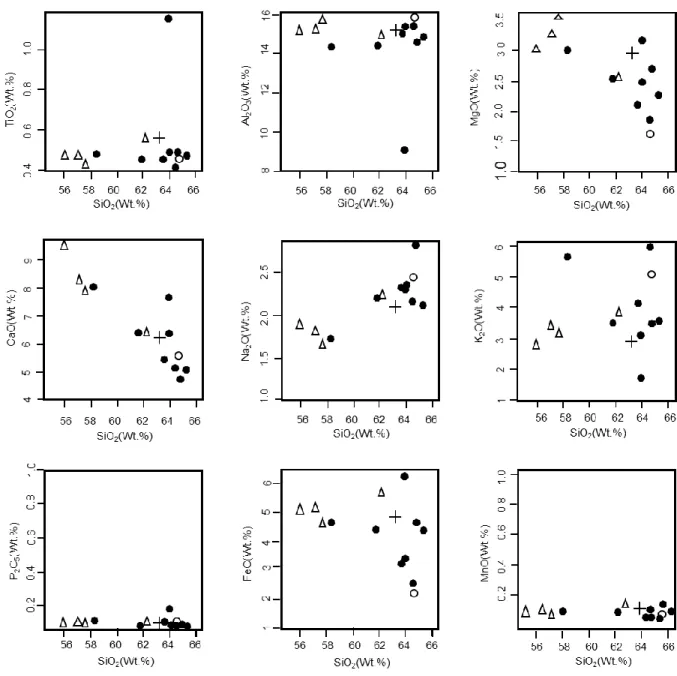
pyrite………..29 Fig. 3.7 Geochemistry of the intrusive rocks on the classification of intrusive rock according to the combined alkali content and silica content (Middlemost, 1994)……….……….35 Fig. 3.8 Geochemistry of the intrusive rocks on the AFM diagram showing whole-rock composition in terms of Na2O + K2O, total iron as FeO and MgO (Irvine & Baragar (1971)……35 Fig. 3.9 Geochemistry of the intrusive rocks on the total alkali versus SiO2 diagram; A/NK (AL2O3/Na2O+K2O) versus A/CNK (Al2O3/ (CaO+Na2O+K2O)) (Shand, 1943)………36 Fig. 3.10 A spider diagram of selected major and trace elements of the dioritic rocks, normalized to the composition of MORB (Pearce & Parkinson, 1993)……….36 Fig. 3.11 Plot of SiO2 vs. TiO2, Al2O3, MgO, CaO, Na2O, K2O, P2O5, FeOt weight percent of intrusive rocks. Abbreviation of the orebody samples are as in Figure 3.9……….37 Fig. 3.12 Selected trace element contents (ppm) vs. SiO2 of dioritic intrusive rocks from.
Abbreviation of the orebody samples are as in Figure 3.9……….38 Fig. 4.1 Field photograph of the contact between exoskarn and diorite in Bwet Taung orebody...40 Fig. 4.2 Field photograph of the contact between marble, endoskarn and granodiorite in Zin Yaw orebody………..40 Fig. 4.3 Photographs of skarn and sulfide vein from the Bwet Taung orebody. (a) wollastonite garnet-calcite-chalcopyrite in exoskarn, (b) massive chalcopyrite, bornite, pyrite, calcite, quartz, actinolite in retrograde alteration of garnet-wollastonite skarn, and from Tiger Mouth orebody, (c) garnet- pyroxene-wollastonite skarn at Bwet Taung orebody, (d) copper oxide ores (malachite and
azurite) occurred in skarn rock at Tiger Mouth orebody. Abbreviations: Cal=calcite, Grt=garnet, Opx= orthopyroxene, Qtz=quartz, Wol=wollastonite, cp=chalcopyrite, br=bornite, py=pyrite, sph=sphalerite………41 Fig. 4.4 Photomicrographs showing (a) the prograde mineral assemblages of garnet, wollastonite and clinopyroxene partially altered to retrograde mineral assemblages of epidote and actinolite with minor chalcopyrie in skarn at Tiger Mouth orebody (b) anhedral garnet, quartz and calcite in skarn Tiger Mouth orebody (c) wollastonite and tremolite in wollastonite skarn at Bwet Taung orebody (d) quartz, epidote, diopside and calcite occurring in diopside skarn at Bwet Taung orebody. Abbreviations: Grt=garnet, Cal=calcite, Cpx= clinopyroxene, Wol=wollastonite, Qtz=quartz, Epd=epidote, Act=actinolite-tremolite, Chl=chlorite, cp= chalcopyrite………42 Fig. 4.5 Epidote minerals replace earlier formed garnet in skarn at Bwet Taung orebody.
Abbreviations: X.N=crossed Nicols, grt=garnet, epd=epidote, hbl=hornblende………44 Fig. 4.6 Exoskarn mineral assemblages (a) under crossed nicols (X.N) and (b) plane polarized light (PPL) of wollastonite (wol), garnet (gar), epidote (epd) and actinolite (act) at Bwet Taung orebody………..46 Fig. 4.7 Photomicrographs showing the skarn mineral assemblages (a) garnet+ diopside+ epidote+
quartz+ calcite in Bwet Taung orebody, (b) garnet+ quartz + calcite, (c) wollastonite+ epidote with chalcopyrite in Bwet Taung orebody, (d) garnet with chalcopyrite in Bwet Taung orebody, (e) garnet+ wollastonite+ epidote+ quartz+ calcite in the Tiger Mouth orebody (f) wollasonite+
quartz+ epidote in Tiger Mouth orebody, (g) vesuvianite+ calcite+ orthopyroxene in Shwe Taung Gyar orebody, (h) wollastonite partially replace by epidote with ore minerals in Lun Htoe orebody, (i) garnet granually replaced by epidote with actinolite-tremolite at Bwet Taung orebody.
Abbreviations: Cal=calcite, Grt=garnet, Opx= orthopyroxene, Wol=wollastonite, Qtz=quartz, Epd=epidote, Act=actinolite-tremolite, Chl=chlorite, ccp= chalcopyrite………..47 Fig. 4.8 Photographs showing the characteristics of the garnet-wollastonite skarn outcrop in Shwe Min Bon deposit (a) Tiger Mouth orebody and (b) Lun Htoe orebody………..48 Fig. 4.9 Photomicrographs showing the mineralogy of exoskarn. (a) epidote together with chlorite replacing andradite in the retrograde skarn alteration at Lun Htoe orebody, (b) garnet from Au-rich ore exhibits oscillatory zonation in Bwet Taung orebody, (c) retrograde mineral assemblage of epidote, quartz and calcite and exoskarn of Tiger Mouth orebody, (d) chalcopyrite associated with chlorite in skarn at Bwet Taung orebody, (e) fine to medium-grained garent in skarn associated with epidote and calcite in Bwet Taung orebody, (f) garnet, clinopyroxene and wollastonite partially altered to actinolite in retrograde skarn at Bwet Taung orebody. Abbreviations:
Cal=calcite, Grt=garnet, Opx= orthopyroxene, Wol=wollastonite, Qtz=quartz, Epd=epidote, Act=actinolite-tremolite, Chl=chlorite, cp= chalcopyrite………...49 Fig. 4.10 Composition of the skarn garnets in the andradite-grossular-pyralspite ternary diagram.
Pyralspite includes pyrope, almandine and spessartine. SEM data are given in Table 4.1.
Abbreviations: Adr = andradite, Alm = almandine, Grs = grossular, Grt = garnet, Prp = pyrope, and Sps =spessartine………...51 Fig. 4.11 Photographs showing textures and alteration of host rock at Shwe Min Bon; (a) the stockwork vein occurred in dolomite at Tiger Mouth orebody, (b) sulfide bearing calcite vein in dioritic rocks at Tiger Mouth orebody, (c) garnet skarn with calcite veinlets in Bwet Taung orebody, (d) oxidized garnet crossed cut by calcite veinltes in garnet skarn at Tiger Mouth orebody, (e) dioritic rocks with calcite veinlets and fine-grained xenolith at Tiger Mouth orebody, (f) silicified rocks in Shweminbon Formation at Tiger Mouth orebody………..54
Fig. 4.12 (a) the silicified rocks of Shwe Min Bon Formation at Bwet Taung orebody, (b) a hand specimen of silicified rocks from Bwet Taung orebody, (c) sulfide vein associated with calcite and quart from Tiger Mouth orebody, (d) Shweminbon Formation at Tiger Mouth orebody and (e) vuggy quartz in silicified rocks………...57 Fig. 4.13 Outcrops of the bleached zone occurring in the silicified zone at Tiger Mouth orebody………..57 Fig. 4.14 Photomicrographs showing (a, b) calcite and dolomite in marble of Shweminbon Formation (c, d) hydrothermal breccia occurred in breccia zone. Abbreviations: Cal=calcite, Dol=dolomite, Qtz=quartz, Chl=chlorite………...58 Fig. 5.1 Photomicrographs showing (a) native gold occurred along the fracture of garnet in the retrograde skarn at Bwet Taung orebody, (b) intergrowth of bornite and chalcopyrite with tennantite and galena in the retrograde skarn Bwet Taung orebody, (c) replacement of chalcopyrite by tennantite and bornite in the retrograde skarn at Bwet Taung orebody, (d) the relation of tennantite, bornite and native gold in the retrograde skarn Bwet Taung orebody, (e) native gold and chalcopyrite with tennantite in retrograde skarn at Bwet Taung orebody, (f) native gold associated with bismuth-tellurite mineral in brecciated marble Tiger Mouth orebody, (g) arsenopyrite, chalcopyrite and sphalerite in vuggy quartz vein at Tiger Mouth orebody, (h) chalcopyrite, pyrite and galena in quartz vein at Tiger Mouth orebody and (i) sphalerite and pyrite associated with vuggy quartz in Tiger Mouth orebody. Abbreviations: tn=tennantite gn=galena, cc=chalcocite, cp=chalcopyrite, bn=bornite, py=pyrite, sph=sphalerite, apy=arsenopyrite, Au=native gold, Bi-Te= Tellurobismuthinite………...60 Fig. 5.2 Photomicrographs showing nature of ore minerals (a) pyrite and (b) chalcopyrite with sphalerite and pyrite in sulfide vein at Tiger Mouth orebody, (c) chalcopyrite, pyrite and sphalerite
in skarn at Shwe Taung Gyar orebody, (d) chalcopyrite together with sphalerite at Shwe Taung Gyar orebody, (e) chalcopyrite and bornite replaced by tennantite at Bwet Taung orebody, (f) bornite replaced by tennantite and along the fracture with secondary covellite at Tiger Mouth orebody, (g) sphalerite associated with chalcopyrite after pyrite coarse grained at Tiger Mouth orebody, (h) hematite with goethite at Tiger Mouth orebody, (i) Au associated with tellurobismuthite at Shwe Taung Gyar orebody. Abbreviations: tn=tennantite gn=galena, cp=chalcopyrite, bn=bornite, py=pyrite, sph=sphalerite, cv=covellite, Au=native gold, Bi-Te=
Tellurobismuthinite………62 Fig. 5.3 Backscattered electron images showing (a) native gold associated with tellurobismuthinite in brecciated marble of Tiger Mouth orebody, (b) chalcopyrite, emplectite and galena in retrograde skarn at Tiger Mouth orebody, (c) the mutual intergrowth of tennantite and wittichenite in retrograde skarn at Bwet Taung orebody, (d) chalcopyrite associated with wittichenite at retrograde skarn at Bwet Taung orebody, (e) tetradymite associated with tennantite in retrograde skarn at Bwet Taung orebody, (f) native gold grain in hedleyite in brecciated marble of Tiger Mouth orebody, (g) galena and bismuthate occurred in retrograde at Bwet Taung orebody, (h) enargite occurred in retrograde skarn at Bwet Taung orebody, and (i) tellurobismuthinite, tennantite and chalcopyrite in retrograde skarn at Tiger Mouth orebody………...64 Fig. 5.4 Photomicrographs showing (a) bornite cross cut by tennantite and chalcopyrite with galena inclusion in retrograde skarn at Bwet Taung orebody (b) chalcopyrite with galena inclusion and peripheral replacement by tennantite in retrograde skarn at Bwet Taung orebody (c) bornite sequentially replace by chalcopyrite, tennantite and sphalerite (d) chalpyrite replace by covellite in retrograde skarn at Shwe Gu Lay orebody (e) pyrite, chalcopyrite and arsenopyrite in vuggy quartz vein at Tiger Mouth orebody and (f) mutual intergrowth of chalcopyrite and sphalerite in
quartz vein at Tiger Mouth orebody. Abbreviations: tn=tennantite gn=galena, cp=chalcopyrite, bn=bornite, sph=sphalerite, cv=covellite………...68 Fig. 5.5 Schematic diagram showing paragenetic relationships of skarn and ore assemblages in orebodies of the Shwe Min Bon skarn deposit………69 Fig. 5.6 Photomicrographs of fluid inclusions from the Shwe Min Bon skarn deposit (a) fluid inclusions containing aqueous liquid, halite and liquid phase in garnet of prograde skarn, (b) two phase fluid inclusions in quartz, associated with chalcopyrite in retrograde skarn, (c) two phase fluid inclusions in quartz, (d) two phase fluid inclusions in calcite. V-gas; L-liquid; H-halite…...70 Fig. 5.7 Histogram of fluid inclusion homogenization temperatures from (a) garnet of prograde skarn from Bwet Taung orebody. (b) quartz and (c) calcite of retrograde skarn of Bwet Taung and Tiger Mouth orebodies. Abbreviation; LV= liquid+vapor, LVH=liquid+vapor+halite………….73 Fig. 5.8 Plot of δ18O vs. δD values for prograde skarn related garnet calculated from minerals or measured directly on inclusion fluids. Temperatures used for fluid calculations are from fluid inclusion. Sources of the mineral–fluid fractionation equation are noted in the text. Meteoric Water lines and Primary Magmatic Water boxes plotted for reference. Shaded arrows indicate mixing or water–rock exchange processes that affect isotopic composition of fluids. Black arrows indicate the depletion of residual magmatic waters during open-system degassing (Taylor, 1992;
Hedenquist et al., 1998)………..75 Fig. 5.9 Harker-type (a) total alkalies vs SiO2, (b) MgO vs SiO2 (c) K2O vs SiO2 diagrams of the intrusive rocks in Shwe Min Bon deposits compared with those of granitoids associated with skarn deposit in world (the averages for skarn granitoids shown by star mark are taken from Meinert, 1995)………..77
Fig. 5.10 (a) Rb/Sr vs Zr and (b) V vs Ni contents of the intrusive rocks from Shwe Min Bon deposit compared with those of granitoids associated with skarn deposit in world (the averages for skarn granitoids shown by star mark are taken from Meinert, 1995). Abbreviations are as shown in Fig. 5.9………77 Fig. 5.11 (a) Rb vs Y+Nb contents and (b) Nb vs Y contents of the dioritic rocks of Shwe Min Bon skarn deposit compared with intrusive rocks associated with skarn deposits in the world (the averages for skarn granitoids shown by star mark are taken from Meinert, 1995). ORG, oceanic ridge granite; VAG, volcanic arc granite; syn-COLG, syn-collision granite; WPG, within plate granites. Abbreviations are as shown in Fig. 5.9………78 Fig. 6.1 Homogenization temperature and salinity of fluid inclusions for prograde skarn and retrograde skarn. Garnet, quartz and calcite from skarn of the Bwet Taung orebody and quartz from skarn and calcite from brecciated marble of the Tiger Mouth orebody………81 Fig. 6.2 Pressure estimation for fluid inclusions of the Shwe Min Bon Cu-Au skarn deposit. Note that the H-type and V-type inclusions of the quartz+chalcopyrite± Au stage were trapped under immiscible conditions, and L-type and V-type inclusions of the quartz–polymetallic sulfide ±Au stage and calcite+bismuthinite+Au stage were trapped under boiling conditions, thus the estimated pressures indicate the actual trapping pressures. Isobars were calculated from the equations of Driesner and Heinrich (2007)……….83 Fig. 6.3 Pressure-temperature diagram for the H2O-NaCl system (Hedenquist et al., 1998;
Fournier, 1999; Redmond et al., 2004), showing the magmatic hydrothermal fluids leading to ore formation at the Shwe Min Bon deposit………..84
Fig. 6.4 Activity of S2 vs T diagram from Toulmin and Barton (1964), sulfidation curves are from Barton and Skinner (1979)……… 87 Fig. 6.5 Schematic diagram of skarn and hydrothermal breccia suggesting the formation of Shwe Min Bon skarn deposit (modified after Einaudi, 1994). The two shaded arrows represent the formation of Shwe Min Bon deposit………..89 Fig. 6.6 Diagram showing (a) the composition of tetradymite, tellurobismuthinite and hedleyite (b) representative values of Bi-Te-S-bearing minerals from SEM-EDX………90 Fig. 6.7 (a) the composition of wittichenite and emplectite (b) representative values of Bi-Cu-S- bearing minerals obtained from SEM-EDX………...91 Fig. 6.8 Schematic model of Cu-Au skarn deposit in Shwe Min Bon showing relation of host rock, associated skarn skarn and replacement deposits………92 Fig. 6.9 Schematic tectonic evolution of Shwe Min Bon deposit (SMB) with metallogenesis related to major stage and location of major mines (modified after Gardiner et. al, 2016)………93
List of Tables
Table 3.1. Chemical composition of the granodiorite: major (wt. %), minor (ppm) (n.d=not determined). Abbreviation of the orebody names are listed in Figure 3.1……….32 Table 3.2. Chemical composition of the diorite: major (wt. %), minor (ppm) (n.d=not determined).
Abbreviation of the orebody names are listed in Figure 3.1………...33 Table 3.3. Chemical composition of host rock from skarn and silicified zone. Major (wt. %), minor (ppm) (n.d=not determined) (*****=over determined). Abbreviation of the orebody names are listed in Figure 3.1.…..………...………....34 Table 4.1 SEM data for garnets of Bwet Taung and Tiger Mouth orebody, Shwe Min Bon skarn deposit………52 Table 4.2 (a) The alteration mineral assemblages and type of alteration in the Bwet Taung orebody.
(b) The alteration mineral assemblages and type of alteration from Tiger Mouth orebody. (c) The alteration mineral assemblages and type of alteration from Zin Yaw orebody. (d) The alteration mineral assemblages and type of alteration from Shwe Taunggyar and Shwegulay orebody…….55 Table 5.1 Summary of the characteristics of different orebodies in the Shwe Min Bon deposit, Kalaw Twonship, Myanmar………...67 Table 5.2 Summary of microthermometric and salinity data of fluid inclusion in the Shwe Min Bon deposit…….………..…………..72 Table 5.3 Stable isotope composition of garnet from the Shwe Min Bon skarn deposit………74
CHAPTER I. Introduction
Background and history of the research area
Shwe Min Bon skarn copper-gold mineralization is among around 300 gold occurrences in Myanmar. Since Myanmar is rich in natural resources with processing of a variety of minerals, among them, precious and base metal are of important as well as future exploration. Nowadays, gold exploration becomes very famous, not only from secondary (placer), but also from primary fields (Fig. 1.1). Although the different types of gold mineralization in Myanmar, the role of exploration is needed to develop to be a systematic one. In the primary prospect one of the challenging mineralization styles is skarn mineralization.
The Shwe Min Bon gold deposit lies on the Shan scarp zone which is located between the Slate belt and Shan plateau. There are seven prospect in the deposit which are trending nearly north-south. The host rocks comprise brecciated marble, skarn, siliceous and calcareous silitstone and mudstone. Shwe Min Bon deposit has been investigated by many researcher and recorded as the gold mineralization occurs skarn ore zone, hornfels zone, hydrothermal breccias- skarn zone, gossanous zone and late stage tectonic breccias. However, the origin of the mineralization is still remained unclear.
In the Shwe Min Bon area, the ancient tunnels were investigated by German geologists over the period 1914 to 1942. Numerous tunnels were excavated for mining activities by the Department of Geological Survey and Mineral Exploration as well as by Ivanhoe Myanmar Holding Ltd from 1996 to 2004. Since 2011, the mining operations by Geo Asia Co. Ltd are focused entirely on the silicified zone. Local people are also exploiting part of the small scale mining in the skarn zone, which had been mined out by Geo Asia Co. Ltd. The estimated ore reserved were calculated by
the Department of Geological Survey and Exploration (DGSE, 2015) as 238,900 metric ton @ 1.07- 5.94 ppm Au.
The Shwe Min Bon area is in a steep west- facing slope most of which show karst topography. The emplacement of diorite is associated with regional deformation of the area and is implicit in the formation of contact metamorphism, skarn and metasomatic mineralization. There is no record for the timing of intrusion and mineralization. Late stage tectonic breccia of calcite and a limonitic clay matrix occurs along the NW-N-NE fault. The Au contents of tectonic breccia zone is low. But the breccia zone is relatively wide, and has now been utilized for open cut mining.
Chhibber (1934) first suggested that the gold mineralization in southern Shan state including the Shwe Min Bon area is related to dioritic and granitic intrusions. Thacpaw (1966) carried out the preliminary investigations on the alteration and mineralization in the Shwe Min Bon area and suggested that two phases of mineralization are revealed by two stages of pyrite formation. Naing et al. (2013) suggested that the gold mineralization was of the calcic skarn type.
Fig. 1.1 Distribution of gold and copper deposit in Myanmar.
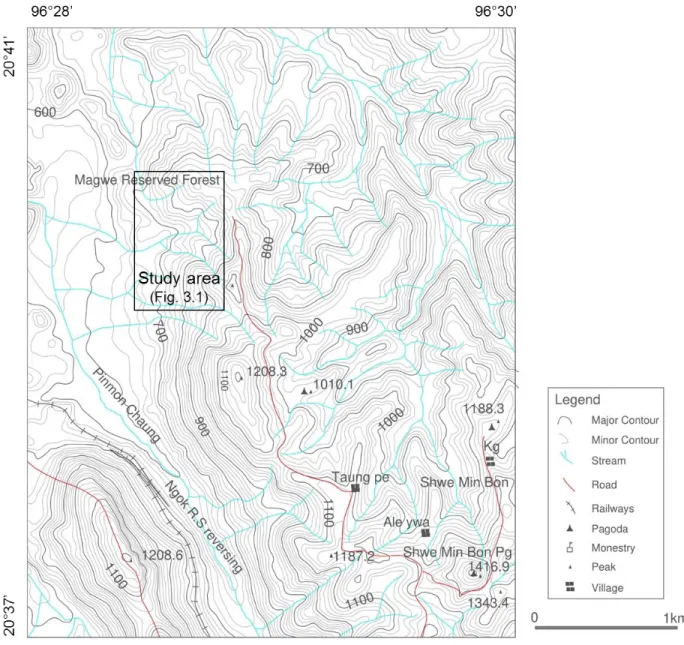
Location of the study area
The Shwe Min Bon (also spelled as Shweminbon) Cu-Au skarn deposit is located between latitudes 20° 39’ 15” N to 20° 40’ 15” N and Longitudes 96° 27’ 30” E to 96° 28’ 30” E, near Kalaw township, southern Shan state, Myanmar. The Shwe Min Bon deposit is an important Cu deposit in Myanmar within the Shan scarp zone of the Mogok metamorphic belt (MMB) (Fig. 1.2).
The MMB occurs as a highly deformed zone between the Central Basin to the west and the Shan plateau to the east, divided by the major Shan scarp and Sagaing faults respectively. The MMB is one of the most important mineral belts in Myanmar. Many different types of ore deposits occur within the MMB and the Shan scarp fault zone. Mesothermal, orogenic gold deposits are hosted by the Slate belt, located in the southern part of the MMB (e.g., Modi Taung, Swe et al., 2017).
The Slate belt in central Myanmar consists of argillaceous rocks correlated with the Mergui group trending N-S. Consequently, the Shan scarp zone which lies between the Mergui group and plateau limestone are the host the gold mineralization in Shwe Min Bon area. Au-Cu mineralization appears to be located in a narrow, elongated belt along the Shan Scarp fault zone.
Topographically, the research area is located in mountainous area. Although the elevation is about 1400m, most of prospects have a karstic surface and steep slope. (Fig. 1.3). As it is in tropical region, the area is covered by thick vegetation during the rainy season and less vegetation in dry season.
Fig. 1.2 Location map of the Shwe Min Bon area.
Fig. 1.3 Topographic map of the research area. (UTM, 2096-06) Statement of the problem and objectives
Thacpaw (1966) and Naing et al. (2013) have investigated the aspects of the gold and copper mineralization but little work has been done to understand the formation of the skarn assemblages and associated copper-gold mineralization. There are seven prospects within the gold district, with exploration and production of gold carried out over 3 years by the Geo Asia Industries and Mining
Co., Ltd. The Department of Geological Survey and Mineral Exploration (D.G.S.E) has been providing a technical team to Geo Asia Industries and Mining Co., Ltd for gold exploration at the Shwe Min Bon gold district since 2011. The geological team has been carrying out regional geological mapping, detailed geological mapping for 2 years and also the drilling at the gold district. Although the company explore for gold production, the research area have favorable for copper mineralization.
In this zone, although both of Ngayant Chaung Formation and Shweminbon Formation are turbidite units, they have different mineralization as Sb and Au-Cu deposits respectively. The main tectonic line in this area, namely Shan scarp zone is oriented in a nearly NS direction. Nwabangyi Dolomite is recognized in thrust fault contact along the west margin of the research area. The presence of numerous cross-cutting veinlets and micro-veinlets of quartz, calcite and sulfides were developed principally during thrusting, suggesting that gold mineralization is related with formation of metamorphic rock or deformation of the structural zone.
Among two or more phases of intrusions, gold mineralization can be occurred in syn- and post- skarnization process by hydrothermal process. It can lead to assist on the exploration aspect and to assay the potential of mineralization. The oxidation products of copper minerals include malachite and azurite. However, the formation of these sulfide minerals and gold mineralization processes remains completely unresolved. To ensure better understanding on the different stages and timing of mineralization, detailed mapping, and fluid inclusion microthermometry need to be conducted in order to understand the phyiscothermal conditions and nature of sulfide and gold mineralization.
The purpose of this study is to systematically document the skarns deposition based on skarn mineralogy and its related mineralization in the Shwe Min Bon area. In addition, this study
identifies the bismuth-, telluride-bearing minerals which are associated with the gold mineralization.
Methodology
A total of about 200 samples of intrusive rocks, host rocks, skarn rocks and ores samples were collected. About petrographic thin sections and thirty polished sections were prepared in order to identify the texture and mineralogy of the host rocks, skarns and ore minerals. These were analyzed by a Nikon Eclipse E600 POL microscope, equipped with a AdvanCam-U3II camera at Department of Earth Resources Engineering, Kyushu University. Scanning Electron Microscopy (SEM) using a SUPERSCAN SS-550, equipped with standardless, Energy Disperse X-ray analyzer (EDAX) at the Center of Advanced Instrumental Analysis, Kyushu University was used for the determination of chemical composition of different ore minerals. Major and minor elements of fifteen fresh and non-mineralized samples were anlayzed in order to determine whole rock geochemistry by X-ray fluorescence (XRF) analysis using a RIGAKU RIX-3100. Loss on ignition (LOI) was determined by heating the samples at 1000°C for 2 hours to determine relative loss of weight. The sample pellets for XRF analysis were prepared by pressing at (20t) for about 2 minutes in a vinyl chloride ring. The measurement conditions of analysis were 30kV and 70mA and JA-3 andesite was used as a standard sample.
Different types of minerals (quartz, calcite, garnet) in prograde, retrograde (I) and (II) of the skarn deposition were also prepared for fluid inclusion analysis. The measurements were conducted using a Linkam LK600 cooling/heating unit with a Nikon Y-IM microscope at the Department of Earth Resources Engineering, Kyushu University. The homogenization and the final ice melting temperature were measured at the rate of 1°C/mins. Thermocouples were calibrated at –53.2°, 0.0°, and +313.5°C using boiling point of hydrocarbon. The salinity of two-
phase fluid inclusions were calculated using the fluid inclusion freezing temperature through the equation provided in Bodnar (1993), based on the freezing-point depression of H2O-NaCl solutions, ranging from pure water to the eutectic composition (23.2 wt.% NaCl). The salinity of three-phase inclusions was calculated using the halite dissolution temperature through equations by Sterner et al. (1988).
The two garnet samples were used for oxygen and hydrogen isotope analysis. Mineral separation was carried out at the economic geology laboratory in Kyushu University, Japan. All mineral separates were examined using a binocular microscope prior to isotopic analysis to ensure 99% purity. Oxygen isotopic analyses were performed by Laser fluorination, involving total sample re-action with excess ClF3 using a CO2 laser as a heat source (in excess of 1500°C;
following Sharp, 1990) at the Scottish Universities Environmental Research Centre (Glasgow, UK). Samples are ablated by laser and the resulting liberated gases were analysed. The CO2
converted from O2 by reaction with hot graphite and the isotopic composition determined by an on-line VG Optima mass spectrometer. The results are in standards notation (δ18O) as per mil (‰) reported with respect to Standard Mean Ocean Water (SMOW).
Hydrogen isotope analysis involved the release of water from fluid inclusions by crushing.
The pure garnet samples were heated at 100°C overnight under high vacuum to release labile volatiles after loading into thoroughly outgassed Pt crucibles. Radiofrequency induction in an evacuated quartz tubed at 1200°C was used to heat the samples and release water, then reduced to H2 in a chromium furnace at 800°C (Donnelly et al. 2001). The yield measured by Hg manometer, with the evolved gas measured standard corrections applied to raw δ18D values to produce true δ18D.
Background on skarn deposit
Since skarn deposits are becoming more and more important for the sources of metals and now the subject of extensive scientific investigation in recent literature. Skarn deposits are widely distributed around the world, containing an array of useful metals, such as iron, tungsten, copper, lead, zinc, molybdenum, silver, gold, uranium, rare-earth elements, fluorine, boron, and tin (Meinert et al., 2005). Skarn deposits are one of the most abundant ore types in the earth's crust, and form in rocks of almost all ages (Meinert et al., 2005). Skarn-type copper deposits are considered to be the most significant skarn-deposit type in the world (Calagari and Hosseinzadeh, 2006). Skarn-type copper deposits mined out high grade ore than the porphyry type deposit in Ertsberg-Grasberg district, Indonesia (2.8 g/t Au with 1.12 % Cu in the skarn and 2.3g/t Au with 1.14 % Cu in the porphyry respectively).
Skarn (or skarn-type) gold deposits can be divided into gold only, copper–(gold), copper–
iron–(gold) and lead–zinc–(gold), with gold only skarn as the most attractive exploration target (Meinert, 1989). The gold mineralization was formed in skarn systems during retrograde alteration, concurrent with or later the main stage of sulfide mineralization. The ore shoots in most deposits are commonly highly irregular and the limits are generally determined by assay methods.
Characteristically, relatively high temperature Ca-Mg-Fe-silicates such as garnet, vesuvianite, diopside, scapolite, wollastonite and axinite are usually present in skarn deposits, in addition to lower temperature mineral assemblage of actinolite-tremolite, epidote, serpentine, phlogopite, muscovite, quartz, calcite, dolomite and various sulfides, mainly chalcopyrite, bornite, chalcocite, pyrite, pyrrhotite, arsenopyrite, galena, sphalerite, molybdenite and locally various Ni-Co sulfides and arsenides. Magnetite and hematite occur in many deposits.
Calcic copper skarn deposits are the most abundant skarn type in the world and mainly associated with I-type, magnetite-series, calc-alkaline, porphyritic plutons (Einaudi et al., 1981, Meinert et al., 2005). They are commonly associated with both oceanic and continental subduction settings. Copper skarns are formed in proximity to stock contacts with relatively oxidized skarn mineralogy characterized by andraditic garnet. Reduced gold skarns are associated with reduced diorite-granodiorite plutons and dike/sill complexes. Gold in these deposits is deposited in relatively late stages as native gold associated with Bi-minerals (Douglas et al., 2000). Skarn deposit characterized by low garnet/pyroxene ratios presence of hedenbergitic pyroxene and abundant sulfide minerals dominated by pyrrhotite and arsenopyrite, which are related with gold skarn deposits classified as reduced skarn (Brooks et al., 1991).
Skarn deposits in Myanmar
Most of the skarn deposits in Myanmar occur along the Mogok metamorphic belt as shown in Fig. (1.1). The Kwinthonze deposit thought to be linked to the intrusion of the Kabaing Granite near Thabeikkyin, is a marble-hosted Au base metal sulfide deposit with accessory garnet and wollastonite, interpreted as a skarn-type deposit, dated through zircon U-Pb geochronology to ca.
17Ma and related to the late stages of Mogok belt metamorphism (Myint et al., 2014). Nearby Thayawin, a marble-hosted Au skarn is characterized by native Au and Pb-Zn sulfides.
Kyaukpazat deposit is also known as an intrusion related copper-gold skarn deposit. It occurs as Au and sulfide bearing quartz vein in andesitic tuff, schist and phyllite of the Shwedaung Formation. Thayetkhone deposit is also characterized by the skarn gold ore and related gold-quartz veins which are hosted in calc-silicate and gneiss of Mogok metamorphic rocks intruded by syenite and granitic rocks. The Taungzon deposit located near Bilin Township is copper skarn deposit which is genetically related with I-type granitic rocks of Early Oligocene (Phyu Phyu Lwin, 2009).
The Baladokhta copper skarn deposit is characterized by the quartz-sulfide veinlets and disseminated sulfides in limestones. The Chaunggyi Cu-Au skarn deposits occur as gold-sulfide vein in the gneiss and marble of Mogok metamorphic belt (Khin Zaw et al., 2017). Moreover, there are some skarn type Pb-Zn-Ag and Sb deposits in Myanmar.
CHAPTER II. Regional geologic setting Regional geologic setting
Much of Myanmar has been subjected to both of the Triasic-Early Jurassic Indosinian and Cenozoic Himalayan orogenies, two major plate collisions related to the closure of the Palaeo- Tethys and the Neo-Tethys oceans, respectively. Myanmar lies at a geologic juncture where the main Tethys Ocean suture zone swing southward around the Eastern Himalayan Syntaxis into Southeast Asia, colliding during the Mesozoic-Cenozoic orogenies (Gardinar et al., 2016; Barber et al., 2017). As a result, several major Tethyan-related metamorphic belts extend from the Eastern Syntaxis southwards across Myanmar, which may be correlated with those lying further west along the main India-Asia collision zone (Searle et al., 2007). The sigmoidal Mogok metamorphic belt (MMB) is exposed at the margin of the Shan-Thai (Sibumasu) terrane (Barley et al., 2003), along the northwestern margin of the Shan Plateau and southwards between the north-south trending Sagaing fault and Shan Scarp (Searle and Haq, 1964; Mitchell, 1993). The tectonic framework of Myanmar can also be sub-divided into seven province; 1. The Rakhine (Arakan) Coastal Strip which is an ensimatic fore-deep, 2. The Indo-Myanmar Ranges which represent an outer-arc or fore-arc, 3. The Western Inner-Myanmar Tertiary Basin or inter-arc basin, 4. The Central Volcanic Belt representing a magmatic-volcanic arc, 5. The Eastern Inner-Myanmar Tertiary Basin forming a back-arc basin, 6. The Mogok-Mandalay-Mergui Metamorphic Belt, 7. The Eastern Shan Highlands or Sino-Myanmar Ranges which host the Bawdwin deposit. The Mogok metamorphic belt and Slate belt which together lie to the west of the Paung Laung-Mawchi Zone (Fig. 2.1). The Panung Laung-Mawchi Zone is interpreted by Mitchell et al. (2012) as a possible pre-Permian suture, consisting of folded late Jurassic to mid-Cretaceous marine clastic sedimentary rocks and limestones. The Panlaung Fault, recognized by arial photography and satellite images as a deep,
rectilinear, series of valleys trending NNW–SSE (Fig. 2.2). The Panlaung Fault marks the western boundary of the Shan Plateau (Grason et al., 1976; Mitchell et al., 2004, 2007, 2012). The Eastern Shan Highlands or Sino-Myanmar Ranges hosts the Bawdwin deposit. The Sagaing Fault is the tectonically significant boundary between the Eastern Inner-Myanmar Tertiary Basin (back-arc basin) and the Mogok-Mandalay-Mergui Metamorphic Belt (Thein, 1973; Zaw, 2017). The Eastern Highland is covered with Plateau Limestone and older Palaeozoic rocks, which were concealed beneath the Lower Palaeozoic Mergui Group. These are possibly the protoliths of the Mogok Metamorphic Complex. The Mergui Group was deformed and acquired schistosity (Mitchell et al., 2007, 2012. The Mogok Metamorphic Belt lying between the Eastern Highland and Central Cenozoic Belt, trending north-south (Maung Thein, 1973). It exists within the 10–25 km wide zone of the western Shan Scarp, west of the Slate Belt and continues to beyond the Sagaing Fault which trends north-south. Consequently, the Shan scarp zone, which sits between the Mergui Group and Plateau Limestone, is the regional structurally deformed zone. The Shan scarp zone results from the NNW-SSE ductile stretching and associated normal faults striking N70E, cross-cut by younger right-lateral faults (Bertrand et al., 2003). The probable age of the first deformation has been suggested as Middle or Upper Miocene (Bertrand et al., 2003). The younger cross-cutting event during the Neogene was also indicated by age dating on the metamorphic rocks (Bertrand et al., 1999).
Fig. 2.1 Regional tectonic setting of Myanmar and its environment, MMB Mogok Metamorphic, EB Eastern Ophiolite Belt, CB Central Basin, WB Western Ophiolite Belt, ST3 Sibumasu Terrane (3) Chaunggyi Schist, ST1 (Sibumasu Terrane1) including Baoshan Block, ST2 (Sibumasu Terrane2) Slate Belt, ST4 (Sibumasu Terrane1) Shan Thai Block(overthrust remnants of Palaeo-Tethys sediments on Sibumasu), PFZ Pan Laung Fault Zone, SFZ Sagaing Fault Zone, SH Shillong Plateau, LHS Lesser Himalayan Series, GHS Greater Himalayan Series, ITPS Indus-Tsangpo Suture Zone, SLB South Lhasa Block, NLB North Lhasa Block, Q-LS-IT Qiangtan+ Lanping Simao+ Indochina Terranes, JAU Jinsha accretionary unit+Yidun unit, SGT Songpan Ganze Terrane +Transitional Unit, EHS Eastern Himalayanm, Syntaxis, GSZ Graze Litang Suture Zone, SCT South China Terrane, ASRR Ailao Shan- red river shear zone, SZ Sukhothai Island Arc Zone, Tr Triassic-Early Jurassic granite and gneiss belt, MPFZ Mae Ping Fault Zone, TPFZ Three Pagodas Fault Zone(modified after Gardiner et al., 2016).
Fig. 2.2 Satellite image showing the physiography of the Shwe Min Bon and surrounding area.
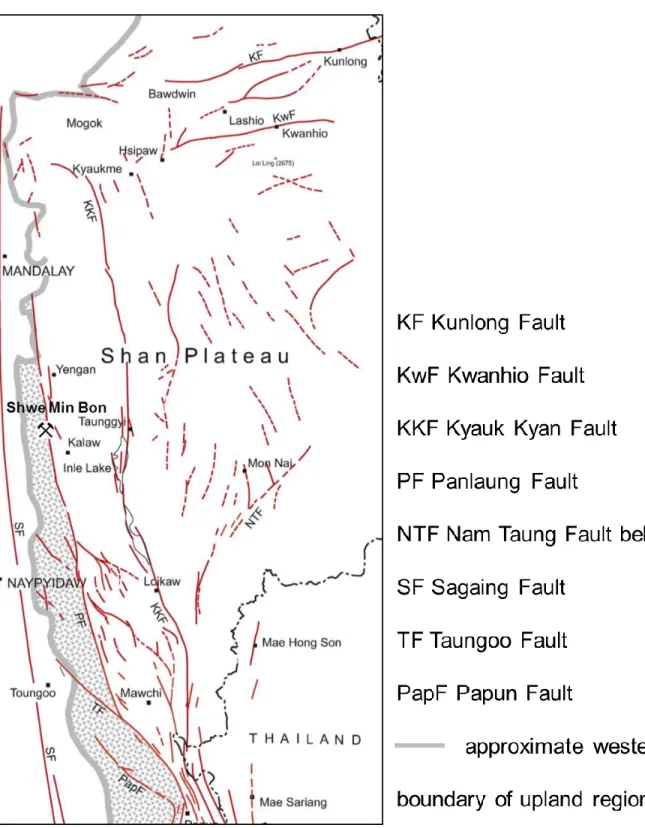
Fig. 2.3 Regional structural map of the Shwe Min Bon area (modified after Ridd et al., 2013).
Shan scarp zone
The Shan scarp zone is of significantly high relief, due to different erosion levels between resistant Shan Dolomite (Thisipin Limestone and Nwabangyi Dolomite) and adjacent mostly clastic sedimentary rocks (Mergui Slate Belt, Kalaw Red Bed and Pan Laung Groups-Kyauksu Taung Formation). The turbidite units of Ma-u-bin Formation (Ngayant Chaung and Shweminbon Formations) are preserved in the thrusts and high-angle fault-bounded slices (UNDP, 1978) as shown in Fig. 2.3. The Nwabangyi Dolomite (Upper Permian and Lower Triassic: Garson et al., 1976) consists of grey to dark grey color dolomite, trending NW-SE, and dipping to the east. The Triassic to Jurassic Shweminbon Formation consists of grey, buff, yellowish brown color mudstone, siltstone and white calcitic marble with limonitic fractures and light grey colored limestone (Ivanhole Myanmar Holding Ltd, 2000) (Fig. 2.4).
The angular unconformity of Kalaw Conglomerate on the older rocks units (Fig. 2.4) suggests that the latest thrusting may have occurred during the post-Cretaceous or Early Paleogene.
The Permian Thitsipin Limestone and Permo-Triassic Nwabangyi Dolomite were thrusted by Triassic- Jurassic Ngayant Chaung Formation and Shweminbon Formation probably during post- Cretaceous or Early Paleogene. A thrust fault contact between the Nwabangyi Dolomite and the turbidite unit of Ngayant Chaung Formation and Shweminbon Formation occurs along the west margin of the area (Fig. 2.4).
Structural setting
Regionally, Sharn scarp is characterized by the major active fault zone such as Pan Laung Fault. The Shan scarp extend southwards from Mandalay along the Shan State and Mandalay region boundary, adjacent to the Shan plateau to the east. The Pan laung Fault in Eastern Myanmar separates the Shan Plateau and Slate belt of the Shan scarp fault zone (Figs. 2.2 and 2.3). Within
the Shan scarp, the steep slopes and rigged relief of the belt occurred. The Shan scarp is also known as the boundary between Shan Plateau to the east and Sagaing fault to the west. The Shan scarp include three narrow north–south-aligned zones (from west to east): the Mogok Metamorphic Belt;
the Slate Belt; and the Paunglaung–Mawchi Belt (Barber et al., 2017). The Shan Scarps area is interpreted as a fold-and-thrust belt (Barley et al., 2003; Bertrand and Rangin 2003) (Fig. 2.2).
Folding and uplift resulted in erosion of the Shan Dolomite Group and Ma-u-bin Formation from the west of the area. Fractures trending northeast-southwest, and north-south are observed within the area. Thrust faults expose trending approximately NNW-SSE along the mineralized area. Gold mineralization is mainly confined to the NE-SW and E-W trending faults probably related to the movement of Shan Scarp Fault system.
Intrusives
The emplacement of granites, granodiorites and diorites with local Au mineralization and Sb mineralization in turbidite units, preceded deposition of the Kalaw Conglomerate (UNDP, 1978). Dioritic and small microdioritic dykes intruded the Ngayant Chaung Formation and small dioritic stocks intruded the Shweminbon Formation. Laser ablation inductively coupled plasma mass spectrometryU-Pb dating on zircon of the diorite intrusion yielded a late- early Cretaceous age (119 ±1.1Ma) (Wai Phyo, 2016; Wai Phyo et al., 2017). Gold-copper mineralization occurred in a narrow, elongated belt along the Shan scarp zone. The presence of numerous cross-cutting veinlets of quartz, calcite and sulfides were developed and appeared to be associated with thrusting, suggesting that gold mineralization was related to the formation of metasomatic rocks when igneous rocks intruded, and/or during deformation.
Fig. 2.4 Regional geological map of the Shwe Min Bon area (modified after Moe et al., 2013).
Stratigraphy and lithology of the Shwe Min Bon deposit
Shan scarp zone is the boundary zone between Shan Plateau of the Eastern highlands and Slate Belt. The Eastern Highland is covered with Plateau Limestone and older Palaeozoic rocks, which were concealed beneath the Mergui Group (the Lower Palaeozoic) as shown in the simplified stratigraphic column (Fig. 2). These are possibly the protoliths of the Mogok Metamorphic Complex. The Mergui Group (Slate Belt) was deformed and acquired schistosity (Mitchell et al., 2007, 2012). The Mogok Metamorphic Belt which is formed by the highly suggestive of the syntectonic or late-tectonic mode of emplacement of intrusives into the Eastern Highland and Central Cenozoic Belt with regional structural trend (Maung Thein, 1973). The region is composed of Mesozoic and Tertiary sediments, intermediate igneous rocks and Upper Paleozoic limestones (Fig. 2.5). It consists largely of argillaceous rocks correlated with the informally named Mergui Group which continue to southern Myanmar. These rocks are thought to have been deposited in a glacio-marine rift setting as the Sibumasu block parted from Gondwana (Metcalfe, 1999).
A late Triassic-early Jurassic succession of tightly folded beds including turbidites has been mapped as the Shweminbon Formation and Ngayant Chaung Formation overlying the Permo- Triassic Plateau Limestone by Mitchell et al. (2002, 2004, 2007, 2012). Mitchell et al. (2004, 2007, and 2012) interpreted these rocks are as Neo-Tethys sediments which was deposited in ocean and probably located between the Shan Plateau and the Slate Belt. Shweminbon Formation turbidites were deposited on the western margin of the Sundaland block (if there was no magmatic arc west of the Shan Plateau at that time), or if separated from the Mesotethys by a magmatic arc that would later form the strike-slip fault boundary of the Slate belt (Ridd, 2013). An Andean-type margin developed intrusion of I-type granites, possibly as early as the Late Triassic, which continued at least to the Cretaceous and probably into the Palaeogene. The back-arc basin was conjectural, but
might have accounted for the deep marine Shweminbon Formation in Myanmar (Ridd, 2013). In the western part of the research area, the Triassic and Jurassic rocks of Ngayant Chaung Formation were overlain by Cretaceous conglomerate and contact with Permian Limestone and Nwabangyi dolomite by thrusting. In the research area, the Nwabangyi Dolomite (Upper Permian to Lower Triassic) and Shweminbon Formation of siltstones and impure limestone were intruded by the dioritic rocks Fig 2.4.
Nwabangyi Formation
The Nwabangyi Formation (or) Nwabangyi Dolomite (Upper Permian and Lower Triassic:
Garson at al 1976) consists of grey, dark grey dolomite. It trends NW-SE dipping to the east.
Thitsipin Permian Limestone transitionally in contacts in the west and Shweminbon Formation thrusts in eastern part.
Shweminbon Formation
Shweminbon Formation was named after IMHL (E) (2000) and it consists of Triassic to Jurassic grey, buff, yellowish brown mudstone, siltstone (Fig.2.4) and white calcite marble with limonitic fractures interbeded layers of silts and sands, micritic limestone and light grey limestone.
The thrust fault contact with the Nwabangyi Dolomite along the west margin.
Dioritic rocks
The diorite intrusions occur as stock and dikes (Fig.2.4). The stocks are weathered and the dikes are fresh and compact.
Fig. 2.5 Simplified stratigraphy of the Shan Scarps region of Myanmar (modified after Ridd and Watkinson, 2013), dark grey tone is mudstone, siltstone and sandstone; brick pattern referring to the limestone.
CHAPTER III. Geology, lithology and host rock geochemistry Geology of rock units
The Shwe Min Bon deposit comprises skarn-type metasomatic alteration, with mineralization occurring along the contact between Nwabangyi Dolomite, Shweminbon Formation and Cretaceous dioritic rocks (Fig. 3.1). Limestone and turbidies units of Shweminbon Formation were metamorphosed into marble, quartzite, lime-silicate and hornfelsic rocks. The emplacement of dioritic rocks associated with regional deformation of the area and was implicit in the formation of contact metamorphism, skarn and copper-gold mineralization. Shweminbon Formation is mainly exposed in the eastern part of the research area and it is recognized as yellowish brown siltstone extending NW-SE along the east margin, and white calcite marble and limestone are exposed at the central part of the deposit.
In the Shwe Min Bon deposit, seven orebodies have been mined out (Fig. 3.1). Among them, the Bwet Taung, Tiger Mouth, Shwe Taung Gyar and Lun Htoe orebodies are the main mineralized zones. The Zin Yaw, Shwe Gu Lay and Shwe Taung Gyi prospects are currently not operational.
This study will focus on the Bwet Taung, Zin Yaw, Tiger Mouth, Shwe Taung Gyar, Shwe Gu Lay and Lun Htoe orebodies. Based on field observation, the Bwet Taung, Zin Yaw, Tiger Mouth and Shwe Gu Lay orebodies are classified as proximal skarns. The Shwe Taung Gyar and Lun Htoe orebodies are identified as distal skarns. Moreover, the silicified zone occurs in the Bwet Taung and Tiger Mouth orebodies where igneous rocks intruded into the clastic rock of the Shwminbon Formation.
Fig. 3.1 Geological map of the Shwe Min Bon area (modified after Ivanhoe Myanmar Holding Ltd., 2000). Location of the collected samples are shown by star; (A) BT009, (B) BT1, BT6, BT7, (C) BT9, BT003, BT006, ZY5A, ZY7, TGM8, (D) TGM1, TGM5, TGM18, TGM15, TGM20, TGM-X1, TGM-X2, TGM-X3, (E) TGM22, (F) TGM9, TGM19,TGM25,TGM35, (G) STG1, STG2, STG3, STG4, TGM28, (H) TGM29, TGM008, (I) TGM014, TGM33, (J) SGL1, STG1, STG003, (K) LH9-star. Abbreviation; BT=Bwet Taung, ZY=Zin Yaw, TGM= Tiger Mouth, STG=Shwe Taung Gyar, SGL= Shwe Gu Lay, LH= Lun Htoe.
Fig. 3.2 Outcrop of the contact between diorite and Shweminbon Formation at Tiger Mouth orebody.
Fig. 3.3 Outcrops of (a) Shweminbon Formation and (b) breccia zone in Shweminbon Formation occurred in Shwe Min Bon deposit.
Fig. 3.4 Outcrop of intrusive rocks in the Shwe Min Bon deposit. (a) surface weathering of dioritic rock, (b) highly jointed dioritic rock, (c) exfoliation appearance of dioritic rock.
Shweminbon Formation
Siltstone and sandstone of the Shweminbon Formation were intruded by diorite and occurred as silicified zone along the contact (Figs. 3.2 & 3.3a). The dioritic rocks intruded into the Shweminbon Formation of calcareous rock in center and clastics rock in eastern part of the research area which are mostly occurred as dykes and a stock. The brecciated occurred in Shweminbon Formation (Fig. 3.3b).
Dioritic rocks
The dioritic rocks are exposed spread the Shwe Min Bon deposit except the Lun Htoe orebody. It is exposed as stock in the center of the deposit area near Bwet Taung orebody and Tiger Mouth orebody whereas the dyke occurs in Shwe Gu Lay, Shwe Taung Gyar orebody and eastern part of Tiger Mouth orebody (Fig. 3.1). Dioritic rocks intruded into limestone, siltstone and mudstone of Shweminbon Formation (Fig. 3.2). They are yellowish brown color where weathered, and exhibits greenish grey color. It showed porphyritic granular texture and is mainly composed of medium to coarse-grained plagioclase feldspar, hornblende, biotite and fine-grained quartz. These rocks were highly altered (Fig. 3.4 a, b) near the contact zone. Fresh diorite was observed along the tunnel wall and drill samples. The exfoliation were observed in diorite as a
physical weathering (Fig. 3.4c). However, these exfoliation rocks are very hard and compact probably due to the silicification.
Petrography of rock units Shweminbon Formation
Siltstone and sandstone occur as interbedded, exhitbiting fine to medium grained quartz, plagioclase with minor pyrite. These rocks are silicified when they occur near the dioritic intrusion.
Marble occurred as both fine grained massive and crystalline coarse-grained (Figs. 3.5a, b).
Fig. 3.5 Photomicrographs showing (a, b) quartz and chlorite in sedimentary rock of Shweminbon Formation.
Dioritic rocks
Based on the microscopic observation, dioritic rocks are composed mainly of plagioclase, pyroxene (diopside and augite), amphibole (hornblende and actinolite) with a minor amount of alkali-feldspar, biotite, quartz. These dioritic rocks exhibit a medium-grained porphyritic granular texture (Fig. 3.6a). Hornblende occurs as medium to coarse-grained euhedral phenocryst. Chlorite is present in dioritic rocks by the hydrothermal alteration of primary biotite (Figs. 3.6b, c). The
diorites are mainly composed of plagioclase, hornblende, and minor biotite and quartz. Pyrite and chalcopyrite occur as ore minerals in altered dioritic rocks (Fig. 3.6d). The granodiorite consists phenocryst of plagioclase, hornblende, with minor groundmass of quartz and alkali-feldspar (Fig.
3.6e). Saussuritization occurs in calcic plagioclase, which is altered to a assemblage of chlorite, amphibole, and carbonates (Fig. 3.6f).
Fig. 3.6 Photomicrographs showing (a) coarse-grained hornblende & biotite (b) replacement of biotite by chlorite (c) hornblende, plagioclase and chlorite in dioritic rock (d) altered dioritic rock (saussuritization, chloritization) associated with opaque mineral (e) phenocrysts of hornblende occurring in a fine-grained groundmass (f) zoned plagioclase showing saussuritization in diorite.
Abbreviations: Hbl=hornblende, Pl=plagioclase, Qtz=quartz, Chl=chlorite, ccp=chalcopyrite, py=
pyrite.
Geochemistry of the host rock Intrusive rocks
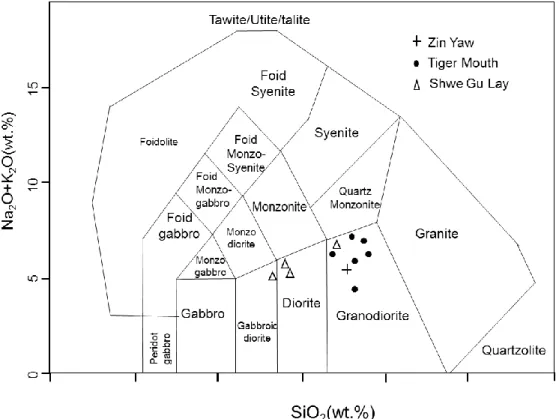
The spatial distribution of the dioritic rocks in the study area were shown in Figure 3.1. The fresh or least altered rocks were selected for chemical analysis of major and minor elements. The results are listed in Tables 3.1 and 3.2. The intrusive rocks from Shwe Min Bon were also classified as diorite and granodiorite (Fig. 3.7) in order to the whole-rock composition in terms of Na2O + K2O, total FeO and MgO contents (Middlemost, 1994). The intrusive rocks from Tiger Mouth are classified as diorite and granodiorite, while the intrusive rocks from Shwe Gu Lay and Zin Yaw are classified as granodiorite. The intrusive rocks of Shwe Taung Gyar are diorite in composition. The SiO2, Na2O, K2O and Al2O3 contents of diorites range from 55.9 wt. % to 62.2 wt. %, 1.7 wt. % to 2.1 wt. %, 2.7 wt. % to 5.6 wt. %, and 14.4 wt. % to 15.7 wt. % respectively, with K2O/Na2O ratios ranging from 0.45 to 0.68 (Table 3.1). The SiO2 , Na2O, K2O and Al2O3
contents of granodiorites in the study area range from 63.2 to 65.3 wt. %, 2.1 to 2.8 wt. %, 1.7 to 5.9 wt. % and 9.1 to 15.8 wt. % respectively and the Na2O+ K2O values range from 5.0 to 8.1 wt.
%, and K2O/Na2O ratios from 0.36 to 1.35 (Table 3.2). These rocks belong to calc alkaline series in AFM diagram (Fig. 3.8). The A/NK versus A/CNK values indicate metaluminous characters (Fig. 3.9).
Trace elements normalized to MORB (Pearce and Parkinson, 1993) (Fig. 3.10) show the enrichment of LILE or mobile elements, especially K, Rb, and Ba. On the other hand, the HFSE or immobile elements show moderate enrichment to slight depletion. The depletion of the high field strength elements (HFSE; Nb, Zr, and Ti) with respect to the large ion lithophile elements (LILE) is a characteristic feature of subduction-related magmatism. It is importance as a tectonic tracer for the continental crust with strong depletion in Nb and Ta, formed subduction-related
processes (Taylor and McLennan, 1985; Rudnick and Fountain, 1995). The titanium is depleted probably due to the alteration of amphibole. The geochemical results show that the major oxide (Fig. 3.11) compositions are negatively correlated with SiO2 while K2O and Na2O are positively correlated. The minor elements such as Pb, Cu, Y, Sr and V are also negatively correlated with SiO2 of dioritic rocks (Fig. 3.12). While Ba is positively correlated, Cr, Ni and Zr are steadily correlated.
The geochemical result also suggest the crystallization differentiation process played an important role in the formation of the dioritic rocks. For example, Fe–Ti oxide crystallization differentiation is suggested by the decreasing of Fe2O3, MgO and TiO2 with increasing SiO2 (Fig.
3.11). K feldspar and alkaline feldspar fractionation crystallization is indicated by the negative correlation between SiO2 and K2O (Fig. 3.11). The trace elements show positive correlation with SiO2 (Fig. 3.12).
Sedimentary rocks
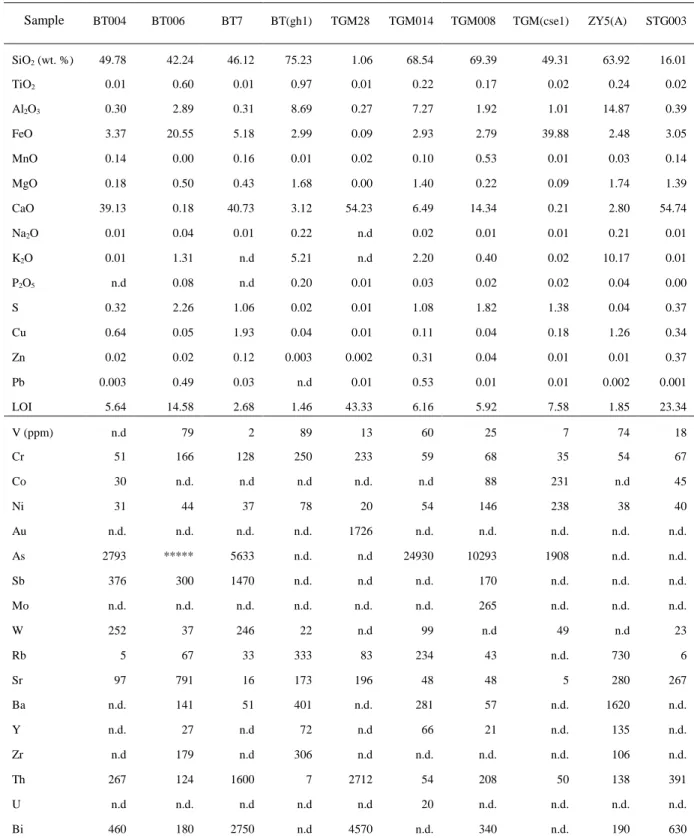
Geochemically, the concentration of copper and gold are positively correlated with arsenic and bismuth in various types of host rocks such as skarn, brecciated marble and silicified rocks of Shweminbon Formation are listed in Table 3.3.