Facets and ideal vertices of 4-dimensional hyperbolic ideal right-angled polyhedra
Jun Nonaka
Abstract
Kolpakov proved that an ideal right-angled polyhedron inH4which has the minimal facet number is 24-cell [4]. In this paper, we focus on ideal right-angled polyhedra inH4other than 24-cell. By looking at the cusps of these polyhedra, we find that they must have many more facets than 24-cell has.
Key words:Right-angled polyhedron, Hyperbolic space, Combinatorics.
MSC (2010)20F55, 51F15, 52B10
1 Introduction
A convex polyhedron in the hyperbolicn-spaceHn is called aright-angledif all its dihedral angles areπ/2.
LetPbe a polyhedron inHn. If the volume ofPis finite, then the intersection of the Euclidean closure ofPand the boundary ofHnis a finite set of points. Acusp point (or anideal vertex) ofP is a pointcofP∩Hn. We say thatPhasa cuspwhen there is a cusp point ofP. If the Euclidean closures of the faces ofPhave a common cuspc, then we say these facesshare the cusp corhave the cusp c. If any vertex ofPis a cusp, thenPisideal.
There are many results concerned with hyperbolic ideal right-angled polyhedra. By Deza and Shtogrin’s work in [2], we obtain the list of 3-dimensional hyperbolic ideal right-angled polyhedra, up to 17 cusps whose any face is either triangle or quadrilateral.
We can also see the first 248 values of ideal right-angled polyhedra inH3in [9]. By Andreev’s theorem (Theorem 2) and Rivin’s theorem [8, Theorem 1], we can find such polyhedra inH3easily.
On the other hand, it is more difficult to find such polyhedra inH4than in H3. Kolpakov proved that a regular ideal right-angled polyhedron, which is called 24-cell, has the minimal facet number among all ideal right-angled polyhedra inH4[4]. In the same paper, he also proved that there is no ideal right-angled polyhedron inHnforn≥7 by using Nikulin-Khovanskij inequality (see [3] and [5]).
From now on, we consider thatP is an ideal right-angled polyhedron inH4. Then any cusp ofPis shared by exactly six 3-dimensional faces. Fix a cuspcofP, and denote byFic(i= 1,· · ·, 6) the six 3-dimensional faces which share this cusp. Denote byFc the set of 3-dimensional faces which are adjacent at least one of the six 3-dimensional facesFic(i= 1,· · ·, 6). The aim of this paper is to prove the following theorem.
Theorem 1.LetP be an ideal hyperbolic 4-dimensional right-angled polyhedron other than 24-cell. Then there is a cuspc0ofPsuch that the number of 3-dimensional faces ofFc0is at least 24.
We remark that, for any cuspcof 24-cell, the number of 3-dimensional faces ofFc is 18. Thus Theorem 1 implies that ideal right-angled polyhedra other than 24-cell must have many more 3-dimensional faces than 24-cell.
Facets and ideal vertices of 4-dimensional hyperbolic ideal right-angled polyhedra
Jun Nonaka
We also remark that we know not so many examples of ideal right-angled polyhedra inH4. One of the ways to construct new ideal right-angled polyhedron is by gluing two ideal right-angled polyhedra. By gluing two 24-cell, we obtain an ideal right-angled polyhedron. This new ideal right-angled polyhedron has forty 3-dimensional faces. In this paper, we use a lot of figures for considering the combinatorial structures of those polyhedra. The paper [6] will help us to understand the meaning of these figures.
2 Hyperbolic convex polyhedra
In this section, we study some characteristics of convex polyhedra in hyperbolic spaces.
The main references in this section are [7] and [10].
LetHi−denote a half-space bounded by the hyperplaneHiin the hyperbolicn-space Hn. Then, a convex polyhedronPinHnis the intersection of finitely many half-spaces Hi−(i= 1,· · ·, m), that isP =∩mi=1H−i. It may always be assumed that none of the half-spacesH−i contains the intersection of all the others. In what follows, we assume this without special mention. Under this condition, the half-spacesHi−are uniquely determined by the polyhedronP. AsideofPis the intersection ofPand a hyperplane Hi.
We now define ak-dimensional face ofPfork= 0,1,· · ·, n. Then-dimensional face ofP isPitself. Any face ofPis a convex polyhedron inHn−1(see [7, Theorems 6.3.1 and 6.3.4]). Then we call this face an (n−1)-dimensional face ofP. Note that we may regard a face of (n−1)-dimensional face ofPas a convex polyhedron inHn−1. Then a face of an (n−1)-dimensional face ofP is called an (n−2)-dimensional face ofP. In the same manner, we obtain thek-dimensional face ofPfork= 0,1,· · ·, n. Aproper vertex is a vertex not lying in∂HnbutHn. Thus a 0-dimensional face ofPis a proper vertex ofP. We remark that 1-dimensional face is an edge ofP. We denote by Ωk(P) the set ofk-dimensional faces ofP.
We call that two hyperfacesF1andF2ofPareparallelif the hyperplanes containing them do not intersect but their Euclidean closures intersect in the boundary ofHn. If two hyperfaces are parallel, then the intersection of their Euclidean closures is exactly one cusp ofP. If two hyperplanes neither are parallel nor have a common point inHn, then we say that they areultra-parallel.
We call a polyhedronnon-obtuseif all its dihedral angles do not exceedπ/2.
Ann-dimensional combinatorial polyhedron is calledsimpleif any of its proper ver- tices belongs only tonhyperfaces, andsimple at edgesif any of its edges belongs only to (n−1) hyperfaces. Besides, we call ann-dimensional hyperbolic polyhedronalmost simpleif it is simple at edges and any of its proper vertices belongs only tonhyperfaces.
According to the above, any compact non-obtuse polyhedron inHnis simple, and any non-obtuse polyhedron of finite volume with vertices at infinity is simple at edges. In particular, any ideal right-angled polyhedron of finite volume inHnis almost simple.
The following theorem tells us that we only need to have information of a combina- torial structure and dihedral angles of a non-obtuse polyhedron to decide whether it can be realized inH3or not.
Theorem 2([1]). An non-obtuse almost simple polyhedron of finite volume with given dihedral angles, other than a tetrahedron or a triangular prism, exists inH3if and only if the following conditions are satisfied:
(a)if three2-dimensional faces meet at a proper vertex or a cusp, then the sum of the dihedral angles between them is at leastπ(πfor a cusp);
(b)if four2-dimensional faces meet at a proper vertex or a cusp, then all the dihedral angles between them equalπ/2;
(c)if three2-dimensional faces are pairwise adjacent but share neither a proper vertex nor a cusp, then the sum of the dihedral angles between them is less thanπ;
(d)if a2-dimensional faceFiis adjacent to2-dimensional facesFjandFk, whileFj
andFkare not adjacent but have a common cusp whichFidoes not share, then at least one of the angles formed byFiwithFjand withFkis different fromπ/2;
(e)if four2-dimensional faces are cyclically adjacent but meet at neither a proper vertex nor a cusp, then at least one of the dihedral angles between them is different from π/2.
It is known that anyk-dimensional face of a non-obtuse polyhedronP⊂Hnbelongs only to (n−k) hyperfaces; anyk-dimensional face is represented by the intersection of (n−k) hyperfaces (see [10]). In particular, any proper vertex belongs only to n hyperfaces.
If a right-angled polyhedron inHnis ideal, then it does not have a proper vertex.
Since this polyhedron is simple at edges, it must satisfy the conditions in Theorem 2. Moreover, the number of its hyperfaces which share one cusp is exactly 2(n−1).
Any of these hyperfaces is parallel to one other and adjacent to the remaining 2(n−2) hyperfaces. In the next section, we use these characteristics of hyperbolic ideal right- angled polyhedra.
3 Ideal right-angled polyhedra in H
3In this section, we study some characteristics of ideal Coxeter polyhedra of finite volume inH3.
By some properties of hyperbolic ideal right-angled polyhedra as we mentioned at the end of the previous section, we obtain the following lemma.
Lemma 1.A three-dimensional hyperbolic ideal right-angled polyhedron satisfies the fol- lowing conditions:
(i)Any cusp are shared by four faces,
(ii)Any one of the four faces which shared a cusp is adjacent to other two faces and is parallel to rest one face,
(iii)if two faces are adjacent, then their intersection is an edge,
(iv)if two faces are parallel but share a cusp, then they share only this cusp.
LetR be the ideal right-angled polyhedron inH3. Denotec(R) (resp. e(R) and f(R)) the number of cusps (resp. edges and faces) ofR. Then we obtain the following combinatorial identities.
c(R)−e(R) +f(R) = 2, (1)
2c(R) =e(R), (2)
4c(R) = ∑
F∈Ω2(R)
c(F). (3)
The first identity is Euler’s identity. The other identities are obtained since any cusp shared by exactly four faces and four edges. Since Any face has at least three cusps, then
4c(R) = ∑
F∈Ω2(R)
c(F)≥3f(R). (4)
By this inequality and the identities (1) and (2), we obtain thatf(R)≥8. Note that whenf(R) = 8, any 2-dimensional face ofRis a triangle. This means thatRmust be a regular octahedron and be the only ideal right-angled polyhedron which has a minimal facet number.
If an ideal right-angled polyhedronRis not an octahedron, then it has a face that has at least four cusps. Thus, by the above inequality, we obtainf(R)≥9. Iff(R) = 9 (i.e.
c(R) = 7), then, by the above inequality,Rhas one rectangular face and eight triangular faces. We know that there does not exist such a polyhedron by Deza and shtogrin’s work in [2].
Now we suppose thatf(R) = 10. IfRhas a face denoted byAwhich has at least five edges, then there are at least five faces that are adjacent toAand at least five faces which are parallel toAbyA′s cusps. Thenf(R)≥11. This means thatRhas only triangular We also remark that we know not so many examples of ideal right-angled polyhedra
inH4. One of the ways to construct new ideal right-angled polyhedron is by gluing two ideal right-angled polyhedra. By gluing two 24-cell, we obtain an ideal right-angled polyhedron. This new ideal right-angled polyhedron has forty 3-dimensional faces. In this paper, we use a lot of figures for considering the combinatorial structures of those polyhedra. The paper [6] will help us to understand the meaning of these figures.
2 Hyperbolic convex polyhedra
In this section, we study some characteristics of convex polyhedra in hyperbolic spaces.
The main references in this section are [7] and [10].
LetHi−denote a half-space bounded by the hyperplaneHiin the hyperbolicn-space Hn. Then, a convex polyhedronPinHnis the intersection of finitely many half-spaces Hi−(i= 1,· · ·, m), that isP=∩mi=1Hi−. It may always be assumed that none of the half-spacesHi−contains the intersection of all the others. In what follows, we assume this without special mention. Under this condition, the half-spaces H−i are uniquely determined by the polyhedronP. AsideofPis the intersection ofPand a hyperplane Hi.
We now define ak-dimensional face ofPfork= 0,1,· · ·, n. Then-dimensional face ofPisP itself. Any face ofPis a convex polyhedron inHn−1(see [7, Theorems 6.3.1 and 6.3.4]). Then we call this face an (n−1)-dimensional face ofP. Note that we may regard a face of (n−1)-dimensional face ofPas a convex polyhedron inHn−1. Then a face of an (n−1)-dimensional face ofPis called an (n−2)-dimensional face ofP. In the same manner, we obtain thek-dimensional face ofP fork= 0,1,· · ·, n. Aproper vertex is a vertex not lying in∂HnbutHn. Thus a 0-dimensional face ofPis a proper vertex ofP. We remark that 1-dimensional face is an edge ofP. We denote by Ωk(P) the set ofk-dimensional faces ofP.
We call that two hyperfacesF1andF2ofPareparallelif the hyperplanes containing them do not intersect but their Euclidean closures intersect in the boundary ofHn. If two hyperfaces are parallel, then the intersection of their Euclidean closures is exactly one cusp ofP. If two hyperplanes neither are parallel nor have a common point inHn, then we say that they areultra-parallel.
We call a polyhedronnon-obtuseif all its dihedral angles do not exceedπ/2.
Ann-dimensional combinatorial polyhedron is calledsimpleif any of its proper ver- tices belongs only tonhyperfaces, andsimple at edgesif any of its edges belongs only to (n−1) hyperfaces. Besides, we call ann-dimensional hyperbolic polyhedronalmost simpleif it is simple at edges and any of its proper vertices belongs only tonhyperfaces.
According to the above, any compact non-obtuse polyhedron inHnis simple, and any non-obtuse polyhedron of finite volume with vertices at infinity is simple at edges. In particular, any ideal right-angled polyhedron of finite volume inHnis almost simple.
The following theorem tells us that we only need to have information of a combina- torial structure and dihedral angles of a non-obtuse polyhedron to decide whether it can be realized inH3or not.
Theorem 2([1]). An non-obtuse almost simple polyhedron of finite volume with given dihedral angles, other than a tetrahedron or a triangular prism, exists inH3if and only if the following conditions are satisfied:
(a)if three2-dimensional faces meet at a proper vertex or a cusp, then the sum of the dihedral angles between them is at leastπ(πfor a cusp);
(b)if four2-dimensional faces meet at a proper vertex or a cusp, then all the dihedral angles between them equalπ/2;
(c)if three2-dimensional faces are pairwise adjacent but share neither a proper vertex nor a cusp, then the sum of the dihedral angles between them is less thanπ;
(d)if a2-dimensional faceFiis adjacent to2-dimensional facesFjandFk, whileFj
andFkare not adjacent but have a common cusp whichFidoes not share, then at least one of the angles formed byFiwithFjand withFkis different fromπ/2;
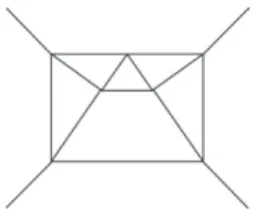
Figure 1: The second smallest ideal right-angled polyhedron inH3
faces and rectangular faces. Then, by [2], its combinatorial structure is depicted in Fig.
1. Note that iff(R) = 10, thenRhas two rectangular faces (AandA′in Fig. 1) and eight triangular faces (AiandAjkin Fig. 1).
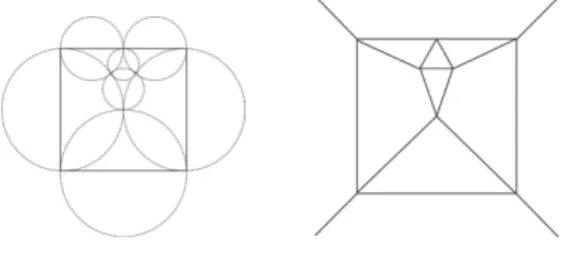
From now on, we consider the upper half-space model ofH3. We assume that a cuspc0of ideal right-angled polyhedronRis the point at infinity of this model. The cuspc0is shared by exactly four faces ofR. The hyperplanes contained these four faces each are vertical Euclidean planes in this model. The hyperplane which contains any face ofRwhich does not have the cuspc0is an upper hemisphere. The intersection of hyperplane and the boundary ofH3is either a circle or a straight line. Thus, for example, a right-angled polyhedronRsuch thatf(R) = 10 is depicted as in Fig. 2. This figure represents the boundary ofH3except for the infinity pointc0. The dotted circles show that the intersection of hyperplanes and the boundary ofH3in this figure. The edges of the rectangle in the figure are the hyperplanes containing each face ofRwhich share a cuspc0. Note that this rectangle cannot be a Euclidean square because of the radiuses of those dotted circles. From now on, when we need only to consider the combinatorial structures of ideal right-angled polyhedra, we deal with the figure as Fig. 3 instead of Fig. 2.
Figure 2: The ideal right-angled polyhedron inH3which has exactly ten faces
Figure 3: The combinatorial structure of the ideal right-angled polyhedron inH3which has exactly ten faces
Next, we try to determine an ideal right-angled polyhedronRsatisfyingf(R) = 11.
IfRhas a pentagonal face, then there are five 2-dimensional faces which are adjacent to it, and there are also five 2-dimensional face which is parallel to it. Thus,Rhas only these 2-dimensional faces. But this situation cannot occur by a similar reason as the case:f(R) = 9. It is clear thatRdoes not have ak-gonal face fork≥6. ThusRmust have rectangular and triangular faces. By [2], its combinatorial structure must be as in Fig. 4 and Fig. 5.
Figure 4: The ideal right-angled polyhedron inH3which has exactly eleven faces
Figure 5: Another representation of the ideal right-angled polyhedron inH3which has exactly eleven faces
4 Ideal right-angled polyhedra in H
4Before proving our main theorem, we prepare for introducing a useful lemma. LetPbe an ideal right-angled polyhedron inH4. LetF1,F2,· · ·,Fmbe an ordered sequence of 3-dimensional faces ofP. We suppose that each facetFiis adjacent only toFi−1and Fi+1through a 2-dimensional face or through a cusp fori= 2,· · ·,m−1, andF1(resp.
Fm) is adjacent only toF2andFm(resp.F1) (through a 2-dimensional face or through a cusp, as before). We also add the condition that no three ofFj(j= 1,· · ·,m) share a lower-dimensional face. Then we call the sequenceF1,· · ·,Fma (k, l)circuit,k+l=m, if it compriseskco-dimension two faces andlcusp shared by the facets. The following lemma is very useful for studying the combinatorial structures of polyhedra inH4. Lemma 2([4]). LetP be an ideal right-angled polyhedron. ThenP does not contain (3,0),(4,0),(2,1)circuits.
From now on, we consider that the 4-dimensional hyperbolic ideal right-angled poly- hedronPis not 24-cell. By observation of the proof of Theorem 4 in [4],Pmust have a 3-dimensional face which is not an octahedron. By some notations that we mentioned in Section 3, we realize that this 3-dimensional face has a 2-dimensional face which is not a triangle. Denote bycone of cusps that this non-triangular face has. We also denote by
5 Figure 1: The second smallest ideal right-angled polyhedron inH3
faces and rectangular faces. Then, by [2], its combinatorial structure is depicted in Fig.
1. Note that iff(R) = 10, thenRhas two rectangular faces (AandA′in Fig. 1) and eight triangular faces (AiandAjkin Fig. 1).
From now on, we consider the upper half-space model ofH3. We assume that a cuspc0 of ideal right-angled polyhedronRis the point at infinity of this model. The cuspc0is shared by exactly four faces ofR. The hyperplanes contained these four faces each are vertical Euclidean planes in this model. The hyperplane which contains any face ofRwhich does not have the cuspc0is an upper hemisphere. The intersection of hyperplane and the boundary ofH3is either a circle or a straight line. Thus, for example, a right-angled polyhedronRsuch thatf(R) = 10 is depicted as in Fig. 2. This figure represents the boundary ofH3except for the infinity pointc0. The dotted circles show that the intersection of hyperplanes and the boundary ofH3in this figure. The edges of the rectangle in the figure are the hyperplanes containing each face ofRwhich share a cuspc0. Note that this rectangle cannot be a Euclidean square because of the radiuses of those dotted circles. From now on, when we need only to consider the combinatorial structures of ideal right-angled polyhedra, we deal with the figure as Fig. 3 instead of Fig. 2.
Figure 2: The ideal right-angled polyhedron inH3which has exactly ten faces
Figure 3: The combinatorial structure of the ideal right-angled polyhedron inH3which has exactly ten faces
F1cthe 3-dimensional face mentioned above. SinceF1chas a non-triangular face which hasc, then there is a 3-dimensional face which is adjacent toF1cby this 2-dimensional face. We denote this new 3-dimensional face byF2c. The number of 3-dimensional faces ofPwhich has this cuspcis six. Then we denote these faces byFicfori= 1,· · ·, 6.
We can define thatFicandFjcare parallel atcif and only ifi+j= 7. ThenFicand Fjcare adjacent ifi+j̸= 7. We also assume thatcis a point at infinity of the upper half-space model. IfP does not have so many 3-dimensional faces, then the number of 3-dimensional faces which are adjacent at least one ofFic(i= 1,· · ·, 6) might be small.
The aim of this section is to prove our main theorem, that is, to obtain the lower bound of the least number of these 3-dimensional faces.
SincePhas neither a (3,0) circuit nor a (2,1) circuit, we obtain the following corollary from Lemma 2.
Corollary 4.1.LetE(resp.E′andE′′)be a3-dimensional face of an ideal right-angled polyhedronPwhich is adjacent toFic(resp.FjcandF7−ic (j̸= 7−i))but does not have c. Then the following three things(1)-(3)satisfy;
(1)if there is no cusp shared byEandE′, thenEdoes not coincide withE′, (2)Edoes not coincide withE′′,
In this section, we say property (1) (resp. (2)) to correspond to (1) (resp. (2)) of Corollary 4.1. We also introduce the following two properties obtained from the condition “almost simple”.
(3) If two 3-dimensional faces are adjacent, then the intersection of them is a 2-dimensional face.
(4) If two 3-dimensional faces are parallel at a cusp, then the intersection of their closures consists only of this cusp.
Property (3) means that two 3-dimensional faces can be adjacent by only one 2-dimensional face and if they are adjacent, they cannot be parallel at a cusp. Property (4) means that two 3-dimensional faces can be parallel at only one cusp. From now on, we divided into cases as follows;
(i) At least one of two 3-dimensional facesF1candF2chas exactly ten 2-dimensional faces, (ii)F1chas exactly eleven 2-dimensional faces, andF2chas at least eleven 2-dimensional faces,
(iii) otherwise.
Case (i)
By the assumption, the 2-dimensional faceF1c∩F2cis not a triangle. ThenF2cmust have at least ten 2-dimensional faces.
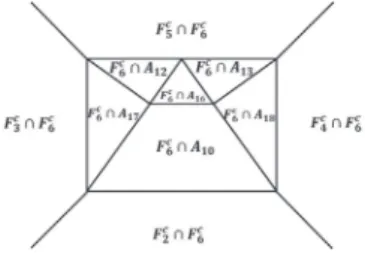
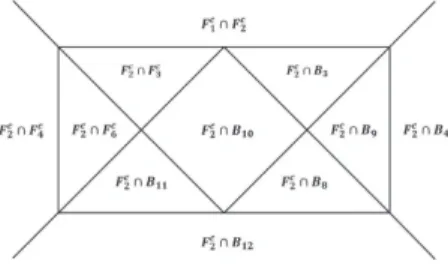
Firstly, we assume thatF2c has exactly ten 2-dimensional faces. In this case, for i= 3, 4, the 3-dimensional faceFiccan be an octahedron since the Euclidean distance d(F1c∩F2c∩Fic, F1c∩Fic∩F5c) between two edgesF1c∩F2c∩FicandF1c∩Fic∩F5cis equal to the Euclidean distanced(F1c∩F2c∩Fic, F2c∩Fic∩F6c) between two edgesF1c∩F2c∩Ficand F2c∩Fic∩F6c. Moreover, ifF3candF4care octahedra, thenF5ccannot be an octahedron since the Euclidean distanced(F1c∩F3c∩F5c, F1c∩F4c∩F5c) are not equal to the Euclidean distanced(F1c∩F3c∩F5c, F3c∩F5c∩F6c). In a similar way as above, we can show that F6calso cannot be an octahedron in this case. Thus, for the number of 3-dimensional faces which are adjacent to at least one ofFic(i= 1,· · ·, 6) is the smallest, we have only to consider the case: F3candF4care octahedra, and each 3-dimensional faceFic (i= 1, 2, 5,6) has ten 2-dimensional faces. Fig. 6-11 show each 3-dimensional faceFic in this case. We denote byAi(i= 1,· · ·, 18) the 3-dimensional faces which are notFjc but adjacent to at least one ofFjcas in Fig. 6-11. By properties (1)-(4), we know that Ai̸=Ajifi̸=j.
Figure 6: The 3-dimensional faceF1cin Case (i)
Figure 7: The 3-dimensional faceF2cin Case (i)
Figure 8: The 3-dimensional faceF3cin Case (i) F1cthe 3-dimensional face mentioned above. SinceF1chas a non-triangular face which
hasc, then there is a 3-dimensional face which is adjacent toF1cby this 2-dimensional face. We denote this new 3-dimensional face byF2c. The number of 3-dimensional faces ofP which has this cuspcis six. Then we denote these faces byFicfori= 1,· · ·, 6.
We can define thatFicandFjcare parallel atcif and only ifi+j= 7. ThenFicand Fjcare adjacent ifi+j̸= 7. We also assume thatcis a point at infinity of the upper half-space model. IfPdoes not have so many 3-dimensional faces, then the number of 3-dimensional faces which are adjacent at least one ofFic(i= 1,· · ·, 6) might be small.
The aim of this section is to prove our main theorem, that is, to obtain the lower bound of the least number of these 3-dimensional faces.
SincePhas neither a (3,0) circuit nor a (2,1) circuit, we obtain the following corollary from Lemma 2.
Corollary 4.1. LetE(resp.E′andE′′)be a3-dimensional face of an ideal right-angled polyhedronPwhich is adjacent toFic(resp.FjcandF7−ic (j̸= 7−i))but does not have c. Then the following three things(1)-(3)satisfy;
(1)if there is no cusp shared byEandE′, thenEdoes not coincide withE′, (2)Edoes not coincide withE′′,
In this section, we say property (1) (resp. (2)) to correspond to (1) (resp. (2)) of Corollary 4.1. We also introduce the following two properties obtained from the condition “almost simple”.
(3) If two 3-dimensional faces are adjacent, then the intersection of them is a 2-dimensional face.
(4) If two 3-dimensional faces are parallel at a cusp, then the intersection of their closures consists only of this cusp.
Property (3) means that two 3-dimensional faces can be adjacent by only one 2-dimensional face and if they are adjacent, they cannot be parallel at a cusp. Property (4) means that two 3-dimensional faces can be parallel at only one cusp. From now on, we divided into cases as follows;
(i) At least one of two 3-dimensional facesF1candF2chas exactly ten 2-dimensional faces, (ii)F1chas exactly eleven 2-dimensional faces, andF2chas at least eleven 2-dimensional faces,
(iii) otherwise.
Case (i)
By the assumption, the 2-dimensional faceF1c∩F2cis not a triangle. ThenF2cmust have at least ten 2-dimensional faces.
Firstly, we assume thatF2chas exactly ten 2-dimensional faces. In this case, for i= 3, 4, the 3-dimensional faceFiccan be an octahedron since the Euclidean distance d(F1c∩F2c∩Fic, F1c∩Fic∩F5c) between two edgesF1c∩F2c∩FicandF1c∩Fic∩F5cis equal to the Euclidean distanced(F1c∩F2c∩Fic, F2c∩Fic∩F6c) between two edgesF1c∩F2c∩Ficand F2c∩Fic∩F6c. Moreover, ifF3candF4care octahedra, thenF5ccannot be an octahedron since the Euclidean distanced(F1c∩F3c∩F5c, F1c∩F4c∩F5c) are not equal to the Euclidean distanced(F1c∩F3c∩F5c, F3c∩F5c∩F6c). In a similar way as above, we can show that F6calso cannot be an octahedron in this case. Thus, for the number of 3-dimensional faces which are adjacent to at least one ofFic(i= 1,· · ·, 6) is the smallest, we have only to consider the case: F3candF4care octahedra, and each 3-dimensional faceFic (i= 1,2,5,6) has ten 2-dimensional faces. Fig. 6-11 show each 3-dimensional faceFic in this case. We denote byAi(i= 1,· · ·, 18) the 3-dimensional faces which are notFjc but adjacent to at least one ofFjcas in Fig. 6-11. By properties (1)-(4), we know that Ai̸=Ajifi̸=j.
Figure 9: The 3-dimensional faceF4cin Case (i)
Figure 10: The 3-dimensional faceF5cin Case (i)
Figure 11: The 3-dimensional faceF6cin Case (i)
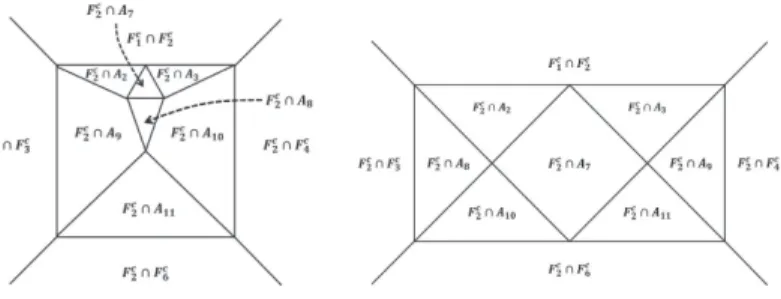
Secondly, we assume thatF2chas exactly eleven 2-dimensional faces. In this case, F2cas in either left one or right one in Fig. 12. Since the Euclidean distanced(F2c∩ F3c∩F6c, F1c∩F2c∩F3c) is not equal tod(F1c∩F2c∩F3c, F1c∩F3c∩F5c), thenF3ccan not be an octahedron. Similarly, we can also show thatF4cis not an octahedron. Thus, by properties (1)-(4), we obtain|Fc| ≥24.
Lastly, we assume thatF2c has at least twelve 2-dimensional faces. If three 2- dimensional facesF2c∩Fic (i= 2, 3, 4) are not triangles, then F3c andF4care not octahedra because of the Euclidean distances between some two 2-dimensional faces as we mentioned above. IfF2c∩F3c(resp.F2c∩F4candF2c∩F6c) is not a triangle, thenF3c (resp. F4candF6c) is not an octahedron. Thus, in any case, ifF2chas at least twelve 2-dimensional faces, then|Fc| ≥24 by properties (1)-(4).
Figure 12: The other possibilities of 3-dimensional faceF2cin Case (i)
Case (ii)
We may determine that bothF1candF2chave exactly eleven 2-dimensional faces, and the other four 2-dimensional facesFic(i= 3, 4, 5 and 6) are octahedra for giving the minimal number of|Fc|. In this case, the combinatorial structures of these six 3-dimensional faces are depicted as in Fig. 13-18. By properties (1)-(5), seventeen 3-dimensional facesBi
(i= 1, 2, · · ·, 17) depicted in Fig. 13-18 are different. Thus, this situation gives
|Fc|= 23.
Figure 13: The 3-dimensional faceF1cin Case (ii)
Figure 14: The 3-dimensional faceF2cin Case (ii) Figure 9: The 3-dimensional faceF4cin Case (i)
Figure 10: The 3-dimensional faceF5cin Case (i)
Figure 11: The 3-dimensional faceF6cin Case (i)
Secondly, we assume thatF2chas exactly eleven 2-dimensional faces. In this case, F2cas in either left one or right one in Fig. 12. Since the Euclidean distanced(F2c∩ F3c∩F6c, F1c∩F2c∩F3c) is not equal tod(F1c∩F2c∩F3c, F1c∩F3c∩F5c), thenF3ccan not be an octahedron. Similarly, we can also show thatF4cis not an octahedron. Thus, by properties (1)-(4), we obtain|Fc| ≥24.
Lastly, we assume thatF2c has at least twelve 2-dimensional faces. If three 2- dimensional faces F2c∩Fic(i= 2, 3, 4) are not triangles, then F3cand F4c are not octahedra because of the Euclidean distances between some two 2-dimensional faces as we mentioned above. IfF2c∩F3c(resp.F2c∩F4candF2c∩F6c) is not a triangle, thenF3c (resp. F4candF6c) is not an octahedron. Thus, in any case, ifF2chas at least twelve 2-dimensional faces, then|Fc| ≥24 by properties (1)-(4).
8
Figure 15: The 3-dimensional faceF3cin Case (ii)
Figure 16: The 3-dimensional faceF4cin Case (ii)
Figure 17: The 3-dimensional faceF5cin Case (ii)
Figure 18: The 3-dimensional faceF6cin Case (ii)
Now we consider this situation, i.e.,Phas the six 3-dimensional facesF1c,F2c,· · ·,F5c andF6cwhich are depicted by Fig. 13-18. Denote byc′the cusp which is shared by the six 3-dimensional faces:F1c,F2c,F4c,B4,B7andB12. Then we consider the new upper half-space model whose point at infinity isc′. In this model,F1c(resp. F2candF4c) is depicted as Fig. 19 (resp. Fig. 20 and Fig. 21). Then the combinatorial structures of B4,B7andB12where they may give the minimal number of|Fc′|is the case that these 3-dimensional faces are depicted as in Fig. 22-24. Note that we do not mention whether Pexists or not with satisfing the combinatorial structures of those 3-dimensional faces as in Fig. 13-24. We remark thatG1 andG2 are new 3-dimensional faces which are parallel toF1c, andG3(resp.G4) is parallel toF4c(resp. F2c). We also remark that we do not mention that the 3-dimensional facesH1andH2are already dealt with before or not. Thus we obtain|Fc′| ≥26.
Figure 19: The 3-dimensional faceF1cwith the cuspc′at infinity
Figure 20: The 3-dimensional faceF2cwith the cuspc′at infinity Figure 15: The 3-dimensional faceF3cin Case (ii)
Figure 16: The 3-dimensional faceF4cin Case (ii)
Figure 17: The 3-dimensional faceF5cin Case (ii)
Figure 21: The 3-dimensional faceF4cwith the cuspc′at infinity
Figure 22: The 3-dimensional faceB4with the cuspc′at infinity
Figure 23: The 3-dimensional faceB7with the cuspc′at infinity
Figure 24: The 3-dimensional faceB12with the cuspc′at infinity Case (iii): otherwise
The polyhedronP has the six 3-dimensional faces: Fic. There are also at least twelve 3-dimensional faces that are adjacent to at least two ofFicandFjc(i̸=j). There are the other at least three 3-dimensional faces that are adjacent toF1c(resp. F2c) that we do not count in before sinceF1c(resp.F2c) has at least thirteen 2-dimensional faces. Thus, we obtain|Fc| ≥12 + 6 + 6 = 24.
Hence, by considering Case (i)-(iii), we proved Theorem 1.
In this paper, we count the number of 3-dimensional faces that are adjacent at least one ofFkc(k= 1, 2,· · ·, 6). We remark that there also exist 3-dimensional faces, we did not count in, that are parallel to at least one of these six 3-dimensional faces. That is, ideal right-angled polyhedra other than 24-cell have a lot of 3-dimensional faces. We also remark that we may obtain the lower bound on the volume of these polyhedra by the following theorem.
Theorem 3([4, 11]). LetP be a 4-dimensional hyperbolic ideal right-angled polyhedron which hasc(P)cusps andf3(P)3-dimensional faces. Then its volume is equal to
vol(P) =c(P)−f3(P) + 4
3 π2.
Acknowledgment
This paper is a part of outcome of research performed under a Waseda University Grant for Special Research Projects (Projects numbers: 2018B-334 and 2018K-418).
References
[1] E. M. Andreev,On convex polyhedra of finite volume in Lobachevskij spaces, Math.
USSR. Sb.,12(1971), 255–259.
[2] M. Deza and M. Shtogrin,Octahedrites, Symmetry Cult. Sci,11(2000), 27–64, MR2001411.
[3] A. G. Khovanskij,Hyperplane sections of polyhedra, toric varieties and discrete groups in Lobachevskij space, Funktsionla. Anal. i Prolozhen,20(1986), 50–61, 96, MR831049.
[4] A. Kolpakov,On the optimality of the ideal right-angled 24-cell, Algebr. Geom.
Topology,12no. 4 (2012), 1941–1960.
[5] V. V. Nikulin,On the classification of arithmetic groups generated by reflections in Lobachevskij spaces, Izv. Akad. Nauk SSSR Ser. Mat,45(1981), 113–142, 240, MR607579.
13 Figure 21: The 3-dimensional faceF4cwith the cuspc′at infinity
Figure 22: The 3-dimensional faceB4with the cuspc′at infinity
Figure 23: The 3-dimensional faceB7with the cuspc′at infinity
[6] J. Nonaka,The number of cusps of right-angled polyhedra in hyperbolic spaces, Tokyo J. Math.,38no.2 (2015), 539–560.
[7] J. G. Ratcliffe, Foundations of Hyperbolic Manifolds Second Editions, Graduate Texts in Math., Springer,149(2006).
[8] I. Rivin,A characterization of ideal polyhedra in hyperbolic 3-space, Ann. of Math., (2)143(1)(2996), 51–70.
[9] A. YU. Vesnin and A. A. Egorov,Ideal right-angled polyhedra in Lobachevsky space, Preprint, arXiv:1909.11523.
[10]E. B. Vinberg, Geometry II: Spaces of Constant Curvature, Encyclopaedia of Mathematical Sciences Vol 29, Springer-Verlag, (1993), 138–248.
[11]T. Zehrt,The covolume of discrete subgroups of Iso(H2m), Discrete Math.,309 (2009), 2284–2291.
Waseda University Junior and Senior High School, 3-31-1 Kamishakujii, Nerima-ku, Tokyo, 177-0044, Japan.
email:[email protected]
14