Abstract of Dissertation (Ph.D. in Public Management)
The Challenges of Localization for Japanese Corporations in China:
Creating Public Value
July 2009
The Okuma School of Public Management Waseda University
Keikoh RYU
The Challenges of Localization for Japanese Corporations in China:
The Challenges of Localization for Japanese Corporations in China:
Creating Public Value
z Purpose
This thesis attempts to evaluate the evidence supporting the existence of a positive correlation between strategic commitment to public value creation and localization performance for Japanese corporations in China. It postulates that public value creation is essential for Japanese corporations to adjust to the dynamic conditions of the Chinese marketplace and to proactively contribute to the resolution of its social issues. It then explores various strategies for creating public value based on the twin pursuits of business development and social engagement, both of which are essential to achieve greater localization in China. The following is a summary of the various theoretical and practical implications of this research.
z Outline of Study
In its examination of the ways in which the creation of public value can be used to facilitate the localization of Japanese corporations in China, this study is divided into two parts:
Part I offers a theoretical analysis of the underlying concerns behind localization and the importance of public value creation; Part II offers a practical assessment of the various strategies for creating such value (Fig.A.1).
Source: Author
FIGURE A.1. Outline of Study
Part 1 is composed of the following three chapters. Chapter 1 provides an overview of the Practical Assessment
Examination of the correlation between social activities and financial performance
Comparative analysis of social engagement between Japanese and
western corporations
Identification of strategies for creating public value
Theoretical Analysis
Relevance of prior research
Examination and assessment of the notion of public value Challenges facing the localization of
Japanese corporations in China
Conclusion
PurposeThe Challenges of Localization for Japanese Corporations in China:
Creating Public value - 2 -
obstacles to localization in the Chinese marketplace and discusses the importance of redefining
"business-society relations" in order to surmount these obstacles. Chapter 2 discusses prior research into the subject and addresses the unique conditions surrounding Japanese corporations in China.
Building on prior discussions, Chapter 3 provides a fresh look at the localization process in light of the growing importance of corporate social responsibility while outlining the role of public value creation in the private sector. Based on the assumption that any initiatives geared toward the creation of public value will not come to fruition unless Japanese corporations first understand the potential economic benefits to such action, Part II examines the empirical evidence supporting a correlation between public value creation and economic profit in an effort to develop effective strategies for localization. Part II consists of the following chapters: Chapter 4 presents statistical and qualitative evidence in support of the hypothesis that social engagement leads to improved local business results. Chapter 5 examines the importance of promoting social activities so as to increase public value and facilitate localization. Chapter 6 explores various strategies for Japanese corporations to create public value in China.
z Analysis of Prior Research
Chapter 2 provides a critical assessment of prior research into business-society relations theory and how such research may help illuminate the unique challenges facing Japanese corporations in China. Section 1 discusses three approaches to the theory of business-society relations, including: (1) The evolution of corporate social responsibility as both an organizational strategy and a theory of corporate legitimacy; (2) The notion of stakeholder management, which views the corporation as an institution engaged in creating wealth for a diverse array of
"stakeholders" in addition to shareholders (i.e. employees, government, mass media, etc.); (3) The so-called "dilemma" of corporate social activity, which focuses on the need to resolve the inherent conflict between satisfying shareholder expectations for the maximization of profit and meeting societal expectations for public value creation.
Section 2 goes on to discuss "social strategies" for cultivating better business-society relations, including: (1) Strategic philanthropy, in which corporations collaborate with NPOs devoted to the promotion of various social and environmental causes; (2) Strategic sociality, which emphasizes the importance of social activities as a means of securing a competitive advantage in the marketplace (i.e. through brand differentiation, etc.). Section 3 focuses on prior research comparing Japanese-style management with that of the West, highlighting the need for management to adapt to the local business practices and customs of China. Finally, Section 4 offers a critique of the various shortcomings of prior research in dealing with the complex and diverse challenges facing localization in China.
The underlying aim of Chapter 2 is to identify the nexus between the corporation's pursuit of its economic mandate and the fulfillment of its social responsibilities. At a time when standards of good corporate behavior are at unprecedented highs, attention to the needs and expectations of society is now a prerequisite for the advancement of a company's economic agenda. Japanese corporations in China must therefore aim to be good citizens in addition to economically profitable organizations.
z Defining” Public Value”
As discussed at length in Chapter 3, "public value" can be defined as "the creation of social and economic value in the interests of the corporate stakeholders." Although optimizing the relationship between economic and social value may no longer enable corporations to maximize profit at all costs, studies have shown that whatever value is created in the process ends up being more sustainable. This thesis is primarily concerned with the ways in which corporations come to terms with their "social existence" by engaging in activities in adherence to public notion of publicness. In order to effectively pursue such an agenda, however, it is first necessary to clarify the
standards by which such activities are measured. This is where the need to define "public value"
comes into play.
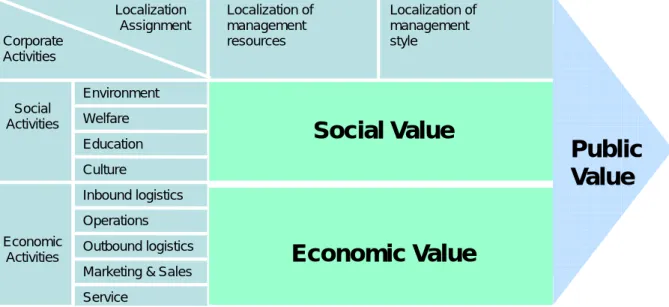
Source: Drafted by author based on Porter, M.E, Competitive Advantage: Creating and Sustaining Superior Performance, Free Press, 1985, p.256
FIGURE A.2. Analytical Framework for Public Value Creation
Figure A.2 provides a framework for public value creation based on the notion of public value as defined above. Note that the "social activities" referenced above are: (1) for social concerns in fields not directly related to the business of the corporation; and (2) engaged in over and above the
"economic activities" meant to maximize profit for executives and shareholders. This formulation of public value is particularly helpful to the extent that it offers a concrete and quantifiable standard for evaluating corporate responsibility, which is in itself a somewhat amorphous concept.
z Methodology and Results
Building on the theoretical discussion above, Chapter 4 provides an overview of the statistical and qualitative evidence supporting the hypothesis that active engagement in social activities by Japanese corporations in China leads to improved financial performance.
On January 16, 2007, a questionnaire was mailed to the public relations departments of 100 Japanese corporations from various industries, all of which maintain offices in mainland China. The aim of the survey was to determine whether there was a correlation between efforts to create public value within the Chinese market and economic performance for the 2006 fiscal year. Specifically, the survey was designed to test the following two hypotheses: (1) That engagement in social activities within the Chinese market increases the profitability of Japanese corporations operating in China; (2) That engagement in social activities within the Chinese market increases the growth potential of Japanese corporations operating in China. For the purposes of this study, overall profitability and growth potential were used to measure financial performance, while investment in and frequency of social activities were used to measure social engagement.
In general, the fact that strategic engagement in social activities appeared to drive traditional indicators of financial growth indicates a positive correlation between social engagement and financial performance. The results of this survey thereby demonstrated that the decision of Japanese corporations to engage in social activities within China has not only fostered better relations between the two countries, but has also improved brand recognition and enhanced profitability (FigA.3).
Service
Marketing & Sales Outbound logistics Operations
Economic Value
Inbound logistics
Economic Activities
Culture Education Welfare
Social Value
Environment Social
Activities
Localization of management style
Localization of management resources Localization
Assignment Corporate Activities
Public
Value
The Challenges of Localization for Japanese Corporations in China:
Creating Public value - 4 -
Source: Edited by author based on survey results. Solid and broken lines represent products/service and investment, respectively.
FIGURE A.3. The Impact of Social Engagement on Financial Performance
In addition to the quantitative analysis discussed above, anecdotal research was also conducted in support of the hypothesis that active engagement in social activities by Japanese corporations in China has led to improved financial performance. Specifically, the purpose of this research, based on data collected from surveys and interviews, was to gain a better understanding of the ways in which Japanese corporations view the inevitable cost of social engagement in connection with its potential benefits for localization. As shown in Figure C.1, while participation in social activities was found to increase overhead, it was also found to hold enormous potential to facilitate localization. Specifically, the data suggested that social engagement improves shareholder satisfaction, attracts investment, and enhances productivity, all of which can lead to enhanced profitability and growth.
z Identifying Strategies for Public Value Creation
As discussed in Chapters 4 and 5, statistical and anecdotal data strongly suggests that Japanese corporations that focus exclusively on economic performance will not be accepted by Chinese society, nor will they be in a position to overcome the formidable obstacles to localization in China. Building on the theoretical discussion above, this thesis provides an overview of the various strategies for creating public value based on the pursuit of both business development and social engagement, both of which are essential for Japanese corporations hoping to achieve greater localization in China.
Generally speaking, the research indicates that there is a positive correlation between public value creation and financial performance, which should provide a strong incentive for companies to pursue social activities. As statistical and anecdotal data has demonstrated, the expansion of local partnerships with an eye toward benefiting business and society serves to reduce corporate risk and minimize operational costs while driving improvements in financial performance. The resulting long-term sustainability has already been recognized by a number of corporations. Hence, the development of strategic partnerships with local stakeholders based on the dual incentives of benefiting business and society are all essential elements of public value creation. Based on the discussion above,
Growth of Productivity
Society Business
Financial Resources
Tax Economic
Activities Research &
Development
Production Government
Investors
Employee Satisfaction
Welfare
Education
Culture
Environment
Contribution Consumers
Social Activities
Disuse
there are at least four basic strategies for Japanese corporations to create public value though economic and social activities in the Chinese market (FigA.4).
Source: Drafted by author based on survey results
FIGURE A.4. Concrete Strategies for Public Value Creation
The need for public value creation is grounded in the belief that, while outstanding product quality and service remain of upmost importance, corporations are also members of society and must therefore act in its best interest by effectively utilizing management resources and actively engaging in the long-term improvement of social and environmental conditions. In essence, its promotion requires nothing less than a paradigm shift from the "localization to society" ideal to one defined by "localization in society." It should be the aim of future research to analyze all of the complex and dynamic relations such a shift necessarily entails.
z The Feasibility of Public Value Creation in China
The long and complex history between China and Japan, and in particular the "negative heritage" of the Second World War, has effectively alienated the two countries and led to a pervasive culture of anti-Japanese sentiment throughout China. Yet the impact of Japanese corporations that have achieved some measure of success in China should not be underestimated, for the efforts of these companies to create public value have significantly improved Sino-Japanese relations.
Anti-Japanese sentiment aside, China is currently in the midst of a strategic crossroads in its development which begs a radical reexamination of the last thirty years of economic reform since the Cultural Revolution. As China has evolved from a "planned socialist economy" to a
"socialist market economy" and a "harmonious society," the Chinese government has begun to develop political ideologies which prioritize social issues in an effort to maintain a delicate balance between economic growth and social stability. As a result, Japanese corporations must not only compete with domestic and multinational corporations, but also take into account these ideologies in formulating new and creative approaches to localization.
z Theoretical Implications
Generally speaking, the theoretical implications of this research are two-fold. Until recently, very little research has focused on public value creation within the private sector, though individual examples of social engagement have been discussed. This thesis attempts to fill that gap
4. Monitoring Public Value Creation
2. Redefining the Value Chain
3. Securing Local Management Resources 1.Developing a Local
Business Model
The Challenges of Localization for Japanese Corporations in China:
Creating Public value - 6 -
by presenting public value creation as an essential means for corporations to achieve sustainable development in an increasingly competitive market. At the same time, it also strives to underscore the importance of embracing the notion of "localization in society," which conceives of the corporation as an integral member of society, as the starting point for further research into the localization of Japanese corporations in China. This research could address such topics as: the incentives for Japanese corporations to promote social activities in China; the ways in which these activities could be incorporated into Japanese-style management techniques and organizational strategies; and the responses of the Chinese market to the creation of public value by Japanese corporations.
z Practical Implications
At a time when China's "harmonious society" is in full swing, there is a growing interest in the importance of corporate responsibility for sustainable development. For Japanese corporations, brainstorming about what they can do to address the needs and demands of Chinese society, even before such demands materialize, has become a prerequisite for expanding market share. Japanese corporations must thereby learn to anticipate the emergence of social issues in China and structure their localization strategies accordingly. Only when public value creation becomes the standard for corporate performance will they begin to gain a competitive edge in the Chinese market.
The appraisal of Japanese corporations in China is based on traditional standards of economic achievement as well as instances of social engagement by local stakeholders. The promotion of social activities by both the Chinese government and society at large should encourage Japanese corporations to pay increasing attention to the latter without losing sight of the former. It is hoped that the empirical and anecdotal data collected here will contribute to our understanding of the standards by which Chinese society evaluates Japanese corporations, and demonstrate how a greater awareness of such standards can be used to improve localization performance.
z Current Limitations
As a preliminary effort to analyze the complex relationship between social engagement and economic performance among Japanese corporations in China, the scope and reliability of this research is necessarily limited. As a result, there are still several issues left to be addressed.
First, the use of management resources for social value creation inevitably may have a negative, albeit temporary, impact on the creation of economic value. Yet the resulting improvement of a company's corporate image should, in theory, attract the interest of additional consumers thereby leading to enhanced profit and the eventual creation of economic value. Still, the initial costs of public value creation in relation to its resulting benefits are not easily discernible.
It is also unclear whether the creation of social value is best measured by multiplying the number of social activities engaged in with the reported effects of those activities. These issues clearly require further consideration.
Second, the research conducted here is limited to an analysis of Japanese corporations in the manufacturing industry with operations in Beijing, Shanghai and Dalian. Yet Japanese firms from the service and financial industries, many of whom maintain operations in other regions, have also made inroads into China. Since most of these Chinese operations were not established until the mid 1990's and have therefore been around for less than 20 years, the conclusions reached here will necessarily need to be reevaluated as time goes by.
Finally, to the extent that this research has focused exclusively on large-scale multinational corporations, the results do not necessarily reflect the conditions and obstacles faced by the numerous small and mid-sized Japanese enterprises currently making inroads into the Chinese market. This is an obvious subject for additional research.
z Future Challenges
The underlying subject of this research is the changing relationship between corporations and society, and the growing importance of public value creation as both a source of legitimacy and a means of sustainable development. Although numerous studies have elaborated on the theory of
"business-society relations" by focusing on such topics as social responsibility and management ethics, academic papers dealing with "public value" are relatively few and far between. That is to say, little attention has been paid to the impact of the activities of multinational corporations on society at large, as well as the resulting conflicts between the aims of the corporations and the needs of the people. It is therefore essential that future research focus on understanding the best way for companies to take this impact into account, and to mediate and channel it for the mutual benefit of all involved.
In the future, environmental protection and sustainable energy will no doubt become the next target of foreign investment in China. If conditions continue as they are, the sustained and rapid growth of China's economy should provide invaluable opportunities for investment by Japanese and Western corporations alike. Those best able to overcome the considerable challenges to localization by taking into account the social consequences of this investment will be in the best position to effectively compete in the upcoming century.