九州大学学術情報リポジトリ
Kyushu University Institutional Repository
高吸水性セルロースグラフト共重合体の膨潤機構
吉延, 匡弘
九州大学農学研究科林産学専攻
https://doi.org/10.11501/3075468
出版情報:Kyushu University, 1993, 博士(農学), 課程博士 バージョン:
権利関係:
Chapter 4
Porous Structures of Hydrogels of Cellulose Graft Copolymers
4.1 Introduction
Super absorbent polymers, which can absorb a large amount of water, are rapidly swollen to hydrogels when they come into contact with water, and the absorbed water in the hydrogels does not liberate despite the pressure given.
Many concepts of the structure and property of the water in the hydrogels from natural and synthetic polymers have been proposed [2-9, 164-176]. In general, the absorbed water in the hydrogel of the super absorbent polymer has been considered to fall into three groups according to the the thermal analysis of the hydrogel: the bounded water, the free water, and the half-bounded water
[2].
The bounded water combines directly to the ionicgroups in the polymer and do not freeze at any temperature below 0 o c. The free water has no interaction ·with the
Polymer and freezes at 0 o C. The half-bounded water freezes at some temperature below 0 o C. The abundance of the bounded water and the half-bounded water is only a few Percent of the total absorbed water, and a large part (over
Chapter 4
gg%)
of the absorbed water in the hydrogels of the superabsorbent polymers is the free water. The free water is considered to exist in the pores in the hydrogel. It is important to have accurate information on the porous structures of the hydrogels of the super absorbent polymers.
However, the porous structures of the hydrogels of the super absorbent polymers have not been investigated because there have been no suitable method.
On the other hand, Stone et al. had investigated the porous structures of the cell wall of woods and pulps and the fiber saturation point of them by using of the solute exclusion technique
[177-180].
The solute exclusion technique is the technique for measuring the pore size that based on the diffusion of solute molecules with different hydrodynamic diameters into the pores with different widths.The hydrogels of the super absorbent polymers contain extremely large amount of water, and the pores in them are not probably uniform in size and the pore size distributions in them are probably wide. The solute exclusion technique would be suitable for measuring the pore sizes in the hydrogels of the super absorbent polymers, because ·the wide
Pore size distributions in them can be obtained by the use of the solute moleceles with a wide range of a few angstroms to some hundreds angstroms in hydrodynamic diamters, and because there would be no interaction between the nonionic
solute molecules and the hydrogels.
Therefore, the porous structures of the hydrogels of
the cellulose graft copolymers were discussed by measuring the pore size and pore size distribution by using of the solute exclusion technique. To clarify the swelling
behavior of the cellulose graft copolymer, moreover, the relationships between the changes in the porous structures and in the swelling ratios with the change in the swelling
condition were also discussed.
4.2 Experimental 4.2.1 Samples
Chapter 4
The partially hydrolyzed graft copolymers of
crosslinked polyacrylamide(PAM) on wood pulps such as a bleached kraft pulp from softwood(NBKP), a NBKP being in powdery form(P/PULP), and a water-solubilized NBKP modified by slight cyanoethylation(CE/PULP) and a commercial super absorbent polymer from starch polymer(COMMERCIAL-1) were used as the samples in this chapter.
characteristics of them.
4.2.2 Solute Exclusion Technique
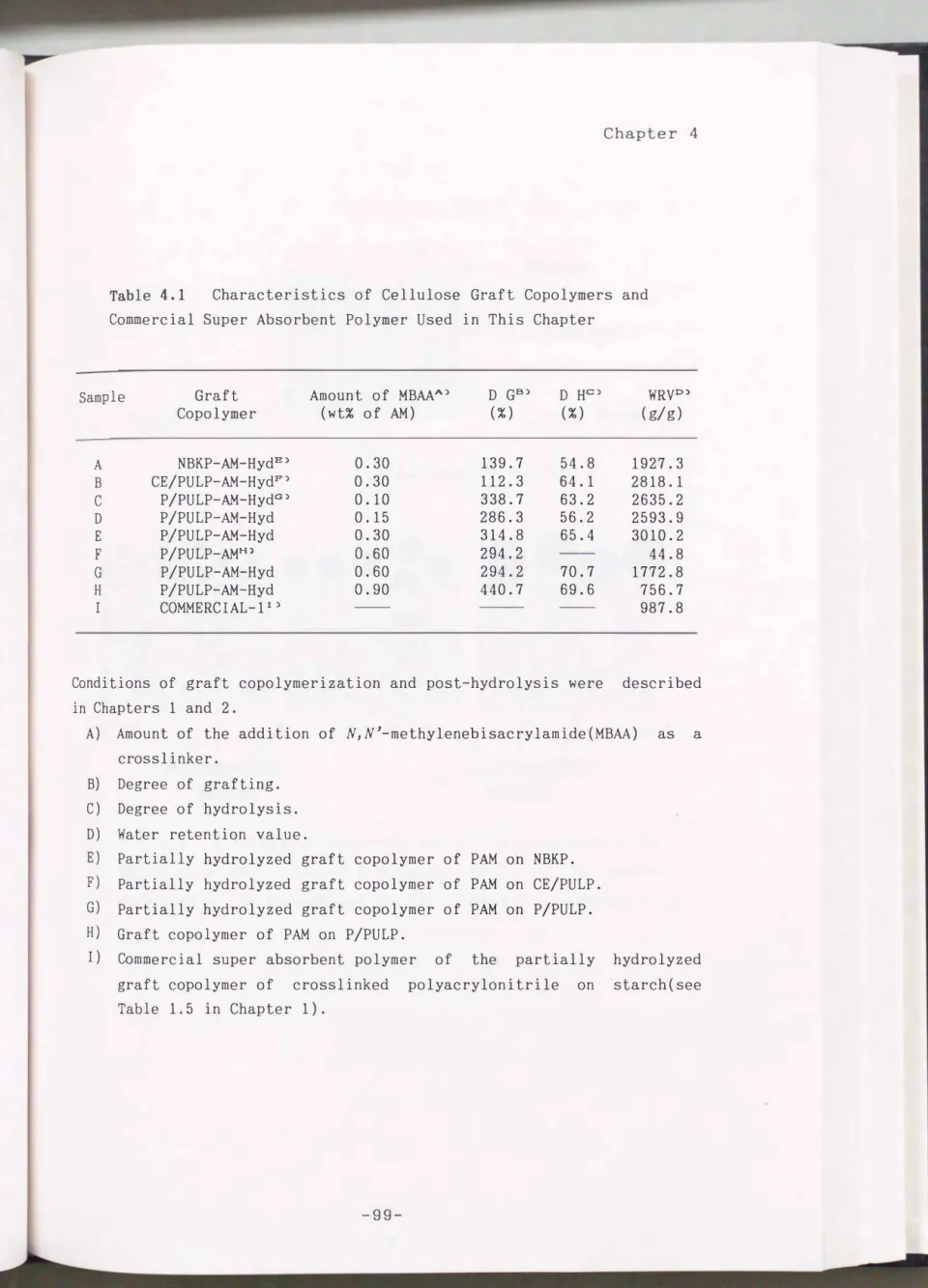
Table 4.1 shows the
The principle of the solute exclusion technique is illustrated in Fig. 4.1 [177-180]. A hydrogel containing a known quantity of water, which is swollen in water to an equilibrium state, is immersed in an aqueous solution of known concentration of a solute of known hydrodynamic diameter. The solute molecules diffuse into the water contained in pores of wider widths in the hydrogel than the diameter of the solute molecules. If all the solute molecules are smaller in diameter than the pores, all the water originally contained in the hydrogel can be accesible to the solute molecules, and it will all equilibrate with and dilute the solution, as shown in Case A. If a solution containing larger solute molecules is used as shown in Case
Table 4.1 Characteristics of Cellulose Graft Copolymers and Commercial Super Absorbent Polymer Used in This Chapter
Sample Graft Amount of MBAAA> D QB> D HC) WRV0) Copolymer (wt% of AM) (%) (%) (g/g)
A NBKP-AM-HydE> 0.30 139.7 54.8 1927.3
B
CE/PULP-AM-HydF> 0.30 112.3 64.1 2818.1c P/PULP-AM-HydG> 0.10 338.7 63.2 2635.2
D P/PULP-AM-Hyd 0.15 286.3 56.2 2593.9
E
P/PULP-AM-Hyd 0.30 314.8 65.4 3010.2F P/PULP-AMH> 0.60 294.2 44.8
G P/PULP-AM-Hyd 0.60 294.2 70.7 1772.8
H
P/PULP-AM-Hyd 0.90 440.7 69.6 756.7I
COMMERCIAL-11> 987.8Conditions of graft copolymerization and post-hydrolysis were described in Chapters 1 and 2.
A) Amount of the addition of N,N'-methylenebisacrylamide(MBAA) as a crosslinker.
B)
Degree of grafting.C) Degree of hydrolysis.
D) Water retention value.
Partially hydrolyzed graft Partially hydrolyzed graft Partially hydrolyzed graft
copolymer copolymer copolymer
E) F)
G)
H)
Graft copolymer of PAM on P/PULP.of PAM on NBKP.
of PAM on CE/PULP.
of PAM on P/PULP.
I)
Commercial super absorbent polymer of the partially hydrolyzed graft copolymer of crosslinked polyacrylonitrile on ·starch(see Table 1.5 in Chapter 1).Small Pore
Case A
Accessible Water
Chapter 4
Large Pore
�
Addition of SolutionInaccessible Water
Case C
Fig. 4.1 A schematic representation of the principle of the solute exclusion technique for the examination of the porous structure of the hydrogel of the cellulose graft copolymer.
B, such that the water in the smaller pores in the hydrogel are inaccessible to the solute molecules used, then this water is unavailable for dilution, and the mixed solution will be somewhat less diluted than in the Case A. This difference in concentration is the basis of a simple calculation to give the amount of the inaccessible water.
The larger the solute molecule, the more water is inaccessible to it. If the solute molecules is so large that they cannot enter any pores in the hydrogel as shown in Case C, the amount of the inaccessible water equals the total water in the hydrogel, assuming that the hydrogel does not shrink in the solution or that the porous structure does not change in the solution in any way.
4.2.3 Examination of Porous Structure
The porous structures of the hydrogels of the cellulose graft copolymers were examined by using of the solute excl usion technique.
The solute molecules used were a few simple sugars
(
glucose, maltose, and raffinose) and a series of Dextran fractions obtained from Wako Pure ·chemical Industries, Ltd. and Pharmacia Ltd., respectively. Their molecular weights and hydrodynamic diameters are listed in Table 4.2.The procedure was as follows: Ten grams of the dried
Chapter 4
Table 4.2 Molecular Weights and Hydrodynamic Diameters in water of the Solute Molecules Used on the Solute Exclusion Technique
Solute Molecular Hydrodynamic
Molecule Weight Diameter (A)
Glucose 180.16 8A)
Maltose 342.30 lQA>
Raffinose 504.44 12A)
Dextran TlO 11,200 51 B)
Dextran T40 39,800 goa>
Dextran T70 70,000 118B>
Dextran T500 420,000 27QB>
Dextran T2000 2,000,000 56QB>
A)
The hydrodynamic diameter was estimated by interpolation of the diffusion data given by Longsworth [181].B) The hydrodynamic diameter was estimated by interpolation of the diffusion data given by Granath and Kvist [182].
graft copolymer was weighed into an Erlenmeyer flask. To this was added about 30 g of water. The mixture was allowed to stand for 60 hours in order to swell to an equilibrium state. Then, about 30 g of an aqueous
1
wt%stock solution of a solute molecule was added to the hydrogel dispersion in the flask. The flask was then
tightly stoppered and was allowed to stand for 60 hours with periodic shaking. After this time, the hydrogel dispersion was filtered through a glass filter, followed by through a Millipore filter. The concentration of the filtrate was compared with that of the original stock solution by use of
a refractometer
(
Knauer Differential Refractometer, Type98.00).
The amount of water inaccessible to the solute molecule, which corresponded to the cumulative pore volume to a size of a hydrodynamic diameter of the solute molecule used in the hydrogel, was calculated by the following equation[177-180]:
0 = w
+ q
X
( 1 -
p
w w + q
Ci
X--
)
C:e
(
4.1)
where o is the inaccessible water in grams or the cumulative Pore volume in milliliters per gram of dry graft copolymer, P is the dry weight of sample, q is the weight of water in
hydrogel, w is the weight of solution of solute molecule, Ci is the initial concentraion of solution of solute molecule, and C:e is the final concentration of solution after addition
Chapter 4
of hydroge 1.
It was tried to investigate the effect of the swelling
condition such as an addition of neutral salt and a change in pH on the porous structures of the hydrogel. In order
to examine whether the hydrodynamic diameters of the solute molecules in water differs from those in aqueous NaCl solutions or not, the viscosities of the solute molecules were measured in water and aqueous NaCl solutions. There was little difference between the intrinsic viscosities of the solute molecules in water and those in aqueous NaCl solutions. This result indicates that the hydrodynamic diameters of the solute molecules in aqueous NaCl solutions were equal to those in water. Therefore, the porous structures of the hydro gels swollen in aqueous NaCl solutions or in solutions with d ifferent pHs were also examined in a similar manner as described above.
Moreover, the relative cumulative pore volume was calculated as the percentage of the cumulative pore volume
relative to the total pore volume that corresponded to the water retention value
(
WRV)
or saline retention value(
SRV)
ofthe cellulose graft copolymer.
4.3 Results and D iscussion
4.3.1 Porous Structures in Water of Hydrogels of Cellulose
Graft Copolymers
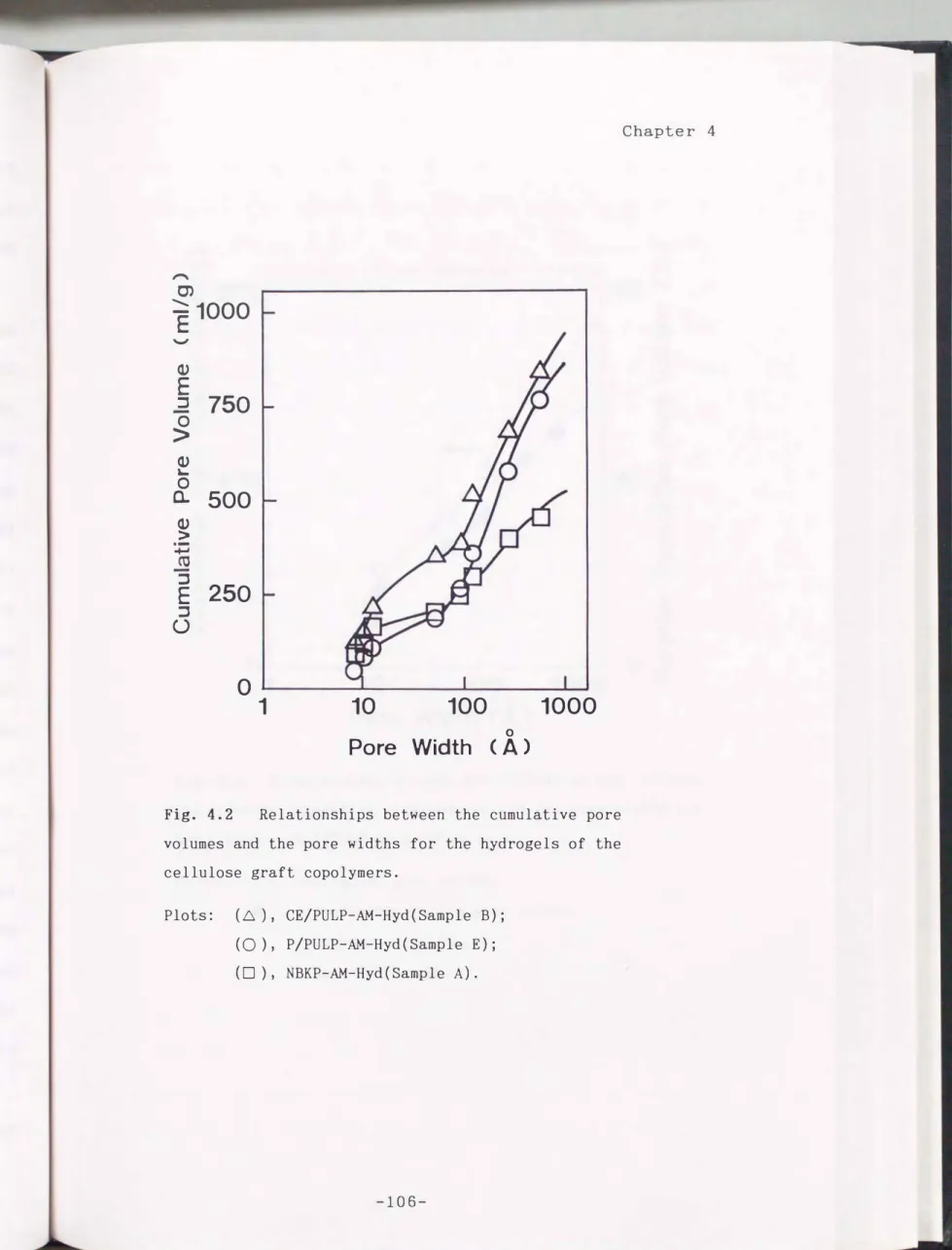
Fig. 4. 2 shows the relationships between the cumulative
pore
volumes and the pore widths for the hydrogels ofCE
/
PULP-AM-Hyd(
Sample B)
, P/
PULP-AM-Hyd{
Sample E)
, and NBKP- AM-Hyd(
Sample A)
. The hydrogels were extremely porous.Stone
and Scallan found that the total pore volumes of thep
ulps swollen in water were from 0.8 mL/
g to 2 .0 mL/
g[
177-180] .
They also found that the cumulative pore volumeincreased with an increase in the pore width and leveled off around 90-560 A in pore width. However, the cumulative
pore
volumes up to 560 A in pore width of the hydrogels of CE/
PULP-AM-Hyd, P/
PULP-AM-Hyd, and NBKP-AM-Hyd were 8 43. 7mL/g,
766.1 mL/
g, and 452 .6 mL/
g, respectively, and the cumulative pore volumes tended to increase with a further increase in the pore width over 560 A. The total porevolume
that corresponded to the WRV of NBKP-AM-Hyd wassmaller
than those of CE/
PULP-AM-Hyd and P/
PULP-AM-Hyd asshown
in Table 4. 1, and it is considered that this is thereason
why the cumulative pore volume up to 560 A in porewidth of the hydrogel of NBKP-AM-Hyd was smaller than those of the hydrogels of CE
/
PULP-AM-Hyd and P/
PULP-AM-Hyd.Fig. 4. 3 show the relationships between the cumulative
Pore
volumes and relative cumulative pore volumes and the,...
C)
�1000
...,
C1)
E
:J
750
-
0
>
C1) '-
a. 0
500
C1) >
·-
+""
C'O
::J
250
E
::J(.)
0
�---�---�---�1 10 100 1000
Pore Width < A )
0Fig. 4.2 Relationships between the cumulative pore volumes and the pore widths for the hydrogels of the cellulose graft copolymers.
Plots:
(6),
CE/PULP-AM-Hyd(Sample B);(0), P/PULP-AM-Hyd(Sample E);
(D), NBKP-AM-Hyd(Sample
A).
Chapter 4
r"'\ ""'
C) � 0
::J 800 40
'llt,JE
Q)\.,/
E
:J
Q) -
E >
0:J Q)
-
0 '-
>
0Q) a..
'- (1)
0
400 20
>c.. +""
(1) C'O
> :J
... C'O
E
:J
:J
(.)
E
(1):J >
(.)
...C'O
0 0
(1)1 10 100 1000
0::Pore Width (A)
0Fig. 4.3 Relationships between the cumulative pore volumes and relative cumulative pore volumes and the pore widths for the hydrogel of P/PULP-AM-Hyd(Sample
D).
Plots: (0), cumulative pore volume;
(e),
relative cumulative pore volume.pore widths of the hydrogel of
Chapter 4 P/PULP-AM-Hyd(Sample D).
The cumulative pore volume up to 560 A in pore width of the hydrogel was 652.2 mL/g. The relative cumulative pore volume up to 560 A in pore width was 25.1%, and only 25.1%
of the total pore volume was occupied by the pores smaller
than 560 A in pore width. This result indicates that the pores larger than 560 A in pore width comprised about 75% of the total pore volume in the hydrogel.
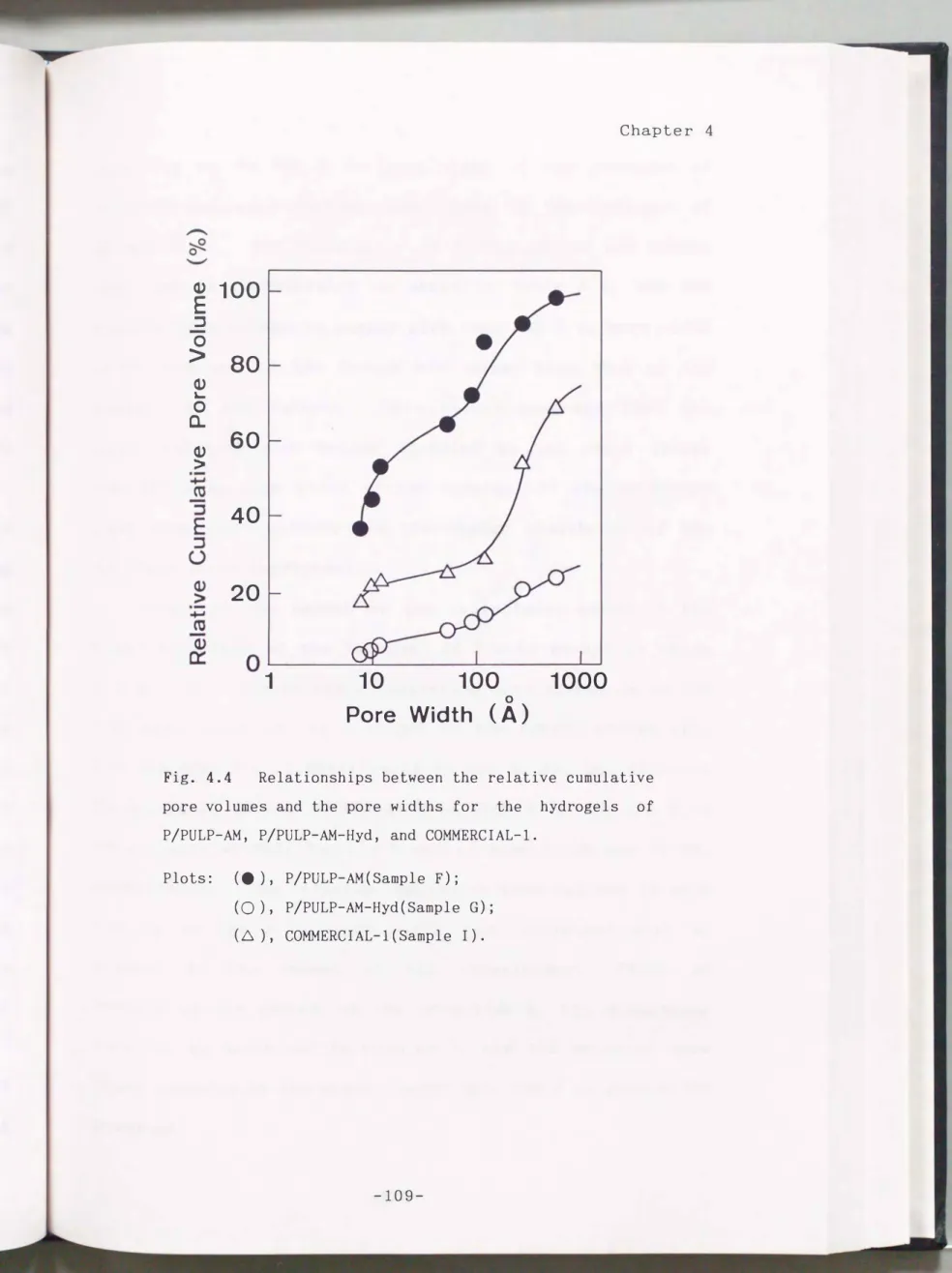
Fig. 4. 4 shows the relationships between the relative cumulative pore volumes and the pore widths for the hydrogels of P /PULP-AM (Sample
F)
, P /PULP-AM-Hyd (SampleG) ,
and COMMERCIAL-l(Sample I). After hydrolysis, the hydrogel of the cellulose graft copolymer of PAM came to highly swell in water, and the WRV increased from 44.8 g/g to 1772.8 g/g as shown in Table 4. 1. The relative cumulative pore volumes up to 8 A and 560 A in pore width of the hydrogel of P/PULP-AM were 36. 2% and 99.0%, respectively, but those of the hydrogel of P/PULP-AM-Hyd were 1.9% and 23.0%, respectively. Most of the pores in the hydrogel of P/PULP- AM was smaller than 560 A in pore width, but most of the
Pores in the hydrogel of P/PULP-AM-Hyd was larger than 560 A in pore width.
The relative cumulative pore volume of the hydrogel of COMMERCIAL-! increased from 17.1% to 69.7% with an increase in the pore width. The relative cumulative pore volumes in
� 100
::J 0
> 80
Q)
L.
0 c..
Q) >
60
40
20
0
�----��---�---��1 10 100 1000
0
Pore Width (A)
Fig. 4.4 Relationships between the relative cumulative pore volumes and the pore widths for the hydrogels of P/PULP-AM, P/PULP-AM-Hyd, and COMMERCIAL-!.
Plots:
(e),
P/PULP-AM(SampleF);
(0), P/PULP-AM-Hyd(Sample
G);
(6
), COMMERCIAL-l(Sample I).Chapter 4 each size up to 560 A in pore width of the hydrogel of P/PULP-AM-Hyd were smaller than those of the hydrogel of COMMERCIAL-1 . The absorbency of P/PULP-AM-Hyd was higher than that of COMMERCIAL-1 as shown in Table 4. 1, and the relative pore volume in larger size than 560 A in pore width of the hydrogel of the former was larger than that of the hydrogel of the latter. This result suggests that the larger relative pore volume occupied by the pores larger than 560 A in pore width of the hydrogel of the cellulose graft copolymer participates the higher absorbency of the ce llulose graft copolymer.
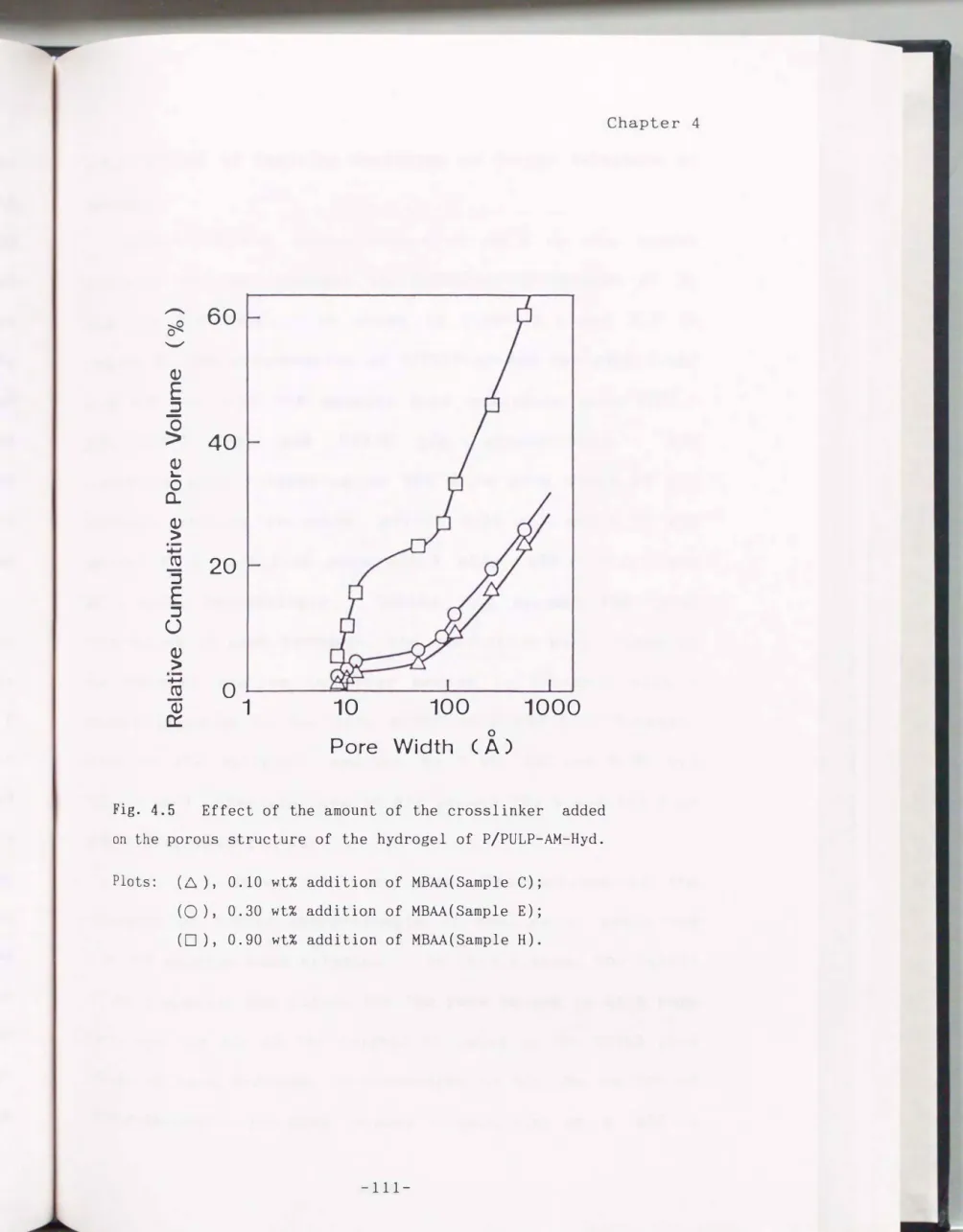
Effect of the amount of the crosslinker added on the porous structure of the hydrogel of P/PULP-AM-Hyd is shown in Fig. 4.5. The relative cumulative pore volume up to 560 'A in pore width of the hydrogel of the P/PULP-AM-Hyd with 0.90 wt% addition of MBAA(Sample H) was 60.6%, but those of
the hydrogels of the P/PULP-AM-Hyds with 0.10 wt% and 0.30 wt% addition of MBAA(Samples C and E) were 23.1% and 25.5%, respectively. The relative cumulative pore volumes in each size up to 560 A in pore width also increased with an
increase in the amount of the crosslinker. With an increase in the amount of the crosslinker, the absorbency decreased as described in Chapter 1, and the relative pore volume occupied by the pores larger than 560 A in pore width decr e ased.
....-....
60
� 0
""'-"'
d)
� E
� 40
d) '-
0 c.
d) >
-+--1
C'O
20
::J
E
()
::Jd) >
-+--1
0
C'O
d)
1 10 100 1000
0::
Pore Width CA)
0Fig. 4.5 Effect of the amount of the crosslinker added
on the porous structure of the hydrogel of P/PULP-AM-Hyd.
Plots:
(.6 ) ,
0.10 wt% addition of MBAA(SampleC);
(0),
0.30 wt% addition of MBAA(Sample E);(D),
0.90 wt% addition of MBAA(Sample H).Chapter 4 3 2 Effect of Swelling Condition on Porous Structure of 4. •
Hydrogel
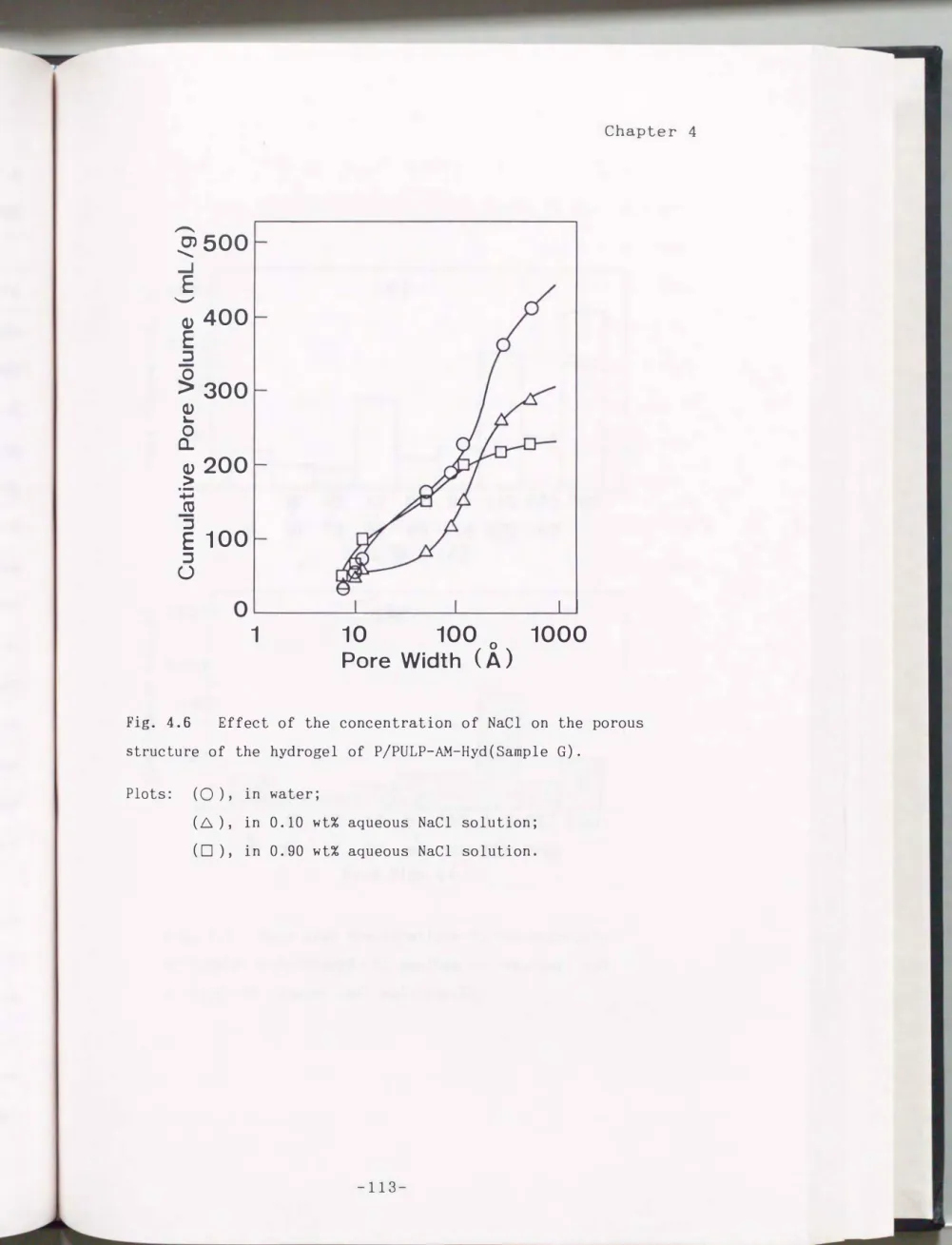
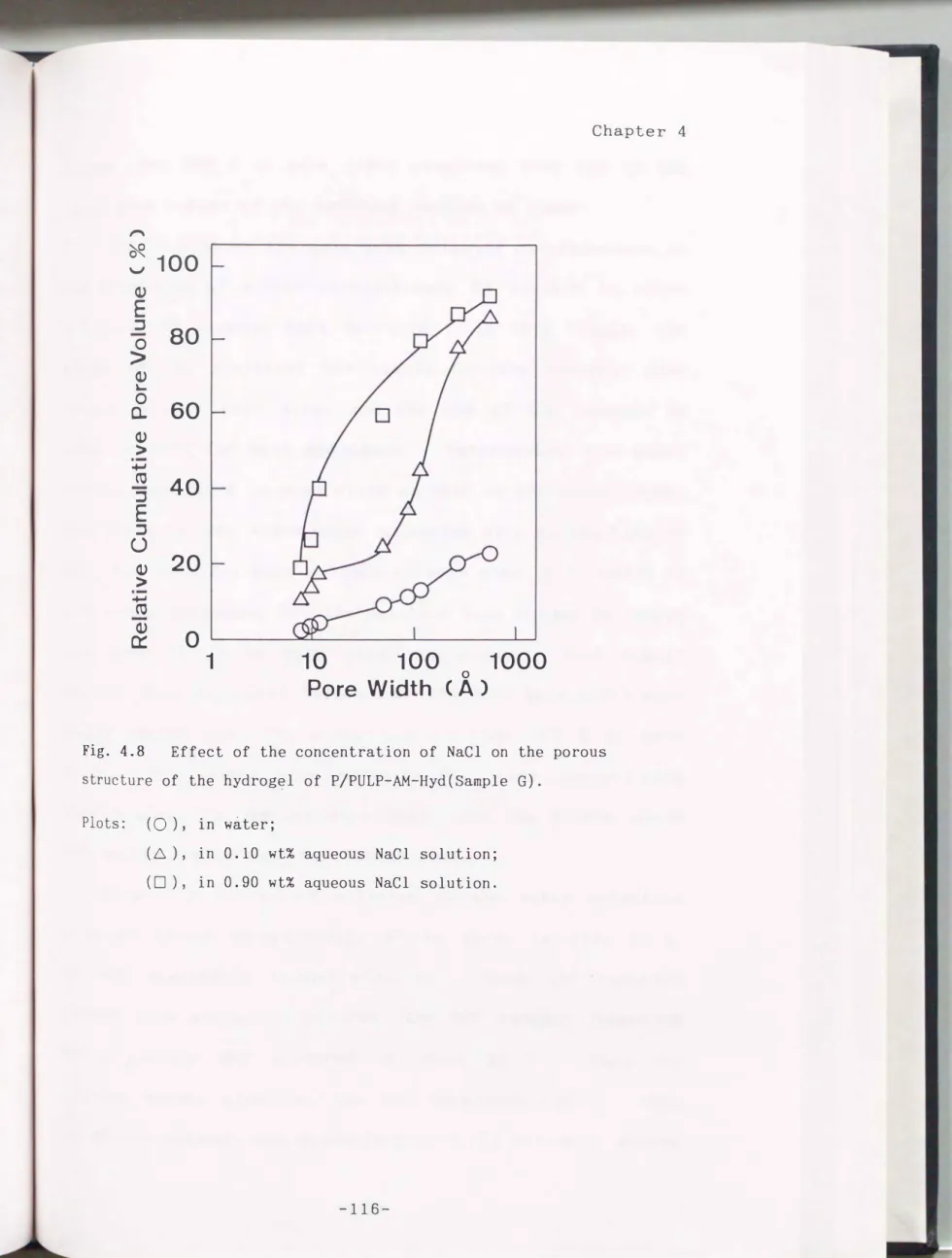
Effect of the concentration of NaCl on the porous
structure of the hydrogel of P
/
PULP-AM-Hyd(
SampleG)
isshown in Fig. 4.6. As shown in Figs. 2.1 and 2.2 in Chapter 2, the absorbencies of P
/
PULP-AM-Hyd for water, and0.10 wt% and 0. 90 wt% aqueous NaCl solutions were 1772.8
gjg,
338.0 gj
g, and 249.6 g/
g, respectively. Thecumulative pore volumes up to 560 A in pore width of the hydrogels swollen in water, and in 0. 10 wt% and 0. 90 wt%
aqueous NaCl solutions were 408.5 mL
/
g, 289.0 mL/
g, and 227.6 mL/
g, respectively. Taking into account the total pore volume of each hydrogel, the cumulative pore volume of the hydrogel swollen in water tended to increase with a further increase in the pore width over 560 A. However, those of the hydrogels swollen in 0. 10 wt% and 0. 90 wt%aqueous NaCl solutions leveled off around 270 A and 118 A in Pore width, respectively.
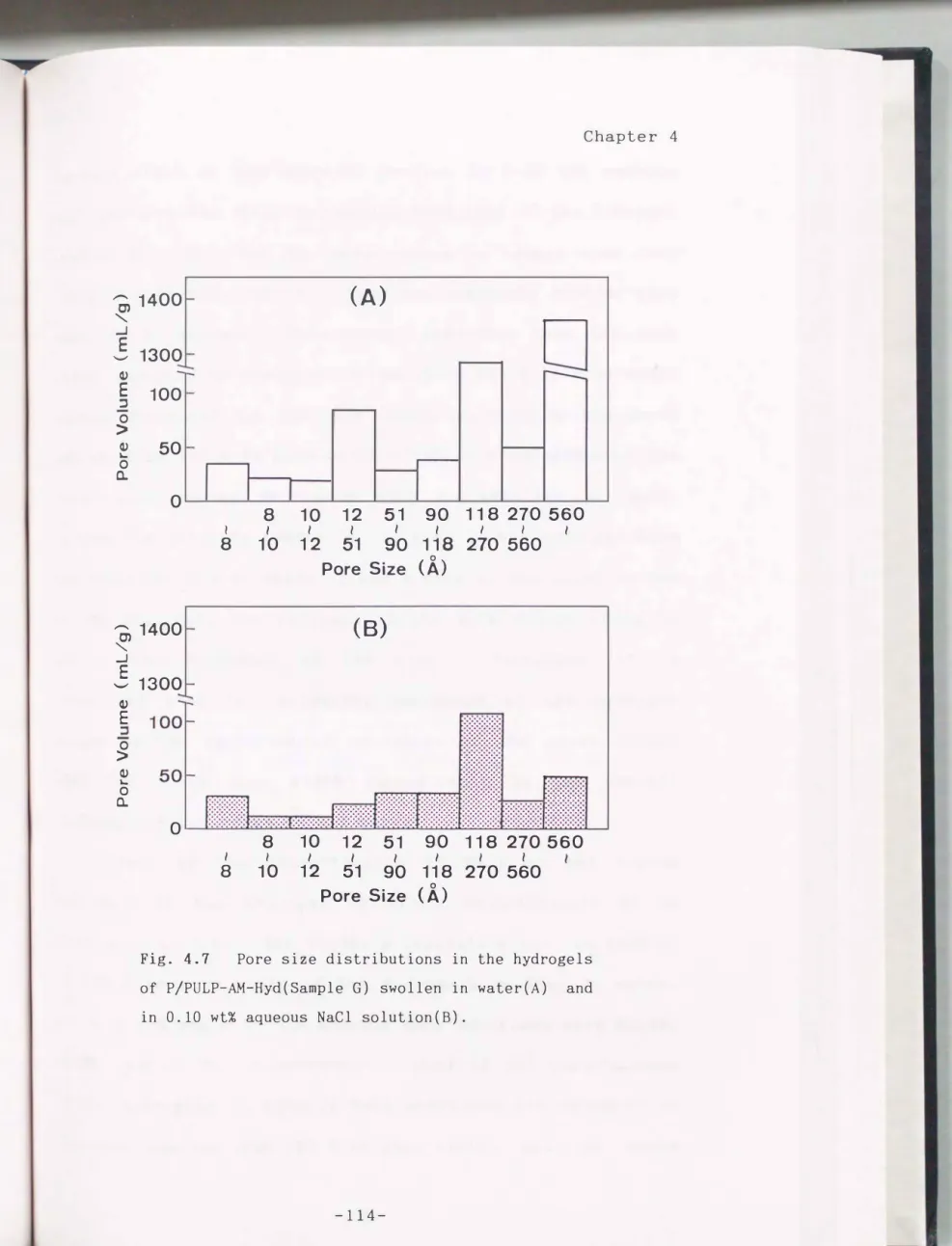
Fig. 4.7 shows the pore size distributions in the hydrogels of P
/
PULP-AM-Hyd(
SampleG)
swollen in water and0.10 wt% aqueous NaCl solution. In this figure, the height of the graphical bar stands for the pore volume in each pore size, and the sum of the heights is equal to the total pore Volume of each hydrogel corresponding to the WRV or SRV of P
/
PULP-AM-Hyd. The pore volumes in each size up to 560 A..-..
�500
...J
E
..._,
Q)
400
E
:J 0> 300
Q) '-
0 Cl.
Q)
200
>
� (TJ ::J
E 100
::J
u
O L-._
___ _�._ ___ --�..._ ___ __.___.J1 10 100
0
1000
Pore Width ( A)
Fig. 4.6 Effect of the concentration of NaCl on the porous structure of the hydrogel of P/PULP-AM-Hyd(Sample
G).
Plots: (0), in water;
(.6), in 0.10 wt% aqueous NaCl solution;
( D ) , in 0. 90 wt% aqueous NaCl solution.
Chapter 4
a, 1400
-(A)
...
...J
E 1300
_..
Q)
-
g
::::::
E 100
::J -
> 0
Q)
50
"- -
a. 0
0 n 8 r 10 12 5 1
Jl 90 118 270 560
l I I l I I I I I
8 10 12 51 90 118 270 560
Pore Size(A)
-m 14oo (B)
"' ...J
.5 1300
Q)
E
::J> 0
Q) "-
a. 0 ...
0 8 10 12 5 1 90 118 270 560
I I I I I I I l
8
10 12 51 90 118 270 560
Pore Size(A)
Fig. 4.7 Pore size distributions in the hydrogels of P/PULP-AM-Hyd(Sample
G)
swollen in water(A) and in 0.10 wt% aqueous NaCl solution(B).in pore width of the hydrogel swollen in 0. 10 wt% aqueous NaCl solution was slightly smaller than that of the hydrogel swollen in water, but the pore volume in larger size than 560 'A in pore width of the former was extremely smaller than that of the latter. This result indicates that the pore volume occupied by the pores larger than 560 A in pore width steeply decreased but the pore volume occupied by the pores smaller than 560 A in pore width slightly decreased when the total pore volume decreased with an addition of NaCl.
Becau se the absolute number of the pore in the hydrogel does not probably vary in spite of the change in the total volume of the hydrogel, the decrease in the pore volume would be due to the shrinkage of the pore. Therefore, it is considered that the voluminal shrinkage of the hydrogel occurs by the preferential shrinkage of the pores larger than 560 A in pore width rather than by the overall shrinkage of the pores in all sizes.
Effect of the concentration of NaCl on the porous structure of the hydrogel of P
/
PULP-AM-Hyd(
SampleG)
is shown in Fig . 4 . 8 . The relative cumulative pore volumes up to 560 'A in pore width of the hydrogels swollen in water, and 0.10 wt% and 0. 90 wt% aqueous NaCl solutions were 23.0%, 85.5%, and 91.2%, respectively. Most of the pore volumes of the hydrogels in aqueous NaCl solutions was occupied by the Pores smaller than 560 A in pore width, but the pores�
� 100
Q) E
:J
>
0Q)
,_0
0.
Q)
>+J
ro :l E
:J
() Q)
>+J
ro c:: Q)
80
60
40
20
0
Chapter 4
1 10 1 00 1000
Pore Width (A)
0Fig. 4.8 Effect of the concentration of NaCl on the porous structure of the hydrog�l of P/PULP-AM-Hyd(Sarnple
G).
Plots:
(0)'
in water;(6)'
in 0.10 wt% aqueous NaCl solution;(0 )
' in 0.90 wt% aqueous NaCl solution.larger than 560 A in pore width comprised over 70% of the
total pore volume of the hydrogel swollen in water.
Fig. 4.9 shows the pore size relative distributions in
the hydrogels of P
/
PULP-AM-Hyd(
SampleG)
swollen in water and 0. 90 wt% aqueous NaCl solution. In this figure, the height of the graphical bar stands for the relative pore volume in each pore size, and the sum of the heights is equal to 100% for both hydrogels. Nevertheless the pores smaller than 560 A in pore width as well as the pores larger than 560 A in pore width ought to shrink with an addition of NaCl, the relative pore volumes in each size up to 560 A in pore width increased, but the relative pore volume in larger size than 560 A in pore width decreased. This result suggests that the pores larger than 560 A in pore width more easily shrink than the pores smaller than 560 A in pore width. The larger pore probably has lower crosslinkingdensity than the smaller pore does, and the former would more easily shrink than the latter does.
Effect of the pH of solution on the water retention value of P
/
PULP-AM-Hyd(
SampleG)
is shown in Fig. 4.10.The WRV remarkably varied with pH. When the ·solution changed from acidic to neutral, the WRV steeply increased and a maximum WRV appeared at about pH 7. When the solution became alkaline, the WRV decreased again. When the PH was reduced, the dissociation of the carboxyl groups
I""'\
�
""
4)
E
::J> 0
4)
0 ...
a.
1""\
�
""
4)
E
::J> 0
4)
... 0 Q.
0
8
0
-7 0-
:::::20
-10
r-0
I
8
I
8
8
10
I I
1
0 12
8 10
I I
10 12
(A)
12 5 1 90 11 8 270 560
I I I I I I
51 90 118 270 560
0
Pore Width CA>
(B)
12 51 90
118270 560
I I I I I
51 90
118270 5 60
Pore Width (A) 0Chapter 4
Fig. 4.9 Pore size relative distributions in the hydrogels of P/PULP-AM-Hyd(Sample
G)
swollen inwater(A) and in 0.10 wt% aqueous NaCl solution(B).
'@2000 '
C')v
�
�1500
>
c:
0
·-
...,
�1000
c:� a::
2 4 6 8 10 12 14 pH
Fig. 4.10 Effect of the pH of solution on the water retention value of P/PULP-AM-Hyd(Sample G).
Chapter 4 in the graft copolymer was depressed, and the WRV decreased in acidic solutions. When the pH was raised, the difference in the osmotic pressure between the internal and external solution of the hydrogel decreased owing to the increase in the ionic strength in the external solution, and the WRV decreased in alkaline solutions. Such a pH dependence of the absorbency is a general swelling phenomenon of the super absorbent polymer
[
2-9].Figs. 4.11 and 4.12 show the effect of pH of solution on the porous structure of the hydrogel of P
/
PULP-AM-Hyd (Sample G) . The porous structure also changed with a va1·iation of the pH. As shown in Fig. 4.11, not only the relative cumulative pore volume up to 560 A in pore width increased from 23.0% to 96.5% when the pH was reduced, but the cumulative pore volumes in each size up to 560 A in pore width of the hydrogels swollen in acidic solutions were larger than that of the hydrogel in water. In alkaline solutions, as well as in acidic solutions, the relative
cumulative pore volumes in each size up to 560 A in pore width increased when the pH was raised as shown in Fig.
4.12. On the other hand, in regard to the curves · given in the relationships between the relative cumulative pore Volumes and the pore widths for the hydrogels, the curves for the hydrogels in alkaline solutions were different in shape from those for the hydrogels in acidic solutions but
r'\
� 100
Q)
E
-::J
0
>
Q)
�
0 c.
Q)
>
·-
+-'
ro
-::J
E
::J
() Q)
>
+-'
ro Q) c::
80
60
40
20
0
L---��---�---��1 10 100 1000
Pore Width C A)
0Fig. 4.11 Effect of the pH of solution on the porous structure of the hydrogel of P/PULP-AM-Hyd(Sample
G).
Plots: (0), in water of pH
6.5;
(6
) , in aqueous solution of pH 4.1;(0
), in aqueous solution of pH 2.1.'"'
� 100
4.)
E
-
::J 0>
4.)
�
0 a.
4.) >
...,
C'O :J
E
:J
(.)
4.) >80
60
40
20
0
1 10 100 1000
Pore Width (A )
0Fig. 4.12 Effect of the pH of solution on the porous structure of the hydrogel of P/PULP-AM-Hyd{Sample G).
Plots:
( 0
) , in water of pH 6. 5;(D. ) , in aqueous solution of pH 10.4;
(0 ), in aqueous solution of pH 12.3.
Chapter 4
were similar in shape to those in aqueous NaCl solutions as shown in Fig. 4.8. This result indicates that the pore
size distributions in the hydrogels swollen in alkaline
solutions were different from those in the hydrogels swollen in acidic solutions but were similar to those in aqueous NaCl solutions, and that the effects of alkalis and neutral salts on the shrinkage of the hydrogel was different from the effects of acids. Therefore, it was confirmed by the result from the examination of the porous structure of the hydrogel that the mechanism of the decrease in the absorbency, i.e., the depression of the expansion of the pulymer network in an alkaline solution was similar to that in an aqueous NaCl solution but was different from that in an acidic solution.
Chapter 4 4.4 Conclusion
The porous structures of the hydrogels of the cellulose
graft copolymers were examined by using of the solute exclusion technique. The hydrogels of the hydrolyzed cellulose graft copolymers were extremely porous. The cumulative pore volumes up to 560 A in pore width of them were went up to about 450-850 mL
/
g and tended to increase with a further increase in the pore width over 560 A.However, the relative cumulative pore volumes up to 560 A in pore width to the total pore volume of them were only about 23-25%. The pores larger than 560 A in pore width comprised over 70% of the total pore volume that corresponded to the WRV. On the other hand, the relative cumulative pore volume up to 560 A in pore width of the hydrogel of the graft copolymer that had not been hydrolyzed reached 9 9%. The hydrolyzed cellulose graft copolymers had higher absorbencies than the commercial super absorbent Polymer did, and the relative pore volumes in larger size than 560 A in pore width of the hydrogels of the formers
were larger than that of the hydrogel of the latter. With
an increase in the amount of the cross linker added, the total pore volume decreased, and the relative pore volume in larger size than 560 A in pore width decreased. Most of the total pore volume of the highly swollen hydrogel was
occupied by the pores larger than 560 A in pore width, and
the relative pore volume in larger size than 560 'A in pore width increased with an increase in the total pore volume.
It is considered that the reason why the hydrolyzed cellulose graft copolymers could absorb extremely large amounts of water is due to the porous structures of their hydrogels that are extremely porous and are composed by
extremely large pores.
To clarify the swelling behavior of the cellulose graft copolymer, the effect of the swelling condition on the porous structure was also examined. Fig. 4.13 shows a schematic representation of the changes in the porous structure with the change in the total volume of the hydrogel of the cellulose graft copolymer. Models A and B show the hydrogel swo·llen in water and in an aqueous NaCl solution, respectively. The total pore volume decreased with an increase in the concentration of NaCl in solution.
The absolute number of the pore in the hydrogel does not Probably vary in spite of the change in the total volume of the hydrogel, and the decrease in the pore volume would be due to the shrinkage of the pore. With a decrease in the total pore volume, the pore volume occupied by the pores larger than 560 'A in pore width steeply decreased with a decrease in the total pore volume, but the pore volume occupied by the pores smaller than 560 'A in pore width slightly decreased. Therefore, the voluminal shrinkage of
Chapter 4
B
Fig. 4.13 A schematic representation of the change in the porous structure with the shrinkage of the hydrogel the highly water-absorptive cellulose graft copolymer.
the hydrogel would be due to the preferential shrinkage of the pores larger than 560 A in pore width rather than to the overall shrinkage of the pores in all sizes. Moreover, although the pores smaller than 560 A in pore width as well as the pores larger than 560 A in pore width ought to shrink with an addition of NaCl, the relative pore volumes in each size up to 560 A in pore width increased, but the relative pore volume in larger size than 560 A in pore width decreased. The larger pore, which has lower crosslinking density than the smaller pore does, would more easily shrink that the smaller pore does.
The WRV remarkably varied with pH, and a maximum WRV appeared at about pH 7. The porous structure also changed
with a variation of the pH. Not only the relative
cumulative pore volume up to 560 A increased when the pH was reduced or raised from pH 7, but the relative cumulative pore volumes in each size up to 560 A in pore width for the hydrogels swollen in acidic or alkaline solutions were larger than that for the hydrogel in water. The pore size distributions in the hydrogels swollen in alkaline solutions were different from those in the hydrogels swollen in acidic solutions but were similar to those in aqueous NaCl solutions. It was confirmed by the result from the examination of the porous structure of the hydrogel that the mechanism of the decrease in the absorbency, i.e., the
Chapter 4 depression of the expansion of the polymer network in an alkaline solution was similar to that in an aqueous NaCl solution but was different from that in an acidic solution;
that is, when the pH was raised or the concentration of NaCl increased, the difference in the osmotic pressure between the internal and external solution of the hydrogel decreased owing to the increase in the ionic strength in the external solution, and the expansion of the polymer network depressed in alkaline solutions or aqueous NaCl solutions. When the pH was reduced, the dissociation of the carboxyl groups in the graft copolymer was depressed, and the expansion of the polymer network depressed in acidic solutions.
Chapter 5
Rheological Properties of Hydrogels of Cellulose Graft Copolymers
5.1 Introduction
Gels of crosslinked polymers have unique properties that are intermediate between those of liquids and solids.
Because the gels are insoluble in solvents, it had been difficult to analyze their formation processes, structures, and rheological properties [ 5] . Thus, the pract?ical studies on the gels had been carried out in preference to the theoretical studies on them, and new materials had been developed from them. In 1978, it was reported by Tanaka that a discontinuous and reversible swelling-shrinking phenomenon with a change in the composition of swelling solvent was observed in a gel of partially hydrolyzed Polyacrylamide swollen in the mixture of water-acetone, and this phenomenon has come to be known by the special term
"phase transition of gel" Taking this opportunity, the
investigation for the gels have proceeded, and the swelling behavior and the rheological properties of various gels have been extensively reported [ 2-9, 176, 183-256]. The gels have been utilized in various engineering and industrial
fields as seals, toys, sensors, electrodes,
Chapter 5 water-oil separable materials, cosmetics, lenses, shock and sound absorber, artificial muscles, and elastmers owing to their swelling properties, electrical properties, selectivities for water, thickening
for lights,
properties, transparencies, permeabili ties shock and sound absorptive properties, flexibilities, mechanochemical responsibilities, and viscoelastici ties [ 2-9, 176, 209].
The hydrogels of the super absorbent polymers also show the swelling-shrinking phenomenon with a change in the swelling condition, and the magnitudes of their voluminal changes are larger than those of other gels. They have recently become of interests in the development of new materials, and their rheological properties as well as their swelling properties have been important. In general, however, only the absorbencies of the super absorbent polymers have been measured. The rheological properties for the hydrogels and dispersions of the starchy absorbents have studied by Taylor and Bagley [27, 28, 257-259], but the changes in the rheological properties with the voluminal changes have not been studied in detail.
Therefore, the rheological properties such as viscosities and dynamic viscoelastici ties of the hydrogels and their dispersions of the cellulose graft copolymers were discussed. Moreover, the changes in the rheological
propereties with the changes in the swelling condition were also discussed to clarify the swelling behavior of the graft copolymers.
5. 2 Experimental 5. 2. 1 Samples
The partially hydrolyzed
Chapter 5
graft copolymers of
crosslinked polyacrylamide
(
PAM)
on cellulosics such as a bleached kraft pulp from softwood(
NBKP)
, a NBKP being in powdery form(
P/
PULP)
, and a water-solubilized NBKP modified by slight cyanoethylation(
CE/
PULP)
, which were synthesizedas described in Chapters 1 and 2, were used as the sample in
this chapter. Table 5.1 shows the characteristics of the cellulose graft copolymers used in this chapter.
5.2.2 Measurement of
V
iscosityBecause a slip occurs between the hydrogel particles in the hydrogel dispersion or a destruction of the hydrogel locally occurs during measurement, it is difficult to measure accurately the viscosity of the hydrogels and their dispersions of the super absorbent polymers by use of the conventional dynamical viscometers. Therefore, a viscometer based on the heat transmission in the hydrogel
(
Rheo Catch SVM-100, Snow Brand Milk Products Co., Ltd.) was used for the measurement[
260-262]
.Fig. 5.1 shows the principle of the measurement. When
a constant electrical current is given to a sensor that is
vertically stood in a fluid, the tempeature of the sensor increases with time, and the difference in temperature
Table 5.1 Characteristics of Cellulose Graft Copolymers and Commercial Super Absorbent Polymers Used in This Chapter
Sample Graft Amount of MBAAA> D G8) D HC) WRV0) Copolymer (wt% of AM) (%) (%) (g/g)
A
NBKP-AM-HydE> 0.30 218.2 63.0 2692.8B CE/PULP-AM-HydF> 0.30 112.3 64.1 2818.1
c CE/PULP-AM-Hyd 0.30 150.2 72.8 2710.3
D P/PULP-AM-Hyd0> 0.10 338.7 63.2 2635.2
E
P/PULP-AM-Hyd 0.30 314.8 65.4 3010.2F P/PULP-AM-Hyd 0.60 294.2 70.7 1772.8
G
P/PULP-AM-Hyd 0.90 440.7 69.6 756.7H
COMMERCIAL-1H> 987.8I
COMMERCIAL-21> 680.8Conditions of graft copolymerization and post-hydrolysis were described in Chapters 1 and 2.
A)
Amount of the addition of N,N'-methylenebisacrylamide(MBAA) as a crosslinker.B)
Degree of grafting.C)
Degree of hydrolysis.D) Water retention value.
E) F) G) H)
Partially hydrolyzed graft Partially hydrolyzed graft Partially hydrolyzed graft Commercial super absorbent
copolymer copolymer copolymer polymer
of PAM on NBKP.
of PAM on CE/PULP.
of PAM on P/PULP.
of the partially graft copolymer of crosslinked polyacrylonitrile on Table 1.5 in Chapter 1).
hydrolyzed starch(see
I)
Commercial super absorbent polymer of the crosslinked poly(sodium acrylate)(see Table 1.5 in Chapter 1).12
10
r"\
u
0 v
CD 8
�
6
I
4
I I I I I I
CONDUCTIVITY
10°
Time C s)
Chapter 5
>- t- 0 (/) (.) (/)
>
Fig. 5.1 Principle of the measurement of viscosity by the viscometer used in this chapter.
between the surface of the sensor and the fluid, �®, increases with time. The slope of the linear relationship corresponds to the thermal conductivity in the fluid, and the thermal conductivity is calculated from the following equation:
A =
Q
41T
I
d�®dlnT
( 5 . 1 )
where A is the thermal conductivity in the fluid, Q is the heat quantity evolved in the inside of the sensor in a unit length, 1T is the circular constant, �® is the difference in temperature between the surface of the sensor and the fluid, and T is the time for giving the electrical current.
It is known that the heat transmission is owing to the thermal conduction, thermal convection, or thermal radiation, and their combinations. The linear relationship in Fig.
5.1
indicates that the heat is transmitted in the fluid only by the heat conduction. With further passing of the time, however, the thermal convection occurs by the difference in density in the fluid, and the value of �®appears to level off.
The heat transmission owing to the thermal convection falls into two cases: the heat transmission owing to the natural convection and that owing to the forced convection.
The heat transmission owing to the thermal convection in both cases is obtained as a function of Nusselt number,
Chapter 5 Grashof number, Prandtl number, and Reynolds number, which are all dimensionless numbers, as follows:
F
(
Nu, Gr, Pr, Re)
= 0(
5 . 2) (
5 . 3)
where Nu is Nussel t number, Gr is Grashof number, Pr is Prandtl number, Re is Reynolds number, CO-C5 are constants, Bs and @_ are the temperatures of the surface of the sensor and of the fluid, and d and 1 are the diameter and length of
the sensor. Nu, Gr, Pr, and Re are represented by the following equations:
Nu =
Gr =
Pr =
Re =
a·d A
v
a
u·d A
(
5o4)
(
5 . 5)
(
5 0 6)
(
5 0 7)
where a is the heat transfer coefficient in the fluid, d is the diameter of the sensor, A is the thermal conductivity in the fluid, g is the gravitational acceleration, {3 is the coefficient of cubical expansion, �@ is the difference in temperature between the surface of the sensor and the fluid at equilibrium, v is the kinematic viscosity of the fluid, a is the temperature conductivity in the fluid, and u is the fluid current o
The kinematic viscosity of the fluid, v, is obtained as
a function as follows:
v = f
(
A, P, a, u, ®s, ®�,a) (
5.8)
In the measurement for a solution, the equilibrium value of t1@ increaes with an increase in the viscosity of solution, and the linear relationship exists between the equilibrium value of t1@ and the viscosity. An example of the measurements for aqueous solutions of hydroxyethylcellulose
(
HEC, the intrinsic viscosity in water at 30 oc is7.64)
of known viscosities is shown in Fig. 5.2.The plot of the equilibrium value of t1@ against the viscosity gave a straight line.
can be calculated from equilibrium value of t1@.
the
Therefore, the viscosities observed values of the
The viscosities for the hydrogels of the cellulose graft copolymers were measured as follows: A weight of dry copolymer and
110
mL of water were placed in a glass tube, to obtain the required concentration. The glass tube was put into a thermostatic bath, and the copolymer was allowed to swell completely. The sensors of the viscometer were vertically set up in the hydrogel, and then the time courses of �@ was measured. The viscosity was calculated from the equilibrium value of t1@.16 15
r".
14
0
(.)
v
13 CD
� 12 1 1 10
Chapter 5
Viscosity CPa ·s)
Fig. 5.2 Relationship between the difference in temperature and the viscosity for HEC solution.
5.2.3 Measurement of Dynamic Viscoelasticity
The cylindrically moulded hydrogels of the cellulose graft copolymers were used for the measurement of dynamic viscoelasticity: A fixed weight of dry copolymer was shaped into a tablet with a mold and a manual press. The tablet was placed in a tube that was greased on its surface with silicone grease, and a fixed volume of water was added to the tube. After the polymer had swollen completely, the hydrogel was removed from the tube. The radius and height of the cylindrically moulded hydrogel were both 10.0 mm.
The dynamic viscoelasticities of the hydrogels of the cornrnerc i al super absorbent polymers from starch and synthetic polymers
(
COMMERCIAL-1 and COMMERCIAL-2)
and the thermo reversible gels of agar and gelatin were also measured. Agar and gelatin were obtained from Kishida Chemical Co., Ltd. and Nakarai Chemicals Ltd., respectively.The dynamic viscoelasticities of the hydrogels were measued by use of a compressible oscillating plate
/
plate rheometer(
Rheorograph-Gel, Toyo Seiki Seisakusho Co., Ltd.)
. The complex elastic modulus, E*, was obtained from the follwing equation:E* = E' + iE"
(
5 .9 )
in which E', the dynamic storage modulus, is the real component and E", the dynamic loss modulus, is the imaginary component.
Chapter 5 5.3 Results and Discussion
5.3.1 Concentration Dependence of Viscosity of Hydrogels The concentration dependence of viscosity at 28 oc for an aqueous solution of HEC is shown in Fig. 5. 3. The viscosity linearly increased with an increase in the concentration. Such a linear relationship between the viscosities of solutions and the concentrations of polymers is generally given for solutions of linear polymers.
Fig. 5.4 shows the concentration dependences of viscosity at 28 oc for the hydrogels of the cellulose graft copolymers
(
Samples A, B, and E)
. Because the absorbency of the copolymer would greatly affect the rheological properties of the hydrogel of the copolymer, the copolymers that were similar to one another in the water absorbency as shown in Table 5.1
were used. The viscosities of the hydrogels steeply and linearly increased with an increase in the concentration. Each straight line in Fig. 5.3 shows a change in slope at a particular concentration designated by arrows. These transition points coincided with the reciprocals of the water retention values(
WRVs)
. That is, the hydrogels s welled to equilibrium states at these concentration, and they were dispersed in excess water below these concentrations, and they limitedly swelled above these concentrations.The slopes of the straight lines for the hydrogel
101
r'\
(/) .
co a.
10°
u +J �
·-
(/) 0 u (/)
>
10-1
10-2
0.01 0.1 0 1.00 10.00 Concentration C wt% )
Fig. 5.3 Concentration dependence of viscosity at 28 oc for HEC solution.
2
10
r---r�1
10
�
(/)
ro 0
a..
"-'
10
>.
o+-1
(/) 0 -1
u
10
(/)
>
-2
10
0 -3 6.
10
0.001 0.010 0.100 1.000 Concentration ( 0/o )
Fig. 5.4 Concentration dependences of viscosity at 28 oc for the hydrogels of the cellulose graft copolymers.
Plots: (0), P/PULP-AM-Hyd(Sample E);
(0), NBKP-AM-Hyd(Sample
A);
(6),
CE/PULP-AM-Hyd(Sample B).Chapter 5
dispersions before the transitions and those for the hydrogels after the transitions are shown in Table 5. 2.
The slope for the hydrogel dispersion decreased in the order of CE/PULP-AM-Hyd, NBKP-AM-Hyd, and P/PULP-AM-Hyd. In regard to the characteristic of the cellulose trunk polymer, CE/PULP was a water-solble pulp but NBKP and P/PULP were water-insoluble pulps, and the fiber length of NBKP was
larger than that of P /PULP. The hydrogel dispersion of the graft copolymer on a water-soluble pulp had the largest concentration dependence of viscosity. It is considered that the extension of the CE/PULP trunk polymer would be more larger than those of NBKP and P/PULP as described in Chapter 1, and that this is the reason why the hydrogel dispersion of CE/PULP-AM-Hyd had the largest concentration dependence of viscosity. On the other hand, the slope for the hydrogel increased in the order of CE/PULP-AM-Hyd, NBKP- AM-Hyd, and P /PULP-AM-Hyd. The concentration dependences of viscosity for the hydrogels of the graft copolymers on water-insoluble pulps were larger than that for the hydrogel of the graft copolymer on a water-soluble pulp, and the hydrogel of the graft copolymer on a pulp with longer fiber length had larger concentration dependence of viscosity than that of the graft copolymer on a pulp with shorter fiber length. Because the NBKP and P/PULP trunk polymers were Water-insoluble pulps, these trunk polymers would serve as a
Table 5.2 Concentration Dependence of Viscosity for Hydrogels of Cellulose Graft Copolymers
Slope of Viscosity versus Concentration
Chapter 5
Sample Graft
Copolymer
Hydrogel Dispersion
Swollen Hydrogel
B c F
NBKP-AM-Hyd CE/PULP-AM-Hyd
P/PULP-AM-Hyd
2.3 6.7 2.8
1.6 0.7 1.4
wick in the hydrogels of the graft copolymers. Therefore, the hydrogel of the graft copolymer on a water-insoluble pulp with longer fiber length had the largest concentration dependence of viscosity.
Chapter 5 5. 3. 2 Concentration Dependence of Dynamic Viscoelasticity of Hydrogels
Fig. 5.5 shows the concentration dependences of dynamic
viscoelasticity at 30 o C for the hydrogels of P/PULP-AM- Hyd(Sample E), agar, and gelatin. The values of E' and E"
for the hydrogel of P/PULP-AM-Hyd were intermediate between those for the thermoreversible gels of agar and gelatin at a concentration. The values of E' and E" for the hydrogels increased with an increase in the concentration. The concentration dependences of dynamic viscoelasticity for the thermoreversible gels of agar and gelatin gave linear relationships, but that for the hydrogel of P/PULP-AM-Hyd did not give a linear relationship.
Fig. 5.6 shows the concentration dependences of dynamic viscoelasticity at 30 oc for the hydrogels of the cellulose graft copolymers (Samples A, C, and E) . The values of E'
and E" for the hydrogel of P/PULP-AM-Hyd that was the graft
copolymer on a water-insoluble pulp and had the largest absorbency were larger than those for the hydrogels of NBKP- AM-Hyd CE/PULP-AM-Hyd. The values of E' and E" for the hydrogels of the graft copolymers, as well as those for the
gels of crosslinked polymers, increased with an increase in the concentration, but the concentration dependences of dynamic viscoelasticity for the hydrogels of the graft copolymers were nonlinear and the magnitudes of the increase
r"\
N
E
u
""'
Q) c�
"'C
'-' ::
UJ ...
UJ
106
105
1 5
Concentration (%) 10
Fig. 5.5 Concentration dependences of dynamic viscoelasticity at 30 o C for hydrogels.
Plots:
(0)' E'
for hydrogel of P/PULP-AM-Hyd(SampleE);
(6)' E'
for hydrogel of agar;(D)' E'
for hydrogel of gelatin;(e), E"
for hydrogel of P/PULP-AM-Hyd(SampleE);
(.A ) '
E' for hydrogel of agar;(
.)
, E' for hydrogel of gelatin.Fig. 5.6 at 30 a C Plots:
1 5
Concentration (Ofo)
Chapter 5
10
Concentration dependences of dynamic viscoelasticity for the hydrogels of the cellulose graft copolymers.
(0)' E'
for P/PULP-AM-Hyd(Sarnple E);(0)' E'
for NBKP-AM-Hyd(SarnpleA);
(6)' E'
for CE/PULP-AM-Hyd(Sarnple C);(e),
E' for P/PULP-AM-Hyd(Sarnple E);(.)
'
E' for NBKP-AM-Hyd(SampleA);
(A)'
E' for CE/PULP-AM-Hyd(Sample C).were small. These concentration dependences of dynamic viscoelasticity for the hydrogels of the cellulose graft copolymers may be related to the changes in the porous structures of the hydrogels with the shrinking of the hydrogels. It is considered that an increase in the
concentration corresponded to a decrease in the swelling ratio of the hydrogel at a constant volume, and that the
dynamic viscoelastici ties increased with shirinking of the hydroge 1 s. · In the range of the concentration for the measurement of the dynamic viscoelasticity, the swelling ratios of the hydrogels were about 12-45 g
/
g, and thehydrogels greatly shrank from the equilibrium swelling.
Because the pore volume occupied by the pores larger than 560 A. in pore width decresed with a decrease in the total pore vo 1 ume , i.e., the swelling ratio as described in Chapter 4, the hydrogels used for the measurement would be comprised by very small pores. The average pore sizes for the hydrogels would further decrease with an increase in the concentration, but the magnitude of the shrinking of the Pores would be small.
for the hydrogels of
Therefore, the values of E' and E"
the graft copolymers gradually increased with an increase in the concentration.
Fig. 5.7 shows the concentration dependences of dynamic Viscoelasticity at 30 a C for the hydrogels of the commercial super absorbent polymers
(
Samples H and I)
. The hydrogels/""\
""
E
u
""'
a>c �
"'C
v :::
w
...
UJ
10
610
51
E'
E"
5 Concentration C % )
Chapter 5
10
Fig. 5.7 Concentration dependences of dynamic viscoelasticity at 30 o C for the hydrogels of the commercial super absorbent polymers.
Plots:
(0)' E'
for COMMERCIAL-l(SampleH);
(.6.), E'
for COMMERCIAL-2(Sample I) ;(e),
E' for COMMERCIAL-l(SampleH);
(A)'
E' for COMMERCIAL-2(Sample I) .of the commercial super absorbent polymers were softer than
those of the cellulose graft copolymers, and the measurement for their hydrogels less than 5% in the concentration was impossible. The values of E' for both hydrogels were smaller than those for the hydrogels of the graft
copolymers. For the 5% hydrogels, the value of E" for COMMERCIAL-1 were larger than those for the graft copolymers, but those for COMMERCIAL-2 were smaller than those for the graft copolymers.
Chapter 5 s.3.3 Temperature Dependence of Dynamic Viscoelasticity of
Hydro gels
Fig. 5. 8 shows the temperature dependences of dynamic viscoelasticity for the hydrogels of P/PULP-AM-Hyd(Sample
E) ,
agar, and gelatin. With an increase in thetemperature, the values of E' and E" for the hydrogel of agar increased and then began to decrease at about
40
o C,and those for the hydrogel of gelatin monotonically decreased, but those for the hydrogel of P/PULP-AM-Hyd slightly increased. According to the study by Nishinari et
al.
[4, 176, 227, 237],
the tempeature dependences of the elastic modulus for the thermoreversible gels that are composed of crosslinking junction zones connected with long flexible chains are governed mainly by the bonding energy required for a segment to be liberated from the junction zones and by the length of the flexible chains connecting these junction zones. For example, the the elastic modulus increases with an increase in the temperature and then begins to decrease at a temperature for some thermoreversible gels such as agarose gels[229]
andPolY ( vi n y 1 a 1 coho 1