Panel Data Research Center at Keio University
DISCUSSION PAPER SERIES
DP2015-004 September, 2015
Toward an International Comparison of Economic and Educational Mobility: Recent Findings from the Japan Child Panel Survey
Hideo Akabayashi* Ryosuke Nakamura**
Michio Naoi* Chizuru Shikishima*** 【Abstract】
In past decades, income inequality has risen in most developed countries. There is growing interest among economists in international comparisons of economic and educational mobility. This is aided by the availability of internationally comparable, large-scale data. The present paper aims to make three contributions. First, we introduce the Japan Child Panel Survey (JCPS), the first longitudinal survey of school-age children that includes cognitive and non-cognitive measures, and rich household information. The JCPS was developed to measure dynamic inter-relationships between children’s academic and social outcomes, their family background, and local policy and environment, in a way that allows comparison of the results with international data. Second, based on JCPS data, we present selected results of the dynamics of inequality in multiple indicators of children’s educational and behavioral outcomes. We found that changes in cognitive achievement across parental income groups, the degree of mobility of cognitive test scores, and the correlation between the difficulty score and parental education in Japan are similar to other countries, such as the United States, United Kingdom, Australia, and Germany. Finally we discuss issues underlying the globalization of education research based on our experiences with the JCPS. We discuss reasons and strategies for further globalization of education research in Japan, and propose suggestions as to how Japanese education research can move toward better international collaboration, particularly in research on economic and educational mobility.
* Keio University ** Fukuoka University ***Teikyo University
Panel Data Research Center at Keio University
Keio University
1
Toward an International Comparison of Economic and Educational Mobility: Recent Findings from the Japan Child Panel Survey
Hideo Akabayashi (Keio University) Ryosuke Nakamura (Fukuoka University)
Michio Naoi (Keio University) Chizuru Shikishima (Teikyo University) *
September 27, 2015 JEL classification: D31, I24, J13
Keywords: Economic Inequality; Educational Inequality and Mobility; Panel Data; Cognitive and Non-cognitive Abilities
Abstract
In past decades, income inequality has risen in most developed countries. There is growing
interest among economists in international comparisons of economic and educational
mobility. This is aided by the availability of internationally comparable, large-scale data.
The present paper aims to make three contributions. First, we introduce the Japan Child
Panel Survey (JCPS), the first longitudinal survey of school-age children that includes
cognitive and non-cognitive measures, and rich household information. The JCPS was
developed to measure dynamic inter-relationships between children’s academic and social
outcomes, their family background, and local policy and environment, in a way that allows
comparison of the results with international data. Second, based on JCPS data, we present
selected results of the dynamics of inequality in multiple indicators of children’s
educational and behavioral outcomes. We found that changes in cognitive achievement
across parental income groups, the degree of mobility of cognitive test scores, and the
correlation between the difficulty score and parental education in Japan are similar to other
countries, such as the United States, United Kingdom, Australia, and Germany. Finally we
discuss issues underlying the globalization of education research based on our experiences
with the JCPS. We discuss reasons and strategies for further globalization of education
research in Japan, and propose suggestions as to how Japanese education research can move
toward better international collaboration, particularly in research on economic and
educational mobility.
* email: Akabayashi: [email protected], Nakamura: [email protected], Naoi: [email protected], Shikishima: [email protected]. We used individual data drawn from the Keio Household Panel Survey (KHPS), the Japan Household Panel Survey (JHPS), and the Japan Child Panel Survey (JCPS) from the Panel Data Research Center at Keio University. This research was financially supported by a Grant-in-Aid for Specially Promoted Research (24000003), a Grant-in-Aid for Scientific Research (B) 24330090, and the JSPS Topic-Setting Program to Advance Cutting-Edge Humanities and Social Sciences Research (Responding to Real Society). We would like to thank Yoshio Higuchi for continuous support of our survey and research. Part of this paper was previously presented at the 20th International Panel Data Conference (IPDC), Tokyo, under the title “Dynamics of Educational Inequality among Children in Japan: Findings from the First Four Years of the Japan Child Panel Survey.” We also thank all colleagues involved in the JCPS project, especially the co-authors of the IPDC presentation, Jun Yamashita, Kayo Nozaki, Shinpei Sano, and Wataru Senoo. The views expressed here and possible errors are solely the authors’ own.
2 1. Introduction
1.1. Growing Interest in Economic and Educational Mobility
It is well-known that income inequality has risen in most developed countries over the past decades (OECD, 2015). As this rising inequality is increasingly recognized among policy makers, social scientists, and the general public, discussion has evolved about why widening income inequality has occurred and what kinds of policy could stop this trend (Goldin & Katz, 2008; Piketty, 2014).
Economic theory suggests that rich families tend to have better access to financial resources for private education of their children than poor families, and that motivation for private education can create forces that widen the achievement gap between rich and poor over generations (Becker, 1967). Therefore, most social scientists have viewed the development of high-quality public education systems as a key mechanism through which any society may move to a more equal society over generations. Long-term trends in widening inequality have triggered concerns in many countries about whether public education has been truly effective in narrowing the gap between children from wealthy families and children from low-income families (Hanushek, Peterson, & Woessmann, 2013). If the public school system is ineffective, income inequality tends to be transmitted over generations through an education gap, widening income inequality and strengthening low intergenerational mobility.
Given such concerns, the economics of education has recently focused on two major issues: first, whether and what kind of public school system is effective in enhancing children’s cognitive and non-cognitive ability, and their future economic and social well-being; and second, whether and how family resources are related to various dimensions of children’s educational achievement during the course of child development. In the past decade, both issues have been intensively examined worldwide, largely because of increasing awareness of the limitations of only looking at one economic system in one country, and the availability of internationally comparable educational datasets.
One notable example is a cross-country scatter plot of income inequality and intergenerational mobility measured by the intergenerational elasticity of earnings, created by Corak (2013). This scatter plot was called “the Great Gatsby Curve” by Alan Krueger, then Chairman, Council of Economic Advisers to President Obama (Figure 1).
(Insert Figure 1 about here)
The curve shows that some developed countries, especially the United States, are among the most unequal societies and also among the countries with the fewest
3
opportunities for children in poor families. This is the opposite of the long-held and widely-accepted belief that America is the “Land of Opportunity” (Duncan & Murnane, 2011, p.3).
Discussion has occurred about the reliability of the estimates in the curve that use cross-country data, underlying mechanisms that could have created this curve, and potential policy actions that may generate better chances for future generations, particularly in the countries located at the top-right of the curve, with greater inequality and less equal opportunities for children. Researchers and policy makers in those countries have been directing attention to the education systems in the countries in the left-bottom of the curve, with less inequality and more opportunities for children (Hanushek & Woessman, 2015; Ripley, 2013).
This has been aided by the availability of internationally comparable large-scale educational data collected by international organizations, such as the Programme for International Student Assessment (PISA) and the Trends in International Mathematics and Science Study (TIMSS). However, as the currently available internationally comparable education data are all cross-sectional, there is emerging international research cooperation that aims to make domestic longitudinal data for children as comparable as possible, to gain insights into the differences in the degree of the effects of family resources on educational inequality, and the associated policy implications (Ermisch, Jäntti, & Smeeding, 2012a; Smeeding, Erikson, & Jäntti, 2011).
1.2. Aim of the Present Paper: Educational Mobility in Japan Using Longitudinal Data Japan should not be an exception to this cooperation, as Japan also faces concerns about increasing inequality. Although previously considered to be an equality-oriented society, research over the past 15 years found that there was emerging and increasing inequality in Japanese society (Tachibanaki, 2006).
A widening gap in children’s and students’ academic ability has recently been identified as a serious problem in Japan (Park & Lee, 2013). Household socioeconomic factors have been highlighted as a possible explanation for this widening gap. In previous surveys of academic ability, a child’s academic ability was found to be affected by his or her parents’ educational attainment and income (Kariya & Shimizu, 2004). The percentage of questions answered correctly by children who did not study in any place other than a school (“No study kids”) was also found to be low. It has been suggested that the impact of school teaching on a child’s academic ability has decreased, whereas the impact of the child’s home environment has increased (Kariya, 2008, p.37). A recent study based on the National Assessment of Academic Ability, a nation-wide
4
cognitive test of Japanese and mathematics that assessed children in grades 6 and 9, found that parental income and education had a positive association with both scores in both grades (Hamano, 2014).
As the home environment has an influence on children’s academic ability, recent social changes such as increasing socioeconomic inequality and poverty may have resulted in the accelerated decline in academic ability and the widening academic ability gap across households with different family backgrounds. Therefore, to address the issues of the decline in academic ability and the increase in academic ability gap, it may be important to clarify the impact of household socioeconomic factors such as parents’ educational attainment and income on children’s academic abilities, as well as the dynamic process of this impact.
The importance of using longitudinal data to examine the role of family resources in shaping children’s educational outcomes has long been recognized. For example, Carneiro and Heckman (2003) provided an early account of how educational inequality such as test scores, evolved during child development across income groups in the United States. More recently, Duncan and Murnane (2011) documented the changes in the relationship between socioeconomic status (SES) of families and an array of children’s educational and social outcomes such as test scores, academic achievement, and behaviors and attitudes of children over their life-course and over generations.
However, in Japan, the lack of longitudinal data for children’s academic and non-academic outcomes has hindered researchers in comprehensively investigating dynamic interrelationships between family, educational investment, and children’s outcomes.1
The present paper aims to make three contributions. First, we introduce the Japan Child Panel Survey (JCPS), Japan’s first longitudinal survey of school-age children, including cognitive and non-cognitive measures, and rich household information. We conceived, designed, and developed this dataset with the help of many other researchers, to measure dynamic interrelationships between children’s academic and social outcomes, their family background, and local policy and environment. We also explain the survey design of the JCPS that makes the dataset potentially comparable to major datasets available in other developed countries, and the construction of key variables used in the present analyses.
Second, we present some of our recent findings on the dynamics of inequality using multiple indicators of children’s educational and behavioral outcomes based on
1 Ikesako and Miyamoto (2015) discuss research findings using longitudinal data for children in Japan, including the JCPS.
5
the JCPS.2 Previously, Akabayashi et al. (2013) presented evidence of the correlation between a child’s attributes and home environment and that child’s academic abilities. In the present paper, taking advantage of the recent accumulation of multiple observations of the same children, we take the analysis a step further and examine the dynamics of the correlations between family socioeconomic conditions and a child’s academic outcomes. We also compare our results with those from other countries, and provide a brief discussion about the differences and similarities, as well as the issues involved in international comparisons of this kind.
Finally, we discuss some issues underlying the globalization of education research, based on our JCPS experiences. We consider the growing interest in international comparisons of economic and educational mobility, and discuss possible reasons and strategies for further globalization of education research in Japan. We also suggest several potential future directions for Japanese education research, to allow better international comparisons of economic and educational mobility of children.
2. Japan Child Panel Survey: Design and Measurement
The JCPS is a longitudinal parent-child survey initiated in 2010 by the Panel Data Research Center (PDRC) at Keio University. It was designed as a supplement module to the Japan Household Panel Survey (JHPS) and the Keio Household Panel Survey (KHPS), two comprehensive household surveys initiated in 2004 (KHPS) and in 2009 (JHPS).
The JCPS participants were parents of children enrolled in elementary (grades 1– 6; aged 6–12 years) or junior high school (grades 7–9; aged 12–15 years), as well as the children themselves. The PDRC conducts JCPS surveys with the JHPS and KHPS adult samples on alternate years.3 Participants in the JHPS 2010 were invited to participate in the first JCPS survey (2010). The second JCPS survey (2011) targeted participants from the KHPS 2011, the third JCPS survey (2012) targeted participants from the JHPS 2012, and the fourth JCPS survey (2013) involved participants from the KHPS 2013.4 Figure 2 summarizes the JCPS, JHPS, and KHPS timeline structure.
(Insert Figure 2 and Table 1 here)
Table 1 shows the potential number of households/children who could participate
2 Some of these results are prepared for our forthcoming monograph, Akabayashi, Shikishima, & Naoi (forthcoming).
3 The JCPS structure is similar to the Children of National Longitudinal Survey of Youth.
6
in the JCPS, the number of households/children who actually participated, and the response rates by household and child units, respectively.
The JCPS survey consists of separate children’s and parents’ forms. The children’s form includes basic academic ability tests in Japanese and mathematics (Shikishima, Naoi, Yamashita, & Akabayashi, 2013), logical reasoning tests, and a questionnaire relating to school, studies, and subjective quality of life (QOL). The Japanese and mathematics questions differed for each grade.5 The same academic ability test batteries were used in each of the different JCPS years. Children were asked to complete the academic ability test by themselves within 20 min., and complete the questionnaire independently after completing the test. The questionnaire included questions on afterschool activities, favorite and least favorite study subjects, school life, and homework situation. The instructions specified that the child him/herself should immediately seal the completed survey form using the enclosed seal and then hand it to his/her parent.
Parents completed the same questionnaire irrespective of their child’s grade. The parent’s questionnaire included items such as the type of school that their child attended, the size of the class that their child belonged to, experience of an entrance examination for a private or national school, the time the child spent studying, the actual household expenditure on education, parenting style, and their child’s sociality and problem behaviors. Parents who had two or more children in the survey were asked to respond to an individual questionnaire for each child.
The children’s outcome variables analyzed were: Academic ability test scores for Japanese and mathematics (cognitive ability), and questionnaire scores for behavioral difficulties (non-cognitive ability). The Japanese test consisted of vocabulary, and reading and writing of kanji characters. The mathematics test consisted of calculations and questions expressed in words concerning numbers and the manipulation of figures. The reliability and validity of the academic ability test was verified elsewhere (for details of the academic ability test, see Shikishima et al., 2013). The internal consistency of each grade’s test using Cronbach’s α ranged from 0.84 to 0.94 (M=0.88) for Japanese and 0.76 to 0.93 (M=0.87) for mathematics.
Children’s behavioral difficulties were assessed based on parental responses on the Strengths and Difficulties Questionnaire (SDQ) (Goodman, 1997) for each child. The SDQ is a 25-item Likert-style psychometric scale that asks parents to rate children’s difficulties on four subscales: emotional symptoms, conduct problems,
5 Therefore, the test scores are not comparable across grades. We are planning to make grade-standardized test scores using item response theory (IRT) in future.
7
hyperactivity/inattention, and peer relationship problems. Each subscale is measured with five items, with the summed score of the five items forming the subscale score. A total difficulties score is derived from the summed scores of the subscales (based on 20 of the 25 items). This questionnaire has been used by Japan’s Ministry of Health, Labour, and Welfare as a continuous variable scale to screen children for problematic behaviors and to identify mild developmental disorders (Matsuishi et al., 2008). The reliability and validity of the scale has been confirmed (Stone, Otten, Engels, Vermulst, & Janssens, 2010). The internal consistency for the total score of our sample (Cronbach’s α was 0.77.6
Individual-level datasets from the JCPS, JHPS, and KHPS are available to international researchers for general research purposes.7
Currently, children over 18 years of age who formerly participated in the JCPS are being resurveyed, with a variety of social, economic, and psychological outcomes expected to be measured. These data will be incorporated into the current JCPS data files, to allow empirical clarification of how developmental process and family environments during school age affects the individual’s later outcomes in adolescence and adulthood.
3. Empirical Analysis of Cognitive/Non-cognitive Achievement and Family Background At the time of the present analysis, we had only two waves of survey data for all cohorts of children. Therefore, we pooled the cohorts and analyzed changes in the distribution of outcome variables across groups over the two waves. To overcome the small sample size, we pooled children of two grades to form groups to compute average outcomes. For example, the distribution of outcomes for children in grades 1–2 across groups was compared with the distribution of outcomes two years later (outcomes for grades 3–4). Therefore, we had three different groups of children: grades 1–2, 3–4, and 5–6 in the base year, with a two-wave panel structure. This formed the basis of our
6 The JCPS also measures educational investment by the parent, including monetary expenditure in several categories (tuition, allowances, and extra-curricular study costs); frequency of the child’s extra-curricular activities (arts, sports, study excluding
cram-school, and cram-school). There are other behavioral and health outcomes such as hours of study (answered by the parent), height and weight at present and at birth. The JCPS also includes the subjective QOL of children enrolled in grades 3 and beyond through self-report. See Akabayashi, Naoi, & Shikishima (forthcoming) for analyses using these variables.
7 The JCPS 2010–2012 files are currently available with questionnaires in English. See http://www.pdrc.keio.ac.jp/en/ for detailed information.
8 sample data.
The outcome variables of interest were (1) cognitive test scores (Japanese and mathematics), and (2) non-cognitive questionnaire scores (SDQ total difficulty score). For the cognitive measures, we transformed the individual total test scores to factor scores using categorical factor analysis.8 We also applied standardization at grade level whenever possible for the purpose of comparability.
In the present paper, we present selected results that demonstrate the value of the JCPS in terms of its comparability to previously published results from other countries (Ermisch et al., 2012a). With regard to the test scores, we first examine the dynamics of the test scores across households with different levels of income. We then examine the 2-year mobility of test scores. Finally, we present the results of the association between the total difficulty score and parental education background.
For household income groups, we used household gross income quartiles surveyed in the base year of the 2-year panel structure. For parental education background, we used the International Standard Classification of Education (ISCED) to achieve comparability across countries. Any international comparison using different national data sources has obvious limitations, and difficulties and possibilities are noted whenever applicable.9
3.1. Dynamics of Cognitive Test Score Inequality
Figure 3 (1) shows the dynamics of the average Z-scores10 for Japanese and mathematics tests for the top and bottom income quartiles for the grade-based groups of children (grades 1–2, grades 3–4, and grades 5–6) in the JCPS base survey year. The vertical axis shows standardized Z-scores and the horizontal axis the groups of children. The lines are connected for children in the same family income quartiles in the same grade-based group.11
This indicates that the test score gap tends to widen across income groups over grades. The pattern of the changes is similar for the Japanese and mathematics scores,
8 For details of the academic ability test score, see Shikishima et al. (2013). 9 As the sample weights of children were not available at the time of writing, our mobility calculation was based on the raw distribution of our sample.
10 Individual factor scores were transformed to Z-scores, with a mean of 50 and a standard deviation of 10.
11 An alternative choice is to define the quartiles based on the contemporaneous income level, which has an advantage in being applicable to both cross-section and panel data and to precisely reflect the contemporaneous income inequality. Our current definition exploits the structure of panel data, and has an advantage in fixing unobserved
9
with a negligible score gap for children in grades 1–2, but a widening gap toward grades 3–4 that continues to widen, albeit to a lesser extent, toward grades 5–6. However, the gap tends to shrink toward grades 7–8. The score gap between the top and bottom income quartiles is the widest at grades 5–6.
In comparison, Figures 3 (2) and (3) show the dynamics of the test scores for reading and mathematics for income quintile groups constructed from longitudinal data from the United Kingdom and United States (Magnuson, Waldfogel, & Washbrook, 2012). Although exact comparability across different countries is not possible because of differences in the test items, the similarities in the test score gaps across income groups between the two countries are interesting, and the gap appears to be more stable across the ages than in Japan. Moreover, the gap appears to increase continuously from 7 years of age toward 14 years of age. This differs from Japan, where the gap appears to narrow around ages 11 to 14 years.
Figure 4 shows graphical images of the transition matrix of cognitive outcomes for two years in three countries: Japan, the United Kingdom, and Australia. The Japanese figure was created for children who were in grades 7–8 in the base year. We calculated the 4 × 4 transition matrices for Japanese and mathematics test scores, and used the average of the two transition matrices for the figure for comparability to the other two countries. Figure 4 (1) shows the two-year transition probabilities from the first (bottom) quartile to each quartile, and Figure 4 (2) shows the same transition probability from the fourth (top) quartile to each quartile. The United Kingdom (age 7 years) and Australia (ages 6 to 7 years) figures were drawn from Blanden, Katz, and Redmond (2012). At a glance, the curves are strikingly similar across the countries, although the dataset in each country includes different test items. The transition probability to remain in the bottom quartile ranges from 46.2% to 55.9%, with the United Kingdom showing the highest persistence. The transition probability to remain in the top quartile ranges from 45.9% to 52.0%, and again the United Kingdom shows the highest persistence.
3.2. Correlation Between Difficulty Scores and Parental Education
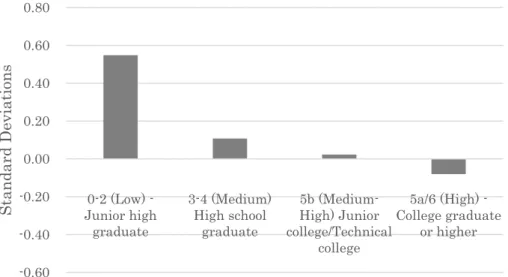
Figure 5 shows the mean Z-scores for the SDQ total difficulty score (a negative value is more desirable) by parental education and parental income quartiles for Japan. The comparable figures were created for the United Kingdom, and Germany by Ermisch, Frauke, & Spiess (2012b)12. The comparability of outcome variable is maintained as all
12 The ages of the children in the United Kingdom and Germany were 5 and 6 years, whereas we used children aged 7 and 8, the youngest children in the JCPS. The figures
10
countries used similar questionnaires.13 To maintain the comparability of parental education level across different higher education institutional settings, we followed Ermisch et al. (2012b), and defined four education level categories in Japan using the UNESCO-ISCED classification table.14
We found that the mean standardized difficulty scores by parental education are similar across the three countries, with the gap being the largest in the United Kingdom and the smallest in Japan. The average scores by parental income in Japan show a different structure from those in the United Kingdom and Germany. The mean scores shows a monotonic decline as the level of parental income increased in the two European countries. However, the mean scores in Japan are not monotonically related to parental income levels, and the score gap between income groups is smaller for Japan. This suggests that economic condition seems less important than parental education in terms of affecting children’s problematic behavior in Japan.
4. Growing Importance and Current Limitation of International Comparison of Educational Mobility
There are several factors that have influenced increasing interest among economists in international comparisons of economic and educational inequalities.
First, there is growing interest in the role of institutions as a factor affecting economic and social outcomes. Traditional neoclassical economics have relied heavily on a prototypical model of market, applying it as an approximation to countries with different cultures and historical backgrounds and using predictions from the prototypical model as a benchmark. However, researchers have increasingly noted that institutions have a key role in determining differences in the economic development across countries (Acemoglu & Robinson, 2012).
Second, the internationally comparable education data initiated by TIMSS and PISA has been successful, allowing researchers to examine cross-country studies of the performance of different educational institutions as factors that potentially determine the economic performance (Hanushek & Woessman, 2015).
Third, as a logical consequence of the first and the second points, economists in the United States started to direct more attention to the educational systems and for the two countries in Ermisch, Frauke, & Spiess (2012b, Figures 5.3-4, pages 129– 130) are available at https://www.russellsage.org/publications/parents-to-children. 13 Ermisch, Frauke, & Spiess (2012b, p.126), however, note that the German data used only 13 items out of 20 SDQ questions to construct the difficulty score.
11 performance in other countries.
Current international comparisons of educational mobility and dynamics use longitudinal data from different countries with different test items and survey questionnaires. This has obvious limitations and potentially faces strong criticism. Our analysis has made it clear that it is not possible to create perfect comparability across countries using different national survey questionnaires and test items. However, economists, while noticing weaknesses, tend to take an “incremental approach,” and “bravely” compare scores from different test items and variables from slightly different questions. In other words, researchers working on international comparisons tend to place more weight on the possibility of discovering a “Big Question” than minor limitations and accuracy, leaving more detailed analysis for future research.
Researchers in this field still believe that the gain from imperfect comparison outweighs the loss from no practice. For example, in a recent volume that collected analyses of cross-country data for children, Ermisch, Jäntti, Smeeding, and Wilson (2012c) note that
A set of comparably designed national studies of this type can reveal how family resources are correlated with individual outcomes at various points during the early life course, and may be able to shed light on the structural differences that moderate intergenerational mobility in different ways in different countries. Another advantage ... is that genetic transmission in the outcome (for example, cognitive ability) should be the same across countries, and so cross-country differences should reflect different environments, policy and otherwise. (Ermisch et al. 2012c, p.11)
5. Agenda for Future Research in Japan
For Japanese education researchers, what are the positive purposes for challenging international comparisons? This question may best be answered by considering three separate stages.
As in any comparative study, the first step is to incorporate outside perspectives of the state of education in Japan. There have been many studies for this purpose (Omomo Inoguchi, Ueda, & Uesugi, 2007; Shimizu & Yamada, 2015). The second step is to attract non-Japanese researchers to undertake quantitative research on Japanese education. Japan should be an attractive country to study as it is continuously ranked in the top-tier of international educational achievement tests. By attracting international researchers, Japanese researchers learn about recent quantitative
12
methods, which in turn, stimulate policy makers to create new datasets and experimental policies. The third stage is to share the quantitative evaluation of Japanese education and policies with other countries, and thereby to use it to improve education policies in Japan and other countries. Japan has not yet accomplished the second stage.
Several previous studies have noted the uniqueness and effectiveness of non-Western education systems and teaching styles. Until the mid-1990s, Japan attracted many education researchers with its distinctive education tradition in family and school organization (Lewis, 1995; Stevenson & Stigler, 1992; Tobin, Wu, & Davidson, 1989). However, these have been predominantly studied with anthropological or participatory methods, and their influence is limited to open-minded educational practitioners. Often, they are treated as a good “case study” that provides some reflections for traditional Western education practices, but not overarching policies.
Recent trends in the United States, backed by a growing awareness of institutions and comparable data, are making an impact on countries previously overlooked in the research community. The OECD has published several detailed reports using PISA data that compared the results of selected high-performing countries (OECD, 2012). In addition, journalists have started to take serious note of previously neglected countries such as Poland (Ripley, 2013).
Globalization is expected to accelerate through the power of internet and big data, and the international research and policy community has assumed the use of the internet and easy access to education big data. In the era of quantitative research, with the exception of some notable publications (OECD, 2011; 2012), Japan seems to have faded from international comparison of the performance of education policies.
Our discussion suggests the following steps to achieve the second stage of the globalization of education research.
1. Education research in Japan should use language that is common and internationally interpretable.
2. Data and general information about Japanese school and education policies should be made easily accessible in English on the internet.
3. More weight should be placed on the use of economic frameworks, data, and quantitative methods as a common language in education research and policy debates.
13
research for its frequent use of technical terms and concepts that are not easily shared with other fields.15 A similar argument can be applied for international education research collaboration. Japan remains an “invisible” country in terms of education research in the internet era, because of the paucity of basic information about education policies, laws, and states of schools available in English. For example, the official English language websites for governmental education policies often lack information compared with the official Japanese websites.16 Many PISA reports have highlighted that basic economic and quantitative methods play the role of a common language to evaluate the state of education and policies in different countries. There is much to be gained for education researchers and policy makers if they acquire basic knowledge of economic frameworks and statistical modeling.
Our study of economic and educational mobility using JCPS data highlights the importance and challenges for the Japanese research community in participating in international comparisons in the economics of education. The JCPS is in the early stage, and there is much room for improvement to allow better comparability with international data. We wish to continue to make this database larger and more reliable for the research of economic and educational mobility, which will involve more people from different fields. However, it should also be noted that the data is just one of the necessary conditions. To compare and share the strength and weakness of the Japanese education system with the global community, further movement of the research community and policy makers toward globalization is necessary.
15 Hirota (2007) criticized education research in Japan as using jargon difficult for professionals in other fields to understand.
16 As of the time of writing (September 5, 2015), the official English site of Japan’s Ministry of Education, Culture, Sports, Science and Technology
(http://www.mext.go.jp/english/) had 809 pages, compared with the total 208,000 pages on the official Japanese website (http://www.mext.go.jp/). The Tokyo Metropolitan Board of Education, the district with the largest non-Japanese population, had only 28 English pages of the total 19,300 pages.
14 References
Akabayashi, H., Naoi, M., & Shikishima, C. (forthcoming). Gakuryoku, shinri, katei kankyo no keizai bunseki. Tokyo: Yuhikaku [published in Japanese].
Akabayashi, H., Nakamura, R., Naoi, M., Yamashita, J., Shikishima, C., & Shinogaya, K. (2013). Children’s academic ability and family background: Findings from the Japan Child Panel Survey 2011. Keio University Panel Data Research Center. SDP2012-009. http://www.pdrc.keio.ac.jp/en/SDP2012-009.pdf
Acemoglu, D., & Robinson, J. (2012). Why nations fail: The origins of power, prosperity, and poverty. New York: Crown Business.
Becker, G.S. (1967) Human capital and the personal distribution of income: An analytical approach. In G.S. Becker. Human capital (2nd ed., pp. 94–144). Chicago: University of Chicago Press.
Blanden, J., Katz, I., & Redmond, G. (2012). Family background and child outcomes. In J. Ermisch, M. Jäntti, & T. Smeeding (Eds.), From parents to children: The intergenerational transmission of advantage (pp. 140–163). New York: Russell Sage Foundation.
Carneiro, P., & Heckman, J. (2003). Human capital policy. In J. Heckman & A. Krueger (Eds.), Inequality in America: What role for human capital policies? (pp. 77–239). Cambridge, MA: MIT Press.
Corak, M. (2013). Income inequality, equality of opportunity, and intergenerational mobility. Journal of Economic Perspectives, 27(3), 79–102.
Duncan, G. J., & Murnane, R. J. (2011). Whither opportunity? Rising inequality, schools, and children’s life chances. New York: Russell Sage Foundation.
Ermisch, J., Jäntti, M., & Smeeding, T. (Eds.). (2012a). From parents to children: The intergenerational transmission of advantage. New York: Russell Sage Foundation. Ermisch, J., Frauke, P. H., & Spiess, C. K. (2012b). Early childhood outcomes and
family structure. In J. Ermisch, M. Jäntti, & T. Smeeding (Eds.), From parents to children: The intergenerational transmission of advantage. (pp. 120–139). New York: Russell Sage Foundation.
Ermisch, J., Jäntti, M., Smeeding, T., & Wilson, J. A. (2012c). Advantage in comparative perspective. In J. Ermisch, M. Jäntti & T. Smeeding (Eds.), From parents to children: The intergenerational transmission of advantage. (pp. 3–52). New York: Russell Sage Foundation.
Goldin, C., & Katz, L. F. (2008). The race between education and technology. Cambridge, MA: Harvard University Press.
15
Goodman, R. (1997). The Strengths and Difficulties Questionnaire: A research note. Journal of Child Psychology and Psychiatry, 38, 581–586.
Hamano, T. (2014). Katei kankyo to kodomo no gakuryoku in heisei 25 nendo gakuryoku chosa wo riyo shita senmonteki na kadai-bunseki ni kansuru chosa-kenkyu. Tokyo: Ochanomizu University [published in Japanese].
http://www.nier.go.jp/13chousakekkahoukoku/kannren_chousa/hogosya_chousa.h tml
Hanushek, E. A., Peterson, P. E., & Woessmann, L. (2013). Endangering prosperity: A global view of the American school. Washington: Brookings Institution Press. Hanushek, E. A., & Woessmann, L. (2015). The knowledge capital of nations: Education
and the economics of growth. Cambridge, MA: MIT Press.
Hirota, T. (2007). Kyoikugaku no konmei. Shiso, March, 1–2 [published in Japanese]. Ikesako, H., & Miyamoto, K. (2015). Fostering social and emotional skills through
families, schools and communities: Summary of international evidence and implication for Japan’s educational practices and research. OECD Education Working Papers, No. 121. Paris: OECD Publishing. DOI:
http://dx.doi.org/10.1787/5js07529lwf0-en
Kariya, T. (2008). Gakuryoku to kaisou: Kyouiku no hokorobi wo dou syusei suruka. Tokyo: Asahi Shimbun Press [published in Japanese].
Kariya, T., & Shimizu, K. (2004). Gakuryoku no syakaigaku. Tokyo: Iwanami Shoten [published in Japanese].
Lewis, C. C. (1995). Educating hearts and minds: Reflections on Japanese preschool and elementary education. Cambridge: Cambridge University Press.
Magnuson, K., Waldfogel, J., & Washbrook, E. (2012). SES gradients in skills during the school years. In J. Ermisch, M. Jäntti, & T. Smeeding (Eds.), From parents to children: The intergenerational transmission of advantage (pp. 235–261). New York: Russell Sage Foundation.
Matsuishi, T., Nagano, M., Araki, Y., Tanaka, Y., Iwasaki, M., Yamashita, . . . Kakuma, T. (2008). Scale properties of the Japanese version of the Strengths and Difficulties Questionnaire (SDQ): A study of infant and school children in community samples. Brain and Development, 30, 410–415.
Omomo, T., Inoguchi, J., Ueda,T., & Uesugi, T. (Eds.) (2007). Kyoiku kaikaku no kokusai hikaku. Kyoto: Minerva Shobo [Published in Japanese].
Organization for Economic Cooperation and Development (OECD). (2011). Lessons from PISA for the United States, strong performers and successful reformers in
16
Organization for Economic Cooperation and Development (OECD). (2012). Lessons from PISA for Japan, strong performers and successful reformers in education. Paris: OECD Publishing. http://dx.doi.org/10.1787/9789264118539-en.
Organization for Economic Cooperation and Development (OECD). (2015). In it together: Why less inequality benefits all. Paris: OECD Publishing. http://dx.doi.org/10.1787/9789264235120-en
Park, H. J., & Lee, T. J. (2013). Growing educational inequality in Japan during the 2000s. In G. DeCoker & C. Bjork (Eds.), Japanese education in an era of globalization. New York: Teachers College Press.
Piketty, T. (2014). Capital in the twenty-first century. Cambridge, MA: Harvard University Press.
Ripley, A. (2013). The smartest kids in the world: And how they got that way. New York: Simon & Schuster.
Shikishima, C., Naoi, M., Yamashita, J., & Akabayashi, H. (2013). Japan Child Panel Survey: Reliability and validity of the academic ability test. Keio University Panel Data Research Center, SDP2012-006.
http://www.pdrc.keio.ac.jp/en/SDP2012-006.pdf
Shikishima, C. (2013). Overview of the Japan Child Panel Survey 2012. Keio University Panel Data Research Center, SDP2012-002.
http://www.pdrc.keio.ac.jp/en/SDP2012-002.pdf
Shimizu, K., & Yamada, T. (2015). Gakuryoku kakusa zeseisaku no kokusai hikaku. Tokyo: Iwanami Shoten.[Published in Japanese]
Smeeding, T. M., Erikson, R., & Jäntti, M. (2011). Persistence, privilege, and parenting: The comparative study of intergenerational mobility. New York: Russell Sage Foundation.
Stevenson, H., & Stigler, J. W. (1992). Learning gap: Why our schools are failing and what we can learn from Japanese and Chinese education. New York: Simon & Schuster.
Stone, L. L., Otten, R., Engels, C. M. E., Vermulst, A. A., Janssens, M. A. M. (2010). Psychometric properties of the parent and teacher versions of the Strengths and
Difficulties Questionnaire for 4- to 12-Year-Olds: A review. Clinical Child and Family Psychology Review, 13, 254–274.
Tachibanaki, T. (2006). Confronting income inequality in Japan: A comparative analysis of causes, consequences, and reform. Cambridge, MA: MIT Press.
Tobin, J.J., Wu, W.Y.H., Davidson, D.H. (1989). Preschool in three cultures: Japan, China and the United States. Connecticut: Yale University Press.
17 Figure 1. Great Gatsby Curve
Source: Reproduced from Corak (2013) with permission. Figure 2. Timeline of the Japan Child Panel Survey (JCPS)
18
Figure 3. Dynamics of Japanese and mathematics Z-scores for the top and bottom family income classes.
(1) Japan Child Panel Survey, by income quartile (a) Japanese
19 (2) United Kingdom, by income quintiles
(3) United States, by income quintiles
Source: (1) Akabayashi, Naoi, & Shikishima (forthcoming). (2) and (3) Authors calculation based on Magnuson, et al. (2012, Table 10.2-3, 10.8-9, pages 246–247, 254– 255).
Note: Data for Japan is the Japan Child Panel Survey (JCPS), data for the United Kingdom are drawn from the Avon Longitudinal Study of Parents and Children (ALSPAC), and data for the United States are drawn from the Early Childhood Longitudinal Study, Kindergarten Cohort (ECLS-K). The vertical axis measures the z-score of cognitive test outcomes.
20
Figure 4. Transition matrices of composite cognitive test score in Japan, United Kingdom, and Australia
(1) Transition from first (bottom) quartile of cognitive test score
(2) Transition from fourth (top) quartile of cognitive test score
Source: Authors’ calculation based on the Japan Child Panel Survey and Blanden et al. (2012, Figure 6.1, p.149). United Kingdom (composite cognitive test scores based on the Millennium Cohort Study) Australia (composite cognitive test scores based on the Longitudinal Study of Australian Children). The vertical axis measures the transition probability in percentage.
21
Figure 5. Problematic behavior (difficulty score) by parental education and income quartiles in Japan
(1) By parental education
(2) By parental income quartiles
Source: Akabayashi et al. (forthcoming), calculated using the Japan Child Panel Survey. Note: Ages of children were 7 to 8 years. The vertical axis measures the standard deviation unit of the total difficulty score of Strengths and Difficulties Questionnaire (SDQ; positive value means more difficult).
-0.60 -0.40 -0.20 0.00 0.20 0.40 0.60 0.80 02 (Low) -Junior high graduate 3-4 (Medium) High school graduate 5b (Medium-High) Junior college/Technical college 5a/6 (High) -College graduate or higher Standard Deviations -0.40 -0.30 -0.20 -0.10 0.00 0.10 0.20 0.30 0.40
First Quartile Second Quartile Third Quartile Fourth Quartile
22
Table 1. Number of observations of children and households, and the Japan Child Panel Survey response rate
Survey year Household Survey of Number of target households Number of cooperative households Response rate by household Number of target children Number of cooperative children Response rate by children 2010 JHPS 644 312 48.4% 959 467 48.7% 2011 KHPS 730 434 59.5% 1126 662 58.8% 2012 JHPS 595 342 57.5% 888 493 55.5% 2013 KHPS 808 453 56.1% 1242 709 57.1%
Source: Authors’ calculation using Japan Child Panel Survey (JCPS).