1.Introduction
For many developing countries, industrial development has been one of the first pri-ority issues for their economic development policy. In the post Second World War period, Korea and some other ASEAN (Association of South East Asian Nations) countries suc-ceeded in fast industrialisation. The manufacturing industry has been the driving force of these countries’ fast industrialisation. Among the other sectors of the manufacturing in-dustry, the consumer electronics industry and the car industry played the most important role in their industrial development.
Preceding studies examined these industrialisation cases of developing countries. However, not much attention was paid to some industry specific issues, although it is in-dispensable to address these industry specific issues when the industrialisation strategy of a developing country is discussed. These issues for the manufacturing industry are the economies of scale and the multi-layered structure of the manufacturing industry.
For the economies of scale, Helpman and Krugman explicitly introduced the econo-mies of scale into the international trade model and discussed economic implications and policy matters.1) In their discussion, economic implications of various trade policy were discussed. However, it seems to be required to deepen the analysis further on industry specific issues to discuss the industrialisation strategy of a developing country. Without taking industry specific issues into consideration, it would be very difficult for a develop-ing country to identify strategic options to successfully promote a specific industry for in-dustrialisation.
Further to the economies of scale, the multi-layered structure of the industry needs to be addressed by a theoretical analysis, because this multi-layered structure is one of the most important characteristic features of the consumer electronics industry. The lead-ing manufacturlead-ing industries, such as the car industry and the consumer electronics in-dustry, have the multi-layered industrial structure.
Trade Policy and Industrial Development
― A Two-Sector Trade Model Analysis ―Those manufacturers that form a multi-layered structure are either final products manufacturers or component manufacturers including raw materials suppliers. A large number of component manufacturers and a relatively smaller number of the producer of final products together form a pyramid shape of the multi-layered industrial structure. Although the final products manufacturers produce some important components called key-components by themselves, they rely on component manufacturers for most of their components supplies. Some technological innovations in final products production lines improve productivity. However, without close collaboration between component manufacturers and final product producers, many technological breakthroughs were not possible.
On the other hand, those firms in the same segment of the industry, such as plastic injection moulding, compete among themselves. To this extent, horizontal competition and vertical collaboration simultaneously take place in the industry. A discussion of industrial development in a developing country requires us to bear the multi-layered structure and the relations between final product and component producers in mind.
It is widely known that many developing countries have made serious efforts to pro-mote their component industries. These developing countries attempted to increase the amount of value added in their countries rather than importing components from abroad. They also tried to create more job opportunities by promoting the component industry in their countries. Those developing countries have taken many different policy measures to promote the component industry as well as the final product industry as a whole. Some of them were successful and the others were not.
This paper aims at a theoretical analysis of trade policy’s industrial implications to the manufacturing industry in a developing country. For this purpose, a theoretical model of an industry with the multi-layered structure under the economies of scale is built to ex-amine the interplay of the two-sectors in the international trade environment.
2.A Basic Two-Sector Model
For simplicity and clarity in the following discussion, it is helpful to introduce a few assumptions. These assumptions reflect a typical situation in a developing country.
1) There are two sectors in a manufacturing industry, namely a component industry and a final product industry.
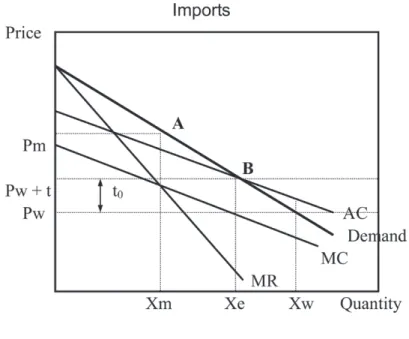
Fig. 1 Domestic Component Industry Facing Competition with
Im-ports
3) There exists a monopolistic component industry in a country where the government tries to protect the component industry as the supporting industry.
4) The final product industry is established by either fully foreign capital or joint ven-ture, and is facing the threat of imports from abroad.
5) The government of the country may impose import duty on both final products and components.
Under these assumptions, it is possible to construct international trade models.
2. 1.Domestic Component Industry
Suppose that the domestic component industry faces the demand as described in Fig. 1 shown above and the economies of scale in producing components prevails.2) In this fig-ure, AC, MC and MR denote average cost, marginal cost and marginal revenue respec-tively. Xw is the demand when price is set at the world prevailing price Pw. This implies that foreign made components are imported at the world prevailing price, Pw, if there is no import duty. The average cost of domestic component industry (AC) exceeds Pw at Xw, where the domestic component industry can not make a positive profit at this point. Therefore, the domestic component industry will produce no component. On the other hand, if there is no import for any reason, the market becomes monopolistic and the in-dustry sets a profit maximising price and quantity, or a so-called monopolistic price and
quantity, Pm and Xm.
These can be mathematically explained as follows;
〈Definition〉
For a quantity of output “X”, cost function is defined as follows; C=C(X)
Then, the average cost (AC) and marginal cost (MC) are defined as follows; AC=C(X)/X
MC=dC(X)/dX
For a price “P”, demand (D), revenue (R) and marginal revenue (MR) of the industry are defined as follows;
D(X)=P
R=PX=D(X) X MR=dR/dX
〈Case I: No import duty (no government intervention)〉
If Pw is given, D(Xw)=Pw
If the domestic component industry does not have cost competitiveness against the im-ports, then AC(Xw)>Pw
The profit (H) of the domestic component industry is calculated as follows; H=PwXw-C(Xw)= PwXw-AC(Xw) Xw=[Pw-AC(Xw)] Xw By assumption (AC(Xw)>Pw),
H<0
Therefore, the domestic component industry suffers from a negative profit. For this rea-son, the domestic component industry does not produce any component as long as AC (Xw)>Pw holds.
〈Case II: Monopolistic Price Formation〉
Case I was the situation where there was not any government intervention into the market. Because the domestic component industry does not have cost competitiveness, the industry can not operate to make a profit under these conditions. In contrast with the situation described in Case I, some government intervention such as import restrictions may be totally stopped. If there is no import, the domestic industry does not have any
competitor in its homeland. Under a given demand function (D(X)), there is a monopo-listic market for the domestic component industry. On the basis of profit maximisation principle, the industry tries to maximise its profit by adjusting its output,
H=D(X)X-C(X)= R(X)-C(X) At max. H, dH/dX=0 should hold: hence, dH/dX=MR(X)-dC(X)/dX=MR-MC=0
If a particular amount of output “Xm” satisfies the monoplistic profit maximisation, MR(Xm)=MC(Xm)
This “Xm” is called the monopolistic output, and “Pm” defined by the following equation is called the monopolistic price.
Pm=D(Xm)
This result implies that the domestic component industry engage itself in production activities under the government intervention to stop the imports. Nevertheless, the do-mestic market prevailing price will be a much higher price than the world prevailing price Pw, because of the domestic industry’s monopolistic behaviour.
〈Case III: Effect of Import Duty〉
Case I examined the situation where there was no import duty. Under this condition, the domestic component industry could not make any positive profit, because it does not have cost competitiveness against the imports. If the government imposes import duty, t, there are three different phases of the domestic component market situation in accor-dance with the level of the import duty.
The minimum import duty for the domestic component industry to start its produc-tion is given by “t0” in the figure, where the average cost of production intersects the
de-mand curve (point B). This minimum import duty “t0” can be used as a benchmark for
the analysis of three different market situations.
(Phase 1: 0<t<t0)
While “t”, import duty rate, does not exceed t0, the domestic industry average cost of
production AC is higher than the market clearing price of imports. Namely, AC>Pw+t. Therefore, the domestic component industry does not engage itself in production, because the industry can not make a positive profit under this condition.
(Phase 2: t0<t<Pm-Pw)
While Pw+t intersects the demand curve between A and B in Fig 1 the domestic component industry engages itself in production of component. The domestic industry’s
average cost of production becomes lower than the market prevailing price, Pw+t, where the domestic component industry can make a positive profit. However, the domestic com-ponent industry faces a threat from the foreign made comcom-ponents that can be imported at the price of Pw+t. Therefore, the domestic component industry’s price to offer is restrict-ed at Pw+t. At the same time, it is not axiomatic if the domestic component industry can dominate the market or not. In order to clarify this question, the substitution issue has to be addressed.
There are two possibilities of substitution. The first is the case of complete substitu-tion of foreign made components by domestic components. In this case, if t satisfies the above condition, domestically produced components dominate the entire market of this country. Namely, the foreign made components are completely substituted by the domes-tic made components. The necessary condition for the complete substitution is both for-eign made and domestically made components are indifferent from each other.
The other possibility is the case of incomplete substitution. Incomplete substitution takes place if there is a difference in a non-price factor. For instance, if two components are different from each other in terms of quality or brand name, there should be incom-plete substitution. In other words, if there is not any difference between two components, complete substitution prevails.
Electronic components are, nowadays, internationally standardised under the frame-work of ISO and other internationally recognised industrial standards. Therefore, the in-complete substitution that unnecessarily complicates the model may be excluded from this analysis.
(Phase 3: Pm-Pw<t)
When Pw+t>Pm that means the price of imported components exceeds the level of monopolistic price, Pm, the domestic component industry supplies the amount that maxi-mise the monopolistic profit. Under this monopolistic market situation, the optimum choice for the domestic component industry is to produce Xm, at the price of Pw+t, regardless to the level of import duty, t.
2. 2.The Final Products Industry
A private firm has, by nature, an instinct to try to grow. A firm with a larger share of a market usually enjoys larger profit. If a firm is competing in a matured market, it tries to find either a new business domain or a new market that often means an overseas market. Direct overseas investment for local production is a part of a private firm’s
growth strategy. Direct overseas investment is diversified because of differences in in-vestment conditions of a host country. Such differences in inin-vestment conditions are due to the trade policy, the size of the domestic market and the operation costs such as the la-bour cost of the host country.
In accordance with these differences in investment conditions, there are three major motives for the final products industry to invest in developing countries. The first is the traditional import substituting type of investment. While a developing country takes an import substitution trade policy by imposing a high import duty or by quantitative re-strictions, there exists a motive for the final products industry to make an investment in a production base in the country. However, two issues have to be pointed out. First, an in-vestment in a production capacity under import substitution policy mainly aims at the do-mestic market of the country. Therefore, if the dodo-mestic market is not large enough to re-cover the investment, any investment can not be expected. Second, as many have argued, the final product industry faces a potential threat from imports as long as import restric-tion by import duty is imposed on the final products.
The second motive for the final product industry’s direct investment is the case where a large and growing domestic market exists and the final product industry invests in a production base in the country. The expected size of the domestic market exceeds a certain level, the final product industry’s direct investment takes place regardless of any trade policy by the host country.
For example, the Chinese CTV market is said to be 25-30 million units a year, al-though any reliable official statistics do not exist. If this estimation is true, the Chinese market is almost comparable with the US market. The majority of products sold in the Chinese market are still low-end products, or the cheapest segment of a product category. However, it is large enough for any manufacturer to be interested in investing in local production.
The third motive is the case where the final product industry makes an investment in aiming at exports to the global market from this host country. Even in this case, as dis-cussed in the following section, the size of the domestic market may play an important role.
2. 3. Linkage between the Domestic Component Industry and the Final Product Indus-try
from the domestic component industry. This does not imply that all of components for the final products industry are purchased domestically. Consumer electronics products, for example, consist of 1,000-2,000 components. Even if a few components are not delivered in time, the entire production can become halted. Therefore, regardless of the share of do-mestic components in the total purchase of the final products industry, the dodo-mestic com-ponent industry may win a monopolistic position in this market. To this extent, the host country’s local procurement requirements to the final products industry may encourage less efforts for improvements by the domestic component industry.
At the same time, the share of components in the total production cost in the leading manufacturing industries is approximately 70-90%. Therefore, the average price of com-ponents sold in the domestic market decides a large part of the total production cost of the final product. The final product industry decides its price of its products on the basis of the cost of components.
Therefore, in the discussion on industrial development of a developing country, it is of vital importance to discuss the details of the close relationship between the component industry and the final product industry. For this purpose, a theoretical model called the two-sector trade model is proposed in this study. Following the discussion in 2.1, there should be three phases of the market situation in accordance with the level of import duty imposed on foreign made components.
〈Case I: Very High Import Duty imposed on Component Imports〉
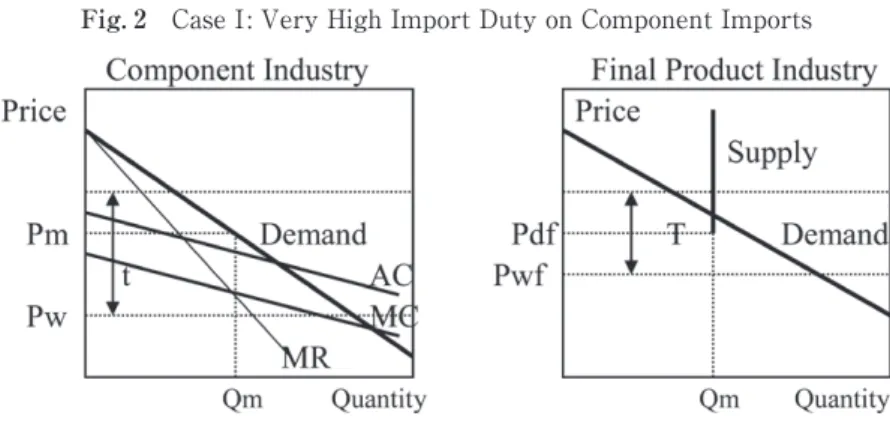
If t>(Pm-Pw), or a ban on components imports are imposed, the domestic compo-nent industry will enjoy a monopolistic market situation. Under this market condition, the supply of the component industry is set at the monopolistic optimal point, Pm and Qm. The final product industry’s production activity is restricted by this quantitative ceiling, Qm. Therefore, the supply curve of the final product industry becomes vertical at the point of Qm.
If the prevailing world price of final products is Pwf, which is lower than the mini-mum domestic price, no domestic production of the final products takes place. The gov-ernment of the developing country faces a dilemma. If the govgov-ernment tries to shut for-eign competition out of the domestic component market by securing monopolistic market conditions, there arises a possibility of no production in the final product industry of the country. Considering that the largest portion of the production cost of the final products is the cost for components, Pdf based on the domestic monopolistic component price is
Fig. 2 Case I: Very High Import Duty on Component Imports
very unlikely lower than Pwf based on the globally prevailing component price.
In this case, the government of this developing country faces another challenge in de-ciding whether it gives up the location of final product industry in the country or it pro-tects the industry by imposing an import duty at a level of T>Pdf-Pwf.
〈Case II: Medium Level of Import Duty on Component Imports〉
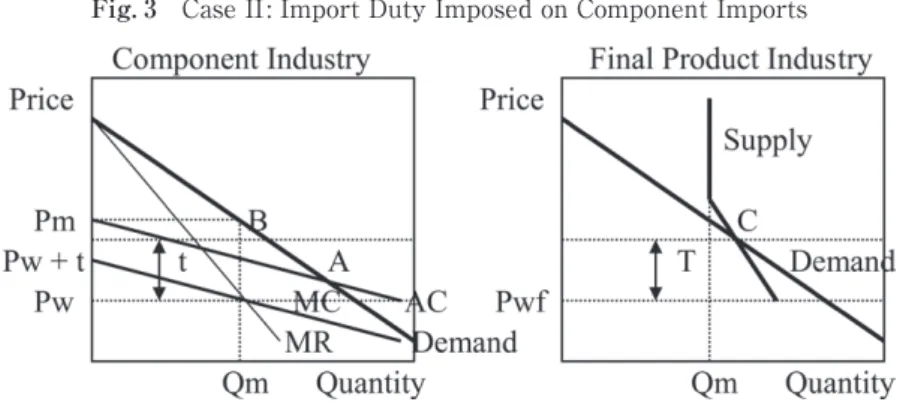
In the electronics industry, for instance, the majority of electronic components are in-ternationally standardised. Therefore, it may be assumed that complete substitution pre-vails in the component market between domestic products and imports. Under this condi-tion, if (Pm-Pw)>t>t0, the supply of components follows the slope between A and B
according to the amount of import duty. As discussed in the previous section, domestic production of final products is quantitatively restricted by the supply of domestic compo-nents.
Therefore, as “t” becomes larger, the supply of components follows the slope (dis-tance A and B). When the supply of components reaches the point “B”, the component in-dustry establishes monopolistic market situation. By using such components, the final products industry produce final products. The slope of the kinked supply curve of the fi-nal products industry does not directly reflect the slope (between the points A and B) of the demand curve of the component industry. Because the cost for components is 70 -90% of the total production cost, it is not unreasonable to assume that the supply curve of final products is kinked. The supply curve of the domestic final product industry inter-sects the demand curve at C.
Under this condition, the final product industry does not have cost competitiveness because of expensive domestic component supply. Therefore, the final products industry is not sustainable unless the government imposes import duty on final product imports. If
Fig. 3 Case II: Import Duty Imposed on Component Imports
the government tries to protect the domestic component industry by imposing a medium level import duty, the government consequently has no other choice but to protect the domestic final product industry as well. The policy dilemma where a protected industry demands an additional trade protection continues.
〈Case III: Liberalisation of Domestic Component Market〉
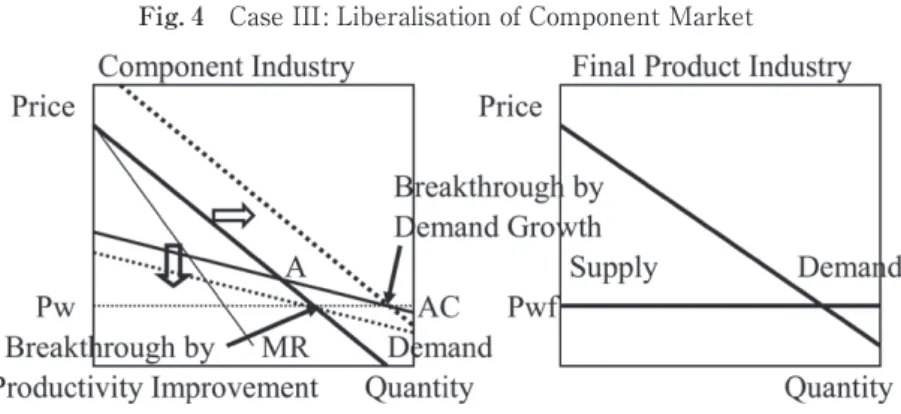
If no import duty is imposed on component, the final products industry has a lower production cost and can be operated without any bottleneck in the component supply. The final product industry with foreign technology is likely to have higher competitive-ness against imports because of lower labour cost. However, there will be no domestic component production in this developing country as discussed in 2.1.
In order to make domestic component production possible in this developing country, there are two possibilities. The first possibility is that the domestic demand for nents grows through the expansion of the domestic final product industry and/or compo-nent exports. The second possibility is that the domestic compocompo-nent industry lowers its average costs by improving its productivity. These may be called the “Breakthrough” of the domestic component industry.
A country with a rapidly growing and large domestic market has advantage in achieving the breakthrough in three ways. First, its very large and rapidly growing do-mestic market is a very attractive business opportunity for many entrepreneurs. New en-trants into each segment certainly intensify market competition and that encourages pro-ductivity improvement of each competitor. Second, rapidly growing domestic demand, as discussed in Case III, accelerates the breakthrough. Third, the learning effect, or the dy-namic economy of scale, has an effect on the productivity of the industry through a steady and rapid increase of accumulated production.
Fig. 4 Case III: Liberalisation of Component Market
3.Conclusion
In many cases of economic development of developing countries, the manufacturing industry has been the driving force. The manufacturing industry such as the car industry and the consumer electronics industry has contributed to industrialisation of a developing country by creating new job opportunities and exporting its products. This paper was an attempt to analyse economic implications of trade policies on the industrialisation of a de-veloping country.
It was first pointed out that, unlike traditional theoretical models, trade policy analy-sis of the manufacturing industry should focus on the internal structure of the industry. The manufacturing industry is made up of many different manufacturers specialising in various segments of the industry. These manufacturers are either final product manufac-turers or component manufacmanufac-turers. Namely, the manufacturing industry consists of the final products industry and the component industry. This multi-layered structure is one of the most important characteristic features of the manufacturing industry.
Secondly, it has been widely observed that the average production cost declines as the quantity of production increases. This specific tendency is called the economies of scale. It also has been observed that the average cost declines as the accumulated produc-tion volume increases. This is called the learning effect.
In this paper, a theoretical model where the multi-layered structure of the manufac-turing industry and the economies of scale are incorporated was introduced to analyse trade policy implications on industrialisation of a developing country. This theoretical model is called the Two-Sector Trade Model.
Through the analysis by the Two-Sector Trade Model, it became clear that industrial development efforts of promoting both component industry and final product industry
pose a dilemma for a developing country. The government of the developing country usu-ally tries to promote its component industry to make its industrial development a com-plete one where both component and final product industries become equally well estab-lished. By achieving this goal, the government can expect an increase of employment opportunities as well as improvement on an income level.
However, if the government tries to protect its domestic component industry, it will also have to apply heavy protection to the domestic final products industry in order to make its own final product industry sustainable. This combination of policy measures tends to eliminate the possibility of healthy industrial development. As long as the gov-ernment imposes high import duties, there will be no incentive for both industries to make efforts to improve their productivity and consequently their international competi-tiveness.
Trade liberalisation policies may pose another problem. Unless the breakthrough is achieved by an improvement of the component industry’s productivity, or by an increase in demand for components, no component will be domestically produced. However, it is also true that both component and final product industries will achieve international com-petitiveness, once breakthrough is achieved.
Consequently, the traditional belief that trade protection of domestic industry is bene-ficial to growth and development of that industry is not sustainable. The analytical result by the Two-Sector Trade Model clarified that productivity improvement and dynamic economy of scale through competition with imported final products and components plays the crucial role for the industrialisation of a developing country. At the same time, the Two-Sector Trade Model can analyse the interaction between the final product industry and the component industry in the trade policy analysis for industrialisation.
The Two-Sector Trade Model analysis also made it clear that the size of the domestic market plays an important role for balanced industrialisation because of the economy of scale. This concept of the domestic market does not necessarily have to be limited to a political national boundary. Regional industrial cooperation where each member country concentrates on different sectors in the industry and exchange their products may result in a similar market situation with those countries having a large domestic market.
Globalisation is often discussed in a negative context for developing countries. Indeed, there are several threats for developing countries from their industrial development point of view. Nevertheless, globalisation also offers opportunities for developing countries, be-cause developing countries may make their neighbours’ market just like their own
domes-tic markets through a wider framework of cross boarder collaborations.
This research was supported by the research grant of Tokyo Keizai University No. 17-34. I would like to express my gratitude.
Notes
1 ) [Helpman and Krugman 1989] 35p. 2 ) [Helpman and Krugman 1989] 35p.
3 ) The Economies of Scale and the Learning Effect
Reference
[Helpman and Krugman 1989]: Helpman, Elhanan, and Paul R. Krugman, “Trade Policy and Market Structure”, MIT Press, 1989
[Ito and Oyama, 1985]: Ito, Motoshige, and Michihiro Oyama, “International Economics (in Japa-nese),” Iwanami Shoten, 1985
[Besanko, Dranove, and Shanley, 2000]: Besanko, David, David Dranove and Mark Shanley, “Economics of Strategy 2nd edition,” John Wiley and sons, Inc., 2000