Original article
*Division of Health Sciences, Graduate School of Medical Sciences, Kanazawa University
Received 21 August 2006; accepted 18 January 2008
Mother's feelings of distress and related factors resulting
from the crying of her one-month-old infants
Noriko TABUCHI*, Keiko SHIMADA*, Yukie KAMEDA*
Naomi SEKIZUKA*, Akemi SAKAI*
Abstract Purpose
The purpose of this study was to clarify the nature of mother's distress and its related factors resulting from the crying of her one-month-old infant.
Subjects and Methods
The subjects were mothers who delivered children in hospitals/maternity clinics in the Hokuriku dis-trict and who gave consent to our survey at the time of health examinations for one-month-old infants. The contents of the questionnaire were: characteristics of the infant's crying, states of mother's sleep, feeding and receiving support related to her distress about her infant and its associated factors. Scores were ob-tained using a 4-point Likert scale.
Results
Effective responses were obtained from 630 mothers, who consisted of 298 primiparas (47.3%) and 332 multiparas (52.7%). About 50% of the mothers experienced distress because they felt at a loss when their infant cried and when the infant did not stop crying even when being held or lulled. New mothers who had no experience with infants were more likely to indicate distress. The distress was significantly as-sociated with factors such as the way the infant cried and if the infant failed to fall asleep in a timely way. It also was associated with factors in the mother's life such as feeling burdened with childcare and lack of confidence in childcare.
Conclusion
In order to support mothers having a one-month-old infant, it is important to pay attention to the char-acteristics of infant's crying, states of mother's fatigue, mother's expression of depression, and to know how mother comprehends childcare and her infant's crying. For screening to be effective it must include both infant and mother factors.
Key words: one-month-old infants, crying, mother's feeling of distress, childcare
I. Introduction
Japan's birth rate began decreasing in 1975. The total fertility rate in 2005 was 1.25/1000 and the aver-age family size was 2.68. The nuclear family occupies about 60% of all the families (Health and Welfare Statistics Association, 2006). The downward trend of small family size poses some special problems for new mothers. Having no relatives or close friends who are
raising infants, first time mothers have no role models nor comfortable social resources through which they could gain valuable experience with infants. Gaining advice about coping with their crying infant may not be possible. Previous studies suggested that the moth-ers' feelings of distress and anxiety about childcare in-creased when they cannot appropriately cope with their crying infants (Kawai et al.; 1994, 1995, 1996, 1997, 1998). There is a possibility that the increase in distress
and anxiety may prevent appropriate childcare behavior leading to dysfunction and harmful patterns in relating to their child.
As early as the 1960s infants' crying has been tape recorded and phonetically analyzed to determine the various types of crying (Kono, 1972; Niki, 1973; Wasz-Hockert, O., et al., 1968) as well as to clarified the characteristics of infants' cries associated with medical problems such as Down's syndrome and intrapartum asphyxia (Baba, 1994; Oi, 1977a, 1977b). However, studies by acoustic analysis using sound spectrograms mainly aim at the diagnosis of abnormalities. Though there have been studies on the identification of the meaning of cries (Wakita, 1994), mothers' coping be-havior for their infant's crying (Kayashima, 1988), and studies to clarify factors associated with a mother's ability to discriminate among cries (Adachi, 1984) we have only qualitatively evaluated mothers' feelings toward and responses to their infants' crying (Tabuchi, 1999). Some mothers appeared to have adapted to the crying one month after birth, but others appeared to still have feelings of distress (Tabuchi et al., 1998). There-fore, we intended to evaluate the status of mothers' dis-tress resulting from the crying of their one-month-old infants, and clarify the associated factors.
Definition of terms
In this study, the feeling of distress resulting from her crying infant refers to a stressful feeling resulting from the uncertainty, frustration and helplessness felt when her infant cries. Infant's rhythm refers to the pat-tern of waking, crying, feeding and sleeping.
II. Study methods
1. Design and SubjectsA descriptive, correlation design was used and data were collected through a non-probability sampling survey using a self-administered questionnaire. The subjects were mothers who delivered a normal infant in hospitals and maternity clinics in the Hokuriku dis-trict and gave consent to be surveyed at the time of the health examination for one-month-old infants.
2. Instrument
1) Self-report questionnaire 2) Questionnaire contents
The questionnaire contents were derived from sev-eral sources: (1) the results of a qualitative analysis of mothers' feelings about their infants' crying and related factors (Tabuchi, 1999; Tabuchi, et al., 1998, 2000), (2) the analysis of interviews of seven mothers of one-month-old infants revealed the mothers' feelings of distress such as irritation when their infants kept crying and failed to sleep or cried throughout the night, and when they had to cuddle their infant constantly because it would not stop crying and (3) a review of related lit-erature (Hanasawa, 1992; Muller, 1994; Narama, et al., 1999). Reliability of the questionnaire, the number of items and expressions, were established after six ma-ternity nursing researchers conducted a pre-test to eight mothers of one-month-old infant. The questionnaire was composed of the following three sections.
(1) Mother's distress resulting from crying infant Each of the following four items was scored on a four-point Likert scale: "Often (Definitely agree), 4 points; "Sometimes (Generally agree)", 3 points; "Rarely (Somewhat disagree)", 2 points; and "Never (Definitely disagree)", 1 point. The total score for the four items was calculated for the feeling of distress score (minimum-maximum, 4-16). The higher score in-dicated the more difficult the situation that the mothers experienced.
①
"I am at a loss when my baby cries."②
"My baby does not stop crying even when be-ing held."③
"My baby does not stop crying even when be-ing lulled."④
"When my baby cries, I don't have my own method of stopping it".(2) Factors possibly related with the feeling of distress As possible factors related with mothers' feel-ings of distress, were 53 items sorted into 21 factors, including the nature of the infant's crying, the mother's sleep/feeding behavior, and the availability of support. Scoring was based on a four-point Likert scale so that the degree of distress expressed by mothers' subjective evaluation could be quantified.
(3) Basic information
Sixteen socio-demographic items that could influ-ence the mother's perceived sense of distress were also collected. These were: mother's age, delivery experi-ence, the gender of the infant, feeding method, family constellation, housing environment, state of employ-ment, and experience of contact with infants or small children.
3) Survey procedure
The researchers sent a statement explaining the purpose and method of the survey to the hospital direc-tors who had management responsibility for the out-patient maternity clinics in the Hokuriku region with 18 clinics giving consent. Next, the purpose of the study, the time required for answering the questionnaire and ethical considerations were explained verbally and in writing to mothers who brought their children to the health examination for one-month-old infants. Questionnaires were distributed directly to consenting mothers with instructions on how to complete and re-tain questionnaire anonymity. The questionnaires were collected either by staff immediately after being filled in or placed in a secure contain and collected later in a batch.
3. Survey period June-July, 2000. 4. Analysis methods
Data were analyzed using descriptive and inferen-tial statistics. The distress score mean for all mothers was calculated. Subjects were classified by levels of distress using the mean ±1 SD as a standard into high, average and low distress groups. Comparison between the three groups divided by attributes was conducted by a one-dimensional allocation distribution analysis. Comparison between two groups was conducted by a homoscedastic evaluation and followed by a t-test. For possible factors associated with the feeling of distress, Pearson's (or Spearman's) correlation coefficient was calculated, and step-wise multiple regression analysis was performed using factors showing significant corre-lations as independent variables and the feeling of dis-tress score as a dependent variable. All analyses were
performed using SPSS for Windows 11.5.1J. 5. Ethical Considerations
We told mothers that their cooperation in this study would be voluntary, and guaranteed that they would not suffer loss of benefits in medical care or negative responses of medical staff irrespective of their participation or non-participation in the study. We also ensured participant's freedom to withdraw at any time. Anonymity of data and confidentiality were guaran-teed. In addition, an explanation was given in writing that the obtained data would not be used for purposes other than research, and that we intended to report only the aggregated results of this study in scientific meet-ings.
III. Results
Of 763 distributed questionnaires, 654 (85.7%) were collected. There were 630 effective responses (82.6%). This survey was performed 32.4±4.0 (mean± SD) days after delivery (range 21-60 days).
1. Characteristics of subjects
1) Mothers' delivery experiences and employment status The mean age of the mothers was 29.2±4.1 years (range 17-43 years old). There were 298 primiparas (47.3%) and 332 multiparas (52.7%). Concerning em-ployment, 232 (36.8%) were taking maternity leave, 210 had not been employed (33.3%), 173 (27.5%) re-signed from work after pregnancy, and 15 (2.4%) were working, while only 92 (14.6%) of all the subjects had ever had a job requiring contact with small children. 2) Infants gender and feeding methods
The gender of the infants was 318 males (50.5%) and 312 females (49.5). The feeding method was breastfeeding for 258 infants (41.0%), mixed breast and formula feeding for 329 infants (52.2%), and formula feeding for 43 infants (6.8%).
3) Family constellation and dwelling
The family form was a nuclear family for 398 mothers (63.2%) and cohabitating with family were 226 mothers (35.9%). For delivery, 464 mothers (75.0%) went back to their parent's home. Among
the 154 mothers who did not go back to their parent's home, there were 44 primiparas (28.6%) and 110 mul-tiparas (71.4%). The type of dwelling was a house for 390 mothers (62.0%) and apartment for 239 (38.0%). 2. Mothers' feelings of distress resulting from their infants' crying
Reliability of the four factors of mothers' distress resulting from their infants' crying was established by Cronbach's α=0.719. Themes of distress related to crying of the 630 mothers are shown in Figure 1. Of-ten/sometimes at a loss when their baby cries were 344 mothers (54.6%)., 283 mothers (45.0%) responded that their baby often/sometimes does not stop crying even when being lulled, 243 mothers (38.6%) stated that their baby often/sometimes does not stop crying even when being held, and 90 mothers (14.3%) reported, when their baby cries, they definitely agree/generally
agree that they don't have their own method of stopping their baby cries. A majority of the mothers often/some-times experienced distress or difficulty in coping with the baby's crying (Fig. 1).
The feeling of distress score was 4-15 (mean, 9.1 ±2.4), and the most frequent score was eight, showing a normal distribution. According to the distress scores, the high distress group (12 points or more in total) had 104 mothers (16.5%); in the average distress group (7-11 points) were 446 mothers (70.8%); and in the low distress group (6 points or less) were 80 mothers (12.7%). There was a significance difference among the three groups, in terms of mother's delivery experiences and feeding methods. Mothers in the high distress group tended to be more primiparas than multiparas (p<0.001) (Fig. 2) and the proportion of mixed feeding was significantly higher (p<0.001) (Fig. 3).
Often Sometimes Rarely Never
85 (13.5) 259 (41.1) 224 (35.6) 62 (9.8) 64 (10.2) 219 (34.8) 274 (43.5) 73 (11.6) 41 (6.5) 202 (32.1) 303 (48.1) 84 (13.3) 14 (2.2) 76 (12.1) 295 (46.8) 245 (38.9) Definitely agree Definitely disagree Generally agree Somewhat disagree
0 20 40 60 80 100 (%)
I am at a loss when my baby cries n=630
I have no method of stoping my baby crying n=630 My baby does not stop crying even when being lulled n=630 My baby does not stop crying even when being held n=630
Fig. 1 Themes of distress related to crying
Primiparas Multiparas
78 (75.0) 26 (25.0)
209 (47.3) 237 (52.7)
11 (13.8) 69 (86.2)
0 20 40 60 80 100 (%)
Significant difference was found among the three groups in terms of delivery experiences (p<0.001) High distress group
n=104 Average distress group n=446 Low distress group n=80
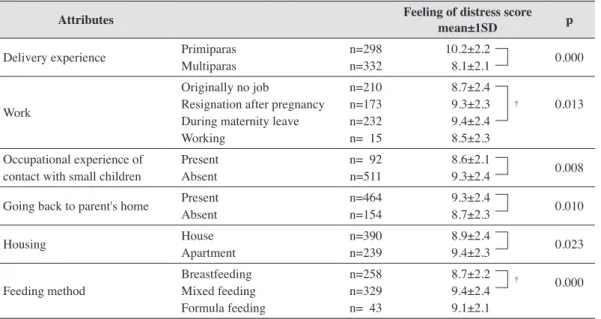
1) Comparison of mother's feeling of distress according to attributes
There was significant difference in distress feel-ings in terms of mother's delivery experiences, employ-ment status, occupational experience of contact with small children, whether or not they went back to their parent's home, and the feeding methods (see Table 1).
The feeling of distress score in primiparas and multiparas was 10.2±2.2 and 8.1±2.1 respectively. The score of primiparas was significantly higher. (p<0.001).
The feeling of distress scores were: mothers tak-ing maternity leave (9.4±2.4), those who resigned from work after pregnancy (9.3±2.3), those who had not been employed (8.7±2.4), and those who currently worked (8.5±2.3). The scores of the mothers taking maternity leave were significantly higher (p<0.01) than the score
of those who had not been employed. The score was also significantly higher (p<0.01) in mothers without occupational experience of contact with small children (9.3±2.4) than in those with this experience (8.6±2.1). Mothers who went back to their parent's home scored significantly higher on the distress score (p<0.05) in (9.3±2.4) than those mothers who did not (8.7±2.3).
In terms of housing environment, the feeling of distress score was significantly higher (p<0.05) in mothers who lived in an apartment (9.4±2.3) than in those who lived in a house (8.9±2.4).
The relationship of feeding method to distress indi-cated that the feeling of distress score was significantly higher (p<0.001) in mothers using mixed feeding (9.4 ±2.4) than in those using formula (9.1±2.1) and breast feeding (8.7±2.2).
Brestfeeding Mixed Formula
32 (30.8) 68 (65.4)
183 (41.0) 229 (51.4) (7.6)34
43 (53.8) 32 (40.0) (6.2)5
4 (3.8)
0 20 40 60 80 100 (%)
Significant difference was found among the three groups in terms of feeding methods (p<0.001) High distress group
n=104 Average distress group n=446 Low distress group n=80
Fig. 3 Feeding methods according to group
Table 1 Status of mother's feeling of distress according to attributes (N=630)
Attributes Feeling of distress scoremean±1SD p
Delivery experience PrimiparasMultiparas n=298n=332 10.2±2.2 8.1±2.1 0.000
Work
Originally no job
Resignation after pregnancy During maternity leave Working n=210 n=173 n=232 n= 15 8.7±2.4 9.3±2.3 9.4±2.4 8.5±2.3 0.013 Occupational experience of
contact with small children PresentAbsent n= 92n=511 8.6±2.1 9.3±2.4 0.008 Going back to parent's home PresentAbsent n=464n=154 9.3±2.4 8.7±2.3 0.010
Housing HouseApartment n=390n=239 8.9±2.4 9.4±2.3 0.023
Feeding method BreastfeedingMixed feeding Formula feeding n=258 n=329 n= 43 8.7±2.2 9.4±2.4 9.1±2.1 0.000 †: significant difference with Bonferroni correction
† †
3. Factors associated with mothers' feelings of dis-tress resulting from infant's crying
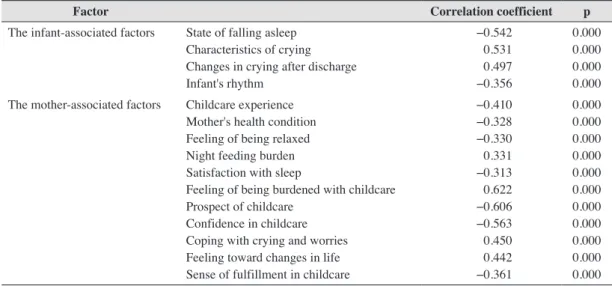
Reliability of the 53 related items of mothers' dis-tress was established by Cronbach's α=0.873. The in-fant-associated factors significantly correlated with the feeling of distress score were the infant's "state of fall-ing asleep" (correlation coefficient r=-0.542, p<0.001), "characteristics of crying" (r=0.531, p<0.001). In other words the more easily the infants fell asleep, the less distress mothers felt; the more frequently the infants cried or the more difficulty in getting the infants to stop crying, the higher distress the mothers felt. The mother-associated factors most significantly correlated with the feeling of distress score were "childcare ex-perience" (correlation coefficient r =-0.410, p<0.001 ). This means that when mothers had more experience with childcare they felt less distressed. The "feeling of being burdened with childcare" (correlation coefficient r=0.622, p<0.001), "prospect of childcare" (r=-0.606, p<0.001), and "confidence in childcare" (r=-0.563, p<0.001) also significantly correlated with the feeling of distress score. This indicates that the more mothers felt burdened with childcare, the more distress they felt, and when they felt more confidence with childcare, the mothers felt less distressed (Table 2).
As a result of multiple regression analysis of the
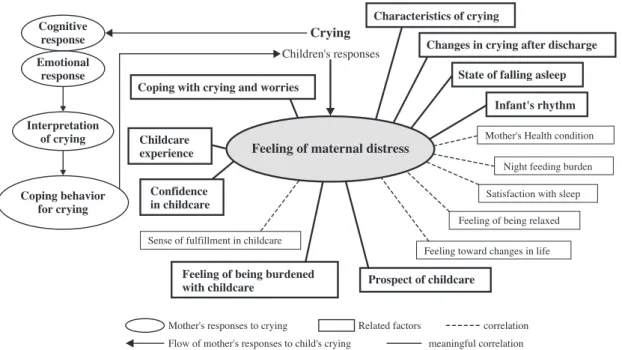
15 factors significantly associated with the feeling of distress score (r<0.3), 64.0% were explained by the fol-lowing nine factors: "feeling of being burdened with childcare"(β=0.101, p<0.001), "confidence in child-care" (β=-0.181, p<0.05), "characteristics of crying" (β=0.184, p<0.001), "state of falling asleep" (β=-0.175, p<0.001), "childcare experience" (β=-0.126, p<0.001), "changes in crying after discharge" (β=0.139, p<0.001), "prospect of childcare" (β=-0.132, p<0.001), "infant's rhythm" (β=-0.098, p<0.01), and "coping with crying and worries" (β=0.093, p<0.01). This indicates that influencing the mothers' distress were such factors as the infant's difficulty in falling asleep, frequent cry-ing, changes in crying after discharge, infant's irregu-lar rhythm, feeling of burdened with childcare, little confidence with childcare, little prospect of childcare, worried about how to cope with the infant's crying, and little experience with childcare. Among them "state of falling asleep" (β=-0.281, p<0.001), "characteristics of crying" (β=0.287, p<0.001), "changes in crying after discharge" (β=0.242, p<0.001), and "infant's rhythm" (β=-0.158, p<0.001) as child-associated factors ex-plained 48.5% of all feelings of distress. The revised model of distressed feelings related to infants' crying obtained is depicted in Figure 4.
Table 2 Correlation of factors associated with maternal distress (N=630)
Factor Correlation coefficient p
The infant-associated factors State of falling asleep Characteristics of crying Changes in crying after discharge Infant's rhythm −0.542 0.531 0.497 −0.356 0.000 0.000 0.000 0.000 The mother-associated factors Childcare experience
Mother's health condition Feeling of being relaxed Night feeding burden Satisfaction with sleep
Feeling of being burdened with childcare Prospect of childcare
Confidence in childcare Coping with crying and worries Feeling toward changes in life Sense of fulfillment in childcare
−0.410 −0.328 −0.330 0.331 −0.313 0.622 −0.606 −0.563 0.450 0.442 −0.361 0.000 0.000 0.000 0.000 0.000 0.000 0.000 0.000 0.000 0.000 0.000
IV. Discussion
This survey was performed one month after birth. When mothers are discharged from maternity institu-tions with their newborns, they start life with their in-fant and childcare 24-hours a day. It is the period when mothers encountered their infants crying due to various reasons, considered the reason for each episode, and tried to use various coping methods. We discuss the status of mothers' distress during this period, the as-sociated background factors, and give suggestions for nursing.
1. Relationship between life after discharge and feel-ings of distress
One month after birth, more than 50% of the mothers were at a loss when their infant cried. In other words, mothers had difficulty in coping with some types of crying frequently encountered during a day and experienced distress. About 50% of the mothers could not stop their child crying by holding or lulling. These results revealed a category of mothers who were at a loss when their child did not stop crying.
Mothers who were employed prior to pregnancy and resigned or who work during pregnancy and who took maternity leave experienced significantly higher
distress scores than those mothers who were never employed. The result was different from what was described in Murakami (2005), Shimizu and Nishida (2000), Mera and Kashiwagi (2005) who indicated distress was higher in full-time mothers. Those three surveys were focused on mothers who were caring for the toddler or preschooler: the survey conducted by Murakami (2005) focused on mothers of 1.6 years old and 3 year old children, Shimizu and Nishida (2000) focused on mothers of 2-4 years old children, and Mera and Kashiwagi (2005) focused on mothers of 3-4 years old children. On the contrary our study was about one-month-old infants. It is quite possible that the differenc-es reflect the timing of the survey. However, we could not clarify whether mothers during maternal leave sub-sequently took childcare leave or returned to work after maternal leave. We speculated that childcare with the prospect of returning to work or resigning from work led to the responsibility for continuous childcare in the future, burdening mothers.
Mothers who went back to their parent's home represented 75% of all the subjects in this study. In Japan it is the custom that a pregnant woman spends a few weeks before and after the delivery at her parents' home. The woman receives necessary care from her own family members, therefore she can be fully rested
Feeling of maternal distress Crying Children's responses Cognitive response Emotional response Interpretation of crying Coping behavior for crying
Coping with crying and worries Childcare
experience Confidence in childcare
Feeling of being burdened
with childcare Prospect of childcare Characteristics of crying
Changes in crying after discharge State of falling asleep
Infant's rhythm
Mother's Health condition Night feeding burden Satisfaction with sleep Feeling of being relaxed Feeling toward changes in life Sense of fulfillment in childcare
Mother's responses to crying Related factors correlation meaningful correlation Flow of mother's responses to child's crying
(Morita, 2002). There are no statistics to document the reason yet it is assumed that most primiparas went back to their parent's home because it was their first delivery, while many multiparas did not go back to their parent's home probably because they were used to delivery and had older children to care for. Because 71.4% of the mothers who did not go back to the parent's home were multiparas in this study, the low feeling of distress score in mothers who did not go back to their parent's home may have been because most of them were mul-tiparas. On the contrary, most of the primiparas went back to their parent's home where presumably psycho-logical and physical support was available from their family; it was of note to see they had even higher score in distress than mothers who remained in their own home.
According to Yoshinaga and Kishimoto (2007), the perceived stressor is different between primiparas and multiparas. There is also report that high stressed moth-ers who do not receive much social support are still highly stressed in a year (Araki et al. 2003), and there is a strong tendency for mothers to request support from those around her (Kobayashi, 2006). There is a need to investigate further how the quality of the grandmother's support and relationship among family members would affect the feeling of distress resulting from the infant's crying.
Mothers living in apartments, were significantly more anxious compared to mothers living in houses. Kawai, et al. (1996) said that there was significant cor-relation between a high score of distress and consider-ation for closely surrounding neighbors and neighbors in the same apartment building. In recent years, moth-ers having an infant possibly have become more sensi-tive with perceptions of the distress and reactions by the neighbors.
2. Factors increasing mothers' feelings of distress resulting from crying of their infant
The factors associated with mothers' feelings of distress resulting from crying of their infant consisted of both mother and infant associated factors. One month after birth, it was found that mothers had a high stress score when their infant: "did not have a rhythm
of "crying→feeding→sleeping→crying"; "did not eas-ily fall asleep"; "awoke and cried soon after falling asleep"; "cried at a high pitch or frequently" or "did not stop crying once started". The inexperienced primipa-ras' high distress resulting from crying can be readily understood. In such a situation, mothers may be further perplexed with characteristic crying and crying states they did not expect and did not know how to manage, therefore stress accumulated. A previous study also indicated similar responses of: "I do not know what to do", "I become uncertain", "I want to cry" when moth-ers heard their one month old infant crying uncontrol-lably; significantly more primiparas had these reactions than multiparas (Tabuchi et al., 2000).
Hiramatsu et al., (2006) reported an association between the sleep and awake rhythm and the number of times the infant wakes up during the night and the mother's distress. Hotta and Yamaguchi (2005) indicat-ed through a survey focusindicat-ed on mothers of six months old infants, that mothers suffered when their infant had "inconsistent behavior", "trouble getting to sleep", and "cried at a high pitch". They also noted a relationship between stress-related childcare and depressive ten-dency.
In terms of feeding methods, it was expected that the score of mothers using mixed feeding would be higher showing more distress. The characteristic of one month after birth is a stage of establishing breast feed-ing. Mothers using breast feeding only are not restrict-ed by time schrestrict-edule and mothers using formula only prepare the formula milk at a certain interval, the level of stress of both of them seems low but mothers who use mixed feeding had psychological anxiety whether or not the infant was sufficiently fed, had burden of breast feeding, and additional preparation of formula. Feeding at three-hour intervals is necessary and moth-ers should wake up and feed their infant during the night, and thus mothers' sleep tends to be insufficient. This can be supported by the correlations between the feeling of distress and "burden of night feeding" as well as "degree of mother's satisfaction with her sleep". Per-sistent insufficient sleep tended to induce a poor physi-cal condition, fatigue, and a depressive mood, showing an association with the "mother's health condition".
These results were also consistent with those of previ-ous studies that showed a close association between the mother's health condition and lack of emotions (Tabu-chi et al., 2000) or associations between the mother's anxiety/depressive feeling and infant's frequent crying, difficulty in soothing the infant, and an infant who does not sleep so much (Kawai et al.; 1994, 1996).
In addition, this study shows that the more moth-ers felt "feeling of being burdened with childcare" and "could not imagine the prospect of childcare" devel-oped higher distress scores. Such mothers may experi-ence increase distress during childcare as they had ac-cumulate stress.
Takahashi and Kirita (2006) confirmed that the crying sounds of infants stimulated mother's negative emotion and there was stress induced reaction such as higher blood pressure with mothers who get depressed and had anxiety feelings resulting from an infant's cry-ing. They also pointed out that mothers who showed strong annoyance toward crying also had poor toler-ance for crying.
As described above, both the infant-associated factors such as characteristics of crying, state of falling asleep and infant's rhythm, and the mother-associated factors such as childcare experience, burdens from night feeding, lack of confidence with childcare and feeling of being burdened with childcare increased mothers' feelings of distress.
3. Limitations and Future issues
This study was limited to the subjects in the Hokuriku region therefore it is difficult to generalize. Next, we need to consider enlarging and randomizing the sample size ensuring representativness and compar-ing situations between regions. In addition, in order to cover all the distress items resulting from infant's cry-ing, we will continue to increase the validity and reli-ability of the instrument and revise the model. There is also a need to clarify the mother's perception of the housing environment and it's role in increasing the mothers' distress.
To evaluate support during this period, atten-tion should be paid to factors associated with both the mother and infant. Understanding the characteristics
and life cycle of one month old infants, consideration should be given to the factors that increase distress clarified through the current study. By knowing how mothers understand crying behavior, it is important to provide close support so that mothers can perceive crying to be a healthy characteristic of their infant. In addition, interventions to ensure mothers' sleep for the maintenance of their health are necessary and a support system involving living situation and family members should be established. During the health examination for one-month-old infants, nurses must address each mother's state of fatigue and note her expression of de-pressive feelings in order to provide timely recognition of her situation. A screening system should be estab-lished toward that goal.
V. Conclusion
About 50% of the 630 mothers with a one-month-old infant experienced being at a loss or had difficulty in stopping their infant crying. The mothers with an infant who had difficulty getting to sleep, irregular wake-up behavior, frequent crying, could not stop crying once started and those mothers who had little experience with childcare tended to develop feelings of distress.
Acknowledgment
We express deep gratitude to the mothers who par-ticipated in this survey and the directors and midwives of institutions who gave their cooperation to this study.
A part of this study was reported in the 15th meet-ing of the Japan Academy of Midwifery held in 2001.
References
Adachi, T., Nihira, Y., Murakami, N. (1984). Nyuji no na-kigoe ni taisuru hahaoya no taisyo koudou ni kansuru kenkyu [Study on mothers' coping behavior for their infant's crying]. Japanese Journal of Maternal Health, 25(2), 235-239.
Araki, A., Kanemats, Y., Arayashiki, A., et al. (2003). 1-2 saiji wo sodateru hahaoya no ikuji stress no ichinen-kan no henka [Changes in a year of childcare stress of mothers with 1-2 years old infants]. Child Health,
6(12), 71-75.
Baba, K. (1994). Kaitei shoni seirigaku [Revised Pediatric Physiology]. 1-5, Tokyo: Herusu Shuppan.
Hanasawa, S. (1992). Bosei shinrigaku [Maternal psychol-ogy]. Tokyo: Igakushoin.
Health and Welfare Statistics Association. (2006). Kousei no shihyou, supplement, Kokumin eisei no doukou [Journal of health and welfare statistics, supplement, Annual statistical report of national health conditions]. 53(9), 35-40.
Hiramatsu, M., Takahashi, I., Omori, T., et al. (2006). Nyuji no suimin rhythm to ikuji stress ni tuite. [Sleep rhythm of infant and childcare stress]. Japanese Society of Child Health, 65(3), 415-423.
Hotta, N., Yamaguchi (Kuno), T. (2005). 6 kagetu ji wo motsu hahaoya no seishin jyotai ni kansuru kenkyu (1st report) —Fuan, yokuutsu to ikuji stress tono kankei kara—. [Study on mental status of mothers with 6 months old infants, 1st report, —Relationship of anxi-ety, depression and childcare stress]. Japanese Society of Child Health, 64(1), 3-10.
Kawai, H., Shouji, J., Chiga, Y. et al. (1994). Ikuji fuan ni kansuru kisoteki kentou [Basic study of childcare anxiety]. Annals of Japan Child and Family Research Institute, 30, 27-42.
Kawai, H., Shouji, J., Chiga, Y. et al. (1995). Ikuji fuan ni kann-suru kisoteki kentou —Youji no hahaoya wo tai-syou ni [Basic study of childcare anxiety in mothers of preschool children]. Annals of Japan Child and Family Research Institute, 31, 27-39.
Kawai, H., Shouji, J., Chiga, Y. et al. (1996). Ikuji fuan ni kann-suru kisoteki kentou —Ikuji fuan no hontai tosi-teno ikuji konnankan ni tuite [Basic study of childcare anxiety II— Childcare feeling of difficulty as the es-sence of childcare anxiety]. Annals of Japan Child and Family Research Institute, 32, 29-47.
Kawai, H., Shouji, J., Chiga, Y. et al. (1997). Ikuji fuan ni kann-suru kisoteki kentou: Ikuji konnankan no assess-ment sakusei no kokoromi [Basic study of childcare anxiety: An attempt to produce a system for the as-sessment of childcare feeling of difficulty]. Annals of Japan Child and Family Research Institute, 33, 35-56. Kawai, H., Shouji, J., Chiga, Y. et al. (1998). Ikuji fuan ni
kannsuru kisoteki kentou —Ikuji konnankan no
pro-file hyoutei shian [Basic study on childcare anxiety: A tentative plan for the profile assessment of childcare feeling of difficulty]. Annals of Japan Child and Fam-ily Research Institute, 34, 93-111.
Kayashima, K., Kuwana, K., Emori Y. et al. (1988). Sinseiji no nakigooe ni taisuru jyokuhu no hannou [Responses during puerperal to neonate's crying]. Japanese Journal of Maternal Health, 29(4), 467-468.
Kobayashi, S. (2006). Ninshinki kara sango 1 kagetsu ni kakete no shosanpu no stress to taishokodo no yoso —Taishokodo no junansei no shiten kara—. [Status of primipara's stress and coping behavior during preg-nancy period through 1 month after delivery - from the viewpoint of flexibility of coping behavior]. Japanese Society of Child Health, 65(6), 740-745.
Kouno, G. (1972). Nyuji no nakigoe [Infants'cries]. Japa-nese Journal of Pediatric Surgery, 4(7), 721-727. Mera, A., Kashiwagi, K. (2005), Ikujiki no josei no seikatsu/
kazoku kanjo —Gakureki to shuro tono kanren kara—. [Women's feeling about their lives in their child-care —The relation between education and work—]. Hu-man Developmental Research, 19, 113-124.
Morita, S. (2002). Shussan to kazoku. [Birth and family]. Kenkobunka, 32. http://www.kenkobunka.jp/kenbun/ kb32/morita32.html/ [2007.12.23]
Muller, M. (1994). A questionnaire to measure mother-to-infant attachment. Journal of Nursing Measurement, 2(2), 129-141.
Murakami, K., Iino H., Tsukahara, M. et al. (2005). Nyuy-ouji wo motsu hahaoya no ikuji stress ni kansuru youin no bunseki [Analysis of factors related to parenting distress of mothers having infants]. Shoni Hoken Ken-kyu, 64(3), 425-431.
Narama, M., Kanematsu, Y., Araki, A., et al. (1999). [Ni-honban parenting stress index (PSI) no shinraisei, datousei no kentou [Review of reliability and validity of Japanese version of parenting stress index (PSI)]. Shoni Hoken Kenkyu, 58(5), 610-616.
Niki, T. (1979). Shinseijiki, Nyujiki ni okeru naki to sono hattatsuteki igi, jidou seinen seishin igaku to sono kin-rin ryouiki [Meaning of development of crying dukin-ring neonatal and early childhood, Child and adolescent psychiatry and related areas]. Japanese Journal of Child and Adlescent Psychiatry, 20(3), 161-175.
Oi, T. (1977). Onsei spectrograph ni yoru nakigoe no ken-kyu ver. 1, Seijyou sinseiji to nou syougai ji ni okeru nakigoe ni tuite [Study of cries by sound spectrograph analysis], 1st ed. Cries in normal neonates and neo-nates with brain disorders]. Acta Neonatologica Ja-ponica, 13(2), 250-258.
Oi, T. (1977). Onsei spectrograph ni yoru nakigoe no ken-kyu ver. 2, Senten ijyou ji no nakigoe —Cornelia de Lange syoukougun wo tyusin tosite— [Study of cries by sound spectrograph analysis, 2nd ed. Cries of chil-dren with congenital abnormalities - mainly Cornelia de Lange syndrome]. Acta Neonatologica Japonica, 13(2), 259-269.
Oi, T., Baba, K. (1973). Nakigoe to sinkei sikkan [Cries and neurological diseases]. The Pediatric Quarterly, 6(6), 1081-1097.
Shimizu, Y., Nishida, K. (2000). Ikuji stress kozo no ken-kyu. [Study on childcare stress]. Journal of Japanese Society of Nursing Research, 23(5), 55-67.
Tabuchi, N. (1999). Sinseiji no nakigoe ni taisuru hahaoya no hannou [A study of a mothers' reaction to infant cries]. Journal of Japan Academy of Midwifery, 12(2), 32-44.
Tabuchi, N., Shimada, K., Sakai, A. et al. (1998). Seigo 1 kagetu ji no naki ni taisuru hahaoya no hannou [A study of a mothers' reactions to infant cries]. Memoirs of School of Health of Sciences Faculty of Medicine Kanazawa University, 22, 35-43.
Tabuchi, N., Shimada, K., Sakai, A. et al. (2000). Seigo 1 kagetu ji no naki ni taisuru hahaoya no kanjyou · jou-dou hannou [Emotional responses of mothers to their crying one-month-old infants]. Memoirs of School of Health of Sciences Faculty of Medicine Kanazawa University, 24(1), 105-112.
Takahashi, Y., Kirita, T. (2006). Nyuji no nakigoe ga iku-jichu no hahaoya ni oyobosu shinri seiriteki eikyo — Ikuji stress tono kanrensei—. [Psychophysiological responses to infant crying : Comparison of group of women in different maternal stress]. Technical report of IEICE. HIP, 106, 69-74.
Wasz-Hockert, O., Lind, J., Vuorenkoski, V. et al. (1968). The infant cry: A spectrographic and auditory analysis, Clinics in Developmental Medicine, 29.
Wakita, M., Toyokawa, K. (1991). Sinseiji no nakigoe no imi no rikai -Boshi sougo sayou no kanten kara [Un-derstanding of the meanings of neonates' cries-in terms of mother/child interactions]. Japanese Journal of Ma-ternal Health, 32(4), 531-532.
Yoshinaga, S., Kishimoto, N. (2007). Nyuji wo motsu hahaoya no ikuji stressor, social support to stress hanno tono kanren —Shosanpu to keisanpu no hikaku kara—. [Childcare stressor of mothers with infants, and relationship with social support and stress reac-tion-comparison between primiparas and multiparas. Japanese Society of Child Health, 66(6), 767-772.