51
■
Article■
British
Imperial
Strategy
and
the Gurkha
Negotiations
●
Marie I zuyama
1. Strategic Factors in the Transfer of Power
India was the keystone of British imperial defence at least during the two World Wars. It is natural to assume that independence and the partition of India had a great impact on British imperial strategy. How-ever, it is not clear whether Britain reviewed her strategy unilaterally and rationally in response to the emerging trend of decolonisation in the Subcontinent or was forced to change her strategy in face of local de-mand.
Studies on British imperial strategy tend to emphasize the incoher-ence of strategy and make the interpretation that Britain was slow to adjust to political realities in her imperial holdings!) Studies on indepen-dence and the partition, on the other hand, tend to emphasize the strength of British strategic thinking, which posed challenges for Indian leaders.2) While the former assume the Indian leaders' political preference as static and given, the latter assume British strategic interests as static and given.
The purpose of this paper is to fill this gap by analysing the interac-tion between the redefiniinterac-tion of British imperial strategy and
negotia-伊豆 山真理 Marie Izuyama, The National Institute for Defense Studies, Diplomatic History.
Main publications: "America no senryaku no naka no minami ajia seisaku [United States' Policy towards South Asia: Nuclear Nonproliferation or Security Assistance to Pakistan?" in Norio KONDO (ed.), Gendai Minami Ajia no Kokusai Kankei [Contem-porary International Politics in South Asia] Tokyo: Ajia Keizai Kenkyusho [Institute of
tions over the transfer of power. The paper deals with the negotiations for the employment of Gurkhas in the British Army. There are two reasons for focusing on Gurkha negotiations. First, it was the only suc-cessful defence arrangement that Britain was able to secure in India. Secondly, because the Gurkha negotiations continued from 1945 to No-vember 1947, we can also gain an insight into Indo-British defence rela-tions in the post-partition era. Although recent anthropological litera-tures on Gurkhas have concerned orientalist and military discourse, this paper focuses on the interests and material resources of the actors rather than their discourse.3)
The negotiation process can be divided into three stages. The first stage covers the period of post-war military planning. The negotiations were mainly conducted between British local officers and strategists in London. My argument is that the initial differences between local offi-cers and strategists were put aside and their respective interests merged through the initiative of the former.
The British decision to withdraw from India in the autumn of 1946 (Wavell plan) marks the beginning of the second stage. The negotiating actors were expanded to include leaders of Congress and the Muslim League as well as the ruler of Nepal, all of which positions were affected by considerations about partition, especially partition of the Indian Army. However, it could be argued that the Muslim League was effectively excluded from the negotiation process as is shown in the tripartite nego-tiations of April 1947.
The third stage covers the post-partition period. Now that the negoti-ating actors were the three sovereign states of India, Nepal and the UK, what they perceived as national interests were reflected in their respec-tive arguments. Dividends of the imperial military resources were at stake as well as the degree of Britain's commitment to the area of the former Indian Empire.
Before beginning analysis, the background of Gurkha employment in the Indian Army may be briefly sketched.4) The tradition of recruiting Gurkhas as a distinct martial race goes back to the Anglo-Nepalese War of 1814-16. The value of Gurkhas for the Indian Army was fully recog-nized in the Indian Mutiny of 1857. The rulers of Nepal were not very cooperative about recruitment until the 1880s, when Bir Shamshere Rana assumed power in a coup. Bir Shamshere Rana issued two orders in
British Imperial Strategy and the Gurkha Negotiations 53
1885 and 1888 to encourage his subjects to enlist in the Indian Army. During the First World War, Rana made every effort to induce his subjects to be recruited into the Indian Army. As a reward, after the War the British gave symbolic independence status to Nepal, as em-bodied in the Treaty of Friendship between Britain and Nepal in 1923, and also an annual subsidy of Rs.10 lakhs. In the Second World War, as many as 124,000 were recruited. When the war ended, the trading of Gurkhas between the British colonial authorities and the Rana regime was an established fact.
2. The First Stage: Gurkhas and the Post War Reorganisation
of the Indian Army
The idea of recruiting Gurkhas directly into the Imperial Force in the
post-war era can be traced back as early as 1943. The main actors
pro-moting this idea were British officers •\both military and civilian •\in
India. The process by which local interests merged with imperial
inter-ests is examined in this section.
It was Betham, the British Minister in Nepa1,5) who first raised the
idea. Betham was concerned about the impact of demobilisation on
Ne-palese villages, and wrote to O.K. Caroe, at the External Affairs
Depart-ment of India, urging that a plan be devised for a military reconstitution
fund.6) Upon finding the External Affairs Department insufficiently
help-ful, he turned to the military authorities. In March 1945, he argued
before the Armed Forces Reorganisation Committee in India that Gurkhas
could be employed directly in the Imperial Force.7)
Betham's idea attracted Field Marshal Auchinleck,
Commander-in-Chief of the Indian Army, who was in charge of the post-war
reorgani-sation of the Indian Army. Auchinleck himself shared Caroe's concern
about the problem of demobilisation in Indian villages. He thought that
dissatisfaction among returned soldiers would cause political unrest,
be-cause those soldiers would be used to higher standards of living and
administrative efficiency.8)
Apart from the demobilisation problem, Auchinleck had an emotional
reason for salvaging the Gurkhas. As an officer who had started his
career in the 62nd Punjabi, later posted to Peshawar, Quetta and other
posts in India and appointed Commander-in-Chief of the Indian Army
Gurkhas were amongst the best soldiers in the world if properly officered and trained.9) At the same time, he was well aware that "Indianization" of the army was a trend that could not be resisted. His experience as a member of the Chatterfield Committee on the modernisation of the In-dian Army in the late 1930s made him envisage that British officers must be gradually replaced by Indians. If this was implemented, he was un-certain whether the future Indianized Army would accept Gurkha sol-diers, since he felt that Gurkhas would not like to be officered by Indians and that Indian nationalism would not tolerate foreigners in the Indian army. To his regret, Gurkhas' existence was in danger, and therefore, he felt responsible for the safeguarding of their status as warrior.
Auchinleck made an unofficial request to Alan Brooke, Chief of the Imperial General Staff (CIGS), to accept Gurkhas under British com-mand. The War Office responded by giving a pledge to accept twenty Gurkha battalions.10) Even at this early stage, the War Office stated their hope that Gurkhas might be stationed in the Middle East or the Far East as Imperial Strategic Reserves.11)
Auchinleck then unofficially called on the Maharaja of Nepal') in October 1945. His tactic in the negotiations to compel the Maharaja to accept Gurkhas serving under British officers was to offer the option of either Indian or British officers. Knowing the Maharaja's preference for British officers, Auchinleck explained that Indianization of officers was inevitable and that training for Nepalese to become Gurkha officers in the UK could not be provided. Auchinleck's belief in "British superior-ity in officering" was shared by the Maharaja, and this eventually led to the construction of their common interest in keeping Gurkha units inde-pendent of the future Indian Army.13) As an advocate of apolitical and professional soldiers, Auchinleck envisaged the Gurkhas as reliable units which would keep their distance from Indian troops, because he thought the latter "might be liable to sudden withdrawal" from garrison duties in imperial and occupied territories.14)
Directed by Auchinleck, the General Staff in India and military per-sonnel in the India Office worked on the details throughout 1946. Some of the men were themselves officers in Gurkha Regiments, and they felt they could make plans in Delhi better than at the War Office in Lon-don.15) By contrast, the War Office had retracted its firm bid by March 1946; because of financial limitations, it reduced its bid from twenty to
British Imperial Strategy and the Gurkha Negotiations 55
eight battalions.16) At a meeting with the India Office, the War Office representative raised the question of the Gurkha's fighting quality, in-fluenced by General Slim's17) observation that "although a Gurkha was an ideal infantryman, he would never be a good gunner, signaller or tank man. "18) To counter this argument, two representatives from the India Office emphasized the merit of cheap labour costs, but were silent on martial quality.19)
3. The Second Stage: Withdrawal, Partition and Negotiations in
April 1947
The British withdrawal plan presented by Viceroy Wavell in
Septem-ber 1946 reawakened interest in the Gurkhas among strategists in
Lon-don. In this section., I examine the process by which the Gurkha
em-ployment plan was consolidated, and review the responses of Indian
leaders •\ in both Congress and the Muslim League •\ and Nepalese
rulers towards the Gurkha issue.
3.1 Strategic Importance of Gurkhas Reconfirmed
In the withdrawal plan, Wavell proposed to take immediate action, in
consultation with both the 'Interim' Government of India and the
Gov-ernment of Nepal, to reach a satisfactory solution on the Gurkha units in the Indian Army.20) Wavell represented local commanders' concerns about the law and order problem and the reliability of the army in a communal
riot. However, the concern of strategists in London was not so much
administrative difficulties in India as the role of the Indian Army in occupied territory. The Chiefs of Staff thought that if the new Indian
Government demand the withdrawal of all Indian forces outside India
such as South East Asian Command, Middle East, Burma, Malaya and
Hong Kong, then British troops would be required there. Thus, the
Chiefs of Staff reported to the Cabinet Defence Committee that employ-ment of Gurkhas is considered as one of "possible expedients by which the requirements for additional British units might be reduced. "21) Al-though their focus was different, by late 1946 there was a vague consen-sus between British local officers and military strategists in London that
Gurkhas could take over part of the role that the Indian Army had
hitherto played.
Government of India was involved partly due to the attitude of the India Office, for the India Office opposed Britain's unilateral approach to Ne-pal. They held the position that Gurkhas were an integral part of the
Indian Army and that the Indian government had priority over the War Office in bidding for them.22) Accordingly, Viceroy Wavell introduced the issue to the Interim Government in October 1946 . In a Cabinet meeting of the Interim Government, it was decided that nine Gurkha battalions should be employed in the future Indian Army, officered by Indian officers. The Cabinet was against any British employment of Gurkhas but recognized that the matter had to be dealt with in tripartite negotiations between Nepal, India and the UK. The decision was almost that designed by Auchinleck and the India Office. Also, it should be noted that this Cabinet meeting was the last meeting before the Muslim League joined the Interim Government.23)
When Mountbatten was appointed Viceroy, he asked for a definite decision on the part of strategists in London .24) Responding to his re-quest that the Gurkha issue be decided before his departure, the Chiefs of Staff Committee took up the matter in March. The committee noted in the minutes that the War Office was shortly proceeding to New Delhi to discuss the issue and that provided the Indian Government agreed , it proposed making an offer in Nepal for eight Gurkha battalions. It also proposed to use the Gurkha battalions in Malaya.25)
Within two weeks, the Cabinet Defence Committee also endorsed the opening of negotiations. Attlee emphasized the importance of employing Gurkhas, saying he was surprised that this question had not previously been submitted to the Defence Committee. Considering the serious man-power shortage in the UK, Attlee said that every practical method should be sought to meet the needs of the Armed Forces from outside sources .
It was agreed that up to 25,000 Gurkhas should be employed in the Regular British Army without any time limit to their employment.26) At the time, Attlee had high hopes of restoring the co-ordination of defence policy within the Commonwealth as it had been during the Second World War. His idea was adopted by the Chiefs of Staff and the plan for "zones of defence" in the Middle East, India, Southeast Asia and Australia was to be proposed at the Commonwealth Prime Ministers' Conference in April and May.27) The Gurkhas' contribution was linked to Attlee's idea of "Commonwealth defence."
British Imperial Strategy and the Gurkha Negotiations 57
3.2•@ Negotiations in April 1947 and Partition Entanglement
Attlee's endorsement opened the way for sending a War Office delega-tion to India. In March 1947, the War Office delegadelega-tion headed by General Lyne started preliminary negotiations in Delhi. General Lyne held meetings with Nehru, Patel, Liaquat Ali Khan and Baldev Singh.28) At this stage, Nehru seemed unprepared for the matter, and his position was based on the principle of anti-imperialism, being unable to accept Britain's employment of Gurkhas for suppressing nationalist struggles in Malaya. The War Office delegation was well briefed to counter his argu-ment, and the text of the formula drafted by the Ministry of Defence carefully used the word "Commonwealth" to mask its "imperial" inter-ests: "adequate military forces should be established and maintained in Southeast Asia to safeguard the interests of the Commonwealth in that area in the event of aggression against the Commonwealth, and generally to assist His Majesty's Government to discharge any military responsi-bilities arising out of their membership of the United Nations. "29) The point was that the Gurkhas were not mercenaries to be used by imperial Britain but were sharing the Commonwealth defence responsibility, and this Commonwealth responsibility was mandated by the United Na-tions.
Unlike Nehru, the reaction of Liaquat was based on a realistic strategy from the Muslim League's point of view. Just two days before he met the War Office delegation, Liaquat wrote to Mountbatten requesting adequate Muslim representation in the Indian Army so that partitioning of the Army could be implemented.") When Liaquat's proposal was put before the Cabinet Defence Committee, Mountbatten said the matter
should be put aside until a political decision had been taken. Auchinleck also emphasized the difficulty of partitioning the Army from a practical point of view. According to his disclosure of the composition of infantry battalions, there were 28 battalions of which "Other Ranks" were entire-ly Hindu or Sikhs and 25 battalions of Gurkhas, but no infantry battal-ions were composed entirely of Muslims; the remaining 70 battalions were of mixed composition.31) Regardless of political or technical rea-sons, Liaquat's desire to prepare Muslim service units was rejected, which might have led him consider the Gurkha issue in the whole con-text of partitioning of the Army.
more definite information about numbers to be employed, and the pos-sibility of using Gurkhas for civil aid, for example in Burma.32) Soon after the meeting with the War Office delegation, Liaquat raised objec-tions at a Cabinet meeting to the inclusion of Gurkhas in the Indian Army on the grounds that the decision to continue to employ Gurkhas in the Indian Army had been taken before the Muslim League joined the
Interim Government.33) This objection was totally unexpected by the British delegation.34) At the end of April, the Indian Cabinet Defence Committee re-examined the decision to include Gurkhas in the post-war Indian Army, but Liaquat's proposal was overruled by a majority.
For Liaquat and the Muslim League, the issue of Gurkhas in the future Indian Army was a quite different matter from Gurkhas in the British Army, but when they realized this, it was too late for them effec-tively to take part in the negotiation process.
3.3•@ Gurkhas and the Redefinition of Relations between Britain
,
India and Nepal
The employment of Gurkhas in the Indian Army should also be con-sidered in terms of emerging Indo-Nepalese relations. Despite Nehru's principled and reluctant stance, Congress defence members did not con-ceal the fact that India also wanted Gurkhas. The Interim Government was pressing the Maharaja to clarify whether Nepal was anxious to main-tain connections with the Indian Army in addition to the British Army .35) The Maharaja was reluctant to commit himself to supply Gurkhas for the future Indian Army without foreknowledge of the terms and condi-tions of employment and the future attitude of India towards Nepal , and he wondered whether Britain could guarantee that India would abide by her agreed conditions. Another difficulty for Nepal was uncertainty aris-ing from the partition. A Nepalese official told the United Karis-ingdom's High Commissioner that while their natural preference would be to deal with a "Hindu Government", Nepal could not afford to risk the
displea-sure of Pakistan "particularly if Calcutta fell within Pakistan."36) Because of this mutual suspicion between India and Nepal, a tripartite meeting could not begin. Finally, London instructed General Lyne to visit Kathmandu even without an Indian delegation.37) Contrary to the High Commissioner's expectation, Nehru did not object to the depar-ture of the War Office delegation,38) and in fact, allowed two Indian
British Imperial Strategy and the Gurkha Negotiations 59
members to accompany it. They were Sir G. S. Bajpai, who had just fulfilled his duties as Indian Charge d'Affaires in the US,39) and
Briga-dier A. A. Rudra, Director of Public Relations.4°)
Thus, the tripartite conference started rather irregularly on May 1. At this conference, the Maharaja endeavoured to achieve the lasting good-will of India and Britain in exchange for Gurkhas, and in particular tried to extract a commitment from the British to regulate Indo-Nepalese
relations. In his speech, he stated his devout hope that India and Britain, the former as her "neighbour" and the latter as her "old and trusted friend," would be good friends in the future. If they were in different camps, he pleaded, an impossible situation would arise for Nepal with Gurkhas in both armies.41) At the end of the conference, the Maharaja's statement was issued. It read: "My government will be happy to main-tain connections with both armies provided men of Gurkha Regiments are willing to serve and if they will not be looked down upon as merce-naries." The Indian delegate Bajpai was satisfied with this statement and thought it had removed any doubt on the part of India.42)
Soon after the conference, there was a change in Nehru's attitude as he started to view the Gurkha issue in terms of strategic value rather than anti-imperialism. In talks with General Lyne and the War Office delegation, Nehru indicated his preference for retaining all Gurkhas in the Indian Army. He asked for General Lyne's view on the possibility of India taking all the Gurkha units, and loaning some to the UK. When General Lyne rejected this as not being the intention of the Maharaja, Nehru replied that he hoped the UK would not give a much higher rate of pay than India." It is interesting to note that both Nehru and General Lyne were interpreting the Maharaja's intention for their own case. This incident indicates the emergence of competition between Britain and India over the Gurkhas, once regarded by the latter as a tool of imperial defence.
A further example of the change in Nehru's attitude came in early August, when Nehru approached the Maharaja in a direct private letter, asking permission to recruit 2,000 Gurkhas into the Bihar Police Force.` 4) With the transfer of power just around the corner, Indian leaders turned to the Gurkhas for the defence of their own state apparatus. Once Indian leaders became conscious of their own terms of military strategy, compe-tition over military resources was inevitable.
On the other hand, there existed one common interest between Con-gress leaders and British strategists, and this was to reserve the Gurkhas from the whole process of partitioning the Army. For British negotia-tors, Pakistan was to be excluded to avoid complicating the negotiations. Although nine battalions out of a total of twenty-one were posted in the
North West Frontier Province (see Map 1), the British assumed without serious discussion that the Muslim League would not demand their share of Gurkhas. For Nehru, Gurkhas were not to be a precedent for recruit-ing separate troops from other ethnic groups, especially Patan.45) He was quite aware that if cultivated by Britain, manpower resources in neigh-bouring Pakistan could be converted into military resources, which could threaten the new Dominion of India.
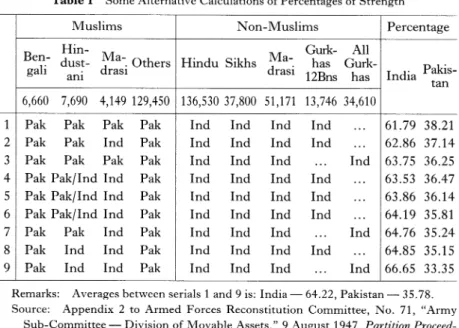
When the Joint Defence Council started to implement the division of the Indian Army in August 1947, they classified military personnel into
"Muslims" and "non -Muslims
," each of which had four categories (see Table 1). Under Muslims, there were "Bengali," "Hindustani," "Ma-drasi," and "Others," while under "non-Muslims," there were "Hindu,"
Table 1 Some Alternative Calculations of Percentages of Strength
Remarks: Averages between serials 1 and 9 is: India •\ 64.22, Pakistan •\ 35.78. Source: Appendix 2 to Armed Forces Reconstitution Committee, No. 71, "Army
Sub-Committee •\ Division of Movable Assets," 9 August 1947, Partition Proceed-ings, Vol. V.
British Imperial Strategy and the Gurkha Negotiations 61
Distribution of Gurkha Battalions India 23 Bns. (Incl. 2 Bns, Assam Regt.) Burma 4 Bns. (Incl. 1 Bns, Assam Regt.) Malaya 6 Bns.
Japan 1 Bn.
Total 34 Bns. (Incl. 3 Bns, Assam Regt.) Source: L/WS/1/1091.
"Sikhs
," "Madrasi" and "Gurkhas." In all the nine alternative allot-ments, Gurkhas were allocated to India.46)
4. The Third Stage: Concluding the Tripartite Negotiations
In this section, the process by which the Gurkha agreement has
sur-vived is examined. The agreement was the only defence arrangement
that the British were able to secure from India.
4. 1 Competition between India and Britain
At the end of July, General Headquarters (GHQ) in India and the Interim Government agreed that twelve battalions of Gurkhas would be retained in the Indian Army and eight battalions would be transferred to the UK.47) The next step was to select the four regiments to be trans-ferred.48) The selection process shows the mixture of emotional and stra-tegic aspects in British policy-making. The 2nd Gurkha Regiment was selected, it was explained, for its long association with the 60th Rifle since the time of the Indian Mutiny. The other three regiments, 6th, 7th and 10th, were selected for their wide recruiting potential both in West-ern-Central and Eastern Nepal.49) In spite of strong objections from the War Office, which lobbied for the 9th Gurkha, General Scoones of
the Indian Office reiterated the reason of convenience. He explained
that the 9th Gurkha, which consisted of higher caste Chettri and
Takurs, was undesirable due to their caste customs and difficulties in
mixing with others.50) The final bid was rather hastily left to the
discretion of the British High Commissioner in the first week of
Au-gust and the four regiments were earmarked in the Communique
issued in Delhi on August 8, 1947.
On the same day, GHQ in India issued a questionnaire to all ranks of Gurkhas asking whether they wished to serve the Indian Government, the UK Government or to be discharged. This questionnaire was issued without prior approval of the Defence Department of the Interim Government.51) Nehru immediately raised an objection to issuing the questionnaire to ranks other than officers,52) and was followed by Bhalja, Secretary of the Defence Department, who argued, "No question-naire need be issued to personnel of the Gurkha regiments selected for service in the Indian Army inasmuch as they are akin to Indi-ans."53) GHQ counterargued by applying the analogy of partitioning
British Imperial Strategy and the Gurkha Negotiations 63
of the Indian Army. According to Arthur Smith, Deputy Supreme Com-mander, "Every Indian soldier has been asked whether to serve India or Pakistan. In the case of the Gurkha, they are being asked whether they wish to serve the Government of India or His Majesty's Government. It was most urgently necessary to send the questionnaire to Gurkha sol-diers because they could not understand why they had not been given their option. "54)
Nehru was not convinced by the logic of partition, and reiterated that the question of asking to serve or not did not arise in the case of Gurkhas because "in no event are they going to serve Pakistan. They have been serving in India in the past and normally they [will] continue to serve unless something happens."55) Auchinleck, the Supreme Commander, complained about the attitude of Nehru and Balja. He held that "the UK has a definite responsibility for the future of these soldiers and, there-fore, should have a say as to their conditions in which they are to serve in future, and as to their right to elect whom they shall serve." Besides this paternalistic position, he frankly stated that "the intention was that Gurkhas in the eight battalions should certainly be given the prior claim to opt for His Majesty's Government and that only if enough volun-teers were not forthcoming from these battalions, volunteers would be called for from those belonging to the 19 battalions for India. "56)
What was the cause of the dispute? First, it was about the interpreta-tion of the Gurkhas' status. Indian leaders interpreted Gurkhas as "non-Muslim residents in India" while the British commander's interpreta-tion was that they were "soldiers of undivided India."57) Secondly, at a deeper level, Indian leaders and British commanders were compe-ting for the loyalty of the Gurkhas. In this competition, there was an uneven distribution of self-confidence; British military officers were quite confident that a Gurkha would certainly prefer to serve Britain while Indian leaders were uncertain about where a Gurkha's alle-giance would lie. It is evident that Nehru and Balja were anxious to avoid giving the option to serve Britain and more particularly Paki-stan.
To end the dispute, the Indian leaders' feeling of inferiority had to be mitigated. Mountbatten tackled this by intervening to suspend the questionnaire.58) Also, some British servicemen who remained in the Dominion of India thought it necessary to "Indianize" the Gurkha
regiments that were allocated to the Indian Army. In October, General Lockhart, Commander-in-Chief of the Indian Army, wrote to the Com-monwealth Relations Office that the attitude of some British officers was wrong in the sense that they looked down on Indian officers of Gurkha regiments. Among his suggestions were (a) a warm welcome should be extended to Indian officers commanding Gurkhas, and (b) the knowl-edge and use of Hindustani by all ranks should be encouraged.59) Mount-batten took up the latter point and proposed to Lord Ismay, Chief of the Viceroy's Staff, that the War Office should consider teaching English in place of Urdu which, Mountbatten added, "Gurkhas have never liked. "60) 4. 2 Tripartite Negotiations
There was no sign of progress towards settlement in the month
following the partition, as other urgent matters that distracted from
the Gurkha issue preoccupied India. Symon, British Deputy High
Commissioner, reported India's lack of interest and also the slow rate
of acceptance of Gurkhas by Malayan authorities.61) He was inclined
to accept Nehru's suggestion that all Gurkha units should be kept as
part of the Indian Army, with some on loan to the UK.62) General Scoones,
who was now in the Commonwealth Relations Office, continued his
efforts towards finalisation, and reminded Symon of the importance of
an early agreement and the final transfer of Gurkhas to the UK in view of reductions in the British Army. He totally opposed the idea of leaving allotted Gurkha units under the control of the Indian Government."
With this strong push, Symon started detailed discussions with Indian Ministries and paved the way for the joint UK-Indian Mission to Kath-mandu.64) The first informal meeting between the UK delegation and the Indian Ministry of Defence took place on October 28. There was a breakthrough on several points. First, India made concessions as to re-cruiting depots, and allowed the continued use of Gorakhpur and Ghum. Secondly, the UK promised to set a ceiling on recruitment to avoid hindering recruitment by the Indian Army. Thirdly, financial arrange-ments were agreed in principle; India would make rupee requirements available to the UK provided the sterling equivalent was credited to their account. However, the Indian delegation was tough on the issue of the questionnaire, and it was decided that the questionnaire should be distributed only to those units earmarked for the UK. Instead, to
com-British Imperial Strategy and the Gurkha Negotiations 65
pensate for any deficiencies that might occur in the UK units, the UK would be allowed to conduct direct recruitment. The Indian delegation also made it clear that all Gurkha units earmarked for the UK should leave India within three months after transfer.65) To fulfill this "early leave" provision, Duncan Smith, a delegate from the War Office , urged the Far Eastern Land Forces (FARELF) in Singapore for an accelerated program of acceptance. He proposed the date for acceptance of the three battalions posted to Burma to be by mid January 1948, the two battal-ions posted from India to Hong Kong to be by mid E.(sic) 1948 and the three battalions and combined regiment centre to Malaya to be by mid March 1948.66)
Symon of the UK delegation and Lieutenant Colonel Kanwar Daya Singh Bedi of the Indian delegation jointly visited Kathmandu in the first week of November. Besides a UK-Nepalese informal meeting, two tripartite meetings were held, and final agreement was formalised in the following three documents: (a) an agreement between India and the UK, (b) Symon's letter to the Maharaja67) and (c) a memorandum signed by the three delegates. Symon endeavoured to avoid the tripartite mem-orandum, but the Indian delegate insisted on it.68)
Each party's concern was somehow embodied in the documents. From the British point of view, one unsatisfactory point was that they could not obtain permission to set up recruiting depots on Nepalese territory. Because of Nepal's fear that a similar request might be made by India, the UK delegation felt it prudent not to press the issue in front of the Indian delegation." Otherwise Britain secured
Indian cooperation in vital matters regarding recruiting depots, pas-sage and transport facilities, and the making up of deficiencies. India should also facilitate postage, foodstuffs and currency.
The Maharaja's concern was recorded in Symon's letter to the Maha-raja. The Maharaja was eager to keep the Gurkhas' prestige high, but at the same time was cautious not to make them a source of activity against his regime. Among his requirements were (a) promotion to King's Com-missions, (b) not using Gurkha troops against Hindu or any other un-armed mob, (c) monitoring of subversive propaganda among troops, (d) training of Nepalese Army officers in the military academies of the UK , (e) admitting Gurkha's carriage of the Khukri, and (f) opening recruit-ment to all martial classes.70)
India's point of view had basically been cleared in the UK-Indian meeting in Delhi. India's concern was that competition with the UK should not prejudice their recruiting activities. This was guaranteed when Britain's payment was set according to the Indian Payment Code plus a Malayan allowance in order not to prejudice the Gurkha strength in the Indian Army.71)
Following the agreement, the questionnaire was implemented in December. The result was disastrous for Britain. Only 1,900 out of 6,000 men opted for Britain.72) Although India agreed to a second referendum, the final result was that around 3,500 opted for the Brit-ish Army, 4,900 for the Indian Army and 1,600 with no preference indicated.73) Colonel Leonard, who was in the 5th Gurkha Regiment, was appointed recruiting officer and was authorised to enlist 2,400 men before April 1, 1948.74) He successfully made up the deficiency
by enlistment and the total contingent of 8,600, comprising ten bat-talions, was sent to Malaya by September 1948.75)
Once agreement had been reached, the Far Eastern Land Forces wanted to concentrate control in their hands. Unlike the Commonwealth Rela-tions Office and the Foreign Office, they would not tolerate condiRela-tions imposed from India. They suggested that the recruiting depots of Ghum should be transferred to the UK on the grounds that Ghum served eastern Nepal, recruiting Limbus and Rais exclusively for the 7th and 10th Regiments.76) This was not accepted. Later, they argued that com-mand should be transferred from India to Singapore, to which the War Office agreed. Although the Foreign Office thought that "FARELF should be kept out of India," it was decided to move command to FARELF, Singapore.77) Thus British Gurkhas were gradually separated from the Indian Army and Indian affairs.
5.•@ Conclusion
No historian can deny that post-war Britain failed to engage India
in defence cooperation, regardless of whether it was called Imperial
Defence or Commonwealth Defence. There are many reasons for
this, including, as is often pointed out by historians, a deep-rooted
suspicion among Indians of military involvement. However, this
pa-per emphasizes that British strategy was so incoherent that it failed to
British Imperial Strategy and the Gurkha Negotiations 67
The Gurkha negotiations revealed that the matter of the future Indian Army was not dealt with by a coherent strategy, nor was it guided from London. The employment of Gurkhas was projected on the initiative of British commanders and officers in India. Their strategic rational-ism was based on continuity, while London was searching for a new strategy to adjust to post-war changes. What facilitated the consent between London and local British officers was their fears about the partition. Both valued Gurkhas either for domestic law and order purposes or for imperial purposes overseas, because they assumed Gurkhas to be politically neutral. The small Gurkha-interest group of officers disliked any interference with military professionalism by the partition entanglement. Thus they hastily and quietly settled the matter with the Indian military and bureaucracy, which led to the exclusion of the Muslim League. There was the wider question of the size and priority of imperial defence to be answered in London. But before any precise redefinition of imperial defence was given, the Gurkhas were driven out of India rather than pulled by the need of Malaya.
The feature of tripartite agreement between the UK, India and Nepal implied the reconstitution of diplomatic relations in the Subcontinent. Both Britain and Nepal felt it important to maintain Indian cooperation, which inevitably led to the creation of Indo-centric regional order. As Anita Inder Singh has argued,78 Britain encouraged Indo-centric re-gional order in order to make India a pillar of imperial defence. Howev-er, the tripartite agreement never became a stepping stone either for imperial or for Commonwealth defence.
Notes
1) Phillip Darby, British Defence Policy East of Suez, 1947-1968. Oxford: 1973; John Darwin, Britain and Decolonisation: The Retreat from Empire in the Post-War World, London: MacMillan, 1988; John Kent, British Imperial Strategy and the Origins of the Cold War 1944-49, Leicester: Leicester University Press, 1993.
2) Anita Inder Singh, "Post-Imperial British Attitude to India: The Military Aspect, 1947-51," The Round Table, No. 296, 1985; Ayesha Jalal, "India's Partition and the Defence of Pakistan: An Historical Perspective," The Journal of Imperial and Com-monwealth History, Vol. 15, No. 3, 1988; Partha Sarathi Gupta, "Imperial Strategy and the Transfer of Power, 1939-51," in Amit Kumar Gupta (ed.), Myth and Real-ity: The Struggle for Freedom in India, 1945-47, Delhi: Manohar, 1987; Nagasaki Nobuko, "Indo, Pakisutan no Seiritu [The Formation of India and Pakistan]," in Rekishigaku Kenkyukai [The Historical Science Society of Japan] (ed.), Kaiho no
Yume [The Postwar World: Dreams of Freedom], University of Tokyo Press, 1996, pp. 96-97.
3) Lionel Caplan, Warrior Gentlemen: "Gurkhas" in the Western Imagination, Provi-dence & Oxford, Berghahn Books, 1995; Marie Des Chen, "Relics of Empire: A Cultural History of the Gurkhas, 1815-1987," unpublished PhD Thesis, Stanford University, 1991. For the relationship between discourse and interest, see Sakaguchi Isao, "Zouge torihiki rejimu: chishiki, gensetu, rieki [The Ivory Trade Regulation Regime: Knowledge, Discourse, and Interests]," Kokusai Seiji [International Rela-tions], Vol. 119, October 1998.
4) Caplan, Warrior Gentlemen; Des Chen, "Relics of Empire," unpublished PhD The-sis; Asad Husain, British India's Relations with the Kingdom of Nepal, 1857-1947, London: George Allen & Unwin, 1970.
5) After the First World War, in order to give symbolic sovereignty, "British residen-cy" was changed to "Legation," and "Resident" to "British Minister." Des Chen, "Relics of Empire
," unpublished PhD Thesis, p. 152.
6) Betham to Caroe, 2nd June 1943, L/WS/1/1021, Oriental and India Office Collec-tions, The British Library, London [hereafter, OIOC].
7) Answer to questionnaires, March 1945, ditto.
8) Auchinleck to the Viceroy, 26 July 1945, cited in John Connell, Auchinleck: A Biography of Field-Marshal Sir Claude Auchinleck, London: Cassell, 1959, p.789. 9) Auchinleck to Lord Alanbrooke, CIGS, 30 September 1945, Auchinleck papers,
John Rylands University Library of Manchester.
10) Wavell to Pethick Lawrence, 5 August 1945, L/WS/1/1023, OIOC. 11) A. Brooke to Gen. Mayne, August 1945, ditto, OIOC.
12) Joodha Shumsher Rana was the Maharaja at the time. In the British documents "Maharajah" is more often used than "Maharaja
," but "Maharaja" is used in this paper.
13) Auchinleck to Wavell, 6 November 1945; 20 November 1945, L/WS/1/1023, OIOC. 14) ditto.
15) Maj. Gen. Bruce, General Staff India, to Brig. Lewis, IO, 15 July 1946, L/WS/1/ 1027, OIOC.
16) WO to Pethick Lawrence, 15 March 1946, L/WS/1/1023, OIOC.
17) General Slim had commanded the 7th Gurkhas and later commanded British forces in Burma during the Second World War, in which campaign several Gurkha regi-ments took part. See Caplan, Warrior Gentlemen, p. 129.
18) Slim to Auchinleck, 15 November 1946, L/WS/1/1027, OIOC.
19) Minutes of Meeting held in WO, 10 December 1946, L/WS/1/1023, OIOC. 20) Field Marshal Viscount Wavell to Lord Pethick-Lawrence, 8 September 1946, L/
PO/6/118, in N. Mansergh and P. 1N/loon (eds.), Constitutional Relations Between Britain and India: The Transfer of Power 1942-7, London: Her Majesty's Stationary Office, 1981, Vol. VIII, 286 [hereafter T. P. followed by volume and document number].
21) Cabinet Defence Committee, "Indian Forces outside India": Report by the COS (enclosed in Lord Pethick-Lawrence to Field Marshal Viscount Wavell, 26 Septem-ber 1946) L/WS/1/1013, T. P., VIII, 371.
British Imperial Strategy and the Gurkha Negotiations 69
22) Cabinet Defence Committee, "Indian Forces outside India": Report by the COS (enclosed in Lord Pethick-Lawrence to Field Marshal Viscount Wavell, 26 Septem-ber 1946), L/WS/1/1013, T. P., VIII, 371; Gen. Mayne, Minute, 11 January 1946, L/WS/1/1023, OIOC.
23) Field Marshal Viscount Wavell to Lord Pethick-Lawrence, 30 October 1946, L/PO/ 10/23, T. P., VIII, 534.
24) Alexander to COS, 28 February 1947, L/WS/1/1030, T. P., IX, 474. 25) COS (47) 36th Meeting, 5 March 1947, L/WS/1/1045, T. P., IX, 487. 26) DO (47) 8th Meeting, Minute 2, 17 March 1947, L/WS/1/1023, T. P., IX, 539. 27) John Baylis, The Diplomacy of Pragmatism: Britain and the Formation of NATO,
1942-49, London: Macmillan, 1993, p. 78; R. J. Moore, Making the New Common-wealth, Oxford: Clarendon Press, 1987, pp. 9-12.
28) Nehru was external affairs member, Patel was home member, Liaquat was finance member and Baldev Singh was defence member of the Interim Government. 29) Cabinet Office to UKHC, tel. 29 March 1947, L/WS/1/1024, OIOC. 30) Liaquat to Mountbatten, L/P & J/10/79, T. P., X, 94.
31) Cabinet Secretariat, "Papers concerning the meeting of the Defence Committee, India, 25 April 1947," Auchinleck Papers.
32) UKHC tel., 9 April 1947, L/WS/1/1024, OIOC.
33) Viceroy's Personal Report No. 4, L/PO/6/123, 24 April 1947, T. P., X, 211. 34) UKHC tel., 11 April 1947, L/WS/1/1024, OIOC.
35) GOI tel., cited in UKHC, 17 April 1947, L/WS/1/1024, OIOC. 36) UKHC tel., 19 April 1947, L/WS/1/1024, OIOC.
37) Cabinet Office to UKHC, 22 April 1947, L/WS/1/1024, OIOC. 38) UKHC, 23 April 1947, L/WS/1/1024, OIOC.
39) Bajpai later became Indian first External Affairs secretary. 40) UKHC tel., 26 April 1947, L/WS/1/1024, OIOC.
41) Records of Conference between Representatives of Nepal, GOI and UK, 1 May 1947, L/WS/1/1024, OIOC.
42) Records of Conference, ditto.
43) Record of an interview between Mr. Nehru, Sir G. Bajpai and Maj. General Lyne, 6 May 1947, L/WS/1/1024, OIOC.
44) Mr. Donaldson (I()) to Allen (FO), 1 August 1947, FO 371/63861, Public Record Office, London [hereafter PRO]
45) Sir T. Shone (UKHC India) to Secretary to the Cabinet, Dispatch No. 63, 28 June 1947, L/WS/1/1024, T.P., XI, 388.
46) C-in-C's Secretariat, Armed Forces Reconstitution Committee, No. 71, "Army Sub-Committee - Division of Movable Assets", 9 August 1947, Partition Proceedings, Vol. V, OIOC.
47) GHQ India to WO, tel. 30 July 1947, L/WS/1/1025, OIOC. 48) Each regiment consisted of 2 battalions.
49) I0 Minutes, 22 January 1947, L/WS/1/1025, OIOC.
50) Scoones to Auchinleck, 25 October 1946, L/WS/1/1025, OIOC.
51) GHQ India to Military Department, 10, tel., 8 August 1947, L/WS/1/1025, OIOC. 52) Nehru, 13 August 1947, F0371/63861, PRO.
53) Bhalja, 14 August 1947, F0371/63861, PRO. 54) Arthur Smith, 15 August 1947, F0371/63861, PRO.
55) Nehru (EA & CR Dept), 19 August 1947, F0371/63861, PRO. 56) Auchinleck to Mountbatten, 21 August 1947, F0371/63861, PRO. 57) Bhaldev Singh (Defence Minister), 18 August 1947, F0371/63861, PRO.
58) Mountbatten gave assurance to Auchinleck that it was Nehru's policy to give every Gurkha soldier the option. Mountbatten to Auchinleck, 24 August 1947, F0371/ 63861, PRO.
59) Lockhart to Scoones, 18 October 1947, L/WS/1/1025, OIOC.
60) India (HC) to CRO, tel., 23 October 1947 (Ismay from Mountbatten), L/WS/1/ 1025, OIOC.
61) UKHC to S/S CRO, tel., 18 September 1947, L/WS/1/1025, OIOC. 62) Murray, Minute, 8 October 1947, FO 371/63861, PRO.
63) S/S CRO to UKHC India (for Symon from Scoones), tel. No. 926, 30 September 1947, FO 371/63861, PRO.
64) UKHC India to S/S CRO, tel., No. 972, 11 October 1947, FO 371/63861, PRO. 65) UKHC India to CRO (for Donaldson from Symon), tel., 29 October 1947, FO 371/
63861, PRO.
66) UKHC India to Singapore (FARELF), (for Redman from Duncan Smith) tel. No. 1128, 30 October 1947, FO 371/63861, PRO.
67) Maharaja Sir Padma Shumshere Jung Bahadur Rana, Prime Minister and Supreme Commander-in-Chief of Nepal.
68) Donaldson to Brig. Tuck, 22 November 1947, L/WS/1/1026, OIOC.
69) Donaldson to Brig. Tuck, 22 November 1947, L/WS/1/1026, OIOC; F0371/63862, PRO.
70) FO 371/63862, PRO.
71) "Gurkha Troops in the British Army: Terms and Conditions of Service, November 1947, F0371/63862, PRO.
72) UKHC India to CRO, No.1515 Top secret, 28 December 1947, FO 371/69963, PRO.
73) New Delhi Reuter, 20 January 1948, L/WS/1/1026, OIOC.
74) UKHC tel., 18 December 1947; Indarmy (for British Gurkha) to WO, 12 January 1948, L/WS/1/1026, OIOC.
75) Falconer to FO, tel., No. 921, 4 September 1948, FO 371/69964, PRO. 76) GHQ FARELF to WO, tel., 8 December 1947, L/WS/1/1026, OIOC. 77) Murray, Minute, 22 January 1948, FO 371/69963, PRO.
78) Anita Inder Singh, The Limits of British Influence: South Asia and the Anglo-Amer-ican Relationship, 1947-56, London: Pinter Publishers, 1993.