Introduction
This study examines how Japanese learners of English use politeness strategies in disagreement, the context in which power relations of the interlocutors are reflected, and an addressee’s action is restricted (Locher, 2004). In particular, this study focuses on the use of hedging devices.
Previous studies on the use of politeness strategies by Japanese learners of English have revealed that speakers insufficiently produced appropriate expressions in the contexts in which politeness needs to be considered (Shigemitsu, Y. Murata & Tsuda, 2006; Taguchi, 2008). Moreover, even some learners who studied abroad can leave impolite impressions of themselves on senior people such as supervisors and lecturers (Thomas, 1995, p. 161).
The popular accounts of Japanese people have claimed that they tend to prefer mitigating expressions in their L1 interactions so that their speech sounds more hedged and polite, especially when they interact with senior people, people in a higher position, and people at a first encounter. They use different politeness strategies according to different variables, which affect vertical power relations among speakers, such as age, social status, and the degree of familiarity and intimacy (Niyekawa, 1991).
Likewise, native speakers of English often use politeness strategies, although the degree of which is not as rigid and hierarchical as that of Japanese (Brown & Levinson, 1987, p. 25). However, there seems to be a misunderstanding among Japanese learners that native speakers of English do not use hedged expressions. In addition, Japanese learners feel uncomfortable using unhedged expressions especially in contexts where they need to disagree with senior people or people whom they have met for the first time (Shigemitsu et al., 2006).
The number of studies on politeness strategies used by Japanese learners of English in their L2 disagreement is limited, and this area remains under-researched despite the fact that it is often said that learners experience awkward moments while studying abroad. In previous studies, Hill, Ide, Ikuta, Kawasaki and Ogino (1986) indicated that the politeness strategy proposed by Brown and Levinson (1987), which has been claimed as universal across cultures (Kasper, 1992; Leech, 2005), is, to some extent, applicable to Japanese. Shirato and Stapleton (2007) and Takahashi (2001), on the
The Use of Hedges in Polite Disagreement by Japanese Advanced Learners of English
Yukako NOZAWA
other hand, investigated the use of particular hedges such as modals and epistemic stances. Other learners’ pragmatic development has been studied by Taguchi (2008, 2011). However, none of them has qualitatively inquired whether Japanese learners of English attempt to enact their L1 politeness strategy in L2 communication. In other words, it has not yet been clarified why learners do or do not use polite linguistic items in a certain situation, or if influential variables such as age and first encounter should also affect their use of those items in L2 communication. As Walkinshaw (2004) suggested in his research, more context-concerned research is required.
This study, therefore, is designed to investigate the following inquiries: (a) what kinds of expressions they do or do not use in disagreement, and (b) why they used or did not use polite linguistic forms.
For the present investigation, this study adopted a case study framework, that is, language studies and interviewing (Bryman, 2008; Creswell, 2013). The investigation started with collecting data of Japanese participants in a mono-ethnic context. This was done for two reasons. One is because the learners claimed that they feel awkward especially when they join a discussion group and need to disagree with other Japanese at pre-sessional courses while studying abroad. Another is their learning contexts. Most Japanese learners are studying English in contexts where they need to communicate in English in a mono-ethnic situation. This study observes the behaviours of Japanese learners of English in these contexts where they actually use English as a means of communication.
The above introduction section explained why polite hedges function as crucial items in English. The next section describes how the concepts of pragmatic competence, politeness and hedging devices or hedges are understood in this paper and how the research questions were developed by a review of previous studies. The third section details how I investigated the research questions. The fourth section will show, analyse and discuss the results of this study. This section is followed by the concluding remarks.
1. Politeness strategy
1.1 Pragmatic competence and politeness strategy
Pragmatic competence is one of the key constituents of communicative competence, which refers to “communicating meaning in a socially appropriate manner” (Taguchi, 2008, p. 424). This is closely related to sociolinguistic and strategic competence, and explains the functional aspect of language (Ellis, 1991; Hedge, 2000; Leech, 1986). The notion of pragmatic competence has been informed by such influential theories as Speech Act Theory by Austin (1962) and Searle (1969), Conversational Implicature and the Cooperative Principles (Grice, 1975). However, these theories disregard the power relation of the interlocutors (Locher, 2004); in contrast, the principles of politeness proposed by Leech (1983) and the theory of politeness developed by Brown and Levinson (1987) deal directly with it. The
former describes power relations between interlocutors by a “cost” and “benefit” relationship. On the other hand, Brown and Levinson (1987) developed their theory based on Goffman’s (1967) notion of
‘face’, which is defined as the image of self as accepted by society (Brown & Levinson, 1987, p. 61).
People tend to conserve or maintain face of each other, and endeavour to make their actions accepted by society by trying to avoid threatening face or face-threatening acts (FTAs) (Brown & Levinson, 1987, pp. 65–68). This has been claimed as universal across cultures (Cutting, 2008; Thomas, 1995) and also to some extent found to be applicable to that of Japanese people (Hill et al., 1986; Leech, 2005). This study therefore, utilises the framework for politeness strategy shaped by Brown and Levinson (1987).
According to their theory, there are two aspects of politeness regarding two faces: positive politeness and negative politeness. When people are concerned with the former, they attempt to save positive face, the want and need to be accepted as a member of a group. This is enacted by showing solidarity or claiming a shared, common ground of the participants of the conversation and avoiding disagreement.
The latter, negative politeness strategy, concerns saving negative face, the right not to be imposed or presumed upon. This strategy can be performed by demonstrating the distance between interlocutors and avoiding invading personal territory. When a speaker enacts this strategy, s/he offers some options to the listener to the expected answer (Brown & Levinson, 1987, p. 144; Cutting, 2008, p. 45). The speaker sometimes threatens the listener’s face or makes the FTAs due to such factors as implicit power relations which are caused by social distance, degree of familiarity, or the size of impositions (Brown &
Levinson, 1987, p. 74; Thomas, 1995). The following section will describe how these factors or variables influence the use of politeness strategy and attributed linguistic forms in disagreement among Japanese people.
1.2 The politeness strategy of Japanese people, power relation and politeness in disagreement Normally, disagreement is seen as “dispreferred” action, and people tend to avoid disagreement and seek agreement (Liddicoat, 2007, p. 111). As mentioned in the introduction, disagreement is also seen as an FTA clearly reflecting power relations of interlocutors and restricting an addressee’s action (Locher, 2004, pp. 113–117). In polite disagreement, the interlocutors are concerned with both positive and negative politeness strategy. When there is a power relation, the speaker tends to seek agreement and, simultaneously, tries to avoid imposing the force of his/her speech upon the listener (Brown &
Levinson, 1987, p. 114; Locher, 2004). While this has been regarded as applicable to politeness strategy used by Japanese people (Ellis, 1991), it cannot be readily applied as the vertical power relation is more complicated in Japan.
Generally, it has been assumed that Japanese people tend to prefer saving the face of others over their own (Kiyama, Tamaoka & Takiura, 2012; Tanaka, 1988). Other studies have revealed that people tend
to be more concerned with the maintenance of the atmosphere of the place of conversation (i.e., ba or place), and consider the relationship with others as more rigid in terms of mandatory power relations (Ide, 1989; Matsumoto, 1988). The possible variables that can determine power relations include “rank and position”, “social status”, “age”, “first meeting” and “gender difference” (Niyekawa, 1991). As also indicated by Niyekawa (1991), the importance of “age” and “first meeting” seem to be obvious and particularly salient. When people are aware of age difference or interact at a first encounter, they show respect to the other conversational interlocutor and try to save his/her face by using linguistic forms called keigo (honorifics or respective forms) and mitigating expressions such as hedges (Geyer, 2008).
Since disagreement is seen as dispreferred response in Japanese as well as in English, it is often delayed and mitigated by hedging expressions (Ellis, 1991; Hill et al. & Ogino, 1986; Leech, 2005).
A survey conducted by the MEXT in 1995, 1997 and 1998 state that 70% to 80% of Japanese people tend to situate themselves in higher or lower positions following the rules of power relations regarding age difference and degree of familiarity (Shigemitsu et al., 2006). Indeed, Leech (2005) indicates that Japanese people use appropriate hedged expressions such as omou, omoi-masu (I think, I guess, I suppose) or kamo shirenai (it might be that~) (Leech, 2005, pp. 16–17). Having introduced the notion of pragmatic competence and the use of politeness strategy by Japanese people in their L1 communication, the following section will review the studies concerning how Japanese people perform politeness strategies in L2 communication.
2. Politeness strategy and the use of hedges in L2 communication
2.1 The use of hedges in polite disagreement in English
As explained in the previous chapter, hedges or hedging devices are defined as linguistic forms that can enact politeness strategy (Brown & Levinson, 1987, pp. 113–114). Lakoff (1972) identifies the function of hedges as “semantic modifiers or approximators” which “makes things fuzzier” (p. 195).
They can reduce the force of the statement so that it can be accepted by the receiver (Brown &
Levinson, 1987; Myers, 1989). Hedges have mainly been observed in negative politeness strategy for avoiding imposition and threatening face in power relations (Myers, 1989); however, they can also function as enacting a positive politeness strategy by amending disagreement and seeking agreement with the receiver (Brown & Levinson, 1987, pp. 113–114). This study sees both these aspects of hedges as mitigating and softening expressions of the statement.
The hedging devices for analysis in this study focus on those used in polite disagreement and are chosen from previous work on hedges as presented in Table 1.
I will now review how these hedging devices have been used by Japanese learners of English.
2.2 The use of hedges by Japanese learners of English in polite disagreement
As previous research has shown, the use of hedges seems to be preferred in English in formal contexts with power differences between the interlocutors and when the size of imposition is large as in business contexts (Bjorge, 2012, pp. 5–7). However, it is widely reported that non-native speakers of English often omit such hedging devices in situations concerning politeness, and that they tend to use more formulaic and unmitigated expressions (Beebe & Takahashi, 1989; Garcia, 1989; Kreutel, 2007; Nakajima, 1997), which results in leaving “harsh”, “too direct” or even “rude” impressions of them (Kreutel, 2007, p. 4). As mentioned in 1.1, a politeness strategy is enacted as part of pragmatic competence which reflects the local context of the interlocutor, or cultural aspect of the speaker and listener (Edstrom, 2004; Garcia, 1989). Some cultures may prefer unmitigated, more direct expressions when they disagree even in a power-different relationship.
According to research on the use of politeness strategies of Japanese learners (Hori et al., 2006), while the Brown and Levinson’s politeness strategy is claimed to be applicable to communication in Japanese, Japanese people seem to have difficulty in adjusting themselves to politeness in English at a first encounter where there is an age difference. This is because age difference is generally considered more important in Japanese than in English (Hori et al., 2006). Generally, Japanese people in their mother tongue tend to use a negative politeness strategy such as avoiding imposing and being too Table 1. Hedges identified in previous studies
Types of hedging Items and examples functions quotes
modal auxiliary verbs may, might, can,
could, would show conditional statements
Cutting, 2012; Fukushima & Iwata, 1985;
Hyland, 1994, 1998; Carter & McCarthy, 2006; Leech, 2005; Murphy, 2010; Myers, 1989; Salager-Meyer, 1994
propositional hedges
I think, I mean, I suppose, I assume, I guess, I don’t suppose, I was wondering if~, I don’t know but~, I’m not sure but~
avoid imposing Brown & Levinson, 1978, 1987; Leech, 2005; Locher, 2004: Tsui, 1991
epistemic stance verbs and probability adverbs, their derivational noun and adjectives
s u g g e s t , a p p e a r, perhaps, probably, possibly, likely
avoid fully comit- ting to the certainty of the statements
Cutting, 2012; Fukushima & Iwata, 1985;
Hyland, 1994, 1998; Carter & McCarthy, 2006; Leech, 2005; Murphy, 2010; Myers, 1989; Salager-Meyer, 1994
stance adverbs and restrictive adverbs
maybe, actually, kind of, sort of, really, basi- cally, personally, just, only, quite, relatively, necessarily
avoid imposing Bjorge, 2012
question tags (with ris-
ing tone) ~isn’t it?, ~aren’t
they? imply uncertainty
of the statement Carter & McCarthy, 2006
friendly in order to make the distance between interlocutors clear (Niyekawa, 1991). However, Shirato and Stapleton (2007) and Takahashi (2001) have reported the underuse of modals and other epistemic stances such as I think, I don’t know if~ by Japanese learners of English compared to the native speakers’ corpora in which many more hedged expressions occurred.
Other previous studies on the use of polite hedges by Japanese learners have indicated that they have difficulty in using polite hedging forms and that certain items are underused. As mentioned in the introduction to this paper, a limited number of studies have focused on the use of polite hedges, and the topic remains under-researched despite the fact that Japanese learners actually face cultural differences between the use of Japanese and English politeness strategy. Their skills of using polite linguistic forms need to be improved. As Walkinshaw (2004) indicated, more context-concerned research is required in order to clarify what can cause hesitation when facing a polite context in English.
The current research, therefore, is designed to cover the above-mentioned research gaps.
In particular, I will focus on the use of hedges as a crucial linguistic element of enacting polite disagreement, as well as analyse the underlying context such as age difference and first encounter which can affect the use of hedges, via the following inquiries:
1) What hedges are used by Japanese learners of English where there is a power difference in the interaction?
2) What are the reasons why hedges are used or not used?
The following section will describe how the research was conducted and the data were analysed.
Subsequently, section 4 will cover the results and what the results imply.
3. Methods of data collection and analysis
3.1 Participants
Six Japanese learners of English were recruited as voluntary participants. All of them were MSc students at a university in the UK. The participants were limited to female post-graduates. Their proficiency of English can be identified as ‘advanced’ as all achieved IELTS 6.5 to 7.0 overall in the academic module and at least 6.5 in the speaking section. The age of the participants is shown in Table 2.
Table 2. Age Groups of Participants
Younger (24 to 25 years) Participant A (25) Participant B (25) Participant F (24)
Middle (28 to 32 years) Participant D (32) Participant E (28)
Older Participant C (46)
3.2 Data collection
The participants were divided into four pairs according to different age groups and the degrees of acquaintance as shown in Tables 3–1 and 3–2.
For the recording, the participants were asked to have a conversation in a quiet room for five to ten minutes on a given topic, i.e., abortion. In each recording session, one participant was asked to present an affirmative argument, and the other was asked to propose a negative opinion on this topic. The topic was chosen so that the participants could discuss a relatively familiar topic which would invite controversial discussions. The participants were not informed about the main theme of this study.
The collected speech data were transcribed and analysed by the researcher within the framework of language studies (Bryman, 2008). I familiarised myself with the data and transcribed them according to the transcription system developed by Jefferson (1985). In analysing the data, the types of hedges and expressions of unhedged disagreement were observed from both quantitative and qualitative perspectives. The number of hedges and unhedged expressions was counted, and the use of these items was analysed in relation to possible variables. Through this process, I eliminated some words that seemed like hedges but actually were used for other functions. After transcribing the speech data, the participants were asked to look through the results, listening to their speech and confirm that the transcript was accurate.
After approving the transcriptions, the participants were asked to attend interview sessions conducted in Japanese, which were designed to examine whether and how they had tried to express politeness strategies in English. The two questions asked were: (a) what were the motivations for using hedges, and (b) if they did not use hedges, what were the reasons. Along with the interview data, I collected background information of the participants, such as English proficiency and experience living in English-speaking countries. After the interview sessions, all interview answers were translated and
Table 3‒1. Recording Pairs
Age difference First encounter Established friends
Same age group Pair 1: Participants A (25) and B (25) Pair 4: Participants A (25) and F (24) Different age group Pair 3: Participants E (28) and F (24) Pair 2: Participants C (46) and D (32)
Table 3‒2. Labels of Recording Pairs Pair 1: same age and first encounter Pair 2: different age and established friends Pair 3: different age and first encounter Pair 4: same age and established friends
confirmed by all participants. The data were analysed in relation to the use of hedges found in their speech. The following section will present and discuss the results.
4. Results and Discussions
In this section, the first two sub-sections provide the answers to the research questions through an analysis of the findings. The third sub-section discusses and presents notable findings.
4.1 What hedges are used by Japanese learners of English where there is a power difference in the interaction?
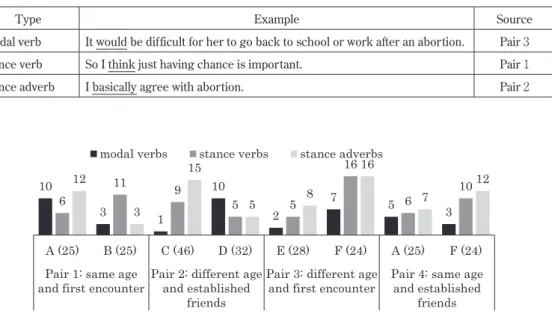
First, I sorted the data into three different hedging items, i.e., modal verbs, stance verbs, and stance adverbs. An example of each is given in Table 4.
The most frequent hedging items were stance adverbs such as maybe, probably, actually, basically, and stance verbs such as I think~ and I suppose~. Among these expressions, the most popular expressions were maybe and I think across all the participants. The total number of stance adverbs was 78 and that of stance verbs was 68 across all groups. Modal verbs such as would, could, may, might, can numbered 41. As can be seen in Figure 1, there seems to be some difference in the kinds of hedges used by each participant. For instance, B (25) used more stance verbs while A (25) and C (46) used more stance adverbs, and F (24) used both. The salient difference is that modal verbs were correspondingly less
10
3 1
10
2
7 5 3
6
11 9
5 5
16
6 10
12
3
15
5 8
16
7
12
A (25) B (25) C (46) D (32) E (28) F (24) A (25) F (24) Pair 1: same age
and first encounter Pair 2: different age and established
friends
Pair 3: different age
and first encounter Pair 4: same age and established
friends modal verbs stance verbs stance adverbs
Figure 1. Three different hedging items produced by each participant Table 4. Types of hedges
Type Example Source
modal verb It would be difficult for her to go back to school or work after an abortion. Pair 3
stance verb So I think just having chance is important. Pair 1
stance adverb I basically agree with abortion. Pair 2
used across all interactions. Another notable difference is that participant F (24), compared to the other participants, used a relatively larger number of stance verbs. These differences in the numbers of produced items will be discussed in relation to the background information of the participants such as experience abroad.
4.2 What are the reasons why hedges are used or not used?
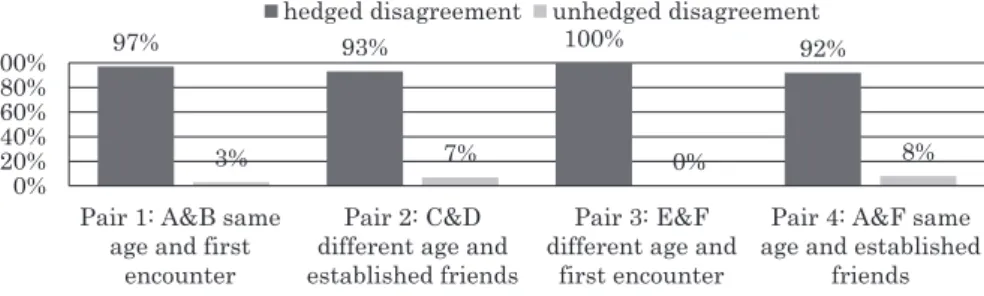
The percentage of hedges in each disagreement is presented in Figure 2.
It can be seen that all pairs used many more hedged than unhedged expressions in disagreement.
The highest number and percentage of hedges was used in the interaction of Pair 3, whose total number of disagreements was 63, all of which were hedges. It was the interaction between E (28) and F (24), which includes both different age and first encounter variables. In the interactions of Pairs 1 and 2, which include first encounter and different age variable respectively, almost the same number of hedges was used. The smallest number of hedges was registered in the interaction of Pair 4, which includes neither age difference nor first encounter variables. The total number of hedges was limited to 47, although 92% of disagreements were hedged expressions.
Figure 3 illustrates which external variables might have affected the use of hedges by each participant. As can be seen, participant F (24) used remarkably more hedges than any other participant,
97% 93% 100% 92%
3% 7% 0% 8%
20%0%
40%60%
100%80%
Pair 1: A&B same age and first
encounter
Pair 2: C&D different age and established friends
Pair 3: E&F different age and
first encounter
Pair 4: A&F same age and established
friends hedged disagreement unhedged disagreement
Figure 2. Percentage of hedges in each Recording Pair
34 23 28 26
17
46
19 28
1 1 3 1 0 0 1 3
A (25) B (25) C (46) D (32) E (28) F (24) A (25) F (24) Pair 1: same age
and first encounter Pair 2: different age and established
friends
Pair 3: different age
and first encounter Pair 4: same age and established
friends hedges unhedged expressions
Figure 3. Number of hedges used by each participant
particularly in Pair 3, different age and first encounter, but also in Pair 4, same age and established friends.
In comparison, it seems that the first encounter variable mattered more than the age variable. For example, A (25) used many more hedges in Pair 1 (same age/first encounter) than in Pair 4 (same age/
established friends). On the other hand, in the interaction of Pair 2 (different age/established friends), despite the fact that participant C (46) is more than 10 years older than D (32), D (32) used fewer hedges. This result shows that, if the interlocutors are established friends, an age difference is not as important as the first encounter variable. In a comparison of their interaction with the one in Pair 4, the same age and established friends pair, age difference seems to have had some influence, as Pair 2 produced more hedges than Pair 4.
To summarise, though the limited number of participants does not allow for statistically appropriate tests of significance (Robson, 2011, p. 128), the results of the quantitative analysis suggest that first encounter variable seems more important for the participants than the age variable. The following analysis will explore if the participants used hedges intentionally.
4.3 The interview sessions
In the analysis of hedges in the speech data, it seems that all participants apparently recognised the age difference and the first encounter variables as in L1 communication. However, the answers to the following interview sessions suggest otherwise. Firstly, all the participants answered that they used hedging expressions in discussions, but they did not seem to relate the use of hedges to the two variables unless the interviewer explicitly asked. In the answers to interview question 1, “What were the motivations for using hedges?”, participants A (25), B (25), and D (32) answered that they thought hedges as a device to soften the force of disagreeing expressions and maintain a pleasant atmosphere. Likewise, participant C (46) answered that she tried to adopt her disagreement strategy in L1 to L2 communication. These answers suggest that they seemed to understand the function of hedges as softening or mitigating expressions and adopted them in disagreement in L2 as they do in L1 communication, although they did not mention the word ‘politeness’ or anything about the two variables.
On the other hand, participants E (28) and F (24) answered that they recognised hedges as an appropriate academic discussion strategy. They held that they did not relate hedges to politeness considerations such as age differences and first encounter, even though the data strongly suggest so: the interaction between E (28) and F (24) (i.e., Pair 3), which included both variables, showed the highest amount of hedges. In particular, F (24), the younger, was not aware of the fact that she reduced the number of hedges and responded more quickly in the interaction with A (25), the same age and an established friend (i.e., Pair 4). As the interview proceeded, it was inferred that she associated
hedges with politeness in English rather than Japanese. She answered that she related hedges to power relations but also saw them as a means of presenting herself as intelligent. In addition, she said that by keeping a distance from argument, she remained less easily attackable. This perspective would be more relevant to the common image of face-saving in English than in Japanese. As described in section 1.2, while the former tends to be concerned with faces of both the speaker and the other interlocutor, the latter is claimed to be more concerned with negative face-saving of the other person. This still does not explain her behaviour in Pair 3, but might explain why she was unaware of her different behaviour between Pairs 3 and 4.
The difference between the two types of answers might lie in the different learning environments (Taguchi, 2008b, 2011). While A (25), C (46), and D (32) had little experience living abroad before their MSc programme year, B (25), E (28), and F (24) had relatively longer exchange experiences during their tweens and before. The latter group is likely to have developed their understandings of politeness strategies and pragmatic competence through more exposure to English than the former three participants. This can explain the recognition of the use of hedges by E (28) and F (24), which is not applicable to B (25). According to their bio-data, B (25) was the latest of the three to go abroad. This variable is to be explored in future research.
Another possible factor which might have affected the participants’ use of hedges is their English proficiency. In her answers to question 2, “What were the reasons that you sometimes did not use hedges?”, participant E (28) reflected on her language skills. She explained that she intended to use more hedging expressions, but, due to her insufficient English proficiency, could not adopt them as accurately as she wished. This explanation could also be relevant to the fact that F (24), who achieved the highest IELTS speaking score (8.0), used many more hedges than the other speakers. Indeed, learners’ English proficiency has been regarded as a possible factor that can facilitate pragmatic development (Kasper & Rose, 2002).
Another finding is that as shown in Figure 1, the participants made different choices of hedging devices in their interactions. As has been suggested (e.g. Kasper, 1992), such choices may be influenced by positive and negative pragmatic transfer. While the frequently used items across all the participants, maybe and I think, have corresponding expressions in Japanese translation, modal auxiliary verbs, which were much less frequently used, have no such correspondents. Presumably, learners relied more on corresponding items. The effect of English proficiency, the learning environment, and the pragmatic transfer should be scrutinised further by obtaining more comprehensive background data through interviews or questionnaires.
5. Conclusions
This research has revealed that Japanese advanced learners of English tend to use hedges in disagreement and that their choices to do so is influenced by two variables: age difference and first encounter. The results suggest that the latter is more influential than the former. Another notable finding is that Japanese people use more hedges when they are faced with both variables although they were not aware of the fact that they were enacting the politeness strategy on the basis of these variables as in L1 communication. The interviews also revealed the possibility of the influence of English proficiency, learning environment, and pragmatic transfer, as these might have affected how the learners perceived ‘using hedges’ differently.
One limitation of this research is the small number and exclusive focus on female speakers. Future studies should work with a larger sample that would allow for appropriate statistical tests, and also include male speakers. Another limitation pertains to the counting of the hedges. As it was expected that there would not be much individual difference in the amount of the speech of each participant, the quantitative part of the analysis is based on absolute numbers rather than percentages. However, it turned out that the amount of speech varied greatly for each participant. It is therefore recommended that future research should count each speaker’s hedges in proportion to their total amount of speech.
As the results of this study indicate, Japanese learners, to some extent, tend to adopt their L1 politeness strategy to L2 communication. While the present study was confined to interaction between L2 speakers from the same cultural background, future research should also look into inter-cultural encounters. Given the growing prominence of English as a lingua franca, it would be helpful to clarify what hedges Japanese learners need when they face polite disagreement with speakers from different cultural backgrounds. Further research needs to determine what hedges they can, should, or should not use, and what external variables may influence these decisions.
References
Austin. (1962). How to do things with words. Harvard University Press.
Bjorge, A. K. (2012). Expressing disagreement in ELF business negotiations: Theor y and practice. Applied Linguistics, 33(4), 406–427.
Brown & Levinson. (1978 [1987]). Politeness; Some universals in language usage. Cambridge: Cambridge University Press.
Bryman, A. (2008). Social research methods (3rd ed.). NY: Oxford University Press.
Carter, R., & McCarthy, M. (2006). The Cambridge grammar of English: Spoken and written English grammar and usage. Cambridge: Cambridge University Press.
Creswell, J. W. (2013). Qualitative inquiry and research design: Choosing among five approaches (3rd ed.). US: SAGE Publications, Inc.
Cutting, J. (2008). Pragmatics and discourse (2nd ed.). London: Routledge.
Cutting, J. (2012). Vague language in conference abstracts. Journal of English for Academic Purpose, 11, 283–293.
Edstrom, A. (2004). Expressions of disagreement by Venezuelans in conversation: reconsidering the influence of culture. Journal of Pragmatics, 36, 1499–1518.
Ellis, R. (1991). Communicative competence and the Japanese learner. JALT, 13(2), 103–129.
Fukuda, A., & Asato, N. (2004). Universal politeness theory: Application to the use of Japanese honorifics. Journal of Pragmatics, 36, 1991–2002.
Fukushima, & Iwata. (1985). Politeness in English. JALT, 7(1), 1–14.
Garcia, C. (1989). Disagreeing and requesting by Americans and Venezuelans. Linguistics and Education, 1(3), 299–322.
Geyer, N. (2008). Discourse and politeness-ambivalent face in Japanese. London: Continuum.
Goffman, E. (1967). Interaction ritual: Essays on face-to-face behaviour. New York: Doubleday Anchor.
Hayashi, T. (1996). Politeness in conflict management: Application to the use of Japanese honorifics. Journal of Pragmatics, 25, 227–255.
Hedge, T. (2000). Teaching and learning in the language classroom. Oxford: Oxford University Press.
Hill, B., Ide, S., Ikuta, S., Kawasaki, A., & Ogino, T. (1986). Universals of linguistic politeness: Quantitative evidence from Japanese and American English. Journal of Pragmatics, 10, 347–371.
Hori, M., Tsuda, S., Otsuka, Y., Murata, Y., Shigematsu, Y., Oya, M., et al. (2006). Politeness to Eigo-kyouiku [English Education in Japan: Politeness Perspectives]. Japan: Hitsuji-shobo.
Hyland, K. (1994). Hedging in academic writing and EAP textbooks. English for Specific Purposes, 13(3), 239–256.
Hyland, K. (1998). Writing without conviction? Hedging in science research articles. Applied Linguistics, 17(4), 433–454.
Ide, S. (1989). Fromal forms and discernment: Two neglected aspects of universals of linguistic politeness.
Multilingua,8, 223–248.
Jefferson, G. (1985). An exercise in the transcription and analysis of laughter. In Van Dijk, T. A. (ed.) Handbook of Discourse Analysis. London: Academic.
Jenkins, J. (2003). World Englishes. A resource book for students. London: Routledge.
Kasper, G. (1992). Pragmatic transfer. Second Language Research, 8(3), 203–231.
Kasper, G., & Rose, K. R. (2002). Pragmatic development in a second language. Blackwell Publishing.
Kiyama, S., Tamaoka, K., & Takiura, M. (2012). Applicability of Brown and Levinson’s politeness theory to a non-western culture: Evidence from Japanese facework behaviours. SAGE Open, 1–15.
Kreutel, K. (2007). “I’m not agree with you.” ESL learners’ expressions of disagreement. Teaching English as a Second or Foreign Language, 11(3), 1–23.
Lakoff, R. (1972). Hedges: A study in meaning criteria and the logic of fuzzy concepts. Chicago Linguistic Society Papers, 8, 183–228.
Leech, G. (2005). Politeness: Is there an East-West divide? Journal of Foreign Languages, 160, 1–30.
Leech, G. N. (1983). Principles of pragmatics. NY: Longman.
Liddicoat. (2007). An introduction to conversational analysis. London: Continuum.
Locher, M. A. (2004). Power and politeness in action. Disagreements in oral communication. Berlin: Mouton de Gruyter.
Matsumoto, Y. (1988). Reexamination of the universality of face: Politeness phenomena in Japanese. Journal of Pragmatics, 403–426.
Murphy, B. (2010). Corpus and sociolinguistics: Investigating age and gender in female talk. Amsterdam: John Benjamins B.V.
Myers, G. (1989). The pragmatics of politeness in scientific articles. Applied Linguistics, 10(1), 1–35.
Nakajima, Y. (1997). Politeness strategies in the workplace: Which experiences help Japanese businessmen acquire American English native-like strategies? Working Papers in Educational Linguistics, 13(1), 49–69.
Niyekawa, A. M. (1991). Minimum essential politeness: A guide to the Japanese honorific language. Tokyo: Kodansha International.
Salager-Meyer, F. (1994). Hedges and textual communicative function in medical English written discourse. English for Specific Purposes, 13(2), 149–170.
Robson, C. (2011). Real world research (3rd ed.). Chichester, UK: John Wiley & Sons Ltd.
Searle, J. R. (1969). Speech Acts: An essay in the philosophy of language. Cambridge, UK: Cambridge University Press.
Shigemitsu, Y., Murata, Y. & Tsuda, S. (2006) Ibunka Taiken Anketo. In Hori, M., Tsuda, S., Otsuka, Y., Murata, Y., Shigemitsu, Y., Oya, M. & Murata, K. (Eds.) Poraitonesu to Eigo-kyouiku [English education in Japan: Politeness Perspectives]. Japan: Hitsuji Shobo.
Shirato, J., & Stapleton, P. (2007). Comparing English vocabulary in a spoken learner corpus with a native speaker corpus: Pedagogical implications arising from an empirical study in Japan. Language Teaching Research, 11(4), 393–412.
Taguchi, N. (2008). Teaching pragmatics: Trends and issues. Annual Review of Applied Linguistics, 31, 289–310.
Taguchi, N. (2008b). The role of learning environment in the development of pragmatic comprehension. Studies in Second Language Acquisition, 30, 423–452.
Taguchi, N. (2011). The effect of L2 proficiency and study-abroad experience on pragmatic comprehension. Language Learning, 61(3), 904–939.
Takahashi, S. (2001). The role of input enhancement in developing pragmatic competence. In K. Rose, & G. Kasper, Pragmatics in language teaching. Cambridge: Cambridge University Press.
Tanaka, N. (1988). Politeness: Some problems for Japanese speakers of English. JALT, 9(2), 81–102.
Thomas, G. (2009). How to do your research project. London, UK: SAGE Publications Ltd.
Thomas, J. (1995). Meaning in interaction. NY: Longman.
Tsui, A. (1991). The pragmatic function of I don’t know. Text, 11(4), 607–622.
Walkinshaw, I. (2007). Power and disagreement. RELC, 38(3), 278–301.