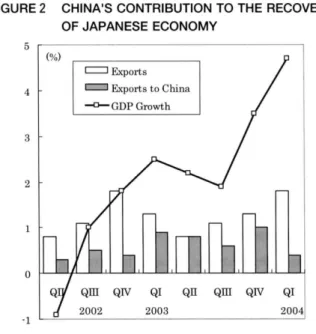
129
THE SINO-JAPANESE ECONOMIC RELATIONS
UNDER THE KOIZUMI ADMINISTRATION1
Hideo Ohashi
INTRODUCTION
In the first half of the 2000S, the Sin°-Japanese relations were often
char-acterized by the word of seirei keinetsu (politically cold but economically
hot). Overcoming the financial crisis in the late 1990S, East Asian
coun-tries established the regional cooperative framework called the 'ASEAN (Association of Southeast Asian Nations) plus Three,I comprising the ASEAN 10 countries and the three economic powers (Japan, China, and Korea) in the region. In the context of the `ASEAN plus Three,'Japan, China, and Korea also tried to build trilateral constructive partnership and make a wide range of proposals for regional economic cooperation.
In Japan, however, Mr. Junichiro Koizumi took the seat of Prime Minister
inApri1 2001 by publicly promising tovisit Yasukuni Shrine, which is
dedi-cated to the war dead including the Class-A war criminals. After he
In May 2005, the Chinese Ⅵce Premier Wu Ⅵ abruptly canceled her meeting with Prime Minister Koizumi and directly returned home. The top leaders'dialogue betweerl Japan and Chilla On the occasion of the `ASEAN plus Three'meeting in autumn 2005, which had been used as alternative opportunities for Japanese and Chinese top leaders to meet each other regularly, was also cancelled. The channel for the top leaders'dialogue was substantially closed in 2005.
Under the seirei condition, however, the SinoIJapanese economic
tions unexpectedly expanded. What enabled the bilateral economic
rela-tions to expand so quickly? Did the se7:ref condition have any negativein-nuence on the economic relations between them? What roles did the
p0-1itical factors play in the current bilateral relations? By replying to these questions, this paper, focuslng On an economic aspect of the bilateral rela-tions, considers the Sino-Japanese relations in the seirei keinetsu period in the first half of the 2000S.DETERIORATING BILATERAL RELATIONS
THE SINO_JAPANESE ECONOMIC RELATIONS UNDER THE KOIZUMI ADMINISTRATION 131
China achieved a remarkable economic growth and enhanced its interna-tional presence. The rise of China provided opportunities for neighbors
and at the same time accompanied a number of frictions and conflictswith
them.
In addition to emotional entanglements between them, the
Sho-Japa-nese relations significantly turned soured when Prime Minister Koizumi made an officialvisit to Yasukuni Shrine. He promised Prime Minister's offi-cial visit to it during the election campaign for the presidency of the Lib-eral Democratic Party (LDP), the ruling party of Japan, partly because theJapan War-Bereaved Association was the mainstay of support for his rival
candidate, former Prime Minister Ryutaro Hashimoto. The repeated visits
by Koizumi and other Cabinet members to Yasukuni Shrine exasperatingly irritated the Chinese leaders, and consequently widened the issue areasbetween Japan and China ranging from historical distrust to differing
terri-torial claims. Moreover, some disrespectful behavior and insensitive official
remarks by the Japaneseintensified anti-Japanese sentiment among the
Chinese people in general.The annual survey on publicviews on diplomacy by the Cabinet Office
of Japan iuustrates the Japanese sentiment toward China and their assess一 ment of current status of the Japan-China relations (Figure 1). The indexof the Japanese affinitywith China drastically droppedin1989 when the
mananmen Square Incident occurred, accompanied by a continuous drop
in the mid-1990s when China repeated a series of atomic bomb tests and threatened Taiwan by militaⅣ exercise with missile launchings. The indexfurther dropped in 2004.Another index of the Japanese assessment of the
bilateral relations also traces similar curves.FIGURE
1 THE
JAPANESE
PUB
l
L
C VIEWS
ON CHINA
(
A
)
00
u
y
o
l
e
e
f
n
y
a
t
i
n
i
f
f
a
h
t
i
w
(
B
)
00
u
y
o
k
n
i
h
t
a
n
a
p
J
s
a
h
d
g
o
o
Ch
i
?
a
n
a
l
e
r
s
n
t
o
i
w
h
i
t
?
a
n
i
h
C
1
3
2
90 国 0 0 制 的 OON 叩 司OON 円 OON N O O N h 一 【 8 制 -a ' ' 4 一 同 」 只百四 山 内 U 4 8 2 T A 刊 4 ト E M -ー l 巾 川 ] 8 2 4 m 廿 ] 岬 申 AM -n 四S 4 ZE C n」
円 。 由
-m 叫 ] g a -同 町 」 【 富 山 A mu し } EE 」 申 咽 ∞ -」 司 曲 目 白 」 坦 園 田 -4 守 一 田 町 -J Z W E -」 口 曲 由-ト
N
A山 川dIr;
片
四 郎 '10 30 70 60 50 10 20 10。 。 。 問
的 CCN 宝 甲 O 割問
。
DN m C O N - A MEN D -o 開 閉 e E -国 間 a dト
。
。
-。 -。
ω-唱
申
。
-守
。
。
-円
由
。
-N 由 明 -m m -c o o-。
曲
。
-国
曲
。
-ト国田-唱
曲
。
-n uC
a
b
i
n
e
t O
i
f
f
e
c
6
)
0
0
(
2
.
S
o
u
r
e
c
C
h
i
n
a
e
c
a
u
s
e
b
i
f
o
s
t
n
a
i
r
a
t
i
r
o
h
t
u
a
n
o
i
s
s
e
r
p
e
r
pro-democracy
f
o
movem
e
t
n
and
s
t
i
c
s
u
u
o
n
i
t
n
o
y
r
a
t
i
l
i
m
.
p
u
d
l
i
u
b
The
e
s
i
r
f
o
a
n
i
h
C
d
e
i
d
o
v
r
p
e
h
t
-
a
p
J
a
n
e
e
s
an o
y
i
t
n
u
r
t
o
p
p
o
t
r
e
d
i
s
n
o
c
e
r
e
h
t
e
l
o
r
f
o
e
n
e
s
J
a
p
a
l
a
i
c
i
f
f
O
p
-
l
o
v
e
D
e
m
e
t
n
e
c
n
a
t
s
s
i
s
A
(ODA)
o
t
.
a
n
i
h
C
l
i
t
n
U
e
h
t
e
s
e
p
a
n
a
J
s
'
t
n
m
e
n
r
e
v
o
g
n
o
i
s
i
c
e
d
t
o
h
a
s
p
e
u
t
o
e
h
t
ODA
o
t
a
C
h
i
n
,
e
h
t
r
e
t
t
a
l
was
e
h
t
d
o
r
l
w
t
s
e
g
r
a
l
t
n
e
i
p
i
c
e
r
o
f
h
t
e
e
r
o
r
m
f
.
d
i
a
Most
f
o
e
s
p
a
n
J
a
e
w
e
r
e
g
n
i
l
l
i
w
o
t
e
d
i
v
o
r
p
a
n
a
t
e
e
q
u
a
d
l
e
v
e
l
f
o
ODA
o
t
i
n
a
C
h
e
s
u
a
c
e
b
y
e
t
h
s
a
l
l
e
w
s
a
e
h
t
e
n
e
s
h
i
C
d
d
e
a
r
g
e
r
e
h
t
a
i
d
s
a
s
n
o
i
t
a
r
a
p
e
r
r
o
f
s
'
n
a
p
a
J
e
i
m
r
t
a
w
.
r
o
i
v
a
h
e
b
However
,
e
h
t
e
s
e
p
a
n
J
a
v
i
e
ws r
g
n
d
i
r
a
g
e
e
h
t
ODA
o
t
n
a
C
i
h
v
e
h
a
y
l
t
n
a
c
i
f
i
n
g
i
s
d
.
g
e
n
h
a
c
t
s
r
i
F
,
i
n
a
C
h
h
a
THE SINO-JAPANESE ECONOMIC RELATIONS UNDER THE KOIZUMI ADMINISTRATION 133
nal threat. These facts negated the need for Japan's ODA to China. The Japanese resentment against China consequently emerged when the Japanese soccer team won the Asian Cup held in China in summer 2004. A number of the Japanese youths, who were usually little interested in China, Witnessed on TV that the Chinese spectators unreasonably booed the Japa-nese team throughout the event and some of them finally attacked an offi-cial car of the Japanese embassy when the Japanese team defeated China in the final. Incidents such as the offshore oil development by a China's state-Owlled enterprlSe in the area of disputed waters and the intrusion into Japanese territorial waters by a China'S submarine further intensified the Japanese anti-Chinese sentiment.
DEEPENING ECONOMIC RELATIONS
China as an LEconomic Threatl
The SinoIJapanese economic relations unexpectedly developed throughout the seirei period, although there was a particular concern that the bilat-eral relations would go from bad to worse or from seirei kei77,etSu tO seirei keiryo (Politically cold and economically cool) A China became Ja-pan's largest import partner in 2002. In the 'lost decade'of the 1990S, Chi-nese products which were more competitive in a value-for-money sense
metwith the Japanese consumers'favorina severe recession. A large
number of them were the products developed by Japanese distributors for their Japanese consumers and mostly made by Japanese subsidiary
facto-ries locatedinChina. During the period of 'bubble economy'from the late
1980s to the early 1990S, Japan increased imports of brand-name mer-chandise such as high-priced luxury cars and designer-label goods from Europe. A decade-long recession totally changed the Japanese attitude to-ward consumption.THE SINO_JAPANESE ECONOMIC RELATIONS UNDER THE KOIZUMI ADMINISTRATION 135
phones, and air conditioners) in June 2001.2
Reaching an agreement after several rounds of negotiations, Japanese government did not invoke full safeguard measures and the Chinese gov-ernment withdrew its countermeasures at the end of 2001.3 protectionist measures would be obviously against the basic principles of free trade re一 gime from which Japan has benefited throughout the post-war period, and have adverse effects on structural reform in Japan. They also impair the interests of Japanese consumers gained from Chinese products and Japa-nese firms earnestly engaged in China business. Needless to say, social costs of protecting domestic industries are tremendously increasing.
Growing mports from China put immeasurable pressure on industrial adjustment in Japan. Faced with the increaslng number of bankruptcies and unemployment, a lot of Japanese tried to attribute ongoing economic
difficulties to the rise of China. Awide range of Japanese industries
per-ceived China as an `economic threat.'China was also charged with an
`ex-port of deflation.'Criticism was focused on the following two points. First,
China's economic growth was driven by low-priced exports at the expense of Japan and other neighboring economies. Second, the Chinese govern一 meれt should take measures to counter domestic denation or appreciate the Chinese renminbi (RMB). Undoubtedly deflation was rooted in
differ-ent causes in the two countries, although the revaluation of RMB would
make positive contributions to redress the imbalances in the world econ-omy. In Japan, deflation was mainly caused by the sharp drop of the asset markets such as real estate and stocks. Theseviewpoints, therefore, simply reflected the Japanese lost confidence in its economy and their Jealousy over China's economic success.China led to the hollowlng Out Japanese industries. Many Japanese prod-ucts, laboトintensive products in particular, Were defeated by competitive
products imported from China. A number of Japaneseindustries shifted
their manufacturing plants to China to get access to the rapidly growing
local market and to reduce production costs by uslng ample and cheap lo-cal labor. Consequently, not a few of Japanese businesses were forced to close doⅥT and unemployment rate unprecedentedly rose. Dai-Ichi Life Research lnstitute (2001) indicated that the shift of Japanese manufactur-ing industries to China decreased the domestic sales by 2.3 percent and the number of full-time workers by 0.9 percent in these industries in 1998
-2000.Another empirical study by Fukao and Yuan (2001) estimated that
the loss of manufacturing jobs would amount to 577,000 during 1987-1998 due to Japanese outward investment in East Asia, but the study also pointed out that the job opportunities created in the same period would cover job losses caused by Japanese outward investment. It is almost im-possible to demonstrate a causal relationship between Japanese investmentin China and the hollowing out of Japanese industries, but it is true that
numerous opportunities created in China had considerable impacts on Japanese industries and structural reform.Chiztese Special Procurement Boom4
THE SINO-JAPANESE ECONOMIC RELA lTONS UNDER THE K Ol ZUM I ADM INl STRA lTON
7
1
3
b
u
s
i
n
e
s
s
e
s
and
s
e
i
r
t
s
u
d
n
i
l
l
a
r
e
o
v
e
h
t
l
d
w
o
r
.
s
e
e
a
n
J
p
a
s
m
r
i
f
o
s
l
a
c
e
t
u
n
e
x
p
-e
d
l
y
d
t
e
i
f
e
n
e
b
m
f
o
r
Chugoku
t
o
k
u
)
μ(Chinese
l
a
i
c
e
p
s
e
t
n
e
m
o
r
u
c
r
p
boom)
T
a
k
i
n
g
e
s
e
h
t
s
e
i
t
i
n
u
t
r
o
p
p
o
,
e
n
s
e
a
a
p
J
economy
d
l
o
u
c
e
t
a
r
e
l
e
c
c
a
e
h
t
p
a
c
e
o
f
r
y
r
v
e
o
e
c
f
r
o
m
a
decade-
l
ong
.
n
o
i
s
s
e
c
e
r
As
s
i
y
l
d
e
t
a
e
p
e
r
e
n
e
s
n
i
e
h
t
e
r
-c
o
v
e
r
y
s
s
e
c
r
o
p
J
f
o
s
e
n
e
a
p
a
economy
n
i
e
h
t
t
s
a
p
,
t
r
p
o
x
e
e
n
c
o
n
i
a
g
a
d
y
e
a
p
l
an e
y
e
l
e
m
t
r
x
t
n
t
a
o
r
p
m
i
.
e
l
o
r
y
l
l
a
i
c
e
p
s
E
a
d
i
p
a
r
e
s
a
e
r
c
n
i
n
i
t
r
o
p
x
e
o
t
i
n
a
C
h
e
d
e
g
a
r
l
n
s
e
a
n
e
p
a
J
t
r
o
p
x
e
s
a
a w
h
o
l
e
,
and
l
y
n
t
u
e
e
q
s
n
o
c
d
e
t
s
o
o
b
s
t
i
-
r
e
t
l
a
f
i
n
g
economy
e
r
u
g
i
F
(
)
2
.
5T
h
r
o
u
g
h
o
u
t
a
d
c
a
d
e
e
f
o
n
o
i
s
s
e
c
e
r
,
e
s
n
e
a
p
a
J
s
m
r
i
f
g
g
u
r
t
s
l
ed t
o
e
c
r
o
f
n
i
e
r
and
e
r
u
t
c
u
r
t
s
e
r
r
i
e
h
t
s
s
e
n
s
i
u
b
by
g
n
i
h
s
i
l
o
b
a
e
l
b
a
t
i
f
o
r
p
n
u
s
r
o
t
c
e
s
,
by r
c
e
d
u
-i
n
g
s
s
c
e
x
e
n
i
o
t
u
c
d
o
r
p
y
t
i
c
a
p
a
c
,
and
by l
g
n
i
y
a
s
u
l
p
r
u
s
s
r
e
k
r
o
w
f
o
.
f
r
i
h
e
T
e
x
p
a
n
d
i
n
g
s
t
r
p
o
x
e
o
t
a
n
i
h
C
d
e
t
u
b
i
t
r
n
o
c
o
t
d
i
p
a
r
e
s
t
n
e
m
v
o
r
p
m
i
n
i
r
i
e
h
t
b
u
s
i
n
e
s
s
e
r
m
a
n
c
e
r
f
o
p
and
a
rebound
f
o
e
s
e
a
n
J
p
a
economy
s
a
a
w
h
o
l
e
from a prolonged recession. China's growing demands for resources and
materials caused by the booming economy were so huge that its appetite for them could increasingly affect their international prices.China's heavy demand for steel had many spillover effects on Japanese industries. In response to it, Japanese steel makers expanded production and increased exports to China. 'Special procurement'from China quickly improved their business performance and made them embarked on new in-vestments in plant and equipment. Their new inin-vestments to eI山ance their production capacity, Coupled with heavy investments by Chinese steel makers, stimulated Japanese plant industry to be actively engaged in China
-related business. China's growing imports of steel products and materials
(iron ore and coal) pushed up freight charges. This also induced Japanese shipping business to be revitalized. Since shipping firms began to place
or-derswith shipbuilders for new merchant vessels to meet China's growing
demands, Japanese shipbuilding industry as well benefited from China. As
a comprehensive assembly industry, shipbuilding requires a great number of equipment and materials. China'S Ⅵgorous appetite for steel had an ex-traordinaIY 1mpaCt On a Wide range of Japanese industries including steel, oil refinery, shipping, and shipbuilding, all of which had been recognized as `structurally-depressed industries'in Japan.In the Chugoku tokuju in Japan, not only many industries directly re-sponding to China's industrialization but also other business to meet its
va-riety of demands greatly benefited from the booming economy. Reflecting
THE SINO- JAPANESE ECONOMIC REL ATIONS UNDE R THE KOI ZUM l ADMIN1STRATION
9
3
1
Most
f
o
e
h
t
s
m
r
i
f
n
i
s
t
i
h
t
s
u
d
n
i
y
r
d
e
n
r
u
t
e
r
o
y
t
t
i
l
i
b
a
t
i
f
o
r
p
b
y e
g
n
i
g
r
a
u
r
C
n
i
h
a
n
s
i
u
b
s
e
s
.
a
n
J
p
a
e
s
e
j
o
r
m
a
l
a
r
e
n
e
g
o
c
a
r
t
n
s
r
o
t
c
o
s
l
a
r
e
g
a
d
r
e
d
a
C
h
i
n
s
a
a
-
t
s
a
f
n
g
o
w
i
g
r
mark
t
e
,
a
nd m
a
d
e
b
o
l
d
t
r
e
o
f
f
s
o
t
e
t
n
e
r i
o
t
n
n
ew
n
i
s
b
u
s
s
e
i
n
s
i
h
t
g
i
b
e
m
e
g
n
i
g
r
m
a
r
k
e
t
.
C
h
i
n
a
i
s c
r
r
u
e
l
t
n
y
n
i
a
c
r
o
p
s
s
e
f
o
d
i
p
a
r
.
n
o
i
t
a
z
i
r
o
t
o
m
g
n
i
s
s
p
a
r
S
u
J
a
p
a
n
,
C
a
n
h
i
b
a
e
c
me t
e
h
d
l
r
o
w
o
n
d
s
e
c
g
g
i
b
t
s
e
a
u
tomob
l
i
e
m
t
e
k
r
a
n
i
2006
.
Con
-s
d
i
e
g
n
i
r
t
h
e
t
a
e
r
g
numb
e
r
p
f
o
s
t
r
a
a
nd mat
r
e
s
l
a
i
o
t
u
b
e
s
e
d
r
o
f
manufa
c
-t
u
r
i
n
g
e
h
t
a
n
i
f
l
produ
s
t
c
,
l
e
b
i
m
o
t
o
a
u
r
t
s
u
d
n
i
y
d
u
l
h
o
s
hav
e
m
a
ny s
v
o
l
l
i
p
r
e
e
c
e
f
f
t
s
o
n
a
w
i
d
e
r
a
ng
e
o
f J
a
p
s
e
n
e
a
i
r
t
s
u
d
n
i
.
s
e
C
n
i
h
s
'
a
g
n
i
s
i
r
o
c
n
s
u
m
p
t
i
o
n
wo
d
l
u
c
r
e
t
a
e
hug
e
d
e
mands
r
o
f
c
i
v
r
e
s
e
s s
u
c
h
s
a
s
m
i
u
r
o
t
,
t
n
a
r
u
a
t
s
e
r
,
w
l
o
h
e
l
a
s
e
r
/
a
t
e
l
i
n
s
i
u
b
s
e
s
,
and
c
o
mmuni
t
a
c
n
o
i
.
s
e
c
i
v
r
e
s
C
n
i
h
a
n
s
i
u
b
s
s
e
e
c
-
r
t
a
u
r
i
y
o
c
t
u
b
i
r
t
n
ed
o
t
an
i
m
p
r
o
v
e
m
e
t
n
n
i
m
a
n
c
e
r
f
o
r
p
e
f
o
J
a
p
a
n
e
s
e
s
m
r
i
f
which
had
b
e
e
n f
a
c
e
d
h
t
w
i
a s
l
h
s
i
g
g
u
dom
c
i
t
s
e
o
e
c
nomy
.
As a
t
l
u
s
e
r
f
o
a
r
d
i
p
a
n
i
e
a
s
e
r
c
n
i
e
d
a
r
t
h
i
t
w
C
a
n
i
h
,
g
n
i
d
o
r
c
c
a
o
t
e
h
t
t
r
a
d
e
k
o
o
l
t
u
o
f
o
e
h
t
a
p
a
n
J
E
e
t
x
n
r
a
l
r a
T
d
e
n
o
i
t
a
z
i
n
a
g
r
O
J
E
(
TRO
200
7
)
,
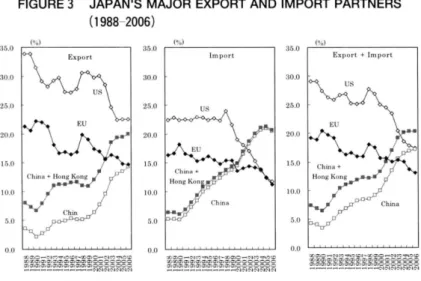
2 0 . 0 10.5 10.0FIGURE
3 JAPAN'S
MAJOR
EXPORT
AND
IMPORT
PARTNERS
China is expected to be the largest trade partner of Japan in 2007. China became the largest import partner in 2002 as mentioned above. China plus Hone Kong6 was the largest trade (export and import) partner in 2004 (Figure 3)・ The rise of China has drastically changed the trade and indus-trial structure of Japan.
China's Involvement in Regional Production Network
ln the post-war period, East Asian economies including Japan, the Asian
Newly Industrializing Economies (NIEs), and the ASEAN countries
achieved unprecedentedly high economic growth by increasing exports
mainly to the United States.All of them have been the primary
beneficiar-ies of the free trade system under the General Agreement of Tariffs andTrade (GATT)/WTO regime. The United States as the embodiment of free
trade system has been the most open market in the world. China iscur-rently following the same path as other East Asian economies have traced,
but China's trade and industrial structure is quite different from that of its neighbors.
Most of East Asian economies have been engaged in processing trade by importing materials and intermediate input goods mainly from Japan. Us-ing their ample and cheap labor, they processed and assembled them into the final goods, mostly labor-intensive manufactured goods, and directly exported them to the world largest market in the United States. Faced
with rising production costs and revaluation of their currencies, however,
they had to readjust their development strategies. A great manyindustries
shifted their production plants to foreign countrieswith less production
Un:itBillion$
THE SINO-1APANESE ECONOMIC RELATIONS UNDER THE KOIZU阻 ADMINISTRATION
1
4
1
1
9
7
0
s
.
L
o
c
a
t
e
d
i
n
t
h
e
c
e
n
t
e
r
o
f
i
n
t
e
r
n
a
t
i
o
n
a
l
d
i
v
i
s
i
o
n
o
f
l
a
b
o
r
i
n
E
a
s
t
A
s
i
a
,
C
h
i
n
a
h
a
s
i
n
c
r
e
a
s
e
d
t
h
e
e
x
p
o
r
t
-
p
r
o
d
u
c
t
i
o
n
i
n
t
h
e
form o
f
t
h
e
f
o
l
l
o
w
i
n
g
t
r
i
-a
n
g
u
l
a
r
t
r
a
d
e
among E
a
s
t
A
s
i
a
,
C
h
i
n
a
,
and t
h
e
U
n
i
t
e
d
S
t
a
t
e
s
.
E
a
s
t
A
s
i
a
n
e
c
onomi
e
s
,
i
n
c
l
u
d
i
n
g
Ja
p
an
,
Korea
,
and Taiwan
,
e
x
p
o
r
t
p
a
r
t
s
and mat
e
r
i
a
l
s
t
o
C
h
i
n
a
,
p
r
o
c
e
s
s
and a
s
s
e
m
b
l
e
them i
n
t
o
t
h
e
f
i
n
a
l
g
o
o
d
s
i
n
C
h
i
n
a
,
and e
x
-p
o
r
t
t
h
e
m from C
h
i
n
a
t
o
t
h
e
U
n
i
t
e
d
S
t
a
t
e
s
.
M
u
l
t
i
n
a
t
i
o
n
a
l
c
o
r
p
o
r
a
t
i
o
n
s
,
f
o
r
-e
i
g
n
f
i
r
m
s
,
and t
h
e
i
r
s
u
b
s
i
d
i
a
r
i
e
s
i
n
C
h
i
n
a
l
e
a
d
t
h
e
e
x
p
o
r
t
-
p
r
o
d
u
c
t
i
o
n
and
t
h
e
t
r
i
a
n
g
u
l
a
r
t
r
a
d
e
among t
h
e
m
.
As a
r
e
s
u
l
t
,
C
h
i
n
a
h
a
s
l
a
r
g
e
t
r
a
d
e
d
e
f
i
c
i
t
s
w
i
t
h
t
h
e
n
e
i
g
h
b
o
r
s
and hug
e
t
r
a
d
e
s
u
r
p
l
u
s
w
i
t
h
t
h
e
U
n
i
t
e
d
S
t
a
t
e
s
and
Europe (
F
i
g
u
r
e
4
)
.
7C
h
i
n
a
c
u
r
r
e
n
t
l
y
a
c
c
e
l
e
r
a
t
e
s
an economic g
r
o
w
t
h
by p
a
r
t
i
c
i
p
a
t
i
n
g
i
n
i
n
-FIGURE 4 CHINA'S TRIANGULAR TRADE: TRADE BALANCE WITH
ternational export-production network in East Asia, ln Other words, by be-ing involved in the global supply chains. In the past decade, intraregional trade in East Asia grew faster than the world trade as a whole, even though most of East Asian economies suffered serious damage from the fi-nancial crisis in the late 1990S. A rapid increase in intraregional trade could be primarily explained by the rise of China. Involved in the global supply chains, China has considerably changed the trade patterns in East
Asia. As for the direction of trade, intraregional trade has become a
domi-nant form of trade in East Asia. The ratio of intrareglOnal trade to totaltrade in East Asia rose from 33.4 percent to 54.2 percent during the
pe-riod of 1980-2003・8 The regional export-production network has changed not only the direction of trade but also the trade co…odity structure in East Asia. In 2000, for example, the intermediate goods accounted for 68.0 percent of the NIEs exports to their neighbors (other NIEs, ASEAN, andChina), while the final demand goods represented 62.7 percent of Chinese
total exports to the UIlited States (Ohashi 2005 : 74-76). In short, the in-termediate input goods such as parts and materials are circulating in the form of intraregional trade in East Asia, while the final goods mostly madein China are massivelyflowing into the United States. As the 'world
fac-toIY,'China has become the hub of the export-production network in East Asia.
THE SINO_JAPANESE ECONOMIC RELATIONS UNDER THE KOIZUMI ADMINISTRATION 143
chitecture is most suitable to mass production. In manufacturing modular products, assembly process makes least profit while both the upstream and the downstream of the value chain are more profitable. Low entry barrier makes it easy to participate in assembly business because most modular products are full of high-technology components but their assembly does not need any high-technology. Severe competition among new participants in assembling modular products has made this business least pro丘table. Since high-technology components can be labor-intensively assembled on a mass quantity basis in China, a great number of industries have shifted
their assembly process to Chha.
Modular products do not need an integrated production process because of their simple interface among standardized components. Their
produc-tion process can be fragmented into several manufacturing processes and
their production plants can be located in the most suitable places for each manufacturing process. Due to the revolutionary changes in communica-tion and transportacommunica-tion, the service link costs between produccommunica-tion plants have decreased to a minimum. Manufacturers of modular products shifted some manufacturing processes to China in the form of foreign direct in-vestment (FDI). China also benefits from the fragmentation of production process in manufacturing industries. As a result, modular architecture re-quires a reassessment of the `nying一geese'mode19 0f East Asian economic development、 This development pattern has been based on the changlng comparative advantage h East Asia, but FDI can readily transfer a set ofproduction factors and has a criticalinfluence on the factor endowments
Growlng Intraindustry and IntrafirmTrade IJed by FDI
Japanese FDI in China has been growing since Deng Xiaoping called for an
acceleration of reform and openlng-uP policy in 1992. The total number of Japanese manufacturing plants in China exceeded that of ASEANinthe mid-1990s and that of the United States in 2000. According to an annual questionnaire survey on outward investment of Japanese manufacturing
in-dustries conducted by Japan Bank for htemational Cooperation (JBIC) ,
China has been regarded as the most promising destination since 1997.10 Since the severe acute respiratory spIdrome (SARS) scare in 2003 and particularly the anti-Japanese demonstrations in 2005, most of Japanesebig businesses have taken a newinvestment strategy of 'China plus one,'
under which they try to establish another overseas manufacturing plant outside China in order to reduce the 'China risk,'although China is still theprimary destination of Japanese FDI.
In the 1990S, Japan's manufacturing investments in China were mostly made by labor-intensive industries. Some of them were called
watari-dori or migrant birds which were likely to make swift shifts of their plants
THE SINO_JAPANESE ECONOMIC RELATIONS UNDER THE KOIZUMI ADMINISTRATION 145
0verseas production of Japanese manufacturing industries is rapidly growing mainly because of their shift of manufacturing plants to China・
Japanese subsidiaries in NorthAmerica are in general domestic
sale-ori-ented, while those of East Asia, especially China, are more export-ori-ented. Over a half of their products made in East Asia is usually exported, a half of which is to Japan, although their products are increasingly sold in local markets as the host countries become affluent. In 1997-2005, Japan's exports to North America remained almost unchanged because the Japa-nese subsidiaries enhanced the local production capacity and JapaJapa-nese ports were substituted for their local production. Not only Japanese ex-ports to China but also their subsidiaries'local sales in China drastically in-creased in the same period. In 2005, more than 90 percent of their prod-ucts were domestically sold in the North America, while their prodprod-ucts made in China were mainly exported and their exports to Japan accounted for almost 30 percent of their sales in China (Table 1), Export ratio of
Japanese subsidiariesinChina reached their peak in the first quarter of
2003, when their parent丘rms accounted for 25 percent of their total sales, 40 percent of their exports, and 73 percent of their exports to Japan. These figures reveal that the growlng bilateral trade between Japan andChina mostly take a form of intraindustry andintrafirm trade.
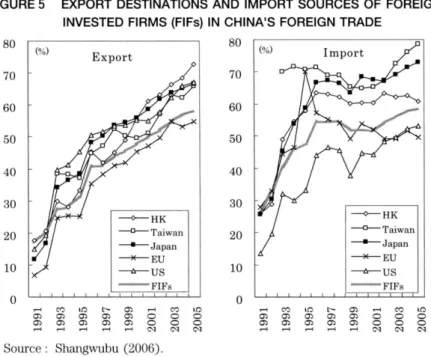
Foreign hvested丘rms (FIFs) have played very important roles in the development of China's foreign trade. In 2005, they represented 58 percent of China's export and import respectively. Japanese丘rms and their
subsidi-ariesinChina constitute far greater portion of the bilateral tradewith
addi-TABLE 1 SALES OF JAPANESE SUBSIDIARIES IN THE UNITED STATES AND CHINA Unit : Billion Yen
1997 2005
World Japan's Exports to the World Total Sales of Subsidiaries
Domestic Sales Export to Japan
Export to Third Countries North Japan's Export to the North America
America Total Sales of Subsidiaries
Domestic Sales Export to Japan
Export to Third Countries China Japan's Export to China
Total Sales of Subsidiaries Domestic Sales Export to Japan
Export to Third Countries Source : MOP (2006) and METI (2006b).
tion to intraindustry and intrafirm trade, a number of Japanese distributors also contribute to the development of the bilateral trade by developing a wide range of products in China mainly targeted for the Japanese consum-ers. These products including garments and vegetables are customized and imported by Japanese distributors, which is called `development import.I
Japanese FIFs have already become a firmly rooted in China. They have made positive contributions to China's economic growth by increasing ex-ports, by transferring technology to local丘rms, and by encouraging com-petition in local markets. Japanese FIFs also created 9.2 million of job op-portunities by 2005 according to China's Minister of Commerce Bo Xilai (Press Office 2005).13 This figure is much larger than the current number of the unemployed in China.14
THE SINO-JAPANESE ECONOMIC RELA lTONS UNDER THE KOIZUMI ADMINISTRATION 147
FIGURE
5 EXPORT
DESTINATIONS
AND
IMPORT
SOURCES
OF FOREIGN
I
NVESTED
FIRMS
)
s
F
I
F
(
N
I
CHINA'S
FOREIGN
TRADE
80 1(%) 70 80 70 60 60 50 50 40 40 30 30
ー
一
+
一
一
HK 20一
}
一
一
{
-
Taiwan 20一
一
ー
一
一
Japan一
一
冊
一
一
EU 10一
一
合
一
US 10 田 園 田 国 国FIFsO
O
σσF F 4 4 ココ ぴσσFコ・ココ4 σUσF34ココ σσFt、コ4コ σσσF34コ3qFp0Cコ4 σひコ0Cコ3 C0 pばqココ Fσσ3F→コ・4 <σσ-σ.コココ σσFu・コココ σσF、・34 コS
o
u
r
c
e
:
Shangwubu
(2006)由
。
。
Nm
o
o
N
HCCN。
。
。
」
[
I
n
d
u
s
t
r
i
a
l
c
u
s
t
r
a
r
f
n
I
t
ure
Shared
by M
a
nufacturers
FDI
s
i
o
t
n
y
l
n
o
a c
l
a
t
i
p
a
w
o
l
f
u
t
b
a dynamic
n
o
i
t
a
r
g
i
m
management
f
o
e
r
-s
o
u
r
c
e
s
g
n
i
d
u
l
c
n
i
n
o
i
c
t
u
d
o
r
p
g
y
l
o
n
o
c
h
e
t
,
management
know
-
how
,
b
r
a
n
d
,
t
e
c
h
n
o
l
o
g
y
- d
t
p
e
m
n
o
l
e
v
e
and
n
o
i
t
a
r
m
o
f
n
i
-
g
n
i
e
r
h
t
a
g
y
t
i
l
i
b
a
,
l
g
n
i
d
e
a
-
i
s
o
p
t
i
o
n
n
i
l
a
i
r
e
t
a
m
,
t
u
c
r
o
d
p
,
and
l
a
i
c
n
a
n
i
f
a
r
k
e
t
s
m
,
and
o
s
.
n
o
As
e
s
e
J
a
p
a
n
FDI
n
i
h
i
n
a
C
s
e
s
a
e
r
c
n
i
,
o
t
h
b
e
a
n
e
s
a
J
p
and
s
e
e
n
i
h
C
s
r
e
r
t
u
f
a
c
n
u
a
m
h
a
v
e
-
e
r
c
e
y
l
t
n
l
e
a
d
n
e
r
o
t
a
r
h
s
l
a
e
i
r
t
s
u
d
n
i
e
r
u
t
c
u
r
t
s
a
r
f
n
i
most
which
f
o
was
-
l
e
v
e
d
products have been forced to retreat from both marketsinChina and
Ja-pan.Although Japaneseindustries are losing to China in their final product
markets, they are of great competitiveness in manufacturing parts and ma-terials. Accepting these challenges, they have changed their productstrategies. Instead of selling the final productsinChina, they give priority
to export their key parts and components to China. Until the mid-1990S, Chinese manufacturers imported most of key partsand components such as the cathode-ray tubes (CRY) for TVs and the compressors for aiトCOn-ditioners from Japan. Even today, they still depend on outsourcing rather than self-manufacturing them.15 chinese manufacturers in general have a tendency to prefer the development of new products in the shortest time by introducing existing technology or imitating the latest models rather than the investment in research and development (R&D) and human re-source. As a result, Japanese industries are able to expand the exports ofkey parts and components to China although they strugglewith the
declin-ing market share of the final products. As is often the casewith the
deve1-0ping economies in East Asia, China's imports from Japan are likely to ex-pand structurally as their exports increase・16
10-THE SINO_JAPANESE ECONOMIC RELATIONS UNDER 10-THE KOIZUMI ADMINISTRATION 149
cal manufacturers are also improving their product quality and delivery schedule. As a result, Japanese manufacturing industries are speedily ra主s-ing their local content rate in China (Figure 6) and achievra主s-ing a swiR eam-ings recovery.
Japanese supporting industries also shift their manufacturing plants to China. Take mold manufacturing industry as a good example. Mold
manu-facturingindustry is one of the most important supportingindustries. A
number of Japanese mold manufacturers have already started theirpro-duction in China. Since molds are indispensable to mass propro-duction, they
are often called 'mother tools of industries.'Highly refined and precise
molds are main sources of international competitiveness of Japanese manufacturing industries, especially automobiles, electronics, and machine tools. Japan is the leading country in manufacturing molds, usuallyac-FIGURE 6 LOCAL CONTENT RATES OF JAPANESE OVERSEAS SUBSIDIARIES IN MANUFACTURING INDUSTRIES 65 60 55 50 45 40 35 30 25
Source : METI (2006a)
Counting for more than one fourth of the shipment value of molds in the
world (EconomicAnalysis Department 2006 : 69).Trade missions from
abroad and foreign political leaders often payvisits to Ota-ku in Tokyo and Higashi Osaka, both of which are noted for mold manufacturing indus-try clusters. But the indusindus-try consists of numerous smau and medium-sized enterprises (SMEs) without strong management base, which ac-Counted for more than a half of the shipment value in Japan in 2005.
Japanese mold manufacturers are currently facing formidable challenges. As their main customers and users, typically automobile and electronics in-dustries, shift their production to China, their domestic production and
ex-port are continuously decreasing. They are in competitionwith imex-ported
molds because mold manufacturersinEast Asia are also improving the quality of their products. China has an extremely huge demand for molds,
but the local manufacturers have difficultiesinmaintaining high precision
and cannot manufacture particularly specified and extra-large molds. Moreover, skilled workers with experienced practice are in short supply (JASME 2004 : 67-68). Japanese manufacturing industries operating in China need high-quality and fine-tuned molds, and urge Japanese mold manufacturers to set up their factories in China.THE SINO-JAPANESE ECONOMIC RELATIONS UNDER THE KOIZUMI ADMINISTRATION 151
residents to move out of town because of noises and environmental degra-dation. Moreover, they are seriously ln Short of successors in business・
Most of the SMEs do not have any definite successors to their business
be-cause of unfavorable business prospects and poor working conditions. These problems have made them close their business. Consequently, a large number of condominium buildings, apartment houses, and parkingstructures are standing together in specific areas of town originally devell
oped as industrial zones. Not a few of Japanese engineers who have ever
worked for the SMEs or reach the mandatoIY retirement age find their new jobs and are hired by local industries in China・ In this way, Japaneseindustrial infrastructure hcluding human resources is constantly
trans-planted in China and it is in a sense shared by both Japanese and Chinese
manufacturers.IN SEARCH OF NEW RELATIONS
Seikei Bunri (Separation of Politics from Economy)
A氏er the diplomatic normalization, the Sin°-Japanese economic rela-tions could not be free from politics. In the 1980S, the economic relarela-tions were basically defined by the bilateral long-term trade agreement. In the mid-1980S, crude oil accounted for almost a half of Japan's imports from China while iron and steel represented more than 30 percent of Japan's exports to China. In the 1990S, the political framework of Japan'S ODA to China dominated the bilateral economic relations. In response to China's repeated atomic bomb tests in the mid-1990S, Japan's grant aid except for humanitarian assistance was temporarily suspended. The Japanese govern-ment's decision considerably deteriorated the Sin°-Japanese relations as a whole.
In the first half of the 2000S, the separation of politics from economy
was unexpectedly achieved. In addition to China's accession to the WTO,
the seirei keinetsu condition unpredictably lifted the political constraints on the bilateral economic relations. The Sin°-Japanese economic relations have unprecedentedly developed by a temporary retreat of troublesomepolitical factors from the bilateral relations. Without any spell of political
inteⅣention, the Sin°-Japanese economic relations certainly expanded as mentioned above.THE SINO_JAPANESE ECONOMIC RELATIONS UNDER THE KOIZUMI ADMINISTRATION 153
Economy in Command?
As the Sin°-Japanese economic relations expand, the number of economic disputes is inevitably increasing and some of them have became political issues between the two countries. Japanese凸rms have sometimes met with severe criticism from the Chinese consumers and customers, which included idiscriminatory'treatment of the Chinese passengers by Japan
Airlines (JAL) , 'defective'laptop computers of Toshiba, TV commercial
looking to `disgrace'China by Tbyota, and so on. In autumn 2006, a brand of cosmetics made by a Japanese subsidiary of the U.S. multinational was under criticism. The Japanese government released the new regulation on unsafe level of pesticide residue found in food a few months ago. The new regulation put a curb on the imports of agricultural products from China.There was a rumor implying that critical comments on the cosmetics were
made in retaliation for the Japanese government's new regulation.There is no denying the possibility that these economic disputes would be sublimated into political issues. Even if the economic relations progress
favorably, the two countries do not have any specific mechanism to confhe
the economic disputeswithin the bounds of normal behavior and to avoid
the sublimation of them into political issues. It is necessaIy tO take mutual
confidence building measures eveninbilateral economic relations. In this
context, the government-t0-government negotiations and the 'normal rel lations'are indispensable to further economic relations between Japan and China.there were some progress in the cooperation of protection of environment and intellectual property right (IPR). The study on the trilateral invest-meれt arrangements among Japan, China and Korea were temporarily sus-pended, which was based on the joint declaration by the three top leaders on the occasion of the `ASEAN plus Three'meeting in October 2003. The purposes of the agreements are to promote trade and investment, to en-large employment, to upgrade industrial structure, and to accelerate eco-nomic growth through an increase in FDI among the three countries. The arrangements should have been the first step for strengthening economic partnership among them. Economic integration under the free trade agree-ment (PTA) is another goal for the Sin°-Japanese economic relations (OhasI七2003). Throughout the seirei kei7WtSu Period, however, the two countries competed with each other for the PTA partners in the world.
By the establishment of the Abe administration, the Sin0-Japanese
eco-nomic relations had lost momentum for further progress because Japanese FDI in China, an engine for deepening bilateral economic relations, went topeak out. In 2006, Japanese FDI in China decreased by 20.8 percentin
number and 29.6 percent in utilized value respectively over the previous year (Shangwubu 2007). Following the strategy of `China plus one,'Japa-nese FDI set out for other countries in East Asia. In particular, Vietnam and India, both of which were primarily regarded as substitutes for China, benefited from increaslng investments from Japan. Between Japan and China, there were an increasing number of issues necessaⅣ to rely on the political leadership to make decisions.THE SINO_JAPANESE ECONOMIC RELATIONS UNDER THE KOIZUMI ADMINISTRATION 155
in the Diet as follows ; "China and South Korea are important neighboring countries. Japan-China and Japan-South Korea relations are now un-precedentedly close in economic and so many other areas. I believe that strengthening bonds of trust with both countries is extremely important for the Asian region and the entire international community, and it is es-sential to make mutual efforts so that we can have futurel0riented,frank discussions with each other" (Abe 2006b). Mr. Abe has been regarded as a hard-liner to China, while Prime Minister Abe seemed to have changed his attitude toward China. In search of new relations, the time has come when politics should contribute to not only further deepening of the bilateral economic relations but also overall development of the Sin°-Japanese rela-tions.
Implications for New Relations between Japan and China
The Sin°-Japanese relations in the seirei kei77/etSu period in the first half of the 2000s have some important implications for their new relations.
their source of legitimacy in economic growth and stability, and they pur-sue positive foreign economic policies to accomplish such economic objec-tives.
Second, development of bilateral economic relations is generauy re-garded as a `last resort'to stab山ze the Sin°-Japanese relations. Even if political factors lead to worsened relations, economic exchanges nowadays are so interdependent that both Japan and China cannot maintain eco-nomic growth and stability without developmg cooperative relations with each other. The two countries should build the multitiered and multifac-eted economic cooperation to raise the level of economic relations. Eco-nomic relations solely depending on exchange of commodities are likely to
be volatile, but those based on the FDI tend to irreversibly diversifyand
deepen the economic relations. In the seirei keinetsu period, Japanese FDI in China greatly contributed to the development of the Sin°-Japanese economic relations. Japanese automobile industries in particular made
such a huge amount of investments in China, accompanying a large
mum-ber of affiliated companies, that they could change the SinoIJapanese
trade structure to a considerable extent.an-THE SINO-JAPANESE ECONOMIC RELATIONS UNDER an-THE KOIZUMI ADMINISTRATION 157
niversary events to enhance friendship and partnership between them.
Considering thevital importance of bilateral economic relations, however,
both countries should propose more effective and timely policy measures according to business cycle. Under the seirei kei7WtSu Period, the econo-mies of both countries showed upward tendencies respectively. It was not necessary for the two governments to launch any specific policy measures to develop economic relations. But the booming economies would not last forever・ The two governments should consider more realistic policy
meas-ures to spur bilateral economic relations in preparation for a dowI一turn in
the economy. In case of weaker economy, it is necessary to con丘rm the
role of politics in the Sin°-Japanese relations.
1 The earlier version of this paper was presented at the Sin°-Japanese Relations
Workshop, organized by St.Anthony's College, Oxford University, On December 13,
2006. The author is deeply grateful to Dr. lan Neary and Professor Vivieme Shue for their excellent arrangements.2 At that time, China was not constrained by the WorldTrade Organization (WTO)
rules as it was not a member yet.
3 For the details of the safeguard issue in 2001, see Ohashi (2004 : 185-187). 4 During the Korean War in the early 1950S, the US forces procured a wide variety
of goods and services from Japan. Taking this opportunity, Japan promptly
com-pleted the posトwar reconstruction and went into an orbit of rapid economic
growth. This is called Chosen tokuju (Korean special procurement boom). The word of tokuju is often used when Japanese economy is unexpectedly booming. 5 In November 2006, Japan's current economic uptrend lasted for four years and
ten months and exceeded the A:a77,agi boom of four years and nine months from November 1965 to July 1970. This is the longest economic expansion in the post-war period although most of the Japanese do not feel so actually a sense of boom-ing economy as they did in the second half of the 1960S. Interesthgly enough, cur-rent economic uptrend began h December 2001, when China entered the WTO.
6 According to Hong Kong's trade statistics,in2005, 60.2 percent of Hong Kong's
0f Hong Kong's exports to Japan were originated in the mainland of China (Census
and Statistics Department 2006). Exports to and imports from Hong Kong should
be practically included i一l Japan's trade with China.
7 China has the largest trade surplus with Hong Kong, which has been regarded as
a gateway of Chinese products re-exported to the United States and Europe.
8 East Asia comprises Japall, NIEs, ASEAN and China. In the same period (1980-2003), the intraregional trade rates of the NorthAmerican FreeTrade Area
(NAFTA) and the EU 15 rose from 33.2 percent to 44.9 percent and from 57.2 per-cent to 60.3 perper-cent respectively (METI 2005 : 285). In other words, current in-traregional trade rateinEast Asia is higher than that of NAFTA and comparable to that ofEU 15 in 1980.
9 For the details of the 'flying-geese'model proposed in Akamatsu (1962), see
Ko-jima (2000).
10 For the latest result of the suⅣey, see JBICI (2005).
ll With a sizable amount of investments by the Japanese `Big Three'and their affili-ates, a leading irldustrial cluster of automobile industIY is emerging in Guangzhou,
wI心ch is called `Detroit in China.'
12 FDI in transport equipment accounted for 44.1 percent of Japanese
manufactur-ing FDI in China in the fiscal year of 2004 (from April 2004 to March 2005) (MOP 2005).
13 Mirdster Bo Xilai also emphasized that Japanese FIFs paid 49 billion RMB of
taxes in the same period.
14 China'S official figure of the unemployment only covers the urban workers
regiS-tered at local labor departments.
15 This fact also reflects Chinese manufacturer'S preference for modular products. 16 According to the Asian internationalinput-output (I-0) tables compiled by the
lnstitute of Developing EconomiesJapaII External Trade Organization (IDE -JETRO), for every 100 units produced by China's machinery industIY, 82.2 units of Chinese intermediate input goods were domestically sourced, compared with 8.0
units of Japanese parts and devices in 1995 (Ohashi 2006a : 222). Because China has sought to build a fun set of industrial structure, its dependency on Japanese
in-dustries is much lower than that of other economiesinEast Asia.
17 As their research objects are shifting to China, Japanese scholars and specialists
majoring in the SMEs and local industries earnestly conduct awide range of field surveysinChina. Their studies shed new lights on specific sectors in China and make great contributions to China studies in Japan (Ohashi 2006b).
THE SINO_JAPANESE ECONOMIC RELATIONS UNDER THE KOIZUMI ADMINISTRATION 159
Prime Minister Abe emphasized that "Japan and China would operate the two wheels of politics and economy and elevate the Japan-China relations tO a higher
dimension" (MOFA 2006). He might have exceeded the stage of separation of poli-tics from economy and proceeded to the next stage of renovating political relations with China.
19 These are (i) to strengthen mutually beneficial cooperation particularly in the
ar-eas of energy, environmental protection, finance, information and corrununication technology, and protection of intellectual property, (ii) to promote ministerial-level
dialogue, consultation among relevant authorities, and dialogue among the public
and private sectors in the economic field, (iii) to actively develop exchange,
espe-cially youth exchange, through holding Japan-China Year of Culture and Sports,
and enhance friendly sentiment between the two peoples, taking the opportunity 。f
the 35th anniversary of the normalization of bilateral relations between JapaI一aI一d
China in 2007, (iv) to enhance mutual trust in the area of security through
Japan-China security dialogue and defense exchange, and (V) to start joint research of
history by Japanese and Chinese scholars.
REFERENCE
Abc, Shinzo (2006a), Utsukushii Kuni e (Toward a Beautiful Country), Tokyo : Bung eishunzhu.
-(2006b), "Policy Speech by Prime Minister Shinzo Abe to the 165th Session of the Diet" (http : //www.kantei.go.jp/foreign/abespeech/2006/09/29speech_e・html) , September 29.
Akamatsu, Kaname (1962), "A Historical Patternof Economic Growth in Developing Countries,''The Developing Eco770mies , Preliminary Issue No.1.
Cabinet Office (2006), Sun)ey o77, Public Views oγ乙DipLomacy (http : //m8.cao.go・
jp/survey/index-gai.html), December 1 1 ・
Census and Statistics Department (2006) , Annual Review of Hong Kong
Mercha77-dise乃・ade 2005, The Government of the Hong Kong Special Administrative
Re-gion.
Dai」chi Life Research Institute (2001), "Chugoku Seisan Item de Kasoku suru Nihon Keizai no Defure Atsuryoku (hCreaSing Denationary Pressures on the JapalleSe Economy by Shifting Production to China)," Economic 7yend , October 12.