A review of the energy situation in Slovenia
著者(英) Chayadit Pumaneratkul journal or
publication title
Journal for information, study and discussion of Global Resource Management, Doshisha
University
volume 4
page range 45‑57
year 2018‑03
権利(英) Organization for Advanced Research and Education, Doshisha University
URL http://doi.org/10.14988/00027518
A Review of the Energy Situation in Slovenia
Chayadit Pumaneratkul
Energy Conversion Research Center, Department of Mechanical Engineering, Graduate School of Science and Engineering, Doshisha University
Abstract
This paper discusses the energy situation in Slovenia, by reviewing the current energy resources and future energy potential. The electric grid system of Slovenia is outstanding, it covers the whole area of the country and transmits electricity from various sources to the community. Slovenia has to share some electric generation and solid fuel with Croatia due to an agreement since both were in Yugoslavia, causing the stability of the country to lower. Energy security is an important issue to be discussed because Slovenia, where oil and gas are used in various sectors including industry and transportation, depends 100% on imported oil and gas. To increase energy security, some resources of renewable energy are introduced and show the potential to develop in Slovenia, and the environmental aspects are also considered. The migrant crisis in 2015 is briefly discussed from the related viewpoint of energy and suitability.
Keywords: Slovenia, Energy security, Renewable energy, Energy consumption
I. Introduction
After the breakup of the Federal People’s Republic of Yugoslavia (Yugoslavia) in 1991, the Republic of Slovenia (Slovenia) seceded from Yugoslavia and was established as independent country at that time [1]. Slovenia joined the European Union (EU) and the Organization for Economic Co-operation and Development (OECD) in 2007 and 2010, respectively, which stabilized Slovenia in term of politics, and economics as well as energy [2-3]. However, Slovenia has fewer natural resource reserves, and the share of energy dependence in its energy supply is about 52.1% and, of that figure, the average energy dependence of the EU is 53.8% (shown in Fig. 1) [4].
Electric power generation in Slovenia is mainly divided into three difference resources nuclear energy (34.4%), hydro energy (30.2%), and thermal energy (32.9%);
others come from renewable energy resources [5]. The trend of Slovenia’s energy security has positive changed compared with in the past [6]. It is evident that Slovenia has high security in terms of energy; however, the country is facing a lack of self- sufficient energy supply. Slovenia also agreed in the Kyoto Protocol to the United Nations Framework Convention on Climate Change (UNFCCC) [7], which aims to
46 Global Resource Management ジャーナルVol. 4
achieve a greenhouse gas emission of 20% reduction by 2020 (from the base year 1986) [8].
In this paper, the current situation in energy of Slovenia is discussed, the three main energy resources are reviewed, and the potential for sustainable development of future energy resources is considered. Furthermore, this paper also discusses the energy security of the country and other related factors, whose details will be discussed in next session.
II. Overview of the energy structure of Slovenia
With a current population of 2.1 million, Slovenia’s gross domestic product (GDP) growth rate is on average 0.6% per year and energy consumption per capita has increased in average 1.7% per year since the country’s independence in 1991 [9]. The total primary energy consumption in Slovenia has been slightly above than the average of the EU: the highest can be found in the year 2007 when it reached 7.33 Mtoe (million tons of oil equivalent) while net imports were around 3.88 Mtoe [10], with a strong drop in the year 2009 due to the economic crisis in Europe [11].
The final energy consumption of Slovenia amounted to 4.59 Mtoe in 2014 and 4.69 Mtoe in 2015 [12], in which gasoline and diesel oil equaled 2 Mtoe, natural gas 0.5 Mtoe, and electric energy 1 Mtoe (shown in Table 1) [13].
Fig. 1 Energy dependency of EU member countries in 2006. Source: Eurostat [4].
Table 1. Final Energy Consumption (2013 – 2015) - Thousand TOE (tonnes of oil equivalent) Source:
Knoema.
Product 2013 2014 2015
All products 4,795.800 4,589.300 4,688.900
Solid fuels 46.900 44.400 38.400
Liquefied petroleum gas (LPG) 83.600 80.300 88.000
Gasoline (without bio components) 482.800 452.500 442.000
Aviation gasoline 1.100 1.100 1.100
Kerosene type jet fuel (without bio components) 26.000 26.000 26.000 Gas/diesel oil (without bio components) 1,608.600 1,582.200 1,582.200
Total fuel oil 6.700 5.700 2.900
Petroleum coke 34.200 35.600 24.500
Natural gas 540.600 518.100 558.000
Electric energy 1,073.000 1,071.300 1,099.600
The population distribution of Slovenia is shown in Fig. 2 [14]. It can be seen that the population is dense almost covering the whole area of the country, except the southern area (Croatian border side) and northwestern area (mountainous land), which have low population density. Looking at an electric grid map (Fig. 3) [15], it can be seen that the electric transmission grid of Slovenia consists of three voltage levels: 400 kV (high), 200 kV (middling) and 110 kV (low). The electric grid is connected to various types of power stations throughout the whole country (hydro, thermal, and nuclear power plants) and to neighboring countries for electric transmission, with total net production of electric energy being approximately 13,000 GWh [16]. It is apparent that the electric grid covers the population-inhabited areas of the whole country, and accessibility to electricity in Slovenia is 100 % of the population [17].
III. Security of energy supply
In 2015, Slovenia’s energy dependency was 48%, which is lower than the average of the EU. For this reason, Slovenia is classified as a medium-dependent country among EU countries [18]. Slovenia can produce more than 75% of coal for domestic consumption, which is mostly used for electric power generation purpose [19]. Slovenia is a net crude oil-importing country, and the import is mostly from EU countries [20].
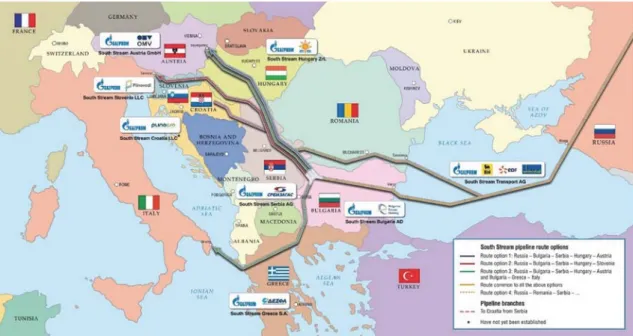
Oil is mainly used for transportation purposes. However, Slovenia depends essentially on gas import from outside the EU (60% from Russia) [21], which may lead to Slovenia facing an energy crisis, such as the 2009 Russia–Ukraine gas dispute [22]. A map of the South Stream pipeline route transferring gas from Russia to Eastern Europe (Fig. 4) shows that the pipeline passes through many countries before arriving in Slovenia [23].
48 Global Resource Management ジャーナルVol. 4
The industrial production of Slovenia is very energy intensive, equaling to 26.3% of the final energy demand in 2014, while the transportation sector, in which use of oil and gas is an important factor propelling the country’s economy, has the largest share; of 39% [24].
Fig. 2 Population density of Slovenia. Source: Environment in the palm of your hand: Slovenia, 2008.
Fig. 3 Transmission network of Slovenia. Source: International Atomic Energy Agency (IAEA).
IV. Primary energy resource
The energy resources of Slovenia are rather limited. The estimated energy resources are shown in Table 2 [25]. Figure 5 shows the energy mix of Slovenia [26]. The details of each energy resource are shown and discussed in this session.
Table 2. Estimated Energy Reserves. Sources: WEC Survey of Energy Resources.
Estimated energy reserves (2011)
(Solid and Liquid in million tons, Uranium in metric tons, Gas in billion cubic metres, Hydro in TWhr per year)
Solid (1) Liquid (2) Gas (3) Uranium (4) Hydro (5)
Amount 223 - - 1,700 9,145
(1) Coal including Lignite: proved recoverable reserves, the tonnage within the proved amount in place that can be recovered in the future under present and expected local economic conditions with existing available technology
(2) Crude oil and natural gas liquids (Oil Shale, Natural Bitumen and Extra-Heavy Oil are not included):
proved recoverable reserves, the quantity within the proved amount in place that can be recovered in the future under present and expected local economic conditions with existing available technology
(3) Natural gas: proved recoverable reserves, the volume within the proved amount in place that can be recovered in the future under present and expected local economic conditions with existing available technology
(4) Reasonably Assured Resources (RAR) under < USD 130/kgU
(5) Hydropower: technically exploitable capability, the amount of the gross theoretical capability that can be exploited within the limits of current technology
Fig. 4 South Stream route. Source: Gazprom.
50 Global Resource Management ジャーナルVol. 4
A. Nuclear energy
As mentioned above, in Slovenia, around 40% of electric power generation comes from nuclear energy, in principle, nuclear energy can be categorized as a sustainable energy resource [27]. However, the only one nuclear power plant in Slovenia, named Krško Nuclear Power Plant, is co-owned with Croatia and was built in 1981 when they were both part of Yugoslavia. From this reason, half of the energy production from the power plant must be transferred to Croatia (as shown in Fig. 3 for high-voltage transmission) [28]. Furthermore, due to nuclear waste and issues of cleaning facilities, Slovenia is facing difficulty in operating the nuclear power plant [29]. Slovenia is scheduled to stop operating the nuclear power plant in 2023; moreover, there is no further plan to build a new nuclear power plant afterward and future decisions are under discussion [30].
B. Thermal energy
Another main resource comes from a thermal power plant using solid fuel to generate electric energy that serves the country amounting to 32.9%. The main solid fuels in Slovenia are low-quality brown coal and lignite, which amount to 199 million tonnes [25]. However, some solid fuel mines are co-owned with Croatia whose production is shared equally by both countries [31]. Wood resource is very important for the country to be used for space and water heating in households, especially in rural
Fig. 5 Energy mix of Slovenia. Source: World Energy Council.
areas [32]. From the data, Slovenia has high enough reserves of solid fuel (80% of domestic production); yet, it is vice versa in the case of oil, where there is 100%
dependency on imported oil [33]. In addition, the thermal power plant produces a high rate of GHG (greenhouse gas) and pollution, which directly affects the environment [34]. To resolve the issues of global warming and environment impacts, the usage of thermal energy should be reduced by using renewable energy, which will be discussed further.
C. Hydro energy
Slovenia is rich in hydro energy due to its terrain [35], in which hydro power plants generating electric energy for 30.2% of primary energy consumption are located nationwide. Slovenia has very high potential for developing hydro power plants [36].
However, there have been no further plans for new development of hydro power plants since 2009 [37]. The reason may be conflict between cost and benefit, as well as the effect on tourism [38]. Anyhow, small-scale hydro power plants have been promoted in fighting climate change and improving the energy security of the country [39].
V. Renewable energy resources
Slovenia plans to increase electric power generation from renewable energy resources to 25% (including hydro power) in its gross final energy consumption by 2020 [40]. To achieve the goal, renewable energy resources such as wind, solar, and geothermal are promoted.
A. Wind energy
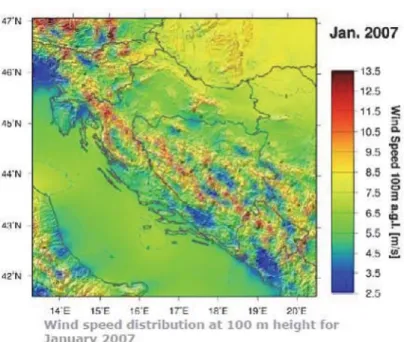
Slovenia has a wind turbine (since 2013), which generates an electric energy capacity of 2.3 MWe [41]. The power generated from the wind turbine is classified as clean energy compared with other resources [42]. Figure 6 shows the wind speed distribution of Slovenia [43], and it can be seen that Slovenia has potential to develop wind turbines in the northwestern and southwestern areas of the country, which have low population density as well (referred to in Fig. 2). By the way, the safety factor of wind turbines has to be taken into account [44].
B. Solar energy
For solar energy, Slovenia has no PV (photovoltaic) solar farms installed in the country but PV solar cells are established and used in households [45]. Solar cells are non-green renewable energy because of the chemical pollution in the manufacturing process and the recycling problem [46]; however, the use of PV solar cells to generate electric energy can be considered as the easiest way to increase the electric energy
52 Global Resource Management ジャーナルVol. 4
Fig. 6 Map of wind resources at 100 meters above ground level. Source: anemos 2010.
Fig. 7 Yearly sum of global horizontal irradiation in Slovenia [48].
potential from renewable energy in the country [47].
A map of solar irradiation in Slovenia is shown in Fig. 7 [48], indicating that Slovenia has potential to install solar farms in the western area due to the high solar irradiation. Some studies on the potential of solar energy showing the high significance of development have been carried out [49]. However, currently, there is no plan to develop solar farms in Slovenia.
C. Geothermal energy
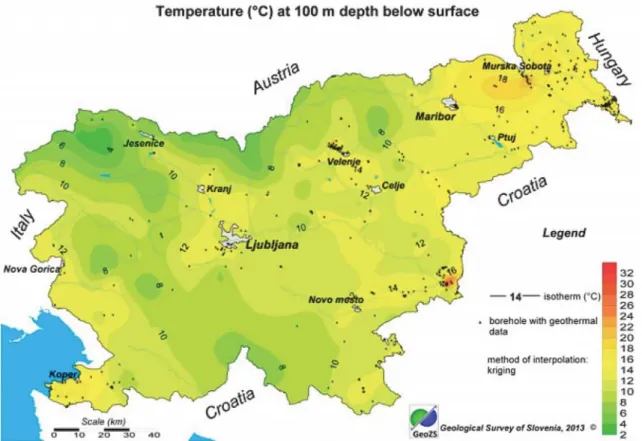
Geothermal energy has been used in Slovenia for a long time for space heating purposes. There was a project of geothermal electric power generation development in 1994; unfortunately, it has not yet been realized [50]. A map of geothermal temperature distribution with isotherms at a depth of 100 m in Slovenia (Fig. 8) shows that the geothermal temperature is not very high [51], not enough to generate electric energy in ordinary geothermal power plants (usually higher than 200°C). A technology for generating electric energy from low-temperature geothermal heat sources should be introduced to increase the energy security of the country [52]. In any case, the increased use of geothermal energy for heating facilities should be promoted to replace the usage of wood for environmental reasons [53].
Fig. 8 Temperature distribution at a depth of 100 m below the surface in Slovenia. Source: GeoZS.
54 Global Resource Management ジャーナルVol. 4
VI. Issue of the migrant crisis
Another issue the author would like to consider in this report is the migrant crisis in Slovenia in 2015, when more than 700,000 refugees from war-torn countries entered the Schengen Area at Slovenia and passed through to other countries [54]. Even though the refugees did not stay permanently in Slovenia, providing hospitality to the refugees costs Slovenia much, in terms of energy consumption, too. However, there is no related report about this issue yet, and the statistics on energy usage in 2015-2016 will be reported this year (2017), which will show that the trend of energy is significantly related to the migrant crisis, as well as having an impact on the infrastructure and environment.
Slovenia is strongly recommended to prepare for these kinds of emergency issues such as conflict or war, which also cause the country to be congested. Energy self-dependence is the first priority to be considered.
VII. Conclusion
Slovenia’s primary energy consumption consists of three main resources (hydro, thermal, and nuclear) and other renewable energy and waste resources. The country is able to serve the energy usage demand, which includes various sectors such as household, infrastructure, and industry. Nevertheless, Slovenia depends on oil and gas net imported from other countries both inside and outside the EU, which leads the country to low suitability in terms of energy.
In order to be sustainable in terms of energy, Slovenia has to increase its energy generation potential along with resolving environmental issues. Moreover, the target of a 20% GHG reduction is considered to be achievable by the development of renewable energy usage such as wind, solar, and geothermal both in electric and heat energy generation. Renewable energy is the key to successful development, which would also help Slovenia increase its strength in policy and economy.
References
[1] Škrk, Mirjam. Recognition of states and its (non-) implication on state succession: the case of successor states to the former Yugoslavia. 1999.
[2] Bussière, Matthieu, Marcel Fratzscher, and Gernot J. Müller. “Current account dynamics in OECD and EU acceding countries-an intertemporal approach.” (2004).
[3] Aristovnik, Aleksander, and Alka Obadić. “Measuring relative efficiency of secondary education in selected EU and OECD countries: The case of Slovenia and Croatia.”
Technological and Economic Development of Economy 20.3 (2014): 419-433.
[4] Al-Mansour, Fouad. “Energy efficiency trends and policy in Slovenia.” Energy 36.4 (2011):
1868-1877.
[5] Energy. Energy | Invest Slovenia [ONLINE] Retrieved from: http://www.investslovenia.org/
business-environment/infrastructure-utilities/energy/ [Accessed 26 Mar 2017]
[6] Radovanović, Mirjana, Sanja Filipović, and Dejan Pavlović. “Energy security measurement–A sustainable approach.” Renewable and Sustainable Energy Reviews 68 (2017): 1020-1032.
[7] KYOTO PROTOCOL. KYOTO PROTOCOL [ONLINE] Retrieved from: http://unfccc.int/
resource/docs/convkp/kpeng.html [Accessed 26 Mar 2017]
[8] European Environment Agency. Tracking progress towards Kyoto and 2020 targets in Europe. Office for Official Publ. of the Europ. Union, 2010.
[9] Slovenia Energy efficiency report. ABB Group [ONLINE] Retrieved from: https://library.
e.abb.com/public/768ae140ad73d433c1257be9002b5a73/Slovenia.pdf [Accessed 27 Mar 2017]
[10] European Bank for Reconstruction and Development. “Final Report: EBRD Energy Sector Assessment 2010.” 2010.
[11] Psycharis, Yiannis, et al. “The Spatial Footprint Of The Ongoing Economic Crisis (2009-
…) In Greece: Assessing The Resilience And Development Of The Greek Regions.”
(2012).
[12] Renewable energy shares for 2015 are approximations and not official data, reflecting the available data (04.10.2016). See the Öko-Institut Report: Study on Technical Assistance in Realisation of the 2016 Report on Renewable Energy, http://ec.europa.eu/energy/en/studies [13] Energy - Slovenia. Knoema [ONLINE] Retrieved from: https://knoema.com/atlas/Slovenia/
topics/Energy [Accessed 27 Mar 2017]
[14] Bernard Vukadin B, Kovač N Environment in the palm of your hand: Slovenia. Ministry of the Environment and Spatial Planning. Environmental Agency of the Republic of Slovenia, Ljubljana. 2008
[15] Energy Act, Ministry of Environment, Spatial Planning and Energy, Ljubljana (1999).
[16] Bondarenko, A., et al. “OHL condition monitoring and engineering solutions to cinch maximum admissible transmitting capacity.” Condition Monitoring and Diagnosis, 2008.
CMD 2008. International Conference on. IEEE, 2008.
[17] Access to Electricity (% of Population). [ONLINE] Retrieved from: http://data.worldbank.
org/indicator/EG.ELC.ACCS.ZS [Accessed 27 Mar 2017]
[18] Slovenia 2016. Country Nuclear Power Profiles [ONLINE] Retrieved from: https://cnpp.
iaea.org/countryprofiles/Slovenia/Slovenia.htm [Accessed 27 Mar 2017]
[19] Grammelis, P., E. Kakaras, and N. Koukouzas. “The perspectives of energy production from coal-fired power plants in an enlarged EU.” International journal of energy research 28.9 (2004): 799-815.
[20] Sheets, EUROSTAT–Energy Balance. Sheets 2014 data, 2016 edition. ISBN 978-92-79- 37858-9.
[21] Final Investment Decision Made for South Stream in Slovenia. Rbth, and Interfax [ONLINE] Retrieved from: http://rbth.com/articles/2012/11/13/final_investment_decision_
made_for_south_stream_in_slovenia_20050.html [Accessed 27 Mar 2017]
[22] Pirani, Simon, Jonathan P. Stern, and Katja Yafimava. The Russo-Ukrainian gas dispute of January 2009: a comprehensive assessment. Oxford: Oxford Institute for Energy Studies, 2009.
[23] Gazprom Pushing Ahead with South Stream and Southern Corridor Projects. Gazprom
56 Global Resource Management ジャーナルVol. 4
Pushing Ahead with South Stream and Southern Corridor Projects [ONLINE] Retrieved from: http://www.gazprom.com/press/news/2014/february/article184145/ [Accessed 27 Mar 2017]
[24] National renewable energy action plan 2010e2020 (NREAP) Slovenia. Ljubljana; July 2010.
[25] GENERAL INFORMATION. Slovenia 2016. [ONLINE] Retrieved from: https://cnpp.iaea.
org/countryprofiles/Slovenia/Slovenia.htm [Accessed 27 Mar 2017]
[26] World Energy Council. Energy Trilemma Index - Slovenia [ONLINE] Retrieved from:
https://www.worldenergy.org/data/trilemma-index/country/slovenia/2014/ [Accessed 27 Mar 2017]
[27] Kessler, G. “Requirements for nuclear energy in the 21st century nuclear energy as a sustainable energy source.” Progress in Nuclear Energy 40.3-4 (2002): 309-325.
[28] Gosar, Andrej. “Seismic reflection surveys of the Krško basin structure: implications for earthquake hazard at the Krško nuclear power plant, southeast Slovenia.” Journal of applied geophysics 39.3 (1998): 131-153.
[29] Križman, Milko, Anthony R. Byrne, and Ljudmila Benedik. “Distribution of 230Th in milling wastes from the Žirovski vrh uranium mine (Slovenia), and its radioecological implications.” Journal of Environmental Radioactivity 26.3 (1995): 223-235.
[30] Sual Power Station Revolvy, LLC. [ONLINE] Retrieved from: https://www.revolvy.com/
topic/Sual%20Power%20Station&item_type=topic [Accessed 27 Mar 2017]
[31] Žerdin, Franc. “Restructuring in Slovenian coal mine Prestrukturiranje premogovniškega gospodarstva v Sloveniji.” RMZ-Materials and Geoenvironment 50.2 (2003): 543-553.
[32] Steierer, Florian, et al. “Wood energy in Europe and North America: A new estimate of volumes and flows.” Joint Wood Energy Enquiry, UNECE/FAO, Geneva, Switzerland (2007).
[33] IEA (2015), Energy Balances of OECD Countries 2015, OECD Publishing, Paris. DOI:
http://dx.doi.org/10.1787/energy_bal_oecd-2015-en
[34] Rao, Anand B., and Edward S. Rubin. “A technical, economic, and environmental assessment of amine-based CO2 capture technology for power plant greenhouse gas control.” Environmental science & technology 36.20 (2002): 4467-4475.
[35] Mikos, Matjaz. “Slovenia, lakes and reservoirs.” Encyclopedia of Lakes and Reservoirs (2012): 716-722.
[36] Tomšič, Tomaž, Gregor Verbič, and Ferdinand Gubina. “Revision of the underfrequency load-shedding scheme of the Slovenian power system.” Electric power systems research 77.5 (2007): 494-500.
[37] AVČE Pumped Storage Power Plant on the Soča River. K-M@RK [ONLINE] Retrieved from: http://www.rudis.si/en/reference/avce-pumped-storage-power-plant-on-the-soca- river/ [Accessed 27 Mar 2017]
[38] Smolar-Žvanut, Nataša, and Matjaž Mikoš. “The impact of flow regulation by hydropower dams on the periphyton community in the Soča River, Slovenia.” Hydrological Sciences Journal 59.5 (2014): 1032-1045.
[39] Zorić, Jelena, and Nevenka Hrovatin. “Household willingness to pay for green electricity in Slovenia.” Energy Policy 47 (2012): 180-187.
[40] Menegaki, Angeliki N. “Growth and renewable energy in Europe: A random effect model
with evidence for neutrality hypothesis.” Energy Economics 33.2 (2011): 257-263.
[41] Dolenja vas (Slovenia) - Wind farms. The Wind Power [ONLINE] Retrieved from: http://
www.thewindpower.net/windfarm_en_20704_dolenja-vas.php [Accessed 27 Mar 2017]
[42] Tavner, Peter. “Wind power as a clean-energy contributor.” Energy Policy 36.12 (2008):
4397-4400.
[43] Gesellschaft für Umweltmeteorologie mbH. Wind Atlas for Slovenia [ONLINE] Retrieved from: http://www.anemos.de/2/?pg=2310&lg=1 [Accessed 27 Mar 2017]
[44] Walford, Christopher A. Wind turbine reliability: understanding and minimizing wind turbine operation and maintenance costs. United States. Department of Energy, 2006.
[45] Stritih, Uros, et al. “Exploiting solar energy potential through thermal energy storage in Slovenia and Turkey.” Renewable and Sustainable Energy Reviews 25 (2013): 442-461.
[46] Tsoutsos, Theocharis, Niki Frantzeskaki, and Vassilis Gekas. “Environmental impacts from the solar energy technologies.” Energy Policy 33.3 (2005): 289-296.
[47] Dincer, Furkan. “The analysis on photovoltaic electricity generation status, potential and policies of the leading countries in solar energy.” Renewable and Sustainable Energy Reviews 15.1 (2011): 713-720.
[48] Solar Radiation Map of Slovenia. Slovenia mappery, [ONLINE] Retrieved from: http://
mappery.com/ map-of/Solar-Radiation-Map-of-Slovenia 2012 [Accessed 27 Mar 2017]
[49] Stritih, Uros, et al. “Exploiting solar energy potential through thermal energy storage in Slovenia and Turkey.” Renewable and Sustainable Energy Reviews 25 (2013): 442-461.
[50] Kralj, Peter, and Dusan Rajver. “State-of-the-art of geothermal energy use in Slovenia.”
Proceedings of the WGC, 2000, Kyushu–Tohoku, Japan (2000): 267-275.
[51] Rajver, Dušan, et al. “Geothermal Development in Slovenia: Country Update Report 2010- 2014.” Proceedings, World Geothermal Congress. 2015.
[52] Pumaneratkul, Chayadit, et al. “Supercritical CO2 Rankine Cycle System with Low- Temperature Geothermal Heat Pipe.” Energy Procedia 105C (2017) pp. 1029-1036.
[53] Hepbasli, Arif. “A review on energetic, exergetic and exergoeconomic aspects of geothermal district heating systems (GDHSs).” Energy Conversion and Management 51.10 (2010):
2041-2061.
[54] Vezovnik, Andreja. “Securitizing Migration in Slovenia: A Discourse Analysis of the Slovenian Refugee Situation.” Journal of Immigrant & Refugee Studies (2017): 1-18.
![Fig. 1 Energy dependency of EU member countries in 2006. Source: Eurostat [4].](https://thumb-ap.123doks.com/thumbv2/123deta/8639869.1823437/3.892.163.732.158.469/fig-energy-dependency-eu-member-countries-source-eurostat.webp)