観測的宇宙論の展望 観測的宇宙論の展望
東京大学大学院理学系研究科 物理学専攻 須藤靖
理論天文学懇談会シンポジウム
15:15-15:55 2011年11月6日@国立天文台
known knowns known
unknowns
unknown unknowns
宇宙論の研究年表
1916 一般相対論 アインシュタイン
1917 宇宙定数の導入と静的宇宙モデル アインシュタイン
1922 膨張宇宙の一般解の発見 フリードマン
1929 宇宙膨張(ハッブルの法則)の発見 ハッブル
1931 宇宙定数導入の撤回 アインシュタイン
1948 ビッグバン宇宙モデルと元素合成理論 アルファー・ベーテ・ガモフ 1950 宇宙初期における陽子・中性子比の導出 林忠四郎
1965 宇宙マイクロ波背景輻射の発見 ペンジアス・ウィルソン 1967 銀河の2点相関関数の巾法則の発見 東辻浩夫・木原太郎 1975 世界初の大構造形成数値シミュレーション 三好和憲・木原太郎 1980 CfA銀河サーベイによる宇宙の大構造の発見 ゲラー・ハクラ
1981 インフレーション宇宙モデル 佐藤勝彦、グース
1985 冷たい暗黒物質による構造形成標準モデル確立 デイビス・エフスタチュウ・
フレンク・ホワイト 1992 COBE衛星による宇宙マイクロ波背景輻射の温度ゆらぎ発見 マーサー、スムート
2003 SDSSによる銀河・クエーサーカタログ初期成果の発表 SDSS グループ(日本人メン バー13名)
1998 Ia型超新星を用いた宇宙の加速膨張の発見 超新星宇宙論グループ他
2003 WMAP衛星による宇宙マイクロ波背景輻射温度地図の精密測定 WMAPチーム(日本人メン バー 小松英一郎)
観測的宇宙論の発見年表
1929 宇宙膨張(ハッブルの法則)の発見 ハッブル
1965 宇宙マイクロ波背景輻射の発見 ペンジアス・ウィルソン 1967 銀河の2点相関関数の巾法則の発見 東辻浩夫・木原太郎
1975 世界初の大構造形成数値シミュレーション 三好和憲・木原太郎 1980 CfA銀河サーベイによる宇宙の大構造の発見 ゲラー・ハクラ
1985 冷たい暗黒物質構造形成標準モデル確立 デイビス・エフスタチュ ウ・フレンク・ホワイト 1992 宇宙マイクロ波背景輻射の温度ゆらぎ発見 マーサー、スムート
2003 SDSSによる銀河・クエーサーカタログ初期 成果の発表
SDSS グループ(日本人メ ンバー13名)
1998 Ia型超新星を用いた宇宙の加速膨張の発見 超新星宇宙論グループ他
2003 WMAP衛星による宇宙マイクロ波背景輻射温 度地図の精密測定
WMAPチーム(日本人メ ンバー 小松英一郎)
1978 Nobel Prize in Physics
Arno Penzias and Robert Wilson
For the discovery of cosmic microwave background
radiation
The Astrophysical Journal 142(1965)419
2006 Nobel Prize in Physics
John Mather and George Smoot
2011 Nobel prize in Physics
Saul Perlmutter, Brian P. Schmidt and Adam G. Riess
for the discovery of the accelerating expansion of the
Universe through observations of distant supernovae
ハッブルの法則か、ルメートルの法則か?
Sidney van den Bergh: The curious case of Lemaître’s equation 24, arXiv:1106.1195
宇宙膨張を発見したのは1929年のハッブルの論文(PNAS, 15, 1929, 168)だというのが通説
しかし、ルメートルの1927年のフランス語論文ですでに
“ハッブル定数”が重みのつけ方によって625 あるいは
575km/s/Mpcと計算されていた(この事実は一部ではよく知
られていたらしい)
この論文はその後MNRASに英訳されて、1931年に発表さ れているが、そこでは、ハッブル定数の計算に関する式の一 部と、本文および脚注がすっぽりと抜け落ちている
これは単なるミスではあり得ないが、誰が何のためにやった のかは不明
英訳版では削除されている箇所 (1)
英訳版では削除されている箇所 (2)
英訳版では削除されている箇所 (3)
後退速度・距離関係の比較
ルメートル (1927) 575km/s/Mpc
ハッブル (1929) 530km/s/Mpc
Un Univers homogène de masse constante et de rayon croissant rendant compte de la vitesse radiale des nébuleuses extra- galactiques, l’Abbé G. Lemaître Annales de la Societe
Scientifique de Bruxelles, A47, pp.49-59 : A homogeneous universe of constant mass and increasing radius accounting for the radial velocity of extra-galactic nebluae, MNRAS
91(1931)483
Stigler's law of eponymy
No scientific discovery is named after its original discoverer (1980 by University of Chicago statistics professor Stephen Stigler)
Aharonov-Bohm effect, Alzheimer's disease, Bode's Law Cardano's formula, Curie point, Dyson spheres Euler's number, Euler's formula, Fermi's golden
rule, Gauss's Theorem, Gaussian distribution,
Halley's comet, Hubble's law, Kuiper belt, Snell's law of refraction, Stigler's Law, attributed by Stigler himself to Robert K. Merton,
Wheatstone bridge, Yagi antenna
最近 20 年間の観測的進展
ダークマターの存在の確立
超新星1987Aからのニュートリノの検出
ニュートリノ天文学
太陽系外惑星の発見
ガンマ線バーストの宇宙論的天体説の確定
超新星を用いた宇宙の加速膨張の発見
ダークエネルギーの存在/一般相対論の限界?
広域銀河3次元地図作成と遠方銀河の地平線拡大
スローンサーベイ、ハッブル望遠鏡、すばる望遠鏡
宇宙マイクロ波背景輻射による精密宇宙論
標準ダークマターモデル(インフレーションによるゆら
ぎ、冷たいダークマター、ダークエネルギー)
宇宙の起源
素粒子物理学・量子重力理論の進展に依存
ダークマターの直接検出
天文学から高エネルギー物理学実験へ
ダークエネルギーの性質の解明
宇宙の加速膨張の起源
重力波の直接検出
一般相対論の検証から新しい天文学の窓へ
高エネルギー宇宙線の起源
粒子加速機構の解明、粒子線天文学の開拓
超新星爆発・ガンマ線バーストのメカニズム
大質量星進化の最終段階の理解
第一世代天体の発見・起源・進化
宇宙の果てを見通す、天体の起源、元素の起源
恒星・惑星の起源
星・惑星・コンパクト天体の形成と進化
地球型系外惑星の発見から宇宙生物学へ
第二の地球、生命・文明の起源、生物の普遍性
残された 課題と 謎
(天文学)研究スタイルの必然的進化:
太陽系外惑星探査を例として
地上からの系外 惑星探査
スペースからの 系外惑星探査
系外惑星上の生命 探査
紀元前
~1995年
山師、先駆者 ハイリスク
・ノーリターン
荒唐無稽 ハイリスク
・ノーリターン
論外:
危ない人々、十分 成功して失うもの がない人
1995年
~2009年
ゴールドラッシュ ハイリスク
・ハイリターン
立案
ハイリスク
・ハイリターン
荒唐無稽 ハイリスク
・ノーリターン 2009年
~ 20xx年
定着
ローリスク
・ハイリターン
実現
ローリスク
・ハイリターン
立案
ハイリスク
・ハイリターン 20xx年~ 統計を稼ぐ
ローリスク
・ローリターン
定着
ローリスク
・ローリターン
実現?
ローリスク
・ハイリターン?
今はどの時期なのかを見極めることが本質
1995年 系外惑星発見
20XX年 ハビタブル惑
2009年 系外惑星専用
衛星Kepler 打ち上げ
星 発見???
ブレイク
スルー
Astro2010: decadal survey
Cosmic Dawn
New Worlds
Physics
of the Universe
August 13, 2010
http://sites.nationalacademies.org/bpa/BPA_049810
The Science Frontier:
discovery areas
and principal questions (1)
Discovery areas
Identification and characterization of nearby habitable exoplanets
Gravitational wave astronomy
Time-domain astronomy
Astrometry
The epoch of reionization
第二の地球 重力波天文学
宇宙の再電離 銀河系・宇宙の精密測量
突発・激変天体 近地球接近天体
Questions:
How did the universe begin?
What were the first objects to light up the universe and when did they do it?
How do cosmic structures form and evolve?
What are the connections between dark and luminous matter?
What is the fossil record of galaxy assembly and evolution from the first stars to the present?
How do stars and black holes form?
How do circumstellar disks evolve and form planetary systems?
How do baryons cycle in and out of galaxies and what do they do while they are there?
What are the flows of matter and energy in the circumgalactic medium?
The Science Frontier:
discovery areas and principal questions (2)
The Science Frontier:
discovery areas and principal questions (3)
Questions:
What controls the mass-energy-chemical cycles within galaxies?
How do black holes work and influence their surroundings?
How do rotation and magnetic fields affect stars?
How do massive stars end their lives?
What are the progenitors of Type Ia supernovae and how do they explode?
How diverse are planetary systems and can we identify the telltale signs of life on an exoplanet?
Why is the universe accelerating?
What is dark matter?
What are the properties of the neutrinos?
What controls the masses, spins and radii of compact stellar remnants?
Dark matter
and dark energy:
21
stcentury clouds over the universe?
Lord Kelvin @ Royal society on April 27, 1900
beauty and clearness of theory was overshadowed by two clouds
Dark matter and dark energy in the 21
stcentury
Two dark clouds in astronomy? → No !
Two probes of new physics? → Yes (hopefully)
http://www.physics.gla.ac.uk/Physics3/Kelvin_online/clouds.htm
アメリカを代表するかつての哲学者かつ詩人 :
ドナルド・ラムズフェルド第 21 代国防長官
2003年『やさしい英語普及運動』から、『関係代名詞や従属節を多用し、なおかつ 接続詞の乱用による長いセンテンスを使用した、わかりにくい英語の演説、発言』
をすることを顕彰して『フット・イン・マウス(意味不明な迷言)賞』受賞
Observational signatures of dark matter
Flat rotation curves of galaxies
Multiple images of quasars due to
gravitational lensing
Bullet clusters
23
Gravitational lens
SDSS J1004+4112
24
Gravitational lens SDSS J1004+4112 : general relativistic mirage
http://hubblesite.org/newscenter/newsdesk/archive/releases/2006/23/
QSO at 10 billion light years away
Galaxy cluster at 6 billion light years away
Bullet cluster (1E 0657-56)
Implies collisionless dark matter
red: baryon gas
blue: collisionless dark matter Head-on collision of two galaxy clusters
Dark matter passes through, and gas interacts, shock-heated and emits X-ray Hydrodynamical merger simulation
Dark matter:
from astronomy to physics
Astronomical observations unambiguously proved the existence of dark matter
Astronomy does not require any specific form of Lagrangian of dark matter particles
From unknown unknowns to known unknowns
On-going/up-coming physics experiments will identify the elementary particle responsible for dark matter in the universe
Particle physics will specify the Lagrangian
From known unknowns to known knowns
Are there any unknown unknowns that distribute homogeneously in the universe ?
Objects are usually identified only through differential measurements
Visible matter: contrast between dark and bright regions
Dark matter: spatial clustering dynamically and gravitationally traced by visible stars, galaxies and quasars
Is it possible to identify the existence of a homogeneously distributed component ?
differential measurements in time domain
(cosmic acceleration, structure growth)
Expanding the expanding universe
Expand the “size” of the universe
current size:
current expansion rate: the Hubble constant
current acceleration rate:
the deceleration parameter+ L
− +
− +
=
0 0 22(
0)
22 ) 1
( )
( )
(
0 0
t dt t
a t d
dt t t da
a t
a
t t
) ( t
0a
0
/
0
a
tdt H ≡ da
0
2 2 2
0
( / )
/ dt
tda
dt a
d q ≡ − a
⇔ the value itself has no physical meaning
⇔ unpredictable: basically
determined by the initial condition (can be either negative or positive)
⇔ related to the cosmic energy density via the Einstein eq.
(should be positive)
Universe should not be accelerated !
Newton’s inverse square law
Einstein’s general relativity
Pressure contributes to gravity
Negative pressure required for acceleration
Cosmological constant: pDE=-ρDE
More generally, dark energy: pDE=wρDE with w<-1/3
General relativity is inaccurate at cosmological scales ? (modified gravity theories)
a p
G p dt
a d
DE
DE
3 )
3 3 (
4
2
2
= − π ρ + + ρ +
3 0 4 3
4 )
(
32 2
2
2
⎟ = − <
⎠
⎜ ⎞
⎝
− ⎛
< =
−
= G a
a a G a
a GM
dt a
d π ρ π ρ
Cosmic acceleration vs. dark energy
cosmic
acceleration
time
Universal repulsion?
Cosmological constant?
Dark energy?
Modified gravity?
13.7 Gyr
Size of the universe
SN Ia CMB
Implies something unknown !
Composition of the universe
dark energy
dark matter (baryons) atom
ordinary matter makes up merely 5 percent
galaxies and clusters are
surrounded by invisible mass an order-of-magnitude more massive than their visible part
even more exotic component !
homogeneously fills the universe (unclustered component)
repulsive force (negative pressure; P=‐ρ?)
Einstein’s cosmological constant ?
or just an illusion …
known knowns known
unknowns
unknown unknowns
cosmic acceleration
geometry of the universe
evolution of structure
4 major probes
Supernova Hubble diagram
Cosmic Microwave Background
Gravitational lensing (galaxy imaging survey)
Baryon Acoustic Oscillation (galaxy redshift survey)
Observational signatures of dark energy
t
R
Standard ruler: baryon acoustic oscillation (BAO) length
Sound horizon length at recombination(≒cs×0.37Myr)
r
s=147 (Ω
mh
2/ 0.13)
-0.25(Ω
bh
2/ 0.024)
-0.08Mpc
Estimate the distance to the CMB last-scattering surface using the above as a standard ruler
Acoustic oscillations detected
SDSS galaxy correlation function
Eisenstein et al.
(2005) CMB photons
WMAP 3yr
(Spergel et al. 2007)
z=1000
z=0.4
Mpc )
/ 024 .
0 ( )
/ 13 .
0 (
147 h
2 0.25h
2 0.08r
s= Ω
mΩ
bRequired accuracy of the BAO
scale measurement to constrain w
3% accuracy of w requires to determine BAO scale at z=1
within <1%
⇒ Needs
bigger surveys of galaxies
Nishimichi et al. (2007)
Sub-percent level accuracy is demanding even for theoretical templates
Best analytic model of nonlinear gravitational evolution: Taruya et al. (2009,2010,2011)
× N-body simulations
38
Univ. of Tokyo Res. Center for the
Early Universe coordinator Yasushi Suto
Princeton U.
Dept. of Astrophys. Sci.
coordinator Edwin Turner
Institut
d’Astrophysique de Paris
coordinator Jerome Martin
Edinburgh U.
Royal Obs.
coordinator John Peacock
CMBGravitational lens Baryon oscillation
Modified gravity Extra-dimension backreaction
Theoretical model Baryon oscillation Weak lens mapping
Tohoku NAOJ
Univ.
Hiroshima Univ.
Kyoto Univ.
Nagoya Univ.
International Research Network for Dark Energy (JSPS, core-to-core program 2007-2012)
DENET
Galaxy survey project: SuMIRe
Subaru Measurement of Imaging and Redshift of the universe
PI: Hitoshi Murayama (director of IPMU, U. of Tokyo)
Japanese Institutes in charge: IPMU, The University of Tokyo, NAOJ,,,
Imaging survey with HSC (Hyper- Suprime Cam)
Japan + Princeton + ASIAA (Taiwan)
Spectroscopic survey with PFS (Prime Focus Spectrograph)
Japan + US, Taiwan, France, Brazil,,,
HSC: Hyper-Suprime Cam
Japan+Princeton+ASIAA (2012-2016)
Imaging galaxy survey (1.5deg FOV) g,r,i,z,Y
200 nights for 1500 deg2 wide survey for weak lensing
100 nights for deep surveys of galaxies
Presented at DENET-Princeton conference (2009) by Satoshi Miyazaki (NAOJ)
PFS: Prime Focus Spectrograph
presented at DENET summer school (2009) by Mike Seiffert (JPL/Caltech)
Japan+ (2016-2020 ???)
Spectroscopic galaxy survey (1.3deg FOV)
2500 fibers, 10000 galaxy redshifts a night
BAO, galactic evolution, Galactic archaeology
Courtesy of
Masahiro Takada (IPMU)
JPL/Caltech WFMOS design on Subaru
Dark energy research is good or bad for astronomy ?
Fundamentalist: high-energy experiments
Pursuit of a single truth (LHC, WMAP)
Huge international collaborations
Universalist: astronomical observations
Multi-purpose (Hubble Space Telescope, SDSS)
Relatively small groups
Different culture, personal perspective and/or preference, a matter of taste
Fundamentalist physics: why dark energy is bad for astronomy Simon D.M. White, astro-ph/0704.2291
HST (universalist) WMAP (fundamentalist)
Simon D.M. White: astro-ph/0704.2291
Two very successful
but quite different
projects in astronomy
Which is happier, the town mouse or the country mouse ?
Town mouse ? Country mouse ? Large Hadron Collider
experiments Desk-top experiments High-energy physicists Amateur astronomers
Germany in EU Greece in EU dark energy
cosmology extrasolar planet hunting
Towards bigger science or downsizing ?
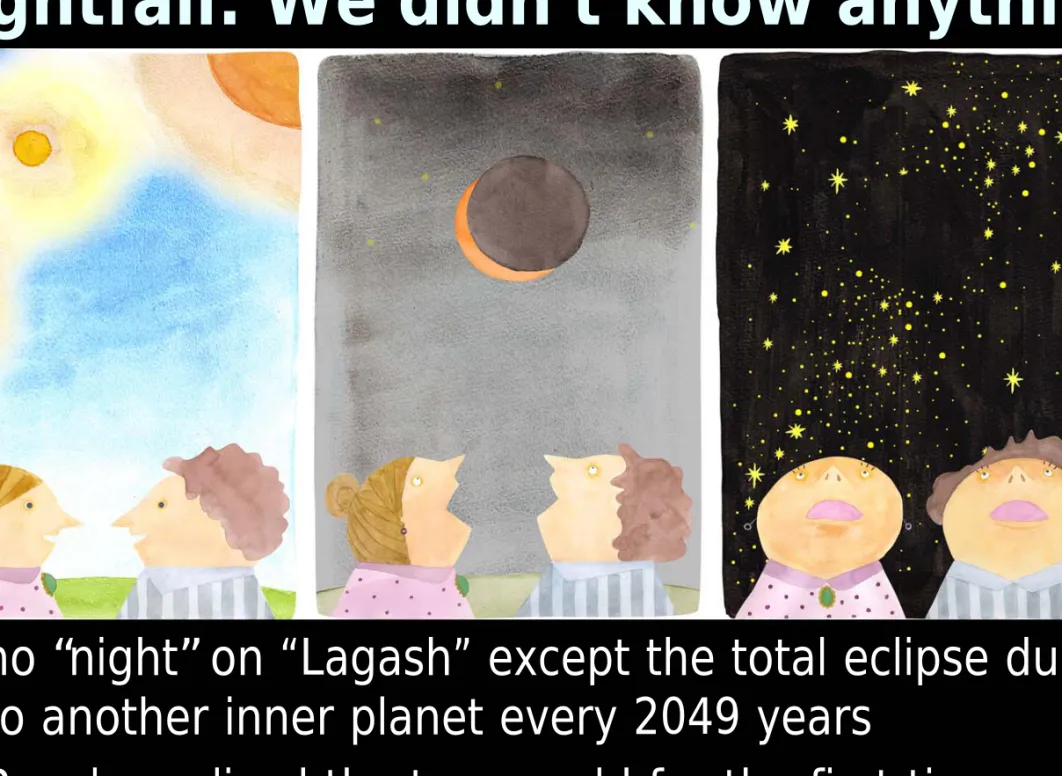
Nightfall: We didn’t know anything
Illustration by Alisa Haba
no “night” on “Lagash” except the total eclipse due to another inner planet every 2049 years
People realized the true world for the first time through the darkness full of “stars”
(Alisa Haba)
Hopefully soon, we will recognize that we didn’t know anything!
known knowns
known
unknowns
unknown unknowns
Have we made progress at all ?
Ancient Indian picture
Our current-best picture of the universe
<PI> ≒ 1 の法則 ? (Suto 2011)
P: probability that a discovery/hypothesis is correct
I: impact that the discovery/hypothesis has on science if it is correct
<PI>: expectation value of the impact of the discovery/hypothesis
ほとんどの発見あるいは仮説は、インパクト
が強いものほど怪しい(大発見が何の前触れ
もなくいきなり登場する可能性は極めて低い)
<PI> ≒ 1 の法則の具体的例
宝くじは 1 等であれ、ハズレであれ戻ってくるお金の期待 値はさほど違わない
宝くじ一等: I=1億円/300円、P=1/1000万
宝くじ末等: I=300円/300円、P=1/10
研究もまた同じ、超大ホームランと地道な積み重ねも科 学に与えるインパクトの「期待値」はさほど変わらない
本当ならば物理の歴史を塗り替えるがとてもありそうにない
(I≫1 & P≪1)
超光速ニュートリノ、ブレインワールド、余次元、素粒子的宇宙論のほと んどの研究、SETI、、、
確実であり地道な研究が大事だが、だからといってそのどれか 一つだけが科学的ブレイクスルーを生み出すわけではない
(I~1 & P~1)
銀河サーベイデータ解析、摂動論、観測的宇宙論のほとんどの研究、、、
<PI> ≒ 1 の法則から学ぶべきこと
心しておくべきこと: いくらPが小さくとも、宝くじに当選 している人は毎回必ず存在する
購入者数Nが、1/P以上であるおかげ
どれほど怪しげな研究であっても、研究者人口が多け れば、そのなかのどれかは正しく大きなインパクトを与 え得る
一等宝くじ的研究(一部の個人プレーによる牽引)
素粒子的宇宙論の研究者数が多いことの必要性
個々の研究は地道でも、多数で進める事で大きな成果 をあげるスタイル
末等宝くじ的研究(コミュニティーが一丸となって牽引)
観測的宇宙論の研究者数が多いことの必要性