4.2 平成 23
年(2011
年)東北地方太平洋沖地震の地震動本項の論文は、SSA(アメリカ地震学会)のオープンアクセス指針に従った上で掲載している。
(Iwakiri, K. and M. Hoshiba, 2012: High-frequency (>10 Hz) content of the initial fifty seconds of waveforms from the 2011 off the Pacific coast of Tohoku Earthquake, Bull. Seism. Soc. Am ., 102, 2232-2238, doi:10.1785/0120110241)
T HE S EISMOLOGICAL S OCIETY OF A MERICA 400 Evelyn Ave., Suite 201
Albany, CA 94706-1375
(510) 525-5474; FAX (510) 525-7204 www.seismosoc.org
Bulletin of the Seismological Society of America
This copy is for distribution only by the authors of the article and their institutions in accordance with the Open Access Policy of the
Seismological Society of America.
For more information see the publications section
of the SSA website at www.seismosoc.org
Short Note
High-Frequency (>10 Hz) Content of the Initial Fifty Seconds of Waveforms from the 2011 Off the Pacific Coast
of Tohoku Earthquake
by Kazuhiro Iwakiri and Mitsuyuki Hoshiba
Abstract We investigate the high-frequency content of the initial 50 s of wave- forms from the 2011 Off the Pacific Coast of Tohoku earthquake (M
w9.0, 11 March 2011). The strong-motion spectra for the M
w9.0 mainshock are richer in high- frequency (>10 Hz) content than those of the M
w7.3 foreshock compared to low frequencies. The mainshock spectra are flat up to at least 20 Hz, which is at variance with the general source spectra models such as the ω-square and f
maxmodels. The spectral ratios of the M
w9.0 – 7.3 events show that after 20 s from the P-wave arrival time, the high-frequency strong motion of the mainshock is distributed in the southern Tohoku district. Analyses of past moderate magnitude earthquakes ( M
w6.0 – 7.3) in the area around the mainshock hypocenter indicate that the radiation from the deeper regions is the main cause of the high-frequency strong motion.
Introduction
The great 2011 Off the Pacific Coast of Tohoku earth- quake with a moment magnitude
Mw9.0 (hereafter the 2011 Tohoku earthquake) occurred on 11 March 2011. This thrust- type earthquake along the Japan Trench triggered a devastat- ing tsunami that resulted in a loss of about 20,000 lives (see Data and Resources section). An area of large slip (>25 m) offshore near the hypocentral region almost coin- cides with the area of considerable seafloor uplift that gen- erated the tsunami (Yoshida
et al., 2011). The region wherethe strong ground motion occurred during the mainshock ex- tends over an area of approximately
400km ×
100km along the Pacific coast between the Tohoku and Kanto districts (Hoshiba
et al., 2011).Initial studies of the 2011 Tohoku earthquake indicate that the high-frequency seismic waves radiated along the down-dip edge of the aftershock zone (e.g., Wang and Mori, 2011; Koper
et al., 2011). These findings are based on theback-projection analysis using the teleseismic data, which are reliable for frequencies of up to about 3 Hz. The radiation sources of 4
–8 Hz, which were estimated from the regional strong motion data recorded in Japan, were located on the rim of the area of the large slip (Yoshida
et al., 2011).Hoshiba and Iwakiri (2011) showed that the 2011 Toho- ku earthquake also radiated high-frequency waves, particu- larly above 10 Hz, and the frequency content of the waveforms deviated considerably from the empirical relation of the average frequency and magnitude (
τc–Mrelation, Wu and Kanamori, 2005). According to the scaling law
described by the
ω-square model (Aki, 1967), large earth- quakes are expected to be relatively richer in low-frequency content than small earthquakes; however, the seismic wave- forms of the
Mw9.0 Tohoku event included a considerable amount of high-frequency (>10 Hz) energy. The frequency contents of great earthquakes such as the
Mw9.0 event pro- vide important information that helps us to evaluate and test this scaling law. However, frequencies above 10 Hz have not been thoroughly examined.
In this study, we investigate the high-frequency com- ponents (10
–20 Hz in particular) of the 2011 Tohoku earth- quake. Then, we estimate the source of the high-frequency waves of the initial 50 s of the 2011 Tohoku earthquake using strong motion records of the past moderate magnitude earth- quakes in the region.
Data Processing
Vertical-component strong motion accelerograms of the KiK-net (surface) and K-NET seismic networks (see Data and Resources section) were used in this study. For spectral analysis, the offsets of the accelerograms were corrected by subtracting the mean of the waveform portion used for each analysis before applying the Fourier transform. Because the stations are close to the source region, these records are expected to contain the long-term change in acceleration due to the static displacement of the mainshock, or a devia- tion of the baseline of the accerelograms during an event.
2232
Bulletin of the Seismological Society of America, Vol. 102, No. 5, pp. 2232–2238, October 2012, doi: 10.1785/0120110241
After the accelerograms are Fourier transformed, the focus is laid on the high-frequency portions. Therefore, the above- mentioned potential source of deviation has relatively little effect on the analysis, which is presented in this paper.
We calculated the signal and noise spectra using a fast Four- ier transform of 10% cosine-tapered waveforms. The noise spectrum calculated for the noise portion just before the
P-wave arrival was compared with the signal spectrum todetermine the suitability of the signal spectrum data for anal- ysis. If the signal-to-noise spectral ratio (S/N) was lower than 3, we excluded the spectrum from the analysis. We calculated the spectral ratios after smoothing each spectrum with a Parzen window of 0.2 Hz bandwidth. Applying the above criteria, 246 stations of K-NET and KiK-net around Tohoku and Kanto district were used in this analysis. The station locations are shown as triangles and crosses in Figure 1.
We focused on the spectra in the frequency range of up to 20 Hz, as the frequency of the anti-alias filter of the seis- mometers used was around 30 Hz.
High-Frequency Waves above 10 Hz
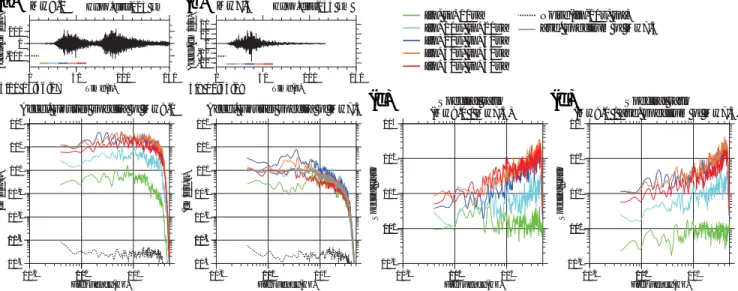
Figure 2a and b shows the Fourier acceleration spectra of the
Mw9.0 mainshock of the 2011 Tohoku earthquake and its
Mw7.3 foreshock (event B1 shown in Fig. 1), respec- tively, for five time windows: [
tp,
tp10s], [
tp10s,
tp20s], [
tp20s,
tp30s], [
tp30s,
tp40s], and [
tp40s,
tp50s], where
tpis the
P-wave arrivaltime. Figure 2c shows the ratios of the
Mw9.0 spectra rela- tive to the
Mw7.3 spectra for the five time windows, and Figure 2d shows the ratios of the
Mw9.0 event relative to the average spectrum of the five windows of
Mw7.3, as representative of the event (gray line in Fig. 2b). The Fourier acceleration spectra of the
Mw9.0 mainshock of the 2011 Tohoku earthquake (Fig. 2a) is flat up to the frequency of the anti-alias filter (~30 Hz) after 10 s from
tp, whereas that of the
Mw7.3 foreshock (event B1) tails off at a lower fre- quency (Fig. 2b), as suggested by Hoshiba and Iwakiri (2011).
According to the
ω-square model (Aki, 1967), large earthquakes are expected to have a much lower frequency content than small earthquakes, as the corner frequencies of large earthquakes are lower than those of small earthquakes.
Furthermore,
fmax(Hanks, 1982), the frequency at which the high-frequency content of the acceleration spectra abruptly diminishes, is expected to exist at frequencies higher than the corner frequency. Because
fmaxis also found in wave- forms recorded at close distance (hypocentral distance
<10 Km), whole path attenuation is not the main factor in the rapid decay of the spectral amplitude (e.g., Hanks, 1982; Archuleta
et al., 1982). The reason offmaxis not well understood (e.g., Tsurugi
et al., 2009):fmaxmight be con- trolled by subsurface characteristics or influenced by source characteristics. In the
Mw9.0 Tohoku event
fmaxis not evident in the time windows later than
tp10s (Fig. 2a).
The spectral ratios (Fig. 2c,d) show that although frequency-
dependence is not evident for the 10 s time window of [
tp,
tp10s], it is clearly present in the later time windows for frequencies above 10 Hz. Thus, after
tp20s the
Mw9.0 mainshock contains more high frequencies (>10 Hz) than the
Mw7.3 foreshock, which is contrary to the model expectations.
We calculated the spectral ratio of the
Mw9.0 event to the averages of five spectral windows of the
Mw7.3
Figure1.
(a) Distribution of earthquakes and seismic stations used in this study. The six earthquakes, labeled A1–A3 and B1–B3, are listed in Table1and their centroid moment tensor solu- tions (determined by the Japan Meteorological Agency [JMA] in the lower hemisphere projection) are shown here. The color scale denotes the centroid depth. Star, the epicenter of the 2011 Tohoku earthquake; crosses and triangles, the 246 seismic stations in KiK-net and K-NET that are used in this study; red contours (contour interval 4 m), the coseismic slip distribution for the 2011 Tohoku earthquake, as estimated from regional strong motion data in the 0.01–0.15 Hz frequency band (Yoshidaet al., 2011); and orange broken lines represent the depth of the subducting Pacific slab (Nakajima and Hasegawa, 2006), with 10 km intervals.(b) Cross-section of the subduction zone along the thick gray line in (a).
Short Note
2233
foreshock corresponding to five frequency bands for the 246 stations of the KiK-net and K-NET (Fig. 3). For the time windows [
tp,
tp10s] and [
tp10s,
tp20s]
(Fig. 3a,b), the spectral ratios are uniformly lower than about 5 across all frequency bands in the Tohoku to northern Kanto district. After
tp20s (Fig. 3c
–e), the high-frequency spec- tral ratios are higher than the low-frequency spectral ratios for the stations distributed mainly in the southern part of the Tohoku district. Across the frequency bands 5
–20 Hz, the distribution of the high spectral ratios expands mainly in the northwest or west direction from the hypocenter of the
Mw9.0 event.
Source of High-Frequency Waves
To investigate the sources of the high-frequency waves, we analyzed six moderate magnitude (
Mw6.0
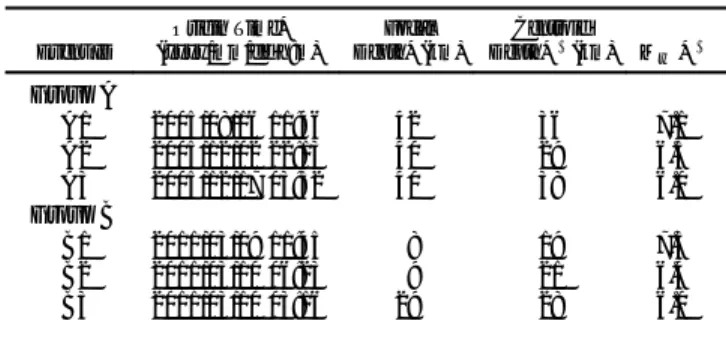
–7.3) events (Fig. 1; Table 1) that occurred in the region of the 2011 Tohoku earthquake. The six events are divided into two groups (groups A and B) on the basis of their focal depths;
group A earthquakes are deeper than the focal depth of the 2011 Tohoku earthquake, whereas group B earthquakes are equal to or shallower than the 2011 Tohoku earthquake.
Group A events consist of the Miyagi-Oki earthquake of 2005 and its two aftershocks, and group B events consist of the three foreshocks of the 2011 Tohoku earthquake. All six events are thrust-type earthquakes, as is the 2011 Tohoku earthquake, and they have almost the same focal mechanism (Fig. 1).
We calculated the spectral ratios for pairs of group A and B events of similar magnitude, that is, the spectral ratios of
events A1 to B1, A2 to B2, and A3 to B3 (Fig. 4). The four seismic stations used for these calculations were selected on the basis of the following criteria: (1) all six events of groups A and B were recorded, (2) the distances to the recording station for the two events used to calculate spectral ratios are similar to minimize the difference of path effects, and (3) the S/N is good. S/N for all events except B2 were greater than about 3 for all frequencies; for event B2, S/N was poor, below about 1 Hz, because the signal was contaminated by the coda waves of a previous small earthquake. The spectral ratios for the three event pairs show that the high-frequency content between about 1 Hz and at least 20 Hz is higher in group A events at all stations. In contrast, group B events have a higher content of frequencies below about 1 Hz, although the spectral ratios at low frequencies are less clear than those at high frequencies. This result suggests that the seismic waves radiated from the deeper regions (correspond- ing to the region of group A) cause high-frequency strong motion more efficiently.
Discussion
Our result, which is derived from Figure 3, shows that after
tp20s the distribution of the high-frequency strong motion from the 2011 Tohoku earthquake relative to the
Mw7.3 foreshock expands in the southern Tohoku district.
The source of the high-frequency radiation can also be seen in the results of the previous studies. Wang and Mori (2011) concluded that the high-frequency rupture (>1 Hz; reliable up to about 3 Hz) moved northwestward from the hypocen- ter, and Yoshida
et al.(2011) indicated that the source of
10-4 10-3 10-3 10-2 10-1 100 101 102
10-1 101000 101 Frequency(Hz)
(cm/s/s*s)
Accel. Fourier spectra of Mw9.0
10-4 10-3 10-3 10-2 10-1 100 101 102
10-1 101000 101 Frequency(Hz)
(cm/s/s*s)
Accel. Fourier spectra of Mw7.3
10-1 100 100 101 102 103
10-1 101000 101 Frequency(Hz)
Spectral ratio (Mw9.0 / Mw7.3)
Spectral ratio
10-1 100 100 101 102 103
10-1 101000 101 Frequency(Hz)
Spectral ratio
(Mw9.0 / ave. spectrum of Mw7.3)
Spectral ratio
-200 0 200
Accel.(cm/s/s)
0 50 100 150
Time(s) 3/11 14:46:27
Mw9.0 Hypo.dist.123 km
-20 -10 0 10 20
Accel.(cm/s/s)
0 50 100 150
Time(s) 3/9 11:45:28
Mw7.3 Hypo.dist.155 km
[tp, tp+10s]
[tp+10s, tp+20s]
[tp+20s, tp+30s]
[tp+30s, tp+40s]
[tp+40s, tp+50s]
Noise([tp-10s, tp]) ave. spectrum of Mw7.3
(a) (b)
(c) (d)
Figure
2.
Vertical accelerograms and Fourier spectra from the data recorded at station MYG011 (red triangle in Fig.1) for (a) the 2011 Tohoku earthquake (Mw 9.0) and (b) its Mw 7.3 foreshock (event B1 of Fig.1and Table1), which is derived from time windows of [tp,tp10s], [tp10s,tp20s], [tp20s,tp30s], [tp30s,tp40s], and [tp40s,tp50s], wheretpis theP-wave arrival time. Dotted lines indicate noise spectra for the [tp−10s,tp] time window. (c) Spectral ratios ofMw9.0–7.3 for the five correspond- ing time windows. (d) Spectral ratios between the five time windows of theMw9.0 spectra and the averageMw7.3 spectrum indicated by the gray line in (b).2234
Short Note36°
38°
40°
42°
100 km
Mw9.0 Mw7.3
0.4-1 Hz
Time window: [tp, tp+10s]
1-5 Hz 5-10 Hz 10-15 Hz 15-20 Hz
36°
38°
40°
42°
0.4-1 Hz
Time window: [tp+10s, tp+20s]
1-5 Hz 5-10 Hz 10-15 Hz 15-20 Hz
36°
38°
40°
42°
0.4-1 Hz
Time window: [tp+20s, tp+30s]
1-5 Hz 5-10 Hz 10-15 Hz 15-20 Hz
36°
38°
40°
42°
0.4-1 Hz
Time window: [tp+30s, tp+40s]
1-5 Hz 5-10 Hz 10-15 Hz 15-20 Hz
138° 140° 142° 144°
36°
38°
40°
42°
0.4-1 Hz
Time window: [tp+40s, tp+50s]
1-5 Hz 5-10 Hz 10-15 Hz 15-20 Hz
0 10 20 30 40 50 Spectral ratio
(a)
(b)
(c)
(d)
(e)
Figure
3.
Averages of spectral ratios of the 2011 Tohoku earthquake (Mw9.0) to its foreshock (Mw7.3; event B1) for five frequency bands. Fourier spectra of the vertical acceleration of theMw9.0 event are derived from five time windows. The spectrum of the foreshock is the average of those obtained from the five time windows.Short Note
2235
high-frequency radiation (4
–8 Hz) was at the western rim of the area of the large slip. These locations are in agreement with the concept that seismic waves radiated from deeper events (in the group A region) cause the high-frequency spectral content, as shown in Figure 4. This regional varia- tion of observed frequency is consistent with the evidence obtained from the rupture of the 2011 Tohoku earthquake (e.g., Ide
et al., 2011;Koper
et al., 2011;Lay
et al., 2012).Figure 1 shows that the high-frequency events (group A) are located on the edge of the area of the large slip, whereas the low-frequency events (group B) are located within the area where the slip exceeded 24 m. These results suggest that the observed spectra of previous earthquakes in a particular re- gion are consistent with the source properties of the ruptures of the subsequent larger earthquakes in the region. The re- gional difference of frequency content might be caused by the regional difference of the source radiation and/or path difference between the sources and the observation stations.
The unclear distance dependence of the spectral ratio (IWT006 and IWTH12) in Figure 4 suggests that the spectral difference might be attributed to the difference of attenuation around the source region rather than the whole path, even though the path plays a major role in causing the spectral difference. To determine whether the regional difference in the source radiation or the attenuation difference around the source regions is the main factor in affecting the wave spec- tra, analysis of the high-resolution attenuation structure might be required for the high-frequency range (>10 Hz).
Figure 4 suggests a correlation between
fmaxand the locations (or the focal depth) of the earthquake rupture. Such frequency dependence was identified in the rupture area of the Sanriku-Oki earthquake of 1994, which occurred north of the 2011 Tohoku earthquake rupture area (Sato
et al., 1996).The 1994 rupture propagated westward from the initial rupture point near the Japan trench and terminated with high- frequency rupture at the deeper part of the inter-plate bound- ary. Takemura
et al.(1989) found a regional dependence of high-frequency and low-frequency earthquakes while anal- yzing the moderate magnitude (
Mw4
–6) events that occurred
at the subduction zone off Fukushima Prefecture: high- frequency inter-plate earthquakes occurred mainly in the northwestern (deeper) part of the region, whereas low- frequency earthquakes occurred in the southeastern (shal- lower) part. These previous studies and our results suggest that the deeper and shallower sources of the subduction zone tend to cause high- and low-frequency ground motions at the Tohoku district, respectively, not only for individual moder- ate size earthquakes but also for subevents of a big earthquake.
Conclusions
Strong high-frequency (>10 Hz) waves were observed in southern Tohoku district in the waveforms from the
Mw9.0 Tohoku Earthquake 20 s after the
P-wave arrival. Analysesof past events near the hypocenter of the
Mw9.0 event show that waveforms from deeper events contain more high-frequency energy compared to those from shallower events. This result suggests that the rupture in deeper regions caused high-frequency waves not only in individual moder- ate size earthquakes but also in the subevents of a big earth- quake. We also provided evidence stating that
fmaxof the
Mw9.0 event was higher than expected, and the timing and frequency content suggest that the strong high-frequency (>10 Hz) wave might be associated with the location (or depth) of the earthquake rupture.
Data and Resources
The situation of damage of the 2011 Tohoku earthquake can be found on the Fire and Disaster Management Agency Web page at http://www.fdma.go.jp/bn/higaihou.html (last accessed April 2012).
The hypocentral parameters (origin time, location, mag- nitude, and focal mechanism) for this study, which were rou- tinely determined by the JMA (JMA, 2011), were retrieved from the JMA seismic catalog (JMA, 2011) and the JMA Web page at http://www.seisvol.kishou.go.jp/eq/mech/cmt/
top.html (last accessed April 2012).
Strong motion accelerograms of KiK-net and K-NET (Okada
et al., 2004) were obtained from the NationalInstitute for Earth Science and Disaster Prevention (NIED) at http://www.kyoshin.bosai.go.jp (last accessed June 2011).
Acknowledgments
We would like to thank the two anonymous reviewers and the editor Zhigang Peng for their comments that were useful in revising the manu- script. Data from KiK-net and K-NET of National Research Institute for Earth Science and Disaster Prevention (NIED) were used in this analysis.
Hypocenter location and focal mechanism of events mentioned in this paper are obtained from the integrated hypocentral catalog of the Japan Meteor- ological Agency (JMA). All figures were made using Generic Mapping Tools, version 4.2.0 (Wessel and Smith, 1998).
Table 1
Parameters of the Earthquakes
Event ID
Origin Time*† (yyyy/mm/dd h:m)
Focal Depth* (km)
Centroid
Depth*‡(km) Mw*‡ Group A
A1 2005/08/16 11:46 42 36 7.1
A2 2005/12/02 22:13 40 29 6.5
A3 2005/12/17 03:32 40 38 6.0
Group B
B1 2011/03/09 11:45 8 19 7.3
B2 2011/03/10 06:23 9 21 6.4
B3 2011/03/10 03:16 29 28 6.0
*JMA seismic catalog (seeData and Resourcessection).
†JST, Japan Standard Time.
‡From centroid moment tensor solutions.
2236
Short Note-20 0 20
(cm/s/s)
0 50 100
IWTH12 A1
Hypo.dist.237 km
-8 0 8
(cm/s/s)
0 50 100
(s) B1
Hypo.dist.258 km
-3 0 3
(cm/s/s)
0 50 100
A2
Hypo.dist.247 km
-2 0 2
(cm/s/s)
0 50 100
(s) B2
Hypo.dist.261 km
-6 0 6
(cm/s/s)
0 50 100
A3
Hypo.dist.204 km
-2 0 2
(cm/s/s)
0 50 100
(s) B3
Hypo.dist.245 km
10-1 101000 101 (Hz) 10-2
10-1 10-1 100 101 102
(cm/s/s*s), (ratio)
A1/B1
A1 B1
10-1 101000 101 (Hz) 10-2
10-1 10-1 100 101 102
(cm/s/s*s), (ratio)
A2/B2
A2 B2
10-1 101000 101 (Hz) 10-2
10-1 10-1 100 101 102
(cm/s/s*s), (ratio)
A3/B3
A3 B3 -20
-10 0 10 20
(cm/s/s)
0 50 100
IWTH09 A1
Hypo.dist.224 km
-5 0 5
(cm/s/s)
0 50 100
(s) B1
Hypo.dist.238 km
-2 -1012
(cm/s/s)
0 50 100
A2
Hypo.dist.233 km
-2 -1 0 1 2
(cm/s/s)
0 50 100
(s) B2
Hypo.dist.242 km
-3 0 3
(cm/s/s)
0 50 100
A3
Hypo.dist.190 km
-0.8 0.0 0.8
(cm/s/s)
0 50 100
(s) B3
Hypo.dist.227 km
10-1 101000 101 (Hz) 10-2
10-1 10-1 100 101 102
(cm/s/s*s), (ratio)
A1/B1 A1 B1
10-1 101000 101 (Hz) 10-2
10-1 10-1 100 101 102
(cm/s/s*s), (ratio)
A2/B2
A2 B2
10-1 101000 101 (Hz) 10-2
10-1 10-1 100 101 102
(cm/s/s*s), (ratio)
A3/B3
A3 B3
-30 0 30
(cm/s/s)
0 50 100
IWT006 A1
Hypo.dist.156 km
-10 0 10
(cm/s/s)
0 50 100
(s) B1
Hypo.dist.171 km
-4 0 4
(cm/s/s)
0 50 100
A2
Hypo.dist.164 km
-3 0 3
(cm/s/s)
0 50 100
(s) B2
Hypo.dist.173 km
-8 0 8
(cm/s/s)
0 50 100
A3
Hypo.dist.122 km
-4 -2 0 2 4
(cm/s/s)
0 50 100
(s) B3
Hypo.dist.158 km
10-1 101000 101 (Hz) 10-2
10-1 10-1 100 101 102
(cm/s/s*s), (ratio)
A1/B1 A1 B1
10-1 101000 101 (Hz) 10-2
10-1 10-1 100 101 102
(cm/s/s*s), (ratio)
A2/B2
A2 B2
10-1 101000 101 (Hz) 10-2
10-1 10-1 100 101 102
(cm/s/s*s), (ratio)
A3/B3
A3 B3 -50
0 50
(cm/s/s)
0 50 100
IWT005 A1
Hypo.dist.173 km
-20 0 20
(cm/s/s)
0 50 100
(s) B1
Hypo.dist.187 km
-8 0 8
(cm/s/s)
0 50 100
A2
Hypo.dist.182 km
-5 0 5
(cm/s/s)
0 50 100
(s) B2
Hypo.dist.190 km
-20 0 20
(cm/s/s)
0 50 100
A3
Hypo.dist.140 km
-4 0 4
(cm/s/s)
0 50 100
(s) B3
Hypo.dist.175 km
10-1 101000 101 (Hz) 10-2
10-1 10-1 100 101 102
(cm/s/s*s), (ratio)
A1/B1
A1 B1
10-1 101000 101 (Hz) 10-2
10-1 10-1 100 101 102
(cm/s/s*s), (ratio)
A2/B2
A2 B2
10-1 101000 101 (Hz) 10-2
10-1 10-1 100 101 102
(cm/s/s*s), (ratio)
A3/B3
A3 B3
Figure
4.
Vertical accelerograms and Fourier spectra of data recorded at stations IWT005, IWT006, IWTH09, and IWTH12 for group A and B events, and spectral ratios of group A to group B for pairs of events of approximately the same magnitude. Details of group A and B events are provided in Figure1and Table1. Seismic station locations are shown in Figure1. Red lines, the spectral ratios of group A (black) to B (gray); red broken lines, spectral ratios for frequencies lower than about 1 Hz indicate low S/N; and solid lines under the waveforms, time windows [tp,tp50s] for which are calculated spectra. Hypocentral distance is shown at the top of each waveform.Short Note
2237
References
Aki, K. (1967). Scaling law of seismic spectrum,J. Geophys. Res.72,no. 4, 1217–1231.
Archuleta, R. J., E. Cranswick, C. Mueller, and P. Spudich (1982). Source parameters of the 1980 Mammoth Lakes, California, earthquake sequence,J. Geophys. Res.87,no. B6, 4595–4607.
Hanks, T. C. (1982).fmax,Bull. Seismol. Soc. Am.72,no. 6A, 1867–1879.
Hoshiba, M., and K. Iwakiri (2011). Initial 30 seconds of the 2011 Off the Pacific Coast of Tohoku earthquake (Mw9.0)—Amplitude andτcfor magnitude estimation for earthquake early warning, Earth Planets Space63,no. 7, 553–557.
Hoshiba, M., K. Iwakiri, N. Hayashimoto, T. Shimoyama, K. Hirano, Y. Yamada, Y. Ishigaki, and H. Kikuta (2011). Outline of the 2011 Off the Pacific Coast of Tohoku earthquake (Mw9.0)—Earthquake early warning and observed seismic intensity,Earth Planets Space 63,no. 7, 547–551.
Ide, S., A. Baltay, and G. C. Beroza (2011). Shallow dynamic overshoot and energetic deep rupture in the 2011Mw9.0 Tohoku-Oki earthquake, Science332,no. 6036, 1426–1429.
Japan Meteorological Agency (JMA) (2011). The Seismological and Volcanological Bulletin of Japan for January 2011 (CD-ROM), JMA, Tokyo.
Koper, K. D., A. R. Hutko, T. Lay, C. J. Ammon, and H. Kanamori (2011).
Frequency-dependent rupture process of the 2011Mw 9.0 Tohoku earthquake: Comparison of short-period P wave backprojection images and broadband seismic rupture models,Earth Planets Space 63,no. 7, 599–602.
Lay, T., H. Kanamori, C. J. Ammon, K. D. Koper, A. R. Hutko, L. Ye, H. Yue, and T. M. Rushing (2012). Depth-varying rupture properties of subduction zone megathrust faults, J. Geophys. Res. 117, no. B04311, 21 pp., http://www.agu.org/pubs/crossref/2012/
2011JB009133.shtml.
Nakajima, J., and A. Hasegawa (2006). Anomalous low-velocity zone and linear alignment of seismicity along it in the subducted Pacific slab beneath Kanto, Japan: Reactivation of subducted fracture zone?
Geophys. Res. Lett.33,L16309.
Okada, Y., K. Kasahara, S. Hori, K. Obara, S. Sekiguchi, H. Fujiwara, and A. Yamamoto (2004). Recent progress of seismic observation networks in Japan—Hi-net, F-net, K-NET and KiK-net,Earth Planets Space56,xv–xxviii.
Sato, T., K. Imanishi, and M. Kosuga (1996). Three-stage rupture process of the 28 December 1994 Sanriku—Oki Earthquake,Geophys. Res. Lett.
23,no. 1, 33–36.
Takemura, M., S. Hiehata, T. Ikeura, and T. Uetake (1989). Regional variation of source properties for middle earthquakes in a subduction region,Zisin 242,no. 3, 349–359 (in Japanese with English abstract).
Tsurugi, M., T. Kagawa, and K. Irikura (2009). Study on a high-cut filter for strong ground motion prediction (Part 2)—Based on the observed records during the 2005 Fukuoka-ken Seiho-oki earthquake,J. Japan Assoc. Earthq. Eng.9,no. 1, 1–18 (in Japanese with English abstract).
Wang, D., and J. Mori (2011). Rupture process of the 2011 Off the Pacific Coast of Tohoku earthquake (Mw9.0) as imaged with back-projection of teleseismicP-waves,Earth Planets Space63,no. 7, 603–607.
Wessel, P., and W. H. F. Smith (1998). New, improved version of Generic Mapping Tools released,Eos Trans. AGU79,no. 47, 579.
Wu, Y. M., and H. Kanamori (2005). Experiment on an onsite early warning method for the Taiwan Early Warning System,Bull. Seismol. Soc. Am.
95,no. 1, 347–353.
Yoshida, Y., H. Ueno, D. Muto, and S. Aoki (2011). Source process of the 2011 Off the Pacific Coast of Tohoku earthquake with the combination of teleseismic and strong motion data,Earth Planets Space63,no. 7, 565–569.
Seismology and Volcanology Research Department Meteorological Research Institute
Nagamine 1-1 Tsukuba 305-0031 Japan
kiwakiri@mri‑jma.go.jp mhoshiba@mri‑jma.go.jp
Manuscript received 29 August 2011