WHEN IS A POLYGONAL PYRAMID NUMBER AGAIN POLYGONAL?
MASANOBU KANEKO AND KATSUICHI TACHIBANA
ABSTRACT. We consider a Diophantine equation arising from a generalization of the classical Lucas problem of the square pyramid: when is the sum of the firstm-gonal numbers n-gonal? We use the theory of elliptic surfaces to deduce several families of parametric solutions of the problem.
1. Introduction. In 1875 Lucas proposed the problem of proving that 12+ 22+· · ·+ 242 = 702 is the only nontrivial solution to the problem referred to as “the cannonball problem” or “the problem of the square pyramid”: When is the sum of the firstnsquares a perfect square? This problem was settled finally by G.N. Watson in 1918 (see [1] for the history and an elementary proof of the problem).
In the present paper, by regarding a perfect square as 4-gonal number, we consider the following generalization of the cannonball problem:
When is the sum of the first m-gonal numbers once again anm-gonal number, or more generally, a polygonal number of possibly different ordern? Here, for positive integersm≥3 andi≥1, the ithpolygonal number of order mor theithm-gonal number, is given by
(1) Gm(i) = m−2
2 i2−m−4 2 i.
We call the sum of the first i m-gonal numbers the ith polygonal pyramid number of orderm, or theith m-gonal pyramid number and denote it by Pyrm(i) : Pyrm(i) =i
j=1Gm(j). Then our problem of the polygonal pyramid is to find (positive) integer solutions (x, y) to the equation
(2) Gn(y) = Pyrm(x)
for fixed integersm,n≥3. By (1), we can write this equation explicitly as
(3) 3(n−2)y2−3(n−4)y= (m−2)x3+ 3x2−(m−5)x.
Received by the editors on February 1, 2000, and in revised form on October 2, 2000.
Copyright c2002 Rocky Mountain Mathematics Consortium
149
For each pair (m, n), this defines an elliptic curve overQand, according to Siegel’s theorem, there are only finitely many integral points on the curve (3). However, it is in general very hard to find them all. Instead, we viewmor nas independent variable and consider a Q[m] orQ[n] point on the curve. This makes it possible to find several parametric solutions to (2) (with varyingmor n).
Our main results are as follows.
Theorem 1.1. (a) For each integer m ≥ 3, there are infinitely many m-gonal pyramid numbers expressible as a polygonal number.
Specifically, we have the following identities:
Pyrm(3(m−2)k−2) =G9k+2((m−2)2k−m+ 3), Pyrm(3k−1) =G(m−2)k+3(3k−1),
Pyrm(6k−3) =G4(m−2)(2k−1)+6(3k−1) for any integerk≥1.
(b)Moreover, if m≡2 mod 3, then Pyrm
1
3(m−2)k−2
=Gk+2
1
9(m−2)2k−m+ 3 , (4)
Pyrm(k) =G(1/3)(m−2)(k+1)+3(k), Pyrm(2k−1) =G(4/3)(m−2)(2k−1)+6(k) for any integerk≥1 (for which the expression has meaning).
Theorem 1.2. (a) For each integer n ≥ 3, there are infinitely many n-gonal numbers expressible as a polygonal pyramid number.
Specifically, we have
Gn((n−2)k2−3k+ 1) = Pyr3k+2((n−2)k−2), (5)
Gn(8k2−6k+ 1) = Pyr3(n−2)k+2(4k−2).
(6)
Moreover, if n≡2 mod 9, we have Gn
n−2
9 k2−k+ 1
= Pyrk+2
n−2 3 k−2
.
(b) For n= 3,5 and 8, there are other families of n-gonal numbers that can be expressed as a polygonal pyramid number. Namely, we have
G3(2(12k2+ 13k+ 3)) = Pyr27k+20(4k+ 2), G5(6k2+k) = Pyr12k+6(3k), G5(6k2+ 5k+ 1) = Pyr12k+10(3k+ 1), G5(2(12k2−25k+ 13)) = Pyr3k(12k−14),
G5(2(12k2−17k+ 6)) = Pyr3k+1(12k−10), G8(30k2+k) = Pyr75k+7(6k), G8(30k2+ 41k+ 14) = Pyr75k+57(6k+ 4).
Here k ≥ 0 is any integer for each equation (for which the sum has meaning).
Theorem 1.3. When both m and n are viewed as independent variables, one and only one Q[m, n] point exists on the elliptic curve (3), namely,
(x, y) =1
3(mn−2m−2n−2),1
9(m2n−2m3−4mn−m+ 4n+ 19) .
The equation (5), or equivalently (4), since these two represent essentially the same solution, when specialized to n = 3k+ 2, gives us a parametric solution (x, y, m) = (3k2−2,3k3−3k+ 1,3k+ 2) to the special casem=nof (2) (whenm≡2 mod 3). We state this as
Corollary 1.4. Suppose m ≡2 mod 3 and write m= 3k+ 2 with k≥1. The equation
Gm(y) = Pyrm(x) has a parametric solution
(x, y) = (3k2−2,3k3−3k+ 1).
Notice that one can easily verify the identities in Theorems 1.1 and 1.2. But we show here how we can obtain these identities systematically
from the polynomial points on the elliptic curve (3). In order to obtain every polynomial point, we use an improved version of the results of Hindy-Silverman [4] on an upper bound of the height pairing (the canonical height) for polynomial points on an elliptic curve over a rational function field (Proposition 4.1 in Section 4).
Various other variations to the original square pyramid problem have been considered. Of them, we mention that Kuwata and Top [5] treated the equationy2=n−1
i=0(x+i)2 for a positive integern≥2 also from a viewpoint of the theory of elliptic surfaces. We also note in passing that Beukers and Top [2] considered the problem that is equivalent to finding integer solutions to the cubic equation Pyr3(m) = Pyr4(n) in our notation.
Theorems will be proved in Section 3 after the determination in Section 2 of the structure of the Mordell-Weil group of the curve (3), viewed as defined over the rational function field Q(m) (with fixed n and varyingm). The last Section 4 will be devoted to giving an upper bound of heights of polynomial points, which is used in Section 3, as mentioned.
2. Mordell-Weil groups and generators. Fixing an integern≥3 and viewingmas a variable, we regard the elliptic curve (3) as being defined over Q(m). Now let us make a change of variables:
(7) t=m−2, x= 3
(n−2)tX−1
t, y= 3
(n−2)2tY + n−4 2(n−2). This changes the equation (3) into the following elliptic curve over the rational function fieldQ(t) defined by a (minimal) Weierstrass form (8) En :Y2=X3+p(t)X+q(t),
where
p(t) =−1
9(n−2)2(t2−3t+ 3), q(t) = 1
108(n−2)2((3n2−20n+ 40)t2
−12(n−2)t+ 8n−16).
In the present section we will determine the structure of the Mordell- Weil groupEn( ¯Q(t)) for eachn≥3. And we will also find generators of
each Mordell-Weil group by calculating the height pairing. Notations here follow [7]. We note that the minimal elliptic surface corresponding to our elliptic curve (8) is rational, and hence the structure theorem of the Mordell-Weil lattice as developed in Theorem 10.3 in [7] is applica- ble. Namely, the structure of the Mordell-Weil group is determined by the data of singular fibers which is described in the following lemma.
Lemma 2.1. For eachn≥3, reducible singular fibers of the minimal elliptic surface overP1 corresponding to the elliptic curve(8)are fully described as follows:
(a)BothE3andE6have anI3-fiber att= 0and anI0∗-fiber att=∞.
(b) E4 has an I2-fiber at each t = 0,3 and 3/2 and an I0∗-fiber at t=∞.
(c)BothE5andEn forn≥7have anI2-fiber att= 0and anI0∗-fiber att=∞.
Proof. It is known as Tate’s algorithm [9] that the type of singular fiber overt=t0 is completely determined and calculable by the orders att0of the discriminant ∆ = 4p(t)3+ 27q(t)2,q(t) and thej-invariant of the elliptic curve (8). The discriminant is given by
∆ =− 1
11664(n−2)4t2
64(n−2)2t4−576(n−2)2t3
−9(27n4−360n3+ 1664n2−3776n+ 3776)t2
+ 648(n−2)(3n2−28n+ 56)t−1296(n−2)(n−3)(n−6) . The order of ∆ att = 0 is 2 for all n except for 3 and 6, in which cases the order is 3. And we can verify by computing the discriminant that the second factor, the polynomial of degree 4, has double zeros only when n = 4, for integer n ≥ 3, and the roots are t = 3 and 3/2. The order of ∆ at t =∞ is equal to that of ∆ at s = 0 in the equation obtained from the change of variabless= 1/t,X =s2X and Y =s3Y. From these the lemma is established using Tate’s algorithm.
Remark. Of course, there are also irreducible singular fibers on each elliptic surface. However, those make no effect on the structure of the Mordell-Weil group and thus we do not describe such fibers here.
For each n≥3, let P1(n)=
1
3(n−2)(t+ 1),1
6n(n−2)t , P2(n)=
1
3(n−2),−1
6(n−2)(n−4)t and
P3(n)= 1
3(n−2)(−t+ 1),−1
6(n−2)(n−4)t
be points on the elliptic curve (8) corresponding to trivial points (1,1),(0,0) and (−1,0) on the original elliptic curve (3). And, for n = 4, we add one more point: Let P4(4) = (2(t−2)/3,0) be the point corresponding to another trivial point ((m−5)/(m−2),0). The following proposition gives the structure and generators of the Mordell- Weil group ofEn( ¯Q(t)).
Proposition 2.2. The structure and generators of the Mordell-Weil group ofEn( ¯Q(t))are as follows:
(a) E3( ¯Q(t))∼=E6( ¯Q(t))∼=Z⊕Zand generators areP1(3), P2(3) and P1(6), P2(6), respectively.
(b) E4( ¯Q(t))∼=Z⊕(Z/2Z)2 and P1(4) is a free generator. Torsion points of order2 are P2(4), P3(4) andP4(4).
(c) Forn= 5 andn≥7,En( ¯Q(t))∼=Z⊕Z⊕Zand generators are P1(n), P2(n) andP3(n).
Proof. (a) There is essentially no difference between two casesn= 3 and 6, and so we treat the first here. From the types of two reducible fibers in Lemma 2.1 (a), the lattice of irreducible components of those fibers is
4 −2
−2 4
. Considering the dual lattice of the orthogonal of this lattice inE8, cf. [3], the Mordell-Weil groupE3( ¯Q(t)) is isomorphic to (1/6)
4 1 1 4
as a lattice. (The lattice is obtained also from the table of [6], and so are the other ones below.) It follows that the rank of the group is 2 and the height pairing of each generator with itself has to be 2/3.
By the explicit formula of the height pairing [7], we have (under the notation in [7])
P1(3), P1(3) = 2−contr0(P1(3))−contr∞(P1(3)).
Since contr0(P1(3)) = 2/3 and contr∞(P1(3)) = 2/3, we have P1(3), P1(3) = 2/3. Hence,P1(3) is a generator ofE3( ¯Q(t)), and by the same calculation, so isP2(3).
(b) From the previous lemma, the lattice of irreducible components is D4⊕A⊕13and therefore,E4( ¯Q(t)) is isomorphic toA∗1⊕(Z/2Z)2. Tor- sion points correspond to the roots of the righthand side of the equation (8), i.e., P2(4), P3(4) andP4(4). Since the free part is isomorphic to A∗1, the height pairing of a generator is 1/2. Observing singular points on each singular fiber, we have contr0(P1(4)) = 1/2, contr∞(P1(3)) = 1 and contr3(P1(4)) = contr3/2(P1(4)) = 0, and henceP1(4), P1(4) = 1/2 from the formula. Therefore,P1(4)is a generator ofE4( ¯Q(t)).
(c) In every case, the lattice of irreducible components is D4⊕A1
and henceEn( ¯Q(t)) is isomorphic to A∗⊕1 3. From singular points on each singular fiber, contr0(Pi(n)) = 1/2 and contr∞(Pi(n)) = 1, and it follows thatPi(n), Pi(n) = 1/2,i= 1,2 and 3, from the formula, as is required.
Corollary 2.3. En( ¯Q(t)) =En(Q(t))for everyn≥3.
Proof. This is clear because all the generators of eachEn( ¯Q(t)) given in the proposition are defined overQ(t).
3. Proof of theorems. By (7), the point (x, y) on (3) corresponds to the point (X, Y) on the elliptic curve (8) where
(9) X= 1
3(n−2)(tx+ 1), Y =1
6(n−2)(2(n−2)y−n+ 4)t.
In order to find integral points on the curve (3) over Q (integers m andnbeing fixed), we search forQ[m]-integral points (x, y), i.e.,xand y ∈Q[m], on (3) viewed as overQ(m), with an integernfixed. Then,
by (9), corresponding points on (8) must beQ[t]-integral (polynomial points). We can find all the polynomial points from the generators of En(Q(t)) because heights of polynomial points are bounded. We need a practical bound for actual computation and this will be given by Corollary 4.4 to Proposition 4.1 in the next section.
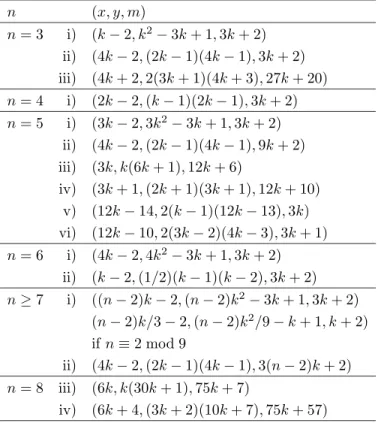
Proposition 3.1. For each value of n ≥ 3, the following table lists the parametric integer solutions(x, y, m)coming fromQ[t]-integral points on the elliptic curve(8).
TABLE 1. Parametric solutions in case of fixingn.
n (x, y, m)
n= 3 i) (k−2, k2−3k+ 1,3k+ 2) ii) (4k−2,(2k−1)(4k−1),3k+ 2) iii) (4k+ 2,2(3k+ 1)(4k+ 3),27k+ 20) n= 4 i) (2k−2,(k−1)(2k−1),3k+ 2) n= 5 i) (3k−2,3k2−3k+ 1,3k+ 2)
ii) (4k−2,(2k−1)(4k−1),9k+ 2) iii) (3k, k(6k+ 1),12k+ 6)
iv) (3k+ 1,(2k+ 1)(3k+ 1),12k+ 10) v) (12k−14,2(k−1)(12k−13),3k) vi) (12k−10,2(3k−2)(4k−3),3k+ 1) n= 6 i) (4k−2,4k2−3k+ 1,3k+ 2)
ii) (k−2,(1/2)(k−1)(k−2),3k+ 2) n≥7 i) ((n−2)k−2,(n−2)k2−3k+ 1,3k+ 2)
(n−2)k/3−2,(n−2)k2/9−k+ 1, k+ 2) ifn≡2 mod 9
ii) (4k−2,(2k−1)(4k−1),3(n−2)k+ 2) n= 8 iii) (6k, k(30k+ 1),75k+ 7)
iv) (6k+ 4,(3k+ 2)(10k+ 7),75k+ 57)
Proof. We find all Q[t]-integral points on the elliptic curve (8) using the estimate of heights given in Corollary 4.4 in the next section, and check if they correspond toQ[m]-integral points on the curve (3). We shall simply writePi forPi(n).
When n = 3, computation shows that only 2P2,−2P1−2P2 and
−2P1 giveQ[m]-integral points on (3) and they are respectively ((m− 8)/3,(m2−13m+ 31)/9), (2(2m−7)/3,(1/9)(2m−7)(4m−11)) and (2(2m−13)/27,2(m−11)(4m+ 1)/243). The first and the second points become (Z- and positive) integral points if and only if mis an integer of the form 3k+ 2 where k≥3 for the first andk≥1 for the second. For the third point the condition ism= 27k+ 20 fork≥0.
When n = 4, −P1+P4 is the unique point to look at and it gives (2(m−5)/3,(m−5)(2m−7)/9) on the curve (3). This will become a positive integer point if and only ifm= 3k+ 2 fork≥2.
For the case n= 5, four points occur: −P1+P2+P3, −P1−P2− P3, −P1 −P2 +P3 and −P1+P2 −P3 on (3). These correspond respectively to (m−4,(m2−7m+13)/3)),(2(2m−13)/9,(2m−13)(4m−
17)/81),((m−6)/4,(m−4)(m−6)/24)) and (4m−14,2(m−3)(4m− 13)/3). The first and the second are integer points only in the case m= 3k+ 2 fork≥1 andm= 9k+ 2 fork≥1, respectively. For the third,m= 12k+ 6 fork≥1 orm= 12k+ 10 fork≥0 is the condition.
Andm= 3kfork≥2 orm= 3k+ 1 fork≥1 is for the last.
When n= 6, −2P1+ 2P2 and −2P1 are required points. (Here we note that 2P2 is also Q[m]-integral but this point gives negativey for allm.) These two points become (2(4m−14)/3,(4m2−25m+ 43)/9) and ((m−8)/3,(m−5)(m−8)/18) on (3), and thenm= 3k+ 2 is the condition to be positive integral points for both cases wherek≥1 and k≥3, respectively.
For every n≥7,−P1+P2+P3,−P1−P2−P3and−P1−P2+P3
satisfy the condition. On the curve (3) these three points correspond to
1
3(mn−2m−2n−2),1
9(m2n−2m2−4mn−m+4n+19) (10)
= 1
3(m−2)(n−2)−2,1
9(m−2)2(n−2)−m+ 3 , (11)
4(m−2)
3(n−2) −2,2(m−2) 3(n−2) −1
4(m−2) 3(n−2) −1
,
and
(mn−2m−8n+22)
3(n−3)2 , (mn−2m−8n+22)(mn−2m−5n+13) 9(n−2)(n−3)3
. The first is positive integral ifm= 3k+2 fork≥1. Whenn≡2 mod 9, the first is always integral for any value ofm. The second is integral if m= 3(n−2)k+ 2 fork≥1. (When n−2 is even, the condition can be weakened. However, we do not want to make our case distinction too complicated to describe.) The third requires a little more work and will be treated as
Lemma 3.2. The point (x, y) =
(mn−2m−8n+22)
3(n−3)2 , (mn−2m−8n+22)(mn−2m−5n+13) 9(n−2)(n−3)3
on the curve (3) becomes an integer point only when n = 8. In that case the condition on mfor(x, y)to be a positive integer point is that m= 75k+ 7 fork≥1 orm= 75k+ 57fork≥0.
Proof of Lemma 3.2. Put n−2 =q. In order that y is an integer, q must divide (mn −2m−8n+ 22)(mn −2m−5n + 13). Since (mn−2m−8n+22)(mn−2m−5n+13)≡6·3 = 18 modq,qmust be a divisor of 18 and hence, becausen≥7, possible values ofn(=q+2) are 8, 11, 20. It is easy to see thatn= 11 andn= 20 are impossible. When n= 8, the point (x, y) becomes (2(m−7)/25,(m−7)(2m−9)/375). For xto be integral,mmust be of the form 25k+ 7. Theny=k(10k+ 1)/3 and thus k must be congruent to 0 or 2 mod 3. Therefore (x, y) is positive integral if and only ifm= 75k+7 fork≥1 orm= 75k+57 for k≥0. This proves the lemma and thus the proposition is established.
In the course of our computation of points on (3) for general n≥7, we found points other than (10) whose coordinates are polynomials in n; namely,
−P1−P2=
3n−m−7
m−2 , 3n−m−7 m−2
and
−P1−P3=
3(n−6)
4(m−2), 3n+ 4m−26 8(m−2)
.
For a fixed value ofm, we shall investigate the condition onnin order for these points to be integral. First, ifm= 3, the first point is always integral and positive provided that n is an integer ≥ 4 whereas the second is a positive intgral when and only whenn= 8k+ 2 withk≥1.
Assume m >3. The point 3n−m−7
m−2 ,3n−m−7 m−2
=
3(n−3)
m−2 −1,3(n−3) m−2 −1
is integral ifn−3 is of the form (m−2)k. Ifm−2 is divisible by 3, then the condition can be weakened ton−3 = (m−2)k/3. The point
3(n−6)
4(m−2),3n+ 4m−26 8(m−2)
=
3(n−6) 4(m−2),1
2· 3(n−6) 4(m−2)+1
2
is integral if and only if 3(n−6)/4(m−2) is an odd integer. This is so ifn−6 is of the form 4(m−2)(2k+ 1). Ifm−3 is divisible by 3, then it is enough forn−6 to be of the form 4(m−2)(2k+ 1)/3. Summing up, we obtain the following
Proposition 3.3. Suppose an integer m≥3 is fixed. We have the following parametric solutions(x, y, n)wherex, yandnare polynomials in an integerk≥1:
(x, y, n) = (3(m−2)k−2,(m−2)2k−m+ 3,9k+ 2),
= (3k−1,3k−1,(m−2)k+ 3),
= (6k−3,3k−1,4(m−2)(2k−1) + 6).
Moreover, ifm≡2 mod 3, then we have (x, y, n) = 1
3(m−2)k−2,1
9(m−2)2k−m+ 3, k+ 2,
=
k, k, 1
3(m−2)(k+ 1) + 3 ,
=
2k−1, k,4
3(m−2)(2k−1) + 6 .
Propositions 3.1 and 3.3 provide the identities of Theorems 1.1 and 1.2. Theorem 1.3 is also deduced from the above consideration, since a Q[m, n] point must be a priori aQ[m] point (whennis fixed).
Remark. If we regard the elliptic curve (8) as being defined overQ(n) (we denote it byEm here), the Mordell-Weil groupEm(Q(n)) is a little complicated. In this case there are two types of the Mordell-Weil group according asm= 5 or m= 5. But we have to pay more attention to their generators. First, in case ofm= 5 (t= 3), the Mordell-Weil group E5( ¯Q(n)) is isomorphic toZ3. We can easily verify thatP1(n)andP2(n)
are again generators in this case, too. But a remaining generator is completely different from any generators ofEn(Q(t)). Indeed,
1 3(3√
−1−2)(n−2), 1
2n(n−2)
is a third generator, which does not correspond to a trivial point on the elliptic curve (3). Thus the Mordell-Weil groupE5( ¯Q(n)) is actually E5(Q√
−1)(n)). Anyway, we can search for Q[n]-integral points from these generators. But there is no new Q[n]-point other than those already obtained before.
In case of m = 5, the Mordell-Weil group Em ( ¯Q(n)) is isomorphic toZ4. Generators areP1(n), P2(n), P3(n) and a point with the following X-coordinate:
X =−1 6
m−2±
m2−22m+ 49
(n−2).
Thus, the field of definition becomes strictly larger thanQ(except for m = 20, 22 and 30). It would, therefore, be hard to investigate the wholeQ(n)-rational points and presumably no newQ[n] points will be found.
4. Upper bound for heights of polynomial points. In this section we shall prove the following
Proposition 4.1. Letkbe an algebraically closed field of characteris- tic other than2or3,Ean elliptic curve given by a minimal Weierstrass form over k(t), andr the number of distinct zeros of the discriminant
∆. Then for a polynomial point P = (x(t), y(t))∈ E(k(t)), we have the following properties:
(i)Whenr≥2,
P, P ≤ 2χ+ 4r−6 if 12deg (∆) 2χ+ 4r−4 if 12|deg (∆).
(ii)Whenr= 1,P is a torsion point, and hence P, P = 0.
Here P, P is the height pairing in the sense of [7] and χ is the arithmetic genus of the minimal model.
We note that the height pairing here is twice the canonical height.
SupposeE is given by a minimal Weierstrass form;
(12) E:y2=x3+p(t)x+q(t),
wherep(t) andq(t) are ink[t]. By minimal we mean the degree of the discriminant ∆ is minimal. Then a positive integerµ= min{m∈Z| deg (p(t))≤4mand deg (q(t))≤6m} is uniquely determined. For a point P = (x(t), y(t)) on the elliptic curve E, if deg (x(t))≤ 2µ and deg (y(t)) ≤ 3µ, then we can easily show P, P ≤ 2χ [7]. Thus we treat a polynomial pointP = (x(t), y(t)) on the elliptic curve (12) such that deg (x(t))≥2µand deg (y(t))≥3µ.
In order to prove the theorem above, we need the following two lemmas.
Lemma 4.2. For a polynomial pointP = (x(t), y(t))∈E(k(t)), (P O) = 1
2deg (x(t))−µ,
where (P O)is the intersection number of the section (P)and the zero section (O).
Proof. Since P = (x(t), y(t)) is a polynomial point, the section (P) does not intersect the zero section (O) except on the fiber att =∞.
It follows that (P O) = (P O)t=∞, where (P O)t=∞is the local index at the intersecting point of two sections on the fiber att =∞. Now we change the coordinate of the elliptic curve (12). Lets= 1/t,X=s2µx andY =s3µy, and moreover, W =X/Y andZ= 1/X. Then we have the elliptic curve
E˜ :Z=W3+ ˜p(s)W Z2+ ˜q(x)Z3,
where ˜p(s) = s4µp(1/s) and ˜q(s) = s6µq(1/s) are in k[s]. By this coordinate change, the point P becomes ˜P = (w(s), z(s)) = (X(s)/Y(s),1/Y(s)) and the point at infinityOis the origin ˜O= (0,0).
So we may calculate ( ˜PO)˜ s=0, i.e., the local intersection number of two sections ( ˜P) and ( ˜O) at the point p= (0,0,0) on{(W, Z, s)}, which is the affine expression of the minimal elliptic surfaceS of ˜E.
The local ring of this surface at the point pis
OS,p=k[W, Z, s]p/(Z−W3−p˜(s)W Z2−q˜(s)Z3)
and the local equation of the section ( ˜P), respectively ( ˜O), at p is W−w(s) = 0, respectivelyW = 0. Since w(s) =us(1/2)deg (x(t))−µ for someuink[s]∗0, it follows from the definition of an intersection number that (P O) = dimkOS,p/(W−w(s), W)
= dimkk[s]0/(s(1/2)deg (x(t))−µ)
= 1
2deg (x(t))−µ,
where the second equality is obtained from the isomorphism ofk-vector spaces
OS,p/(W−w(s), W)∼=k[s]0/(w(s)).
Lemma 4.3. For a polynomial pointP = (x(t), y(t))∈E(k(t)), P, P ≤2χ−2µ+ deg (x(t)).
Proof. From the formula, Theorem 8.6 in [7], of the height pairing, we have
P, P ≤2χ+ 2(P O).
This combined with Lemma 4.2 gives the desired inequality.
Proof of Proposition 4.1. Leth:K→Zbe the height function (Kis the function field) i.e.,h(f) is either the total number of zeros off or the total number of poles [8]. Choosing zeros of ∆ and∞as the setS in the inequality of [4, Proposition 8.2] or [8, Theorem 12.3], we have
(13) hy4
∆
≤24(r−1).
Case (i). As we have noticed, we are treating a polynomial point P = (x(t), y(t)) such that deg (x(t))≥2µ and deg (y(t))≥3µ. Since the discriminant ∆ is also a polynomial and deg (∆) ≤ 12m by the assumption, we have
hy4
∆
≥4h(y)−h(∆) = 4deg (y(t))−deg (∆).
Thus from the inequality (13), deg (y(t))≤6(r−1) +1
4deg (∆)
≤6(r−1) +
3(µ−1) if 12deg (∆) 3µ if 12|deg (∆)
=
6r+ 3µ−9 if 12deg (∆) 6r+ 3µ−6 if 12|deg (∆).
Since deg (x(t)) = 2/3deg (y(t)), we have
deg (x(t))≤ 4r+ 2µ−6 if 12deg (∆) 4r+ 2µ−4 if 12|deg (∆).
Hence we obtain the desired result by Lemma 4.3.
Case (ii). Sinceh(y4/∆) = 0 from the inequality (13),y4 =α∆ for someαink. By the assumption thaty(t) is a polynomial, if 4deg (∆),
thenα= 0, and, therefore,P = (x(t),0), i.e., a torsion point of order 2.
If 4|deg (∆), then a minimal Weierstrass form is as follows:
y2=x3+β(t+γ)2l, l= 1 or 2,
for someβ andγin k. But both of the elliptic curves above have two singular fibers of the types IV and IV∗, and hence the Mordell-Weil groups are isomorphic toZ/2Z. Indeed, for P = (0, β1/2(t+γ)l), we have E(k(t)) = {O, P,2P}. The fact that P, P = 0 is immediately obtained from the definition of the height pairing.
Corollary 4.4. In addition to the assumption in Proposition4.1, if E is a rational elliptic surface, then
P, P ≤ 4r−4 if deg (∆)<12, 4r−2 if deg (∆) = 12.
Proof. This follows immediately from the fact thatχ=µ= 1 when Eis rational.
Corollary 4.5. In general, for a polynomial point P, P, P ≤2χ+ 48µ−4.
In particular,P, P ≤46if E is rational.
Proof. Immediately from the fact thatr≤deg (∆)≤12µ.
Acknowledgments. The authors would like to thank Professor Masato Kuwata for his helpful comments and suggestions which clari- fied our statements of results.
REFERENCES
1. W.S. Anglin, The square pyramid puzzle, Amer. Math. Monthly 97(1990), 120 124.
2.F. Beukers and J. Top,On oranges and integral points on certain plane cubic curves, Nieuw Arch. Wisk.6(1988), 203 210.
3.J. Conway and N. Sloane,Sphere Packings, Lattices and Groups, Grundlehren Math. Wiss.290, Springer-Verlag, 1988.
4. M. Hindy and J.H. Silverman, The canonical height and integral points on elliptic curves, Invent. Math.93(1988), 419 450.
5. M. Kuwata and J. Top,An elliptic surface related to sums of consecutive squares, Exposition. Math.12(1994), 181 192.
6.K. Oguiso and T. Shioda,The Mordell-Weil lattice of a rational elliptic surface, Comment. Math. Univ. St. Paul.40(1991), 83 99.
7. T. Shioda,On the Mordell-Weil lattices, Comment. Math. Univ. St. Paul.39 (1990), 211 240.
8. J.H. Silverman, Advanced Topics in the Arithmetic of Elliptic Curves, Springer-Verlag, New York, 1994.
9. J. Tate,Algorithm for determining the type of a singular fiber in an elliptic pencil, inModular Functions of One Variable IV, (B.J. Birch and W. Kuyk, eds.), Lecture Notes in Math.476, Springer-Verlag, Berlin, 1975.
10. G.N. Watson, The problem of the square pyramid, Messenger Maths. 48 (1919), 1 22.
Graduate School of Mathematics, Kyushu University 33, Fukuoka 812- 8581, Japan
E-mail address:[email protected]
Graduate School of Mathematics, Kyushu University 33, Fukuoka 812- 8581, Japan