文法誤り訂正モデルのエラー分析に基づく 疑似データ生成の効果検証
土肥 康輔 須藤 克仁 中村 哲 奈良先端科学技術大学院大学
{doi.kosuke.de8, sudoh, s-nakamura}@is.naist.jp
1 はじめに
文法誤り訂正(Grammatical Error Correction; GEC)
は,テキスト中の文法的誤りを自動的に訂正するタ スクである.近年では,訂正を誤りが含まれる文か ら誤りが含まれない文への翻訳とみなし,ニューラ ル機械翻訳に基づくアプローチで取り組むことが主 流となっている.ニューラル機械翻訳に基づくアプ ローチでは,モデルの訓練に大規模なパラレルデー タが必要となるが,機械翻訳で利用可能なデータ量 と比べて,GECで利用可能なデータ量は少量であ る.そこで,GECではモデルの訓練に疑似データを 用いることで,モデルの性能を向上させるというこ とが行われている
[1, 2, 3].
本研究では,現状の
GEC
モデルのエラー分析に 基づき,訂正性能が悪い誤りカテゴリに関する疑 似誤りを訓練データに追加することで,モデルの 訂正性能が向上するかを検証する.具体的には,Omelianchuk
ら[4]
とGrundkiewiczy
ら[3]
のモデル1)のエラー分析から訂正性能が悪いと判明した接続詞 誤りに着目し,訓練に用いる学習者データにおける 誤りパターンを考慮した疑似誤りを生成する.GEC では,大規模な単言語コーパスに疑似誤りを生成し たデータで事前学習したモデルを,少量の学習者
データで
fine-tune
することが一般的であるが,本研究では
fine-tune
に用いる学習者データに疑似誤りを生成する.
実験では,疑似誤りを追加する割合を適切に設定 すれば,疑似誤りを含む学習者データで
fine-tune
を 行った後,さらに疑似誤りを含まない学習者データ でfine-tune
することで,接続詞誤りのF
0.5スコアが 上昇することを確認した.また,1回目のfine-tune
のデータには疑似誤りを追加せず,2回目のデータ1
) 現時点での最高性能のモデルと,BEA-2019 Shared Task on Grammatical Error Correction
のRestricted Track
での優勝システ ムである.に疑似誤りを追加する場合でも,同様に生成する疑 似誤りの割合を適切にコントロールすれば,F0.5ス コアが上昇する可能性があることが示された.
2 関連研究
疑似データの生成方法としては,逆翻訳ベースの 手法や,誤りが含まれない文に疑似誤りを直接生成 する手法が提案されている.
逆翻訳を用いた疑似データ生成は,ニューラル機 械翻訳の文脈で
Sennrich
ら[5]
によって提案された.[5]
は,原言語と目的言語の入出力を入れ替えたモ デルに目的言語の単言語コーパスを入力して疑似対 訳コーパスを得る.これをGEC
に応用すると,誤 りが含まれない文から誤りが含まれる文を生成する ようなモデルを訓練し,そのモデルに誤りが含まれ ない文を入力することで,誤りが含まれる文を得る ことができる.Xieら[6]
はこの逆翻訳を拡張し,モ デルのデコード時にノイズを加えることによって,より多くの誤りを含む文を生成できるようにした.
佐藤ら
[7]
は,学習済みの逆翻訳モデルを特定の母 語の学習者によって書かれた文でfine-tune
すること で,母語の影響を考慮した疑似誤りを生成する手法 を提案している.疑似誤りを直接生成する手法は,Zhaoら
[8]
に よって提案された.この手法では,誤りが含まれな い文に「置換・挿入・削除・入れ替え」の操作を行 うことで誤りが含まれる文を生成する.しかし,[8]の手法では,人が犯さないような誤りを生成してし まう可能性があることが指摘されている.そこで,
学習者の誤り傾向を考慮して疑似誤りを生成すると いうことが行われている
[2, 9].
また,fine-tuneによって特定のドメインに頑健な
GEC
モデルを作成する研究も存在する.Nădejdeら[10]
は,書き手の母語情報と習熟度情報が付与さ れた学習者コーパスを用い,一般的なGEC
モデルを
12
の母語,5つの習熟度レベルに適応させる研 究を行った.[10]では,非公開のCambridge Learner
Corpus
が用いられたが,佐藤ら[7]
は一般公開されている母語情報付きの学習者コーパスでモデルを
fine-tune
することで,3つの母語に適応させる試みを行っている.
従来研究では全誤りカテゴリの疑似誤りを生成し たデータを事前学習で用いていたのに対して,本研 究では,特定の誤りカテゴリに関する疑似誤りを加 えたデータでモデルを
fine-tune
することで,その誤 りカテゴリの訂正性能を向上させることを目指す.3 疑似データ生成手法
疑似データの生成には,特定の誤りカテゴリに関 する誤りを選択的に生成するために,疑似誤りを直 接生成する手法を用いる.対象の誤りカテゴリは,
[3][4]
のモデルのエラー分析で訂正性能が低かった接続詞である.対象となる接続詞は,{and, but,
or, so}の 4
種類とし,学習者が犯す接続詞の誤りパターンを考慮するために,ERRANT[11]によって分 類される「不足(Missing)・置換(Replacement)・余 剰(Unnecessary)」の
3
種類の誤りタイプごとに疑 似誤りの生成方法を設定する.本研究では,学習者 データに疑似誤りを生成するため,疑似誤りの生成 元の文にすでに誤りが含まれている場合がある.も ともと存在する誤りを改変することによる影響を最 小限に抑えるために,接続詞誤りがもともと含まれ ている文は,疑似誤りの生成対象から除外する.接続詞が用いられている文は,確率
𝑃
で疑似誤り の生成対象とする.その文に含まれている接続詞の 削除または別の接続詞への置換の操作を行うこと で,それぞれ不足と置換の疑似誤りを生成する.訓 練データの誤り分布分析に基づき2),70%の確率で 不足誤り,30%の確率で置換誤りを生成し,置換後 の接続詞を選択するパラメータ𝑝
𝑟𝑒𝑝𝑙|𝑜𝑟𝑖𝑔は以下の ように設定することとした.( 𝑝
𝑏𝑢𝑡|𝑎𝑛𝑑, 𝑝
𝑜𝑟|𝑎𝑛𝑑, 𝑝
𝑠𝑜|𝑎𝑛𝑑) = ( 0 . 30 , 0 . 60 , 0 . 10 ) ( 𝑝
𝑎𝑛𝑑|𝑏𝑢𝑡, 𝑝
𝑜𝑟|𝑏𝑢𝑡, 𝑝
𝑠𝑜|𝑏𝑢𝑡) = ( 0 . 94 , 0 . 01 , 0 . 05 ) ( 𝑝
𝑎𝑛𝑑|𝑜𝑟, 𝑝
𝑏𝑢𝑡|𝑜𝑟, 𝑝
𝑠𝑜|𝑜𝑟) = ( 0 . 99 , 0 . 01 , 0 . 00 ) ( 𝑝
𝑎𝑛𝑑|𝑠𝑜, 𝑝
𝑏𝑢𝑡|𝑠𝑜, 𝑝
𝑜𝑟|𝑠𝑜) = ( 0 . 99 , 0 . 01 , 0 . 00 )
なお,1文に複数の接続詞が含まれている場合は,
ランダムに選択されたひとつの接続詞が操作の対象 となる.
2) 詳細は付録 A
に掲載する.接続詞が用いられていない文に対しては,0
. 38 𝑃
の確率でランダムな位置に接続詞を挿入すること で余剰の疑似誤りを生成する.挿入する接続詞の選 択は,不足・置換誤りのときと同様に訓練データの 誤り分布を反映して( 𝑝
𝑎𝑛𝑑|𝜙, 𝑝
𝑏𝑢𝑡|𝜙, 𝑝
𝑜𝑟|𝜙, 𝑝
𝑠𝑜|𝜙) = ( 0 . 65 , 0 . 25 , 0 . 03 , 0 . 07 )
とした.4 実験
4.1 データセット
実験に用いるデータは,4.2節で後述する
[4]
の モ デ ル 構 築 に 用 い ら れ た も の に 合 わ せ た.事 前 訓練データには,PIEコーパスに疑似エラーを生 成 し た900
万 文[12]
を 用 い た.訓 練 に は,BEA-2019 Shared Task on Grammatical Error Correction
で配 布されたLang-8[13], NUCLE[14], Write & Improve + LOCNESS
(W&I+L)train[15]
と,CLC-FCE Dataset[16]
を用いた.Lang-8と
NUCLE
は,[4]
でのサイズに合 わせるためにサンプリングして使用した.データの98%を訓練データ,2%を開発データとした.
評価データには,W&I+L dev,CoNLL-2013[17],
CoNLL-2014[18],FCE test[19]
を用いた.4.2 モデル
GEC
モデルには,Omelianchuk
ら[4]
のモデル3)を 用いた.[4]は,入力トークンをターゲットの訂正 に変換するトークンレベルの変換を新たにデザイ ンし,GECを系列ラベリング問題として扱ってい る.モデルには,BERT系の事前学習済みモデルの エンコーダーが用いられているが,本実験では,[4]で
best single model
であったXLNet
を用いた.ハイ パーパラメータは,[4]の設定に準じた.訓練は,疑似データによる事前学習(Stage1)と,
学習者データによる
2
回のfine-tune
から成る.1回目の
fine-tune
(Stage2)では学習者データのうち誤りを含む文のみが用いられ,
2
回目のfine-tune
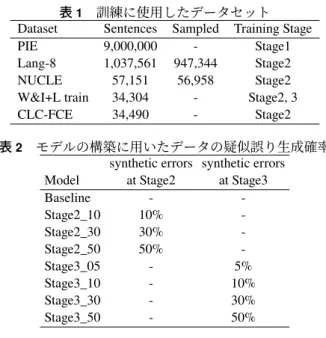
(Stage3)では誤りを含む文と含まない文の両方が用いられ る.各データセットのサイズと,それらが訓練のど の段階で用いられたかを表
1
に示す.4.3 実験設定
3
節で述べた疑似データ生成手法を用い,Stage2および
Stage3
で用いるデータに疑似誤りを生成した.実験は,Stage2のみで疑似データを用いる設
3) https://github.com/grammarly/gector
表
1
訓練に使用したデータセットDataset Sentences Sampled Training Stage
PIE 9,000,000 - Stage1
Lang-8 1,037,561 947,344 Stage2
NUCLE 57,151 56,958 Stage2
W&I+L train 34,304 - Stage2, 3
CLC-FCE 34,490 - Stage2
表
2
モデルの構築に用いたデータの疑似誤り生成確率synthetic errors synthetic errors
Model at Stage2 at Stage3
Baseline - -
Stage2_10 10% -
Stage2_30 30% -
Stage2_50 50% -
Stage3_05 - 5%
Stage3_10 - 10%
Stage3_30 - 30%
Stage3_50 - 50%
定と,Stage3のみで疑似データを用いる設定の
2
種 類 を 行 っ た.Stage2で の 疑 似 誤 り 生 成 確 率 は,𝑃 = ( 0 . 5 , 0 . 3 , 0 . 1 )
,Stage3では𝑃 = ( 0 . 5 , 0 . 3 , 0 . 1 , 0 . 05 )
とした.ベースラインには,疑似誤りを含まないデータで
2
回のfine-tune
を行ったモデルを用意した.構築したモデルの一覧とその構築のために用 いたデータの関係を表
2
に示す.モデルの性能は,ERRANT
により算出されるF
0.5 スコアにより評価した.W&I+L dev,
CoNLL-2013, CoNLL-2014, FCE test
のそれぞれに対し,訂正全体と接続詞訂正のF
0.5 スコアを算出した.4.4 実験結果
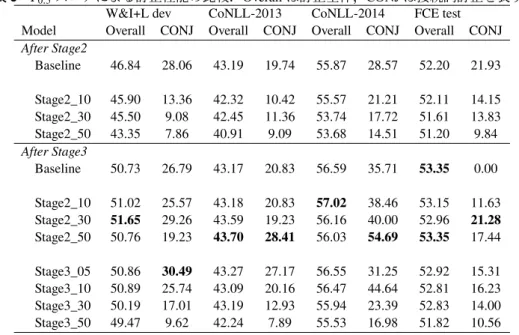
実験結果を表
3
に示す.Stage3後の接続詞訂正のF
0.5 スコアを比較すると,疑似データを導入するこ とで,接続詞訂正の性能が向上する場合と悪化する 場合の両方があることがわかる.また,CoNLL-2013
における接続詞訂正で最も高いスコア(28.41)を達 成したStage2_50
が,W&I+L devではベースライン よりスコアが悪化(26.79→ − 19.23)しているように,
接続詞訂正の性能がすべての評価セットでベースラ インより向上しているモデルは見られなかった.こ れらの結果から,訂正対象のデータに応じて疑似誤 り生成確率を適切に設定すれば,fine-tuneに用いる データに疑似誤りを導入する手法がモデルの訂正 性能向上に効果的であることが示唆される.Stage3 で疑似誤りを導入する場合は,比較的小さい疑似 誤り生成確率(W&I+Lと
CoNLL-2013: 𝑃 = 0 . 05,
CoNLL-2014
とFCE test: 𝑃 = 0 . 1)を設定したとき
に接続詞訂正のF
0.5スコアがベースラインから上昇しているのに対し,Stage2で疑似誤りを導入する場 合は,
𝑃 = 0 . 3
または𝑃 = 0 . 5
のように大きめの生成 確率を設定したときにスコアの上昇幅が大きくなっ ている.4.4.1
疑似データ導入タイミング各評価セットにおいて,接続詞訂正の
F
0.5 スコアが
Stage3
後に最も高くなっているのは,W&I+Ldev
を除いて,Stage2で疑似誤 りを導入したモ デ ルであった.CoNLL-2013とCoNLL-2014
において は,Stage2_50のスコア(28.41,54.69)が最も高く,FCE test
ではStage2_30
のスコア(21.28)が最も高 い.Stage2_30は,W&I+L devの接続詞訂正においても,
Stage3_05
に次ぐ2
番目に高いスコアを達成している.Stage3で疑似誤りを導入したモデルにも,
ベースラインと比較して訂正性能が向上したものが 存在するが,スコアの上昇幅は
Stage2
で疑似誤り を導入したモデルよりも小さくなっている.各評価 セットにおけるスコアの上昇幅の最大値を,疑似誤 りの導入タイミングで比較した結果を表4
に示す.これらの結果から,疑似誤りを含む学習者データで
fine-tune
を行った後,さらに疑似誤りを含まない学習者データで
fine-tune
するほうが,対象の誤りカテ ゴリに対する訂正性能が大きく改善する可能性があ ることが示唆される4).4.4.2
疑似データ導入の効果と影響表
3
よ り,Stage2 で 疑 似 デ ー タ を 導 入 す る と,Stage2
終了時点の接続詞訂正のF
0.5スコアはベースラインより低下することがわかる.このスコア変化 は,
Precision
が低下する一方で,Recall
が上昇するこ とによって引き起こされている.疑似誤り導入後の 接続詞訂正のPrecision
とRecall
の値を表5
に示す.疑似データを含まない学習者データで
fine-tune
した ときは(S2_base),PrecisionがRecall
より高くなっ ているのに対して,疑似データを導入するとRecall
のほうがPrecision
より高くなっている.Stage3に疑 似誤りを導入した場合でも,疑似誤りの生成確率が 高くなるにつれてPrecision
が低下する一方でRecall
が上昇する傾向がみられる.fine-tuneに用いるデー タへの疑似誤り導入はRecall
向上に効果があり,2 回のfine-tune
のうち1
回目の段階でRecall
を高めて おくことが,最終的な接続詞訂正性能の向上に寄与4) 訂正全体の F
0.5スコアへの影響を考慮していないことに注意が必要である.疑似データ導入による影響は
4.4.2
節で述べ る.表
3 F
0.5スコアによる訂正性能の比較.Overall
は訂正全体,CONJ
は接続詞訂正を表す.W&I+L dev CoNLL-2013 CoNLL-2014 FCE test Model Overall CONJ Overall CONJ Overall CONJ Overall CONJ After Stage2
Baseline 46.84 28.06 43.19 19.74 55.87 28.57 52.20 21.93
Stage2_10
45.90 13.36 42.32 10.42 55.57 21.21 52.11 14.15
Stage2_30 45.50 9.08 42.45 11.36 53.74 17.72 51.61 13.83
Stage2_50 43.35 7.86 40.91 9.09 53.68 14.51 51.20 9.84 After Stage3
Baseline
50.73 26.79 43.17 20.83 56.59 35.71 53.35 0.00
Stage2_10 51.02 25.57 43.18 20.83 57.02 38.46 53.15 11.63
Stage2_30 51.65 29.26 43.59 19.23 56.16 40.00 52.96 21.28
Stage2_50 50.76 19.23 43.70 28.41 56.03 54.69 53.35 17.44
Stage3_05
50.86 30.49 43.27 27.17 56.55 31.25 52.92 15.31
Stage3_1050.89 25.74 43.09 20.16 56.47 44.64 52.81 16.23
Stage3_30 50.19 17.01 43.19 12.93 55.94 23.39 52.83 14.00
Stage3_50 49.47 9.62 42.24 7.89 55.53 16.98 51.82 10.56
表
4
疑似誤り導入タイミングによる スコア上昇幅(最大値)の比較Stage2
で導入Stage3
で導入W&I+L dev 2.47 3.70
CoNLL-2013 7.58 6.34
CoNLL-2014 18.98 8.93
FCE test 21.28 16.23
表
5
接続詞訂正のPrecision
とRecall
の値.Stage2_XX
はStage2
終了後,Stage3_XX
はStage3
終了後の値である.W&I+L dev CoNLL-2013 CoNLL-2014 FCE test Pre. Rec. Pre. Rec. Pre. Rec. Pre. Rec.
S2_base 29.0 25.0 20.0 18.8 40.0 13.3 23.8 16.7 Stage2_10 11.5 38.6 8.9 31.3 18.9 41.2 12.5 30.0 Stage2_30 7.6 47.7 9.5 56.3 14.9 73.7 11.8 46.7 Stage2_50 6.5 52.3 7.6 50.0 12.2 65.0 8.3 40.0 S3_base 35.3 13.6 25.0 12.5 66.7 12.5 0.0 0.0 Stage3_05 33.3 22.7 26.3 31.3 37.5 18.8 17.7 10.0 Stage3_10 24.6 31.8 18.5 31.3 50.0 31.3 16.1 16.7 Stage3_30 14.7 45.5 11.1 37.5 21.1 42.1 12.7 23.3 Stage3_50 8.1 43.2 6.6 37.5 14.5 55.0 9.1 30.0
している可能性が考えられる.
また,CoNLL-2014における
Stage2_50
やFCE test
における
Stage2_30
のように,接続詞訂正の性能がベースラインより向上しているにも関わらず,訂正 全体の性能が悪化している場合も存在する.これ は,ある誤りカテゴリの疑似誤りを生成すること が,別の誤りカテゴリに関するモデルの学習に影響 を与えていることを示唆している.本実験では,接 続詞の余剰誤りを生成する手法が問題となった可能 性がある.余剰誤りを生成する対象の文は,接続詞 誤りが含まれていないことは保証されているが,そ れ以外の誤りの有無は確認していなかった.その文
のランダムな位置に接続詞が挿入されることで,も ともと存在していた誤りが変質してしまったことが 考えられる.
5 おわりに
本研究では,現状の
GEC
モデルで訂正性能が低 い接続詞誤りに着目し,fine-tune に用いる学習者 データに疑似誤りを追加することで,モデルの接続 詞誤りの訂正性能が向上するかを検証した.実験の 結果,生成する疑似誤りの割合を適切に設定すれ ば,fine-tuneに用いる学習者データに疑似誤りを追 加することで接続詞誤りのF
0.5スコアが向上するこ とがわかった.本研究では接続詞誤りについてのみ実験を行った ので,別の誤りカテゴリにおいても本手法が効果的 であるかを今後検証する必要がある.また,学習者 データにもともと存在する誤りに影響を与えないよ うな疑似データ生成手法の検討も必要である.例え ば,誤りが存在する区間には疑似誤りを生成しない ように制御する方法や,gold referenceの訂正を適用 後の文法的に正しい文に対して疑似誤りを生成する 方法などが考えられる.疑似誤りを
fine-tune
データ に導入することでモデルの訂正性能が向上できるこ とが確認されれば,特定のドメインや学習者集団の 特徴への適応が容易になることが期待される.謝辞
本研究の一部は
JSPS
科研費JP17H06101
の助成を 受けたものである.参考文献
[1] Shun Kiyono, Jun Suzuki, Masato Mita, Tomoya Mizu- moto, and Kentaro Inui. An empirical study of incorpo- rating pseudo data into grammatical error correction. In Proceedings of the 2019 Conference on Empirical Meth- ods in Natural Language Processing and the 9th Interna- tional Joint Conference on Natural Language Processing (EMNLP-IJCNLP), pp. 1236–1242, 2019.
[2] Yo Joong Choe, Jiyeon Ham, Kyubyong Park, and Yeoil Yoon. A neural grammatical error correction system built on better pre-training and sequential transfer learning. In Proceedings of the Fourteenth Workshop on Innovative Use of NLP for Building Educational Applications, pp.
213–227, 2019.
[3] Roman Grundkiewiczy, Marcin Junczys-Dowmuntz, and Kenneth Heafield. Neural grammatical error correction systems with unsupervised pre-training on synthetic data.
In Proceedings of the Fourteenth Workshop on Innovative Use of NLP for Building Educational Applications, pp.
252–263, 2019.
[4] Kostiantyn Omelianchuk, Vitaliy Atrasevych, Artem Chernodub, and Oleksandr Skurzhanskyi. GECToR – grammatical error correction: Tag, not rewrite. In Pro- ceedings of the Fifteenth Workshop on Innovative Use of NLP for Building Educational Applications, pp. 163–170, 2020.
[5] Rico Sennrich, Barry Haddow, and Alexandra Birch. Im- proving neural machine translation models with monolin- gual data. In Proceedings of the 54th Annual Meeting of the Association for Computational Linguistics (Volume 1:
Long Papers), pp. 86–96, 2016.
[6] Ziang Xie, Guillaume Genthial, Stanley Xie, Andrew Y.
Ng, and Dan Jurafsky. Noising and denoising natural lan- guage: Diverse backtranslation for grammar correction. In Proceedings of the 2018 Conference of the North American Chapter of the Association for Computational Linguistics:
Human Language Technologies, Volume 1 (Long Papers), pp. 619–628, 2018.
[7]
佐藤義貴,和田崇史,渡辺太郎,松本裕治.英語学習者 の母語を考慮した文法誤り訂正のための擬似データ 生成.
研究報告自然言語処理(NL), Vol. 2020-NL-246, No. 5, pp. 1–5, 2020.
[8] Wei Zhao, Liang Wang, Kewei Shen, Ruoyu Jia, and Jing- ming Liu. Improving grammatical error correction via pre-training a copy-augmented architecture with unlabeled data. In Proceedings of the 2019 Conference of the North American Chapter of the Association for Computational Linguistics: Human Language Technologies, Volume 1 (Long and Short Papers), pp. 156–165, 2019.
[9] Yujin Takahashi, Satoru Katsumata, and Mamoru Ko- machi. Grammatical error correction using pseudo learner corpus considering learner’s error tendency. In Proceed- ings of the 58th Annual Meeting of the Association for Computational Linguistics: Student Research Workshop, pp. 27–32, 2020.
[10] Maria Nădejde and Joel Tetreault. Personalizing gram- matical error correction: Adaptation to proficiency level
and L1. In Proceedings of the 5th Workshop on Noisy User-generated Text (W-NUT 2019), pp. 27–33, 2019.
[11] Christopher Bryant, Mariano Felice, and Ted Briscoe. Au- tomatic annotation and evaluation of error types for gram- matical error correction. In Proceedings of the 55th Annual Meeting of the Association for Computational Linguistics (Volume 1: Long Papers), pp. 793–805, 2017.
[12] Abhijeet Awasthi, Sunita Sarawagi, Rasna Goyal, Sabyasachi Ghosh, and Vihari Piratla. Parallel iterative edit models for local sequence transduction. In Proceed- ings of the 2019 Conference on Empirical Methods in Nat- ural Language Processing and the 9th International Joint Conference on Natural Language Processing (EMNLP- IJCNLP), pp. 4260–4270, 2019.
[13] Tomoya Mizumoto, Mamoru Komachi, Masaaki Nagata, and Yuji Matsumoto. Mining revision log of language learning SNS for automated Japanese error correction of second language learners. In Proceedings of 5th Interna- tional Joint Conference on Natural Language Processing, pp. 147–155, 2011.
[14] Daniel Dahlmeier, Hwee Tou Ng, and Siew Mei Wu. Build- ing a large annotated corpus of learner English: The NUS corpus of learner English. In Proceedings of the Eighth Workshop on Innovative Use of NLP for Building Educa- tional Applications, pp. 22–31, 2013.
[15] Christopher Bryant, Mariano Felice, Øistein E. Andersen, and Ted Briscoe. The BEA-2019 shared task on gram- matical error correction. In Proceedings of the Fourteenth Workshop on Innovative Use of NLP for Building Educa- tional Applications, pp. 52–75, 2019.
[16] Diane Nicholls. The Cambridge learner corpus - error cod- ing and analysis for lexicography and ELT. In Proceedings of the Corpus Linguistics 2003 conference, Vol. 16, pp.
572–581, 2003.
[17] Hwee Tou Ng, Siew Mei Wu, Yuanbin Wu, Christian Hadi- winoto, and Joel Tetreault. The CoNLL-2013 shared task on grammatical error correction. In Proceedings of the Seventeenth Conference on Computational Natural Lan- guage Learning: Shared Task, pp. 1–12, 2013.
[18] Hwee Tou Ng, Siew Mei Wu, Ted Briscoe, Christian Hadi- winoto, Raymond Hendy Susanto, and Christopher Bryant.
The CoNLL-2014 shared task on grammatical error cor- rection. In Proceedings of the Eighteenth Conference on Computational Natural Language Learning: Shared Task, pp. 1–14, 2014.
[19] Helen Yannakoudakis, Ted Briscoe, and Ben Medlock. A
new dataset and method for automatically grading ESOL
texts. In Proceedings of the 49th Annual Meeting of the
Association for Computational Linguistics: Human Lan-
guage Technologies, pp. 180–189, 2011.
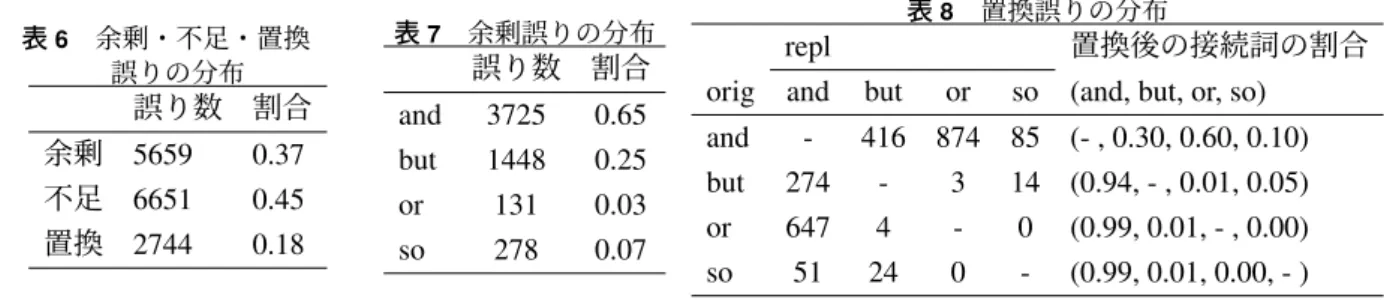
A 訓練データの接続詞誤り分布
訓練データ中で接続詞が用いられている文の数(
470,068
)に表6
の余剰誤りの割合をかけた値と,訓練データ中で接 続詞が用いられていない文の数(723,983)に不足・置換誤りの割合の和をかけた値の比から,接続詞が用いられていな い文に対する疑似誤り生成確率0.38
を得た.また,不足誤りと置換誤りの比7:3
も表6
から得た.余剰誤り生成のため に挿入する接続詞の割合と,置換誤り生成のための置換後の接続詞の割合は,それぞれ表7
,表8
から得た.表
6
余剰・不足・置換 誤りの分布誤り数 割合 余剰
5659 0.37
不足6651 0.45
置換2744 0.18
表
7
余剰誤りの分布 誤り数 割合and 3725 0.65 but 1448 0.25
or 131 0.03
so 278 0.07
表
8
置換誤りの分布repl
置換後の接続詞の割合orig and but or so (and, but, or, so)
and - 416 874 85 (- , 0.30, 0.60, 0.10) but 274 - 3 14 (0.94, - , 0.01, 0.05) or 647 4 - 0 (0.99, 0.01, - , 0.00) so 51 24 0 - (0.99, 0.01, 0.00, - )
B 事例分析
疑似データを用いたことによるモデル出力の変化を表
9
に示す.不足誤りと置換誤りについては,and
とor
が関わる 誤りにおいて疑似誤りを用いたモデルで改善が見られた.しかし,余剰誤りについては,あまり改善が見られなかった.改善が見られた誤りは,疑似データ生成の確率パラメータが大きく設定されているものである.多数の疑似誤りが生成 された誤りの訂正性能が高まる傾向は,[2]で報告されている結果と一致する.また,ベースラインでは正しく訂正でき ていたが疑似データを用いたモデルでは訂正に失敗した例,不必要な訂正をしてしまった例を表
10
に示す.表
9
疑似データを用いたことによるモデル出力の変化例Dataset Model Sentence
W&I+L dev original It was a dark night it was raining until a big ...
gold It was a dark night and it was raining when a big ...
baseline It was a dark night . It was raining when a big ...
Stage3_05 It was a dark night and it was raining until a big ...
CoNLL-2014 original They may set a bias on this person even abandon his or her .
gold They may discriminate against this person or even abandon him or her . baseline They may set a bias on this person , even abandon him or her . Stage2_30 They may set a bias on this person or even abandon him or her . Stage3_05 They may set a bias on this person and even abandon him or her . FCE test original If you have more questions about the conference and something else , ...
gold If you have more questions about the conference or anything else , ...
baseline If you have more questions about the conference and anything else , ...
Stage2_10 If you have more questions about the conference or anything else , ...
W&I+L dev original ... source of energy does n’t always maintain at the constant level , but someday it will be run out . gold ... source of energy does n’t always remain at a constant level , and someday it will run out . baseline ... source of energy does n’t always stay at a constant level , but someday it will run out . Stage2_30 ... source of energy does n’t always stay at a constant level , but someday it will run out . FCE test original I hope you will be happy with our conference and party and etc .
gold I hope you will be happy with our conference and party etc . baseline I hope you will be happy with our conference , party , etc . Stage2_30 I hope you will be happy with our conference and party , etc .
表