In a microwave sintering of ceramics, an improved sintering quality at shorter sintering time, with lower energy consumptions, at lower costs can be expected, as compared to a traditional sintering method. It is also expected that it leads to reduced environmental loads by decreasing the CO
2emission, leading to possible solutions for various problems of ceramics industries and environments.
Various kinds of products in small lots and a quick delivery system are required in the markets. Manufacturers have to tackle the development of the high value-added products and the high quality products.
These problems can be settled with the uniform and the rapid heating by the microwave sintering.
The possibility of the microwave gas hybrid kilns for the industrial manufacturing is verified in the practical trials of some ceramics productions. The way to the widespread use of the microwave gas hybrid kilns starts to be led.
Experiment
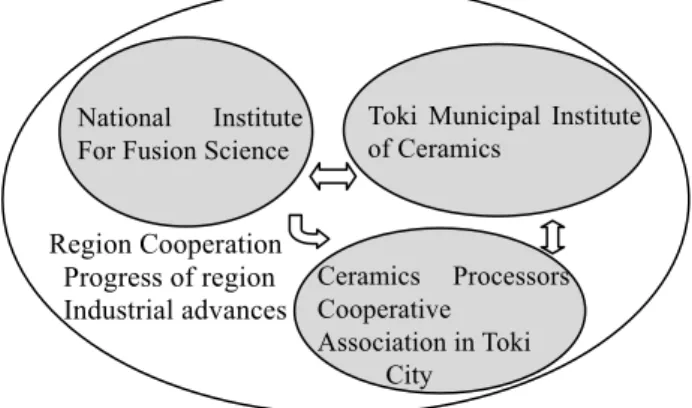
The practical trials were experimented with six microwave gas hybrid kilns which were set up at the Ceramics Processors Cooperative Association in Toki City.
(Fig.1) The practical trials are the estimation for durability of the microwave oscillation system, the insulator and cavity, usability of the kilns, trial productions, new product developments, extractions of improvements and measurements of consumption energy in various sintering patterns.
The questionnaire about the kilns to testers was had.The specifications of the microwave gas hybrid kiln are 10kW of its microwave power, 0.5m
3in an inner volume, permissible temperature1350 degrees Celsius in max. The basic sintering time has been set to 4 hours with the amount of contents that is 250kg in the kiln.
Results
The prototypes and the test pieces which are identical to the products were sintered 1842 times during Feb 2009–
Mar 2012. Properties of the most test pieces that sintered by microwave gas hybrid kilns are equally to the products was sintered with gas kilns by trails and errors.
The energy consumptions had been reduced from 20% to 50% than the gas kilns with the size of from 1 m
3to 7m
3with the microwave gas hybrid kiln. (Table1)
The electric power supply of the microwave oscillation broke down when it had been used for over 8200 hours. The durability of the microwave oscillation is identical with designed value of 8000 hours. The component replacement is possible. The cracks on the inner surface of the insulators by the thermal shrinkage were monitored over time. The durability of insulators depends on its configuration. The trouble of the thermocouples was improved by the configuration of the protection tube. The stirrer of the motor gears broke at Hida and Tokitsu by oil leaks. Some bolts of gear boxes were tightened stronger.
A Lifter and a rapid cooling system are created for working efficiency as requested.
The new products are developed with new 4 clays which are improved in terms of strength and water absorption with selective heating by microwave
as compared to conventional heating.
Practical application of microwave gas hybrid kilns is desired
according to the results of the questionnaire. Itrealizes decreasing in the CO
2emission, savings energy,
high-mix low-volume production in quick delivery,development of new products,
improvements in the work environment. The durability research and sintering in the diversified test pieces are kept on
to become practical.
Fig. 1. The system of
cooperative study National InstituteFor Fusion Science Toki Municipal Institute of Ceramics
Ceramics Processors Cooperative
Association in Toki City
Region Cooperation Progress of region Industrial advances