• 検索結果がありません。

The usefulness of arch pads for people with floating toe: the effects of three different arch pads on the toes

N/A
N/A
Protected

Academic year: 2021

シェア "The usefulness of arch pads for people with floating toe: the effects of three different arch pads on the toes"

Copied!
7
0
0

読み込み中.... (全文を見る)

全文

(1)

Abstract

This study examined the usefulness of arch pads as a conservative treatment for floating toe.

The subjects were 21 female junior high school students with floating toe and no diseases of the foot. The floating toes were toes 4 and 5. Arch pads were placed in the regulation indoor school shoes, and the results examined. The use of arch pads improved floating toe in the static upright posture. During walking, there were significant increases in the load on the toes, walking speed, and stride length. Lateral longitudinal arch pads caused toes 4 and 5 to bend. These findings suggest that inserting an insole into the shoes of people with floating toe increases the load on the toes, thus improving floating toe and giving better gait motion. Furthermore, lateral longitudinal arch pads are useful for people with floating toe involving toes 4 and 5.

Introduction

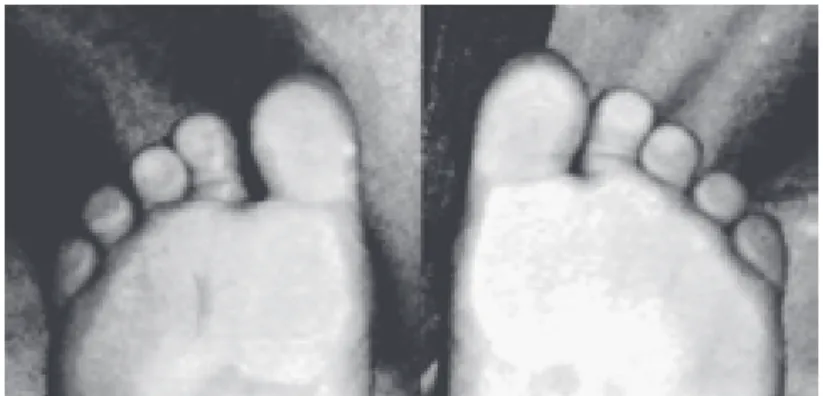
The toes are both sensory and effector organs, and they play an important role in maintaining posture and in ensuring stability during movement [1,3]. A recent increase in floating toe, in which the toes do not make contact with the ground when standing or during walking (Figure 1), has

been reported [4,5]. Floating toe occurs irrespective of age or sex, and there have been suggestions that, as well as causing decreased motor performance, it may also be linked to accidents and diseases of the foot. To date, there have been various studies of floating toe that have examined cause of onset, physical function, methods of evaluation, and treatment methods [3- 13]. We previously showed that insoles aimed at the toe flexor tendons are useful in improving floating toe. However, the effects of the insoles have not been separated to show which arch the insoles are acting on to bring about improvement in floating toe. The aim of the present study was to investigate the effects of different types of arch pad on the toes.

Materials and Methods (1) Subjects

Forty-two feet of 21 female junior high school students (age, 14 ± 0.6 years; weight, 46.2 ± 3.2 kg; foot length 24 ± 0.8 cm) showing floating toe with no diseases of the foot were studied.

(2) Arch pad specifications

Medial longitudinal arch pads, transverse arch pads, and lateral longitudinal arch pads were constructed using EVA (ethylene-vinyl acetate) as Key words: arch pads, floating toe, lateral longitudinal arch pads, plantar pressure, walking

Received: 19 January 2014/ Accepted: 22 October 2014

Corresponding author: Masanori Abe

Tabeya 44-2, Kuroiwa, Fukushima-shi, Fukushima, 960-8153, Japan

E-mail: [email protected]

(2)

the base material. The dimensions of the arch pads were as follows:

1. Medial longitudinal arch pads (Figure 2) Height 6, 8, 10, 12 mm; length 10 cm; width 5.5 cm

2. Transverse arch pads (Figure 2)

Height 3, 5, 7 mm; length 6 cm; width 5 cm 3. Lateral longitudinal arch pads (Figure 2) Height 3 mm; length 5.5 cm; width 3 cm (3) Methods

1) Static upright posture

The subjects were required to stand barefoot on a pidoscope (a device for photographing the soles of the feet, Figure 3) with the feet parallel and 10 cm apart, and to gaze steadily at a target at eye level 2 m to the front. While subjects were in this position, the soles of the feet and rear of the lower legs were photographed using a digital camera.

Using the images from the pidoscope, the floating toe score for all 10 toes was evaluated according to the method of Yahagi et al. [6]: a clear image of the toe was scored as 2 points for contact with the ground, an indistinct image of the toe was scored as 1 point, and no image of the toe was scored as 0 points, giving a maximum possible score of 20 points (Figure 3). Floating toe was taken as a total score of 10 or less, or a score of 0 for at least one toe even if the total was 11 or more.

Subjects with floating toe were fitted with arch pads to the soles of the feet, and the floating toe score was determined. The following six

conditions were used for the experiment:

1. No arch pad (no pad)

2. Medial longitudinal arch pad (height: 6, 8, Figure 1. Floating toe

Figure 2. Arch pads

The broken line shows a medial longitudinal arch pad, the solid line shows a transverse arch pad, and the dotted line shows a lateral longitudinal arch pad.

Figure 3. Floating toe score

(3)

2) Determination of appropriate arch pad height Medial longitudinal and transverse arch pads of different heights were fitted to the soles of the feet. Subjects were examined on the pidoscope to determine whether floating toe had disappeared, and the appropriate arch height was determined from the results. The lateral longitudinal arch pad was 3 mm.

3) Gait analysis

Both groups wore the regulation indoor school shoes. The various arch pads were stuck to the soles of the feet, and measurements were taken.

The arch pads used for gait analysis were pads of the size determined by static upright posture.

Load on the toes was measured using the F-Scan plantar pressure distribution measurement system (version 5.23, Nitta Corporation, Osaka, Japan). Stride length and walking speed during 10 m free walking were also measured. The experimental conditions were as follows:

1. No pad

2. Medial longitudinal arch pad (medial) 3. Biaxial arch pad (biaxial)

4. Triaxial arch pad (triaxial)

Results

(1) Static upright posture

Toes 4 and 5 were observed to be floating toes.

1) Medial longitudinal arch pad (Table 1)

Compared to no pads, the floating toe score was significantly greater with 10-mm arch pads (p

< 0.01). Floating toe disappeared in 10 subjects with 8-mm pads and 16 subjects with 10-mm and 12-mm pads. The floating toe score was significantly greater with 10-mm pads than with 8-mm pads (p < 0.01).

2) Transverse arch pads (Table 2)

Compared to no pads, the floating toe score was significantly greater with 5-mm arch pads (p

< 0.01). Floating toe disappeared in 12 subjects with both 5- and 7-mm pads; there was no significant difference between 5- and 7-mm pads.

3) Lateral longitudinal arch pads (Fig. 4)

Floating toe disappeared in all 21 subjects with 3-mm pads, and the floating toe score was significantly greater than with no pads (p < 0.01).

(2) Gait analysis

Using the results from the static upright posture, the height of the arch pads was: medial

Table 1. Static upright posture results (medial longitudinal arch pad height)

6 mm 8 mm 10 mm 12 mm

Floating toe score ns p < 0.05 p < 0.01 p < 0.01

Table 2. Static upright posture results (transverse arch pad height)

3 mm 5 mm 7 mm

Floating toe score ns p < 0.01 p < 0.01

(4)

longitudinal arch pad, 10 mm; transverse arch pad, 5 mm; and lateral longitudinal arch pad, 3 mm.

1) Load (F-Scan)

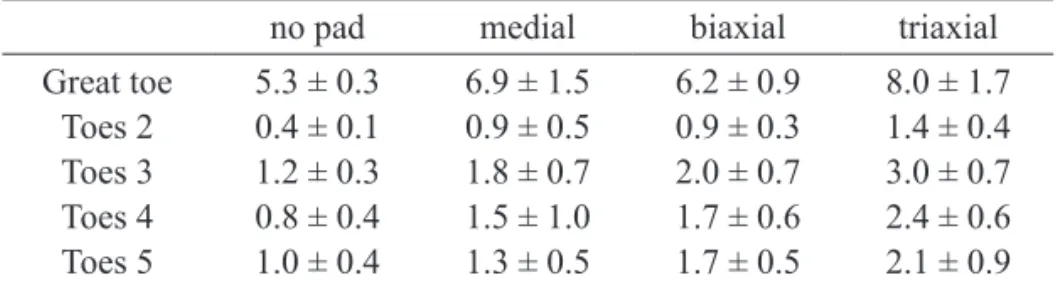
With no pads, toes 4 and 5 made contact with the ground during walking. However, with medial, biaxial, and triaxial pads, the load on all toes was significantly greater than with no pads (p

< 0.01, Table 3, Table 4, Figure 5).

2) Walking speed and stride length

With triaxial pads, walking speed (p < 0.05) and stride length (p < 0.01) were significantly greater than with no pads (Table 5). No significant differences were found between the other conditions.

Discussion

Wearing arch pads caused the toes to bend, so that floating toe disappeared. This resulted in greater load on the toes, with increased walking speed and stride length. It has previously been

reported that people with floating toe have smaller load on the toes and smaller foot pressure trajectory, making it difficult for them to transfer the center of gravity forward during walking [14].

The present results suggest that the use of arch pads by people with floating toe causes the floating toe to disappear and load on the toes to increase, thus helping the forward transfer of the center of gravity and improving walking capacity.

Furthermore, the results for static upright posture indicate that floating toe in toes 4 and 5 disappeared in all subjects only with lateral longitudinal arch pads, from which it may be conjectured that lateral longitudinal arch pads are effective in making toes 4 and 5 bend.

The likely reason for the disappearance of

floating toe is that the medial longitudinal arch

pad reduces calcaneus valgus and subtalar joint

pronation and prevents the extensor hallucis

longus muscle and the extensor digitorum longus

muscles from dorsally flexing the foot. At the

Figure 4. Changes in toe ground contact (left, no pads; right, lateral longitudinal arch pad)

(5)

same time, the alignment of the foot is restored so that the flexor and extensor tendons of the foot are kept at the appropriate tension. In addition, the transverse arch pad raises the transverse arch from its lowered condition, thus applying the appropriate tension to the toe flexor tendons so that the toes make contact with the ground. The

medial longitudinal arch pad and the transverse arch pad assist the abductor hallucis muscle and the flexor hallucis longus muscle, while the lateral longitudinal arch pad assists the abductor digiti minimi muscles and the peroneus brevis muscle [15]. In this way, the use of arch pads by people with floating toe causes bending of the toes, leading to disappearance of floating toe and increased load on the toes. In addition, the great toe has the function of providing support, while toes 2-5 act to return the center of gravity to the center of the body [16]. From this, it may be conjectured that the effect of toes 4 and 5 making contact with the ground is to improve the action of returning the center of gravity from outward during stance phase, helping to guide it toward the great toe. As a result, the load on the great toe increases.

Both walking speed and stride length increased with use of arch pads. A prior study suggested that medial longitudinal, transverse, and lateral longitudinal arch pads assist the muscle groups of the sole of the foot, thus reducing outward sway during the stance phase and helping to guide the Table 4. Statistical analysis of results for load on the toes (kg)

no pad-

medial no pad-

biaxial no pad-

triaxial medial-

biaxial medial-

triaxial biaxial-

triaxial

Great toe * * ** ns ** **

Toes 2 * ** ** ns ** **

Toes 3 * ** ** * ** **

Toes 4 ** ** ** * ** **

Toes 5 * ** ** ** ** **

p < 0.05 = * p < 0.01 =**

Figure 5. Changes in plantar pressure (left, no

pads; right, triaxial arch pads)

(6)

weight toward the great toe, so that propulsive power is increased [15]. In the present study, it appears that the function of the toes improved and propulsive power increased as the load on the toes increased due to arch pad use, leading to greater walking speed and longer stride length.

The present study showed that arch pads are useful for correcting floating toe, and the load on the toes showed significant increases as follows:

medial longitudinal > no pads, biaxial > medial longitudinal, and triaxial > biaxial. This suggests that the effect of arch pads increases as a result of interaction between the different pads. In addition, improved floating toe, increased load on the toes, and significantly increased walking capacity were seen in all subjects as a result of wearing lateral longitudinal arch pads. The effectiveness of arch pads on floating toe therefore differs greatly depending on whether lateral longitudinal arch pads are worn, so that lateral longitudinal arch pads appear to be necessary for improving floating toe.

The relationship between floating toe and deformity or disease of the foot has not been clarified, but as floating toe creates imbalance in the alignment of the feet, possible associations may be conjectured with onset of foot deformities such as flat feet, metatarsus latus, pes cavus, and hallux valgus, as well as shin splints or iliotibial band syndrome. Hallux valgus makes it difficult for the great toe to support the load from the body, so that the load may become concentrated on the head of the metatarsal. The load on the toe is also small with floating toe, so the same tendency is probably present. Furthermore, an increase in load leads to a reduced arch in the foot, thereby leading to flat feet. This suggests

that, since the use of arch pads to correct floating toe distributes pressure across the plantar surface and increases the load on the toes, it may give protection against the onset of disorders or callus formation.

Since the height and width of arch pads differ according to the length of the foot, further studies are needed to examine in detail the best height and width for different foot sizes. There is also a need for studies that continuously examine the feet of people with floating toe, in order to examine the relationships with other foot disorders and the improvement of floating toe by arch pads.

Conclusion

Wearing arch pads improved foot alignment and walking function in people with floating toe, resulting in an increase in the stable base of support during standing and increased propulsive power during walking. Lateral longitudinal arch pads were the most effective for floating toe affecting toes 4 and 5.

Acknowledgements

We would like to thank Kikuchi Yoshihiro, President of Touhoku Prosthetic and Orthotic Co., Ltd., Noda Iron Works, Co., Ltd., Azuma Takeshi, Principal of Fukushima Municipal Fourth Junior High School, and the numerous teachers and subjects who helped with the study.

References

1. Hasegawa M, Kanai S, Sakaguchi A, Ishikura T, Jinnouchi M, Oki S, et al. The Effect on gait of the lack of ground connection by the toes in standing. Journal Table 5. Gait analysis results

no pad triaxial significance

Walking speed (km/h) 3.7 ± 0.4 3.9 ± 0.4 p < 0.05

Stride length (m) 0.61 ± 0.07 0.66 ± 0.07 p < 0.01

(7)

Association. 2002; 29(7): 250-254. (in Japanese)

4. Harada S. A study on physical structures of preschool children’s feet compared between 1980 and 2000. Kutsuno igaku. 2001; 15:

14-18. (in Japanese)

5. Uchida T, Fujiwara K, Takaoka A.

Measurement of foot configuration of kindergartner (the forth report). Kutsuno igaku. 2002; 16: 96-99. (in Japanese)

6. Yahagi T, Nemoto K, Fukuyama K. Utilizing a zouri to treat a floating toes and ease low back pain. Kutsuno igaku. 2004; 18: 65-71.

(in Japanese)

7. Inoue F, Asai C, Kumaki M, Ishizuka C, Fujiwara H. Floating toes and life style in elementary school children. Bulletin of Kyoto University of Education. 2009; 114:

11-18. (in Japanese)

8. Tuneya M, Usui N. Actual state of toe contact in the upright position among healthy adults. The journal of Japanese Physical Therapy Association. 2006; 33(1):

30-37. (in Japanese)

9. Yamashita K, Nomoto Y, Umezawa J, Miyagawa H, Ino S, Ifukube T. Enhancement of physical functions for falling prevention through care of abnormal feet and nailson the elderly. Bulletin of Tokyo Healthcare University. 2005; 1: 1-7. (in Japanese) 10. Friend G. Correction of latrogenic floating

toe following resection of the proximal phalanx. Clin Podiat Med Surg. 1986; 3: 57- 64

11. Lawrence B R, Papier M J. lmplant

JA, Gruber F, Ritschl P, Trnka HJ. The weil osteotomy a seven year follow up. The Bone

& Joint Journal. 2005; 87(11): 1507-1512.

14. Hasegawa M, Shimatani K, Kanai S, Oki S, Shimizu M, Muguruma A, et al. The effect on gait of the lack of ground connection by the toes in standing. Rigakuryoho kagaku.

2010; 25(3): 437-441. (in Japanese)

15. Oyama T, Yokoo H, Nagayama R, Uchida T, Sasaki K. Change in gait by outer longitudinal arch pad. Kutsuno igaku. 2005;

19(2): 37-40. (in Japanese)

16. Kabe N, Kurosawa K, Nishida Y, Kishida A, Tanaka T, Makisako H, et al. The study of relationship between toe and dynamic postural control. Rigakuryoho kagaku. 2002;

17: 199-204. (in Japanese)

Figure 2. Arch pads
Table 2. Static upright posture results (transverse arch pad height)
Figure 5. Changes in plantar pressure (left, no  pads; right, triaxial arch pads)

参照

関連したドキュメント

The inclusion of the cell shedding mechanism leads to modification of the boundary conditions employed in the model of Ward and King (199910) and it will be

It is suggested by our method that most of the quadratic algebras for all St¨ ackel equivalence classes of 3D second order quantum superintegrable systems on conformally flat

Keywords: continuous time random walk, Brownian motion, collision time, skew Young tableaux, tandem queue.. AMS 2000 Subject Classification: Primary:

Answering a question of de la Harpe and Bridson in the Kourovka Notebook, we build the explicit embeddings of the additive group of rational numbers Q in a finitely generated group

Then it follows immediately from a suitable version of “Hensel’s Lemma” [cf., e.g., the argument of [4], Lemma 2.1] that S may be obtained, as the notation suggests, as the m A

In our previous paper [Ban1], we explicitly calculated the p-adic polylogarithm sheaf on the projective line minus three points, and calculated its specializa- tions to the d-th

Our method of proof can also be used to recover the rational homotopy of L K(2) S 0 as well as the chromatic splitting conjecture at primes p &gt; 3 [16]; we only need to use the

Classical definitions of locally complete intersection (l.c.i.) homomor- phisms of commutative rings are limited to maps that are essentially of finite type, or flat.. The