The Solution to the Feldstein-Horioka Puzzle
Charles Yuji Horioka
Asian Growth Research Institute; National Bureau of Economic Research; and Institute of
Social and Economic Research, Osaka University and
Nicholas Ford
Wolfson College, University of Cambridge
Working Paper Series Vol. 2017-17 October 2017
The views expressed in this publication are those of the author(s) and do not necessarily reflect those of the Institute.
No part of this article may be used reproduced in any manner whatsoever without written permission except in the case of brief quotations embodied in articles and reviews. For information, please write to the Institute.
Asian Growth Research Institute
The Solution to the Feldstein-Horioka Puzzle*
Charles Yuji Horioka**
Asian Growth Research Institute; National Bureau of Economic Research; and Institute of Social and Economic Research, Osaka University
and Nicholas Ford
Wolfson College, University of Cambridge
November 2017
Abstract
The purpose of this paper is to set out a surprisingly simple solution to the Feldstein-Horioka Puzzle or Paradox, which is that even though global financial markets appear to be integrated, levels of saving and investment are correlated across countries because financial markets cannot, by themselves, achieve net transfers of financial capital. This is because net transfers of financial capital require the integration not only of financial markets but also of goods markets and because there are substantial frictions in goods markets (e.g., transport, marketing, and distribution costs, technical standards, certification procedures, tariffs and non- tariff barriers, etc.).
Keywords: Capital flows, capital mobility, capital transfers, Feldstein-Horioka Paradox, Feldstein-Horioka Puzzle, financial market integration, goods market integration, interest rate parity, international capital flows, international capital mobility, investment, net capital transfers, Niehans model, real interest rate parity, saving, saving-investment correlations, trade frictions Journal of Economic Literature Classification Codes: F15, F21, F32, F36, G15
*We are grateful to Chris Dillow and Eric Brown for their very helpful comments and discussions. This work was sponsored by JSPS (Japan Society for the Promotion of Science) KAKENHI Grant Number 15H01950, an Asian Growth Research Institute project grant, and a grant from the MEXT Joint Usage / Research Center at the Institute of Social and Economic Research, Osaka University.
**Corresponding author: Charles Yuji Horioka, Asian Growth Research Institute, 11-4,
Ohtemachi, Kokurakita-ku, Kitakyushu, Fukuoka 803-0814, JAPAN. Telephone: +81-(0)93-
583-6202. Facsimile: +81-(0)93-583-6576. Email: [email protected]
1. Introduction
The so-called Feldstein-Horioka Puzzle or Paradox, which was first framed in 1980 (Feldstein and Horioka, 1980) and which Obstfeld and Rogoff (2000) included in the “Six Major Puzzles in Macroeconomics” in 2000, asks why levels of saving and investment are correlated across countries even though global financial markets appear to be integrated, allowing capital to be perfectly mobile across countries. This can be called a puzzle because, if capital is perfectly mobile across countries, one might expect that saving and investment should not be correlated across countries and that saving should flow to wherever the best investment opportunities are.
A large number of studies have been written that have attempted to resolve the Feldstein- Horioka Puzzle (see Apergis and Tsoumas, 2009, for an excellent survey), but we believe that the solution to this puzzle is, in fact, quite straightforward. The purpose of this paper is to set out a surprisingly simple solution to the puzzle, which is that even though global financial markets appear to be integrated, levels of saving and investment are correlated across countries because financial markets cannot, by themselves, achieve net transfers of financial capital. This is because net transfers of financial capital require the integration not only of financial markets but also of goods markets and because there are substantial frictions in goods markets (e.g., transport, marketing, and distribution costs, technical standards, certification procedures, tariffs and non-tariff barriers, etc.).
The key points in the argument are as follows:
(1) It is necessary to clearly differentiate between (a) an individual making a transfer of his or her financial capital between countries, and (b) a net transfer of financial capital between countries occurring.
(2) All international financial transactions have counterparties. The international financial system cannot ‘by itself’ (as opposed to ‘in conjunction with the goods market’) make net transfers of financial capital between countries because the transfer of financial capital by any agent between countries is always netted off to zero by the transfer of financial capital of the counterparty in the opposite direction.
(3) A net transfer of capital between countries can occur only if a party in one country (say, country A) buys a financial asset in another country (say, country B), and the ultimate counterparty uses those funds to buy goods in country A and import them to country B. This means that the net transfer of financial capital will be impeded by frictions in international goods markets (see Obstfeld and Rogoff, 2000, and Ford and Horioka, 2017a). Consequently, we should not be surprised that financial capital is mostly deployed where it is generated and that saving and investment are strongly correlated across countries.
(4) Finally, it is helpful to clarify the impacts of certain international financial transactions. At
times in the literature, the impression is given that the international financial system is, by itself,
making net transfers of financial capital between countries, or in some ill-defined way, having
the equivalent effect of making net transfers of capital between countries, when in fact it is not
capable of doing so. By clarifying what is happening in certain situations, we hope to dispel
the notion that somehow international financial markets, by themselves, are making net
transfers of capital between countries.
The remainder of the paper is organized as follows: In section 2, we elaborate on each of these points in turn in order to resolve the longstanding Feldstein-Horioka Puzzle. In section 3, we demonstrate that the conclusions we reach in section 2 regarding the Feldstein-Horioka findings and the gradual equalisation of interest rates can be supported by a relatively simple real model which incorporates the insights of Niehans (1986) and Obstfeld and Rogoff (2000) and in which the determination of the real interest rate is grounded in economic theory. Section 4 is a brief concluding section.
2. The Basic Argument
2.1. The Difference between Capital Mobility for an Individual and for the System as a Whole
Suppose that an agent such as one Mr. Smith sells a financial asset in the US, exchanges his dollars for yen, and uses the yen to buy Japanese equities.
1If commissions are low, he might justifiably regard his capital as being ‘perfectly mobile’ between the US and Japan. Yet for the financial system to allow Mr. Smith to move his capital in this way, it must find a counterparty for Mr. Smith’s transaction. When Mr. Smith sold his dollars to buy yen there had to be counterparty who sold yen and bought dollars. Let us suppose that this was one Ms. Tanaka, who used the dollars to buy a US government bond. In doing so, this counterparty – Ms.
Tanaka – moved her capital in the opposite direction, from Japan to the US.
This capital transfer of the counterparty Ms. Tanaka cancels out the original capital transfer of Mr. Smith. Individuals might reasonably regard capital as being ‘perfectly mobile’ because they can move their own capital with ‘perfect mobility,’ but it can be seen that, in terms of net transfers of capital, far from causing capital to be ‘perfectly mobile,’ the financial system, by itself, is not capable of making the net transfer of even a single dollar of financial capital between countries because every transfer an individual makes is cancelled out by the offsetting transfer of the counterparty. As a consequence, we should not expect international financial markets, by themselves, to make net transfers of saving from one country to another – international financial markets, by themselves, simply cannot do this.
Once it is appreciated that international financial markets cannot, by themselves, make net transfers of capital between countries, the Feldstein-Horioka Puzzle melts away. We no longer expect international financial markets to be able to divert the saving of one country to be invested in another country because they cannot, by themselves, make net transfers of capital between countries.
The implications for economic modelling are profound. If international financial markets, by
themselves, cannot make net transfers of financial capital between countries, they cannot, by
themselves, even in the absence of risk premiums, instantly equalise real interest rates across
countries either. This means that there should be no place for an automatic world interest rate
r* in economic modelling. Instead, the implication is that we should regard the world as being
comprised of a number of countries or regions, each with its own local real interest rate r,
which is determined by local supply and demand conditions for loans.
2.2. Net Transfers of Financial and Real Capital between Countries 2.2.1. How Net Transfers of Financial Capital Occur between Countries
Ford and Horioka (2017a) explain in detail how net transfers of financial capital between countries arise. A summarised version is as follows.
A net transfer of financial capital between countries can occur only when a party from one country buys a foreign asset but the counterparty to that transaction uses the funds to import goods from the first country. In this case, the transfer of financial capital by the first party is not netted off by a transfer of financial capital in the reverse direction.
For example, suppose that the aforementioned Mr. Smith sells his US government bond, uses the dollars to buy yen, and uses the yen to buy Japanese equities. There has been a transfer of financial capital from the US to Japan. Suppose that the counterparty to the foreign exchange transaction, Ms. Tanaka, sells yen to Mr. Smith for dollars, then uses the dollars to buy a stock of Superman comics, which she imports to Japan. There has now been a net transfer of financial capital from the US to Japan because there is no offsetting transfer of financial capital from Japan to the US, as there was in the example in subsection 2.1. Further, there has been a transfer of real capital from the US to Japan in the form of a stock of Superman comics.
It is a short step from here to an appreciation of the fact that the aggregate net transfer of financial capital from one country to another is given by the aggregate of the trade transactions in both directions (which is consistent with the absolute magnitude of the capital account balance being equal to the absolute magnitude of the current account balance). Thus, we might appreciate that trade transactions (and an imbalance in these) are necessary to permit the net transfer of financial capital between countries. Further, we can appreciate that financial capital (and real capital) can be transferred between countries only at a limited rate, this being the rate at which a trade imbalance is occurring.
2.2.2. How Financial Markets and Goods Markets Combine to Effect Net Transfers of Financial and Real Capital between Countries
Suppose that the economic prospects of Japan improved suddenly and that interest rates in Japan rose with little or no warning because of an increased demand for loans. US investors might seek to sell US financial assets, buy yen for dollars, and use the yen to buy Japanese financial assets to take advantage of the higher interest rates in Japan. They can succeed in doing so only if they can find counterparties for these transactions. In attempting to do so, they will instantly bid up the value of the yen compared with the dollar until either counterparties come forward or the US investors no longer wish to proceed with the transactions. However, no net transfer of financial capital can instantly take place between the countries because every transfer will be netted off by the counterparty’s transfer in the opposite direction.
In the longer run, however, the high price of the yen will make US goods more attractive in
Japan and Japanese goods less attractive in the US. Although subject to lags, this will
eventually affect the trade balance between the countries, and this change in the balance of
trade will precipitate a change in the rate of net transfer of real and financial capital between
the two countries.
Thus, we can see that a net transfer of real and financial capital requires the interaction of both international financial markets and goods markets, is gradual in its effects, and is limited to the rate at which a trade imbalance occurs.
2.3. A Clarification of the Impacts of International Financial Transactions
If the international financial system were capable of costlessly making net transfers of financial capital between countries, we might reasonably expect real interest rates in all countries to be continuously equalised. In practise, this is not the case (see, for example, Mishkin, 1984, and Chung and Crowder, 2004). We believe that this is because, as repeatedly stated here, the international financial system, by itself, is not in fact capable of making net transfers of capital and because the net transfer of capital between countries depends upon the interactions of financial markets and goods markets and thus is subject to frictions and lags. We believe that we have demonstrated, unequivocally, in subsection 2.2 why this is the case by reasoning from first principles.
However, the international economics literature has often given the impression that the international financial system, by itself, can make net transfers of financial capital between countries, or in some ill-defined way, engage in transactions that have the equivalent effect of making net transfers of capital between countries. If a reader believes that this is the case, he or she may have difficulty accepting the proposition that the international financial system cannot by itself make net transfers of financial capital between countries. We therefore discuss a number of issues with the aim of eliminating reservations that impede the acceptance of this fundamental proposition and its implications.
2.3.1. The Cause of the Absence of Significant Arbitrage Opportunities in International Financial Markets
If interest rates are different across countries, an investor might attempt to profit from this difference. However, she has to take into account not only the interest rate differential between countries but also any potential loss or gain she might incur from exchange rate movements.
Alternatively, she might eliminate the exchange rate risk by entering into a forward exchange rate contract, but then she must factor in the difference between the spot and forward exchange rates into her calculation of profit. Investigations have shown that the opportunities to profit from such interest rate differentials are either small or non-existent when exchange rate movements are taken into account. Economists have sometimes concluded that this is evidence that the net movement of financial capital between countries have altered interest rates to eliminate such profit opportunities (see, for example, Feldstein and Horioka, 1980, pp.
315, and Dornbusch, 1976). However, there is an alternative explanation for the absence of
profit opportunities, this being that financial markets have priced spot and forward currencies
such that such profit opportunities are eliminated. Indeed, we argue that the continuous
repricing of exchange rates provides the correct explanation for how international financial
markets are able to eliminate the opportunity to profit from interest rate differentials. This
explanation is consistent with the proposition that the international financial market, by itself,
is unable to effect net transfers of capital between countries.
The corollary of this is that arbitrage in international financial markets does not equalise real interest rates across countries, as is often supposed (see Dornbusch, 1976). Instead, this arbitrage largely changes exchange rates, which adjust until either expected future exchange rate movements or the risk of future exchange rate losses, or a combination of these, offsets the potential profit available from interest rate differentials.
2.3.2. The Implications for r* in Economic Modelling
Suppose, in a simplified economic model, that there are two countries, country A which has an interest rate r, and a second country B which has a real interest rate r* that is lower than r.
Suppose that the exchange rate is allowed to freely float. In each country, the interest rate is determined by the supply of, and demand for, loans.
Suppose that an agent in country A borrows in country B to take advantage of the lower interest rate r*. In order to repatriate the funds she has borrowed, she must find a counterparty in country A who is willing to buy the foreign currency she has borrowed. As a consequence, there is no net increase in the supply of loans in country A because the counterparty has used his funds to buy a foreign asset instead of lending domestically.
Further, the agent will find that, in addition to paying interest of r*, she is faced with either exchange rate risk and expected exchange rate losses or gains or a hedging cost if she eliminates this risk. This brings her effective borrowing cost back up to r. Thus, international financial markets cannot, by themselves, instantaneously equalise interest rates across countries at some rate r*, as is commonly supposed, even in a simplified economic model.
It is only by the net transfer of real resources from country B to country A that the supply of loans in country A will increase and r will be affected. Such a transfer is subject to lags and frictions, which inhibit r from rapidly converging to r*.
2.3.3. The Impacts on Asset Pricing of International Investors with Different Portfolio Preferences to Home Investors
Consider a simplified model in which a country A has an interest rate r and there are no risk premiums. The interest rate can be regarded as the price of loans. Under such circumstances, if the interest rate r changed, we might reasonably conclude that there has been a change in the supply of, or demand for, loans. Because most economists are familiar with such a simple model, they associate a change in r with a change in the supply of loans, which we might alternatively describe as the supply of financial capital.
When we move back from this model to the real world, we must re-introduce risk premiums when discussing the returns on a variety of financial assets such as equities, corporate bonds, government bonds, etc. The interest rate on a particular asset class can change not only as the result of a change in the aggregate supply of loans and/or the aggregate demand for loans but also as a result of a change in risk premiums.
Consider again the impact of Mr. Smith selling, say, a US government bond, buying yen, and
using the yen to buy Japanese equities. Suppose his counterparty Ms. Tanaka sells a
Japanese corporate bond for yen, sells the yen to Mr. Smith for dollars, and uses the dollars
to buy a US government bond.
These transactions cannot be completed without the participation of other counterparties in Japan, who must buy Ms. Tanaka’s corporate bond and sell Japanese equities. We can see that the impact may be potentially to alter Japanese equity prices and Japanese corporate bond prices.
An outside observer might notice that, as a result of these transactions, the price of a Japanese corporate bond has changed--i.e., that there has been a change in a particular Japanese interest rate. He may be tempted to conclude that this implies that there has been a change in the aggregate supply of loans in Japan and that international financial markets have changed the supply of financial capital in Japan. Yet what has happened as a result of these transactions is not a change in the aggregate supply of financial capital but a change in the appetite for risk among Japanese asset holders (Mr. Smith replacing Ms. Tanaka) and a change in risk premiums.
Once this is appreciated, it becomes clearer that a change in the prices of local financial assets is not necessarily an indication of a net transfer of financial capital in or out of a country, and it is possible to understand (a) how the behaviour of foreign investors may alter specific asset prices in a country without any net transfer of financial capital taking place and (b) that such asset price changes do not nullify the proposition that international financial markets cannot by themselves make net transfers of capital between countries. We believe that it is appropriate to describe these as ‘secondary’ effects on the spectrum of interest rates, compared with the primary driver, which is the supply of, and demand for, loans.
2.4. Three Stock Market Analogies
The points of subsections 2.2 and 2.3 can perhaps be usefully illustrated by way of analogies to the stock market and to the transfer of capital between companies.
2.4.1. The Analogy regarding Capital Mobility
When an agent decides she wishes to put her financial capital into a company, she can do so by buying the stock of that company. Of course, she can do so only by finding a counterparty who is prepared to sell the stock of that company. As a consequence of these stock market transactions, there is obviously no net transfer of capital into the company.
If commissions are low, the agent might regard her financial capital as being perfectly mobile between companies. But this is very different from net transfers of either real or financial capital occurring between companies with perfect mobility. If more capital is to be deployed in a company it must increase its external financing (i.e., increase its issuance of stock or increase its net borrowings) and use this capital to purchase additional plant and equipment.
The rate at which it can do this is subject to lags and frictions – capital is clearly not perfectly mobile between companies in the sense of net transfers of capital occurring between companies without delay or cost.
We hope the analogy is clear. Financial markets allow an agent’s capital to be ‘perfectly mobile’
between companies, just as they allow an agent’s capital to be ‘perfectly mobile’ between
countries. However, these transactions in financial markets cannot, by themselves, achieve
any net transfer of capital between companies, just as they cannot achieve any net transfers of capital between countries.
2.4.2. The Analogy between the Mechanisms of ‘Arbitrage’
Suppose that a company experiences an increase in its profits and hence an increase in the internal rate of return it earns on its capital invested in plant and machinery. This makes the stock of the company more attractive to investors. When this information becomes public, agents may seek to buy the stock of that company. This will cause the price of the stock of that company to increase. There can, of course, be no net transfer of capital into the company through this process because for any agent to purchase the stock, there must be a counterparty who transfers their capital out of the company by selling the stock. The price of the stock will increase until the market judges that expected future returns match those of other stocks. Clearly, because there is no net transfer of real or financial capital into the company as a result of these transactions and because the company’s profits and its internal rate of return are not affected by these transactions, the mechanism through which profit opportunities are instantly eliminated is wholly by repricing the stock: it does not involve any instantaneous net transfer of real and financial capital into the company that alters its internal rate of return.
Similarly, suppose that a country A experiences an unexpected upturn in its economy, and the central bank raises interest rates to a new level. This makes bonds in country A more attractive to foreign investors, who may seek to buy them. However, for this to happen, domestic counterparties must sell bonds to allow foreign investors to buy. The supply of loans will be unchanged by these transactions, and the central bank will leave the interest rate at the new level. Any profit opportunity is eliminated by the market repricing the currency of country A until holding the bonds of that country is no longer attractive to foreign investors; it does not involve any instantaneous net transfer of real and financial capital that alters local interest rates.
2.4.3. The Analogy between the Equalisation of Internal Rates of Return across Companies and of Interest Rates across Countries
If an industry enjoys an uplift in its internal rate of return due, for example, to an increase in demand for its products, a gradual process involving the net transfer of real and financial capital into companies in the industry will usually occur. Companies in the industry will raise financing by borrowing and issuing equity and use the funds to buy more plant and equipment.
The additional financial and real capital deployed in the industry will gradually depress returns back to market averages.
Similarly, if the real interest rate of a country rises above those of its neighbors due, for
example, to an improvement in its economic prospects, agents will bid up the value of its
currency. This will induce a trade deficit, and hence an inflow of real and financial capital into
the country. This additional financial and real capital deployed in the country will gradually
depress the interest rate back towards those of other countries.
2.5. The Classical Dichotomy Re-asserts Itself
According to the classical dichotomy, the financial side of the economy should reflect the real side of the economy. Thus, financial capital and real capital are not independent but are a reflection of each other, or to use a different analogy, they are ‘two sides of the same coin.’
According to the classical dichotomy, net flows of financial capital should correspond to net flows of real capital. It is therefore also consistent with the paradigm that net flows of financial capital are restricted by the same frictions that inhibit the transfer of real capital between countries, such as transport, marketing, and distribution costs, technical standards, certification procedures, tariffs and non-tariff barriers, etc. Similarly, net transfers of real capital between countries are inhibited by frictions in financial markets such as foreign exchange controls (see Ford and Horioka, 2017a).
The classical dichotomy implies that the same results and conclusions that we have drawn from the above discussions featuring financial markets should also be reached from a consideration of just real variables. In section 3, we demonstrate that this is the case.
3. A Real Model to Explain the Feldstein-Horioka Findings – A Synthesis of Niehans and Obstfeld-Rogoff
When modelling the international economy, it is frequently assumed that all markets are perfectly competitive, agents have perfect foresight, and there are zero risk premiums. Under such circumstances, there has been a common assumption for many decades that a small country will take the world real interest rate r* as given (see, for example, Obstfeld and Rogoff, 1996). Yet in closed economy macroeconomic modelling, under the same circumstances of perfect competition, perfect foresight, and zero risk premiums, it is generally assumed that the real interest rate r in a country should be given by the marginal productivity of capital (MPK), dY/dK. This inconsistency means that closed economy macroeconomic theory and international macroeconomic theory are not truly cohesive. By instead assuming that countries
‘take’ the world interest rate r* as given, without a clear theoretical explanation of how this should come about, the vast majority of modelling and discourse regarding international economics simply ignores this inconsistency.
Niehans (1986), however, was aware of this inconsistency and put forward a model to try to explain the workings of the international economy that is consistent with both suppositions of how the interest rate is determined. Although Niehans’ model has shortcomings, we believe it represents an undervalued step forward and provides some very useful insights. By synthesising Niehans’ model with the insight of Obstfeld and Rogoff (2000) regarding transport costs, we believe that it is possible to create a new model that can both resolve the contradiction regarding the determination of the interest rate, make sense of the Feldstein- Horioka findings, and possibly provide further insight into other recognised puzzles in international economics.
To this end, we first set out a version of Niehans’ model.
3.1. Niehans’ Model
Niehans (1986) considers the interaction of two similarly sized countries, A and B. All markets are perfectly competitive and agents have perfect foresight. He supposes that the countries have a common interest rate r*, half way between the two MPK’s. (Niehans argues elsewhere in his 1986 book that arbitrage in financial markets must equalise the real interest rate across countries and carries this assumption over into his real model.) Country A has a larger capital stock K
Aand a smaller MPK
Athan country B (K
B, MPK
B). Each country produces the same single consumption good C and is able to produce the same single capital good K. Neither country engages in net new saving or dissaving. There are no economies of scale. There is no comparative advantage. Agents are free to own capital goods located in the other country.
The existing stocks of the capital good cannot be transferred between countries because it is assumed that the costs of transport and re-installation are prohibitive. However, it is assumed that the consumption good can be transferred between the two countries without cost.
Thus, for both countries A and B,
(1) and
(2) Moreover, MPK declines as additional capital is added so that
0 (3) Niehans describes the operation of his model as follows:
If the owners of the capital good in country A could move it between countries, they would instantly move a quantity to country B to take advantage of the higher returns, and in so doing would equalise MPK’s in the two countries to the common interest rate r*. However, it has been specified that this direct movement of the capital good is prohibited. Instead, a net transfer of capital between the countries occurs indirectly and gradually.
In country B, agents will recognise that the MPK on installed capital goods exceeds the interest rate r*. They will therefore bid up its price PriceK
B(measured in the consumption good) above the replacement cost price. As a consequence, additional units of the capital good will be produced and installed in country B. Resources will be diverted from the production of the consumption good in order to produce these additional units of the capital good. Consumption will be unchanged so a corresponding quantity of the consumption good will be brought in from country A to replace that which is no longer being produced in country B. By contrast, agents in country A will value the existing capital good (PriceK
A) below its replacement price.
Consequently, agents in country A will dis-invest from capital goods. As they wear out, they
will no longer be fully replaced. Resources that were being used to make replacement capital
goods will be put to use making additional consumption goods. Consumption in country A will
also be unchanged so the surplus consumption goods will be sent to country B. Thus, capital
will be transferred from country A to country B as a flow of the consumption good. Agents in
country A who dis-invested from capital goods in that country will accumulate ownership
claims against the additional capital goods that are installed in country B.
Niehans posits in his model that the friction that is preventing the rapid equalisation of MPK’s is a version of the explanation of Tobin’s Q (see Mussa, 1977). Compared with simply replacing their worn-out assets, firms that expand (or contract) their stock of capital face additional extraordinary installation costs over and above the cost of the capital goods themselves. It is supposed that these additional costs increase with the rate at which additional capital is installed. This limits the rate at which firms can install new capital goods.
This capital transfer process is shown schematically in Fig. 1:
It is supposed that the additional extraordinary cost of installing a unit of capital is given by the standard ‘Tobin’s Q’ formula so that:
. (4) Hence,
1 . (5) is the cost of newly installed capital goods, as measured in the consumption good, where units are such that Cost K = 1 when the local capital stock is static. q is an appropriate constant.
Because markets are perfectly competitive, firms will install capital at a rate such that the cost of installed capital is driven up to the price of installed capital so that
Fig. 1: Niehans' Model
Country A Country B
Restrictions on capital flows final levels
starting levels
(6) Substituting PriceK
Bfor CostK
Band re-arranging equation 5 yields:
1 (7) Similar relationships apply in the case of the disinvestment of capital in country A.
However, suppose, as a first approximation, that the impact of the losses due to extraordinary installation costs on the total quantity of capital can be ignored so that the flow of capital as measured in the consumption good can be equated to the reduction in the capital stock of country A and the increase in the capital stock of country B:
≅ ≅ (8)
Attracted by the high MPK in country B, agents will bid up the price of assets in country B above their replacement price even though they know that the price of these assets and their MPK will fall in the future because additional capital assets will be installed in country B in the future. Because markets are perfectly competitive and because these agents have perfect foresight, they will bid up the price of assets by just the correct amount such that the temporary benefit of the higher MPK is just offset by the future fall in the price of the assets, and similarly in country A. Hence,
∗
(9)
∗
(10)
If a functional form is assumed for Y=F(K) and values are assigned to the constants, the equations can be solved numerically, and to a first order of approximation, the price of capital assets, stocks of capital, and MPK’s in the two countries will follow the typical paths shown in Figs. 2, 3, and 4 below.
20.4
0.6 0.8 1 1.2 1.4
1 2 3 4 5 6 7 8 9 10 11 12
Fig. 2: Price of Capital Assets/Book Value
Country
B
Country
A
0.4 0.6 0.8 1 1.2 1.4
1 2 3 4 5 6 7 8 9 10 11 12
Fig. 3: Stocks of Capital/ Final StocksCountry
A
Country
B
The graphs demonstrate the gradual equalisation of MPK’s at r* and of capital stocks in the two countries. The ‘trade deficit’ of country B is initially a positive value, as country B imports the consumption good from country A to allow it to accumulate additional capital goods.
Eventually, this flow of consumption goods reverses direction, as agents in country A repatriate the earnings on the capital goods they own in country B.
3.1.1. Discussion
Because the consumption good can be moved costlessly between countries, the model can be seen to be self-consistent in asserting that the real interest rate is the same in both countries at r*. A loan in the form of consumption goods could be made in one country and the goods transported to the other country. It would not be possible to charge different interest rates to borrow or lend the consumption good in the two countries because costless arbitrage would eliminate such differences. Niehans reconciles the MPK’s being different from r* by invoking changes in the price of installed capital goods and by there being a ‘Tobin’s Q’ friction that prevents the rapid redeployment of capital and the equalisation of MPK’s.
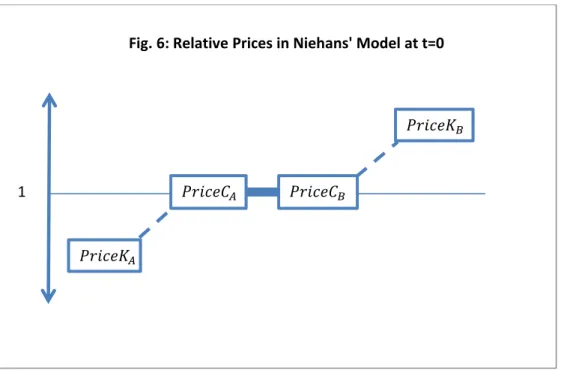
The initial relative prices of capital and consumption goods in Niehans’ model are illustrated in Fig. 6:
1 2 3 4 5 6 7 8 9 10 11 12
Fig. 4: MPK'sCountry B
Country A
r*
‐0.05 0 0.05 0.1 0.15 0.2
1 2 3 4 5 6 7 8 9 10 11 12
Fig. 5: Trade Deficit in Country BThe price of the consumption good in the two countries is locked at the same level because the good can be transferred without cost between the two countries, and with perfect competition, arbitrage instantly eliminates any price difference. By contrast, the price of capital goods (in terms of the consumption good) can deviate from its equilibrium level of 1 because of the frictions involved in turning the consumption good into the capital good and vice versa.
We particularly identify the following positive qualities of Niehans’ model:
1. It addresses the issue that the local real interest rate should be related to the local marginal productivity of capital.
2. It suggests that countries that have high capital stocks should have trade surpluses and that countries with low capital stocks should have trade deficits. This is consistent with the empirical data: Japan and Germany have for several decades had high saving rates, high capital stocks, and trade surpluses, whereas the UK and the US have had lower saving rates, lower capital stocks, and trade deficits.
3. It demonstrates that identical assets can be valued differently from one another by virtue of their location and that real frictions prevent the rapid movement of real capital between countries.
However, on the downside, the model has the following weaknesses:
1. The friction that is assumed to exist with respect to the movement of capital seems implausible compared to reality. In particular, the observed lengthy persistence of trade imbalances seems to be at odds with what might be expected to be a transient Tobin’s Q phenomenon.
2. The model does not help with any of Obstfeld and Rogoff’s (2000) ‘Six Major Puzzles in Macroeconomics.’ In particular, it cannot explain the Feldstein-Horioka findings. This can be
1
Fig. 6: Relative Prices in Niehans' Model at t=0
most easily recognised by considering the situation in the model when capital stocks have been equalised. Suppose that some additional saving occurred in one of the countries.
According to Niehans’ model, half of that saving would be deployed in one country and half in the other as there is no friction regarding the net transfer of capital between the two countries;
there is only friction regarding the deployment of capital within countries. As a consequence, saving and investment would be wholly uncorrelated – in stark contrast to Feldstein and Horioka’s empirical findings (see Fig.7 below).
1. It does not fit with empirical observations that real interest rates are different across countries (see, for example, Mishkin, 1984, and Chung and Crowder, 2004).
3.2. The Synthesised Model
We suggest that, if two modifications are made to Niehans’ model, its positive qualities can be retained while its principal weaknesses can be addressed.
The first modification is to set aside the ungrounded assumption of Niehans that the interest rate must be r* in each country and to replace it with the alternative assumption that, with zero risk premiums and perfect foresight, arbitrage operates via the real exchange rate. The second modification concerns the nature of the friction that constrains the rate at which capital is transferred between countries. In their NBER paper, Obstfeld and Rogoff (2000) suggest that it is ‘transport costs’ between countries that are responsible for the ‘Six Major Puzzles in Macroeconomics.’ (By ‘transport costs,’ Obstfeld and Rogoff mean the additional cost of
Fig. 7: Deployment of New Saving in Niehans' Model
Country A Country B
Equal restriction to flow of capital in each country
Injection
of new saving
supplying goods to a foreign market compared with the domestic market, which includes transport costs, tariffs and nontariff barriers, costs of compliance with technical standards, additional marketing costs, etc.). We can replace the Tobin’s Q friction in Niehans’ model with this friction of transporting goods between countries.
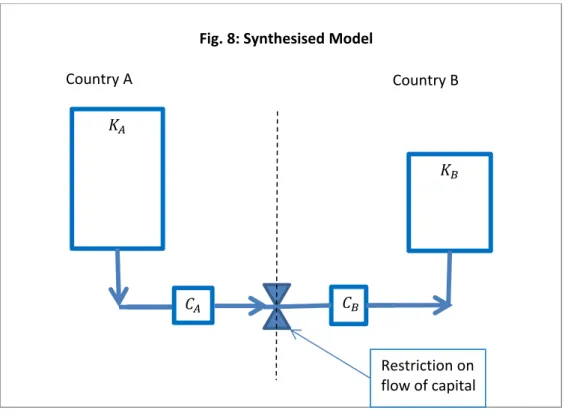
Consider then a model very similar to that of Niehans described above, where again, country A initially has a higher capital stock and a lower MPK than country B. As before, it is assumed that existing capital goods cannot be transported between the two countries. However, suppose (a) that there is no ‘Tobin’s Q’ effect and that consumption goods can be converted to capital goods without cost, and (b) that instead there is a per unit cost to transferring the consumption good between countries and that this per unit cost increases with the rate at which the consumption good is transferred. We call this new model the Synthesised Model.
As described below, forces again cause capital to move between the two countries as a flow of the consumption good and cause capital stocks to eventually equalise. Schematically, the Synthesised Model can be represented as in Fig. 8:
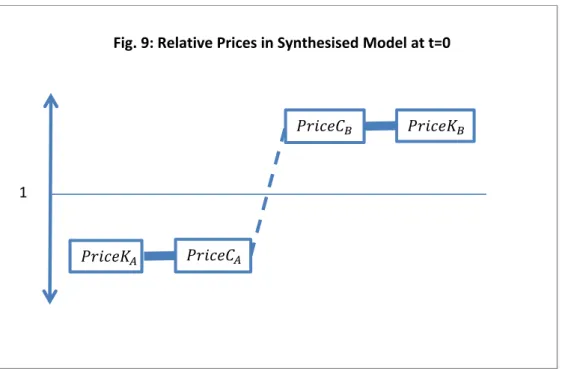
Although the model is on the face of it very similar to Niehans’ model, some important differences emerge. The capital good in country B is, as before, initially more valuable than the identical capital good in country A because it has a higher yield. However, since the consumption good in each country can be converted to the local capital good without cost, their prices must be tied to the local capital good, so identical consumption goods located in different countries must also differ in relative value. This is shown schematically in Fig. 9:
Fig. 8: Synthesised Model
Country A Country B
Restriction on
flow of capital
With no Tobin’s Q friction, the interest rate r in each country must be the same as the local MPK, which means that initially the interest rate in each country is different. This is consistent with there being frictions to the movement of the consumption good between countries: if a quantity of the consumption good is borrowed in the other country, repatriated, then later, a quantity is sent back to repay the loan, the borrower is faced with transport costs as well as interest. As a consequence, the arbitrage mechanism that kept the interest rate the same in both countries in Niehans’ model no longer applies.
The mechanism of the Synthesised Model can be described as follows:
As before, agents are free to own foreign assets. When agents in country A observe that capital goods in country B offer a higher return than those in country A, they will attempt to buy them, offering either title to capital goods or consumption goods located in country A as payment. This will drive up the price of both the capital good and the consumption good located in country B, as denominated in the capital good or consumption good located in country A.
That the consumption good commands a higher price in country B than in country A will create an incentive to transport it from country A to country B, and a flow of the consumption good will commence between the two countries. However, as this flow of the consumption good increases, the unit transport cost will increase. With perfect competition, the flow of the consumption good will increase until the unit transport cost reaches a point where it just eliminates the profit opportunity afforded by the price difference.
There will now be a flow of the consumption good from country A to country B. The level of consumption will remain the same in country A. In order to make up for the additional consumption goods being exported, resources will be diverted from producing capital goods to replace those that have worn out to producing consumption goods, and the capital stock in country A will be allowed to fall. In country B, there will now be a supply of additional
1
Fig. 9: Relative Prices in Synthesised Model at t=0
resources that were being used to produce consumption goods in country B will be diverted to the production of additional capital goods, and the capital stock of country B will increase.
Thus, indirectly, capital will be transferred from country A to country B.
Suppose that the price of either good located in country B, as denominated in units of either good located in country A, is Z. This ‘Z’ amounts to the real exchange rate--i.e., the rate at which the title to goods in one country is exchanged for the title to goods located in the other country.
Agents with perfect foresight in country A will bid up the price of goods in country B until the expected fall in the price offsets the interest rate difference, which is the same as the difference in MPK--i.e., until
1 ≅ (11)
or 1 ≅ (12)
This is, of course, a version of the uncovered interest parity equation.
Unit transport costs TC depend upon the flow of capital in the form of consumption goods between the countries. As a first approximation, we ignore the impact of the losses to the capital stock arising from transport costs so that
≅ ≅ (13)
Consequently, we can express unit transport costs TC as being proportional to the flow of consumption goods:
(14)
where k is an appropriate constant.
As previously stated, arbitrage means that the price of goods in country B must be the same as the price of goods in country A plus transport costs. Hence,
1 (15)
Re-arranging yields:
1 (16)
Equation (15) implies that the trade deficit or surplus (i.e., the flow of consumption goods
between the countries) is proportional to the deviation of the exchange rate from the
purchasing power parity value, which corresponds to Z=1.
As before, if functional forms are assumed for F(K), appropriate values are assumed for the constants, and starting values are assumed for K
Arelative to K
B, equations (1), (2), (3), (10) to (15), etc., can be solved numerically to give the paths of the variables.
3Typical paths are as follows:
These results are, at first sight, very similar to Niehans’ model but there are important differences.
1. Firstly, there is no rapid equalisation of real interest rates across countries, which is consistent with the findings of Mishkin (1984) and Chung and Crowder (2004).
2. The Synthesised Model does explain the Feldstein-Horioka findings. Consider the equilibrium situation when real interest rates and capital stocks have equalised. Suppose there is then a one off period where saving is non-zero in one of the countries. The model predicts that nearly all of this saving will be deployed as additional investment in the country where it occurs (see Fig. 14). This is because there is no friction to inhibit saving from being turned into capital goods within each country, but there is friction to prevent it from being sent to the other country. Only afterwards, and gradually, will the new additional capital stock be spread across the two countries.
1 2 3 4 5 6 7 8 9 10 11 12
Fig. 10: MPK's = Interest Rates
Country B
Country A
0.4 0.9 1.4
1 2 3 4 5 6 7 8 9 10 11 12
Fig. 11: Stocks of Capital
Country A
Country B
‐0.05 0 0.05 0.1 0.15 0.2
1 2 3 4 5 6 7 8 9 10 11 12
Fig. 12: Trade Deficit in Country B
0.85 0.9 0.95 1 1.05 1.1 1.15 1.2
1 2 3 4 5 6 7 8 9 10 11 12
Fig. 13: Real Exchange Rate, Z
The explanation this model provides for the Feldstein-Horioka findings is very straightforward:
trade frictions directly inhibit the transfer of real capital between countries. As discussed in Part 1, they therefore also prevent the net transfer of financial capital between countries, which in the Synthesised Model corresponds to the net accumulation of ownership of foreign capital goods.
3. The Synthesised Model potentially opens up possible solutions to some of the other ‘Six Major Puzzles in Macroeconomics’ of Obstfeld and Rogoff (2000). The model provides an explanation for why an exchange rate can deviate from PPP for a prolonged period – as part of a mechanism to transfer capital between countries – and hence provides a potential explanation for the PPP puzzle (see Ford and Horioka, 2017b).
4. Conclusion
In section 2 of this paper, we provided a surprisingly simple solution to the Feldstein-Horioka Puzzle. We argued that levels of saving and investment are correlated across countries even though global financial markets appear to be integrated because financial markets cannot, by themselves, achieve net transfers of financial capital. This is because net transfers of financial capital require the integration not only of financial markets but also of goods markets and because there are substantial frictions in goods markets (e.g., transport, marketing, and distribution costs, technical standards, certification procedures, tariffs and non-tariff barriers, etc.).
In section 3 of the paper, we present a model that we believe resolves inconsistencies in modelling the determination of interest rates across countries that is consistent with the
Fig. 14: New Saving Deployment in Synthesised Model
Country A Country B
Restriction prevents immediate flow of saving to country B
Country A Country B
Country A Country B
Injection
of new saving
conclusions of section 2 and that also explains the Feldstein-Horioka findings. As in section 2, it is frictions in goods markets which explain the Feldstein-Horioka findings.
Let us note in closing that there is empirical evidence suggesting that our explanation of the Feldstein-Horioka Puzzle is the correct one. For example, Eaton, Kortum, and Neiman (2016) find that the puzzle is greatly attenuated if trade frictions are assumed not to exist. Our explanation also implies that real interest rates should not be equalised across countries, which is also strongly supported by empirical evidence (see, for example, Mishkin, 1984, and Chung and Crowder, 2004).
Note, moreover, that the same explanation has the potential to resolve the Purchasing Power
Parity (PPP) Puzzle (Ford and Horioka, 2017b) and the Exchange Rate Disconnect Puzzle
(Horioka and Ford, 2017), which Obstfeld and Rogoff (2000) also include among their “Six
Major Puzzles in Macroeconomics.”
References
Apergis, Nicholas, and Tsoumas, Chris (2009), “A Survey of the Feldstein-Horioka Puzzle:
What Has Been Done and Where We Stand,” Research in Economics , vol. 63, no. 2 (June), pp. 64-76.
Chung, S. Young, and Crowder, William J. (2004), “Why Are Real Interest Rates Not Equalized Internationally?” Southern Economic Journal , vol. 71, no. 2 (October), pp. 441-458.
Dornbusch, Rudiger (1976), “Expectations and Exchange Rate Dynamics,” Journal of Political Economy , vol. 84, no. 6 (December), pp. 1161-1176
Eaton, Jonathan; Kortum, Samuel S.; and Neiman, Brent (2016), “Obstfeld and Rogoff’s International Macro Puzzles: A Quantitative Assessment,” Journal of Economic Dynamics and Control , vol. 72 (November), pp. 5-23.
Feldstein, Martin S., and Horioka, Charles Yuji (1980), “Domestic Saving and International Capital Flows,” Economic Journal , vol. 90, no. 358 (June), pp. 314-329.
Ford, Nicholas (2015), “A Solution to the Feldstein-Horioka Puzzle, and an Exchange Rate Model that Works,” mimeo., Wolfson College, University of Cambridge, Cambridge, U.K.
Ford, Nicholas, and Horioka, Charles Yuji (2017a), “The ‘Real’ Explanation of the Feldstein- Horioka Puzzle,” Applied Economics Letters , vol. 24, no. 2 (February), pp. 95-97.
Ford, Nicholas, and Horioka, Charles Yuji (2017b), “The ‘Real’ Explanation of the PPP Puzzle,”
Applied Economics Letters , vol. 24, no. 5 (March), pp. 325-328.
Horioka, Charles Yuji, and Ford, Nicholas (2017), “A Possible Explanation of the ‘Exchange Rate Disconnect Puzzle’: A Common Solution to Three Macroeconomic Puzzles,” Applied Economics Letters , vol. 24, no. 13 (September), pp. 918-922.
Mishkin, Frederic S. (1984), “Are Real Interest Rates Equal across Countries: An Empirical Investigation of International Parity Conditions,” Journal of Finance , vol. 39, no. 5 (December), pp. 1345-1357.
Mussa, Michael (1977), “External and Internal Adjustment Costs and the Theory of Aggregate and Firm Investment,” Economica, vol. 44, no. 174 (May), 163-178.
Niehans, Jurg (1986), International Monetary Economics. Baltimore, Maryland, USA: Johns
Hopkins University Press.
Obstfeld, Maurice, and Rogoff, Kenneth (1996), Foundations of International Macroeconomics . Cambridge, Massachusetts, USA: MIT Press.
Obstfeld, Maurice, and Rogoff, Kenneth (2000), “The Six Major Puzzles in Macroeconomics:
Is There a Common Cause?” in Ben S. Bernanke and Kenneth Rogoff, eds., NBER Macroeconomics Annual 2000 , vol. 15 (Cambridge, Massachusetts, USA: MIT Press), pp.
339-412.
Endnotes
1
The issue is most easily understood in a freely floating exchange rate regime, as discussed here. In a fixed regime or a single currency regime, the story is more complicated, but it can be shown that the conclusions are the same (see Ford, 2015).
2 To be precise, we also need to set up a number of equations that describe the effects of the division of the capital stock of country B into two parts--the part owned by residents of country B and the part owned by residents of country A. We have followed Niehans (1986) in not setting this out in detail, but Ford (2015) does so.
3 Endnote 2 applies here as well.